
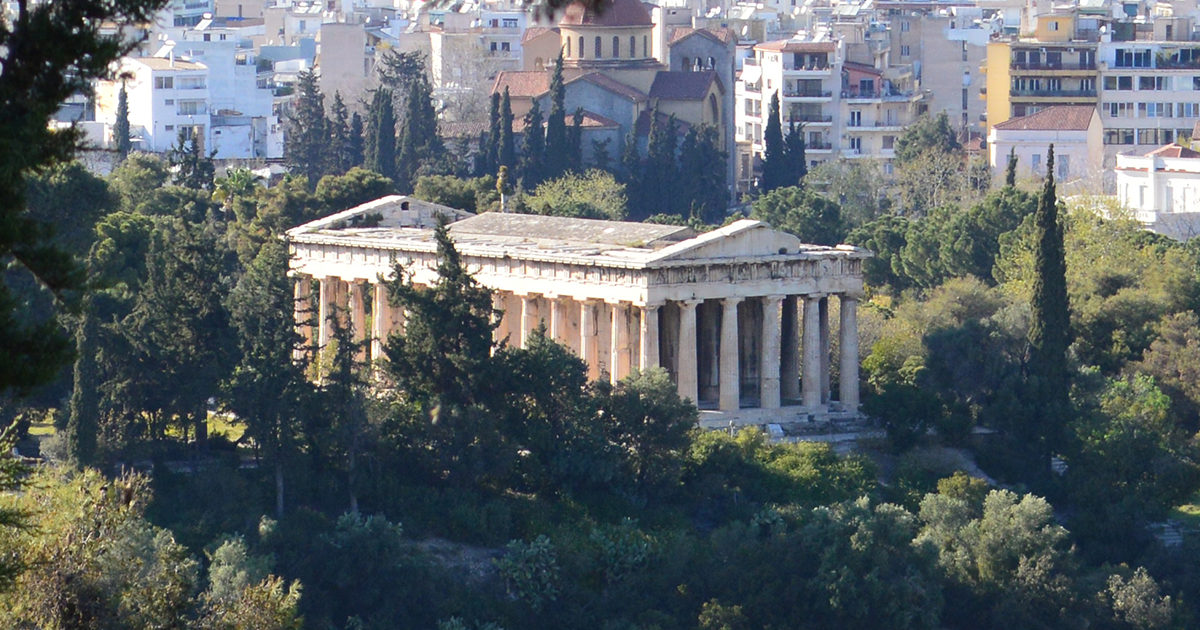
Walk through Athens today and you’ll find temples reduced to scattered column drums, sanctuaries marked only by foundation stones, and monuments that require imagination to reconstruct. Then you’ll climb a low hill northwest of the ancient marketplace, and suddenly you’re facing something startling: a complete Greek temple. Roof intact. All columns standing. Walls unbroken. The marble glowing honey-gold in Mediterranean light.
This is the Temple of Hephaestus, and it shouldn’t exist.
It was built 2,400 years ago, during the same decades that produced the Parthenon. It’s dedicated to a lame god rejected by his divine family. It sat in Athens’s industrial quarter, surrounded by the clanging hammers of bronze-workers and the smoke of pottery kilns. And through 24 centuries of wars, earthquakes, religious transformations, and systematic looting of ancient monuments for building materials, this temple survived virtually complete.
The God Who Wasn’t Supposed to Matter
Before we can understand the temple, we need to understand who Hephaestus was. Because in the hierarchy of Olympian gods, this deity occupied the bottom rung.
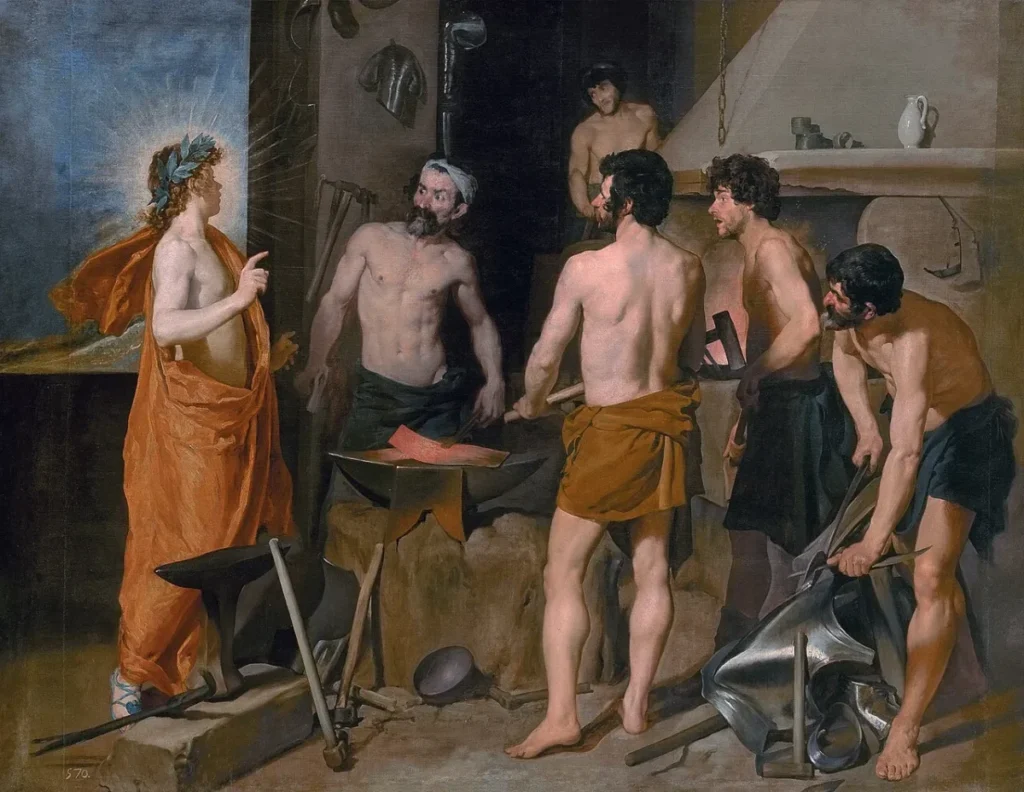
Zeus threw thunderbolts. Athena embodied wisdom and warfare. Apollo radiated divine beauty and prophetic power. And Hephaestus? He was born lame, cast from Mount Olympus because his mother Hera couldn’t bear looking at his twisted foot. Some myths say she threw him out herself. Others claim Zeus did it later, during a family argument. Either way, the divine blacksmith spent his childhood in exile, raised by sea nymphs in an underwater cave, learning his craft far from the perfect, gleaming gods above.
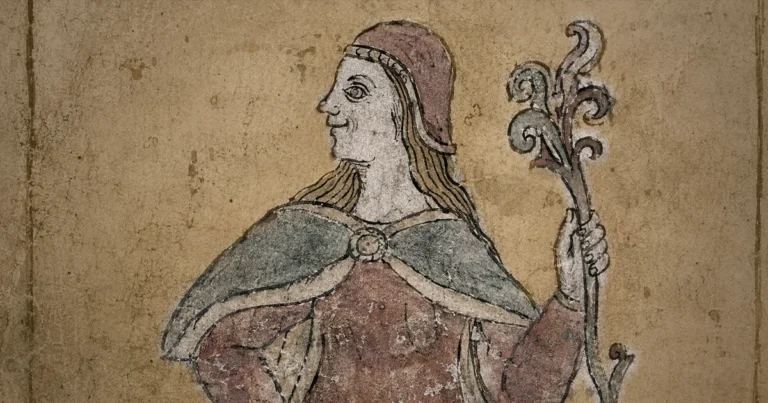
Physical perfection defined the Olympians. They were idealized forms, embodiments of beauty and strength. Hephaestus was the exception. Ancient Greeks called him “the lame one” and “the cripple-footed god.” Vase paintings show him with feet turned backward, or leaning heavily on a walking stick, or riding a donkey side-saddle because he couldn’t maintain balance astride.
Yet this rejected god became essential. He forged Zeus’s thunderbolts. He crafted Achilles’s legendary armor, described in exquisite detail in Homer’s Iliad. He built Helios’s chariot, Hermes’s winged sandals, and Aphrodite’s magical girdle. He created Pandora, the first woman, shaping her from clay. He even split Zeus’s head with an axe to release the fully-grown Athena.
Hephaestus made things. In a pantheon of abstract concepts and natural forces, he represented something concrete: human skill, technological innovation, the transformation of raw materials into objects of power and beauty. His volcanic workshops supposedly blazed beneath Mount Etna in Sicily and on the island of Lemnos. Ancient travelers who heard rumbling from these volcanic vents believed they were hearing the god’s hammers striking bronze.
For Athenians, Hephaestus embodied a particular truth: that skill and craft mattered as much as aristocratic birth or martial prowess. Athens wasn’t just philosophers and politicians. It was bronze-workers casting weapons and sculpture. It was potters shaping the black-figure and red-figure vases that made Athens famous across the Mediterranean. It was stonemasons cutting marble for temples, carpenters building triremes, metalworkers producing tools and decorative objects for export.
These craftsmen needed a patron god. Hephaestus was theirs.
Building a Temple in Pericles’s Athens
Construction began in 449 BCE, the same year workers broke ground on the Parthenon. Athens had defeated the Persian invasion, established dominance over the Delian League, and found itself flush with tribute money and imperial confidence. Pericles, the statesman who shaped this era, envisioned transforming Athens into the cultural center of the Greek world. Massive building projects were his method.
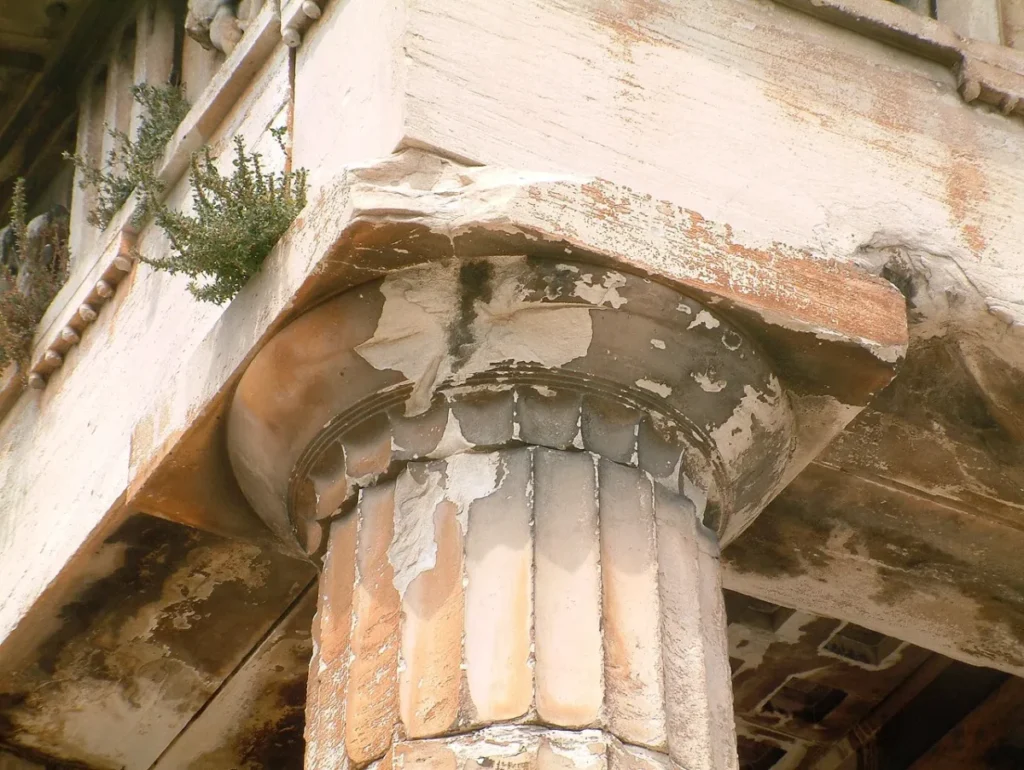
The architect is unknown, though scholars have suggested the design came from the same workshop that produced the Parthenon, possibly even from Iktinos himself. Whether or not one man designed both temples, they clearly emerged from similar architectural thinking. The Hephaisteion uses the same Pentelic marble as the Parthenon, quarried from Mount Pentelicus northeast of Athens. It employs the same Doric order. It incorporates the same optical refinements: columns that lean slightly inward, a platform that curves up at its center, corner columns thickened to compensate for how the eye perceives architecture against bright sky.
But construction moved slowly. Work began in 449 BCE, but the temple wasn’t completed until 415 BCE, three decades later. The reason was simple: the Parthenon took precedence. Funds and skilled workers kept being redirected up to the Acropolis, where the grander project demanded resources. The western frieze of the Hephaisteion was completed between 445 and 440 BCE. The eastern frieze, western pediment, and interior modifications came between 435 and 430 BCE. Only during the Peace of Nicias, from 421 to 415 BCE, was the roof finally completed and the cult statues installed.
The temple was officially inaugurated in 416 or 415 BCE.
By then, Athens had fought nearly two decades of the Peloponnesian War against Sparta. The city’s imperial confidence had curdled into military desperation. Yet even in these darkening years, the Hephaisteion stood complete, a monument to craft and labor rising on its hilltop overlooking the civic and commercial heart of Classical Athens.
What the Architecture Reveals
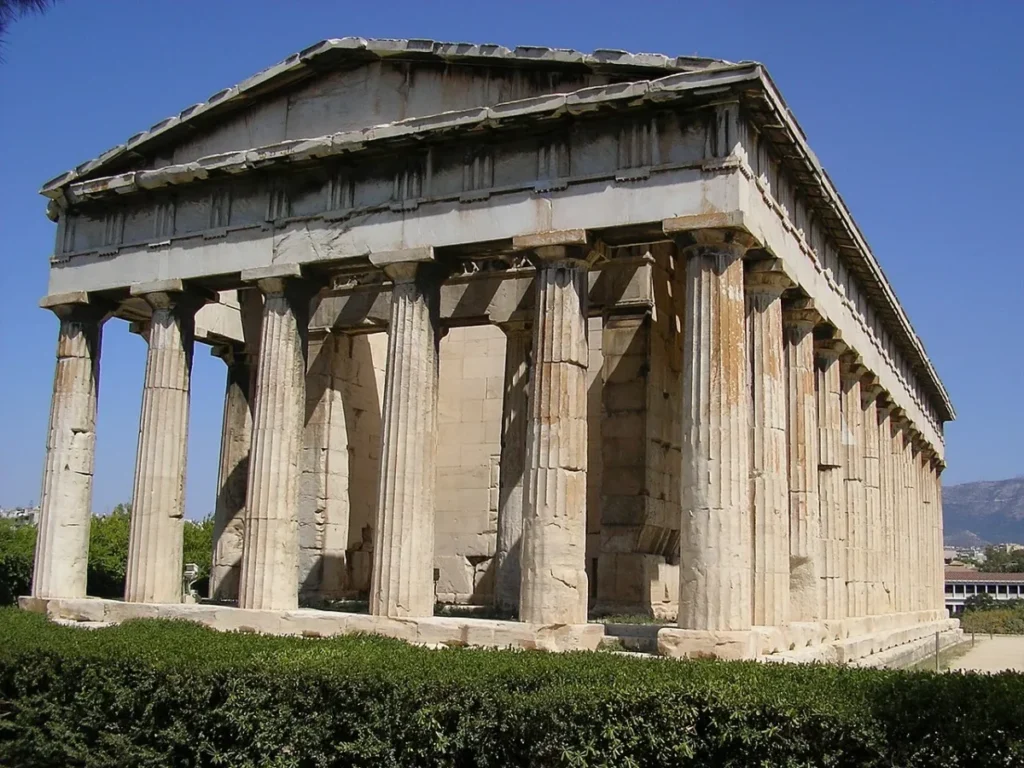
The Temple of Hephaestus measures approximately 13.7 by 31.7 meters, smaller than the Parthenon but substantial enough to dominate its hillside. It follows the peripteral hexastyle plan: a rectangular building (cella) surrounded by columns, with six columns across the front and back, 13 down each long side. Thirty-four Doric columns total, each rising about 5.9 meters and carved with 20 vertical flutes.
The colonnade created a shaded ambulatory between the secular marketplace below and the sacred interior. In Athens’s summer heat, that shade mattered practically. But the colonnade also served a psychological function. Worshippers didn’t step directly from the chaotic commercial life into divine presence. They passed through this intermediate zone, columns framing views of the city and sky.
The sculptural decoration tells us something revealing about Athenian identity. The temple’s Doric frieze includes 68 metopes (rectangular panels between the vertical triglyphs), but only 18 were carved with relief sculpture. The rest were probably painted, though that paint has long since vanished.
The ten eastern metopes, facing the rising sun and approaching worshippers, depict nine labors of Heracles: the Nemean Lion, the Lernaean Hydra, the Stymphalian Birds, the Cretan Bull. These are standard temple subjects, celebrating the hero’s victory over chaos and monsters.
But something strange happens at the eastern corners of the north and south sides. Four metopes shift subject matter entirely: they show Theseus, Athens’s legendary king, fighting various enemies. Why introduce Theseus into a temple dedicated to Hephaestus?
The answer lies in Athenian civic mythology. Theseus represented democratic ideals, Athenian unity, the triumph of civilization over barbarism. Including him in the Hephaisteion’s sculptural program sent a clear message: skilled craft and civic virtue belonged together. The bronze-workers and potters who honored Hephaestus weren’t just laborers. They were essential citizens whose skills sustained democratic Athens.
Inside the colonnade, continuous Ionic friezes ran above the entrance porch (pronaos) and rear porch (opisthodomos). This mixing of Ionic and Doric elements shows architectural experimentation, the same creative blending visible in the Parthenon. The eastern frieze depicted Theseus battling the Pallantides (Athenian enemies) with gods watching. The western frieze showed the Centauromachy, the battle between civilized Lapiths and savage Centaurs.
All these scenes reinforced one theme: order conquering disorder, civilization defeating chaos, skilled craft producing beauty from raw materials.
The interior housed two bronze cult statues, one of Hephaestus and one of Athena Ergane (“Athena the Worker”). An inscription records payments between 421 and 415 BCE for these statues, though it doesn’t name the sculptor. Tradition attributes them to Alkamenes, a leading sculptor of the period, but we have no definitive proof. Ancient writer Pausanias, visiting in the 2nd century CE, described seeing both statues gleaming in the dim sanctuary. They’re long gone now, melted down or lost, but fragments of their inscribed bases have been found built into later walls.
Built out of a love for history, kept free from distractions.
Spoken Past is an independent project shaped by curiosity, care, and long hours of research. Reader support helps keep it maintained, carefully researched, and open to everyone.
A Temple for Working People
Most Greek temples honored gods associated with power: Zeus the king, Athena the warrior-strategist, Apollo the prophet. The Hephaisteion honored skill.
Its location makes this clear. The temple sits on Kolonos Agoraios, a low hill at the northwest edge of the marketplace. Archaeological excavations around the temple’s base have revealed extensive evidence of metalworking: bronze foundries, pottery workshops, tool-makers’ quarters. This was Athens’s industrial zone. The craftsmen who worked here could look up from their furnaces and see their patron god’s temple watching over them.
Two major annual festivals celebrated Hephaestus and his divine partner Athena Ergane:
The Chalkeia took place in late October or early November, marking the start of the season for crafting Athena’s sacred peplos (robe). Bronze-workers closed their shops and carried their tools in procession through Athens. The tools themselves were treated as sacred objects, acknowledgment that technical skill was a divine gift. Sacrifices were made. Grain and animals were offered. The festival linked craft production directly to civic religion, showing that the labor of artisans sustained Athens in ways as essential as military victories or political decisions.
The Hephaisteia came in summer and featured torch races (appropriate for a fire god), athletic competitions, and public feasting. Processions began in the marketplace and climbed to the temple on Kolonos Agoraios. Unlike the elite festivals for Zeus or Apollo, the Hephaisteia celebrated workers. It honored the dignity of labor, the value of skilled hands, the transformation of raw materials into objects of beauty and utility.
Classical authors mentioned a “Chalkeion” (bronze workshop or smithy) adjacent to the temple, suggesting craft guilds or metalworking families maintained altars or work spaces under Hephaestus’s direct auspices. Offerings to the god included miniature bronze tools, terracotta models of hammers and tongs, and other symbols of workmanship. Though few votive objects survive (bronze was too valuable to leave buried), ancient sources describe them as abundant.
The resources invested in this temple tell us how democratic Athens valued its craftsmen. The site occupies prominent real estate on a hilltop visible from across the marketplace. The construction uses expensive Pentelic marble. Leading sculptors carved the metopes and friezes. This wasn’t a cheap neighborhood shrine. It was a major architectural statement: craft deserves the same honor as warfare, artisans contribute as essentially as aristocrats.
Why It Survived
Most Greek temples became ruins. The Parthenon lost its roof to a catastrophic explosion in 1687, when a Venetian artillery shell hit the Ottoman powder magazine stored inside. The Temple of Zeus at Olympia toppled in earthquakes and was systematically quarried for building stone. The Temple of Artemis at Ephesus, one of the Seven Wonders of the Ancient World, exists now as a single reconstructed column and swampy foundations.
The Temple of Hephaestus stands complete. Three factors explain this remarkable preservation:
Location on high ground. The temple sits atop Kolonos Agoraios, elevated above the valley. This protected it from flooding that damaged lower structures. It also made the building less vulnerable during invasions, since armies typically ransacked valleys and flat ground before bothering with hillsides.
Solid construction. The same marble blocks and engineering techniques used on the Parthenon went into this temple, creating a structure that could flex during earthquakes rather than shatter. The roof design distributed weight efficiently. The columns stood on careful foundations. The whole building was engineered to last.
Continuous sacred use. This is the critical factor. Sometime around the 7th century CE, Christians converted the temple into the Church of Saint George Akamates. The conversion required surprisingly minimal changes. The building already had walls, columns, a roof, and a rectangular interior space. The Christians reversed the orientation (pagan temples faced east with the cult statue at the eastern end; Christian churches face east with the altar at the eastern end and entrance at the west), added an apse for the altar, covered the pagan imagery with Christian frescoes, and started holding services.
For more than 1,200 years, from approximately 700 CE until Greek independence in 1833, Orthodox Christians worshipped in this building. That meant constant maintenance. Roofs were repaired when they leaked. Walls were stabilized when they cracked. The structure never became a ruin because it was never abandoned.
Other temples weren’t so fortunate. When Christianity became the Roman Empire’s official religion in the 4th century CE, pagan temples were systematically closed, looted, or destroyed. Many were dismantled for their valuable marble, which was burned to make lime or reused in new construction. The Hephaisteion escaped this fate because it remained sacred. It changed religions but never ceased being a holy place.
In the 19th century, the church gained another function. Foreign philhellenes (supporters of Greek independence) who died in Athens were buried inside and around it. Protestant visitors from Britain, America, and other nations found their final resting place where ancient Athenians had honored Hephaestus and where Byzantine Christians had worshipped Saint George. The building became a multi-layered monument to different forms of devotion across vastly different eras.
After Greek independence in 1833, religious use ceased. The building briefly served as an archaeological museum, then became a protected monument. Excavations by the American School of Classical Studies beginning in 1931 revealed the broader context: this temple had stood at the center of Athens’s industrial quarter, surrounded by the workshops of craftsmen who saw their labor as sacred.
The Temple’s Influence on European Architecture
When British architects James Stuart and Nicholas Revett published detailed measurements and drawings of the Temple of Hephaestus in The Antiquities of Athens (1762-1816), they gave European architects access to precise documentation of a complete Greek temple. The Parthenon was a ruin. The Temple of Zeus at Olympia was scattered drums in overgrown grass. But the Hephaisteion stood complete, every proportion measurable, every detail recordable.
The Greek Revival movement that swept Europe and America in the late 18th and 19th centuries drew heavily on these published measurements. Architects didn’t just admire Greek temples in principle. They could copy the Hephaisteion’s actual dimensions.
The Theseus Temple (Theseustempel) in Vienna’s Volksgarten (1820-1823) is nearly an exact replica at slightly reduced scale. Austrian architect Peter von Nobile used Stuart and Revett’s measurements to create what amounts to a Hephaisteion in central Vienna, complete with the same column spacing, frieze proportions, and pediment angles.
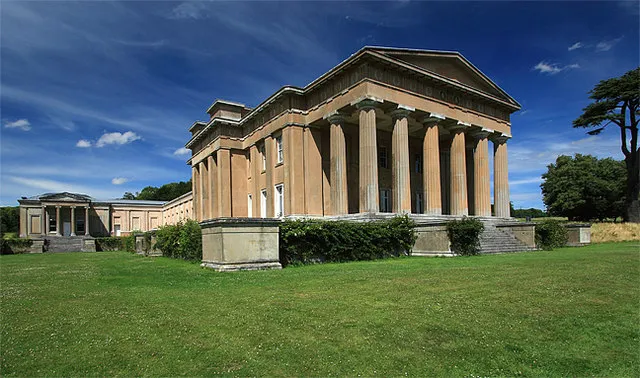
Grange Park in Hampshire, England (1804-1809) wrapped an existing country house in a dramatic Doric colonnade based on the temple’s design. The architect William Wilkins, who later designed London’s National Gallery, used the Hephaisteion as his model for making a gentleman’s estate look like a Greek sanctuary.
The National Library of Greece in Athens itself (1885-1903), designed by Danish architect Theophilus Hansen, reinterpreted the temple in 19th-century neoclassical language.
Across Europe and North America, banks adopted Doric colonnades to project stability. Universities used Greek temple forms to suggest timeless wisdom. Government buildings borrowed the architectural vocabulary to connect modern democracy with ancient Athens. The Temple of Hephaestus became an architectural language, a grammar of columns and proportions that architects could deploy to create meaning.
The irony is rich: a temple honoring the god of craftsmen and workers became the favored model for institutions serving elites.
What Stands Today
The Temple of Hephaestus today looks much as it did in 415 BCE, with a few differences. The bronze cult statues are gone. The Christian frescoes have been removed or covered. The roof tiles are modern replacements for the original terracotta ones, though the roof structure itself is ancient. But the fundamental architecture remains: 34 Doric columns supporting a complete entablature, intact pediments, unbroken walls, and a functioning roof.
This makes it the best-preserved Classical Greek temple in existence.
All 34 columns stand in their original positions. The carved metopes on the eastern end still show Heracles wrestling the Nemean Lion, fighting the multi-headed Hydra, capturing Cerberus in the underworld. Twenty-four centuries of weathering have softened details, but the figures remain visible, their musculature clear, their poses dynamic.
The honey-colored patina the marble has developed over millennia becomes especially visible in late afternoon light. The vertical fluting of each column creates sharp shadows. The building’s optical refinements (the inward-leaning columns, the upward-curving platform, the thickened corner columns) remain subtle but detectable to careful observers.
From the temple’s hilltop position, the spatial relationships of ancient Athens become clear. The Acropolis rises to the southeast, the Parthenon crowning its summit. The reconstructed Stoa of Attalos marks the eastern edge of the ancient marketplace. The Panathenaic Way, the sacred road used during festivals, runs through the valley below.
Ancient metalworkers laboring in that valley could look up and see their patron god’s temple standing at nearly the same elevation as the aristocratic sanctuaries on the Acropolis. The message was unmistakable: skill matters, craft is sacred, workers deserve architectural honor.
Buildings survive when they remain meaningful. The Temple of Hephaestus has been meaningful for 2,400 consecutive years. From ancient craftsmen honoring their patron god, to Byzantine Christians worshipping Saint George, to 19th-century philhellenes finding burial here, to modern scholars studying Classical architecture, the building has continued to matter to people. That continuity of meaning, as much as sturdy construction, explains why it still stands complete.