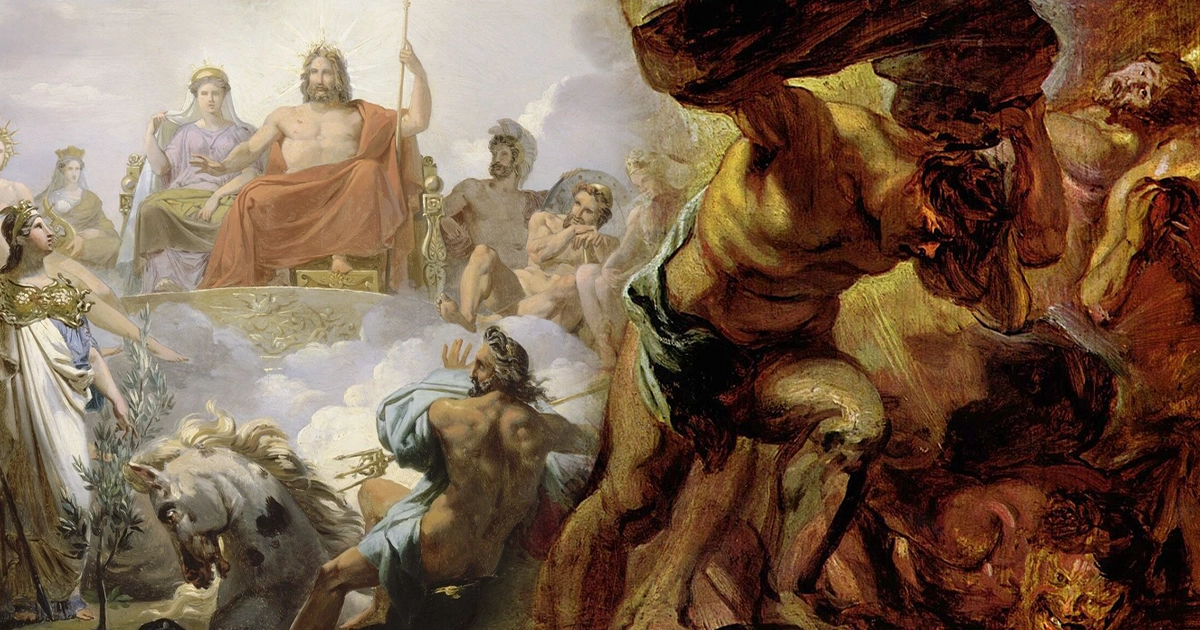
Before Zeus hurled his first thunderbolt, before Athena sprang from her father’s skull, before Poseidon claimed dominion over the seas, there was another race of gods. They were called the Titans. They ruled the cosmos for eons, presiding over a universe without the familiar faces we associate with Mount Olympus. And then came war.
The difference between Titans and Olympians is one of the most fundamental distinctions in Greek mythology, yet it remains surprisingly misunderstood. These were not simply different groups of gods. They represented entirely different cosmic eras, different approaches to power, and different relationships with the universe itself. The Titans were the elder gods, the primordial rulers born from Earth and Sky. The Olympians were their children and grandchildren, the insurgents who would overthrow them in a war that reshaped reality.
To understand Greek religion, Greek heroic literature, and the entire framework of classical mythology, you need to understand this generational divide. The Greeks did not simply worship a pantheon of gods. They told stories about divine regime change, cosmic coups, and the violent birth of the world order they knew.
Who Were the Titans in Greek Mythology?
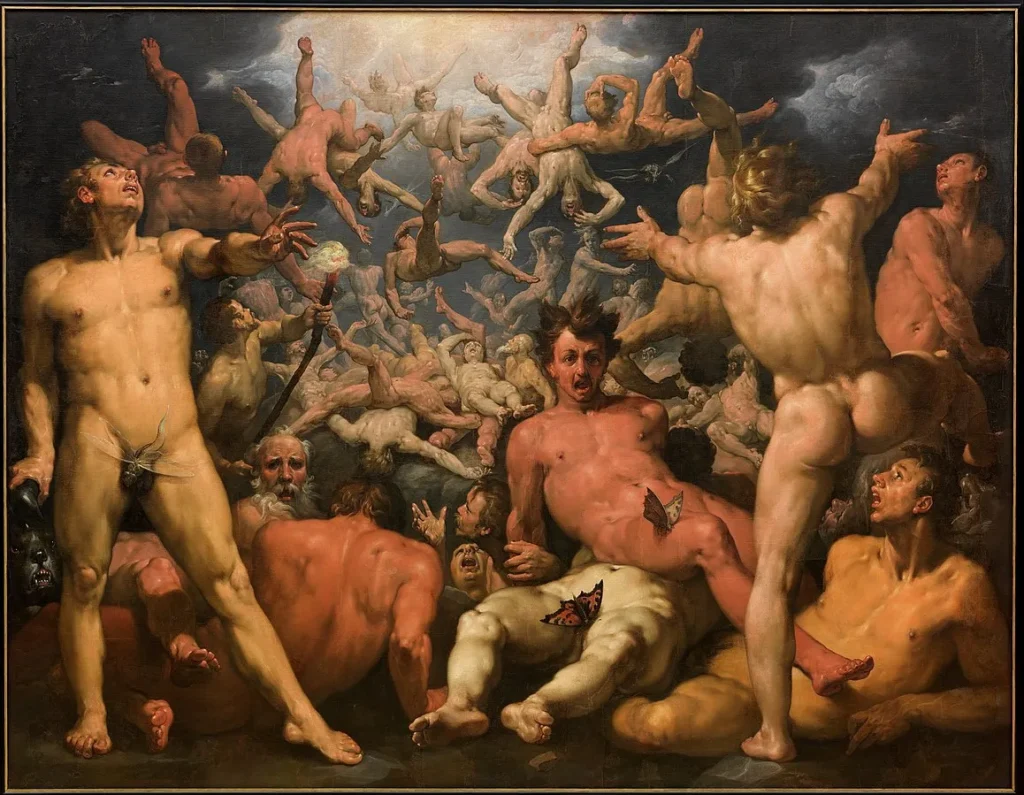
The Titans were the second generation of divine beings in Greek cosmology. According to Hesiod’s Theogony, the foundational text for Greek creation mythology composed around 700 BCE, the universe began with Chaos. From Chaos emerged Gaia (Earth) and a few other primordial entities. Gaia then produced Ouranos (Sky), and from the union of Earth and Sky came the Titans.
This makes the Titans something remarkable in divine genealogy: they were the first gods with recognizable personalities, genders, and domains. The primordial beings that came before them, like Chaos and Gaia, were more like cosmic forces than personal deities. The Titans were gods in the sense that later Greeks would understand the term.
The Twelve Titans
Hesiod names twelve Titans, six male and six female, born from the union of Gaia and Ouranos:
The Six Male Titans:
- Oceanus presided over the great river that the Greeks believed encircled the entire world. He was the source of all freshwater, all rivers, springs, and wells.
- Coeus represented the axis of heaven around which the constellations revolved. He was associated with rational intelligence and the pole.
- Crius was linked to the constellations and the ordering of the stars. He fathered several significant figures including Astraeus, father of the winds and stars.
- Hyperion was the god of heavenly light. His name means “he who goes above,” and he fathered Helios (Sun), Selene (Moon), and Eos (Dawn).
- Iapetus became the ancestor of the human race through his son Prometheus. He represented mortality and the lifespan of mortals.
- Cronus was the youngest and most ambitious. He would become king of the Titans and father of the Olympian gods.
The Six Female Titans (Titanides):
- Theia was the goddess of sight and the shining light of the clear blue sky. She gave gold and silver their brilliance and value.
- Rhea was the goddess of female fertility and the mountain wilds. She would become the mother of the six original Olympians.
- Themis embodied divine law and order, the natural organization of the universe. She would later serve as an adviser to Zeus.
- Mnemosyne was the goddess of memory and the inventress of language and words. She mothered the nine Muses with Zeus.
- Phoebe was associated with the moon and prophetic radiance. She held the Oracle at Delphi before passing it to her grandson Apollo.
- Tethys was the goddess of the sources of fresh water. With Oceanus, she mothered the rivers, springs, streams, and fountains of the world.
The Nature of Titan Power
What distinguished the Titans from the Olympians was not just their age but their connection to cosmic fundamentals. The Titans presided over concepts that exist regardless of civilization: time, memory, the ocean, the sun, the moon, the earth’s fertility. They were not gods of human activities like war, wisdom, or craftsmanship. They were gods of the universe’s basic architecture.
Hesiod called them “earth-born” (chthonic), emphasizing their connection to the primordial physical world. In the Homeric Hymn to Apollo, Hera prays to the Titans “who dwell beneath the earth,” treating them as ancient powers tied to the deep places of the cosmos. Even after their defeat, the Greeks understood them as forces that could not truly be destroyed, only displaced.
Who Were the Olympian Gods?
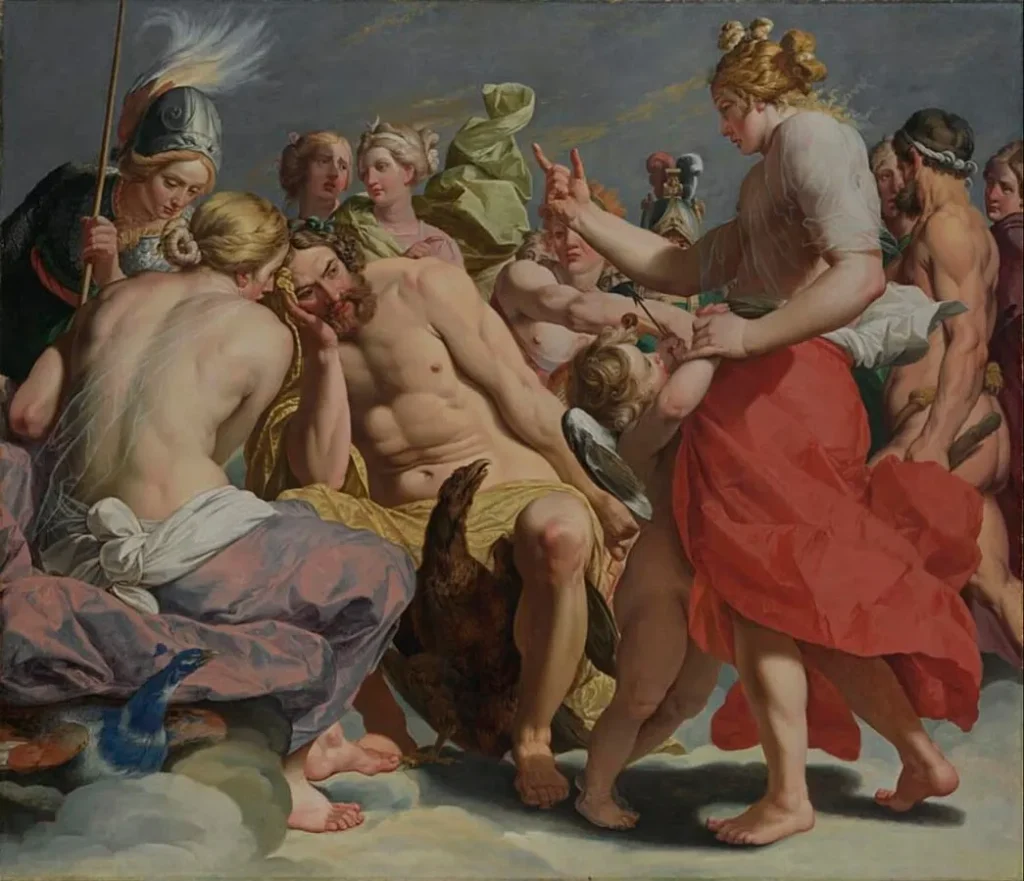
The Olympians were the gods who overthrew the Titans and established themselves as the ruling powers of the Greek religious universe. They took their name from Mount Olympus, the highest peak in Greece, which the Greeks believed served as the gods’ dwelling place and throne room.
Unlike the Titans, who embodied cosmic fundamentals, the Olympians represented aspects of civilization, human experience, and the organized world. They were gods you could pray to for specific outcomes: victory in battle, a successful harvest, wisdom in a dispute, a safe voyage. They interacted with humans constantly, took sides in mortal conflicts, loved and punished individual people, and shaped the course of history.
The Original Six Children of Cronus
The core Olympian gods began as the children of two Titans: Cronus and Rhea. According to Hesiod, Cronus had learned from Gaia and Ouranos that he was destined to be overthrown by his own child, just as he had overthrown his father. To prevent this, Cronus swallowed each of his children whole as Rhea gave birth to them.
The children he swallowed were Hestia (goddess of the hearth), Demeter (goddess of grain and agriculture), Hera (goddess of marriage), Hades (god of the underworld), and Poseidon (god of the sea). Each was fully divine, fully conscious, and alive inside their father’s stomach.
When Rhea was pregnant with her sixth child, she conspired with Gaia to save him. She gave birth to Zeus in secret on the island of Crete and presented Cronus with a stone wrapped in swaddling clothes, which he swallowed believing it to be the infant. Zeus was raised in hiding until he was grown.
The Twelve Olympians
While the original Olympians were the six children of Cronus, the Greek tradition eventually settled on a council of twelve major gods who dwelt on Olympus. The exact membership varied by region and period, but the most commonly cited twelve were:
- Zeus, king of the gods, ruler of sky and thunder
- Hera, queen of the gods, goddess of marriage and family
- Poseidon, god of the sea, earthquakes, and horses
- Demeter, goddess of the harvest and agriculture
- Athena, goddess of wisdom, warfare, and crafts
- Apollo, god of music, poetry, prophecy, and the sun
- Artemis, goddess of the hunt, wilderness, and the moon
- Ares, god of war and violence
- Aphrodite, goddess of love, beauty, and desire
- Hephaestus, god of fire, metalworking, and craftsmanship
- Hermes, messenger god, patron of travelers and thieves
- Hestia (or Dionysus), goddess of the hearth (or god of wine)
Hades, despite being one of the original six children of Cronus, was typically not counted among the Twelve Olympians because he dwelt in the underworld rather than on Olympus. Similarly, Persephone, though a major goddess, split her time between realms and was not consistently included.
The Titanomachy: How the Olympians Defeated the Titans
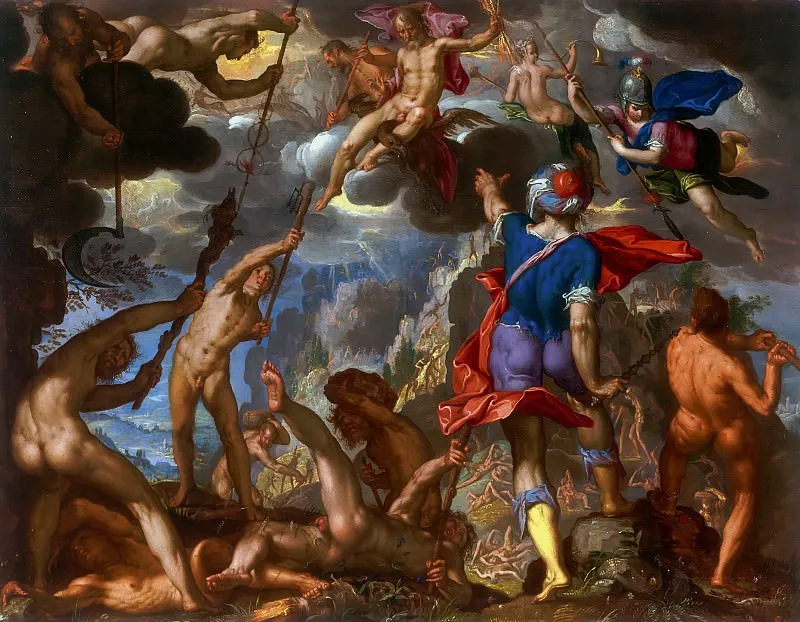
The war between the Titans and Olympians, called the Titanomachy, lasted ten years and fundamentally restructured the cosmos. It remains one of the most significant narratives in Greek mythology, explaining not just the current divine order but the Greek understanding of how power transfers from one regime to the next.
The Liberation of Zeus’s Siblings
The war began when Zeus, now fully grown, returned from his hiding place on Crete. With the help of Metis (a Titan goddess associated with cunning intelligence), Zeus administered a potion to Cronus that forced him to regurgitate the children he had swallowed. Out came Poseidon, Hades, Hera, Demeter, and Hestia, along with the stone that had been substituted for Zeus.
These five gods, now free and fully grown despite their imprisonment, joined Zeus in his rebellion against their father. But six gods, even powerful ones, could not hope to defeat the entire Titan generation on their own.
The Freeing of the Cyclopes and Hundred-Handers
Zeus gained crucial allies by descending to Tartarus and freeing the Cyclopes and the Hundred-Handed Ones (Hecatoncheires), monstrous siblings of the Titans whom Ouranos had imprisoned deep within the earth and whom Cronus had kept imprisoned.
The Cyclopes, master craftsmen of tremendous power, created gifts for the three brothers. To Zeus they gave the thunderbolt, the supreme weapon that would become his defining attribute. To Poseidon they gave the trident, which could shake the earth and stir the seas. To Hades they gave a cap of invisibility, allowing him to move unseen.
The Hundred-Handers, each with fifty heads and one hundred arms, became shock troops of unimaginable power. Hesiod describes them hurling three hundred rocks at a time in rapid succession, overwhelming the Titans with sheer volume of assault.
Titans Who Sided with the Olympians
Not all Titans fought against Zeus. Several either remained neutral or actively supported the Olympian cause, which proved crucial to the rebels’ eventual victory.
Prometheus, the Titan of forethought and one of the most complex figures in Greek mythology, sided with Zeus. His ability to see the future told him which side would win. Prometheus would later become famous for stealing fire from the gods to give to humanity, for which Zeus would punish him severely.
Themis, the Titan goddess of divine law and order, also supported Zeus. After the war, she became one of his most trusted advisers and served as the goddess of justice on Olympus.
Oceanus and Tethys, the Titan rulers of the world-encircling river and freshwater sources, remained neutral. Their domain was distant from Mount Othrys, where the Titans made their stand, and they continued their functions undisturbed.
The Battle and Its Aftermath
For ten years the war raged with neither side able to gain decisive advantage. The Titans fought from Mount Othrys while the Olympians based themselves on Mount Olympus. Hesiod describes the conflict in cosmic terms: the earth groaned, the sea boiled, and fire reached to the upper atmosphere.
The turning point came when Zeus unleashed his full power. He hurled thunderbolts in rapid succession, and the Hundred-Handers launched their barrage of three hundred stones at a time. The combination proved overwhelming. The male Titans were defeated, bound, and cast into Tartarus, the deepest pit of the underworld, with the Hundred-Handers set to guard them for eternity.
The female Titans, along with the Titans who had sided with Zeus or remained neutral, were allowed to retain their positions and functions. Rhea continued as a mother goddess, Themis served Zeus as adviser, Mnemosyne became mother of the Muses, and Oceanus and Tethys continued presiding over the waters.
Built out of a love for history, kept free from distractions.
Spoken Past is an independent project shaped by curiosity, care, and long hours of research. Reader support helps keep it maintained, carefully researched, and open to everyone.
Key Differences Between Titans and Olympians
Understanding the distinction between Titans and Olympians requires examining several fundamental differences in their nature, role, and relationship with the cosmos.
Generation and Genealogy
The most obvious difference is generational. The Titans were children of Gaia (Earth) and Ouranos (Sky), placing them one generation after the primordial forces. The Olympians were primarily children and grandchildren of Titans, making them two to three generations removed from the primordials.
This genealogical relationship meant the Olympians were literally the descendants of the gods they overthrew. Zeus was the son of Cronus. Cronus was the son of Ouranos. The Greek succession myth presents cosmic history as family drama writ large.
Domain and Function
Titans presided over cosmic abstractions and natural forces: the ocean, the sun, memory, time, heavenly light, the earth’s fertility in its most basic sense. These were domains that existed before civilization and would continue regardless of human activity.
Olympians, by contrast, governed aspects of civilized life and human experience: marriage, warfare, craftsmanship, wine-making, athletics, communication. They were gods who cared about the human world and intervened in it constantly. This is why Greek cities built temples to Athena or Apollo, not to Hyperion or Coeus.
Residence and Worship
The Titans, after their defeat, were associated with Tartarus, the deepest region of the underworld, or with distant, primordial locations. Hesiod describes them as dwelling “beneath the earth.” They received little active worship in historical Greek religion.
The Olympians dwelt on Mount Olympus, a real mountain that Greeks could see and point to. They received the bulk of Greek religious devotion: temples, sacrifices, festivals, prayers, and dedications. The Oracle at Delphi spoke for Apollo. The Panathenaic festival honored Athena. The Olympic Games celebrated Zeus.
Relationship with Humans
The Titans had minimal direct interaction with humanity in Greek myth. The major exception is Prometheus, who created humans from clay and championed their cause against Zeus. But even Prometheus was unusual among his kind.
The Olympians, however, interacted with humans constantly. They appeared in disguise among mortals, had affairs that produced heroes, chose favorites in wars, punished impiety, rewarded devotion, and shaped the course of human events. The Iliad and Odyssey are essentially stories about divine involvement in human affairs.
The Succession Myth in Broader Context
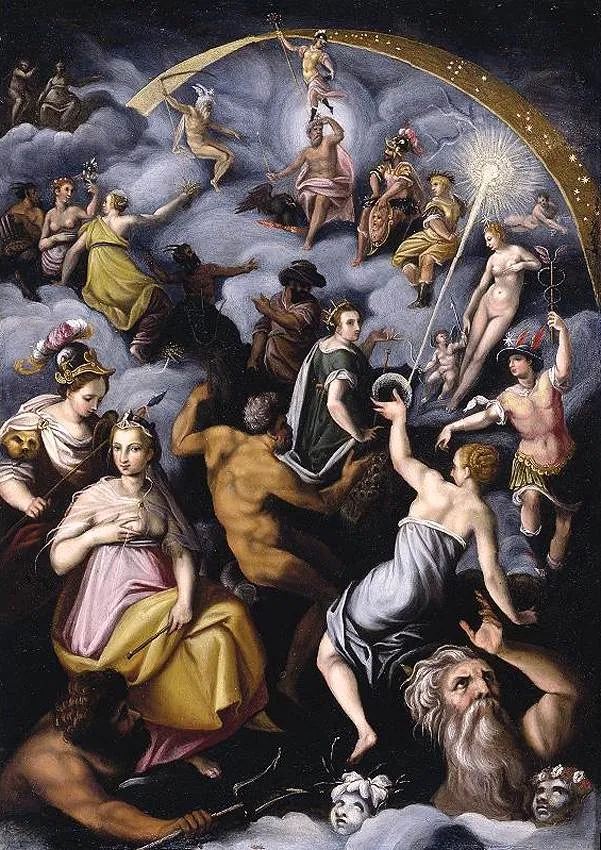
The Greek story of Titans and Olympians belongs to a broader pattern of Near Eastern succession myths that scholars have traced across multiple ancient cultures. Understanding this context reveals that the Greeks were participating in a widespread Mediterranean tradition of explaining cosmic order through divine regime change.
Near Eastern Parallels
The Hurro-Hittite Song of Kumarbi, composed in Anatolia during the second millennium BCE, tells a remarkably similar story. The god Anu (Sky) is overthrown by Kumarbi, who bites off and swallows Anu’s genitals. This act impregnates Kumarbi with several gods, including the storm god Teshub, who eventually overthrows him in turn.
The Babylonian Enuma Elish presents a variation where the younger god Marduk defeats the primordial sea goddess Tiamat, creates the world from her body, and establishes himself as king of the gods. While the details differ, the pattern of younger gods overthrowing elder powers persists.
According to scholarly analysis of these succession myths, the Greeks participated in a cross-cultural exchange of cosmological ideas across the Eastern Mediterranean. Trade routes, migration, and the movement of specialized storytellers spread these mythological patterns from Mesopotamia through Anatolia to the Aegean.
Why Succession Myths Mattered
These stories served multiple functions in ancient societies. They explained the current state of the cosmos: why these particular gods rule, why the world has its current form, why humans exist in their present condition. They also validated existing power structures by presenting them as cosmically ordained.
For the Greeks specifically, the Titan-Olympian succession explained why they worshipped the gods they did. The Olympians were not simply powerful beings demanding worship. They were the legitimate rulers of the universe who had earned their position through victory in primordial conflict. Their rule was established, stable, and permanent.
The Greeks understood that their gods were not eternal in the strictest sense. There had been a time before Zeus. There might, in some traditions, be a time after him. The Orphic mysteries even spoke of Dionysus as a potential successor. But for practical purposes, the Olympian order represented the final state of divine politics, the regime under which humans lived and would continue to live.
The Persistence of the Titans
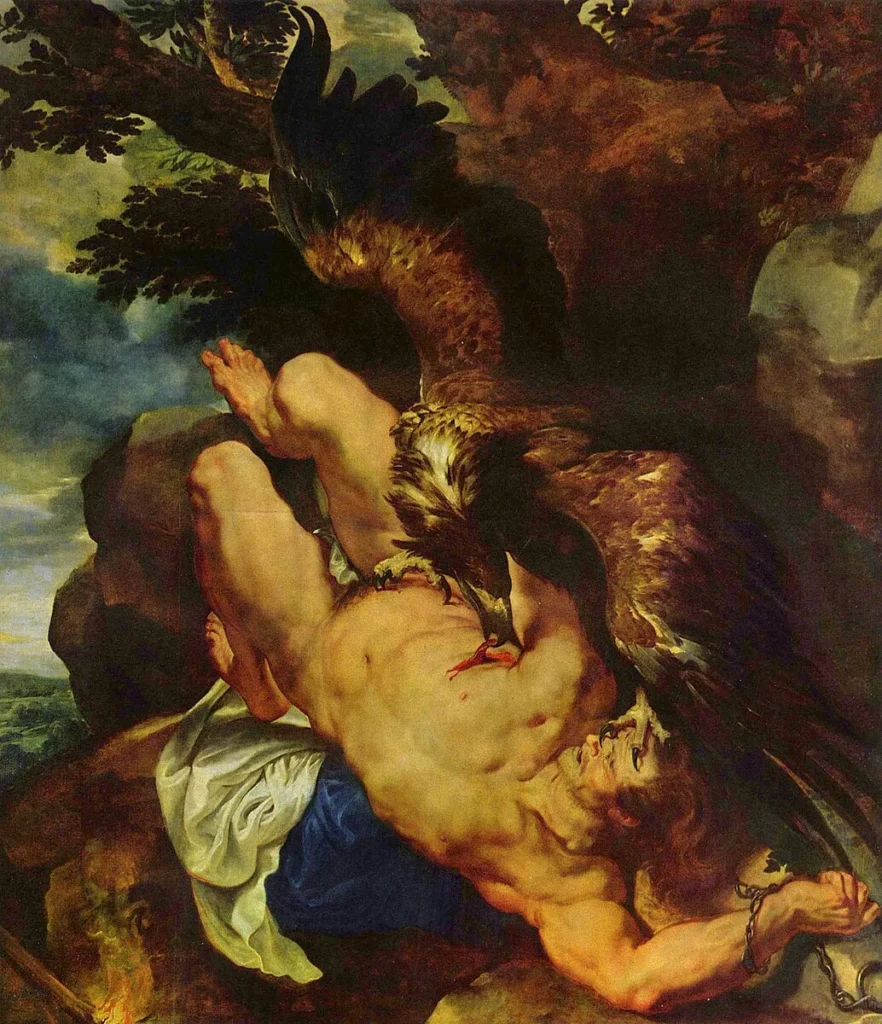
Despite their defeat and imprisonment, the Titans did not disappear from Greek consciousness. They persisted in mythology, religion, and later culture as symbols of primal power, overthrown order, and cosmic memory.
Titans in Later Greek Religion
Several Titans or their immediate descendants continued to function in Greek religious life. Helios, the sun god and son of the Titan Hyperion, received worship at Rhodes and elsewhere. Atlas, punished to hold up the sky, became a significant figure in geographical imagination. Prometheus remained a central figure in myths about human origins and the relationship between mortals and gods.
The Orphic mysteries, a secretive religious movement that developed in the 6th century BCE, gave the Titans particular significance. In Orphic mythology, the Titans dismembered and consumed the infant Dionysus, and from the soot of their bodies being struck by Zeus’s thunderbolt, humanity was created. This gave humans a dual nature: Titanic (earthly, chaotic, material) and Dionysian (divine, ordered, spiritual).
Titans as Symbols
The Titans came to represent several important concepts in Greek and later Western thought. They symbolized the overthrown past, the regime before the current order, the powers that had to be defeated for civilization to emerge. They represented primal strength without wisdom, raw power without the tempering influence of Olympian order.
This is why modern English uses “titanic” to mean something of enormous size or power. The Titans were not simply big. They were the embodiment of primordial force, the strength of the cosmos before it was tamed and organized.
The Greeks themselves were ambivalent about the Titans. On one hand, they were defeated enemies, justly imprisoned for their opposition to Zeus. On the other, they were ancestors, the older generation that gave birth to the current divine rulers. Greek mythology contained both perspectives, reflecting the complex Greek attitude toward tradition, change, and the relationship between past and present.
The story of the Titans and Olympians, then, is not simply an ancient curiosity. It was the Greek way of understanding how the world came to be ordered, why certain gods ruled, and what forces lay beneath the surface of their religious universe. For anyone seeking to understand Greek and Roman mythology and the beliefs of ancient polytheistic cultures, this generational conflict between elder and younger gods provides the essential foundation.