
In the winter of 34 BC, a thirteen-year-old boy was carried through the streets of Alexandria on a golden throne. He wore the double crown of Egypt and carried the crook and flail of a pharaoh. Standing beside him on a silver platform in the city’s gymnasium, Mark Antony declared him to be the true and legitimate son of Julius Caesar, King of Kings, co-ruler of the greatest kingdom in the eastern Mediterranean. It was the most powerful public statement of identity ever made on his behalf. It was also, as M. P. Charlesworth argued in his landmark 1933 study in The Classical Quarterly, a calculated act of propaganda that turned a child into a weapon. That boy was Caesarion, born Ptolemy XV Caesar, and his entire short life followed the same brutal logic: he was useful until he was not, and the moment he ceased to be useful, he was killed.
His story runs through the collapse of the Roman Republic, the love affairs and political marriages of the most powerful people on earth, and the relentless machinery of Roman succession politics. Understanding what actually happened to Caesarion, and why, requires taking seriously the ancient sources that Charlesworth spent his career excavating from beneath centuries of Augustan spin.
Born Into a Political Calculation: The Question of Caesarion’s Paternity
Ptolemy XV Caesar was born in Alexandria around June 47 BC, a few months after Julius Caesar had departed Egypt following the Alexandrian War. His mother was Cleopatra VII, queen of the Ptolemaic dynasty, a ruler Duane Roller describes in his Oxford University Press biography Cleopatra: A Biography as a learned and visionary leader whose overarching goal was always the preservation of her dynasty and kingdom. His alleged father was the most powerful man in the Roman world.
The question of whether Caesar actually fathered Caesarion is one of the most contested points in late Republican history, and the contest itself is telling. Caesar did not officially acknowledge the boy under Roman law, which governed inheritance and legitimacy through a formal process of recognition. He did, however, according to the biographer Suetonius, permit Cleopatra to give the child his name. Charlesworth, working directly from Suetonius, identifies the key testimony in Fragment A.11 of the Antonian propaganda corpus: Antony later affirmed to the Senate that Caesar had acknowledged Caesarion, citing as his witnesses Caesar’s own close friends Gaius Matius and Gaius Oppius. Oppius then published a pamphlet arguing the opposite, attempting to demonstrate that Caesar could not have fathered the child at all.
Why Both Sides Fought Over a Birth
The propaganda battle over Caesarion’s origins was not really about biology. It was about Roman law and the right to inherit the name and legacy of a god. Caesar was deified after his assassination in 44 BC, making his biological heir, if one existed, the son of a god. Octavian’s entire claim to power rested on his status as Caesar’s adopted son and heir under the terms of Caesar’s will. A biological son, particularly one whom Antony was willing to publicly champion, represented an alternative legitimacy that Octavian could never fully neutralize through legal argument alone.
Charlesworth makes the point precisely: Antony’s aim in Fragment A.11 was to pit the claims of a real and acknowledged son of Julius Caesar against those of his adopted son. The modern consensus, as Charlesworth himself stated bluntly, is that Caesarion was in truth the son of Julius Caesar and Cleopatra. Whether Caesar would have ever made that acknowledgment formal under Roman law is a separate question, and one the ancient sources leave unresolved. What matters for understanding his fate is that both sides in the civil war treated the question of his paternity as politically explosive, which is why Octavian’s supporters went to such lengths to deny it.
How Cleopatra Turned Her Son Into a Ruling Symbol
Cleopatra moved with considerable speed after Caesar’s assassination in March 44 BC. Within months of returning to Egypt, she had her co-ruler and younger brother Ptolemy XIV removed, almost certainly by poisoning, and elevated the three-year-old Caesarion to the position of co-regent as Ptolemy XV. This was not sentiment. It was structural politics.
By naming Caesarion co-ruler, Cleopatra solved two problems simultaneously. She embedded his status as Caesar’s son into the official titulature of the Egyptian state, making his identity as a Roman-Egyptian hybrid ruler a matter of public record. She also followed the long Ptolemaic tradition of co-rulership, which had always involved a male figure alongside the queen, providing ceremonial legitimacy within Egyptian religious frameworks. From this point forward, his name and image appeared on official documents, temple reliefs, and royal inscriptions across Egypt, frequently alongside Cleopatra in scenes of pharaonic ritual.
The Temple at Dendera and the Making of a Divine Child
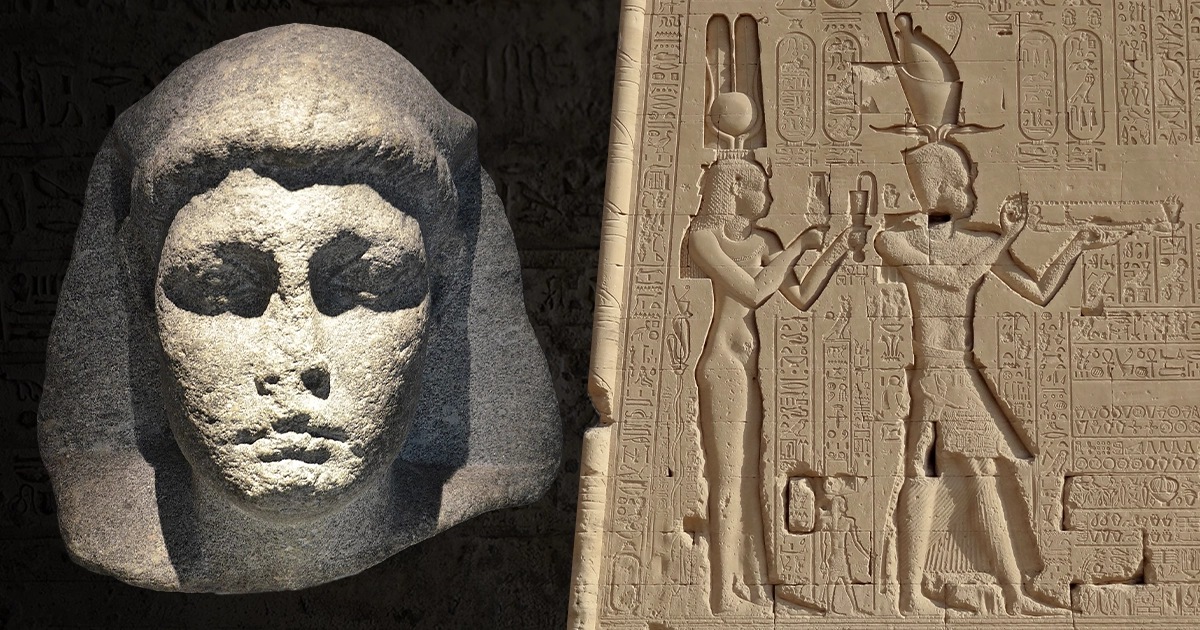
The most striking physical evidence for how Cleopatra constructed Caesarion’s public identity survives at the Temple of Hathor at Dendera in Upper Egypt, where a large relief on the southern exterior wall depicts mother and son in full pharaonic regalia making offerings to the gods. Cleopatra appears as the goddess Isis, while Caesarion takes the role of Horus, the divine son who legitimately inherits his father’s kingdom. The theological implications were deliberate and precise. In Egyptian religious tradition, the pharaoh was always the living Horus, son of Osiris, and the myth of Horus avenging his murdered father and reclaiming his throne was one of the most politically resonant stories in the entire culture. Caesarion’s Egyptian title, preserved in hieroglyphic inscriptions from the period, was Iwapanetjerentynehem, meaning Heir of the God Who Saves. The “god who saves” was a translation of the Greek title Soter, one of Caesar’s honorifics. His Egyptian identity was thus built entirely around his Roman parentage, encoding it in the religious language of three thousand years of pharaonic tradition.
The temple relief at Dendera is now accessible through the collections of the Egyptian Museum in Cairo, and the Karnak stela depicting Cleopatra and Caesarion similarly survives in the Egyptian Museum in Turin. Both objects demonstrate that Cleopatra’s project of constructing Caesarion’s identity as Caesar’s heir was not occasional or informal. It was systematic, monumental, and deeply embedded in the religious infrastructure of the state.
The Donations of Alexandria and Why Caesarion Became a Threat
Between 34 BC and 31 BC, Caesarion moved from being a local Egyptian political symbol to a figure at the center of a confrontation between the two most powerful remaining forces in the Roman world. The mechanism was the Donations of Alexandria.
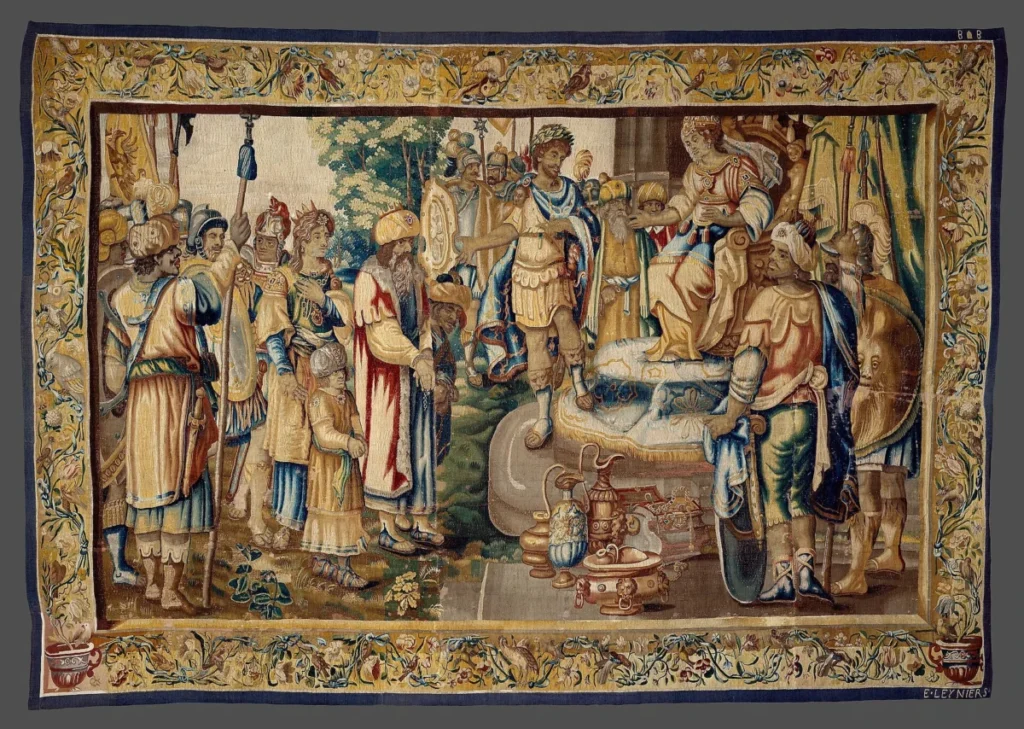
In the autumn of 34 BC, Antony convened a public ceremony in the gymnasium of Alexandria at which he and Cleopatra sat on golden thrones on a silver platform before the people of the city. He declared Cleopatra queen of kings and Caesarion king of kings. He granted Caesarion rule over Egypt and Cyprus as Caesar’s co-ruler, while distributing the other eastern territories among his three children with Cleopatra. Most critically, Antony publicly proclaimed that Caesarion was the true biological son and rightful heir of Julius Caesar.
Charlesworth, in his analysis of the propaganda war that followed, identifies precisely what made this declaration so dangerous to Octavian. The title King of Kings was, as modern scholars have noted, unprecedented in the management of Roman client-king relationships. But the specific claim about Caesar’s heir was more immediately threatening. Octavian’s legal authority rested on his adoption by Caesar. Antony was now asserting, through a public act of state and a despatch composed for the Roman Senate, that the real heir was still alive and reigning in Alexandria. The consuls for 32 BC, Sosius and Domitius Ahenobarbus, who were Antony’s men, refused to read the despatch in the Senate, as Charlesworth notes citing Dio XLIX.41.4. But the political damage was already done.
The War of Words That Preceded Actium
The propaganda campaign that followed the Donations involved both systematic character assassination and competing legal arguments about what Caesar had actually wanted. Charlesworth’s central argument is that much of what we think we know about both Antony and Octavian during this period consists of the other side’s attacks, preserved because Octavian won and controlled the historical record. Charges that have often been treated as historical facts, including stories about Octavian’s personal cowardice at Philippi and his various sexual scandals, derive from authentic Antonian letters and pamphlets, not from neutral observation.
For Caesarion specifically, the propaganda operated in both directions. Octavian’s supporters denied the paternity claim and emphasized Octavian’s exclusive legal status as Caesar’s heir. Antony’s camp emphasized biological reality and the moral priority of blood over adoption. The question was never really about who Caesar’s son was. It was about which version of Roman succession would govern the empire that was now clearly going to exist. Caesarion represented one answer. Octavian represented another. Only one of them could be right, and the resolution was always going to be military.
Built out of a love for history, kept free from distractions.
Spoken Past is an independent project shaped by curiosity, care, and long hours of research. Reader support helps keep it maintained, carefully researched, and open to everyone.
After Actium: Caesarion as a Bargaining Chip
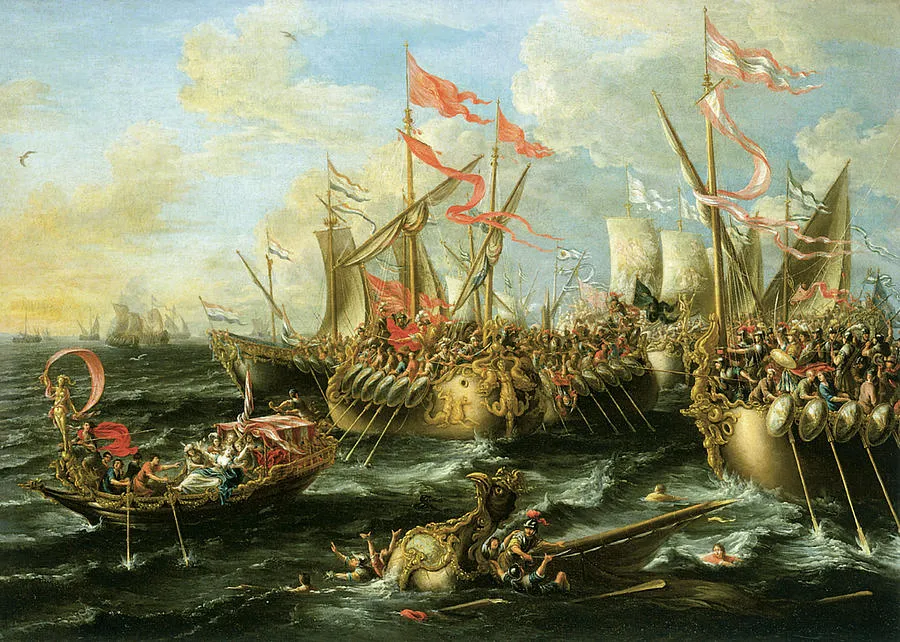
The Battle of Actium on September 2, 31 BC, ended Antony and Cleopatra’s military capacity. Octavian’s forces under the generalship of Marcus Agrippa defeated the combined fleet decisively off the coast of northwestern Greece. Antony and Cleopatra withdrew to Alexandria with approximately ninety ships and whatever remained of their land forces, pursued by Octavian’s army.
In the months between Actium and Octavian’s arrival at Alexandria in August 30 BC, Cleopatra made a series of moves that suggest she was attempting to negotiate survival for herself and her dynasty rather than achieve military victory. She sent Caesarion, then seventeen years old, south toward the Red Sea port of Berenice with a substantial amount of treasure, ostensibly preparing an escape route. Plutarch says the plan was for him to flee to India and potentially re-establish Ptolemaic rule from there. Roller, drawing on the ancient sources, notes that Cleopatra also opened separate communications with Octavian in which she offered to hand over the Egyptian treasury and to abdicate in favor of her children.
This is the moment at which Caesarion was functioning most clearly as a bargaining chip. Cleopatra’s offer implied that she would cooperate fully with the new Roman order if her son’s life and some form of dynastic continuity were guaranteed. She sent Octavian her crown and scepter as gestures of submission. What she did not do was send Caesarion himself. His continued existence and his location outside Alexandria gave her something to negotiate with, because Octavian needed either to capture him or to guarantee his safety in order to fully resolve the political problem he represented.
What Octavian Actually Wanted
Octavian’s conduct throughout the final phase of the campaign reveals that he was pursuing a careful strategy rather than simply seeking revenge. He kept Antony and Cleopatra’s three younger children alive after Alexandria fell, eventually giving them to his sister Octavia to raise in Rome. He gave Cleopatra and Antony a formal military funeral. He portrayed himself as merciful to those who surrendered and as acting in the interest of Rome rather than personal ambition.
Killing a seventeen-year-old boy with no army and no territory of his own would have complicated this narrative considerably, which is likely why Octavian spent the weeks after Actium sending Caesarion assurances that he would be safe and welcome in Alexandria. According to the sources Plutarch and Cassius Dio, Caesarion’s tutor Rhodon, whether through genuine belief in these promises or through direct bribery, persuaded the young king to turn around and return to Alexandria on the grounds that Octavian would grant him the kingdom. He walked back into a city that was already effectively under Roman control.
The Killing of Caesarion: When He Was No Longer Useful
Octavian captured Alexandria on August 1, 30 BC. Mark Antony died by suicide the same day. Cleopatra died on August 12, traditionally said to be by asp bite, though the exact method remains disputed. Caesarion had been the last Ptolemaic king for eleven days, ruling Egypt nominally as sole pharaoh between his mother’s death and his own. He never exercised any actual power during those eleven days. He was in hiding, returning from the south, waiting to learn whether the promises made to his tutor had been sincere.
They had not. The ancient sources preserve the rationale with uncomfortable clarity. Octavian consulted the Alexandrian philosopher Areios Didymos about whether Caesarion should be allowed to live. Areios, adapting a line from Homer, responded that it is not good to have too many Caesars. The phrase, cited by both Plutarch and the broader tradition, is often presented as a witty epigram. It was actually a formal philosophical endorsement of political murder. Octavian had Caesarion executed in late August 30 BC, probably by strangulation. He was seventeen years old.
The calculation was precise and unemotional. As long as Cleopatra was alive and negotiating, Caesarion’s survival had value as a potential outcome of those negotiations, and his death would have ended any possibility of cooperation. Once Cleopatra was dead, that negotiating dynamic ceased to exist. Caesarion alive was a permanent political liability: a biological son of Julius Caesar who could serve as a rallying point for any future opposition to Augustan rule. Caesarion dead was simply the end of a dynasty. Octavian executed him without ceremony and moved on to consolidating Egypt as a Roman province, which he administered under uniquely restrictive personal control, refusing to allow senators or senior military officers to enter Egypt without his personal permission precisely because its wealth and its Caesarian associations made it uniquely dangerous.
The Sources, the Silence, and What History Preserved
One of the most significant things about Caesarion is how little trace he left in the historical record after his death. Octavian, who became Augustus in 27 BC, did not commission histories of the period that dwelt on Caesarion’s legitimacy. The propaganda machine that had spent years arguing whether Caesar was really his father fell largely silent on the question, because the question no longer served any purpose. Augustus was Caesar’s heir. That was the official position of the Roman state for the next several centuries.
What Charlesworth’s 1933 Classical Quarterly article reveals is how much of what we think we know about this period comes from the losing side’s materials, preserved accidentally in works like Suetonius’ Lives of the Caesars, where fragments of Antony’s actual letters and pamphlets survive embedded in biographical narratives that were not primarily concerned with recovering Antonian perspectives. Fragment A.11 in Charlesworth’s collection, the statement that Antony affirmed Caesarion’s paternity to the Senate with Matius and Oppius as witnesses, is preserved in Suetonius’ Divus Julius 52.2 and represents one of the very few places where Antony’s own position on the matter survives in anything close to its original form.
Roller’s biography of Cleopatra, published by Oxford University Press in 2010, provides the fullest modern scholarly synthesis of the papyrological and documentary evidence for Caesarion’s official role. The so-called Cleopatra Papyrus (P.Bingen 45), which records Cleopatra’s approval of tax exemptions during the period of their co-rulership, has been identified by some scholars as a letter addressed to Caesarion specifically, making it a document of their shared administrative authority and one of the very few objects that connects him to actual governance rather than ceremonial display.
Physical artifacts connected to Caesarion are rare but striking. A rose granite statue now in the National Roman Museum in Rome depicts a young pharaoh in the striped nemes headdress, generally identified as Caesarion based on its dating and provenance. A granite head in the Bibliotheca Alexandrina Antiquities Museum in Alexandria is similarly attributed to him. These objects are the remains of a deliberate visual program that Cleopatra maintained for seventeen years, building an identity for her son that would have made him the most symbolically complete ruler of the ancient world: pharaoh of Egypt by birth, son of a Roman god by blood, King of Kings by formal Antonian proclamation. It was an identity assembled entirely by other people for political purposes. He never had the opportunity to become anything else.
The Ptolemaic dynasty that had ruled Egypt since the death of Alexander the Great in 323 BC ended with Caesarion. Three thousand years of continuous pharaonic kingship ended with him. He appears in the historical record primarily as a claim, a threat, and finally a problem to be eliminated. The historian who wants to understand what actually happened to him has to read against the grain of the surviving sources, most of which were written by people who had every reason to minimize his significance or to treat his death as a footnote in the triumphant story of Augustus.