On September 26, 1687, a Venetian artillery officer named Francesco Morosini aimed his mortar at the Acropolis of Athens. The Ottoman Turks had fortified themselves on the ancient citadel, and Morosini was determined to drive them out. His gunners had been shelling the hill for three days. Then, at 7 PM on that Friday evening, one shell arced through the twilight, crashed through the marble roof of the Parthenon, and detonated the Ottoman gunpowder magazine stored inside.
The explosion killed 300 people instantly. The blast tore the temple in half, collapsing the roof, shattering 28 columns, and hurling massive marble architraves hundreds of feet in all directions. Fires burned across Athens for two days. When the smoke cleared, the ancient world’s most architecturally perfect building lay in ruins.
For 2,134 years, the Parthenon had stood virtually intact. It had survived earthquakes, fires, religious transformations, and countless wars. Then a single artillery shell ended its reign as the crown jewel of Classical architecture in a matter of seconds.
This is the story of what was built, what was destroyed, and what still stands today.
Why Pericles Built the Parthenon
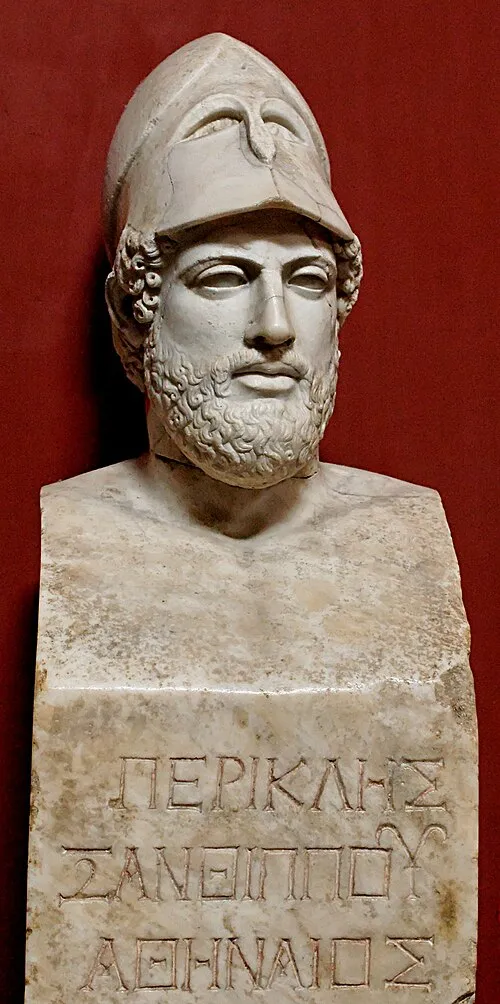
Pericles wearing a Corinthian helmet, the statesman who drove Athens’s mid-5th-century building program. Source: Musei Vaticani
In 480 BCE, Persian King Xerxes invaded Greece with the largest army the ancient world had ever seen. His forces swept through Athens, climbed the Acropolis, and systematically destroyed every temple and sanctuary on the sacred hill. The Athenians, who had evacuated their city, watched from ships offshore as smoke rose from their burning shrines.
A year later, after Greek naval victories at Salamis and land triumphs at Plataea, the Persians were driven from Greek soil. Athens lay in ruins. The Acropolis was a wasteland of toppled columns and charred foundation stones. For decades, the Athenians left it that way as a memorial to Persian sacrilege and a reminder of what they had endured.
By 447 BCE, Athens had transformed from a burned city into an imperial power. The Delian League, originally formed as a defensive alliance against Persia, had become an Athenian empire. Tribute flowed into Athens from hundreds of subject cities across the Aegean. The statesman Pericles controlled Athenian policy and envisioned something audacious: he would rebuild the Acropolis not just as it had been, but greater than anything the Greek world had ever seen.
The centerpiece would be a new temple to Athena Parthenos (“Athena the Virgin”), patron goddess of Athens. It would be larger, more richly decorated, built from finer materials, and architecturally more sophisticated than any temple previously constructed. It would announce to the Mediterranean world that Athens had not merely survived Persian destruction but had emerged as the greatest power in Greece.
Pericles appointed Phidias, the most famous sculptor in Greece, to oversee the entire project. Two architects, Ictinus and Callicrates, worked under Phidias’s supervision. Together, they would spend 15 years creating what would become the defining monument of Classical Greek civilization.
Building the Parthenon: 447 to 432 BCE
Construction began in 447 BCE and proceeded with remarkable speed. The architects chose a site on the highest point of the Acropolis, where an earlier temple (destroyed by the Persians) had stood. They used the existing platform but expanded it significantly to accommodate their more ambitious design.
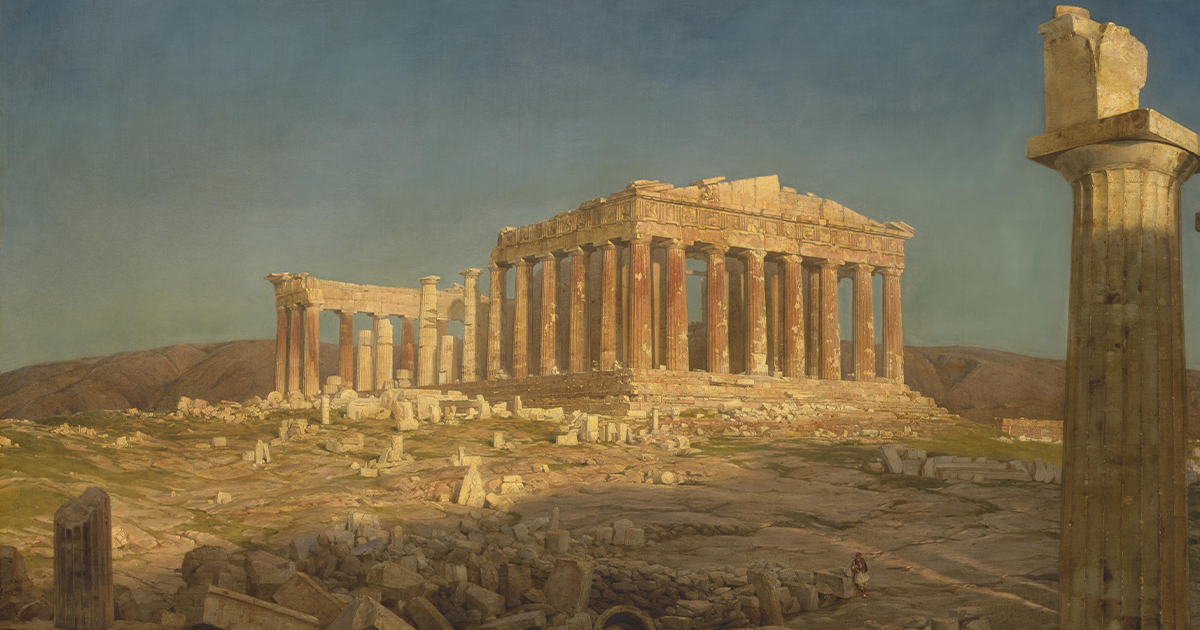
The temple measures 30.9 meters wide by 69.5 meters long at its platform level. It follows what architects call a peripteral octastyle plan: a rectangular central building (cella) surrounded by columns, with eight columns across the front and back, and 17 down each long side. Forty-six massive Doric columns total, each standing 10.4 meters tall and weighing approximately 9 tons.
Every block of marble came from Mount Pentelicus, about 16 kilometers northeast of Athens. Quarrymen cut approximately 100,000 tons of marble from the mountain. Teams using wooden wagons hauled blocks down to Athens, then dragged them up the steep Acropolis approach. The Acropolis of Athens rises 150 meters above the city, and every ton of marble had to be pulled to the summit by human and animal power.
The builders fitted marble blocks without mortar, relying on precise cutting and bronze clamps to hold pieces together. Stonemasons on site carved each block to exact specifications. The precision was extraordinary: blocks fitted so tightly that knife blades couldn’t slip between joints.
The temple incorporates dozens of subtle architectural refinements invisible to casual observers but essential to its visual impact. The platform curves upward at its center (rising about 6 centimeters along the long sides) so it doesn’t appear to sag. The columns lean slightly inward rather than standing perfectly vertical. Each column shaft bulges outward in the middle (entasis) to counteract the optical illusion that makes straight columns look concave. Corner columns are thicker than interior columns to compensate for how bright sky makes them appear thinner.
These refinements required extraordinary mathematical precision and added enormously to construction costs and time. But they created the illusion of perfect regularity even though the building is deliberately irregular in dozens of calculated ways.
By 438 BCE, the main structure was complete. Phidias’s colossal Athena Parthenos statue was installed in the eastern chamber that year. Work on the sculptural decoration continued until 432 BCE, when the Parthenon was officially dedicated.
Phidias’s Lost Masterpiece
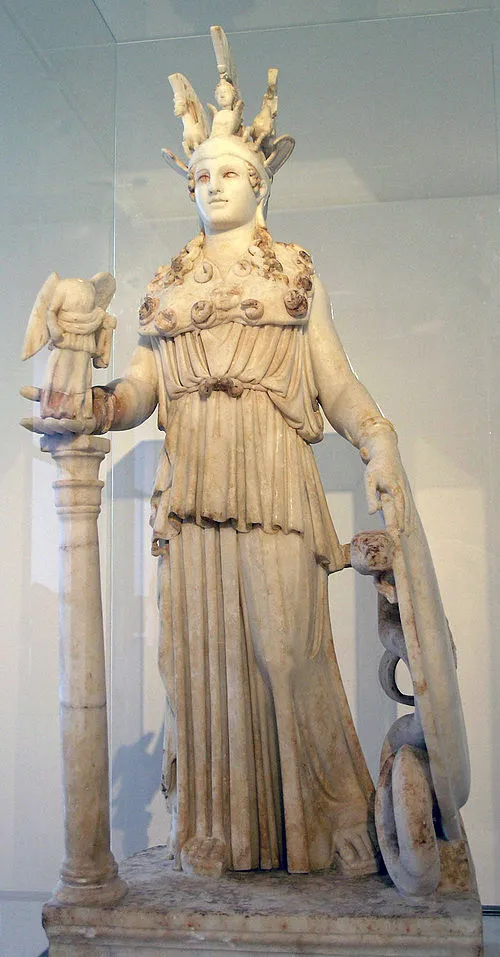
The Varvakeion Athena, a small-scale Roman replica of Phidias’s Athena Parthenos. Source: National Archaeological Museum, Athens
Inside the eastern chamber stood Phidias’s greatest work: a statue of Athena approximately 11.5 meters tall. The goddess was chryselephantine, meaning her exposed flesh was carved ivory and everything else (armor, clothing, accessories) was made of gold. About 1,140 kilograms of gold covered the wooden core.
Ancient descriptions tell us Athena stood in full armor, helmet on her head, holding Nike (Victory) in her outstretched right hand and a shield in her left. A snake (representing Erichthonius, mythical king of Athens) coiled at her feet. The shield’s exterior depicted Greeks battling Amazons. Her sandals showed Greeks fighting Centaurs. Even the helmet was decorated with a sphinx flanked by griffins.
The gold wasn’t just decorative. It was removable. In times of financial crisis, Athens could strip the gold from the statue, melt it down, and mint coins. The gold was the city’s emergency reserve, literally divine wealth stored in the goddess’s image.
In front of the statue, a shallow pool of water reflected light into the dim interior while maintaining humidity to prevent the ivory from cracking. The statue stood on a pedestal measuring 8.04 by 4.09 meters, surrounded by Doric columns forming an interior colonnade.
The statue vanished from historical records sometime in late antiquity, probably during the 5th century CE. It may have been taken to Constantinople. It may have been destroyed by Christian iconoclasts. It may have burned in one of the fires that periodically swept the Acropolis. We have only descriptions by ancient writers like Pausanias and Pliny, plus small Roman copies, to reconstruct what it looked like.
The statue cost approximately 5,000 talents to build, more than the Parthenon’s architectural construction. It represented the largest single expense in Athenian history and demonstrated the city’s determination to honor its patron goddess with unprecedented magnificence.
The Sculptural Program
While the Athena Parthenos statue drew the most attention, the Parthenon’s exterior sculpture created an elaborate mythological narrative visible from anywhere on the Acropolis.
The temple’s sculptural decoration included three main elements:
The metopes (92 rectangular panels in the Doric frieze) depicted four mythological battles, one on each side of the temple. The eastern metopes showed gods fighting giants (Gigantomachy). The western metopes depicted Greeks fighting Amazons (Amazonomachy). The southern metopes illustrated Lapiths battling Centaurs at a wedding feast (Centauromachy). The northern metopes, now largely lost, probably showed the Trojan War.
All four subjects reinforced the same theme: civilization (Greeks, Lapiths, gods) triumphing over barbarism (Amazons, Centaurs, giants, Trojans). This wasn’t subtle symbolism. The Parthenon was built to celebrate Greek victory over Persian “barbarians,” and its sculpture hammered home the message of Hellenic superiority.
The pediments (the triangular spaces at each end beneath the roof) contained free-standing marble sculptures. The eastern pediment showed Athena’s birth, springing fully armed from Zeus’s head. The western pediment depicted the contest between Athena and Poseidon for patronage of Athens, won when Athena’s gift of the olive tree proved more valuable than Poseidon’s salt spring.
The Ionic frieze running around the top of the cella walls depicted the Panathenaic procession, the great festival held every four years to honor Athena. The 160-meter frieze showed 378 human figures and 245 animals (mostly horses) in a continuous narrative. Citizens, cavalry, musicians, sacrificial animals, and priests all moved toward the eastern end where gods sat watching the procession arrive.
This was revolutionary. Greek temples typically depicted only gods and heroes. The Parthenon’s frieze showed ordinary Athenian citizens participating in a contemporary religious event, elevating civic ritual to the level of mythological importance.
Independent. Source-grounded. Reader supported.
Built out of a love for history, kept free from distractions.
Spoken Past is an independent project shaped by curiosity, care, and long hours of research. Reader support helps keep it maintained, carefully researched, and open to everyone.
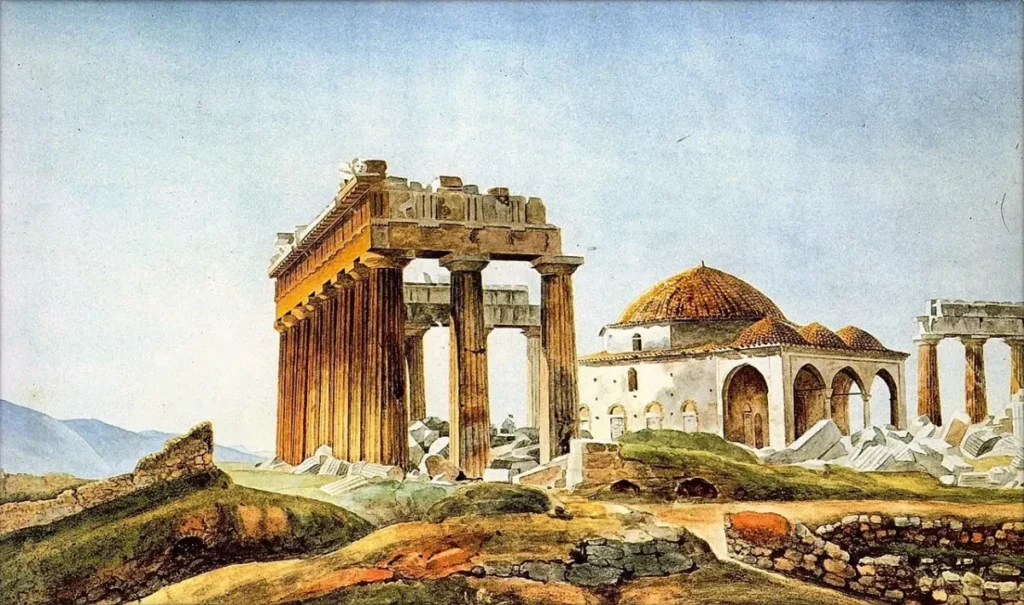
The Ottoman mosque built within the ruined Parthenon after 1715. Source: Pierre Peytier
For nearly a thousand years, the Parthenon functioned as a temple to Athena. Priests performed sacrifices at the altar outside. Citizens celebrated the Panathenaic festival every summer. The building housed the city treasury and stored the gold reserve embedded in Athena’s statue.
When Christianity became the Roman Empire’s official religion in the 4th century CE, pagan temples faced systematic closure and destruction. The Parthenon survived by transforming. In the 6th century CE, it became a Christian church dedicated to the Virgin Mary (Panagia Atheniotissa). The conversion required removing pagan statuary, adding an apse at the eastern end, and covering interior walls with Christian frescoes. But the basic structure remained intact.
For 900 years, Byzantine Christians worshipped where ancient Greeks had honored Athena. The building remained sacred, which meant it remained maintained and protected.
When Ottoman Turks conquered Athens in 1458, they converted the Parthenon into a mosque. A minaret was added at the southwest corner. Islamic prayers replaced Christian liturgy. But again, the building’s religious function protected its structure. Sacred buildings get maintained. Abandoned ruins get looted for building materials.
By 1687, the Parthenon had survived 2,139 years essentially intact. All 46 columns stood. The roof remained complete. The sculptural decoration, though somewhat damaged, was largely in place. It was, arguably, the best-preserved major temple from Classical antiquity.
The Morean War pitted Venice against the Ottoman Empire for control of southern Greece. By September 1687, Venetian forces under Francesco Morosini had conquered much of the Peloponnese and marched north to Athens. The Ottoman garrison retreated to the Acropolis and fortified the ancient citadel.
The Ottomans made a catastrophic decision: they stored their gunpowder and ammunition inside the Parthenon. Perhaps they believed the Venetians wouldn’t dare fire on such a historically significant building. Perhaps they calculated that the thick marble walls provided the best protection. Whatever their reasoning, they packed the temple with gunpowder and housed Turkish civilians inside as well.
Morosini positioned his artillery on the Hill of Philopappus southwest of the Acropolis and began bombarding the fortress on September 23. For three days, mortar shells and cannonballs struck the Acropolis. Most hit the western side of the Parthenon, which faced the Venetian batteries. The ancient marble held firm.
Then, on the evening of September 26, one Venetian mortar shell crashed through the temple’s roof and ignited the gunpowder magazine.
The explosion was catastrophic. It blew out the temple’s entire central section. The roof disintegrated. The cella walls crumbled. Twenty-eight columns toppled, bringing down the massive marble architraves and frieze they supported. Much of Phidias’s sculptural work shattered. Marble fragments were hurled hundreds of meters in all directions, killing Turkish defenders and starting fires throughout the lower city.
About 300 people died in the explosion. Athens burned for two days.
Morosini later called it a “fortunate shot” because it killed so many defenders and allowed the Venetians to capture the Acropolis. But historians consider it one of the greatest cultural catastrophes in European history. In seconds, artillery destroyed what 2,000 years of earthquakes, fires, and wars had failed to damage significantly.
The Venetians occupied Athens for less than a year. When a large Ottoman force approached in 1688, they abandoned the city. Before leaving, Morosini attempted to remove sculptures from the Parthenon’s western pediment as war trophies. The statues crashed to the ground during removal, smashing into fragments.
The Ottomans returned and built a small mosque inside the ruined temple. For the next 140 years, the Parthenon stood as a shattered shell, its central section open to the sky, columns toppled, friezes broken. Locals quarried its marble for building materials. Visitors drew romantic sketches of the picturesque ruins.
The Elgin Marbles Controversy
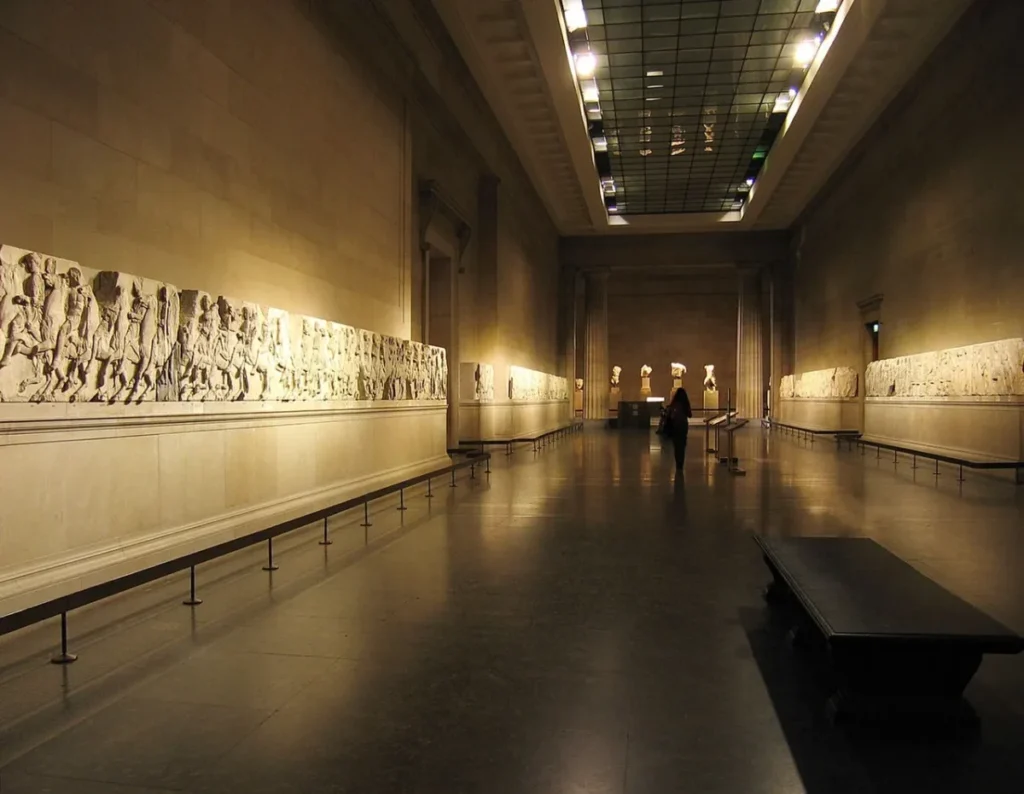
The Elgin Marbles gallery in the British Museum, where Parthenon sculptures have been displayed since the 19th century. Source: Wikimedia Commons
In 1801, Thomas Bruce, 7th Earl of Elgin, was British Ambassador to the Ottoman Empire. He obtained permission (he claimed) from Ottoman authorities to remove sculptures from the Parthenon. Between 1801 and 1805, Elgin’s agents removed approximately half of the surviving sculptural decoration: 75 meters of the Ionic frieze, 15 metopes, and 17 pediment figures.
The sculptures were shipped to England, survived a shipwreck en route, and eventually sold to the British Museum in 1816 for £35,000. They remain there today, displayed as the “Elgin Marbles” or “Parthenon Marbles.”
The removal has been controversial since it occurred. Critics accused Elgin of vandalism and theft. Byron called him a plunderer. Greek governments have demanded the sculptures’ return since independence in 1832. The British Museum argues the sculptures were legally acquired and are better preserved in London than they would be in Athens.
The debate continues today, with Greece maintaining that the marbles are stolen cultural heritage and Britain insisting they were legally purchased. About half the Parthenon’s surviving sculpture remains in London. Most of the rest is in the Acropolis Museum in Athens. Scattered pieces reside in museums across Europe.
What Stands Today
After Greek independence in 1833, the Parthenon became an archaeological monument. The small Ottoman mosque inside was demolished. Restoration efforts began, though early attempts often caused as much damage as they repaired. This happened frequently during early archaeology, especially in the Ancient Agora of Athens.
Serious, scientifically informed restoration started in 1975 under the direction of Greek archaeologist Manolis Korres and continues today. The project faces extraordinary challenges: replacing deteriorated iron clamps with titanium, correcting mistakes from earlier restorations, and determining which scattered fragments belong where.
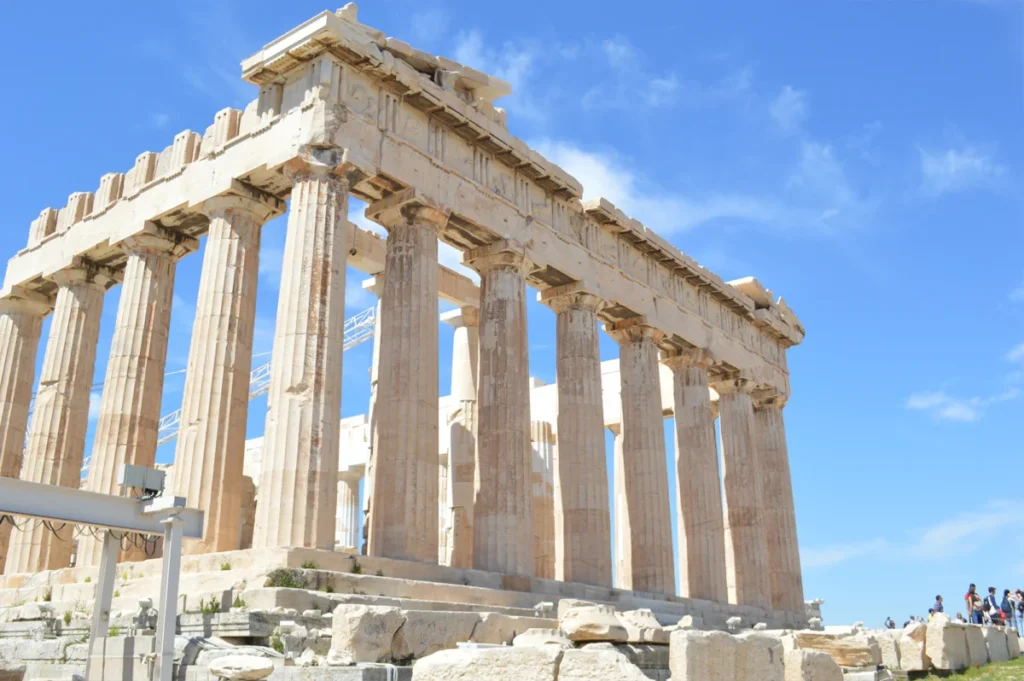
The Parthenon today shows the scars of its history. The southern colonnade, which bore the brunt of the 1687 explosion, has obvious gaps where columns once stood. The northern colonnade is more complete. The western façade remains largely intact, giving the clearest impression of the original design. The eastern end shows both ancient grandeur and modern restoration work.
Restoration is ongoing and will continue for years. Cranes and scaffolding are semi-permanent fixtures. But even in its damaged, partially reconstructed state, the Parthenon dominates the Acropolis skyline. The honey-colored Pentelic marble glows at sunset. The architectural refinements (subtle curves, leaning columns, carefully calculated proportions) remain visible to trained observers.
The building’s footprint measures exactly what it did in 432 BCE. The platform shows the original upward curve. Where columns stand, they stand in their ancient positions. The damage is obvious, but so is the achievement.
The Parthenon’s Meaning
The Parthenon was never just a temple. It served multiple functions: treasury for the Delian League, symbol of Athenian imperial power, architectural showpiece demonstrating Greek technical mastery, and monument to victory over Persia.
The building represented Athens at its peak. Pericles used tribute from subject cities to fund construction, turning imperial domination into architectural glory. The sculptural program celebrated Greek victory and civilization. The scale and richness proclaimed Athens’s status as the greatest power in the Aegean.
Critics at the time accused Pericles of dressing Athens up “like a vain woman” with stolen money. Thucydides recorded that Sparta and other Greek cities resented Athenian appropriation of Delian League funds for Athenian monuments. The Parthenon was beautiful, but it was also controversial, a product of imperialism as much as artistic vision.
The explosion in 1687 robbed us of the chance to see the Parthenon as the ancient Athenians saw it: complete, painted in bright colors (traces of original pigment have been found), with all its sculpture in place and the colossal Athena gleaming inside.
What remains is still extraordinary. The temple’s proportions, its refinements, its sheer presence on the Acropolis hill continue to demonstrate why Classical Greek architecture became the foundation for Western architectural tradition. The Parthenon established principles (clarity, proportion, harmonious relationship between parts and whole) that architects have referenced for 2,400 years.
The damage doesn’t diminish the achievement. If anything, it makes the original accomplishment more poignant. For 2,000 years, this building stood virtually perfect, a testament to Greek skill and ambition. One artillery shell in 1687 destroyed what centuries couldn’t damage.
But the Parthenon still stands. Damaged, incomplete, wrapped in scaffolding, but standing. The columns that survived the explosion remain where Greek masons set them 2,400 years ago. The marble still glows honey-gold at sunset. The optical refinements still work their subtle magic.
The Parthenon was built to last forever. It hasn’t, quite. But it has lasted long enough to remain what Pericles intended: proof that Athens once stood at the center of the world, and that human ambition, skill, and resources applied with vision could create something approaching perfection.
Creator of Spoken Past. With formal training in Ancient History at Macquarie University and experience at institutions including the British Museum, I write to make the ancient world understandable and accessible.
Creator of Spoken Past. With formal training in Ancient History at Macquarie University and experience at institutions including the British Museum, I write to make the ancient world understandable and accessible.