Table of Contents
Cosmic Beginnings and the Prophecy of Overthrow
The story of Zeus begins before his birth, inside a cosmos stratified by ancient powers and patterns of succession. First came Chaos, the gaping space that allowed things to exist and to be named. From Chaos arose Gaia, the broad Earth, who made a home for all that followed. Gaia brought forth Ouranos, the Sky, who covered her, and together they generated the Titans, the Cyclopes, and the Hecatoncheires. The Titans were vast figures anchored to elemental and temporal realities, like Oceanus who wrapped the earth, Hyperion who shone with celestial brightness, and Kronos who came to embody cutting and boundary making. The Cyclopes were craftsmen of thunder and lightning, and the Hecatoncheires were the Hundred Handers, beings of impossible force who could hurl stones in terrifying volleys.
Ouranos, fearful of his children, pressed them into Gaia, denying them light and breath. Gaia suffered and devised a plan. She fashioned a sickle and urged her sons to act. Kronos, the youngest Titan, obeyed, striking his father and separating sky from earth. That cut made time and distance, and it created the space into which Zeus would later step. From the blood of the wound came Furies and Giants, and from what fell into the sea came Aphrodite. Kronos then ruled in Ouranos’s place, yet he quickly imitated the paranoia of his father. He learned of a prophecy that a son of his would overthrow him. To block that fate, he swallowed each child as Rhea bore them, burying voice and promise in the darkness of his stomach: Hestia first, then Demeter, Hera, Hades, and Poseidon. The palace of the Titans grew silent, since the laughter and cries of infants no longer reached the hall.
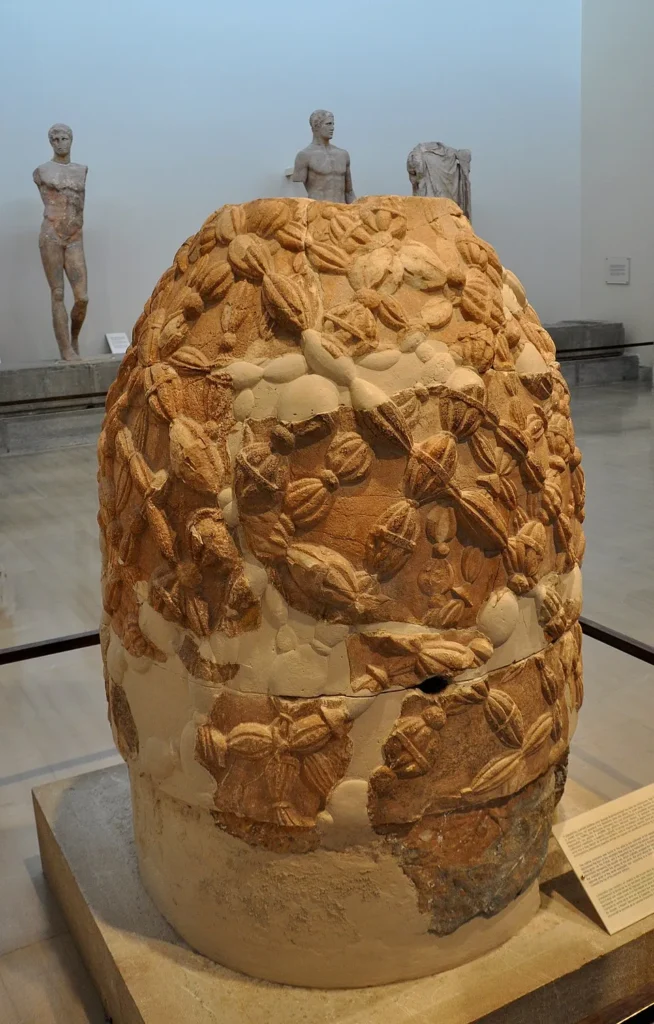
Rhea, weary of loss and angered by the stolen future, resolved to save her next child. She sought Gaia for counsel. Together they planned a concealment that depended on quick hands and louder noise. When the time came, Rhea gave birth in secret to a son on the island of Crete, and she named him Zeus. She swaddled a stone to mimic the weight and shape of a baby, and she gave that decoy to Kronos. He swallowed it as he had the others, believing he had shut fate’s mouth for good. On Crete, Rhea hid the newborn in a cave sacred to the mountain. There the Kouretes, armored dancers, clashed their spears on their shields to mask the sound of his crying. Nymphs nursed him on honey and milk. Adrasteia and Ida reared him, while the goat Amaltheia gave him strength from her udder. From her he received another gift, since one day he would fashion a shield from her hide.
Birth and Concealment on Crete
Zeus’s infancy is always associated with concealment and speed. The cave on Crete appears with different names, yet the pattern is clear: a mountain hollow becomes a secret cradle, armed attendants drown out sound, and divine nurses provide miraculous nourishment. The child grows quickly. The Kouretes, often represented as young men in armor who leap as they dance, show how noise and ritual can protect life. In some versions, they are the sons of Rhea, in others they belong to the Cretan landscape itself. The point is that Zeus receives a homeland and a local cult origin, which later poets and storytellers could point to when they praised his order over chaos.
The Stone that Marked a New Era
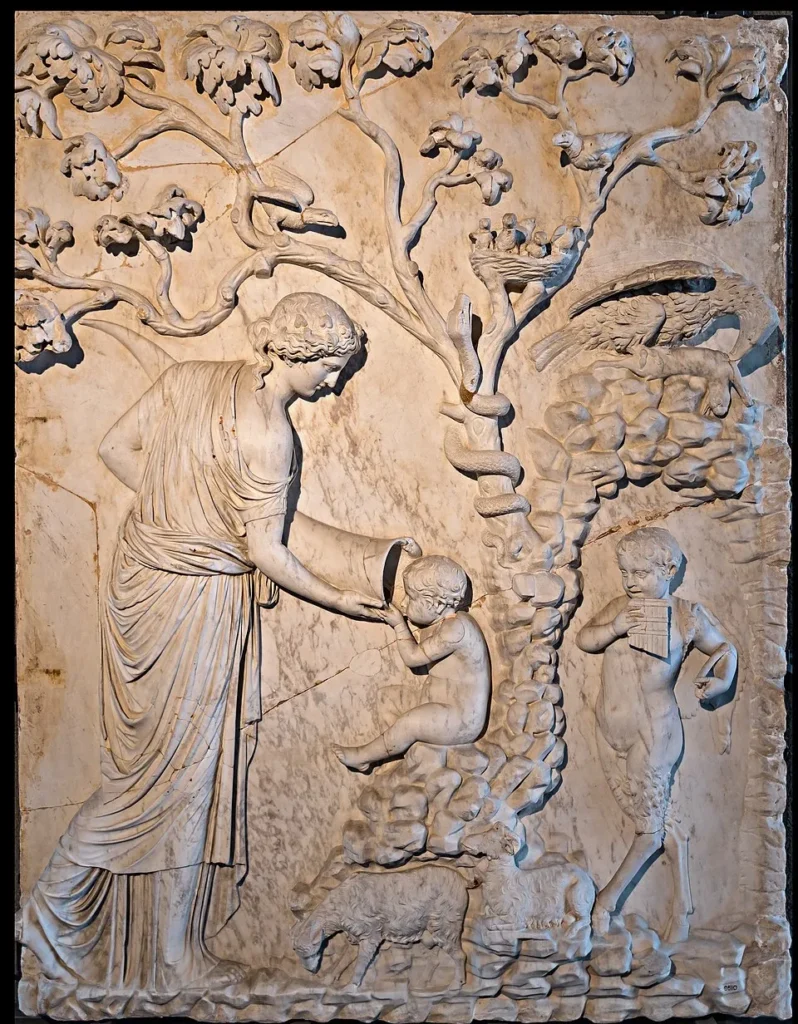
Kronos’s swallowing of the stone matters because that object remains a visible token of the deception. Later tellings place the stone at Delphi, where people could see and touch the proof of Rhea’s trick. The object becomes more than a prop in a story, since it bears the memory of a turning in the world. In narratives that echo one another, material anchors like this stone let listeners picture fate becoming history.
The Hidden Youth and the Gathering of Allies
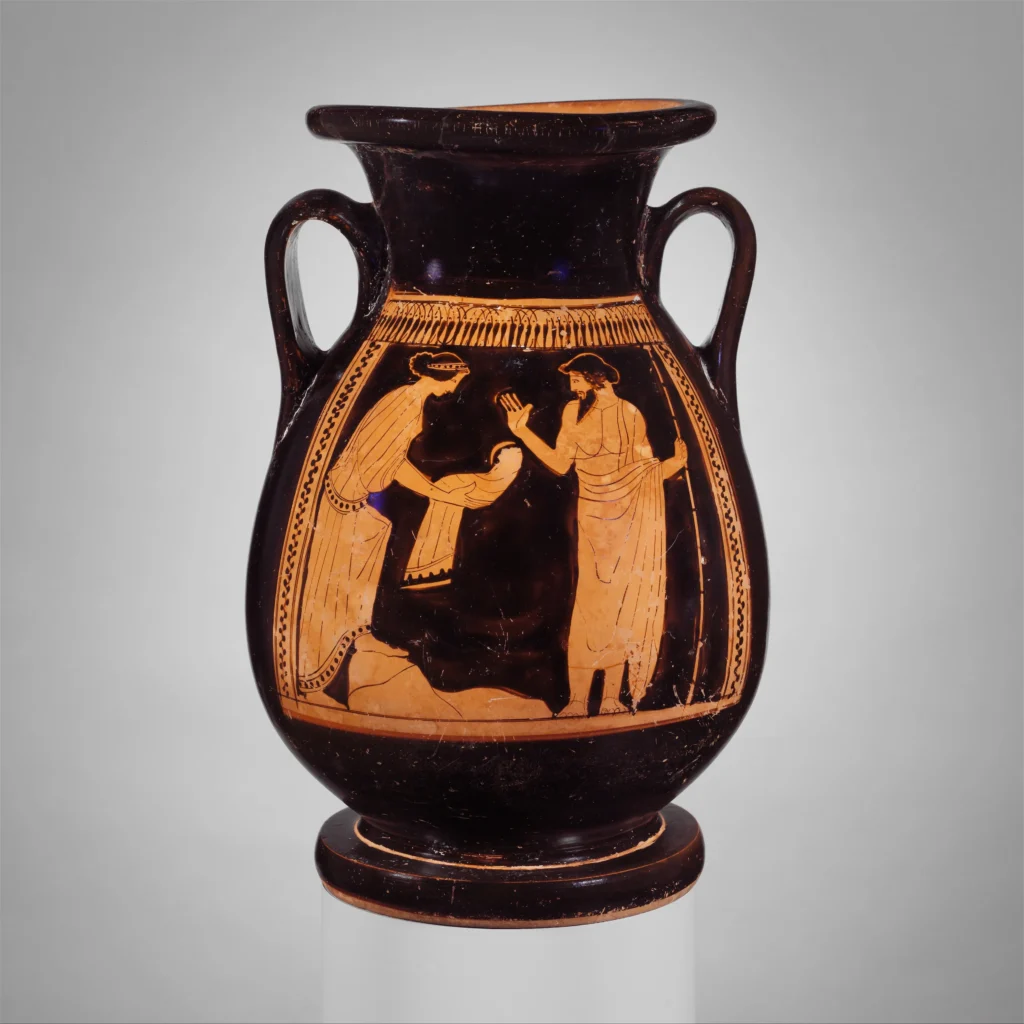
Zeus grows in secret until he is ready to act. He learns caution and patience from his childhood in hiding. He also learns gratitude to those who sheltered him, a theme that will color his later treatment of allies and enemies. When he comes of age, he returns to confront his father. There are several versions of how he forces Kronos to release his swallowed children. In one, the goddess Metis, daughter of Oceanus, prepares a draught that loosens Kronos’s gut. The Titan vomits out the stone and then his children, who emerge fully alive and ready to join their brother. In another version, Zeus strikes Kronos, and the blow compels disgorgement. Either way, liberation follows.
The Reborn Siblings and the Division of Purpose
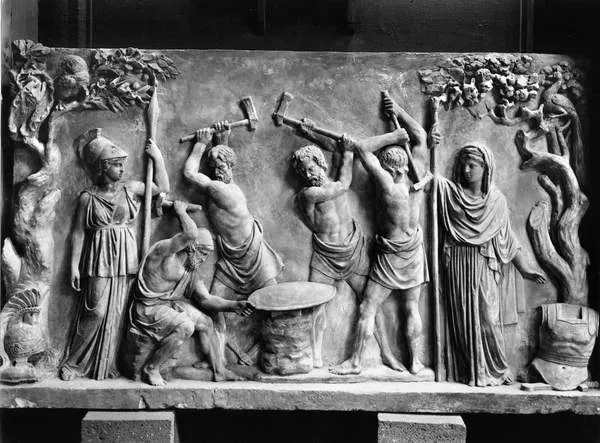
Once freed, Hestia, Demeter, Hera, Hades, and Poseidon stand with Zeus. The family reassembles, though not yet as rulers. They must still win a war. Before they can fight the Titans, Zeus seeks two sets of allies whom Ouranos and Kronos had mistreated. He releases the Cyclopes from their bondage. These one-eyed smiths, humiliated and shut away by earlier tyrannies, now become the armory of Zeus. They forge for him the thunderbolt, a bolt of blinding fire that is at once weapon and signature. They give Hades a helm that confers invisibility, a dark gift that turns absence into power. They give Poseidon the trident, a sea spear that shakes the waters. Zeus also frees the Hecatoncheires, towering sons with a hundred hands and fifty heads who had been forced underground. Their loyalty becomes decisive, since their stone barrages can turn the tide of any siege.
Metis and the First Act of Prudence
Metis’s role matters. She personifies cunning and wise counsel, a kind of sharp intelligence that works alongside brute force. Zeus trusts her advice in the crisis, which already marks a difference between him and Kronos. The new king in waiting seeks counsel before he strikes. Metis will return later in the story, when Zeus must secure his rule against the same pattern of overthrow that had consumed the generations before him.
The Titanomachy: Ten Years of Siege and Skyfire
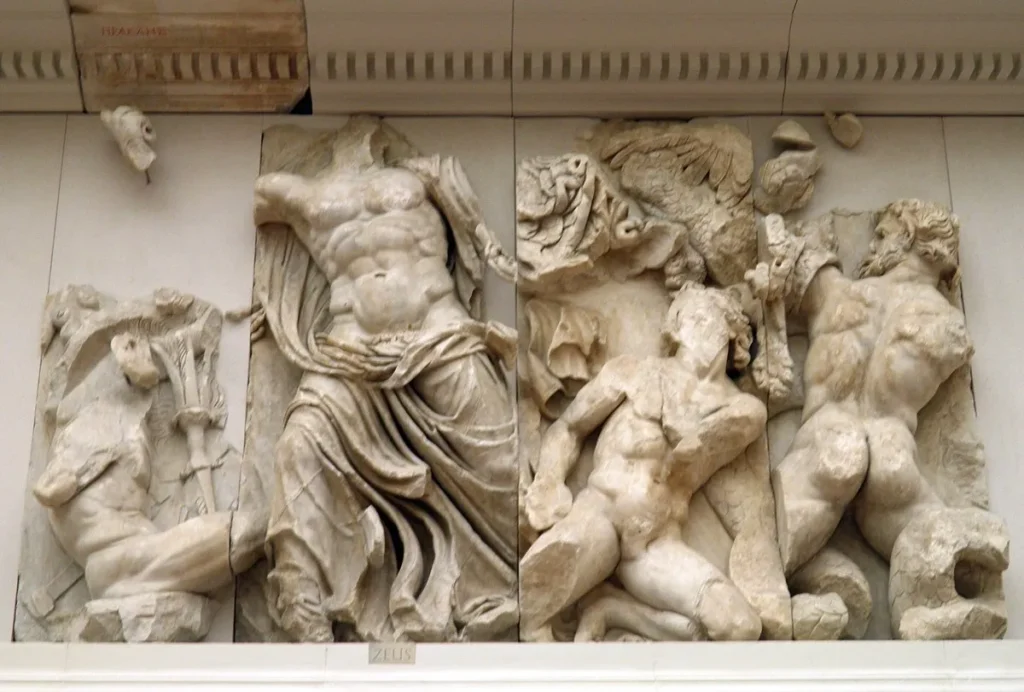
The war known as the Titanomachy pits the Olympians against the Titans who remain loyal to Kronos. The battlefield occupies the whole cosmos. Mountains serve as battlements. Rivers rage. The air becomes a theater of sound and light. A ten-year stalemate follows, the mark of a war larger than any mortal conflict, until Zeus turns the balance by deploying the allies he rescued.
Zeus hurls the thunderbolt that splits clouds and scorches stone. Poseidon shakes the earth until shorelines fracture. Hades moves unseen to strike where least expected. The Hecatoncheires hurl boulders in unending storms, and the Cyclopes forge more weapons, the echoes of their hammers ringing like omens. The Titans respond with mass and endurance, holding high ground and forcing the Olympians to pay for every advance. The war’s duration shows that transformation at this scale does not come cheaply. Even beings that embody elements must fight to bend the pattern of succession.
In the end, Zeus prevails. The Titans are thrown into Tartarus, the pit that lies below the underworld, a place of boundary and distance so stark that even gods feel it as exile. The Hecatoncheires become the wardens of that prison, chains for the unchained. The Cyclopes return to their craft, now honored as makers for a legitimate king.
The New Division of the World
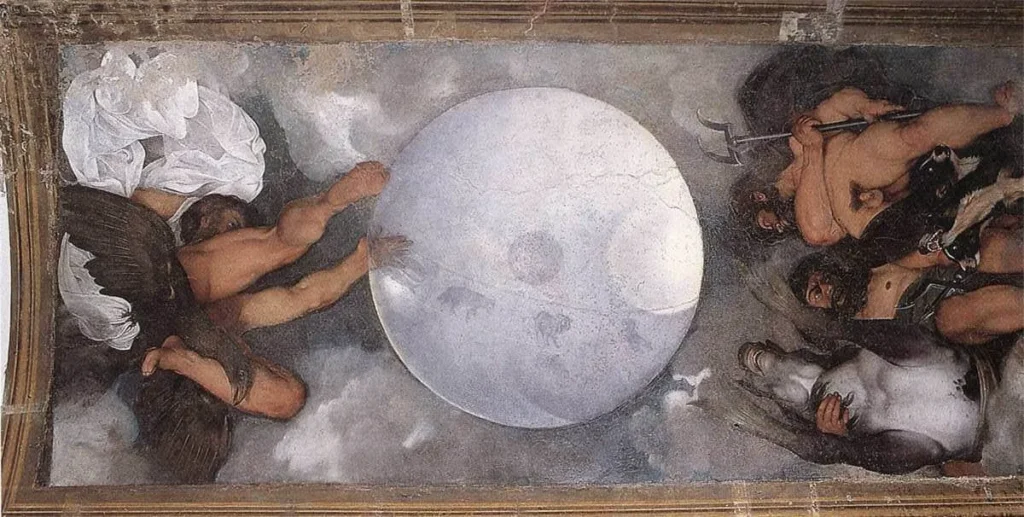
After victory, the brothers divide the realms by lot to avoid rivalry. Zeus receives the open air and sky, the space of clouds and lightning where he can see and be seen. Poseidon takes the sea, the floorless blue and the storms that rise from it. Hades takes the world below, the realm of the dead where shadow rules. Earth and Olympus remain common to all, shared ground for the family. The division serves justice and balance. Zeus does not seize everything. Instead, he enacts a distribution that becomes a pattern for the world’s order.
Zeus begins rule not as a conqueror without limits but as a king who must constantly adjust balance among powers that never fully disappear. Oceanus still encircles the earth. Night still wraps the sky. The Fates still measure out the thread of life. Zeus’s authority works inside these structures. Part of his greatness is that he accepts that framework and then rules effectively within it.
Early Tests: Giants on the March and the Monster Typhon
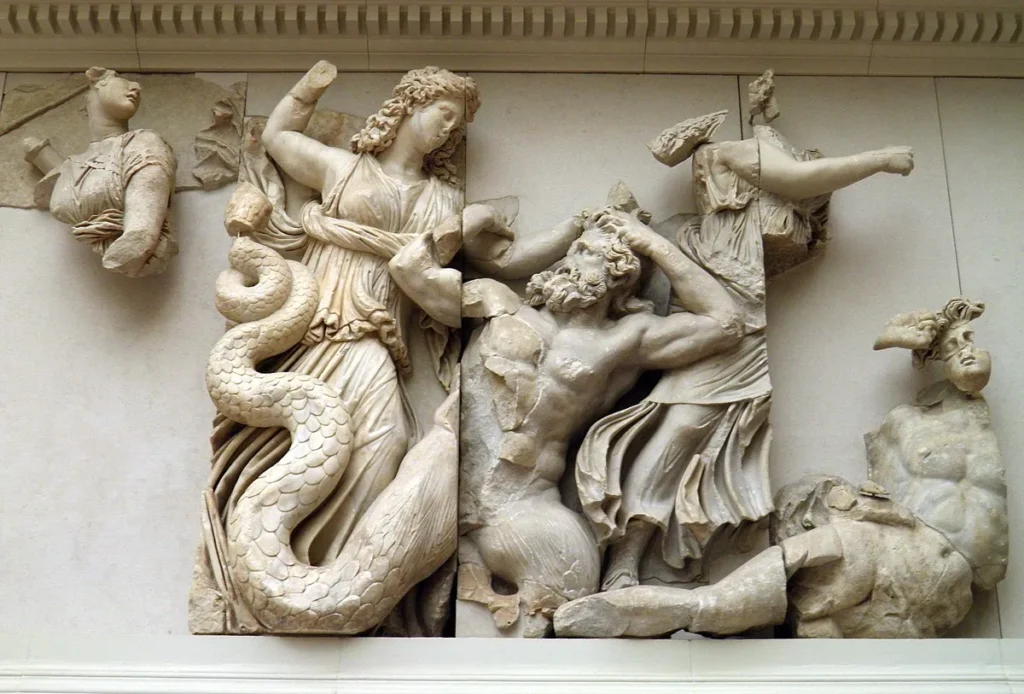
Victory does not end opposition. Power invites challenge, and the world itself still holds seeds of rebellion. Giants rise from the blood of Ouranos that once fell on Gaia. The Gigantomachy, the battle with the Giants, breaks out when they try to storm the new order. The Giants are elemental strength without lawful shape. They throw rocks and uprooted trees, their feet digging into volcanic slopes and coastal flats. Zeus stands at the center of the defense, hurling thunderbolts that burn through their ranks. In many tellings, a prophecy states that the Giants cannot be defeated without the aid of a mortal hero. Heracles, destined to be the son of Zeus, fills that role and tips the balance with his bow. Zeus’s leadership again hinges on allies and on fulfillment of prophecy, not on brute force alone.
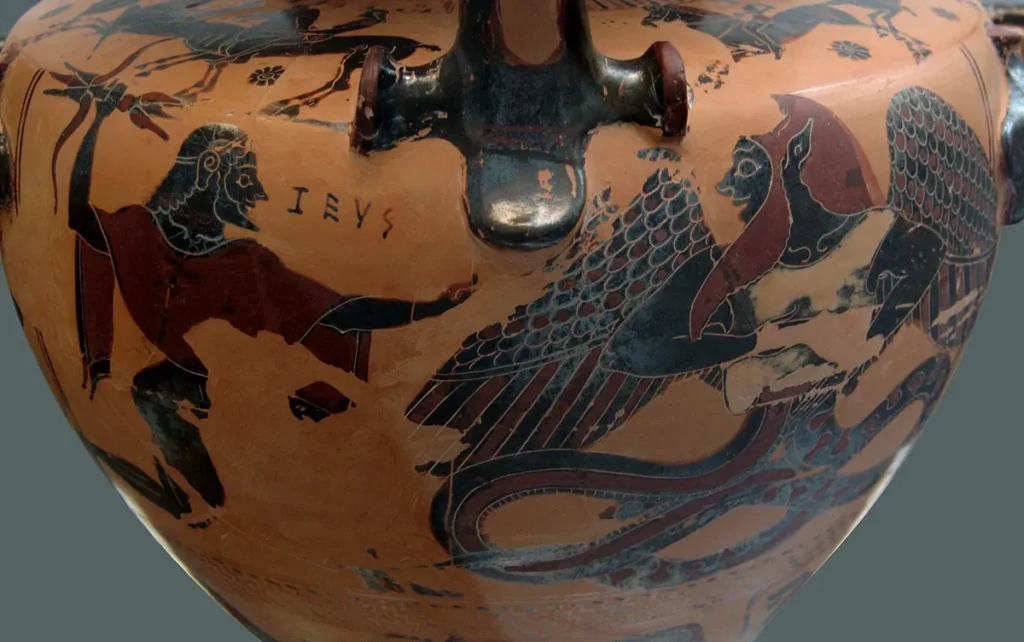
Typhon emerges as the most extreme test. This monstrous being, child of Gaia with the deep, embodies storm and eruption with monstrous scale. He rises against Zeus, and the fight spills across the Mediterranean world. Typhon’s hundred heads spit fire and sound, and his body threatens to pull the sky down. Zeus meets him with lightning and eventually crushes him under a mountain. Different locales claim the resting place of Typhon. The volcanic breathing of certain peaks becomes a sign that the monster remains trapped. Zeus defeats chaos not by healing it but by confining it under weight and sanction.
The Olympian Court: Order, Oaths, and the Signs of Justice
With the wars of establishment behind him, Zeus builds a court that shapes the conduct of gods and humans. He becomes the guardian of oaths, the one who sees perjury and punishes it. He hears petitions under the epithet Zeus Xenios, protector of guests and strangers, an ideal of hospitality that structures the conduct of hosts. He watches assemblies as Zeus Agoraeus, concerned with civic order and public speech. He cares for supplicants who clasp altars and beg for refuge. He blesses just kings who protect their people and rule without cruelty. He knows the thoughts of gods and men, and he reveals his will in signs.
Thunder, Eagles, and Omens
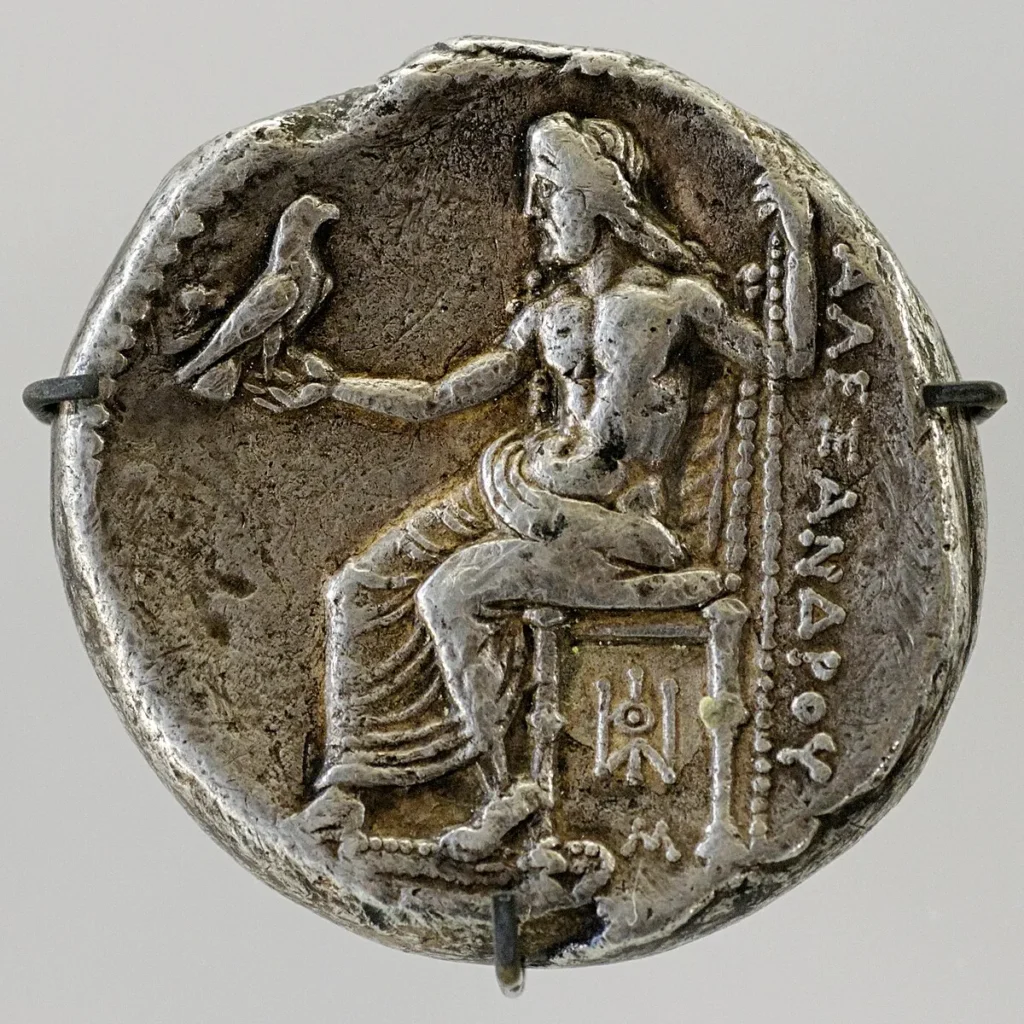
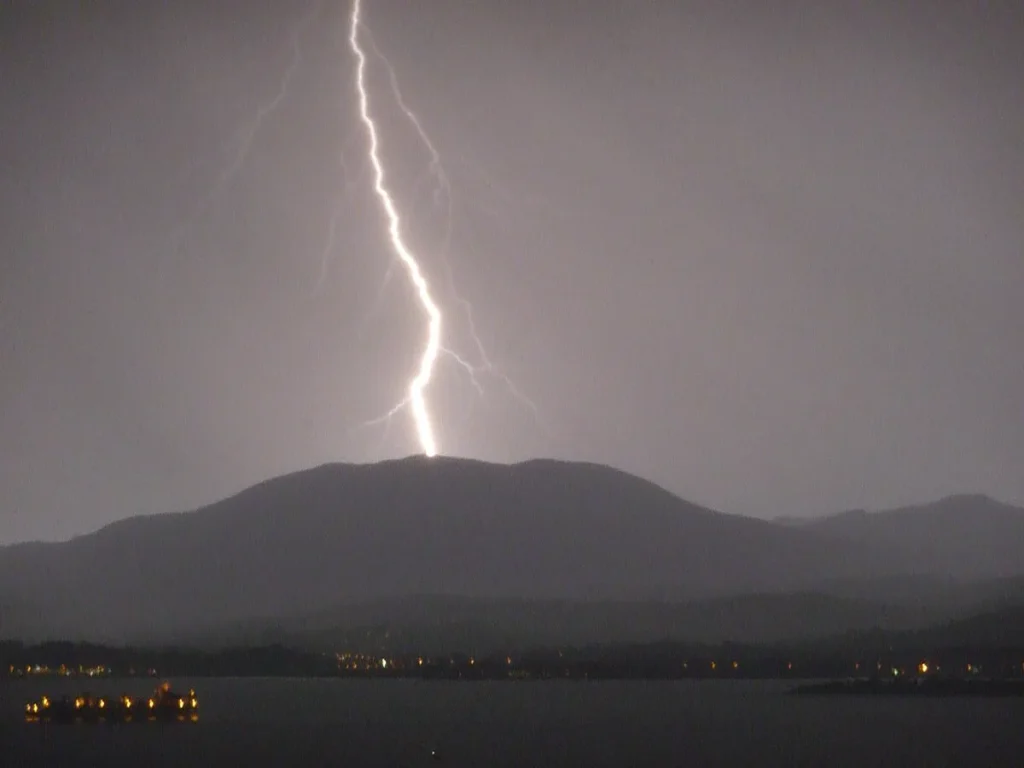
Zeus sends omens. Thunder is not merely noise, it is speech that must be interpreted. Lightning becomes a line drawn from sky to earth. Sometimes an eagle appears, and that bird shows favor or direction. When Zeus sends a sign, mortals argue about its meaning, which shows that communication between gods and humans always carries risk. Zeus’s authority relies on being seen, yet it also requires interpreters who can misread. Stories take care to show exactly where lightning strikes or where an eagle flies, since the details carry the message.
The Scales and the Limits of Intervention
A recurring image presents Zeus weighing fates in a scale. The pans rise and fall, telling which side will die or live. His will appears bound to these measures, which implies that he is often not capricious. When he does intervene, he tends to keep the pattern rather than rip it open. He may delay a death to let a hero finish a task, or he may shift wins and losses to reward piety. Yet he rarely overturns the entire balance. Fate and Zeus align more often than they collide. This restraint builds his moral authority, since justice is best seen when consistent and predictable.
Marriage to Hera and the Politics of the Family
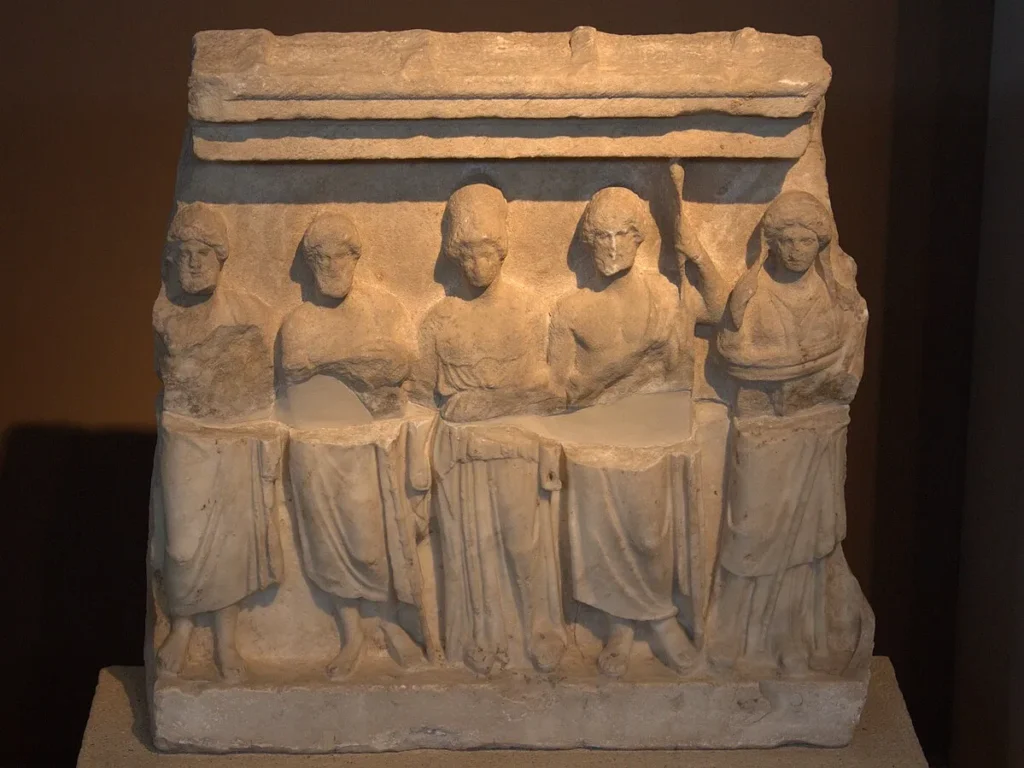
Zeus’s marriage to Hera begins in love and culminates in complicated patterns of rule. Hera is queen of the gods, watchful over marriage and the inviolability of the household. Their union sets a standard for divine respect, yet it also creates friction when Zeus’s desire leads him elsewhere. The marriage becomes a theater for questions about authority, loyalty, and honor among beings who do not age and cannot be forced to die. Hera’s dignity and her quick anger appear again and again, and so does Zeus’s power to reconcile or to punish.
Courtship and Ceremony
One version of the courtship takes place on a mountain ridge. Zeus creates a warm rain out of season, then he appears to Hera as a bedraggled cuckoo. Hera feels pity for the shivering bird and gathers it under her cloak. Zeus resumes his form and asks for her hand. The tenderness of the rain and the animal disguise hint at Zeus’s ability to soften a proud heart without brute force. Their wedding gathers all the gods. Gifts and feasts secure alliances. The marriage turns Zeus’s rule into a household with two thrones, and that image shapes later scenes in which they sit together to judge.
The Struggle Over Samos, Argos, and Thebes
Hera’s spheres of honor include places known for their devotion to her. Samos holds her with high ceremony. Argos praises her with processions. Thebes loves her for reasons bound to royal imagination. These local devotions matter in the stories, since they explain Hera’s attention and the intensity of her anger when she feels slighted. When Zeus’s adventures bring him into contact with heroines and queens from those landscapes, Hera’s reaction carries more than personal betrayal. It carries the outrage of a queen whose patrimony in honor is being challenged.
Children of Zeus: Order, Wisdom, Craft, and Strife
Zeus’s children represent expansions of his power in focused forms. Some are born from union, others from his own mind, and still others appear as strange outcomes of transformation. The births of Athena and Hephaestus, the Muses and the Graces, Ares and Hebe, Persephone from Demeter, and many others set the stage for a pantheon in which Zeus’s rule gains depth.
Metis, the Swallowed Counsel, and the Birth of Athena
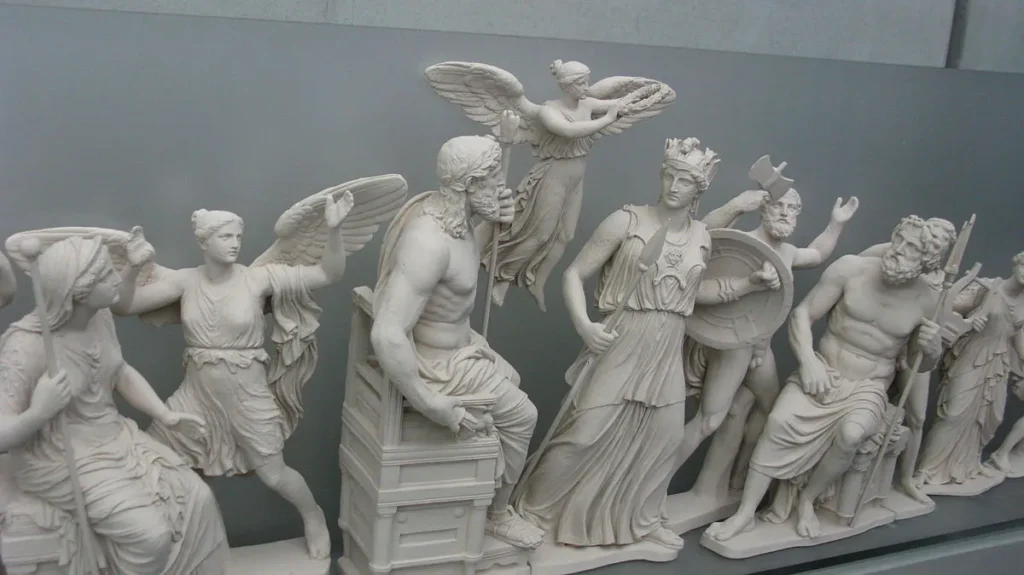
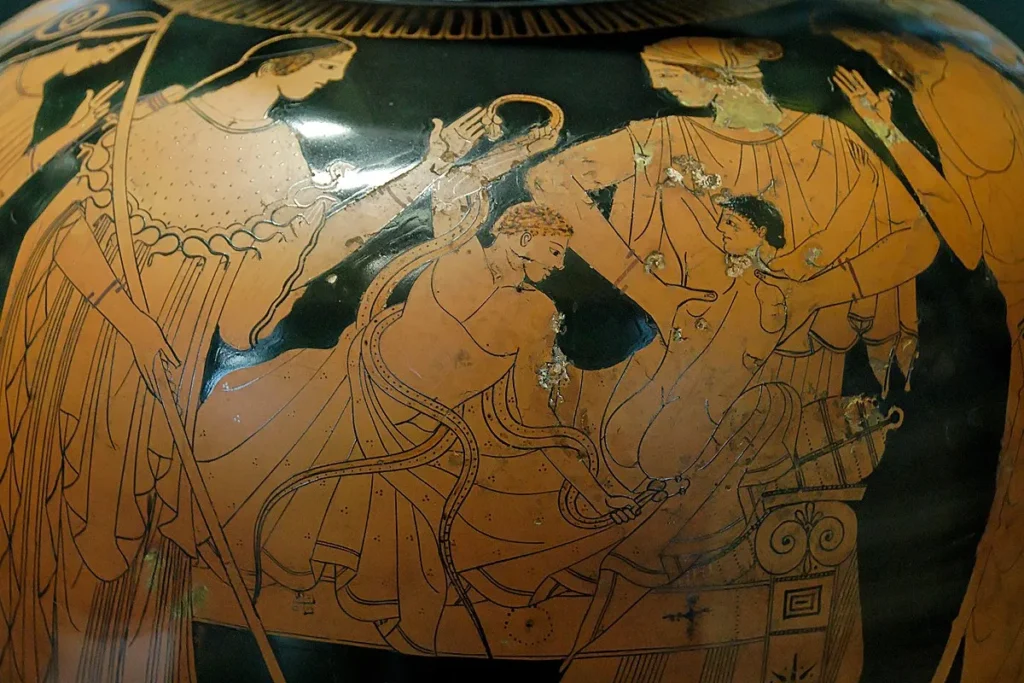
A prophecy warns Zeus that if Metis bears a son, that child would overthrow him. Remembering the pattern that consumed Ouranos and Kronos, Zeus makes a sharp choice. He swallows Metis while she still carries a child, hoping to internalize counsel and neutralize threat. Later, Zeus suffers a fierce headache. Hephaestus, in some tellings, splits Zeus’s head with an ax, and from the opening emerges Athena, armed and clothed with the shimmer of wisdom and warcraft. She is born from both Metis and Zeus, a figure who merges practical intelligence with royal sanction. She becomes goddess of cities, strategy, and artful making. The birth is not merely a marvel. It is a solution to the succession problem that avoids the cruelty of Kronos and the impotence of Ouranos. Zeus transforms danger into an ally.
Hera’s Children and the Balance of Power
Hera bears Ares, Hebe, and Eileithyia. Ares embodies the raw fury of battle, a counterpart to Athena’s disciplined strategy. Hebe keeps youth in the cup, the grace of fresh years that offsets the world’s decay. Eileithyia watches births, the moment of first breath. Hera may also bear Hephaestus alone, depending on the version. Hephaestus crafts weapons and palaces, and he turns fire into art. Zeus’s house gains structure through these figures. When they clash, as Ares and Athena often do, the conflict serves the drama of the world without overturning its pillars.
The Muses and the Graces
With Mnemosyne, Zeus fathers the nine Muses, patrons of song and memory. With Eurynome, he sires the Graces, who spread charm and the social delight that turns duty into pleasure. The court needs this brightness, since rule that lacks beauty becomes brittle. Zeus fosters the arts not for distraction but for harmony in the ways people live together.
Justice Against Pride: Prometheus and the Origin of Sacrifice
Zeus confronts Prometheus, a Titan who favors humanity and uses cunning to alter divine and human exchange. At a feast meant to establish the rules of sacrifice, Prometheus arranges two piles from one ox. He covers the bones with white fat and the good meat with unappealing offal. He then asks Zeus to choose a portion. Zeus, seeing the glittering fat, selects that pile. He thereby fixes a pattern in which gods receive the smoke and bones while humans keep the edible meat. It is a trick, yet not without logic, since gods do not eat as mortals do. The insult, however, is apparent.
Prometheus then steals fire in a fennel stalk and gives it to humanity. Zeus punishes him by binding him to a rock where an eagle eats his liver by day and the wound heals by night. The cycle repeats until a later hero, Heracles, kills the eagle. Zeus’s justice here is severe, yet it produces a law of offerings that sets the foundation of ritual. He also balances punishment with future mercy, since Prometheus eventually gains release. The lesson that runs through the tale is that cleverness without respect damages the order, while respectful craft strengthens it.
The First Woman and the Burden of Unopened Gifts
As part of the same cycle, Zeus commissions the making of the first woman, Pandora. Hephaestus makes her body, Athena teaches her skill, Aphrodite gives her charm, and Hermes puts in her a persuasive voice. She carries a jar filled with ills and hopes. When she opens the lid, troubles spread across the world. Hope stays behind. Zeus’s intent differs depending on the telling, yet in each version the world becomes more mixed. Men must work and suffer, and they must trust to hope. Zeus accepts a world of labor and risk, not a garden free of pain. The point is not to curse humanity, it is to make human life serious. Offerings and prayers matter more because life can go wrong.
The Meaning of Sacrifice and Prayer
Under Zeus’s reign, sacrifice and prayer become the bridges that connect mortals to the gods. Smoke rises, words shape intention, and a bond forms between earthly and heavenly communities. Zeus cares that rites be done with the right mind. He sees whether a gift comes from arrogance or gratitude. He punishes empty boasting, and he honors faithful promises. The stories of Prometheus and Pandora become background for why human beings must honor Zeus before meals, voyages, or war.
The Flood of Deucalion and the Renewal of Human Order
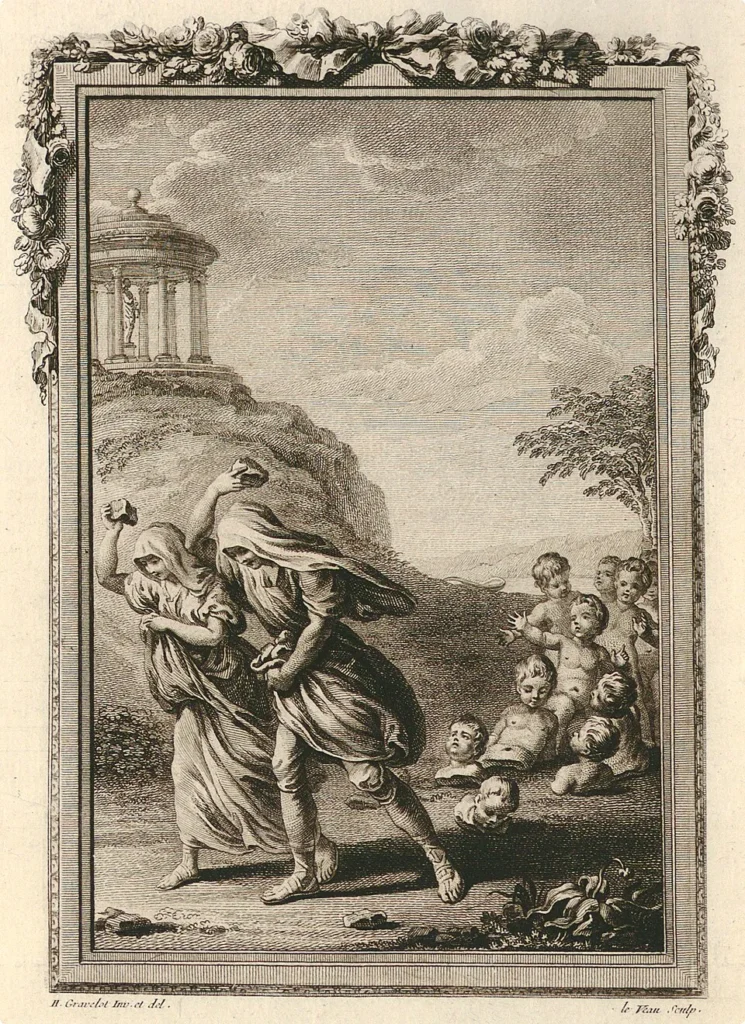
When the generations of mortals grow violent and impious, Zeus considers whether to end them. He chooses a flood to wash away their wrongs. Only Deucalion and Pyrrha find favor because they honor the gods and live justly. Zeus sends rain, and the waters rise over hills. Deucalion and Pyrrha navigate the flood in a chest. When the waters recede, they ask how to repopulate the world without committing further sin. An oracle tells them to throw the bones of their mother behind them. They interpret this as stones from Gaia, mother of all. The stones Deucalion throws become men, and those Pyrrha throws become women. The world receives a gentler restart that depends on obedience to riddling counsel, not on brute propagation.
Zeus’s flood differs from simple destruction. He preserves a remnant and restores human life through an act of piety. He establishes trembling caution in the memory of survivors. The stories that follow often include a renewed emphasis on oath keeping and hospitality, which suggests that Zeus used the flood to reassert moral order.
Transgressions and Punishments: Sisyphus, Tantalus, and Aegis-bearing Fear
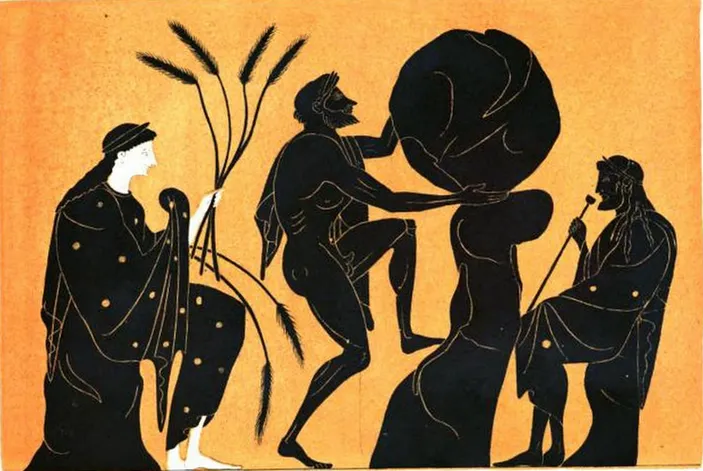
Zeus’s justice extends into the underworld. Those who cleverly evade death or mock the gods receive particular punishments. Sisyphus tricks Thanatos and chains Death, which causes chaos. Zeus restores order and condemns Sisyphus to roll a stone forever uphill. Tantalus serves his own child as food to the gods, a crime that ruptures hospitality at the root. He is made to stand in water that recedes when he bends to drink, while fruit recedes when he reaches to eat. These punishments take the shape of each crime and continue without end, so that the gravity of affronts against divine order becomes clear.
Aegis, the fearful emblem that Zeus carries, often appears in scenes where terrors scatter enemies. Sometimes Athena bears it in battle. The aegis crackles with a fright that breaks ranks. Zeus’s justice does not only consist in later punishments in the underworld. It also shows itself in panic sent upon armies that defy sacred boundaries.
Transformations and Unions: The Web of Lineage Across the World
Zeus’s unions, whether with goddesses or mortals, knit a world of lineages that bind cities and regions to Olympus. These relationships can be painful and contested, especially when Hera turns her attention on the women involved. Yet the children who result often become kings, queens, lawgivers, or heroes whose deeds secure the new order. Zeus’s presence in their stories is not occasional. It is foundational. He appears to women in varied forms, sometimes to protect them from danger, sometimes to bypass suspicion, and sometimes to satisfy desire with disguise.
Europa and the Bull that Crossed the Sea
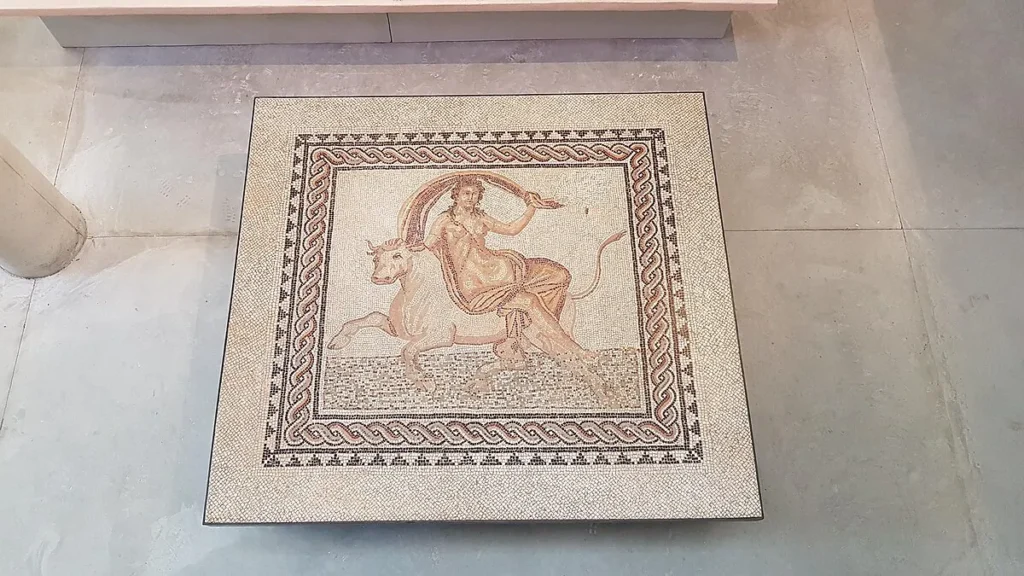
Europa plays with companions on a beach when a gentle bull approaches. The bull is Zeus in change of form. She climbs onto his back, and he carries her across the sea to an island where she will bear sons who found kingdoms and civilize shores. The sea crossing marks a transfer of royal favor. The gentleness of the bull offsets the fear of the sea. Zeus’s power appears as both charm and strength.
Io and the Long Journey of a Woman Turned Cow
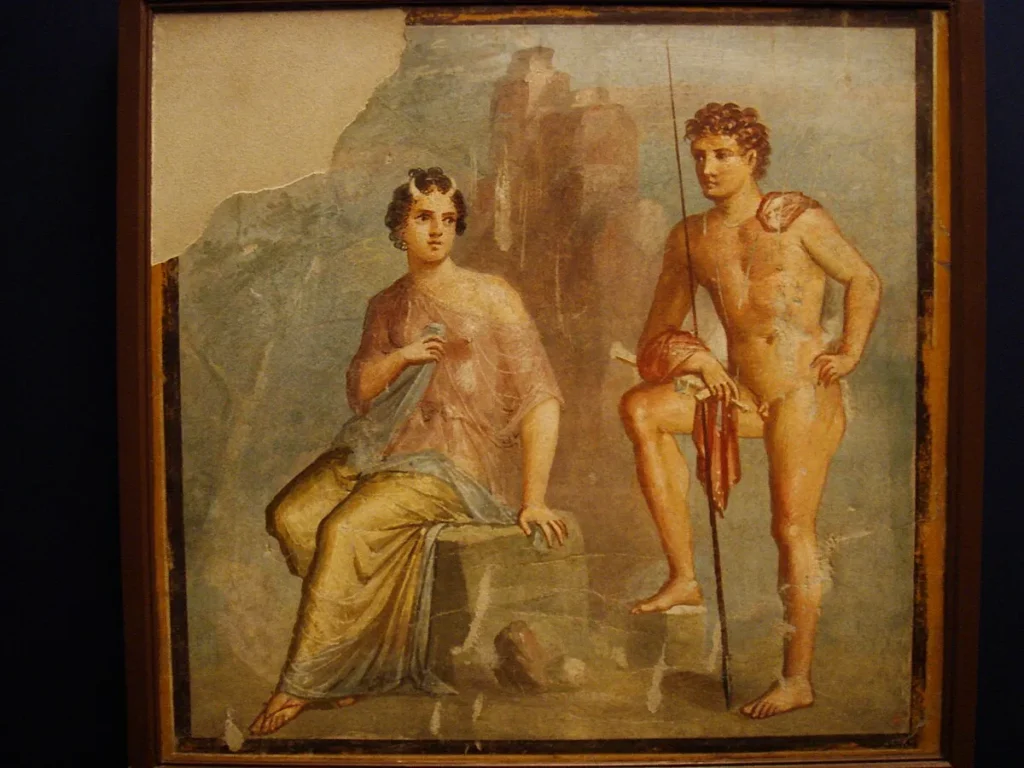
Io, a maiden watched by Hera, draws Zeus’s attention. To hide her, he transforms her into a heifer. Hera suspects and asks for the heifer as a gift. She sets Argus with many eyes to guard the animal. Zeus sends Hermes to free Io, and Hermes kills Argus. Hera then sends a gadfly that torments Io through a long wandering. The story concentrates the pain and danger of transformation. Zeus’s capacity to help seems sometimes delayed by the need to outmaneuver Hera. Eventually, Io returns to human form and becomes an ancestor in lines that matter in the world’s later stories. The path she walks plants place names and memories along coasts and rivers.
Leda and the Swan, Danae in the Shower of Gold
When Zeus approaches Leda as a swan, the tale emphasizes beauty and speed on a riverbank, a seizure of desire that results in children who will shape events far away. When he approaches Danae in a shower of gold, the form is less like seduction and more like an unstoppable visitation. Danae bears Perseus, the hero who will cut off the head of a monster and rescue a queen. Each union extends the net of Zeus’s interest in mortal affairs. Heroes become instruments of rebalancing when monsters or tyrants threaten communities.
Toward the Care of Heroes: The Pattern of Patronage and Trial
Zeus’s care for heroes will become a major feature of the remaining stories. He tests the strength of men by granting tasks that refine them, and he keeps the paths of fate clear so that each person receives what he or she has earned. He can be severe. He can also be strangely tender. He watches when a mother begs for a son’s safety, and he listens when a father calls down a curse. He keeps to the weight of the scales yet finds ways to honor piety inside that weight.
The Seed of Heracles and the Promise of Righted Balance
The man who will do most to clear the world of monsters is Heracles, son of Zeus by Alcmene, a woman of Thebes. The story of his conception contains the familiar elements of cunning and disguise. Zeus makes himself appear as Alcmene’s husband and extends a night into a long span of hours. From that union comes Heracles, whose name publicly honors Hera’s glory. The irony is deliberate but not mocking. Heracles’s labors will cleanse the world, and his final fate will make him kin to the gods. Hera’s anger will nearly wipe him out as a child, yet Zeus will make sure that enough remains intact for the plan to hold.
The infant Heracles chokes serpents sent to kill him. The image becomes a miniature of his life. He strangles threats and sets households free from terrors they had learned to live with. Zeus’s role looks less direct here. He does not hurl thunder. He places a seed where it will grow into strength that helps mortals. Heracles’s labors will cross the world, and along the way he will free Prometheus, which will retroactively soften Zeus’s earlier severity.
The King Who Sees: Assemblies, Temples, and Daily Piety
Zeus’s presence in daily life can be captured in a single scene. A farmer stands by his field and looks up at a sky that may bring rain or hail. A judge considers a case and raises his hand to call Zeus as witness. A host receives a stranger and sets meat and bread on a table, fearful and delighted that a god might be watching. A traveler prays at a wayside altar and pours out a little wine. Zeus inhabits these moments. He animates the rules that keep communities from dissolving into theft and greed. He fights the battles that no army can win alone, like famine and plague, and he tries to keep people from thinking that they can become gods by force.
The Sanctity of the Suppliant and the Rugged Grace of Mercy
When a person in danger touches an altar and begs for protection, the law of Zeus triggers. Even a guilty person can place a hand on a stone and call for a chance to speak. The suppliant might still face punishment, yet he must receive a hearing. Zeus checks rage so that judgments can proceed without blood haze. The stories show kings who respect this law and kings who do not. The former prosper. The latter fall from their thrones.
The Mystery of Divine Jealousy
Jealousy in Zeus is not petty possessiveness. It is guarded honor for the boundaries that hold the world together. When he burns a hall because men have eaten what belongs to the gods, he is not hungry for meat. He is hungry for justice. When he blasts a liar who swore falsely by his name, he is not protecting a vanity. He is protecting the glue that keeps promises from dissolving.
The Trojan Threads: Early Promises and the Gathering of Fates
The long war at Troy will later display Zeus’s impartiality and also his sorrow. He supports balance more than sides. He tries to ensure that fate unfolds as measured. At times he permits a favorite to fall because the scales demand it. At times he delays a death because honor requires a fuller display of courage. Before the final drama, scattered stories show Zeus already engaged in the prelude: he fathered Minos who shaped law that echoes through myth, he watched over Dardanian lines that would feed into the city’s kings, and he kept the sea from breaking the world’s ships at whim.
The Judgment that Backfired and the Seeds of Destruction
The quarrel of goddesses before the Trojan War touches Zeus, since he prefers not to be the judge in that beauty contest. He sends the decision to a mortal, a choice that keeps him above the direct cause of the war. The god who sends omens can also refuse to take the bait when a decision would turn into endless grievance. His distance here suggests that a king sometimes preserves peace by declining to choose where no peace exists.
Mortal Kings Under Zeus: The Models of Justice and Failure
Zeus’s favor does not always track lineage. He can love a mortal king for his justice and then withdraw it when the king turns proud. Rhadamanthys and Minos show two sides. Rhadamanthys judges fairly and is later imagined as a just soul beneath the earth. Minos, son of Zeus and Europa, receives the right to rule and the skill to make law. When he defies divine order in a particular case, his household suffers monstrous consequences. Zeus’s rule over kings teaches that authority is heavier than it appears. It also teaches that honoring the gods in public festivals is not the same as remembering them in private choices.
The Hospitality Code and the Stranger in Disguise
In more than one tale, Zeus and Hermes walk the earth as travelers. They ask for lodging and test whether people will welcome them. Often a poor couple, not a wealthy lord, offers bread and a bed. Zeus rewards such households with protection and long life. He sometimes sends disaster on proud towns that shut their doors. The code here is not about lavish feasts. It is about a willingness to share what one has with a stranger. Zeus Xenios enforces this law because it keeps roads safe and hearts open.
The Rituals that Sustain Peace
Zeus’s festivals are moments where communities renew their ties with the god. Athletes run and wrestle before his altar. Judges swear oaths to keep contests fair. The smoke of sacrifice rises in columns, and the smell of meat blends with laurel and pine. These ceremonies tie cities together. They also remind warriors that fame means nothing without honor before the god who weighs fates. Zeus delights in spectacle when it celebrates the good that binds people together. He despises pageantry that masks injustice.
The Pattern of Zeus’s Appearances: Distance, Nearness, and Shape
Zeus rarely stands in a doorway in his full radiance. He more often appears in a shape that meets the moment. A shepherd sees a traveler who knows the weather. A queen sees a bird who trembles and needs shelter. A maiden sees a golden glimmer that rides light into a locked chamber. The shape suits the purpose. Zeus’s power is both thunder and whisper. He can break a tower with fire and he can place a child in a womb with a soft touch. This flexibility reveals his mastery. A god who can only roar is not king. A god who can speak across types of encounter holds the throne.
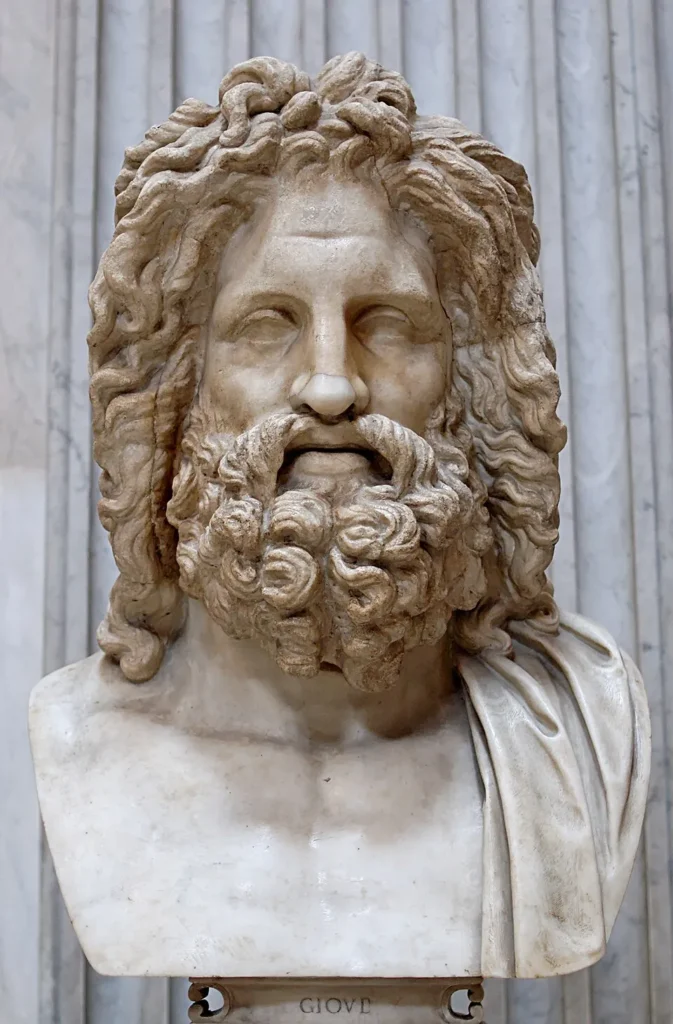
Built out of a love for history, kept free from distractions.
Spoken Past is an independent project shaped by curiosity, care, and long hours of research. Reader support helps keep it maintained, carefully researched, and open to everyone.
Athena’s Cities, Ares’s Fields, and the Tension That Feeds Courage
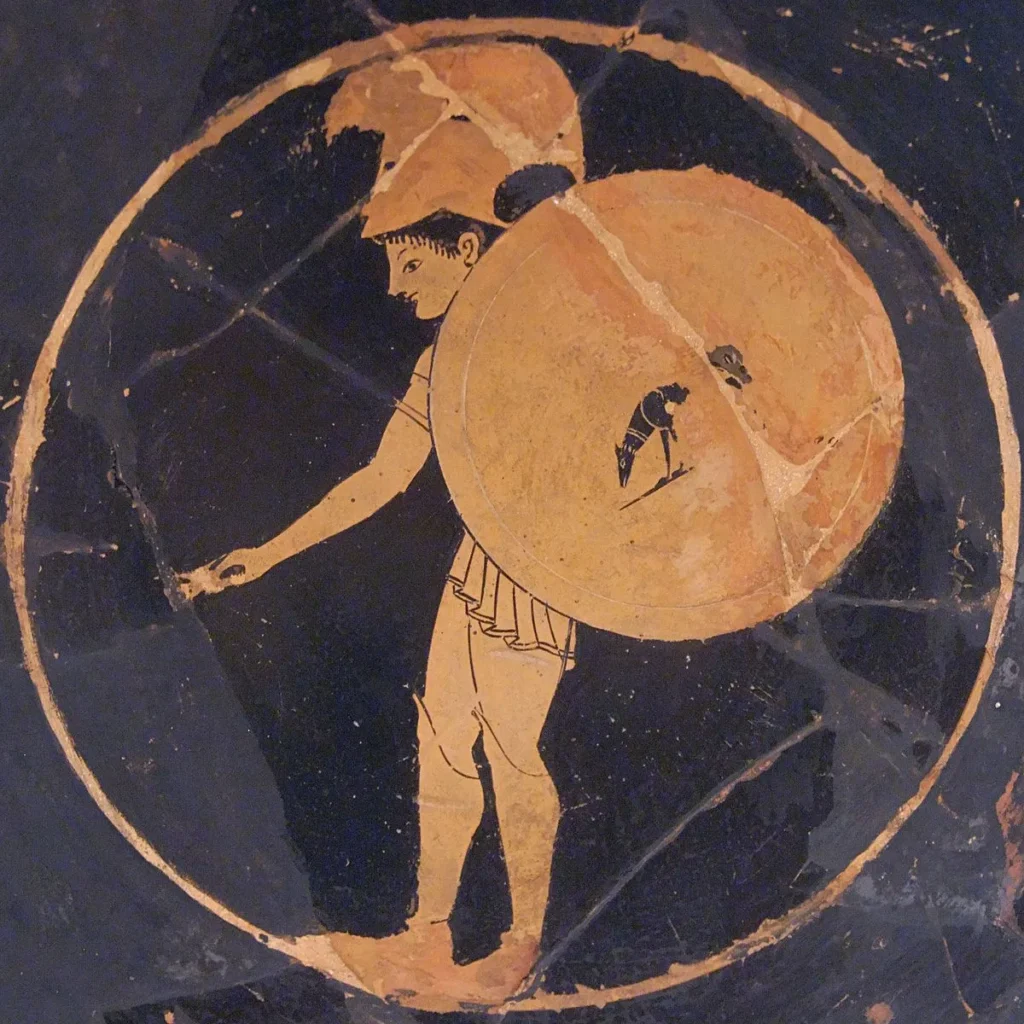
Athena and Ares represent two faces of war, both under Zeus’s jurisdiction. Athena’s cities rise in strength through discipline and counsel. Ares’s fields drink blood when rage takes control. Zeus does not abolish war. He governs its terms. He blesses defense of the weak. He frowns on plunder done for its own sake. He separates noble ferocity from blinding cruelty by granting victory to those who fight for order. The balance is never perfect in stories. Heroes stumble. Kings overreach. Yet Zeus keeps returning battle to some kind of measure.
The Shield and the Sign
When a commander prays to Zeus before battle, he often asks not for effortless victory but for signs that the chosen path aligns with justice. Lightning on the right side or a sudden flight of birds can settle doubt. The shield that bears the aegis shivers lines when viewed in the sun. The sign and the weapon work together. Zeus’s involvement is therefore personal and symbolic. He enters the field through morale as well as through storm.
The Limits of Power: Sarpedon and the Pain of Necessary Loss
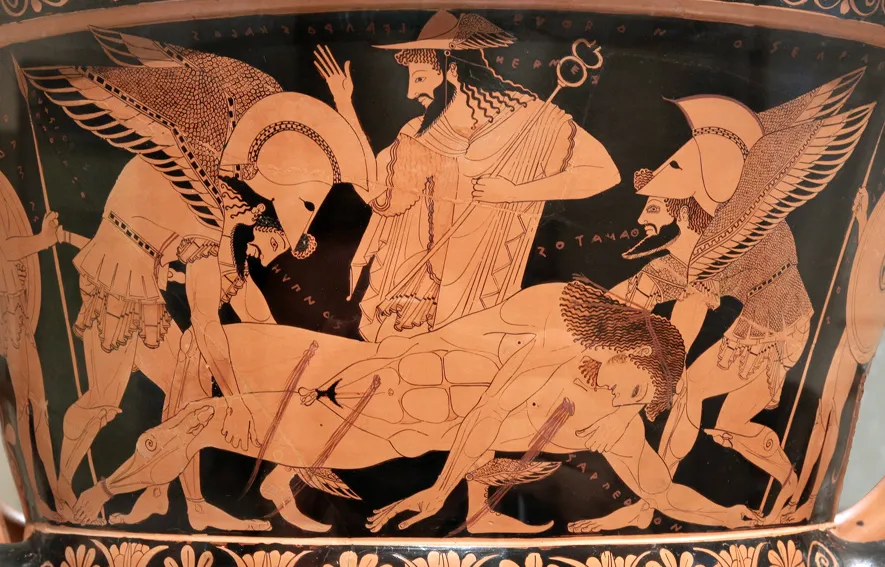
Zeus’s heart is not made of stone. He loves his children. When a beloved son must die because the scales of fate demand it, Zeus feels grief. He debates whether to rescue the son by force and set aside the pattern. He decides not to violate the measure. Instead, he honors the fallen with careful rites. He sends sleep and death to carry the body away gently. He transfers glory to the lineage that receives the corpse. The king of gods weeps where he cannot intercede. The scene reveals that maintaining order costs even Zeus something. Mercy and justice meet not in indulgence, but in a kind of sorrowing fidelity to law.
The Boundaries of Desire: Semele and the Blaze of Unveiled Glory
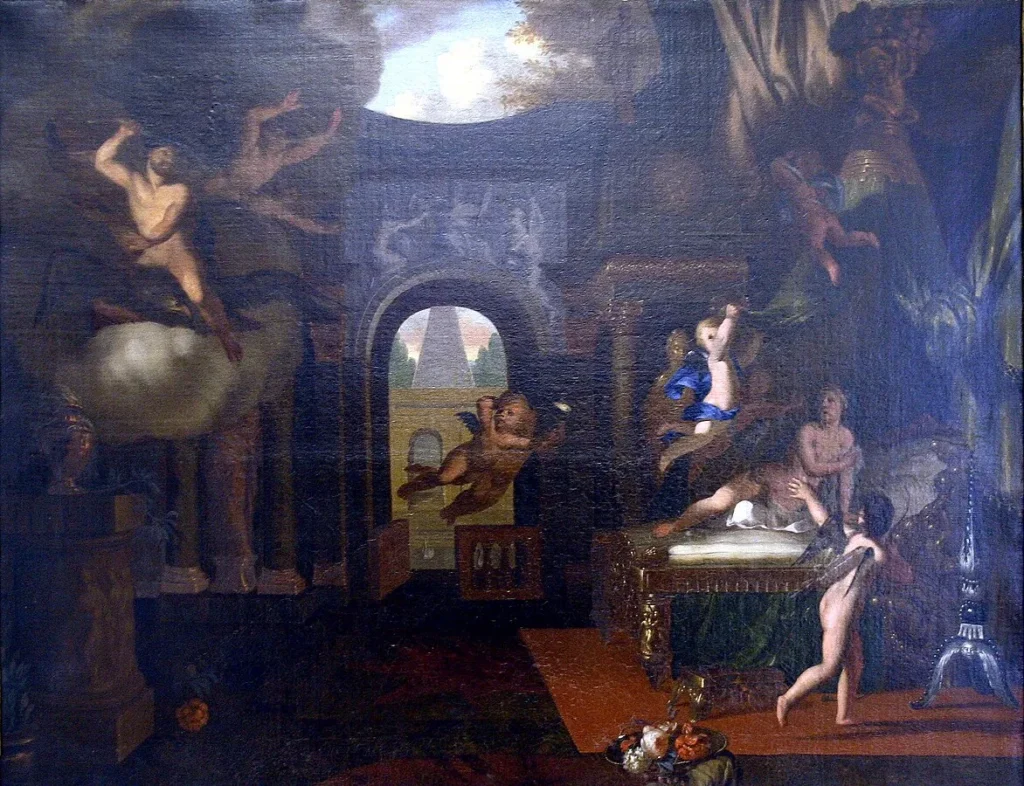
Semele, a princess, becomes beloved of Zeus. Hera deceives her into demanding that Zeus reveal himself in his full splendor. He swore an oath to grant whatever she asked. Bound by his promise, he comes in lightning and fire. The sight destroys her. Yet he rescues the child she carries by sewing the infant into his thigh until the time is right. The child, Dionysus, emerges and will later bring joy and confusion in equal measure. The story teaches that Zeus’s glory is not safe at close range. He gives signs scaled to mortal senses for a reason. He upholds oaths even when the cost is terrible, and he finds a way to preserve a life inside disaster.
Toward the Weaving of a Universal Household
As Zeus’s reign matures, the stories emphasize how households, cities, and kingdoms find their place under his sky. The god of thunder becomes also the god of steady rain for crops. The lord of the aegis becomes the witness of a poor man’s vow. The husband of Hera becomes the judge who hears a queen’s complaint. The father of Athena and Apollo, Ares and Artemis, Hermes and Dionysus, becomes the one who prevents the family from tearing itself apart. The next movements of the tale will follow the heroes whose lives sharpen and clarify Zeus’s justice, above all the labors of Heracles and the winding tragedies and triumphs around Troy. Through those narratives, Zeus’s character will not change so much as it will be tested in public and in private, at the edge of the world and at a hearth where a stranger asks for bread.
The King’s Speech in Thunder and in Dreams
Zeus speaks through thunder and through dreams. When a king lies down on a troubled night and receives a clear instruction, that message often bears Zeus’s authorization. Sometimes a dream deceives, allowed as part of a larger plan. Sometimes it encourages, sealed with a phrase that cannot be misunderstood. The difference between true and false messages in sleep mirrors the difficulty of seeing through storms in the day. Zeus remains the one who knows, while mortals attempt to interpret.
The Measure of a True Oath
When a person swears by the river or by the sky, Zeus hears. The god of the sky becomes the guardian of lids and boundaries. He hates perjury because it pulls the hinges off the doors of trust. In stories, perjurers often suffer sudden, instructive disasters. A floor collapses beneath their feet. A lightning strike destroys their barn. People notice that the payback fits the crime. Zeus’s justice tends to be particular and poetic.
Looking Ahead: Heroes, Wars, and the Last Quiet
Nothing in Zeus’s rule happens only once. Giants can rumble again in earthquakes. Typhon can breathe in mountain smoke. Floods can return when greed becomes a flood in hearts. Yet the balance usually holds because the god continually renews it. The next chapter of the story will follow how he shapes the lives of individual heroes. It will show how he supervises a long war that draws in gods as spectators and combatants. It will trace how he ends cycles of monstrous threat so that ordinary people can plant vines and build houses where song survives. The scenes will be human sized. A mother will hold her child while a storm rolls in. A sailor will call on the sky when a sudden squall darkens the sea. A judge will look up at a carved thunderbolt and think twice before accepting a bribe. Through all of it, Zeus’s timeline stretches like a bright band across the vault that no one can pry loose.

Heracles Under Zeus’s Eye: Conception, Peril, and the Making of a World-Cleanser
Heracles stands as the most concentrated expression of Zeus’s long plan to stabilize the world. His life begins in Thebes when Zeus approaches Alcmene in the form of her husband, Amphitryon, and stretches the night so that conception aligns with favor. Hera’s anger follows at once. She sends serpents into the nursery, and the infant strangles them, an omen that later labors will tighten the world’s slack places.
The Naming that Honors a Rival and the Logic of Trials
The child’s name honors Hera’s glory, a deliberate paradox that acknowledges her power and the public nature of the conflict. Zeus does not hide the cost of his designs. He accepts that attracting Hera’s attention invites a test. When Heracles later falls into madness and must atone, Zeus allows the sentence of labors to stand because purgation through service fits the scale of the man’s strength. The labors clear swamps, hunt monsters, and humble tyrants. Each task reduces a lingering chaos.
The Nemean Lion and the Lesson of Invulnerable Hide
The first labor sends Heracles against a lion with skin that resists iron and fire. He chokes it and then wears its hide. The story elevates craft within force, since he skins the beast with its own claw. Zeus’s design prefers victory that teaches method. A king who learns how to turn an enemy’s feature into a tool becomes harder to overthrow.
The Hydra, the Stables, and the Bow That Reaches Distant Threats
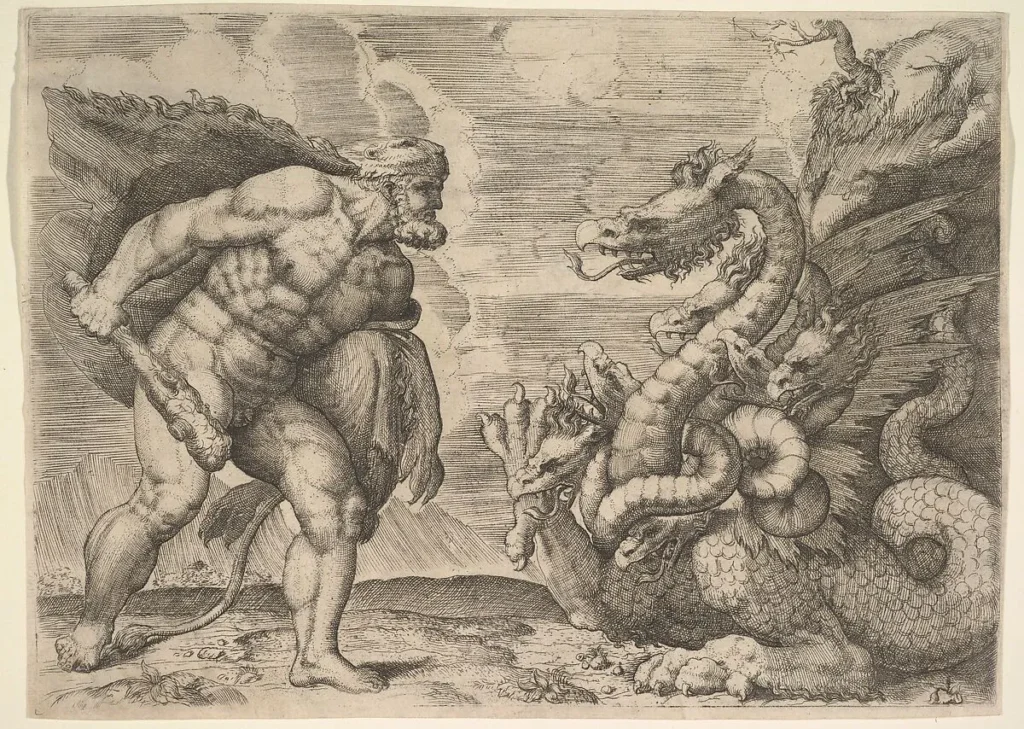
The Lernaean Hydra teaches cooperation, since Iolaus cauterizes necks as they are cut. Cleaning the Augean Stables by diverting rivers shows that power can realign nature to moral ends. The Stymphalian birds that fall to arrows mark the shift from close wrestling to ranged precision. Zeus does not micromanage; he permits a mortal to learn through escalating tasks that even a god would find instructive.
The Golden Hind, the Boar, and the Limit of Sacred Boundaries
The hind sacred to Artemis forces Heracles to respect divine property while still meeting his quota. He asks permission or returns the animal after display, a ritual of deference within conquest. The Erymanthian boar’s capture turns violence into spectacle, since the living monster demonstrates the hero’s control. Zeus’s law embraces theater when it instructs rather than inflames.
The Cattle, the Apples, and the Weight of the Sky
The cattle of Geryon require a far march guarded by Helios’s heat. Stealing the apples of the Hesperides compels Heracles to hold the sky for Atlas, a literal trial of weight. He tricks Atlas back into his burden and departs with the fruit. Zeus tolerates cunning when it restores just order. A mortal briefly borrowed the cosmic load, then returned it to its appointed bearer.
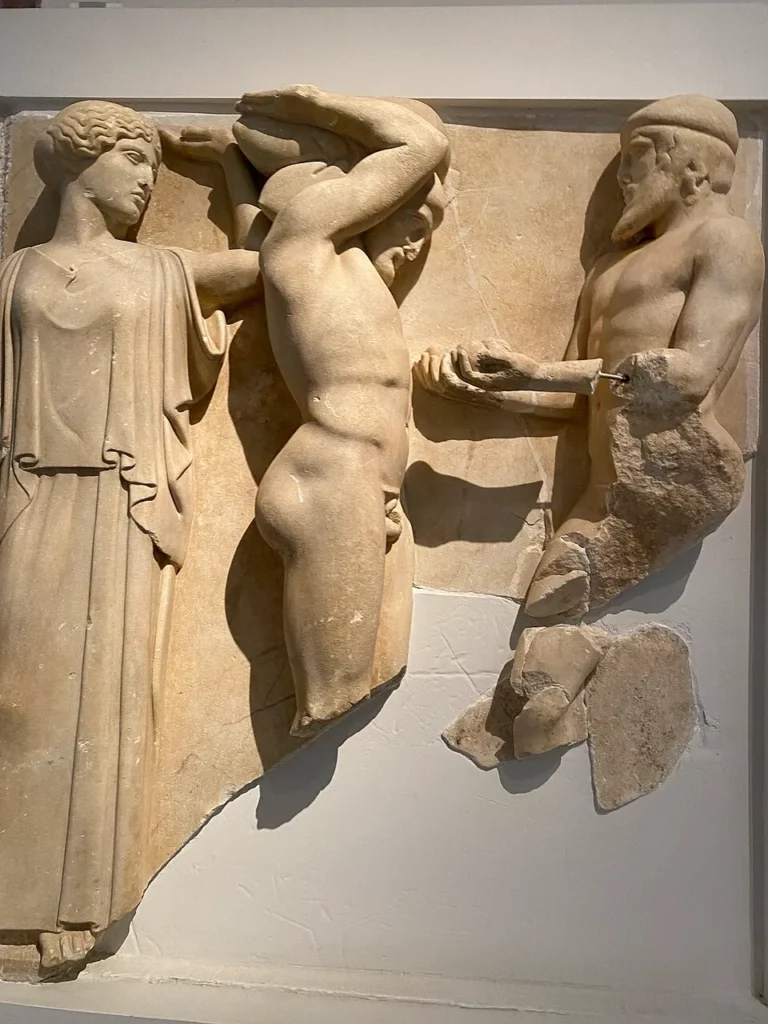
Cerberus and the Road Beneath the World
Fetching Cerberus without weapons displays restraint in the underworld’s precincts. Hades consents, and the three-headed guardian rises to daylight under Heracles’s grip. Zeus confirms a boundary by allowing the demonstration, then ensuring the dog goes home. The pattern reveals that even astonishing feats occur within permissions that protect the world’s joints from loosening.
Asclepius and the Rule Against Unlicensed Resurrection
Zeus’s justice also sets a limit on what gifts may do. Asclepius, son of Apollo, heals so well that he raises the dead. Zeus strikes him with lightning, not from jealousy, but because reopening the gate between worlds at will bends the balance that the underworld maintains. The punishment signals that mercy that ignores measure can wreck communities. Apollo retaliates by killing the Cyclopes who forged the bolt, and Zeus responds with measured discipline, sending Apollo to serve among mortals. Even divine grief must accept structure.
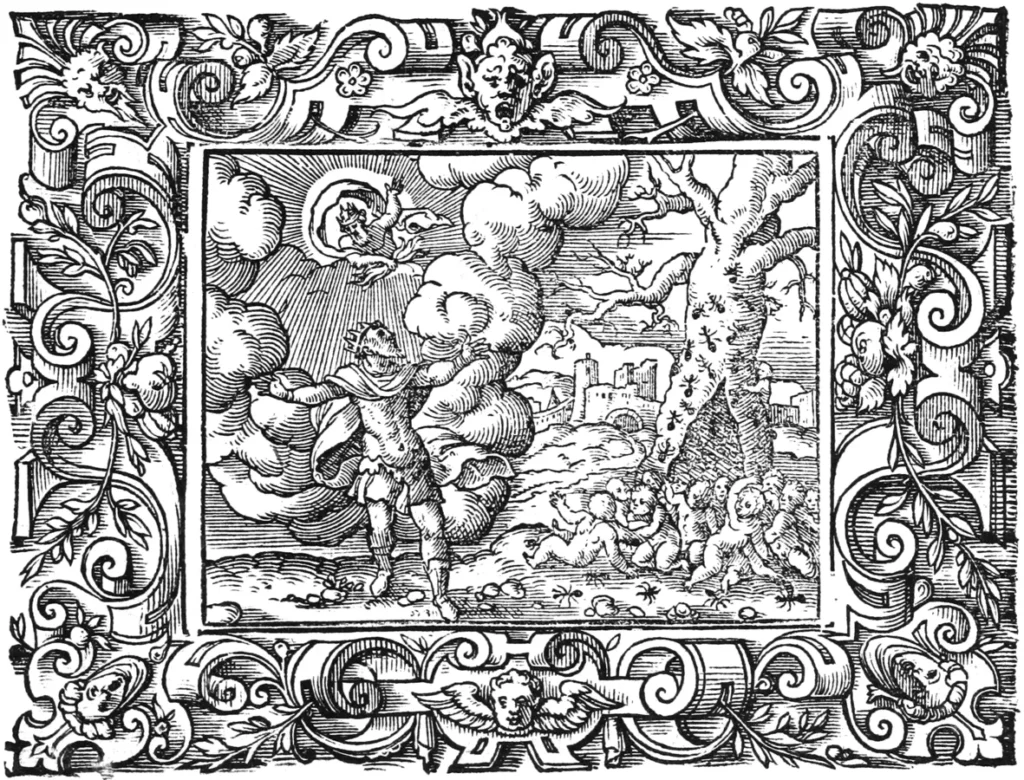
Aegina, Aeacus, and the Birth of the Myrmidons
Zeus carries Aegina to an island that will bear her name. Their son Aeacus becomes a judge so just that even gods admire him. When a plague kills the island’s people, Zeus transforms ants into men at Aeacus’s prayer, populating the land with the Myrmidons. The miracle insists that good rule invites replenishment. It also plants a human stock that will matter later when Achilles draws Myrmidons to the field.
Minos, Rhadamanthys, and the Double Face of Kingship
Europa’s sons, Minos and Rhadamanthys, show different angles of Zeus’s patronage. Rhadamanthys judges straight and later holds a seat among the fair arbiters below. Minos receives a kingdom and signs of favor, yet when he violates the lines of sacrifice and promise, his household suffers. Zeus’s involvement in kings’ fates is continuous: blessing for oath keepers, ruin for promise breakers.
Ganymede and the Service That Softens Sovereignty
Zeus lifts Ganymede, a Trojan prince of exceptional beauty, and gives him a place as cupbearer. The act does not erase the pain of separation, yet stories stress honor and unending youth as his lot. Zeus often brightens service with gifts that dignify the servant. The scene also forecasts Zeus’s later restraint toward Troy, since a thread of affection runs through that city’s house.
Hermes, Hephaestus, and the Culture of Craft and Clever Speech
Under Zeus, Hermes becomes messenger, boundary walker, and patron of exchange. Hephaestus gains a place of permanent esteem where skill turns fire into palaces, arms, and ornaments. Zeus keeps both in his circle, the swift talker and the slow artisan, because a world stands on both the agreements made in an instant and the structures raised through patience.
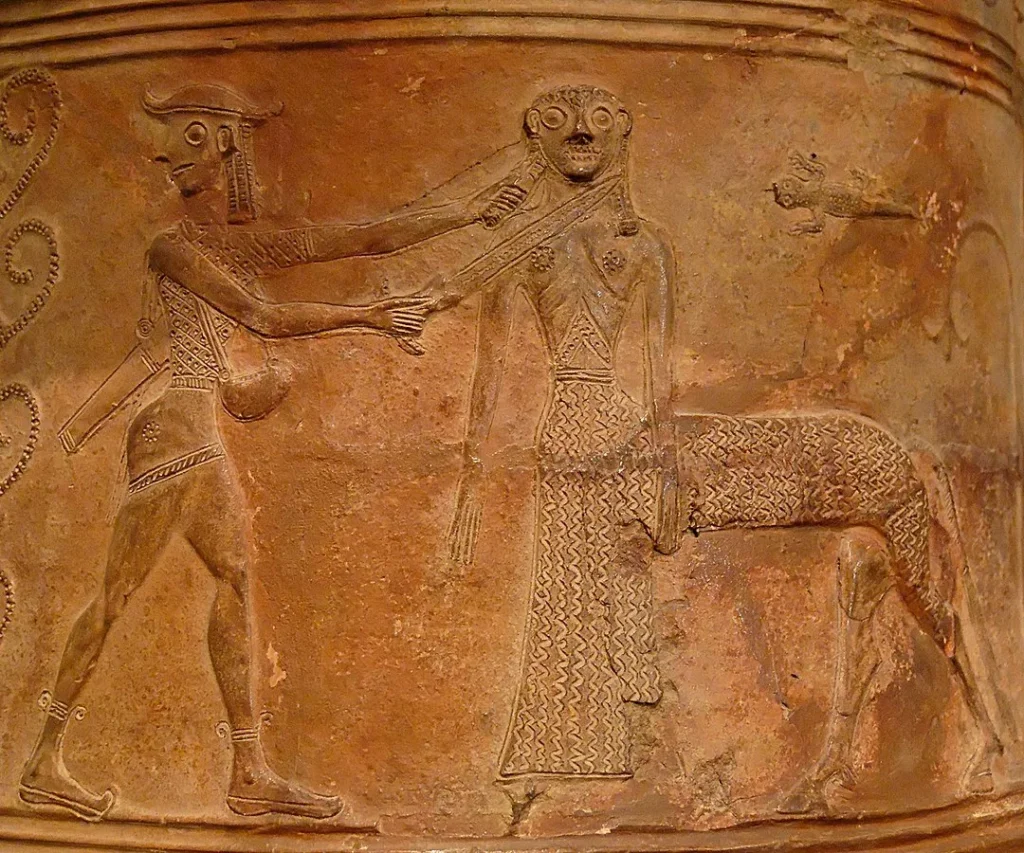
Perseus, Bellerophon, and the Pattern of Monster-Taming
Perseus, son of Zeus and Danae, brings down Medusa and rescues Andromeda from a sea monster. Bellerophon, aided by Pegasus, kills the Chimera. Zeus’s interest appears indirectly, in tokens and nudges that favor the courageous and quick-thinking. The deeper logic is the same as in Heracles’s labors: a civilized world needs champions who remove ancient fears so that families can live beyond terror’s direct shadow.
The Hospitality Test Made Plain: The Stranger at the Door
Zeus often walks with Hermes in disguise and asks for shelter. A poor couple who offer bread and a bed receive blessings, while a prosperous town that slams its doors faces sudden ruin. The code of guest-friendship governs travel, trade, diplomacy, and daily life. Zeus Xenios enforces it because cruelty at the threshold dissolves trust faster than any storm can topple a roof.
The Sacredness of the Suppliant and the Hand on the Altar
In another pattern, the guilty or endangered grasp an altar and ask for safe hearing. Zeus’s law requires the host to pause anger and weigh the plea. This rule does not annul justice, it ensures that judgment happens in cool air rather than in the heat of blood. Kings who respect the altar’s reach prosper in stories, because their cities learn patience from the top.
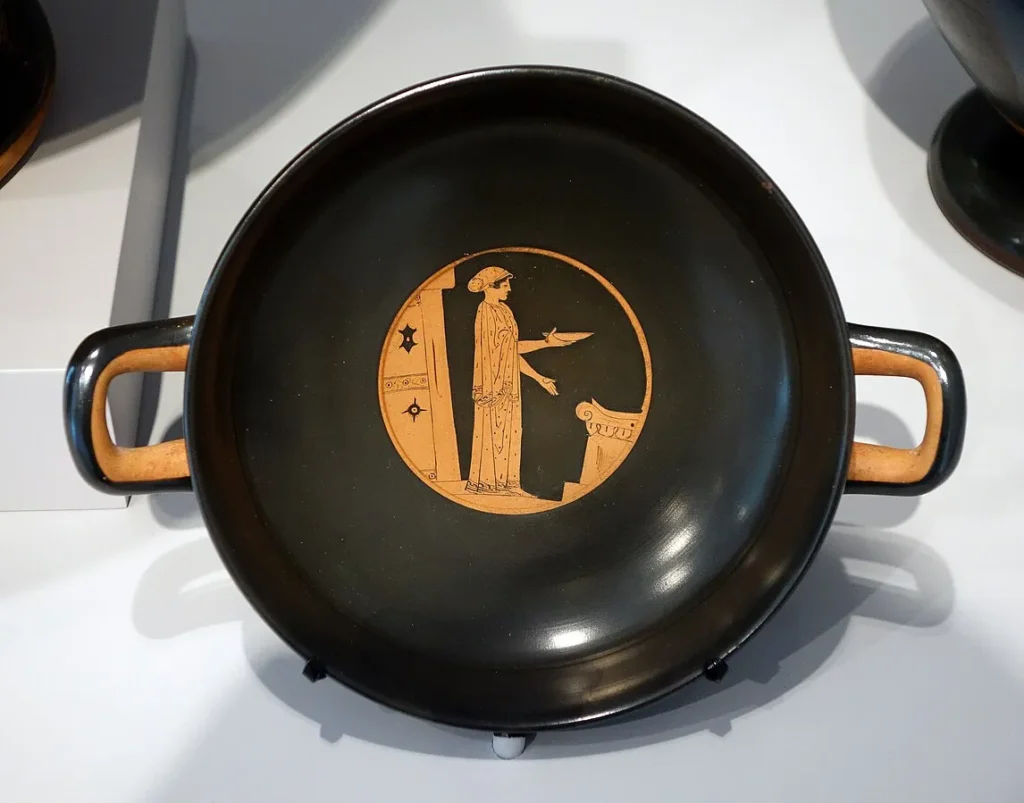
The Trojan War: Zeus’s Scales, Oaths, and the Cost of Glory
The war at Troy draws Zeus into the open, not as a partisan but as the guardian of measure. Oaths were sworn to recover a wronged bride, and the logic of those promises shapes the war’s frame. Zeus sends omens to mark consent or rebuke, and he sometimes deceives a king with a dream that serves a larger plan. He weighs fates on the scale, and when one pan sinks, that side must soon bleed.
Thetis’s Plea and the Delayed Balancing
The sea nymph Thetis asks Zeus to let her son gain honor. Zeus agrees, knowing that the favor will force other deaths and griefs. He nods his assent, a gesture that shakes Olympus because his will, once formed, is not undone. The nod does not abolish the scales; it sets the sequence by which they must fall. Each victory purchased by the favored will cost a future loss.
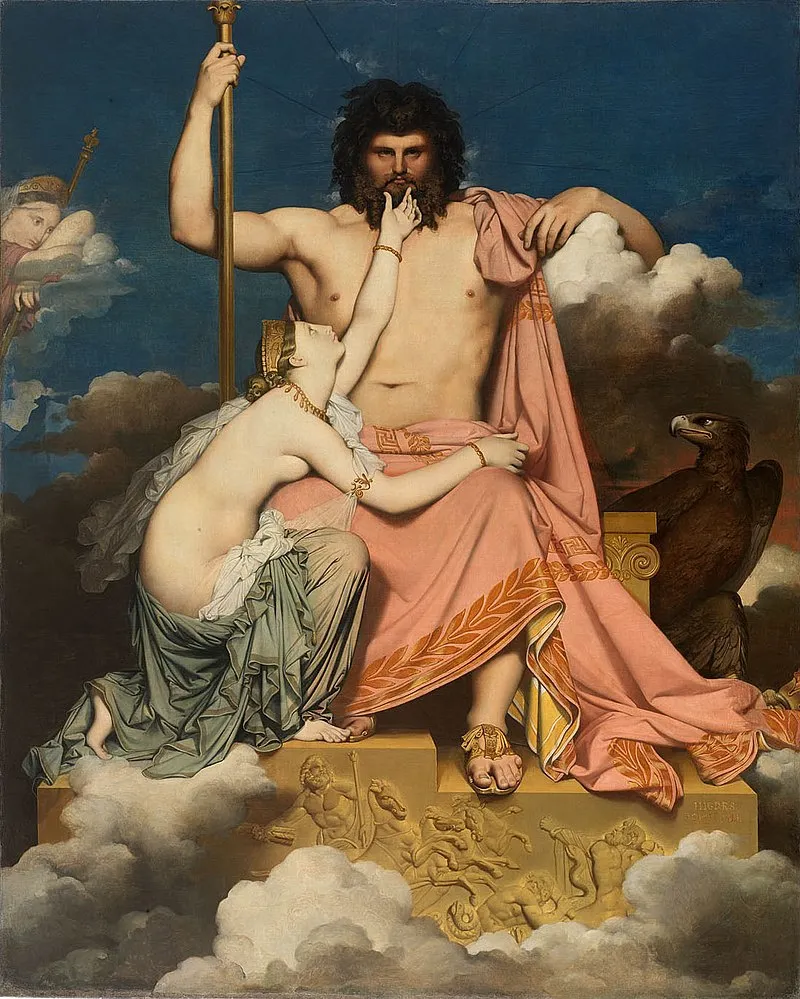
Sarpedon’s Death and the God Who Grieves Inside the Law
Zeus loves Sarpedon, a son fighting far from home. He debates rescuing him but decides against breaking the pattern. Instead, he grants the body careful rites. Sleep and Death carry the prince gently, and his homeland receives him with honor. The scene lays bare Zeus’s tender fidelity to law: feeling does not evaporate, it steadies the hand that must hold the scale.
Hector, Achilles, and the Weight of Oaths Kept and Broken
Zeus allows rage to crest when oaths are violated, then he cools the field when a pledge is renewed. Achilles’ vow shapes the war’s tide and then must subside. Hector’s courage earns a brief stay and a final moment of dignity. Zeus monitors not emotions but their bindings to promises spoken before witnesses. Glory without oath keeping becomes empty noise under his sky.
Odyssean Justice: Shipwrecks, Oaths, and the Bread of Strangers
After the war, Zeus continues to care for sea lanes and the guest code. Sailors who eat the sacred cattle of the sun pay with their lives because oaths about abstaining from divine property are as binding at sea as in city gates. Hosts who welcome storm-tossed travelers tie their households to a long rope of protection. Zeus’s world remains navigable because law follows the traveler through squalls and across beaches.
The Archer’s Prayer and the Anchor of Signs
A small scene captures the pattern. A captain stands at dawn and prays to Zeus for a sign whether to sail. A bolt strikes far out to sea, not as destruction but as a line of light. The captain takes courage. The ship clears the cape. In these moments, Zeus is less a remote thunderhead and more a voice that trims fear into careful action.
The Bounds of Human Pride: Ixion, Tantalus, and the Rehearsal of Limits
Zeus forgives often, yet some violations break the world’s floor and require permanent instruction. Ixion attempts an outrage against Hera after receiving hospitality on Olympus. Zeus catches him in a deception and binds him to a wheel that spins forever. Tantalus violates the feast by serving his son as food. Sisyphus chains Death itself. Each receives a punishment carved to match the crime: endless spin for treachery, endless hunger for profanation, endless uphill for fraud that tried to freeze the law. The stories teach that not all cleverness is worth admiring.
Oath, River, and Sky
Zeus listens when mortals swear by the sky, by the stones, by the rivers. A false oath pulls on an invisible cord that runs to his hand. The punishment may wait, but when it lands it fits the lie like a key in a lock. When people whisper that a barn burned or a ship sank because of a broken oath, they are not speaking out of crude fear. They are reading the world in a way that Zeus encourages.
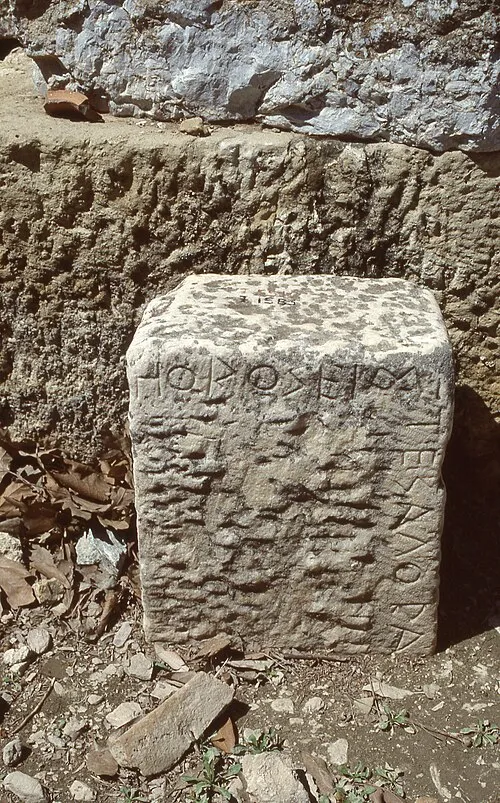
Daughters and Sons Who Extend Order: Athena, Apollo, Artemis, Ares, Hermes, and Dionysus
Zeus’s children carry portions of his care into specific fields. Athena spreads counsel, weaving, and city reason. Apollo orders song, plague, and purification into a harmony that can be invoked. Artemis guards the edges of wild places and the fragile time of childbirth. Ares supplies war’s raw force that must be yoked to purpose. Hermes keeps messages and markets moving. Dionysus loosens rigid hearts so that communities do not crack under the strain of too much rule.
Athena’s Spear and the Cities Under Counsel
Athena’s favor turns small citadels into lasting centers because she encourages measured courage and skilled craft. She perfects the shield, trains the hand to guide the spear rather than simply throw it, and she teaches magistrates to hear both sides of a case. Zeus does not micromanage these cities. He trusts his daughter’s faculty to translate high justice into daily practice.
Apollo’s String and the Cleansing of Crime
Apollo’s string, whether of lyre or bow, sings and stings. He brings plague to rebuke arrogance, then teaches ritual to purge the stain. Zeus approves because a king who can admit guilt and perform cleansing becomes safer to follow than a ruler who hides infection behind loud claims.
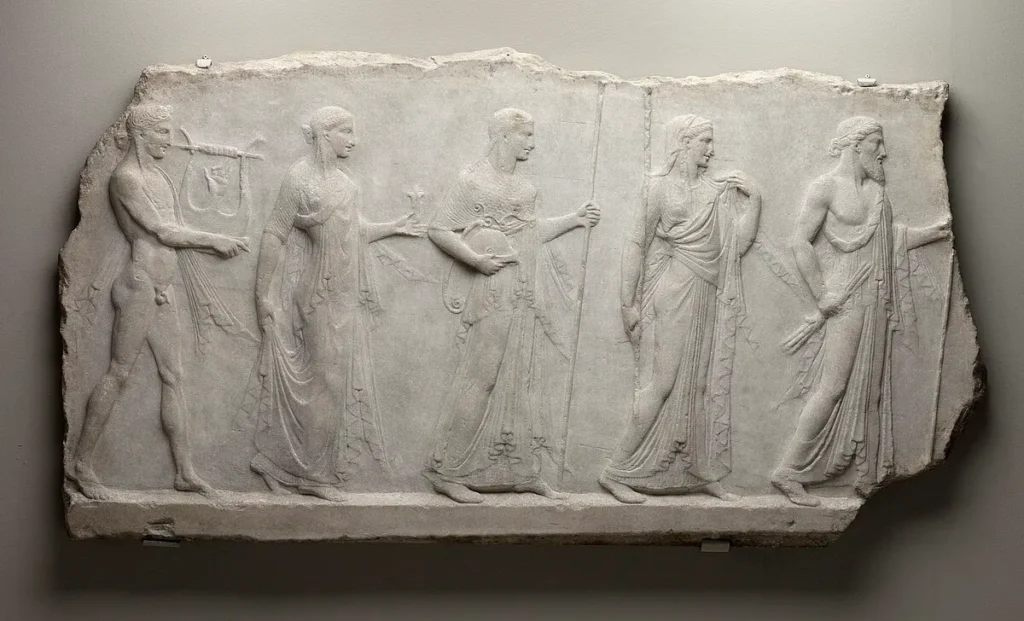
The Lasting Edges of Zeus’s Rule: Fate, the Fates, and the Respect That Keeps the World
Three figures, the Fates, measure out life’s thread. Zeus works with them rather than against them. He can bend a path inside their measure, yet he rarely snaps the thread. The cooperation suggests that the highest power is not the loudest intrusion but the deepest agreement with the world’s plan. Zeus’s greatness lies in his ability to keep tyrant patterns from returning without abolishing choice and risk.
Seasons, Rain, and the Blessing That Looks Ordinary
Much of Zeus’s goodness appears in ordinary cycles: rains that arrive in season, storms that spend themselves offshore, small protections that keep travelers from bandits, judges from bribes, and hosts from forgetting that a stranger can be a god in plain clothes. These events lack drama, yet they build the peace in which drama can take place without devouring the stage.
The Quiet of a Just Evening and the Memory of Thunder
At the end of a long chain of stories, imagine a hill where a small altar holds ash from many years of sacrifice. A father teaches his child to pour a libation and to speak the god’s name with clean hands. Far away, in a court or a battlefield or a harbor, someone else does the same. The scattered acts rhyme. Zeus’s thunder may split a tree today, then leave the next week in steady blue. His gaze remains. His law outlasts a boasting king. His favor makes houses bright, not with spectacle, but with the unremarkable safety in which people sleep.
FAQ
Who are Zeus’s parents and siblings in Greek myth?
Zeus is the youngest child of the Titans Kronos and Rhea. His siblings are Hestia, Demeter, Hera, Hades, and Poseidon. Kronos swallowed the first five at birth to prevent a prophesied overthrow, but Rhea hid the newborn Zeus on Crete and gave Kronos a stone wrapped like a baby instead. Zeus later forced Kronos to disgorge his swallowed children, and the six became the core of the Olympian family.
How did Zeus become king of the gods?
After freeing his siblings, Zeus released the Cyclopes and the Hundred Handers from imprisonment. The Cyclopes armed the gods with the thunderbolt for Zeus, the trident for Poseidon, and the helm of invisibility for Hades. A ten-year war followed against the Titans known as the Titanomachy. With the Hundred Handers hurling stones and Zeus’s thunderbolts breaking the enemy, the Olympians won. The three brothers then drew lots to divide rule: Zeus received the sky, Poseidon the sea, Hades the underworld, while earth and Olympus remained common ground.
What are Zeus’s main symbols and attributes?
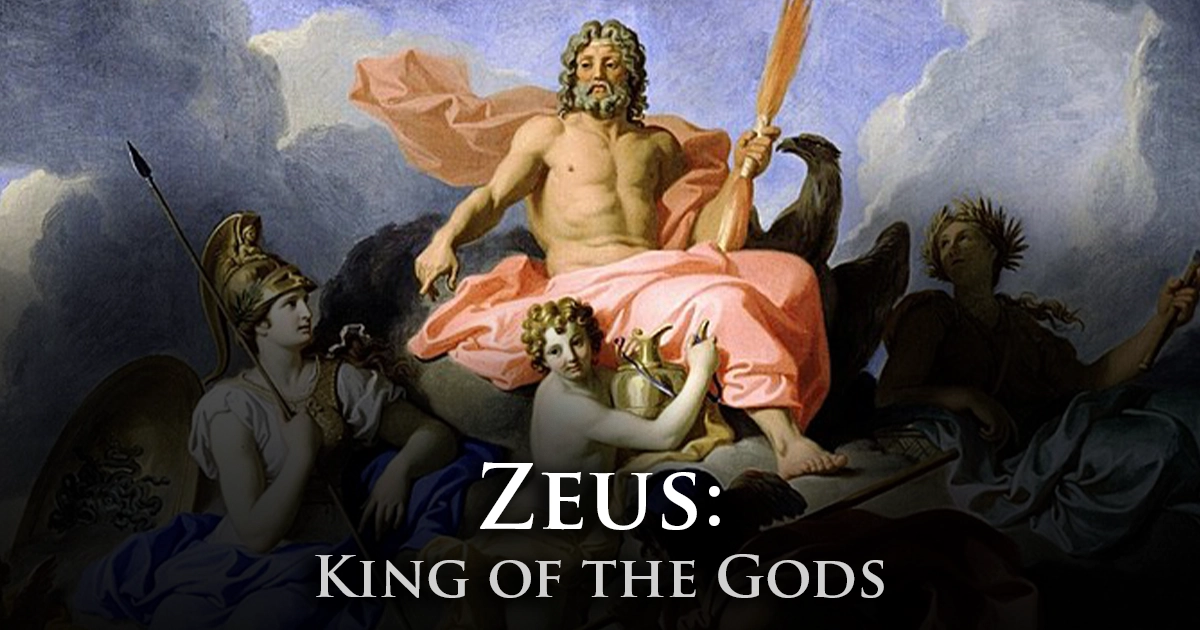
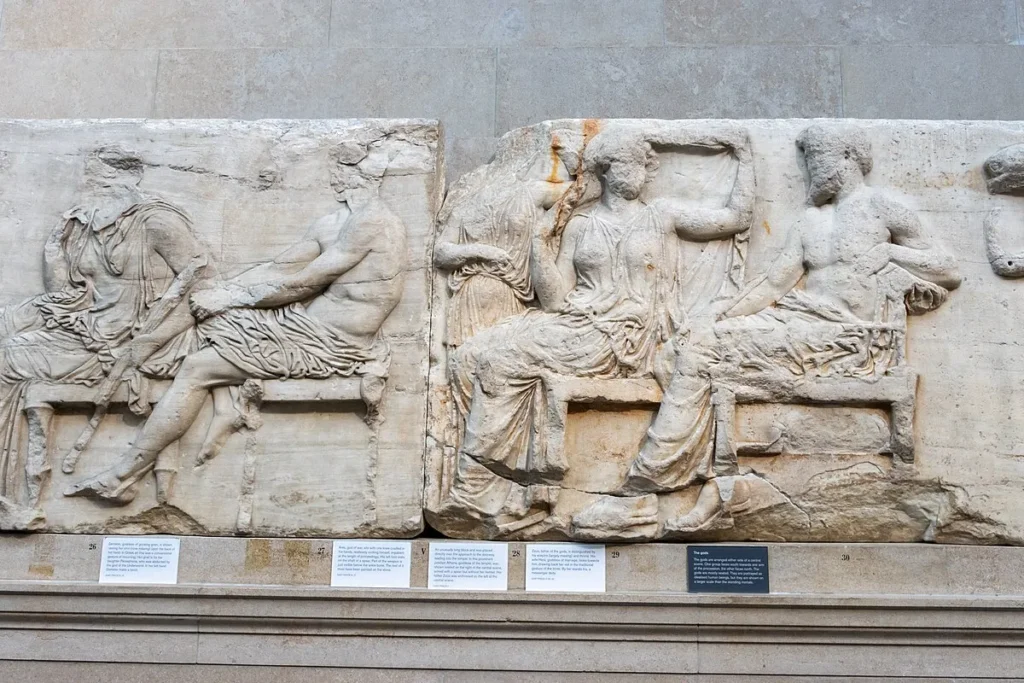
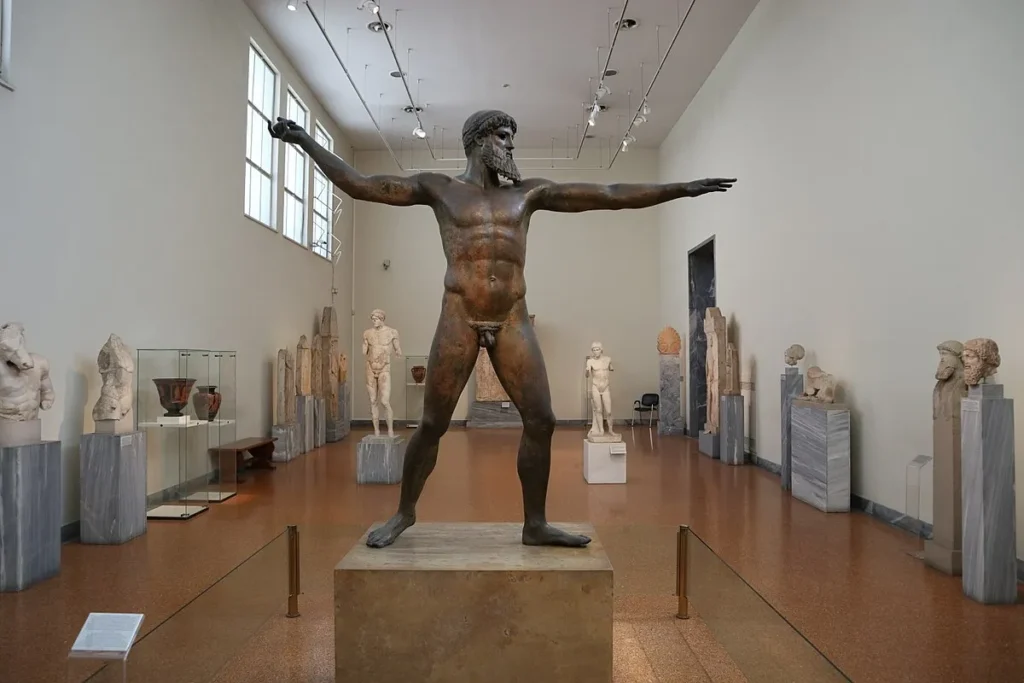
Zeus’s primary weapon is the thunderbolt. His chief bird is the eagle. He is often shown with a scepter, a wreath of oak, or the aegis, a fearsome goat-skin shield that scatters foes. Signs of his presence include thunder, lightning, and favorable omens like an eagle appearing on the right during assemblies or before battle.
Which domains and roles belong to Zeus?
Zeus rules the open sky and weather, and he presides over law, oaths, and justice. As Zeus Xenios he protects guests and strangers, enforcing hospitality. As Zeus Horkios he punishes perjury. As Zeus Agoraeus he watches civic assemblies. As Zeus Keraunios he is the thunderer, and as Zeus Soter he is a saver and protector.
What is the difference between the Titanomachy and the Gigantomachy?
The Titanomachy is the war between the Olympian gods and the Titans led by Kronos that established the new order with Zeus as king. The Gigantomachy is a later uprising of the Giants, born from the blood of Ouranos. Prophecy said the Giants could not be defeated without help from a mortal, so the hero Heracles fought beside the gods and turned the tide with his bow.
Who is Typhon and how did Zeus defeat him?
Typhon is a colossal, many-headed monster born to challenge the new order. He embodies volcanic fire and storm. Zeus fought Typhon across the world, striking him repeatedly with thunderbolts and finally pinning him beneath a mountain. Rumbling or smoke from certain peaks was explained as Typhon’s trapped breath.
How do fate and Zeus’s will interact?
Fate is personified by the three Fates who measure and cut the thread of life. Zeus usually works within their measure. He weighs destinies in a scale and rarely overturns a thread once fixed. In epic scenes he may delay a doom to allow a hero’s final deed, yet he does not abolish the balance. His power is shown not by constant exceptions but by keeping the world’s order steady.
Who are Zeus’s principal consort and children among the gods?
Zeus’s queen is Hera, guardian of marriage and household sanctity. With Metis he fathers Athena after swallowing Metis and bringing Athena forth armed from his head. With Demeter he fathers Persephone. With Leto he fathers Apollo and Artemis. With Maia he fathers Hermes. With Semele he fathers Dionysus. Hera’s children include Ares, Eileithyia, Hebe, and, in some versions, Hephaestus. These gods embody focused aspects of Zeus’s rule such as strategy, song, healing rites, and the boundaries of war.
What is Zeus’s role in the stories of Prometheus and Pandora?
At a sacrifice arranged by Prometheus, Zeus chose the portion of bones covered in gleaming fat, fixing a pattern where gods receive smoke and bones while mortals keep the meat. When Prometheus later stole fire for mankind, Zeus punished him by chaining him to a rock where an eagle ate his liver daily. As part of this cycle, Zeus ordered the making of Pandora, the first woman, whose opened jar released troubles into the world while Hope remained inside. The stories explain why sacrifice and reverence matter in a world now mixed with hardship.
What is the Greek flood story connected to Zeus?
When mortals became violent and impious, Zeus sent a flood that drowned them all except the just couple Deucalion and Pyrrha. After the waters fell, they repopulated the earth by throwing stones behind them, which became men and women. The tale marks a reset in human order under Zeus’s law.
How does Zeus relate to heroes like Heracles and Perseus?
Zeus fathers or sponsors many heroes who cleanse the world of monsters and injustices. Heracles completes labors that tame wild places, free roads, and humble tyrants. Perseus beheads Medusa and rescues Andromeda. Bellerophon slays the Chimera. In each case Zeus’s support channels mortal courage toward restoring balance rather than raw destruction.
Why is Zeus tied to hospitality and oaths?
As Zeus Xenios he tests and rewards hospitality. Stories tell of Zeus and Hermes visiting in disguise, blessing humble hosts who share bread and punishing towns that refuse shelter. As Zeus Horkios he witnesses oaths. Perjury is a personal affront to him because it breaks the hinges of trust that hold communities together. Swift disasters in myth often follow broken oaths to show that the punishment fits the crime.
Did Zeus ever risk being overthrown like Ouranos and Kronos?
A prophecy warned that a child of Metis would dethrone him. Zeus swallowed Metis, internalizing counsel and preventing the birth of a rival son. When Athena was born from his head, counsel became part of kingship rather than a threat outside it. Myths sometimes speak of renewed threats such as Giants or Typhon, yet none dethrone Zeus in the canonical tradition.
What are the most common epithets of Zeus and what do they mean?
Key epithets include Xenios, protector of strangers; Horkios, guardian of oaths; Keraunios, the thunderous; Kataibates, the descender of lightning; Agoraeus, of the assembly; Soter, savior; Panhellenios, of all Greeks; and Chthonios, of the earth’s depths in certain rites. Each epithet marks a role or sphere where his authority is felt.
How was Zeus worshiped in practice in antiquity?
Worship centered on altars under the open sky. People offered animals, incense, wine, and first fruits, sending smoke upward to honor the sky god. Supplicants touched altars for protection. Festivals brought athletic contests and public oaths under his eye, with Olympia as the most famous center. Prayers to Zeus asked for rain in season, victory with justice, safe travel, and stability for households and cities.