The Greeks honoured Hera as the goddess of marriage, but no surviving Greek law code names her as its author. The distinction matters. A marriage could change who inherited a family’s property, whose children counted as legitimate citizens, and which relatives were responsible for a widow. These were questions for families, magistrates and courts. Hera gave marriage a religious importance that the written rules alone could never convey.
In classical Athens, a father could promise his daughter to a prospective husband before the wedding itself. The marriage was then celebrated with sacrifices, bathing, a feast and a procession to the new household. Elsewhere in the Greek world, the rules could differ sharply. A woman in fifth-century BCE Gortyn on Crete had property rights that an Athenian woman did not exercise in the same way. Neither city’s law can be read as a set of commandments delivered by Hera.
Yet Hera’s influence was real. The Greeks called her Teleia, a title associated with the completed or fully realised condition of marriage. Her sanctuaries received offerings from communities whose continuity depended on families and children. Myths of her difficult marriage to Zeus made the goddess a figure of authority, conflict, legitimacy and reconciliation. To understand why she mattered, it helps to separate what Greek people did in weddings, what their laws required, and what their religious stories claimed.
Hera’s marriage to Zeus was a model, not a law code
Hera was the wife of Zeus, the chief Olympian god, and one of the most powerful figures in Greek religion. In epic poetry she argues with him, intervenes in wars, protects her own dignity and refuses to behave as a silent subordinate. Her authority is inseparable from her position as his wife and divine counterpart. That position helps explain her connection with legitimate unions, but the myths do not present her as a judge drafting statutes for mortal households.
In Homer’s Iliad, Hera’s relationship with Zeus is conspicuously troubled. During the Trojan War she wants the Greeks to prevail, while Zeus pursues his own plans. In Book 14 she borrows Aphrodite’s power of attraction, persuades Sleep to help her and seduces Zeus so that the other gods can act without his interference. The episode in the Iliad is a story about divine politics and deception. It would be misleading to turn it into evidence that Greek brides were taught to deceive their husbands or that Hera punished every violation of a wedding oath.
The most useful way to understand her role is through the importance of legitimacy. Marriage helped determine the place of children within a household and, in citizen families, within the city. Hera’s identity as the acknowledged spouse of Zeus made her a fitting patron of that institution, even though Zeus’s many other relationships continually threatened her position. In their study The Hera of Zeus, Vinciane Pirenne-Delforge and Gabriella Pironti emphasise the goddess’s interconnected roles as wife, queen and opponent of Zeus. Her anger is part of her status and agency, not simply a lesson about a jealous wife.
The Greeks did not all tell exactly the same story about the divine couple. Some places located their wedding nearby or attached their own traditions to it. That variety is important because the Greek world consisted of independent cities and regions, each with local cults and customs. A myth told at Argos did not automatically describe a ceremony in Athens, and a ritual at Samos cannot be assumed to have governed the law of Crete.
What Hera Teleia meant to Greek worshippers
Teleia comes from a Greek word associated with completion or fulfilment. Applied to Hera, it marked the goddess in the condition of marriage, often alongside Zeus Teleios. It is not the title of a legislative office. In Pausanias’s account of Stymphalos, written in the second century CE, the people of this Arcadian town told him that Hera had once been worshipped under three titles. As an unmarried girl she was Pais, as the wife of Zeus she was Teleia, and after a quarrel and separation she was Chēra, usually translated as Widow. Pausanias reports the local explanation rather than proving that three separate life-stage rites existed throughout Greece.
At Plataea in Boeotia, Pausanias saw images of Hera identified as the fully grown goddess and as the bride. Local stories explained how she and Zeus quarrelled and reconciled. The emphasis on a marriage that could be disrupted and restored helps explain why worshippers might appeal to Hera at moments of change, but the sources do not establish a universal practice in which every Greek couple swore a formal oath specifically before her altar.
Other titles associated Hera with marriage or the joining of spouses, including Gamelia and Zygia. The exact distribution of these epithets varied with place and period. A cult title records how worshippers addressed a goddess in a particular setting; it is not proof that every Greek city recognised the same ceremonies. Pirenne-Delforge and Pironti’s survey of Hera’s local cults examines Argos, Samos, Perachora, Olympia and other centres, and stresses the overlap between Hera’s roles as spouse and sovereign.
In Athens the month called Gamelion was associated with marriage, and the union of Zeus and Hera was commemorated in a festival generally called Theogamia or Sacred Marriage. The surviving evidence is too incomplete to reconstruct an exact sequence of public acts or to claim that all weddings took place during that month. Emily Kearns’s Oxford Classical Dictionary discussion of sacred marriage distinguishes the ancient evidence for divine marriage festivals from broad modern theories about fertility rites. The ceremony’s social meaning, including the legitimation of human marriage, may have been at least as important as agricultural symbolism.

How an Athenian marriage became recognised
In Athens during the fifth and fourth centuries BCE, marriage among citizen families was embedded in a system of male guardianship. A girl’s or woman’s kyrios, normally her father or another authorised male relative, negotiated with the prospective husband. The formal pledge was called engyē or engyēsis. The man promising the marriage and the man receiving the bride could later be identified in legal testimony. A woman did not simply sign a modern-style marriage certificate and thereby establish an independent legal relationship.
The Cambridge Companion to Ancient Greek Law describes the agreement between guardian and groom as central to Athenian marriage. The word ekdosis, meaning the giving of the bride, also appears in discussions of marriage arrangements. Modern scholars debate the precise relationship between the initial pledge, the transfer to the husband’s household and the moment a union acquired its full legal standing. It is safest to describe these as connected processes rather than invent a single mandatory wedding formula.
Why did the arrangement matter so much? Athenian civic status depended in part on descent. In the fourth century, a litigant in the speech conventionally known as Against Neaera explains that wives were expected to produce legitimate children who could be introduced to their father’s kinship group and local citizen community. The passage at section 122 is often quoted because it expresses a powerful civic ideal. It is also courtroom rhetoric from a hostile prosecution, not a neutral description of every Athenian woman’s life. It tells us what a speaker thought would persuade male jurors.
A bride’s consent and wishes are particularly difficult to recover. The surviving speeches overwhelmingly record the arguments of male litigants, while painted pottery usually shows ceremonies through an artistic convention. Many women will have had preferences, relationships and opportunities to influence decisions, but the formal structure of an Athenian citizen marriage gave the guardian a role that modern readers may find stark. Religious celebration did not erase that imbalance.
The marriage procession mattered because households were public social facts even when agreements were made privately. Relatives, neighbours and guests could know that a woman had entered a husband’s home. Their testimony might later become relevant in an inheritance dispute. Still, visibility at a feast or procession was not itself a citywide registration system, and we should not imagine a single Greek wedding licence, administered in Hera’s name, valid from Athens to Sparta.
The wedding bath, procession and gifts
A wedding was also a major transition in the lives of two households. Athenian images and literary references allow us to reconstruct a recognisable sequence of preparations, sacrifices, a feast, movement to the groom’s house and gifts afterwards. These are best documented for relatively prosperous families whose pottery, monuments and literary references survive. There is no reason to assume that a poorer family could afford the same display.
Before the ceremony, a bride might make offerings connected with leaving childhood behind. Artemis, who watched over young people and their transitions, was important in this context, alongside deities associated with marriage and domestic life. Hera was prominent, but she was not the only god to whom people could appeal. A religious landscape with overlapping divine responsibilities is more accurate than one in which each stage of a wedding belonged exclusively to a single deity.
A special bath, often described as a nuptial washing, required water that could be carried in a vessel called a loutrophoros. The vase’s tall neck and handles made it recognisable in art. Not every surviving example was used to transport water. The Metropolitan Museum’s loutrophoros dated around 400 BCE has unusually elongated proportions that probably made it symbolic rather than practical. Other loutrophoroi served funerary purposes, especially in memorialising people who died before marriage. An object shape therefore tells us about ritual meanings, not always about its last physical use.
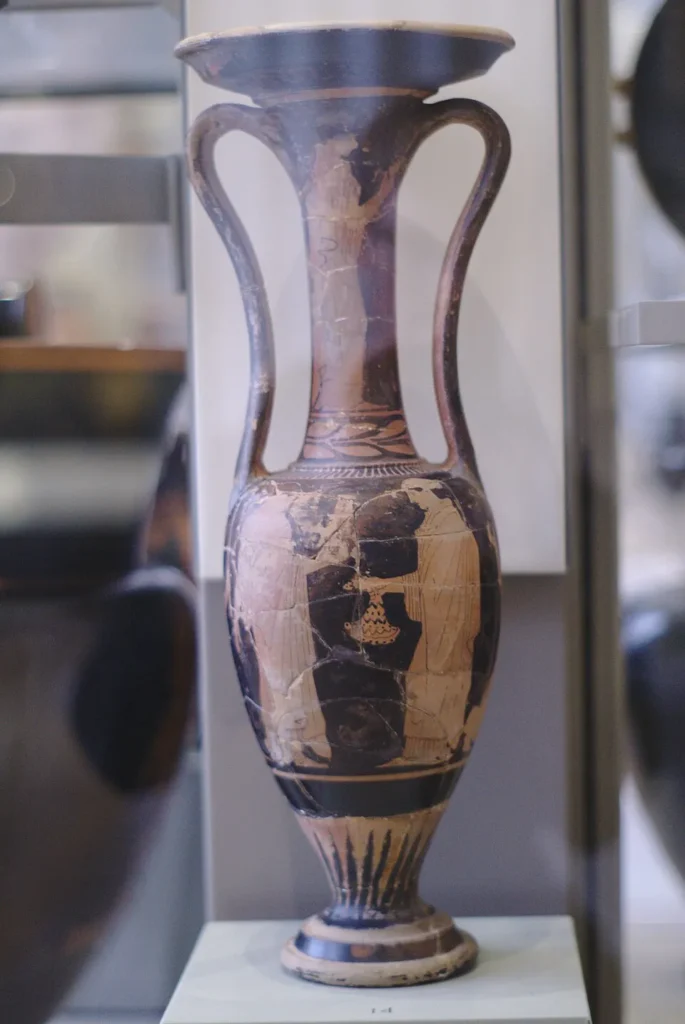
Athenian painters also depicted the bride being dressed, veiled or attended by companions. These scenes show the importance of presentation, clothing, jewellery and female participation in the celebration. They do not record a complete script of words spoken by the bride or prove that every painted gesture happened in precisely the same order. A painted vase is evidence for the images people found meaningful, not a photograph of a particular household’s ceremony.
The procession to the groom’s house is particularly well attested. A black-figure oil flask attributed to the Amasis Painter, dated about 550 to 530 BCE, shows a bridal couple travelling in a cart, accompanied by attendants and torches. The Met’s detailed object record identifies it as an unusually early and complete representation of an Attic wedding. The torchlight suggests a night procession. The groom’s home, where another figure waits, is an important destination: marriage moved the bride into a different household and created new relations between families.
The feast, songs and procession made the occasion memorable to the community. A newly married couple could also receive gifts on the following day, an occasion known as the epaulia. The Met’s miniature wedding vase depicting the epaulia shows how painters represented gift-giving. Because that particular vessel is a miniature, it may itself have had a funerary or symbolic function rather than being an actual serving dish at a wedding. Form, decoration and archaeological context must be read together.
Dowries made marriage an economic agreement
In Athens a dowry, usually called proix, could accompany the bride from her natal family. Its value might consist of money or other property. The husband administered the resources associated with the marriage, but a dowry was not simply an unrestricted gift for him to consume. If the marriage ended, questions of return could become contentious. Families had strong reasons to remember the amount and terms, and disputes about dowries appear in Athenian legal speeches.
The dowry linked marriage to household survival. A father wanted his daughter supported; a husband might need resources to maintain a household; the woman’s natal family wanted protection if the union failed. The size of the dowry also signalled family wealth and could influence the prospects of a match. These were practical calculations made within social rules that privileged legitimate descent and the continuity of family property.
A dowry should not be confused with the bride herself being bought. The existence of payments and transfers does not mean that all Greek marriages were commercial sales. Nor should a modern distinction between romantic love and economic marriage be imposed too neatly. Affection, family alliances, status, financial security and childbearing could all matter, but surviving legal evidence is especially good at recording conflicts over money. The Metropolitan Museum’s account of women in classical Greece gives a concise introduction to the relationship between dowry, guardianship and marriage in Athens.
There were also differences between a woman who married with a dowry and a daughter whose father died without a male heir. The Athenian epiklēros was tied to the transmission of an estate within her father’s family. Special procedures could determine the appropriate male relative with whom she was to be married. This was not the same as an ordinary guardian choosing a match by private agreement, and it illustrates why a single description of ‘the Greek marriage contract’ is inadequate even within Athens.
The Gortyn law inscription tells a different story
The strongest surviving example of a Greek city’s detailed family legislation is not from Athens. It comes from Gortyn, in southern Crete. A large inscription of the fifth century BCE preserves provisions on inheritance, divorce, property, status, adoption and sexual offences. Its lines alternate direction across the stone, a writing pattern called boustrophedon, or turning like an ox ploughing a field. Parts of the original wall were later incorporated into a Roman theatre structure, which is why visitors see the text in an architectural setting much younger than the laws themselves.
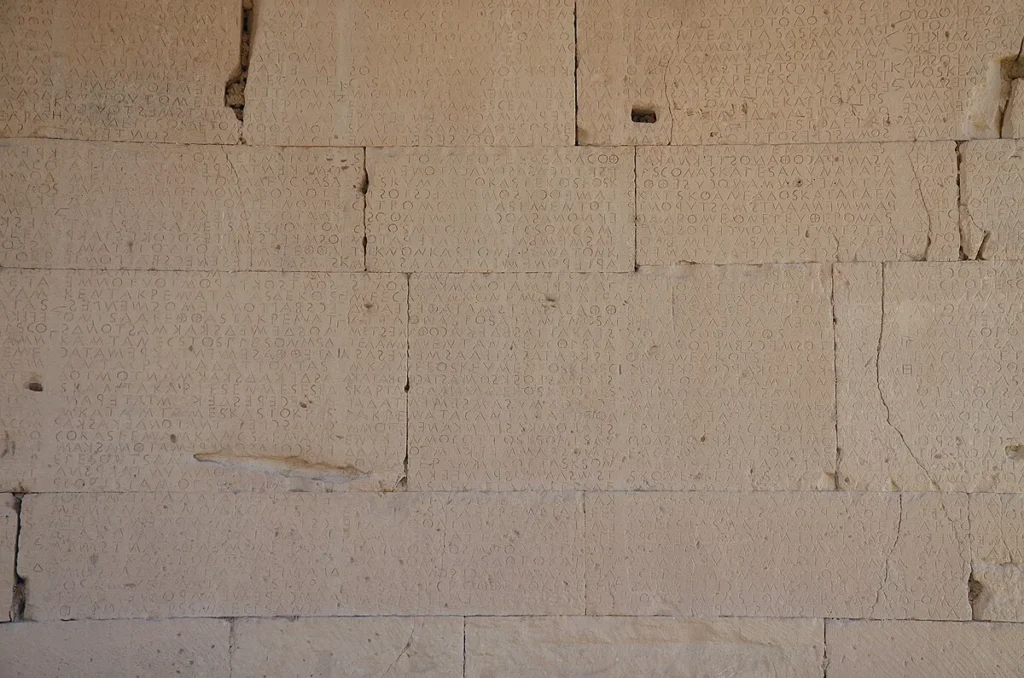
The University of Cambridge Museum of Classical Archaeology’s account of the Gortyn Code dates the inscription to the first half of the fifth century BCE and identifies its many distinctions between free people, dependent groups and enslaved people. It is not a universal Greek code. The rights and obligations it describes belonged to the legal world of one Cretan community, and its provisions should not be projected onto Athens without comparison.
In the sections on divorce, the text specifies what a woman could retain, including property she had brought into marriage and, under particular conditions, a share of what her work or property had produced. Rules also addressed children born after a separation and the treatment of widows. A translation of selected provisions at Fordham’s Ancient History Sourcebook allows readers to see how precise and conditional the clauses could be. Some older translations use language that requires checking against modern editions, and the surviving inscription is not a complete legal system.
The code shows why marriage mattered to a city: disputes over property and children could outlive the relationship itself. But it does not identify Hera as the author of its rules. Nor does its existence prove that Greek religious ritual and civic law were wholly separate. Ancient communities routinely conducted public business in settings filled with sanctuaries, sacrifices and divine witnesses. The distinction is one of evidence: the text tells us what certain legal rules said, while Hera’s cult tells us how marriage could be imagined and celebrated as sacred.
Gortyn also challenges the idea that all Greek women had the same economic position. The inscription recognises forms of women’s property holding that differ from the usual Athenian pattern. Those rights coexisted with strong hierarchies, including slavery and inequalities of status. It would be anachronistic to describe Gortyn as a modern system of gender equality, just as it would be inaccurate to say that Greek women everywhere were legally indistinguishable from property.
Were Greek marriages written down?
Athenian marriage arrangements were commonly supported by witnesses and family memory, and surviving legal arguments often depend on who gave a woman in marriage and under what circumstances. There is no evidence for a standard compulsory written marriage certificate used by every classical Athenian couple. Some transactions and financial arrangements could be documented, and the extent of writing varied across places and periods, but a modern registry office is the wrong model.
An extraordinary surviving marriage document comes from Elephantine, an island in the Nile in southern Egypt. A papyrus dated to 449 BCE records a marriage involving Ananiah, a member of a Jewish military and temple community, and Tamet, an Egyptian woman who was enslaved. The Institute for the Study of the Ancient World’s object account identifies the document as Brooklyn Museum 47.218.89 and explains that the couple already had a son when the agreement was drawn up. The contract is written in Aramaic, not Greek.
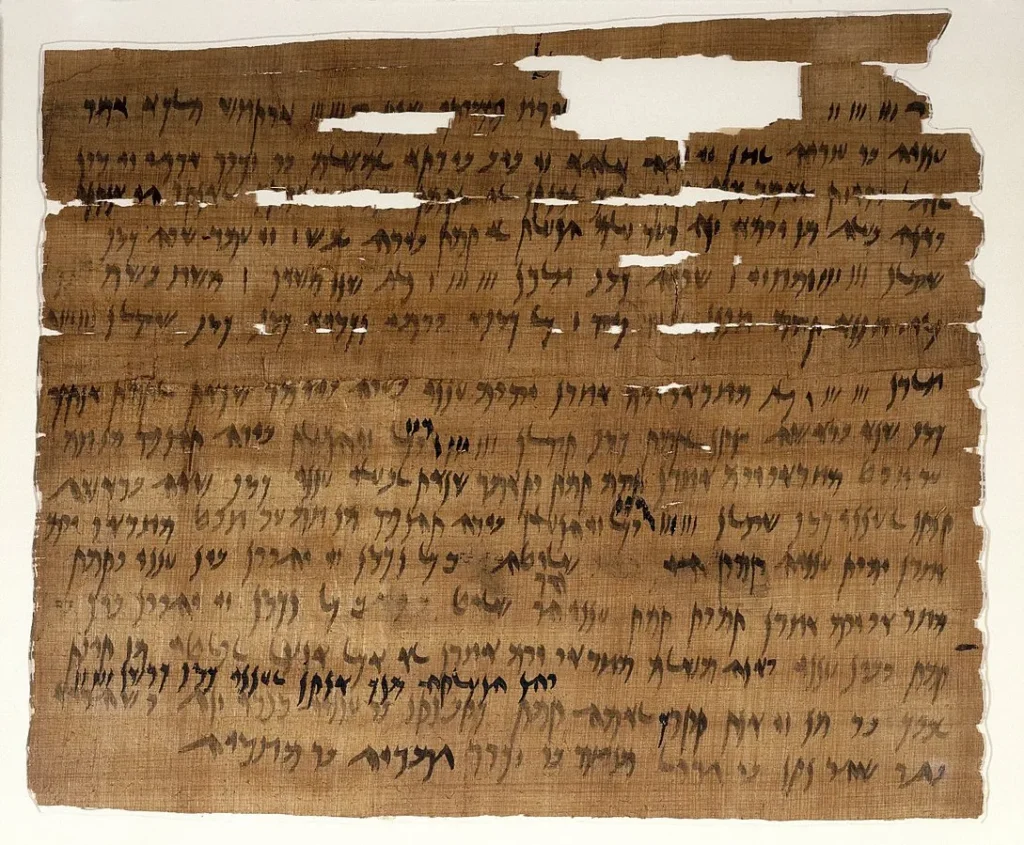
This papyrus is valuable precisely because it shows how much legal detail a marriage document could contain in a neighbouring society under Persian imperial rule. It cannot serve as evidence that Athenians used the same contract form, the same terms of divorce or the same treatment of enslaved women. The document’s date and setting matter. A Greek marriage ceremony and an Aramaic marriage agreement from Egypt may both concern households, property and status, but they belonged to different legal traditions.
The comparison also reminds us that writing survives unevenly. Papyrus is especially likely to survive in Egypt’s dry conditions, whereas many documents once written elsewhere have disappeared. Athens left abundant courtroom speeches; Gortyn left a monumental inscription; Elephantine preserved family papers. Differences between these archives partly reflect different practices, but also what happened to the materials over the next two thousand years.
Enjoying Spoken Past?
I created Spoken Past to share my love of history. I research, write and develop everything myself, and I want my articles and basic guides to remain free for everyone.
If you enjoy my work, please consider supporting Spoken Past with a small donation.
Oaths, witnesses and the meaning of a sacred promise
Greek oaths could invoke gods as witnesses and imagined enforcers of truth. A person who swore falsely risked divine punishment in addition to any human consequences. This made oaths important in politics, law and private relationships. It does not follow that every marriage ceremony included a fixed ‘oath of Hera’ whose wording can now be reconstructed. The original evidence is not strong enough for that claim.
Athenian legal speakers referred to witnesses, guardians and family arrangements when proving that a marriage was legitimate. Their arguments could carry religious assumptions, but a witness to an engyē and a god invoked in an oath were not interchangeable legal instruments. The Against Neaera speech demonstrates the importance of legitimate descent in a court setting, while the Gortyn inscription includes particular circumstances in which an oath could help decide a dispute. Neither establishes Hera as the universal guarantor of all marriage litigation.
What Hera could offer was a powerful religious language for the bond itself. Her titles emphasised the completed union; the myths made her marriage to Zeus a matter of cosmic and civic significance; sanctuaries created places where people could dedicate offerings. This was not a contract enforcement system. Greek gods were approached through prayer, sacrifice, festivals and local custom, and religious hopes did not eliminate the need for human witnesses or legal decisions.
The distinction matters most when marriages broke down. A family seeking the return of a dowry did not simply ask Hera to issue a judgement. It might need to negotiate, invoke witnesses or take a dispute to the relevant civic authority. Religious expectations could shape conduct, but we must not confuse the authority of a goddess with the jurisdiction of a magistrate.
The handshake on a grave is not necessarily a wedding agreement
Ancient Greek funerary reliefs often show two figures clasping right hands, a gesture known as dexiosis. It is tempting to read a man and woman holding hands as a picture of betrothal or marriage. Sometimes the figures were spouses, but the gesture can also express kinship, attachment or farewell. Its meaning depends on the inscription, the figures and the context of the monument.
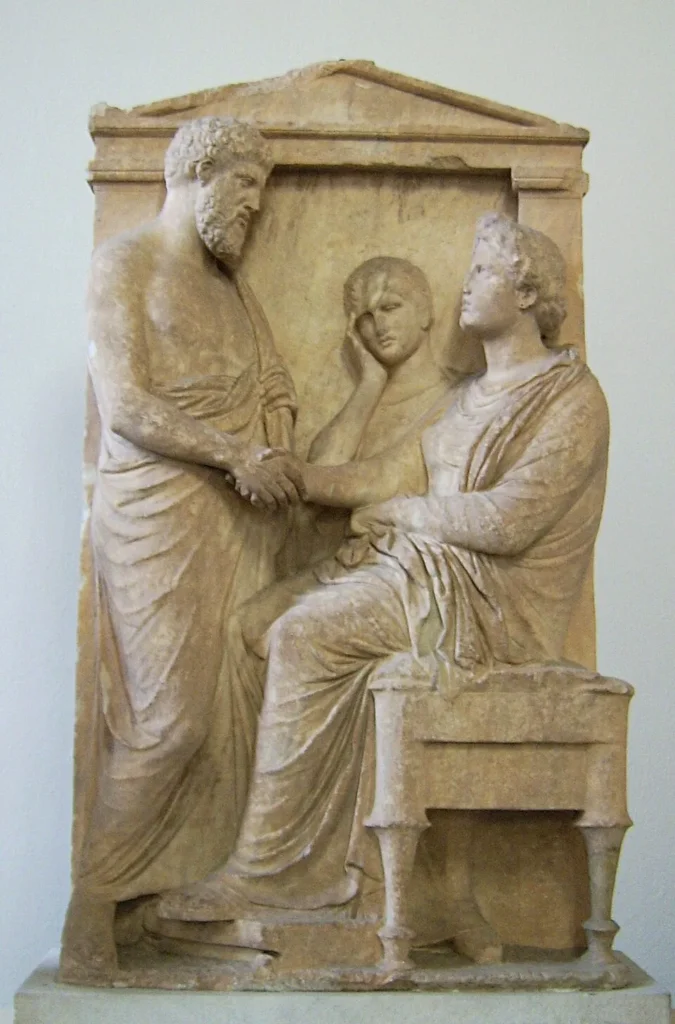
The Met’s grave stele of Lysistrate, dated about 350 to 325 BCE, shows the deceased woman clasping hands with her mother. It is explicitly a farewell scene, and it illustrates why the same gesture cannot always be labelled a marriage contract. On a different painted funerary stele, a seated man and standing woman clasp hands in a similarly solemn composition. Such objects preserve emotional relationships but seldom record the legal details of a wedding.
The surviving image of Thraseas and Euandria used in this article must therefore be read as a funerary monument first. If the people depicted were a married couple, that identification needs independent support from the object’s inscription or museum record. An art-historical label such as dexiosis describes a visual gesture, not an ancient document signed by the participants.
What people gave to Hera at her sanctuaries
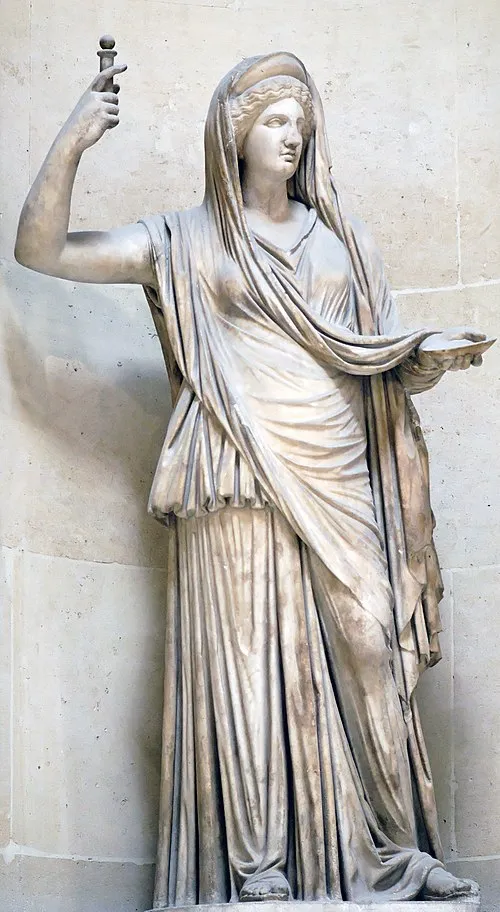
Hera’s sanctuaries were places of public worship, not merely chapels for wedding ceremonies. At Argos in the northeastern Peloponnese, her great sanctuary was an important regional centre. The second-century traveller Pausanias described a monumental cult statue of Hera made by the sculptor Polykleitos, holding a pomegranate and sceptre. In his description of the Argive Heraion, he records a story explaining the cuckoo on her sceptre as Zeus in disguise during his courtship of Hera. Pausanias himself signals scepticism about such stories, which is a useful warning against treating them as historical events.
The Heraion on the island of Samos was even more monumental. According to UNESCO’s archaeological description, successive temples developed from the eighth century BCE onward, and sixth-century building projects produced some of the largest and most technically ambitious temples in the Greek world. The sanctuary received offerings from far beyond the island, reflecting Samos’s maritime connections. Its importance cannot be reduced to local marriage rites alone.
Votive gifts could include objects of personal adornment, figurines, vessels and textiles, but their meanings varied. A gift to Hera might express gratitude, fulfil a vow, honour the goddess’s authority or seek her protection. Without an inscription identifying the donor and purpose, an archaeologist cannot safely classify every piece of jewellery or miniature vase as a bride’s wedding offering. Sanctuaries accumulated objects over centuries, and some offerings had political or communal significance.
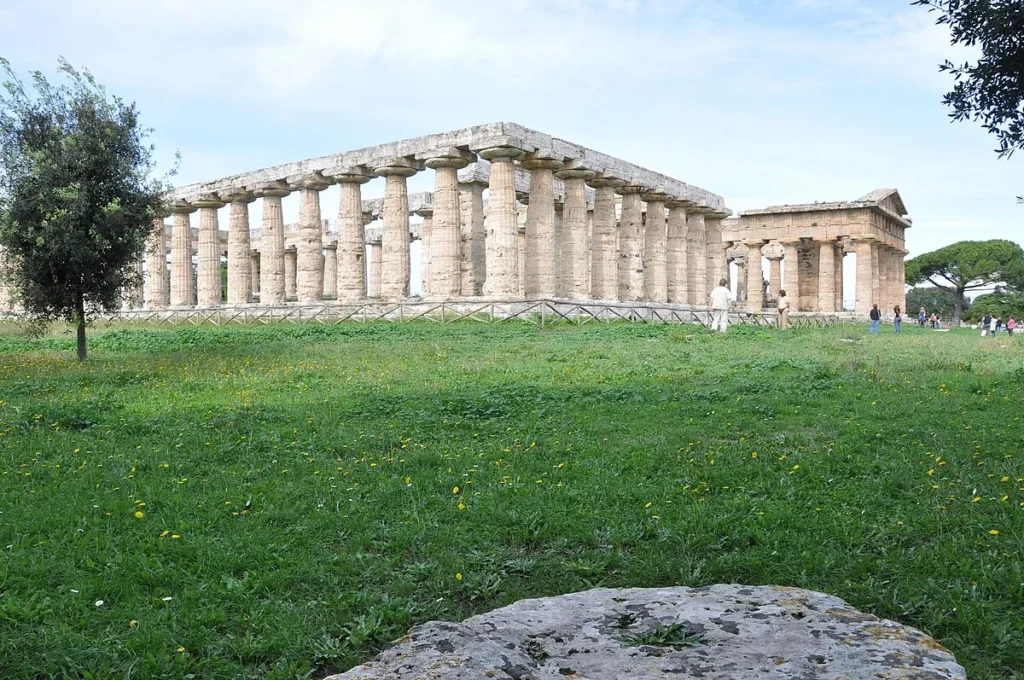
In southern Italy, Greek settlers built major temples associated with Hera at Poseidonia, later called Paestum. The sixth-century temple conventionally known as Hera I is one of the most conspicuous remains of the Greek colony. Its survival is evidence of Hera’s importance across the Greek-speaking Mediterranean, but its columns cannot tell us the precise words spoken at a particular marriage in the settlement. Architecture records collective investment in worship; domestic rituals are often less visible archaeologically.
The Roman-period traveller Pausanias also preserves an elaborate account of the Daedala festival at Plataea. According to the local myth he records in Book 9, Zeus pretended to take a new bride by dressing a wooden image as a woman. Hera discovered the trick and reconciled with him. The festival involved wooden images, processions and sacrifice, and the great celebration brought together several Boeotian communities. Its account is valuable for understanding marriage imagery and civic cooperation, although it was recorded centuries after classical Athens and does not provide a universal Greek wedding manual.
Wedding pottery shows both ritual and idealised family life
Several vessel shapes recur in Greek wedding imagery. The loutrophoros is associated with ceremonial water; the lebes gamikos is a rounded wedding vessel, often supported by a stand; and the pyxis is a small lidded container for personal items. Their decoration may include brides, attendants, torches, Eros, jewellery and household scenes. These details let us see the visual world in which a wedding was imagined.
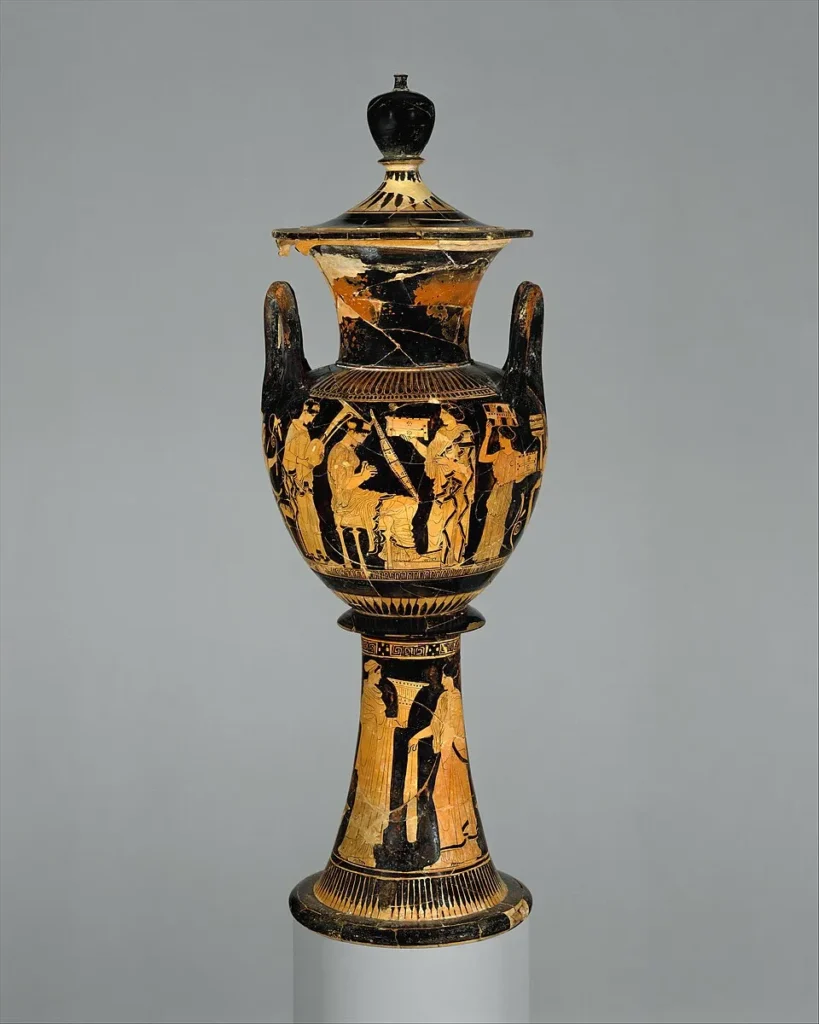
A red-figure lebes gamikos attributed to the Washing Painter, dated around 430 to 420 BCE, shows a seated bride with attendants, a little Eros and torch-bearing figures. The Met notes that the exact function of the vessel remains uncertain, although its association with weddings is clear. That qualification matters: we should not declare that every such bowl held sacred water when the physical evidence does not prove it.
The Met’s related wedding vessel depicts a loutrophoros being carried near the bride. The painting helps identify the ceremonial associations of both vessel types. Yet the scenes are also stylised. They show the wealthy domestic interior, clothing and service that painters chose to present. They cannot be treated as statistically representative of all Greek households or all women.
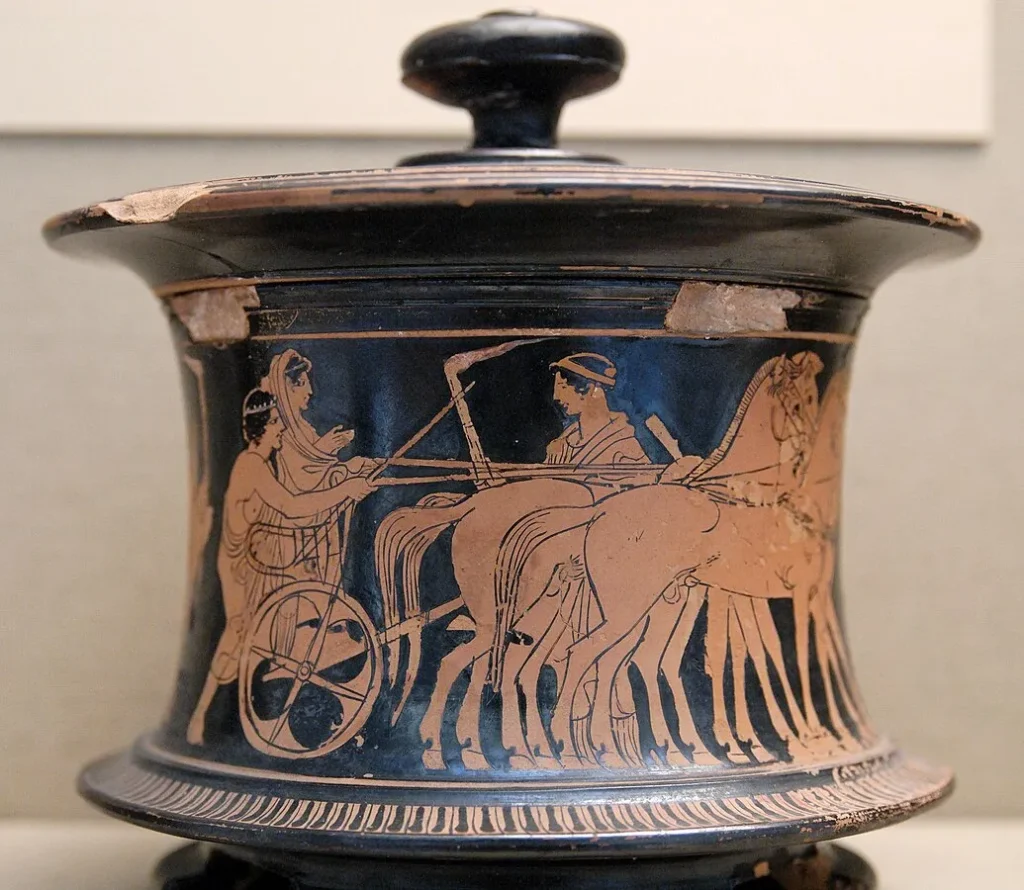
A pyxis might store jewellery or toiletries, and its painted imagery could evoke bridal preparation. A wedding procession on a pyxis shows that the subject mattered to its owners and makers, but not necessarily that the box was carried in the procession depicted. Archaeological context is essential: a vase found in a grave, a sanctuary or a house may have served different purposes over its lifetime. The same caution applies to funerary loutrophoroi, where marriage imagery could express a life stage that the deceased never reached.
What happened when a marriage ended?
Marriage could end through death or separation, and the legal consequences were serious. In Athens, the return of a dowry could be disputed. A widow’s position depended on her household circumstances and kinship relations, while a daughter without brothers could become central to an inheritance case. Women were not simply free to take the same legal actions as male citizens, and a modern description of equal access to divorce would be misleading.
Gortyn’s law provides a more explicit record of some outcomes. It distinguished the property a woman brought to a marriage from other resources, and it specified shares that could be claimed after separation. It also addressed a child born after the parents had separated. These provisions show that Greek legal systems recognised the possibility of divorce and had to resolve practical consequences. They do not imply that divorce was socially effortless or that a woman’s formal entitlement was always easy to enforce.
In the myths, Hera’s own marriage was repeatedly strained. The story at Stymphalos even gave her a title associated with widowhood or separation, while the Plataean Daedala celebrated reconciliation. The contrast is striking: the goddess most closely associated with marriage was not presented as enjoying an untroubled union. Worshippers could recognise conflict as part of marriage without having to regard Zeus and Hera’s behaviour as a code of conduct.
Hera and Juno: a Roman comparison
Romans associated the Greek Hera with Juno, a goddess who also had major roles in marriage, childbirth and the protection of women. Roman wedding customs included distinct legal and religious forms, and some rituals involved the joining of hands or the presence of a marriage-associated divine power. It would be inaccurate, however, to claim that Roman law simply copied an Athenian marriage ceremony or that Juno personally approved every legally valid union.
The comparison is useful because it shows how divine protection and human law could coexist in another ancient society. The Roman understanding of a lawful marriage developed through its own rules concerning consent, status and household authority. Greek and Roman artists shared images and divine names, but similar symbolism does not establish identical institutions. Hera and Juno are best understood within their respective historical contexts rather than as interchangeable officials overseeing a single Mediterranean marriage system.
Why the title ‘Lawgiver’ needs care
Calling Hera ‘the Lawgiver’ is a modern way of emphasising the connection between marriage and social order. It should not be mistaken for an attested, universally recognised Greek title or a claim that she issued the laws of Athens or Gortyn. Greek writers associated lawgiving with human figures and with other divine traditions, while the surviving legal documents name the cities, families and procedures involved. Hera’s strongest evidence-based role is as a goddess of marriage, queenly authority and legitimate union.
We can see her presence in cult titles, temple architecture, local myths, festivals and objects associated with weddings. We can see the legal consequences of marriage in court speeches and inscriptions. And we can see the limits of our knowledge when the two bodies of evidence fail to meet: a painted procession does not tell us the precise dowry agreement, and a law carved in stone does not tell us which prayers a particular bride spoke.
Hera’s importance lies in that combination. For ancient Greeks, forming a household was an intimate event with consequences for families, inheritance and the city. Religion gave the transition meaning and a place within the world of the gods. The rules themselves remained human, local and sometimes sharply unequal. Keeping those strands distinct makes both Hera’s worship and Greek marriage law more intelligible.