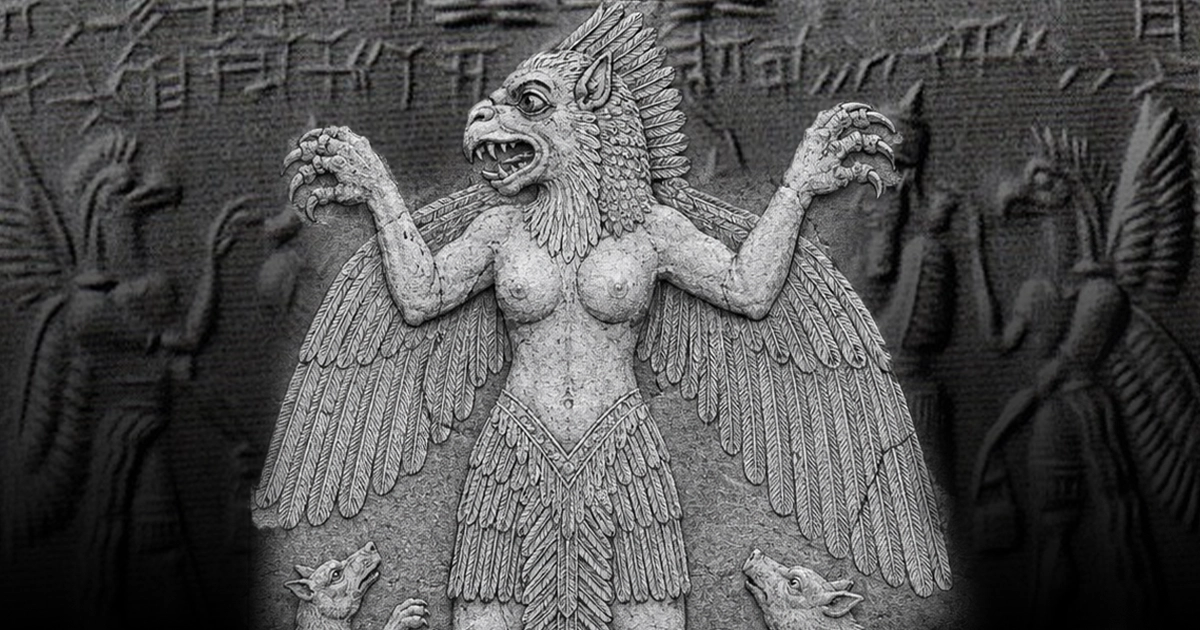
On a small obsidian amulet from the early first millennium BCE, Lamashtu stands trapped inside a frame of cuneiform. Her body is humanlike, her head is leonine and birdlike, her hands are clawed, and animals flank her like offerings meant to distract or appease her. The object, now in The Metropolitan Museum of Art, is only 5.7 centimeters high, yet it preserves one of the most frightening religious anxieties of ancient Mesopotamia. This Mesopotamian demoness was feared as a threat to pregnant women, newborns, infants, and the vulnerable interior of the home.
She was not a vague monster of folklore. In Mesopotamian texts and protective objects, she appears as a named supernatural aggressor with a divine origin, a repertoire of attacks, and rituals designed to drive her away. Families did not simply pray against her. They used amulets, incantations, divine names, offerings, protective demons, and images that turned fear into a controlled ritual system. The evidence is fragmentary, uneven, and often difficult, but it is specific enough to show why mothers and healers took her seriously.
A Divine Demon Who Attacked Birth and Infancy
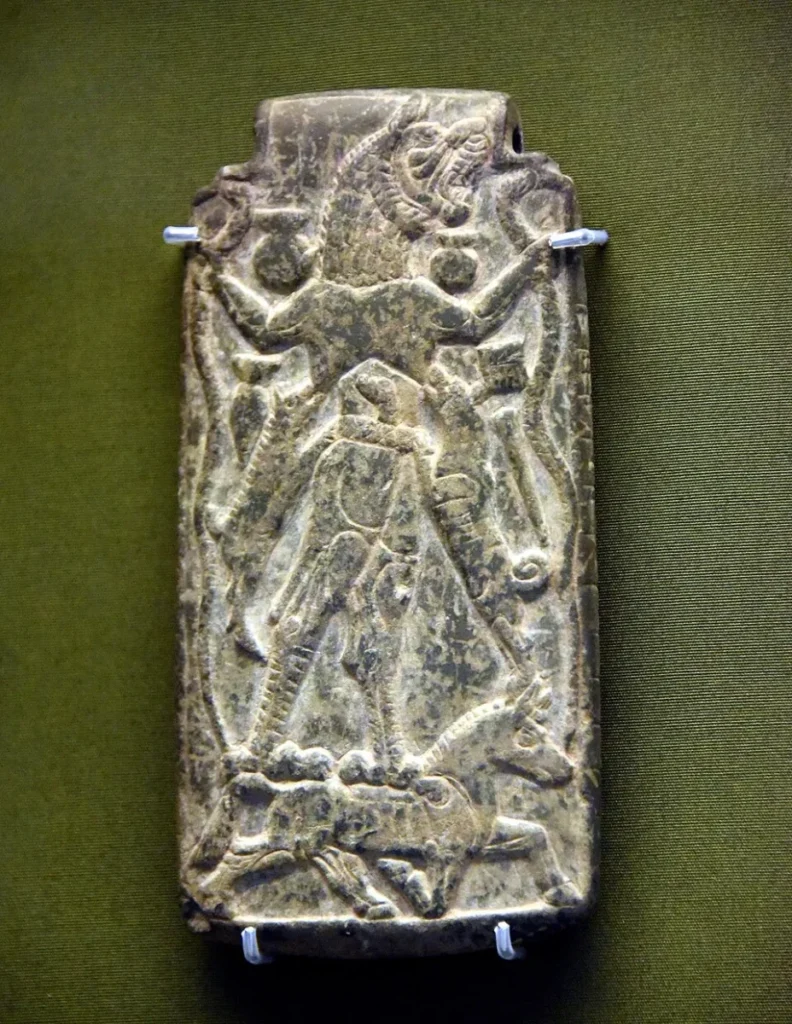
Lamashtu was feared in ancient Mesopotamia as a supernatural danger to pregnancy, childbirth, newborns, and infants. She belonged to the world of Mesopotamian religion and magic, where gods, demons, illness, misfortune, dreams, and ritual protection were treated as connected forces rather than separate categories.
The Met’s object record identifies her as the daughter of Anu, the sky god. That detail matters because it made her more than a wandering spirit or nameless disease. She belonged to a divine order, even while acting violently against humans. Some accounts, summarized in the museum’s record, explain her exile from heaven through her desire to consume human babies. This is mythic material, not a modern medical diagnosis, but it shows how Mesopotamian tradition made sense of threats to infant life through a named supernatural figure.
Her victims were those least able to defend themselves. Pregnant women, women in childbirth, nursing mothers, newborns, and infants appear at the center of the fear surrounding her. This emphasis was not accidental. In ancient Mesopotamia, childbirth was dangerous, infant survival was uncertain, and domestic ritual had to answer problems that neither family affection nor practical care could fully control. When a newborn sickened, when a mother weakened, or when nightmares struck a patient in bed, Mesopotamians could interpret the crisis through hostile supernatural intrusion.
She also inverted motherhood. In some images, according to the Met, a puppy and piglet suckle at her breasts. On the Met obsidian amulet, the animals flank her rather than nurse from her. The meaning is not identical in every object, and the surrounding signs do not always explain themselves. Yet the pattern is clear enough. The demoness was imagined as a distorted maternal figure whose connection with feeding, bodies, birth, and young life made her especially terrifying.
That is the historical force behind the fear. She did not simply represent death. She represented death entering the bedroom, nursery, sickbed, and body.
How Mesopotamian Artists Made Lamashtu Recognizable
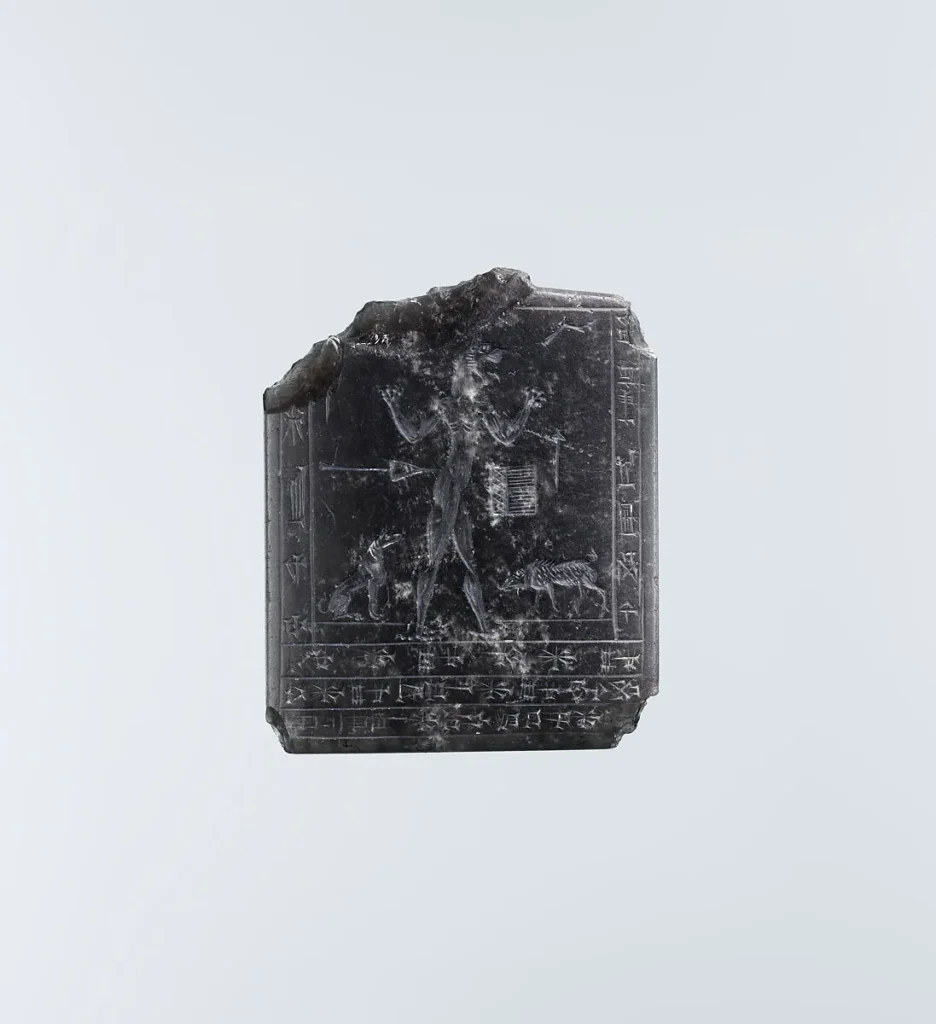
Mesopotamian artists did not give the Lamashtu demon one fixed appearance, but several recurring features made her recognizable. The Met obsidian amulet depicts a figure with a tall, sinewy human body, a lion griffin head, pointed ears, an open roaring mouth, clawed lion’s paws, and bird of prey talons. These features combine human, animal, and monstrous traits. They make visible a being who crosses normal categories.
The amulet’s material also matters. It is carved from obsidian, a volcanic glass. Miriam Said’s MetPublications essay, “Radiance and the Power of Erasure in an Obsidian Lamaštu Amulet”, treats this same object as more than an illustration. Its surface, material, inscription, and imagery belong to a protective object meant to act against danger.
What the Met amulet shows
The Met record states that the demoness is surrounded by objects interpreted as gifts meant to placate her. These include a comb, spindle, and pin, all domestic attributes associated with women. An animal limb may represent a food offering. One arrow-shaped object near her lower back is explicitly described as not well understood, possibly a weapon used against her. That uncertainty should remain visible. Not every element on an ancient amulet can be decoded with confidence.
The image was paired with writing. An Akkadian inscription in cuneiform runs around the central panel and continues across the back. According to the museum, this inscription is similar to those found on other amulets and calls on multiple gods to exorcise the demoness. In this combination, image and text reinforce each other. The frightening being is not left free on the object. She is framed, named, addressed, and ritually constrained.
This is why amulets are such important evidence. They show religious action at the scale of the body and household. The damaged top of the Met plaque suggests it may once have had a drilled projection, allowing it to be strung, worn, or suspended. That does not prove that every such amulet was used in the same way, but it does show that protection could be portable, intimate, and visually explicit.
More than sixty such amulets have survived, most dating to the early first millennium BCE, according to the Met. The wider textual tradition is older and broader. Walter Farber’s Lamaštu: An Edition of the Canonical Series of Lamaštu Incantations and Rituals and Related Texts from the Second and First Millennia B.C. is the key modern edition for the canonical ritual and incantation corpus. The publisher page is accessible, but detailed use of the book requires access to the full text.
The safest chronology is therefore precise but cautious. The demoness appears in Mesopotamian incantation and ritual traditions from the second and first millennia BCE, while many surviving visual amulets belong to the early first millennium BCE. The World History Encyclopedia entry on Lamashtu provides a useful overview of these traditions for readers seeking an accessible entry point.
Why Pazuzu Could Protect Mothers From a Demon
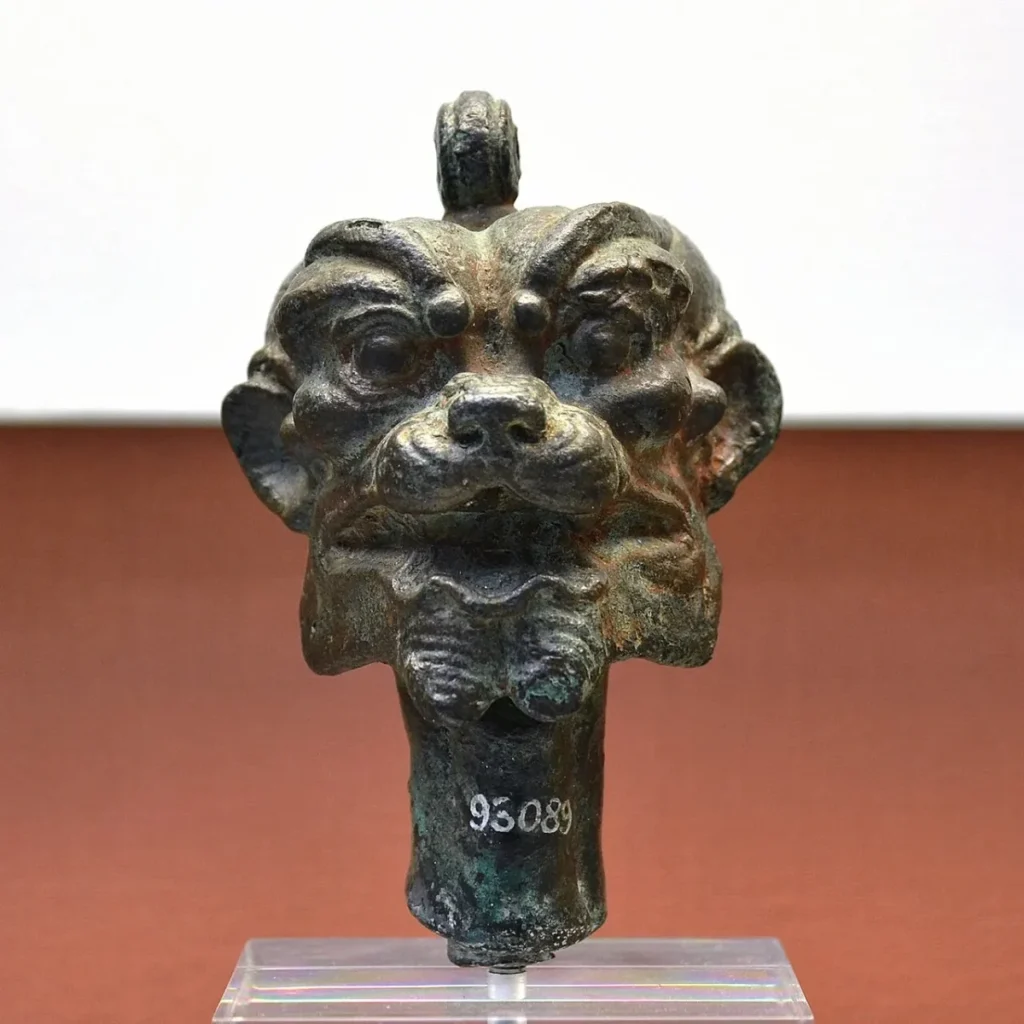
One of the most striking features of this ritual system is that a frightening demon could be used against another frightening demon. Pazuzu, famous today for reasons far removed from ancient Mesopotamia, appears in ancient evidence as a protective force against the child-threatening demoness. The logic was not that Pazuzu was harmless. It was that one dangerous supernatural power could repel another.
The Met’s object record states that many amulets include Pazuzu, king of the evil wind demons, shown driving the demoness back to the netherworld. The same record links images of both beings to personal protection against her destructive power. This corrects a modern assumption that ancient demonology was a simple chart of good spirits against bad spirits. Protective power could be ambiguous, aggressive, and frightening.
A bronze Pazuzu head in the British Museum, museum number 132964, gives a concrete example. It is a Neo-Assyrian copper alloy amulet dated to 800 to 600 BCE and found in northern Iraq. The museum describes it as a cast bronze head with a suspension ring. Its size, material, and ring show that Pazuzu could be made as a portable apotropaic object.
The purpose was not decorative. Such objects belonged to a broader Mesopotamian practice of averting harm through divine names, demon images, inscriptions, figurines, and expert ritual action. The Met’s essay on Mesopotamian magic in the first millennium BCE places these practices in a learned culture where magic, medicine, and ritual knowledge overlapped.
This mechanism explains why the focus on mothers is historically grounded. A mother did not have to meet supernatural danger through private emotion alone. Ritual specialists, household members, amulet makers, and scribal traditions supplied tools meant to control the threat. Pazuzu’s image belonged to that toolkit.
There is still uncertainty. An amulet showing Pazuzu does not always preserve the full ritual performed with it. A museum object may have lost its archaeological context. Even when an object can be dated by style, inscription, or acquisition history, its precise use inside a specific home may remain unknown. What can be said is that first millennium BCE Mesopotamians made and used objects that paired fear of a child-threatening demoness with the protective force of Pazuzu.
Built out of a love for history, kept free from distractions.
Spoken Past is an independent project shaped by curiosity, care, and long hours of research. Reader support helps keep it maintained, carefully researched, and open to everyone.
Ritual Protection Worked Through Image, Text, and Object
A protective amulet was not just a picture. It was an object where image, inscription, divine authority, and ritual intention met. To modern viewers, a plaque or pendant may look like an illustration of mythology. In Mesopotamian practice, it could be a working device for controlling danger.
On the Met’s obsidian plaque, the objects around the demoness are interpreted as gifts or offerings. The inscription does not merely label her. It addresses her and calls on divine powers to exorcise her. In Mesopotamian ritual logic, naming and writing were actions. To write a demon’s name, place her within a framed panel, surround her with words, and pair her with divine authority was to act on the danger she represented.
The Lamaštu and Hulbazizi problem
Specialist scholarship complicates these objects further. Strahil V. Panayotov’s work on healing images and texts emphasizes that many so-called Lamashtu amulets also contain material connected with Hulbazizi incantations, a protective genre associated with eradicating evil. This matters because some plaques combine demon-specific material with broader healing and evil-averting traditions.
A reader may want one simple explanation for every figure, object, and inscription on an amulet. The ancient object may not work that way. It can combine several protective techniques at once. Some images correspond to texts on the same object. Others may correspond to ritual texts preserved elsewhere. In those cases, modern scholars must connect image and text across different manuscripts, objects, and traditions. That work is legitimate, but it is interpretation, not direct ancient explanation.
One incantation associated with sickbed imagery begins with a figure who has crossed into the privacy of the bed. This matters because it links demonic danger with the intimate space of sleep, illness, childbirth, and vulnerability. The fear is not only that a demon exists somewhere outside the house. The fear is that an evil being has crossed into the most private zone of the home.
This gives a sharper answer to why Mesopotamian mothers feared the demoness most. The danger was imagined as intimate. It entered the room where mother and child were least protected by public life, kinship display, or ordinary social order. The ritual response had to work there too, at the bed, door, body, and threshold.
The Sickbed as a Battlefield Inside the Home
Ancient Mesopotamian protection often centered on domestic space. The bedroom was not merely a place of rest. It could be where illness, nightmares, childbirth danger, and demonic attack converged.
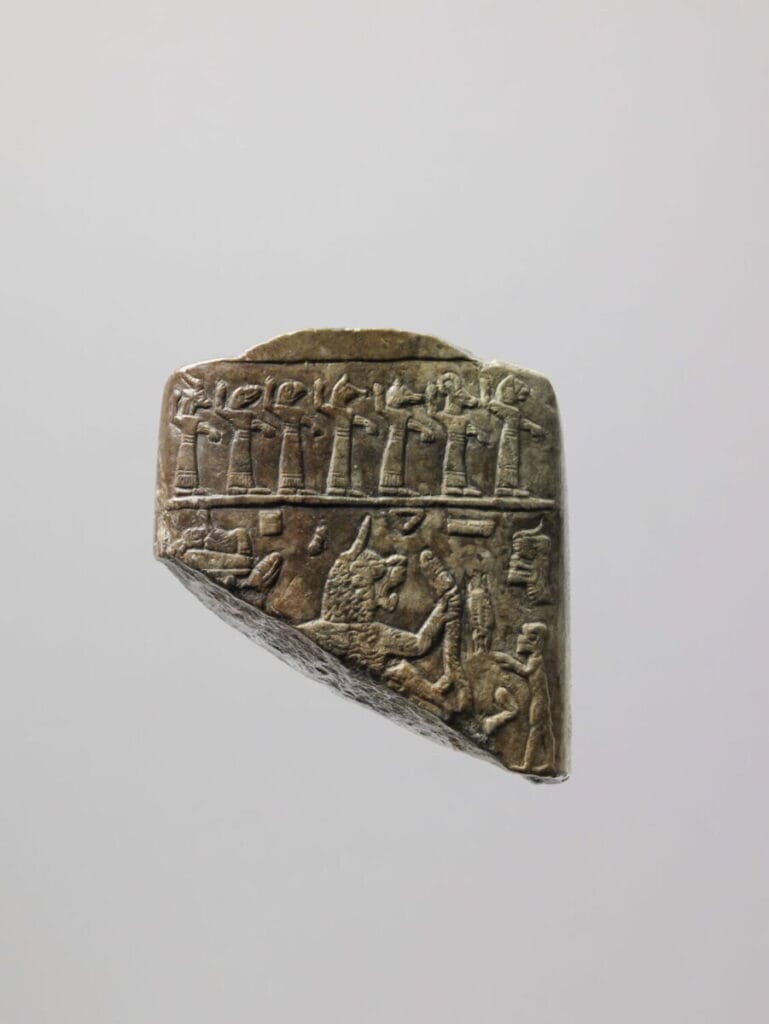
Panayotov’s discussion of sickbed scenes stresses that amulets sometimes flatten a three-dimensional healing scene into a two-dimensional image. A bed, patient, healers, incense burner or lamp, and protective beings may appear on one surface, even though the imagined ritual setting was a room. This means that a modern viewer should not always read the figures as standing exactly where they appear in the carved register. Some protective beings may belong at entrances or thresholds, even if shown near the bed.
This fits wider Mesopotamian protective practice. Doors, windows, beds, corners, thresholds, and inner rooms were vulnerable points. Protective figures could guard entrances. Incense, lamps, and ritual speech could transform the sickroom. The bed itself could become the focus of ritual defense.
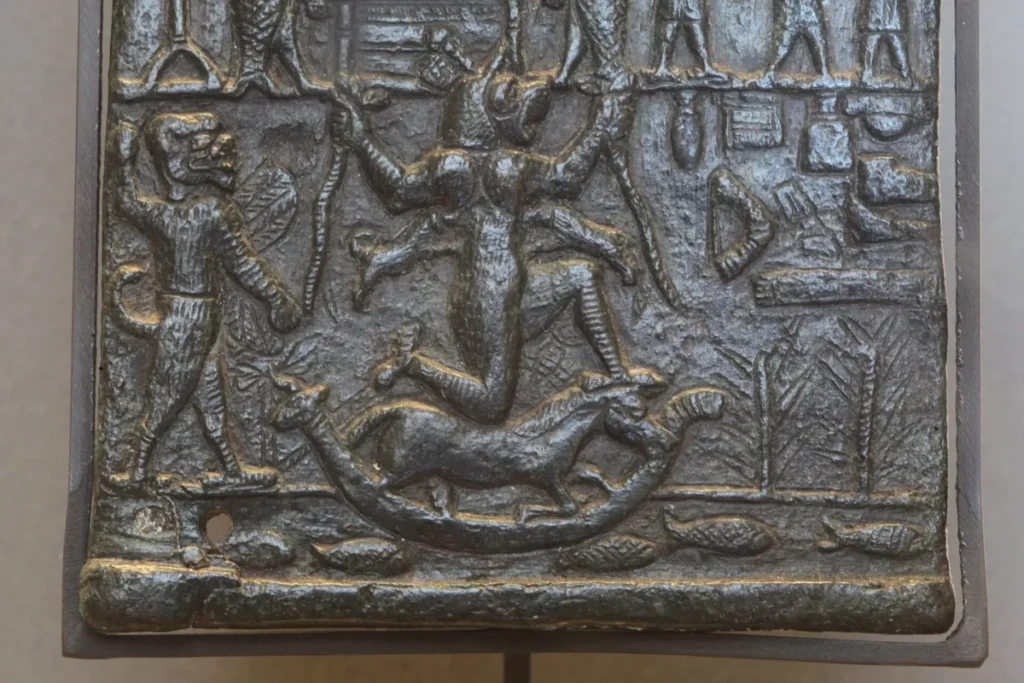
The Louvre plaque known as AO 22205, cataloged as a plaque of conjuration against the demoness, gives one of the most famous visual examples of this broader tradition. It includes multiple registers, suspension rings, and an elaborate arrangement of figures connected with protection and expulsion. The plaque is Neo-Assyrian and was found in Syria, which shows how this protective imagery circulated beyond one narrow local context.
A clear summary for readers: Mesopotamians fought the Lamashtu demon through apotropaic amulets, Akkadian incantations, divine invocations, offerings, protective figures, and ritual scenes focused on the household and sickbed. Pazuzu could be invoked as a counter-demon, while gods such as Marduk and Ninurta appear in the textual world of exorcism.
The geography is broad but not limitless. The Met amulet is listed as from Mesopotamia or Iran. The British Museum Pazuzu head is Neo-Assyrian and found in northern Iraq. The Louvre plaque was found in Syria and is associated with the Neo-Assyrian world. The evidence belongs above all to the ancient Near East, especially Mesopotamian scribal and ritual culture. It should not be treated as a universal ancient demon-mother motif detached from Akkadian texts, cuneiform scholarship, and Near Eastern material culture.
Where the Evidence Holds and Where It Breaks Down
The surviving evidence is powerful, but it is not complete. It comes from museum objects, cuneiform incantations, ritual series, later scholarly editions, and objects whose original contexts are sometimes uncertain. That creates several limits.
First, many amulets were not recovered in controlled modern excavations. Their object histories may be incomplete. When a museum record gives a broad geography such as Mesopotamia or Iran, that is not the same as knowing the exact city, house, room, owner, or ritual occasion. A first millennium BCE date can place an object in a historical range, but it cannot always identify one family’s experience.
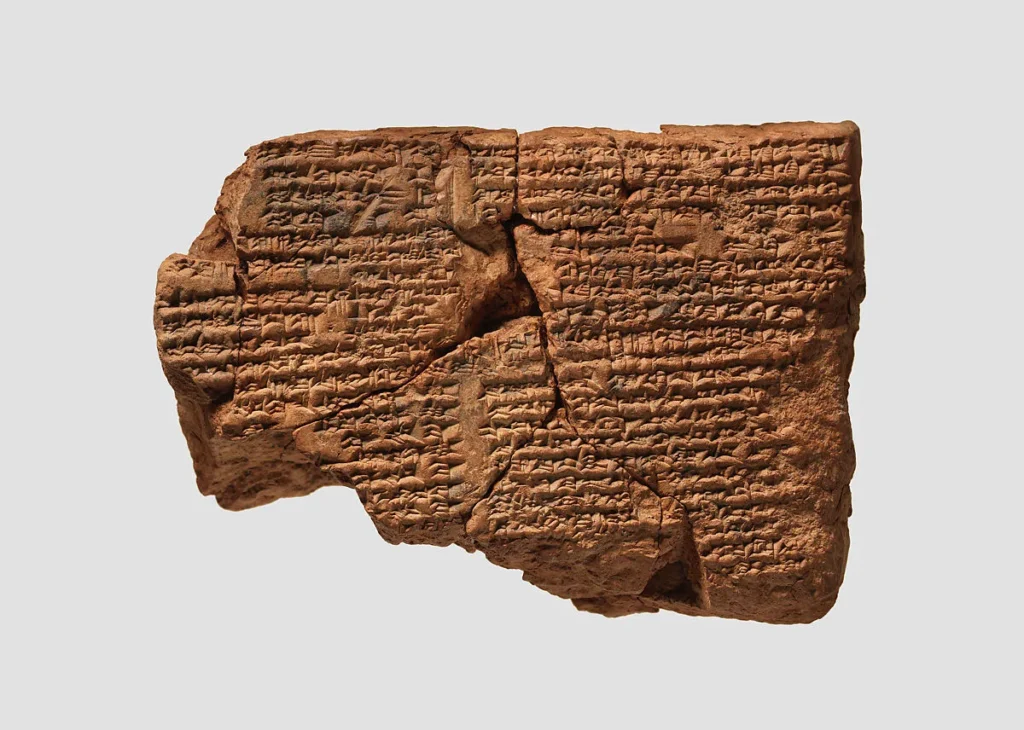
Second, the relationship between text and image is not automatic. Some amulets preserve inscriptions that can be read and compared. Others are broken, worn, or incomplete. Some images appear to match known incantations. Others require more cautious interpretation. Even when a scholar identifies a sickbed scene, the precise ritual sequence behind that scene may remain partly reconstructed.
Third, museum descriptions often summarize complex specialist debates. The Met’s object record is reliable as a collection entry, but it is not a full philological edition. Farber’s edition is essential for the canonical incantation series, but detailed claims from that book should be made only from direct consultation of the text. The Sources of Early Akkadian Literature record for F. A. M. Wiggermann’s “Lamaštu, Daughter of Anu. A Profile” confirms a major scholarly study, but the chapter itself must be read directly before using its arguments in detail.
Fourth, Lamashtu should not be flattened into one modern label. She is not simply a goddess, witch, disease metaphor, or monster. She is a named supernatural attacker in Mesopotamian ritual texts and images, associated with birth, infancy, sleep, sickness, animals, households, and divine exorcism. Some of what she represents overlaps with medical fear. Some belongs to myth. Some belongs to ritual performance.
Ancient Mesopotamians feared a female demon who attacked mothers and infants, and they answered that fear with sophisticated ritual technologies. The evidence does not let us hear one mother’s private thoughts at a cradle. It does let us see the objects, words, and protective images that a culture developed for the moment when childbirth and infancy felt most exposed, inside the house, at the bed, near the body, and at the threshold.