
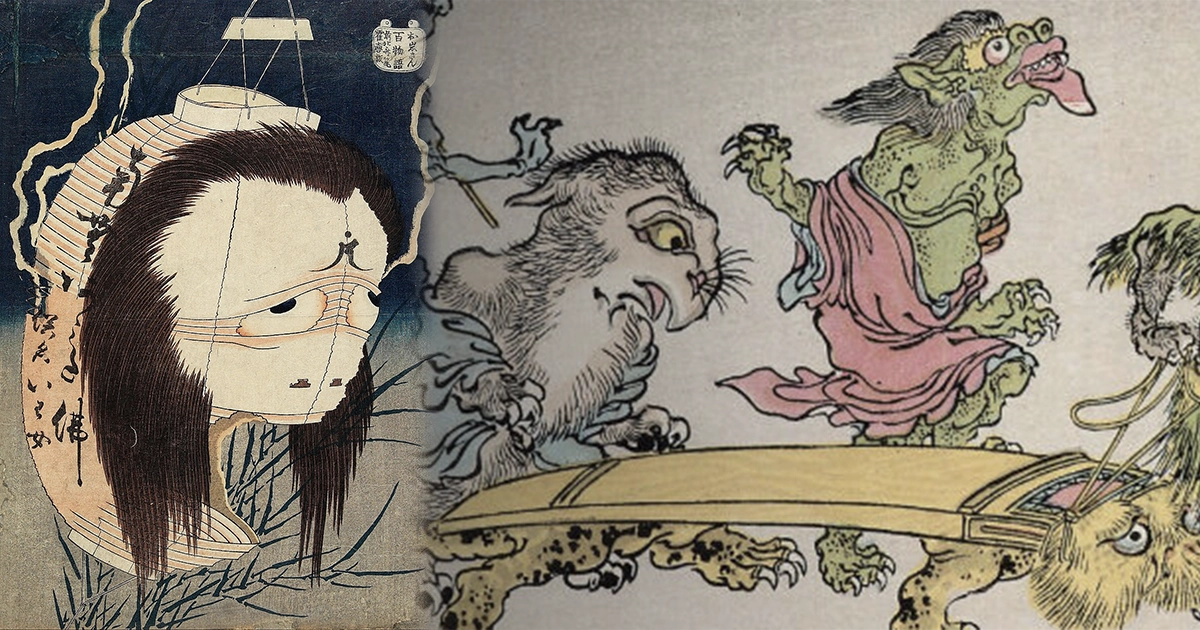
A household tool in medieval Japan could become dangerous at the end of its working life. According to the Tsukumogami ki, an illustrated tale associated with the Muromachi period, old objects that had served people for many years could transform, gain spirit, and turn against human beings. Tsukumogami were not simply cute Japanese object spirits from modern fantasy. In one of their most important early traditions, old tools became angry because humans threw them away before the New Year.
That anger gave the story its force. Worn utensils, musical instruments, containers, and other household objects did not merely haunt a room. They gathered, organized, plotted revenge, attacked people, and were eventually drawn back into a Buddhist moral order. The tale made neglected things into agents with memory and grievance.
The evidence is more complicated than the familiar claim that every object becomes alive after 100 years. The surviving sources mix folklore, Buddhist doctrine, humor, visual culture, and later interpretation. That mixture is exactly what makes the tradition revealing. These old tools were not only monsters. They were reminders that objects had histories, that use created obligations, and that neglect could be imagined as a moral failure.
What Were Tsukumogami in Medieval Japan?
The direct answer is that Tsukumogami were animated old tools or household objects that became yōkai after long use, neglect, or improper disposal. In medieval Japanese literature and art, they could appear as tool specters with arms, legs, faces, and intentions of their own. Their best-known early textual source is the Tsukumogami ki, usually translated as The Record of Tool Specters.
The story belongs to the world of otogizōshi, short illustrated prose tales that circulated in medieval Japan, especially during the Muromachi period, which lasted from 1336 to 1573. These tales were often entertaining, but entertainment did not prevent religious or moral instruction. Noriko T. Reider’s peer-reviewed study, “Animating Objects: Tsukumogami ki and the Medieval Illustration of Shingon Truth”, argues that the work used pre-existing beliefs about animated objects to spread Shingon Buddhist ideas to different audiences.
Michael Dylan Foster, in Pandemonium and Parade: Japanese Monsters and the Culture of Yōkai, places animated objects within a broader history of Japanese monster discourse. He notes that from the Kamakura period onward, one common image of mono-no-ke, mysterious or frightening presences, was the old household object with arms, legs, and riotous life. In the Muromachi tale, an object that reaches one hundred years transforms, receives a spirit, and is called a tool specter. Foster also emphasizes that this transformation is not just a costume change. It is a movement from inanimate thing to living organism, from handled object to independent presence.
The term itself is layered. One common explanation connects tsukumo with ninety-nine and old age, while kami can mean spirit or deity depending on context and writing. This etymology should be handled carefully because names in yōkai traditions often accumulate wordplay, later explanation, and religious interpretation. The important historical point is that the word linked age, transformation, and spiritual animation.
In modern summaries, Tsukumogami are often described as objects that become alive after 100 years. That is convenient but incomplete. In the medieval tale, the transformation is bound to social use, disposal, resentment, and religious salvation. The objects are not neutral antiques. They are former servants of human households who believe they have been wronged.
The New Year Cleaning That Turned Tools Into Enemies
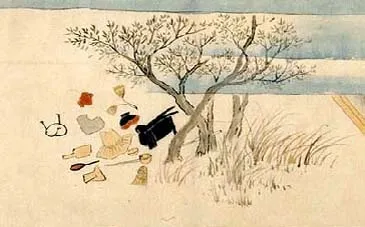
The revenge story begins with a recognizable domestic practice. At the end of the year, households cleaned and discarded old things in preparation for the New Year. In the world of the Tsukumogami ki, that practical act becomes a supernatural crisis. Old tools hear that they are going to be thrown away before reaching the age at which they might become spiritually empowered. Rather than accept disposal, they gather together.
Reider’s translation of Tsukumogami ki, published as an online supplement to the Japanese Journal of Religious Studies, is the key primary-source translation for English readers. It shows that the objects’ anger is not random. They resent being abandoned after years of service. The tale imagines household things as participants in a moral economy, where use creates a relationship and disposal can be experienced as betrayal.
The tools’ grievance turns into collective action. They withdraw from the human world, transform into monstrous forms, and plot retaliation. In the story, their revenge is not merely a ghostly haunting. They take on organized power. They attack human beings, cause fear, and invert the ordinary hierarchy between user and used. A tool normally exists in the hand. In this tale, the handless object grows limbs and acts for itself.
This is why “old tools that sought revenge” is not a metaphor imposed on the material. It is the structure of the tale. The objects become dangerous because they remember service and interpret disposal as injustice. The story gives discarded things motive.
At the same time, the tale is not a documentary record of ordinary Japanese belief. It is a crafted narrative. It uses older ideas about animated objects, but it also arranges those ideas into a Buddhist story of error, violence, conversion, and salvation. The tools’ anger matters because it can be morally redirected. Their monstrous phase is not the final point. It is the problem the tale sets up.
Why the Story Made Old Objects Angry
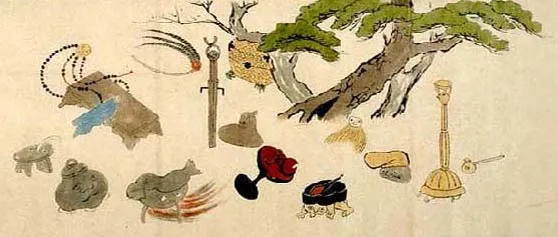
The anger of old tools makes sense only inside a culture that could treat objects as more than dead matter. Medieval Japan inherited and reshaped several overlapping religious and literary ideas: Buddhist transmigration, anxieties about spirits, the power of material forms, and a long-standing interest in things that change shape.
Foster’s history of yōkai stresses instability as a central feature of the weird in Japanese tradition. A human might become a vengeful spirit after death. A living person’s spirit might detach and torment others, as in the famous case of Lady Rokujō in The Tale of Genji. A fox or tanuki might take another form. In this broader imaginative world, transformation was not an exception invented for old tools. It was a recurrent way of explaining dangerous or uncanny agency.
Tools were especially effective subjects for this transformation because they were intimate. They lived inside houses. They touched food, clothing, music, writing, storage, labor, and ritual. Unlike remote monsters, object spirits began as familiar things. Their strangeness came from proximity.
The Tsukumogami ki also draws on Buddhist concerns about attachment and delusion. The tools are angry because they cling to status, revenge, and their own grievance. In Reider’s interpretation, the story uses their animation to illustrate Shingon Buddhist truth. Their monstrous condition is meaningful because it can be transformed through religious awakening.
That religious dimension prevents a shallow reading. These beings are not simply haunted antiques. They are characters in a conversion narrative. Their anger is real within the story, but it is also doctrinally useful. It dramatizes what happens when beings are trapped in resentment and what can happen when they are redirected toward Buddhist salvation.
The result is a strange blend of comedy and seriousness. A pot, instrument, or utensil with limbs can be funny. A crowd of discarded objects plotting violence is absurd. Yet the tale uses that absurdity to speak about use, waste, age, ritual time, and religious discipline. Medieval audiences did not need the story to be only frightening for it to carry weight.
Built out of a love for history, kept free from distractions.
Spoken Past is an independent project shaped by curiosity, care, and long hours of research. Reader support helps keep it maintained, carefully researched, and open to everyone.
The Hyakki Yagyō Scrolls and the Parade of Animated Things
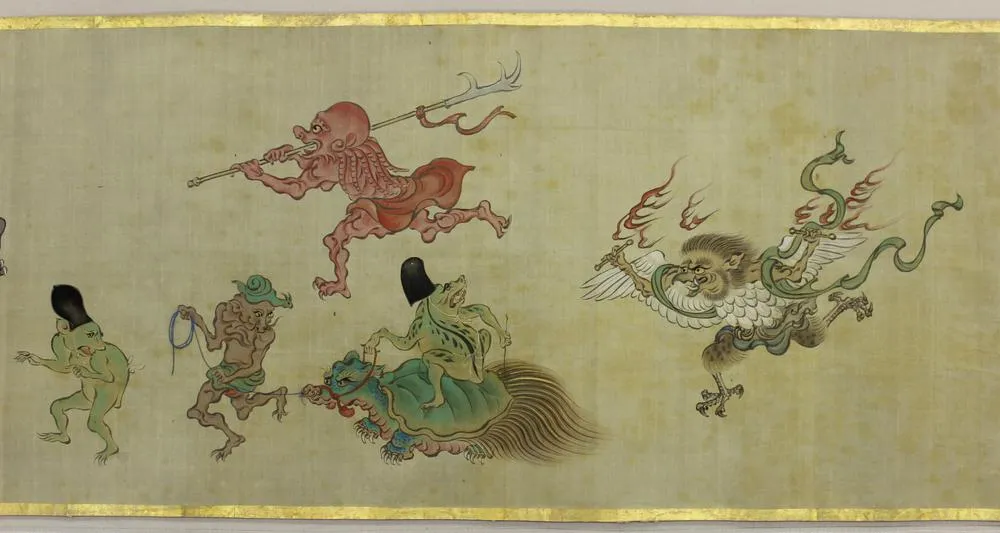
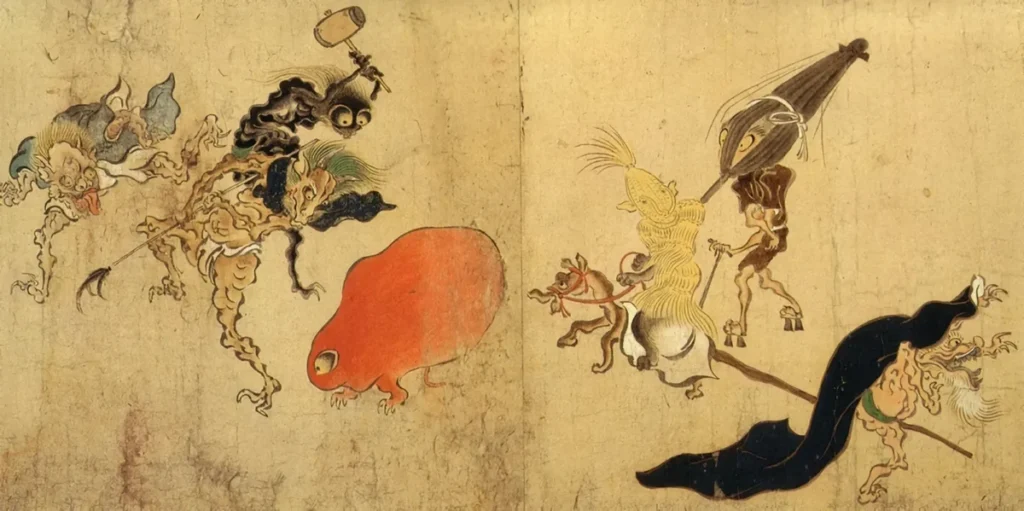
The most famous visual context for animated tools is the Hyakki Yagyō, often translated as the “Night Parade of One Hundred Demons.” This motif imagined a nocturnal procession of supernatural beings moving through the human world. It had older textual associations with danger, but in painting it could become comic, spectacular, and highly inventive.
Foster describes the Hyakki Yagyō emaki tradition as one of the most famous visual representations of animated objects: musical instruments, umbrellas, cooking utensils, and other human-made things appear as living beings with arms and legs. He also stresses that several related sixteenth-century versions survive, rather than a single authoritative original. That matters because the visual tradition is not one fixed image. It is a family of related processions.
The Kyoto University Rare Materials Digital Archive record for Tsukumogami Emaki is especially useful because it preserves a concrete manuscript witness. Its English explanation summarizes the tale in which discarded tools become angry, transform into specters, take revenge, and later receive Buddhist salvation. The archive identifies the object as a two-scroll work held by Kyoto University Main Library, making it one of the strongest online institutional sources for the topic.
The University of Chicago’s East Asian Scroll Paintings project offers a related visual comparator in its record for a Night Parade of One Hundred Demons scroll. It is not the same thing as the Tsukumogami ki, and it should not be treated as direct evidence for that text. Its value is comparative. It shows how the night parade format worked visually, with strange beings arranged in a moving procession across a handscroll.
The British Museum holds several relevant Hyakki Yagyō works. One collection record describes a handscroll titled Hyakki yagyo, associated with Edo-period Japan and claimed to be by Hanabusa Itchō. Another British Museum handscroll is dated around 1800 and attributed to Itaya Kei-i Hironaga of the Sumiyoshi school. These are later than the medieval Tsukumogami ki tradition, but they demonstrate how durable the night parade motif remained in Japanese visual culture.
A key interpretive caution follows from this evidence. Not every creature in a Hyakki Yagyō scroll is necessarily a tool specter, and not every animated object should be forced into one textual tradition. The night parade is a broader visual and folkloric frame. The Tsukumogami ki is a specific tale about old tools, resentment, revenge, and religious resolution. They overlap, but they are not identical.
From Tool Specters to Yōkai Taxonomies
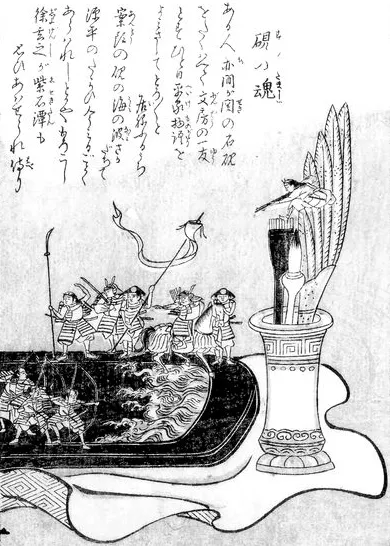
The later history of Japanese object spirits is also a history of classification. By the Edo period, from 1603 to 1867, strange beings were increasingly collected, named, pictured, and organized in encyclopedias, illustrated catalogs, and playful monster books. This did not create Japanese monsters from nothing. It changed how they were displayed and understood.
One major figure was Toriyama Sekien, an eighteenth-century artist whose illustrated yōkai books gave many strange beings durable visual forms. Foster places Sekien within a wider Edo-period movement in which yōkai became subjects of both taxonomy and entertainment. Naming and drawing a monster made it easier to circulate, compare, remember, and enjoy.
This process altered the status of creatures like tool specters. In a medieval religious tale, animated tools had a narrative problem and a moral arc. In later catalog and parade contexts, they could become visual types, comic figures, or collectible images. A broken umbrella with one eye and one leg, a wall screen with staring eyes, or a household object with a grotesque body could be appreciated as a witty design as much as a frightening presence.
This does not mean the tradition became meaningless. It means the meanings multiplied. A yōkai could be frightening, funny, nostalgic, commercial, religious, and aesthetic at different times. Foster argues that yōkai discourse changes through overlap and reinvention rather than clean breaks. Old forms persist, but they are reworked for new audiences and media.
That is why modern searches for Japanese object spirits often encounter a compressed version of a much longer process. The medieval tale, the night parade scrolls, Edo-period monster books, modern manga, games, and internet summaries all shape what people now expect these beings to be. The problem for historical reading is to keep those layers separate without pretending they are unrelated.
The simplest historically responsible answer is this: Tsukumogami began as animated old objects in medieval tale and image traditions, became part of a larger yōkai visual culture, and were repeatedly reinterpreted through Buddhist teaching, comic procession, taxonomy, art, and modern folklore.
What the Surviving Scrolls and Studies Can Prove
The strongest source for the revenge narrative is the Tsukumogami ki itself, especially when read through Reider’s translation and study. It supports the claim that old tools, after being discarded, transform, organize, attack, and later undergo Buddhist salvation. It also supports a more precise reading of the tale as religious and social narrative, not just monster lore.
The Kyoto University Tsukumogami Emaki record supports the survival of illustrated versions of the story and gives an institutional basis for discussing the object tradition. It is especially valuable because it connects text, image, and manuscript culture. But it should not be exaggerated into proof that all medieval Japanese people believed old tools literally became monsters. A manuscript shows that a story circulated and was illustrated. It does not directly measure belief.
Foster’s work supports the broader yōkai context. It helps place tool specters within transformations of Japanese monster discourse from medieval mono-no-ke and illustrated processions to Edo-period catalogs and modern reinterpretations. His discussion also warns against treating yōkai as a single timeless category. The term itself became the dominant technical word relatively late, especially through Meiji-period scholarship and the work of Inoue Enryō.
The evidence is also limited by survival. We have texts, scrolls, later copies, museum objects, and scholarly interpretations. We do not have direct access to how every household understood broken tools, nor can we reduce a complex tale to a single folk belief. The 100-year formula is important, but it is not the whole story. In the medieval narrative, age matters because it intersects with service, disposal, timing, resentment, and religious transformation.
That is the historical power of the old tools that sought revenge. They were not frightening because they came from outside the house. They were frightening because they had always been inside it. The tale turned ordinary utensils into witnesses against their owners, and then made their anger something Buddhism could name, discipline, and save.