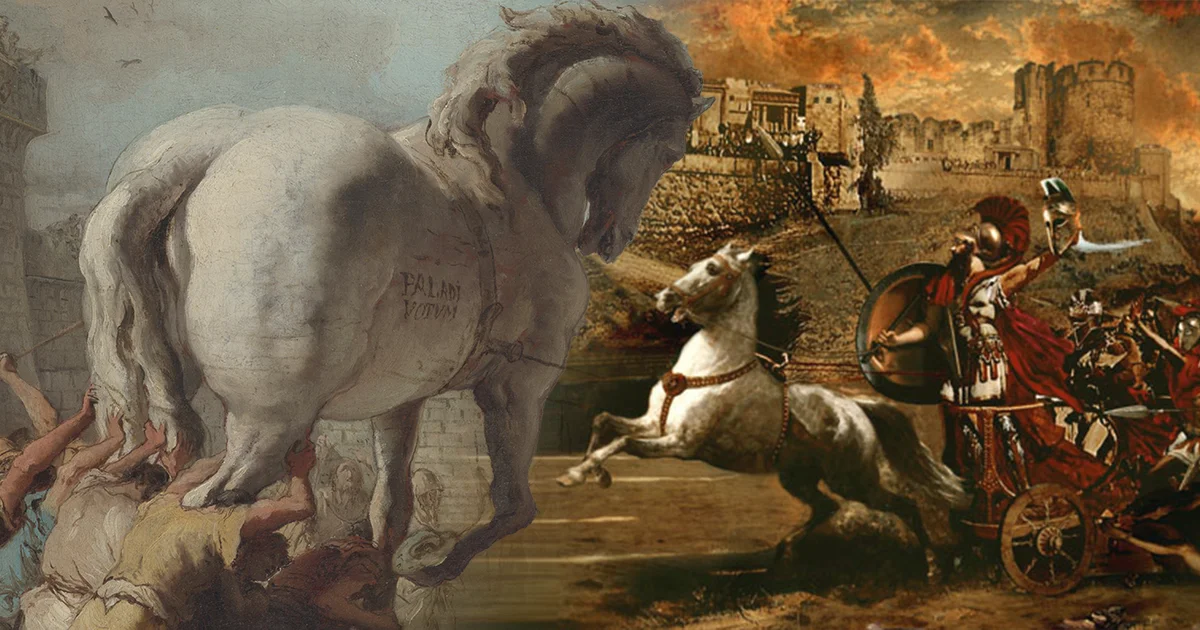
By torchlight, the city of Troy shone with wine and victory songs while a huge wooden figure stood near the broken stretch of wall where it had been dragged inside. According to later epic, a few men waited hidden in its hollow belly, watching for the signal fire that would call their comrades from the nearby island as The Trojan Horse turned from trophy into trap. This famous scene raises the central question for any careful reader of the war stories and the excavated ruins at Hisarlik: was there really such a contrivance, or has a memorable image grown from more ordinary Bronze Age tactics.
The surviving poems about Troy, written centuries after the events they describe, preserve several versions of how the city fell and do not always agree on details. Meanwhile, the archaeological record shows a rich city that burned violently near the traditional date of the war but remains silent on whether attackers used a horse, a tower, or simple treachery. To weigh myth against war tactic, it helps to set the wooden horse within three frames at once: the literary stories that describe it, the known patterns of Late Bronze Age warfare, and the physical evidence from Troy itself.
Wooden horse in Greek epic
The earliest complete poem about the war, the Iliad, ends with the funeral of Hector and never reaches the fall of the city, so it says nothing about a horse inside Troy’s walls. The Odyssey mentions a wooden horse only briefly, when characters recall how a group of elite warriors hid inside it and were led into the city as part of a ruse.
Most of the familiar story comes from later epics now lost, preserved only in summaries and fragments. In one of these, the Cypria, the main focus is the outbreak and early years of the war; the horse itself belongs to later poems in the same tradition.
The fullest archaic outline of the episode appears in the pair of poems later known as the Little Iliad and the Iliou Persis (Sack of Troy). In the summary preserved under an ancient scholar’s name, we hear that:
- A skilled craftsman builds a large wooden horse at the instigation of a goddess who favors the Greeks.
- The best warriors climb inside, the rest of the army burns its huts and sails to the nearby island of Tenedos to feign withdrawal.
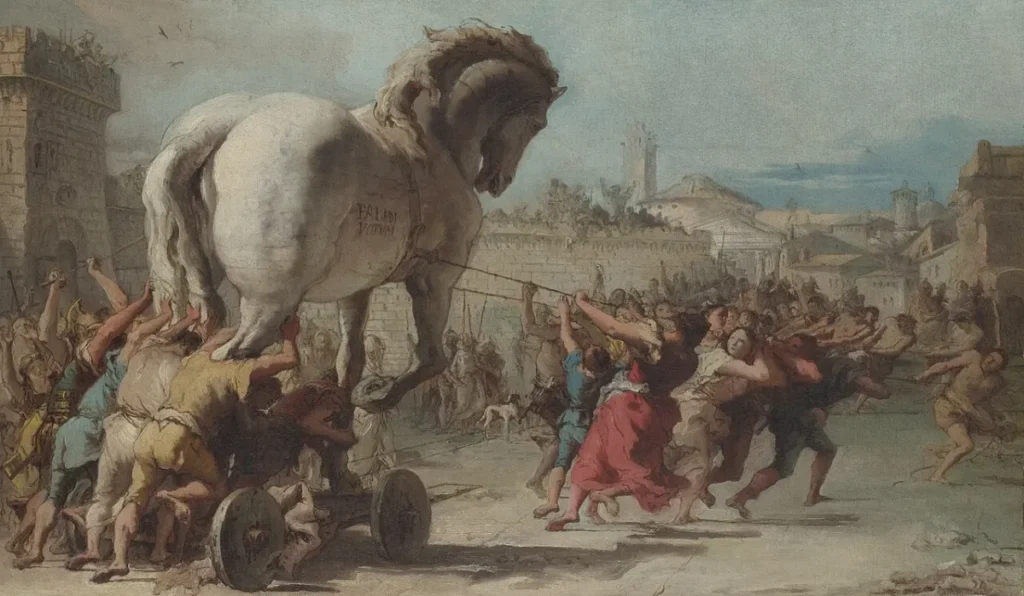
- The Trojans debate what to do with the horse, then drag it inside after breaking part of their own wall and dedicate it to a goddess.
- At night, a signal is given, the main fleet returns, and the men inside open the gates so the army can storm the city.
Later poets in Greek and Latin retell and embellish this plot, adding characters such as the skeptical priest who warns against the horse and the deserter who convinces the Trojans to accept it. By the first centuries AD, the horse has become the decisive turning point of the war in nearly every narrative, even though the earliest epic that survives complete barely mentions it.
Ten years of war around Troy
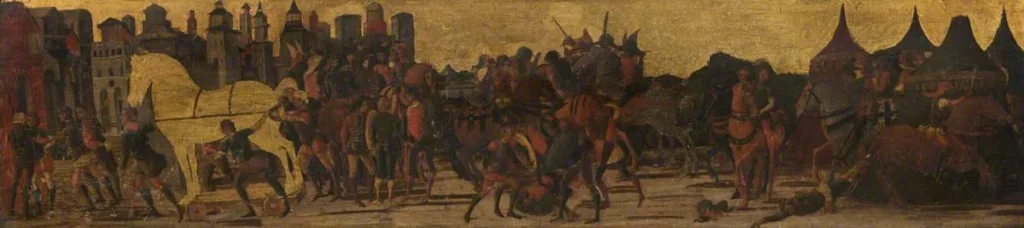
Before asking whether a single device was real, it helps to understand the nature of the wider conflict these poems describe. The literary tradition portrays the war not as one continuous siege at the walls, but as a long campaign of raids, attrition, and shifting momentum around a fortified city that remained unconquered for years.
The epics and their later summaries speak of Greek forces attacking outlying towns, stealing herds, burning farmsteads, and capturing nearby islands, while Troy holds out behind strong walls. The poems also acknowledge that the attackers faced disease, quarrels among their leaders, and shortages, which made a direct assault on well-built fortifications costly and uncertain.
In this context, the horse episode belongs to a final phase when straightforward battle has failed and both sides are exhausted. The poetry pictures Troy still standing, but surrounded by ravaged territory and reliant on dwindling allies, while the Greeks seek some “wonder tactic” to finish a war they cannot afford to fight forever.
The Trojan Horse as battlefield trick
Within that late stage of the conflict, the story tradition presents the Trojan Horse as part of a broader plan of deception centered on a single night. The Greek army apparently pretends to abandon the campaign, leaving behind the wooden figure and a man who claims to have deserted his comrades.
According to the summaries, this agent persuades the Trojans that the horse is a sacred gift that will protect their city if taken inside, while in fact it serves the needs of the attackers. The Trojans themselves are divided: some wish to destroy it, some to push it from the wall, others to dedicate it to a goddess, and in the end the last group prevails.
The same texts also stress the importance of timing and signals. One version has a fire raised within the city as a sign to the fleet on Tenedos, which then rows back under cover of darkness while the horse’s occupants free themselves and open the gates. Such coordination fits well with Bronze Age practice, where torches and beacons commonly appear in narratives about surprise attacks and long-distance communication in clear Mediterranean air.
Separate from the horse itself, the figure of the supposed deserter belongs to a well-attested type of unconventional warfare. Texts from the wider Near Eastern world tell of men who feign defection, infiltrate enemy strongholds, and lull defenders into carelessness before a sudden strike. In that sense, the human aspect of the story matches known tactics, even if the wooden figure seems exceptional.
Could such a horse be built?
The narrative assumes that Greek forces at Troy had the skills and materials needed to construct a large wooden structure on the plain outside the city. Other evidence for the Late Bronze Age confirms that armies depended on shipwrights and carpenters who traveled with fleets and maintained hulls, masts, and fortifications, so trained builders were present in any long campaign.
Wood was available from the slopes of nearby mountains, and elite rulers in the region valued lifelike animal figures in wood and metal as diplomatic gifts and cult objects. Surviving small clay models of horses from Troy and neighboring regions show that horse imagery had strong symbolic and religious appeal long before the classical age.
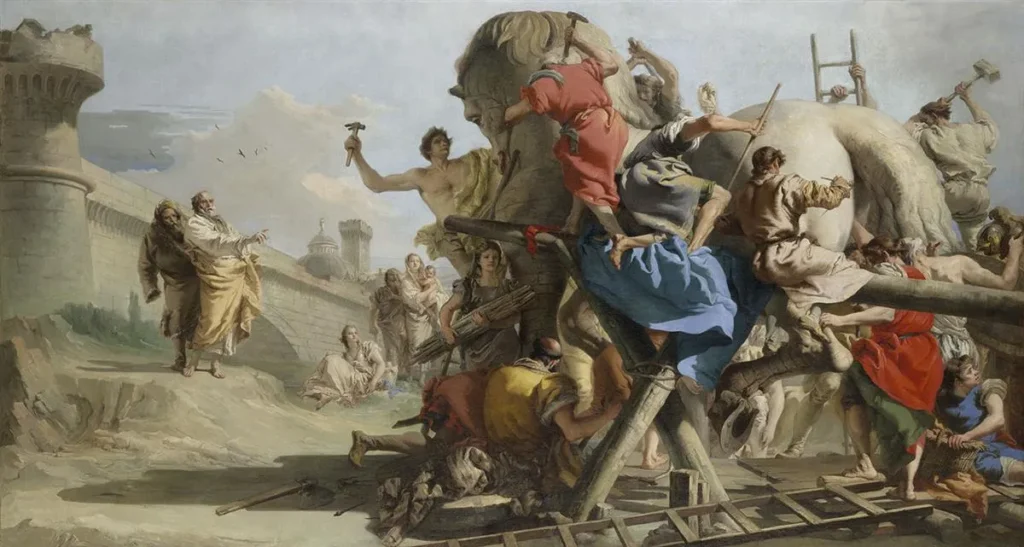
The poems do not give exact dimensions, only the impression of something impressive enough to catch the eye and justify dragging it into the city. A structure large enough to hold several armed men would have been technically possible for Bronze Age builders, but transporting such an object over uneven ground and through city gates would have been difficult and risky, especially under wary eyes.
Because of these practical problems, some reconstructions suggest that the wooden horse in the story may have been smaller than later art imagines, or even empty, while the real infiltration relied on disguised fighters entering the city in less conspicuous ways. The horse would then work chiefly as a decoy that signaled Greek departure and tempted defenders into abandoning strict security.
Built out of a love for history, kept free from distractions.
Spoken Past is an independent project shaped by curiosity, care, and long hours of research. Reader support helps keep it maintained, carefully researched, and open to everyone.
Siege engines, ships, or earthquake symbol
Ancient and modern interpreters have proposed several ways to read the Trojan Horse besides a literal troop carrier. Some traditions outside the main epics compare the device to siege towers or battering rams, recalling that other Late Bronze Age armies named their assault machines after powerful animals, including horses.
A different line of interpretation sees the horse as a poetic image for naval power. In Greek poetry, ships can be compared to swift horses, and a “horse” entering the city could metaphorically represent an attacking fleet or mobile siege gear connected with the sea god who also rules earthquakes.
Finally, there is the idea that the Trojan Horse symbolizes an earthquake which cracked Troy’s walls before any human assault. In one version, the horse stands for the god of the sea and quakes, whose emblem is the horse, and the “gift” that topples the city would then be a natural disaster rather than carpentry. This reading fits well with one of the destruction layers at Troy that seems to have been caused by tectonic forces rather than war, though that layer is not the best match for the fiery sack linked with the war in most reconstructions.
These interpretations do not exclude one another. A real episode of stealth, siege machinery, or earthquake damage could easily have prompted later singers to adopt a vivid, horse-shaped symbol that combined war, wealth, and divine power in a single image.
Archaeology at Troy and the night of fire
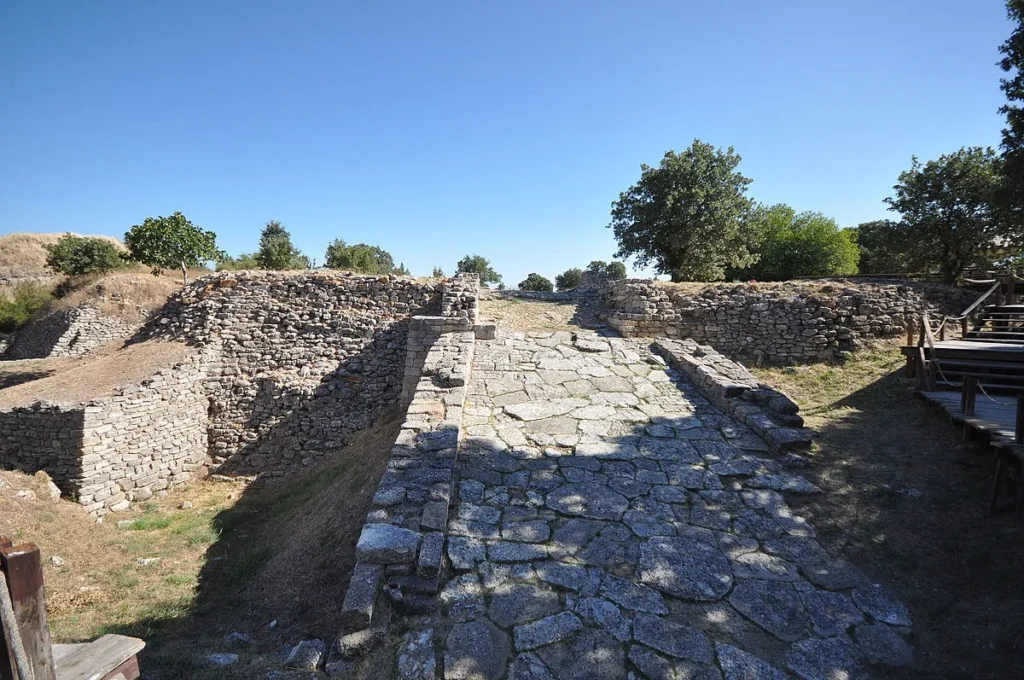
Excavations at the mound identified with Troy reveal a sequence of cities built one atop another over many centuries, numbered by archaeologists from I to IX. The two most relevant for the Trojan War question are a prosperous city with massive stone walls, followed by a successor that reuses those walls but bears clear signs of violent destruction by fire.
The earlier of these, often called Troy VI, ended in a catastrophe that dislodged towers and walls in a pattern strongly suggesting an earthquake, with no clear layer of weapons or unburied war dead. The later level, Troy VIIa, shows burned houses, collapsed roofs, and bodies left in streets and doorways, along with arrowheads, spearpoints, and sling stones scattered across the citadel and lower town.
One house in the lower settlement preserves jewelry and a bronze figurine left behind on the floor, apparently abandoned in haste as flames spread. In and around other buildings, excavators found human remains that had never received formal burial, an unusual situation in this period unless a community collapsed too quickly to perform customary rites.
The destruction layer for Troy VIIa falls broadly within the thirteenth to early twelfth century BCE, close to traditional ancient dates for the Trojan War and fitting the picture of a sack by enemies who broke in and burned the city. However, no trace of a large wooden horse or special gate modification can be identified in the ruins, nor would such features necessarily survive millennia of rebuilding and erosion.
Archaeology therefore supports the idea of a real city at the right time and place that met a violent end consistent with a capture by hostile forces. It cannot by itself confirm whether attackers used the specific ruse described in later poems, only that some decisive breach and night of fire actually occurred.
Storytelling tradition and changing myths
The tradition about Troy developed over many centuries before and after the Homeric poems reached something like their present form. Early on, the story of a long war and a final sack circulated orally in different regions and genres, not only in heroic hexameter but also in prose tales, songs, and visual art.
The poems that modern readers know as the Epic Cycle appear to have crystallized portions of this wider tradition into specific narratives that framed and extended the Iliad and Odyssey. In the Cypria, Aethiopis, Little Iliad, and Iliou Persis, the horse becomes central to the final capture of the city, while other episodes such as earlier raids, the death of Achilles, and disputes over his arms also receive fuller treatment.
Scholars who study these fragments argue that the Homeric poems and the Cycle share the same pool of mythic material, rather than one set simply inventing or borrowing from the other. Over time, elements could move, expand, or shrink as singers adapted them to new audiences, which helps explain why the horse is a minor detail in one surviving epic but dominates later ones.
Art from the late eighth and seventh centuries BCE already shows images of a wheeled wooden horse with warriors inside or around it, underlining how quickly the motif became fixed in Greek imagination. At the same time, there are hints in both texts and images that earlier war stories about Troy involved different kinds of attacks and possibly more than one major conflict in the region, later telescoped into a single great war.
Within this shifting landscape, the Trojan Horse serves as a powerful narrative device that ties together divine will, human cunning, and the sudden reversal of a long stalemate. Whether or not it rests on a precise historical object, the episode has clearly grown in the retelling, absorbing details from siege practice, religious ritual, and moral lessons about trust and deception.
What we can say about the Trojan Horse
Bringing these strands together, the evidence allows a cautious but meaningful answer to the question implied by the title. There almost certainly was a fortified city at Hisarlik that controlled routes between the Aegean and the straits, and it was destroyed by enemy action around the period when later Greeks placed the Trojan War. The warfare of that age regularly used ruses, signal fires, infiltrators, and even named siege engines, so a bold stratagem of misdirection at the end of a long campaign fits what is known of the period.
At the same time, the specific story of a huge wooden figure stuffed with heroes, solemnly dragged inside the walls, and then emptied at night appears fully only in sources several centuries after the supposed events. The way it grows in richness from a passing mention in the Odyssey to the detailed accounts in later epics and art suggests a legendary development built over an older memory of trickery, not a preserved technical report of a single device.
It is therefore reasonable to think that behind The Trojan Horse lies some combination of real Bronze Age tactics, perhaps involving a smaller wooden structure, hidden fighters, or even earthquake damage, which singers later forged into the striking image known today. The story does not allow us to point to a specific artifact with certainty, but it does let us see how ancient warfare, memory, and imagination could work together to turn a wartime stratagem into an enduring symbol.