
Byzantine Silk belongs to the same early medieval language of splendor and authority, but the Lindisfarne Gospels makes its claim through parchment, ink, and a disciplined hand that refused to treat Scripture as ordinary text. The earliest surviving statement about who made this manuscript and why it was made was written into the book itself, long after its creation, and that late testimony has to be weighed against what the manuscript physically shows. The result is a story with clear anchors, a few bright flare-ups of later tradition, and hard limits where certainty is not preserved.
Holy Island and Cuthbert
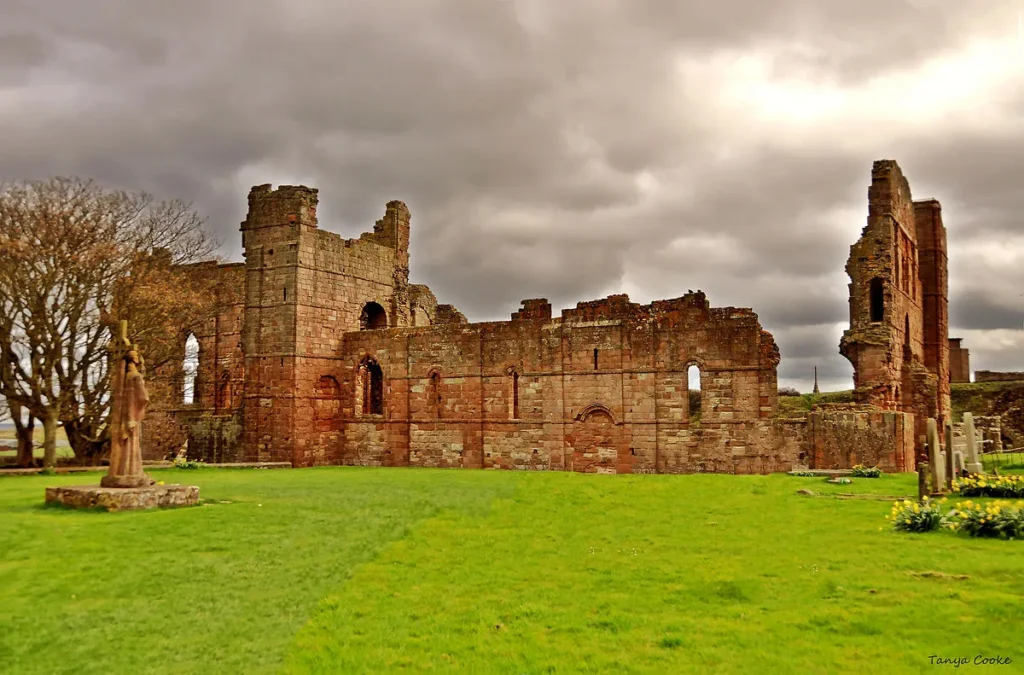
The monastery of Lindisfarne was founded in or about AD 635 on an island off the Northumberland coast, a place twice a day cut off from the mainland by the tide. The same account presents that geography as an advantage for a monastic community, because the sea set a visible boundary while still allowing movement for preaching and travel in Northumbria. The monastery’s early Christian roots in the region are told through a sequence of missions, including an initial mission led by Paulinus in 625, a reversal after King Edwin’s death in 633, and a renewed mission when King Oswald asked the Irish monastery of Iona for priests, led by Aidan.
Cuthbert stands at the center of the book’s meaning in these sources, because the Lindisfarne Gospels is presented as made in his honor and closely tied to the growth of his cult. Two detailed accounts of his life were written only a few years after his death, one by an anonymous monk of the Lindisfarne community and another partly based upon it, drawing on testimony from people still living who had known him. In those narratives he appears as a preacher and reformer, then increasingly drawn to solitude, first on a small islet near Lindisfarne and later on Farne Island, where he built a hermitage with a view of nothing but sky.
Cuthbert died on 20 March 687, and the narrative preserves the image of torches waved across the sea to signal his passing to the community on Holy Island. Eleven years later, in 698, the grave was opened and the body was said to be miraculously undecayed, after preparations that included a new lead roof for the wooden church and a carved oak chest to receive the relics. That same account states that the Lindisfarne Gospels was almost certainly written and illuminated during the period leading up to this reopening, which ties the book’s making to the building of a shrine culture around Cuthbert’s body.
What the Lindisfarne Gospels contains
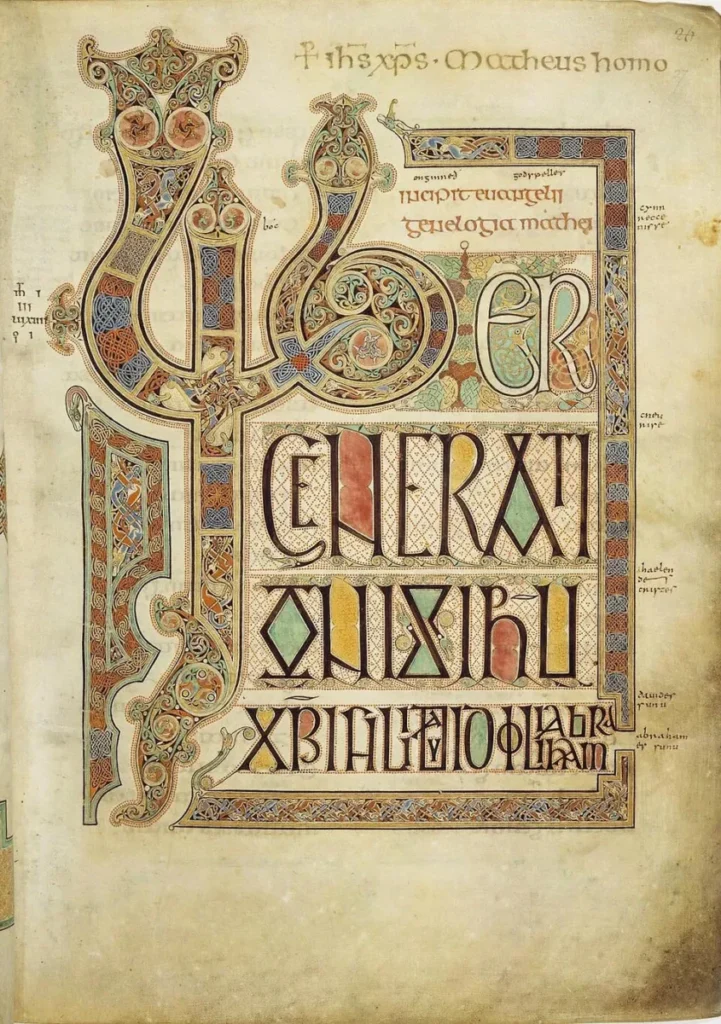
The book is a Gospel-book, and the sources treat it as a cult object as much as a textual container, something meant to sit within a sacred economy of relics, memory, and ritual. It includes a Latin Gospel text, and it later received an Old English interlinear translation added between the lines, so that two languages occupy the same pages in a single field of reading. It also includes a prefatory system for cross-referencing the four Gospels through canon tables and numbered sections, a device that supports comparison and concord across the narratives.
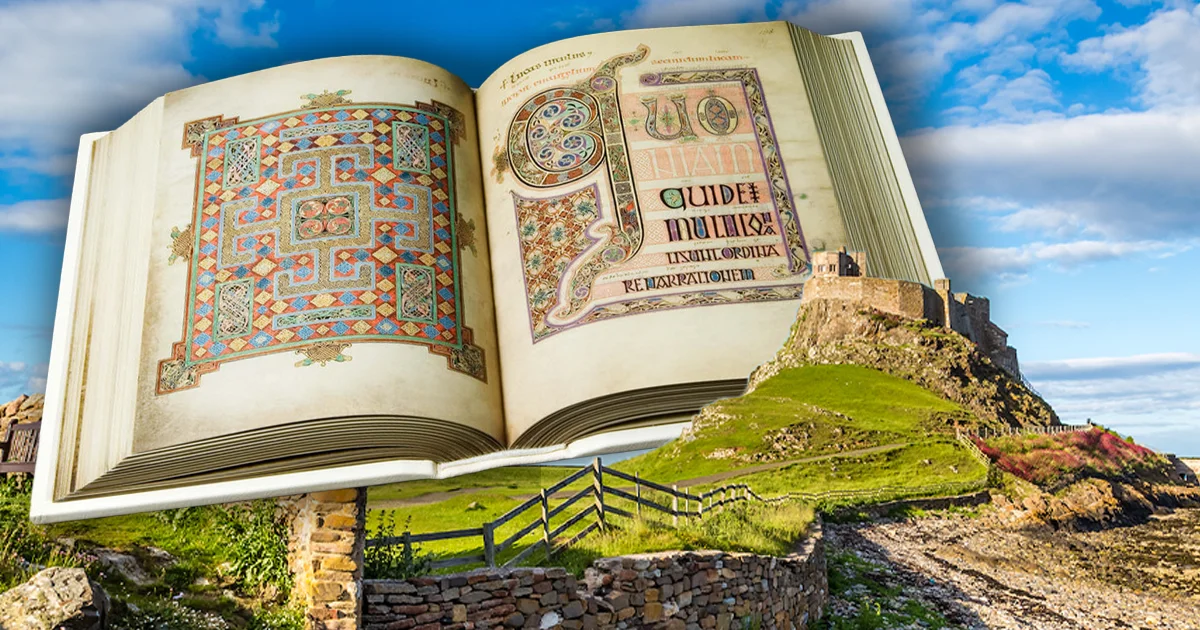
The visual impact described in the attached scholarship is not a matter of one decorative flourish, but a repeated pattern of threshold-making that prepares the reader’s eye before the reader’s mind enters the text. A structured sequence of openings is described as recurring across the manuscript, including evangelist portraits, cross-carpet pages, and elaborate incipit pages. Whatever else the book did in its community, the evidence presented here treats it as designed for sustained attention, not quick consultation.
- The manuscript preserves a Latin Gospel text that later received an Old English gloss between the lines, and the glossator explicitly names himself in the colophon.
- The book includes systems for navigating and comparing Gospel passages, including Eusebian section numbers linked to canon tables.
- The decoration is described as integral to the manuscript’s program, with repeated full-page elements that frame each Gospel as a ceremonial entry rather than a simple start of text.
- The book includes systems for navigating and comparing Gospel passages, including Eusebian section numbers linked to canon tables.
The colophon and named makers
A priest called Aldred, writing about the middle of the tenth century, added the Old English translation and then wrote a colophon on the last leaf naming the men associated with making the book, including himself. Although the book was already about 250 years old when he wrote, the same account treats him as recording well-established tradition and states there is no reason to doubt his statement. In that colophon’s translated wording, the book is framed as made for God, for Saint Cuthbert, and for the saints whose relics were in the island, a statement that binds text to place, shrine, and communal identity.
The colophon assigns roles with striking clarity, even when the physical evidence for some of those roles no longer survives. Eadfrith, Bishop of the Lindisfarne church, is credited with writing the book, Ethelwald is credited with binding and covering it, Billfrith the anchorite is credited with forging and adorning exterior ornaments with precious materials, and Aldred says he glossed it in English between the lines with God’s and Saint Cuthbert’s help. Later local tradition recorded in the early twelfth century is described as categorically stating that Eadfrith wrote the book with his own hand, strengthening the colophon’s claim rather than weakening it.
Writing and decorating the manuscript
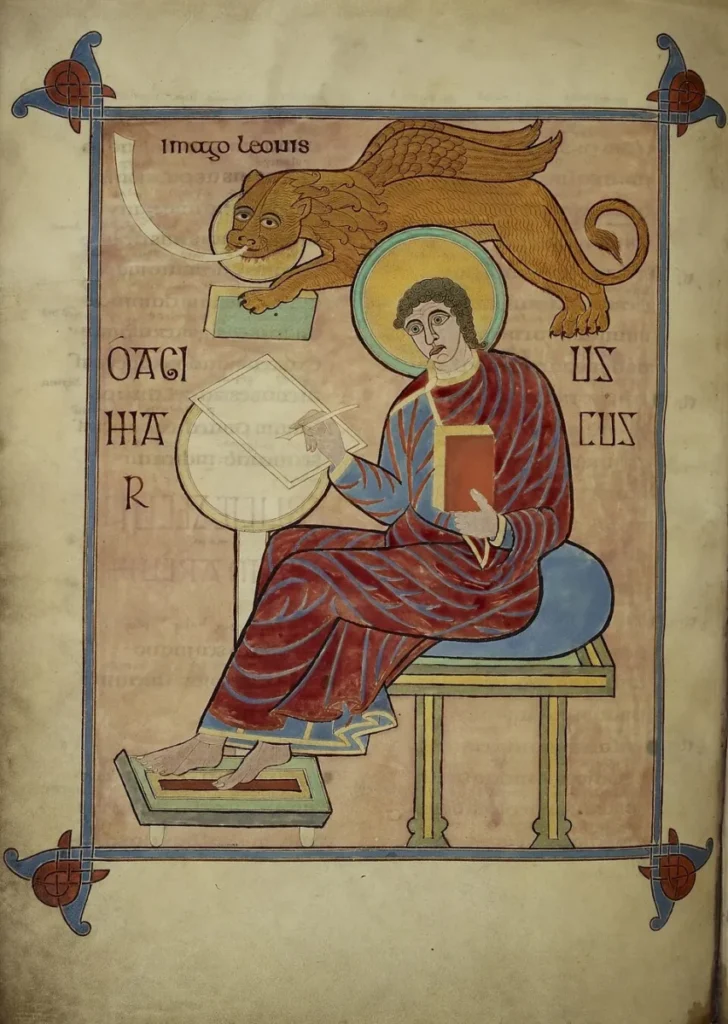
A later careful examination of the manuscript concluded that, with the exception of rubrics and some contemporary corrections and additions, the Gospels were written by a single scribe. It also concluded that the decoration is so closely linked to the writing that it must have been the work of the scribe himself, including places where an initial scheme was sketched and then changed before completion. This is the kind of evidence that makes the manuscript feel less like a workshop product and more like a long act of sustained, controlling attention by one trained person.
The same examination suggested the manuscript was designed and made in a single campaign without major interruption, and it estimated at least two years to complete, while warning that this may underestimate the time needed. A concrete example is offered from 764, when an abbot of Wearmouth-Jarrow blamed an exceptionally cold winter for scribes failing to complete books, which places real weather and real working limits behind the romance of illuminated pages. This is not just a point about time, it is a point about human endurance, because a Gospel-book of this complexity is a project that had to survive fatigue, error, correction, and the slow grind of repetition.
The attached sources also preserve a genuine limit to certainty about when, precisely, the work was done. One reconstruction argues that it is unlikely a bishop would have had the leisure for such a major artistic task after election, and so it proposes the work was done before the elevation of the relics in 698, when Eadfrith may have been a senior member of the community, possibly head of the scriptorium. Another reconstruction places the project’s finalization around 715 to 722, linking aspects of planning, liturgical marking, and a broader structured program to the years before Eadfrith’s death in 722.
Built out of a love for history, kept free from distractions.
Spoken Past is an independent project shaped by curiosity, care, and long hours of research. Reader support helps keep it maintained, carefully researched, and open to everyone.
Canon tables and Gospel navigation
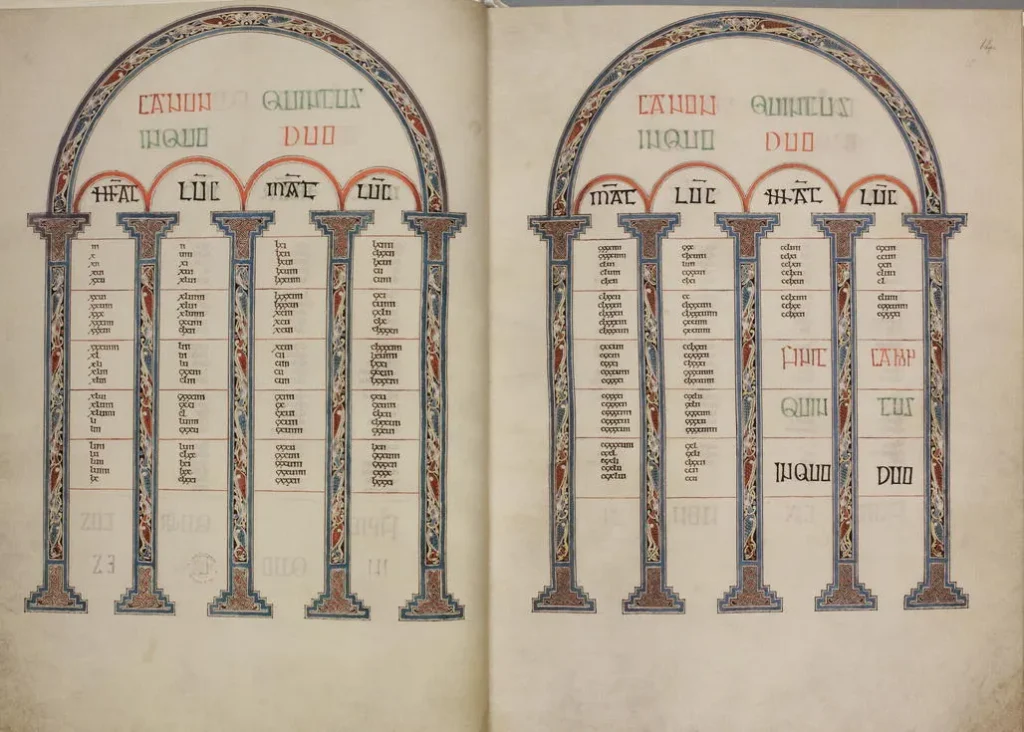
The canon tables and section numbers are treated in the attached scholarship as more than a technical tool, because they embody the idea that four distinct Gospel voices can be read together without being collapsed into one. The numbered apparatus allows a reader to track parallel accounts and to see agreement and divergence across the narratives, and the manuscript emphasizes this apparatus visually by giving it careful presentation. The book’s navigational aids also include a hierarchy of initials and marking systems that help guide a trained reader through divisions and readings.
A related strand in the attached material links this navigational structure to liturgical performance and public reading, rather than private study alone. A specific example discussed is a marginal cross at Matthew 26, near words tied to Passover and the Crucifixion, and the analysis treats such marks as signs of continuing relationship between the book and performed reading. At the same time, the same discussion warns that marginal crosses do not always fix a precise lection system by themselves, so the mark suggests liturgical engagement without automatically proving a single rigid practice.
Lindisfarne Gospels and ecumenical horizons
The attached scholarship also frames the Lindisfarne Gospels as a book that tries to situate its community within a wider Christian world, shaped by international doctrinal controversies and patterns of schism and reconciliation. Within that framing, events such as the Synod of Whitby in 664, the Council of Hatfield in 679, and the council held at Constantinople in 681 belong to the backdrop of a church trying to speak with one orthodox voice across distance and local difference. This argument also places weight on the idea that imagery and book-making could carry doctrinal implications, especially as tensions grew over the legitimacy and function of figural images in Christian worship.
In that interpretive frame, the book’s visual program is read as structured rather than merely ornate. The evangelist portraits are described as framed and icon-like, with symbolic contrasts including bearded, aging figures for Matthew and Luke and youthful, clean-shaven figures for Mark and John, interpreted as a meditation on Christ’s human and divine aspects. The cross-carpet pages are also interpreted as charged objects, standing at the threshold of each Gospel, and the incipit pages’ display scripts are described as blending multiple letter-forms and traditions, including Roman capitals, Greek letters, rune-like forms, and forms compared to Irish ogam.
Raid, flight, and the long road

In 793, Lindisfarne was raided and sacked by Vikings, and the account preserves a reaction written from the court of Charlemagne that described the terror as unprecedented in Britain. The community returned to the island, yet the narrative traces a longer arc of pressure and danger as more monasteries suffered similar attacks. By 875, the sources state that Bishop Eardulf took Cuthbert’s relics and other treasures, explicitly including the Lindisfarne Gospels and even the bones of Eadfrith and Ethelwald, and left in search of a safer home.
A later narrative written down in the early twelfth century describes about seven years of wandering and preserves a dramatic sea episode where a storm rose, waves were said to turn to blood, and a richly bound Gospel book was swept overboard and lost. It then describes a dream appearance that revealed where the manuscript could be found, washed up unharmed on the sands at low tide, and it identifies the manuscript as the Lindisfarne Gospels. This episode cannot be treated as contemporary eighth- or ninth-century reporting within these sources, yet it matters as preserved community memory about what it meant to lose and regain the book that traveled with the saint.
The party later settled at Chester-le-Street, where Cuthbert’s relics remained until 995, and it was there that Aldred added the Old English gloss and colophon, probably during the third quarter of the tenth century. That location anchors the book’s transformation into a bilingual artifact, with English written between Latin lines, and it anchors the colophon that names the makers and frames the manuscript as a communal offering. By the time the book reaches this stage of its life, it is not only a masterpiece of making, it is also a record of survival through flight, resettlement, and the long maintenance of a shrine community.
What can be said with certainty
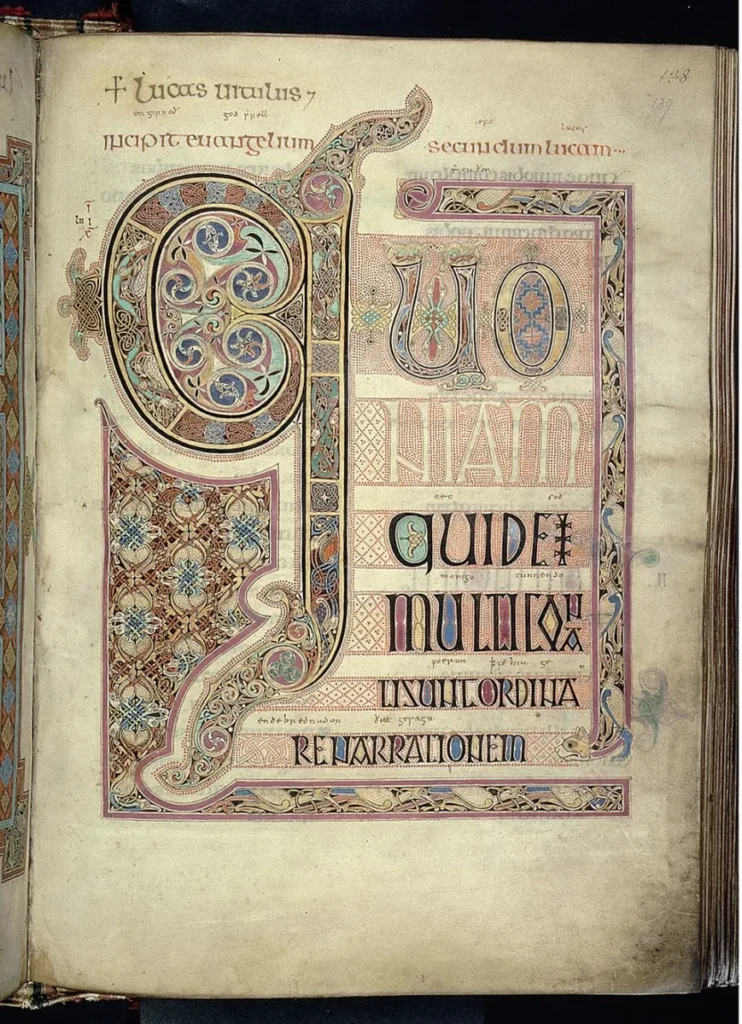
The evidence preserved in the attached sources supports a strong core narrative: Lindisfarne was founded around 635, Cuthbert died in 687, his body was elevated in 698, the Lindisfarne Gospels is tied to his cult, and Aldred’s tenth-century work embedded the names of makers and glossator into the manuscript’s own pages. The same evidence supports that the manuscript’s writing and decoration were controlled in a unified way, consistent with a single scribe-artist, and that the book’s structure repeatedly stages each Gospel as a threshold of image, cross, and text. It also preserves real uncertainty about the tightest dating of the manuscript’s production within the late seventh and early eighth centuries, because different reconstructions are presented within the attached material and neither is closed by a single surviving contemporary colophon from the moment of production.
Even with those limits, the book remains fully legible as an act of devotion built to endure handling, reading, and movement, and it remains inseparable from the cult of Saint Cuthbert and the community that carried both relics and manuscript across danger. The stories preserved about raid, flight, loss, and recovery show how easily a treasure could vanish, and how fiercely a community could insist on its return. That is the world in which Byzantine Silk belongs, a world where sacred authority could be stitched into cloth, sealed into a shrine, or written into a Gospel-book that made the act of reading feel like entering holy ground.