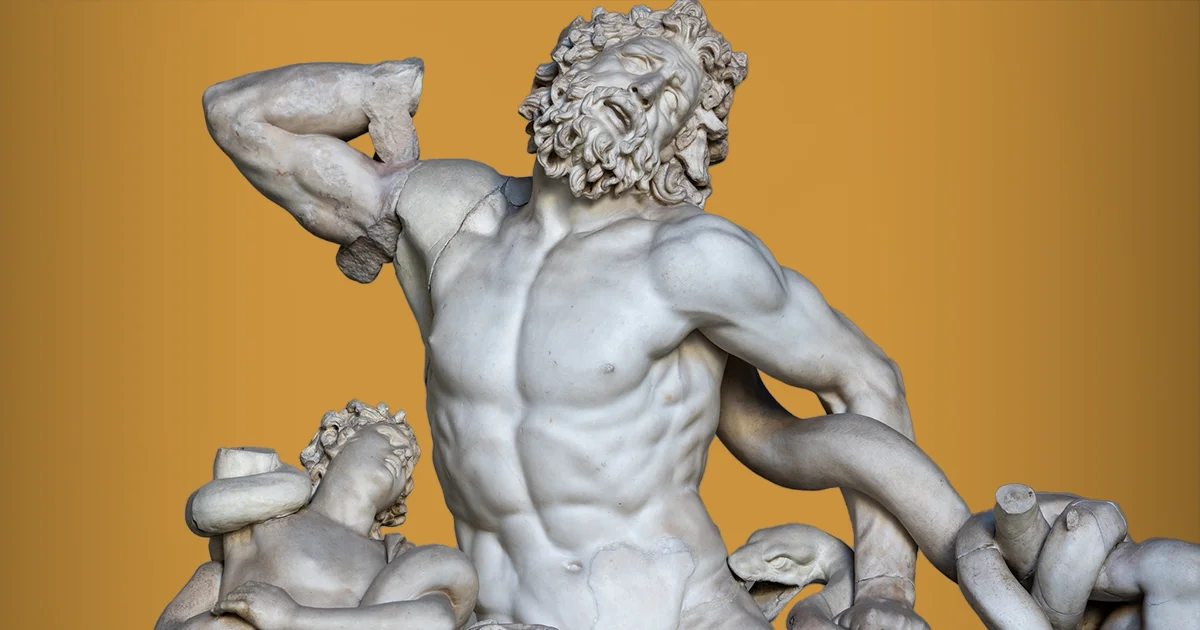
The Laocoon sculpture stands among the most discussed artworks from antiquity. Carved from marble by three Rhodian sculptors named Hagesander, Polydorus, and Athenodorus, the work depicts the Trojan priest Laocoon and his two sons struggling against massive serpents. The group was discovered on January 14, 1506, in a vineyard on the Esquiline Hill in Rome, owned by a man named Felice de Fredis. The discovery electrified Renaissance artists and scholars, who immediately recognized the sculpture as the masterwork praised by Pliny the Elder in his Natural History.
Pliny had written around 77-79 AD that the Laocoon in the palace of Emperor Titus was “a work to be preferred to all that the arts of painting and sculpture have produced.” The three Rhodian sculptors, according to Pliny, had made the piece “after careful planning” from what he described as a single block of stone, though this claim proved incorrect when the sculpture was unearthed showing clear evidence of multiple marble blocks joined together.
The sculpture captures a moment of profound horror. Two enormous serpents coil around the bodies of Laocoon and his sons, constricting and biting. The father strains against the crushing coils while his children suffer in different stages of death and desperation.
The Discovery in January 1506
On January 14, 1506, workers digging in Felice de Fredis’s vineyard near the ruins known as the Sette Sale on the Esquiline Hill struck something extraordinary. What emerged was the Laocoon group, missing the priest’s right arm and other fragments but otherwise remarkably preserved. Word spread immediately through Rome.
Pope Julius II dispatched some of the greatest artists of the age to inspect the find. Michelangelo and the architect Giuliano da Sangallo rushed to the site. Francesco da Sangallo, Giuliano’s son, was present as a child and later wrote an account of that day in 1567, describing how his father instantly recognized the sculpture from Pliny’s description.
The identification was certain. Cesare Trivulzio wrote in June 1506 that artists and scholars were unanimous in recognizing the work as Pliny’s Laocoon. The sculpture was acquired by Pope Julius II within weeks and installed in the Belvedere courtyard of the Vatican, where it became the centerpiece of the papal collection.
The immediate response combined artistic admiration with learned debate. Some observers noted that the sculpture appeared to be carved from multiple blocks rather than one, contradicting Pliny’s account. Yet all agreed, as Trivulzio wrote, that “the statues are most excellent and deserving of every praise.” The discovery was celebrated as a cultural event of the first magnitude, and poets composed verses in honor of the statue’s return to light.
The Ancient Literary Sources
Two ancient texts provide context for understanding the Laocoon sculpture. Pliny the Elder, writing in his Natural History around 77 AD, describes the work in its original location in the palace of Emperor Titus. He praises it as superior to all painting and bronze sculpture, emphasizing that the three Rhodian artists created it “after careful planning.” Pliny notes specifically that Laocoon, his sons, and the serpents’ coils were all part of a unified composition.
This passage became the key to identifying the sculpture when it was found in 1506. Renaissance scholars immediately connected the discovered work to Pliny’s description, even though details like the single-block claim were demonstrably wrong.
The literary tradition behind the sculpture’s subject comes from Virgil’s Aeneid, composed between 29 and 19 BC. In Book 2, lines 199-227, Virgil describes Laocoon’s horrific death. The priest had warned the Trojans against accepting the wooden horse left by the Greeks. As punishment, two serpents swim across from Tenedos, attack his sons first, then coil around Laocoon himself as he rushes to help them.
Virgil writes of the serpents: “Their bosoms rise amid the surge, and their crests, blood-red, overtop the waves.” The serpents first “enfold in their embrace the youthful bodies of his two sons and with their fangs feed upon the hapless limbs.” Then Laocoon himself, coming to aid with weapons, is seized. “Now, twice encircling his waist, twice winding their scaly backs around his throat, they tower above with head and lofty necks.” The priest “strains his hands to burst the knots, his fillets steeped in gore and black venom; the while he lifts to heaven hideous cries.”
The relationship between Virgil’s text and the sculpture has provoked debate. The sculptors’ names appear in Rhodian inscriptions dated between 80 and 20 BC, meaning the group was likely created around 50 BC. This makes the sculpture roughly contemporary with Virgil’s epic, raising questions about which influenced which, or whether both drew on earlier Greek sources.
The Composition and Artistry
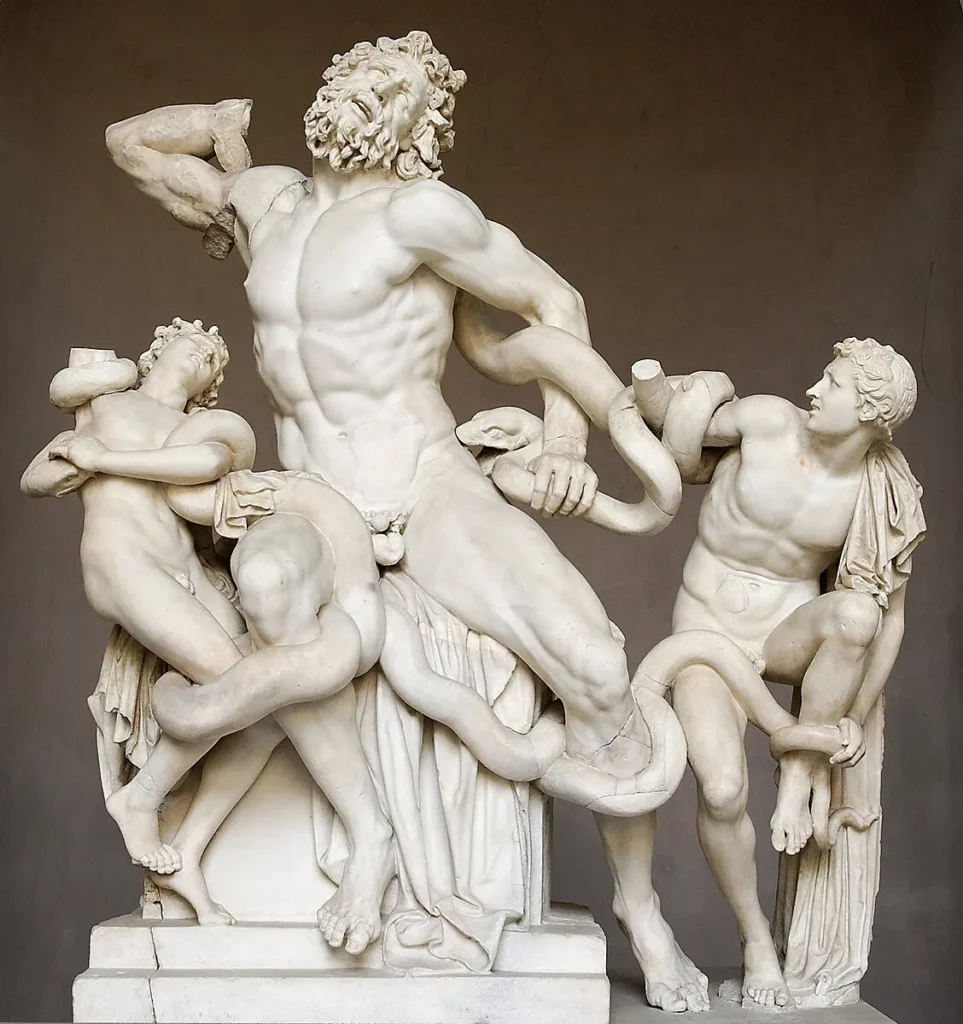
The Laocoon group measures approximately seven feet in height. Three figures struggle together in a pyramidal composition. The central figure, Laocoon himself, dominates. His muscular body twists as he attempts to tear the serpent from his left hip, where the creature has just bitten. His face contorts in agony, mouth open in what appears to be a groan or cry of pain.
The elder son stands to Laocoon’s right, relatively less entangled. He looks toward his father with an expression of sympathy and horror, one foot raised as if trying to push away the serpent’s tail. He appears to have some hope of escape, though a coil wraps around his torso.
The younger son, positioned to Laocoon’s left, suffers the most advanced stage of death. The serpent has already bitten deep into his side. His body sags, weakening, his dying glance directed toward his father. The child’s helplessness contrasts with his father’s violent struggle.
The serpents themselves constitute marvels of sculptural technique. Their massive coils wrap around all three figures, binding father and sons together in shared doom. One serpent attacks Laocoon from behind and below, having already struck. The other completes the encirclement, its body creating visual links between the three victims.
The composition works from every viewing angle, though a frontal view was clearly primary. The figures arrange themselves so that each face, each struggling limb, each section of serpent body, can be read clearly from the front while still creating depth and complexity. The sculptors achieved what ancient critics called a “frozen moment,” capturing peak action with such clarity that viewers can imagine both what came before and what will follow.
Details throughout demonstrate extraordinary skill. Laocoon’s right foot presses firmly against the altar base, his toes spread with the strain of resistance. His abdomen draws inward, muscles tensed against pain. The younger son’s hand, weak and failing, vainly attempts to push away the serpent biting his side. The elder son’s feet show softness and youth, contrasting with his father’s powerful, mature feet.
The sculptors rendered the serpents’ scales, the texture of human skin, the priests fillet, and the drapery with equal attention. Every surface invites close examination. The work demonstrates complete mastery of marble carving at the highest technical level Hellenistic art achieved.
Renaissance Reception and Restoration
The sculpture’s rediscovery transformed European art. Within days of the 1506 excavation, artists began studying and copying the group. The earliest known engraving, by Marco Dente, a pupil of Marcantonio Raimondi, shows the sculpture before any restoration. This print reveals that significant pieces were missing, most importantly Laocoon’s right arm and portions of both serpents.
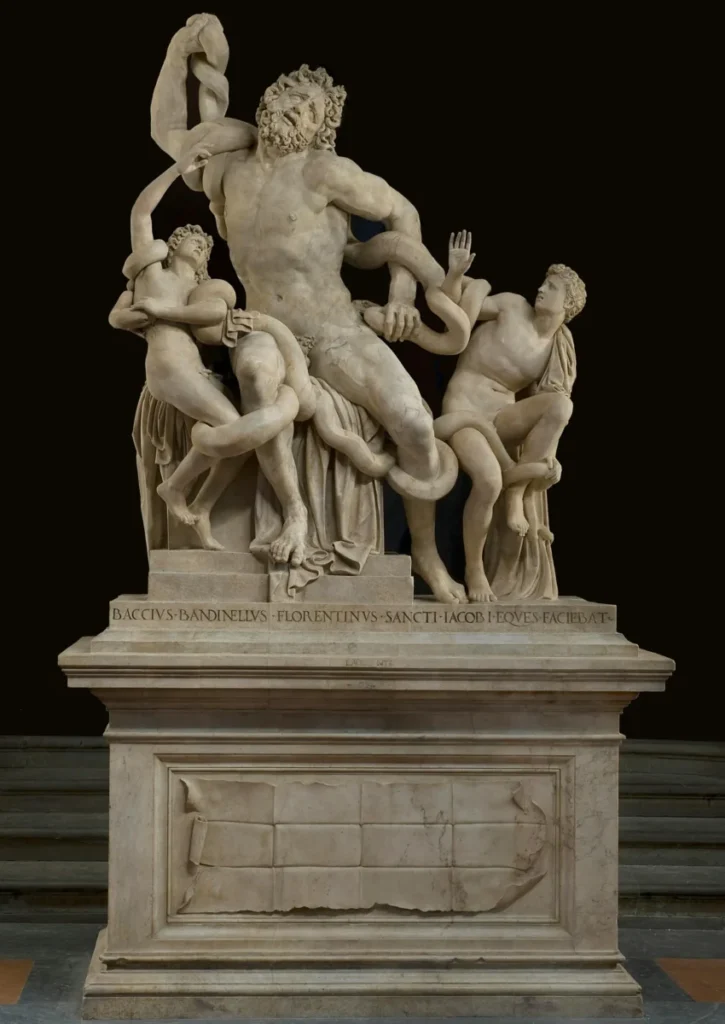
Renaissance restorers immediately began proposing solutions. The dominant interpretation held that Laocoon’s right arm had reached upward dramatically, increasing the sense of violent struggle. Various artists created restorations based on this theory. In 1520, Pope Leo X commissioned Baccio Bandinelli to carve a marble copy with restored sections. Bandinelli’s version, now in Florence, shows the arm thrust high, the musculature exaggerated in baroque fashion.
Bronze versions multiplied. Jacopo Sansovino created a bronze cast before 1523. François Girardon made another, later acquired by Horace Walpole for Houghton Hall. These bronze versions emphasized dramatic contrasts of light and shadow, intensifying the baroque qualities artists saw in the work.
The Vatican sculpture itself received restorations over the following centuries. Laocoon’s right arm was attached reaching upward and outward. The elder son’s right hand and arm were completed above the serpent coil. The younger son’s right arm was restored. Portions of both serpents, including one head, were recarved. These additions reflected baroque taste for maximum drama and emotional intensity.
Artists of the sixteenth and seventeenth centuries found inspiration everywhere in the sculpture. Michelangelo studied it intensively. Titian copied Laocoon’s pose for the figure of Christ in his Resurrection altarpiece at Brescia in 1522. Later, perhaps recognizing the exaggerated influence, Titian created or inspired a caricature of the group, known through a woodcut by Boldrini.
Engravings spread knowledge of the sculpture across Europe. Pierre Perrot drew the bronze version at Houghton Hall in 1581. Joachim von Sandrart drew Laocoon alone with exaggerated musculature as a model for anatomical proportion. Gérard Audran created four views with exact measurements, publishing them in his treatise on human proportions.
The sculpture dominated artistic education for generations. Drawing academies made plaster casts mandatory study subjects. Every serious artist knew the Laocoon’s forms intimately. It became, alongside the Apollo Belvedere and the Belvedere Torso, one of the three canonical ancient sculptures that defined ideal beauty and heroic suffering.
Eighteenth-Century Aesthetic Debates
The Laocoon provoked the most important aesthetic controversy of the Enlightenment. Johann Joachim Winckelmann, in his 1755 Reflections on the Imitation of Greek Works, used the sculpture to define classical restraint. He argued that despite extreme physical pain, Laocoon maintains spiritual nobility.
Winckelmann wrote: “The pain of the body and the greatness of the soul are distributed and, so to speak, balanced throughout the entire frame of the figure with equal strength. Laocoon suffers, but he suffers like the Philoctetes of Sophocles. His misery touches our soul, but we would wish to be able to bear misery like this great man.”
Winckelmann contrasted the sculpture with Virgil’s text, where Laocoon “lifts to heaven hideous cries.” In the statue, Winckelmann insisted, the mouth opens only enough for “an anxious and oppressed groan,” not a full scream. This restraint, he argued, exemplified Greek ideals of beauty over raw expression. The marble Laocoon thus demonstrated moral superiority to the literary Laocoon.
Gotthold Ephraim Lessing challenged Winckelmann in his 1766 treatise Laokoon. Lessing agreed that the sculpture showed restraint but denied moral reasons. Instead, he argued, formal requirements of visual art dictated the choice. A wide-open screaming mouth would create “a hollow that produces the most repulsive effect.” Beauty, not ethics, constrained the sculptors.
Lessing further distinguished between spatial and temporal arts. Sculpture, frozen in a single moment, must choose the most “pregnant” instant, one that allows imagination to construct what came before and after. Poetry, unfolding in time, can show development and permit heroes to scream without loss of dignity.
Though Lessing’s reasoning was more purely aesthetic than Winckelmann’s, he still treated the Laocoon as exemplifying restraint. This interpretation dominated through his century and the next.
Johann Wolfgang von Goethe, in his 1798 essay Upon Laocoon, advanced a third view. He praised the sculpture for capturing perfect transitional motion, making “the work of art ever become alive again for millions of onlookers.” He compared it to “a fixed lightning” or “a wave turned into stone the moment it streams against the beach.”
Goethe analyzed how the three figures show gradations of suffering. The elder son is least entangled, feeling “fear” but also “hope for his escape.” The younger son, dying, awakens “pity.” Laocoon himself, combining physical and spiritual suffering, provokes “terror in the highest degree.” These graded emotions create a complete aesthetic experience.
All three German writers treated the sculpture as definitive classical art. Their debates shaped aesthetic theory for generations, establishing the Laocoon as a test case for understanding how visual art represents passion and pain.
Built out of a love for history, kept free from distractions.
Spoken Past is an independent project shaped by curiosity, care, and long hours of research. Reader support helps keep it maintained, carefully researched, and open to everyone.
The Twentieth Century and the True Right Arm
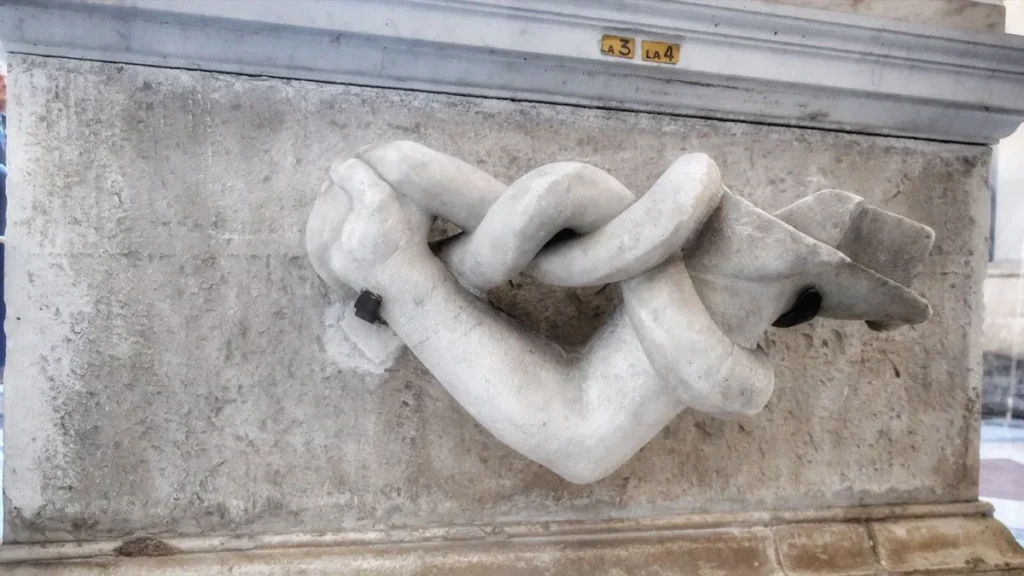
In 1905, Ludwig Pollak, an archaeologist and art dealer in Rome, discovered a bent right arm in a stonemason’s shop. The fragment came from the area where the Laocoon had been found. Its marble matched the sculpture’s marble. Its scale fit Laocoon’s body perfectly.
This arm bent backward at the elbow, the hand reaching toward the head in a gesture of defensive struggle rather than heroic resistance. It contradicted all the baroque restorations that had shown the arm thrust high and outward.
Pollak donated the arm to the Vatican. Comparisons proved it genuine. A small sketch attributed possibly to Michelangelo or to Montorsoli, made shortly after the 1506 discovery, showed exactly this bent-arm position. The Renaissance artists who first saw the sculpture apparently understood its original form correctly, even as later restorers chose more dramatic solutions.
The bent arm changes the sculpture’s meaning. Instead of fighting with maximum violence, reaching desperately upward, Laocoon struggles more defensively, trying to protect himself while trapped. The gesture is more human, less heroically exaggerated. It suggests the practical reaction of a man being crushed and bitten, rather than a symbolic expression of defiance.
Despite this discovery, the Vatican did not remove the restored arm until 1957. For over fifty years after finding the correct arm, the sculpture continued to display the baroque version. When finally the ancient arm was attached, the Laocoon appeared in something approaching its original form for the first time in over 400 years.
Other restorations remained. The elder son’s right hand and sections of both serpents are still baroque additions. Complete authenticity is impossible, as pieces are genuinely lost. But the correction of the right arm represents a major step toward understanding what the Rhodian sculptors actually created.
Modern Archaeological Understanding
Margarete Bieber’s 1942 study, Laocoon: The Influence of the Group Since Its Rediscovery, established modern scholarly understanding of the work. Bieber analyzed the sculpture’s style as late Hellenistic baroque, created around 50 BC during a transitional period when classicizing tendencies were beginning to temper emotional intensity.
The sculptors’ names appear in Rhodian inscriptions that can be dated epigraphically. Hagesander, Athenodorus, and Polydorus were active between 80 and 20 BC. This means the sculpture cannot have been carved later than Virgil’s Aeneid, and probably preceded it. Both artists and poet drew on earlier Greek literary traditions about Laocoon’s death.
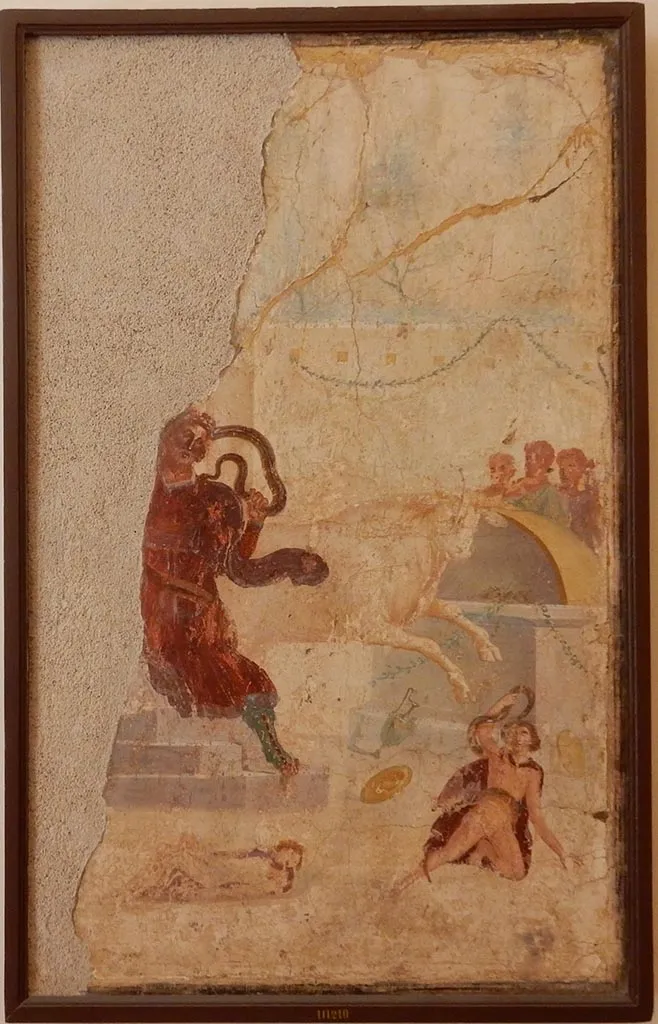
Two wall paintings from Pompeii, one in the recently excavated House of Menander, show the Laocoon story in compositions that resemble the sculpture. These paintings copy an earlier Hellenistic prototype. In the paintings, as in Virgil, the serpents attack the sons first, then the father arrives to help. The sculpture shows all three attacked simultaneously, a more unified composition but less faithful to narrative sequence.
The question of original location remains debated. Pliny saw the sculpture in Titus’s palace, apparently on the Esquiline Hill where it was later rediscovered. Whether this was the original installation site or whether the sculpture had been moved there from elsewhere is unknown. The quality suggests it was a major commission, possibly for a wealthy Rhodian patron or possibly for Rome itself.
The sculpture demonstrates characteristics of Rhodian sculpture workshops in the first century BC. The complex multi-figure composition, the intense emotionalism, the virtuoso rendering of anatomy under extreme stress, and the theatrical presentation all match other known Rhodian works. The school of Rhodes specialized in such dramatic groups, and the Laocoon represents their art at its peak.
The Subject and Its Meaning
The Laocoon story carried complex meanings in ancient culture. Laocoon was a priest of Apollo or Neptune (sources vary), serving Troy during the Greek siege. When the Greeks left the wooden horse and pretended to sail away, Laocoon recognized the trick. “I fear the Greeks, even when bringing gifts,” he warned, according to Virgil. He hurled his spear at the horse’s side to prove it was hollow.
The gods, supporting the Greek cause, punished Laocoon for his interference. Two serpents came from the sea and killed him and his sons. The Trojans interpreted this as divine anger at Laocoon’s attack on a sacred offering, not understanding it was punishment for his correct warning. They dragged the horse into the city, ensuring Troy’s destruction.
The story thus embodies profound irony. The man who saw truth and tried to save his city was destroyed by the gods. His punishment convinced the Trojans to commit the error he had identified. Divine justice appears cruel and inexplicable. Laocoon becomes a symbol of the tragedy of right action punished, wisdom ignored, and fate inexorable.
The choice to represent this subject in sculpture was itself significant. Most Hellenistic sculpture celebrated victory, beauty, or divine mythology. The Laocoon shows defeat, agony, and divine injustice. It presents a priest, a supposedly protected figure, being destroyed at an altar with his innocent children. This is dark subject matter, suited to the pessimistic philosophy of later Hellenistic culture, when belief in divine benevolence was weakening.
The sculptors emphasized the altar setting. Laocoon sinks back against the altar base, trying to brace himself. His priestly fillets remain on his head. The serpents violate sacred space, attacking priest and sons at the very center of religious worship. This compounds the horror, showing divine power turned against its own servants.
For Roman viewers like Pliny, the sculpture had additional meaning. Romans claimed descent from Aeneas and the Trojan refugees. Laocoon’s death was part of Rome’s founding story. The sculpture connected viewers to their mythic past while demonstrating Greek artistic achievement. It combined cultural pride with acknowledgment of Greek artistic superiority.
Technical Mastery
The sculpture consists of at least five separate marble blocks joined together. The ancient blocks are the central figure of Laocoon, the younger son, the elder son, and major portions of both serpents. Joints were concealed with such skill that Renaissance observers could detect only four, and Pliny apparently believed the single-block story told to him.
The marble is probably from the quarries at Luni (modern Carrara), the finest white marble available to ancient sculptors. Each figure was carved to near-completion before assembly. The sculptors then fitted blocks together, using bronze or iron dowels set in drilled holes and fixed with lead. The joint lines fall along anatomical boundaries or serpent coils where they could be hidden.
The surface finish varies subtly across different areas. Flesh surfaces receive high polish to suggest living skin. The serpent scales have crisp definition to emphasize their texture. Drapery shows different tool marks to indicate fabric. Hair receives detailed individual treatment. This variation in surface treatment helps distinguish elements and adds visual richness.
The undercutting throughout is extraordinary. The sculptors carved deep behind projecting limbs, creating shadows and allowing light to define forms fully. Fingers, toes, serpent coils, and drapery edges all project free of background support. This undercutting was technically dangerous, risking breakage during carving, but creates three-dimensionality that allows the sculpture to be viewed successfully from multiple angles.
The composition is based on a pyramidal structure, but filled with complex rhythms. The central vertical of Laocoon’s body anchors the design. The sons create balanced diagonals on either side. The serpents’ coils unify all three figures while creating movement throughout. No element is static, yet the whole remains visually stable.
The emotional characterization is psychologically subtle. Laocoon’s face shows not just pain but also recognition of doom, concern for his sons, and desperate will to resist. The elder son’s expression combines personal fear with sympathy for others. The younger son has moved beyond fear into the weakness of approaching death. These different states of awareness create dramatic variety within the unified action.
Legacy in Art History
The Laocoon influenced European art more than any other ancient sculpture except perhaps the Apollo Belvedere. From 1506 onward, every artist who aspired to greatness studied it. The influence appears in paintings, sculptures, prints, and academic theory.
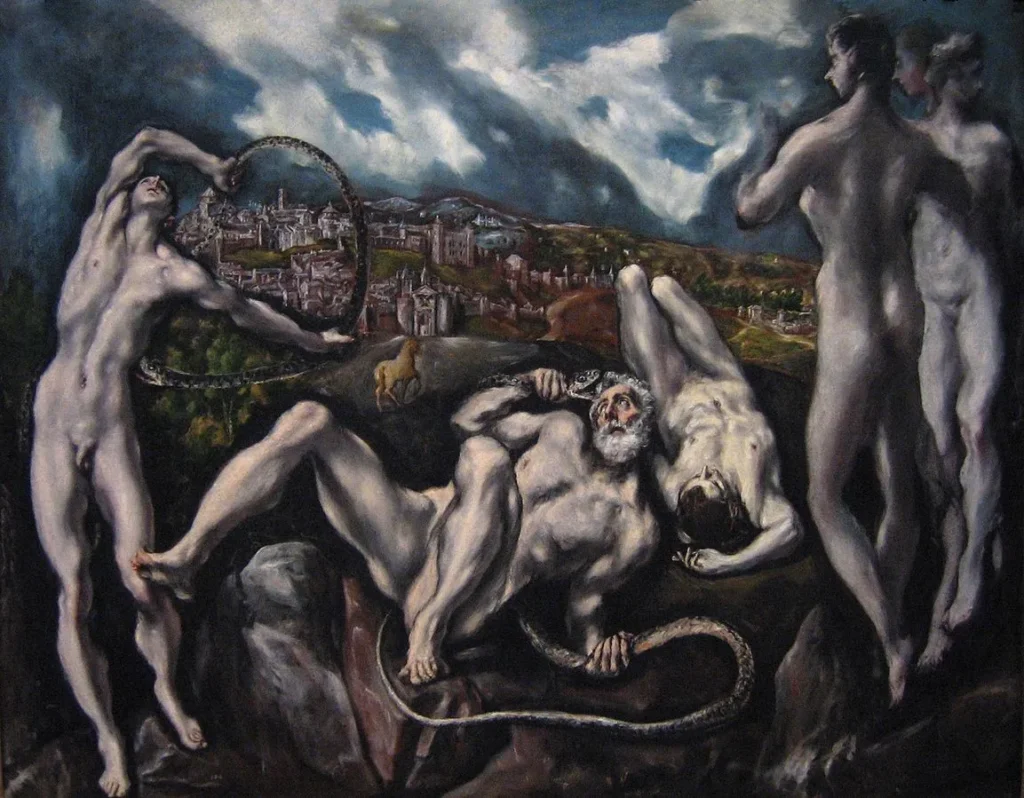
Michelangelo’s figures show Laocoon’s influence throughout his career. The contorted poses, the muscular strain, the expressions of spiritual and physical struggle in the Sistine ceiling and the Last Judgment reflect his intense study of the group. Raphael knew the sculpture intimately. El Greco painted a version of the Laocoon. Bernini learned from it. Rubens copied it.
In the nineteenth century, reaction set in. Some critics attacked the Laocoon as theatrical, exaggerated, inferior to the restraint of classical Greek art. The Hellenistic period’s emotionalism fell from favor as scholars elevated the Parthenon sculptures as supreme ideals. The Laocoon came to represent baroque excess rather than classical perfection.
Margarete Bieber, writing in 1942, defended the sculpture as representing its period brilliantly. She argued that each age interprets the Laocoon according to its own aesthetic values. The baroque saw and praised baroque qualities. Winckelmann imposed classical restraint. Nineteenth-century critics condemned emotional expression. Each response reveals more about the viewer’s age than about the sculpture itself.
Modern viewers, with the correct right arm restored and with understanding of Hellenistic art’s deliberate emotionalism, can appreciate the Laocoon on its own terms. It represents not failed classicism but successful expression of late Hellenistic aesthetic goals. The sculptors sought to move viewers through representation of extreme suffering, and they succeeded completely.
The sculpture remains in the Vatican Museums, in the Cortile del Belvedere where Pope Julius II installed it in 1506. It stands as one of the most studied, copied, debated, and influential ancient artworks. The three Rhodian sculptors created a work that has maintained power over viewers for over 2,000 years, provoking responses from Renaissance popes to Enlightenment philosophers to modern tourists. Few ancient sculptures can claim such sustained impact on Western culture.