
Roman mosaics covered the floors and walls of buildings from Britain to Syria between the first century BC and the fourth century AD. The techniques used to design and install these pavements are documented in two primary sources: Marcus Vitruvius Pollio’s De Architectura from the first century BC and Pliny the Elder’s Natural History from the first century AD. These texts describe the multi-layered foundation systems, the cutting of tesserae (individual mosaic cubes), and the methods mosaicists used to transfer designs from drawings onto prepared surfaces. Archaeological evidence from sites like Fishbourne Palace in Britain (75 AD) and the Lod villa in Israel (300 AD) confirms the construction sequences and material choices recorded in these ancient manuals.
The process of creating a Roman mosaic involved multiple specialized workers, from quarrymen who sourced stone to artists who laid tesserae according to complex geometric and figural patterns. Each installation required careful preparation of foundation layers, precise calculation of tesserae quantities, and coordination between the design phase and the physical laying of thousands or millions of individual pieces. Understanding how Roman mosaics were designed and installed reveals not only technical mastery but also the organization of workshops and the transmission of artistic knowledge across the Mediterranean world.
Vitruvius And Pliny On Mosaic Construction
Marcus Vitruvius Pollio wrote De Architectura in the late first century BC, dedicating Book 7 to pavements and their construction. Vitruvius provides the most detailed technical description of mosaic foundations, specifying the thickness and composition of each layer and the order in which they should be laid. His account became the standard reference for Roman builders and remained influential in Byzantine and later periods.
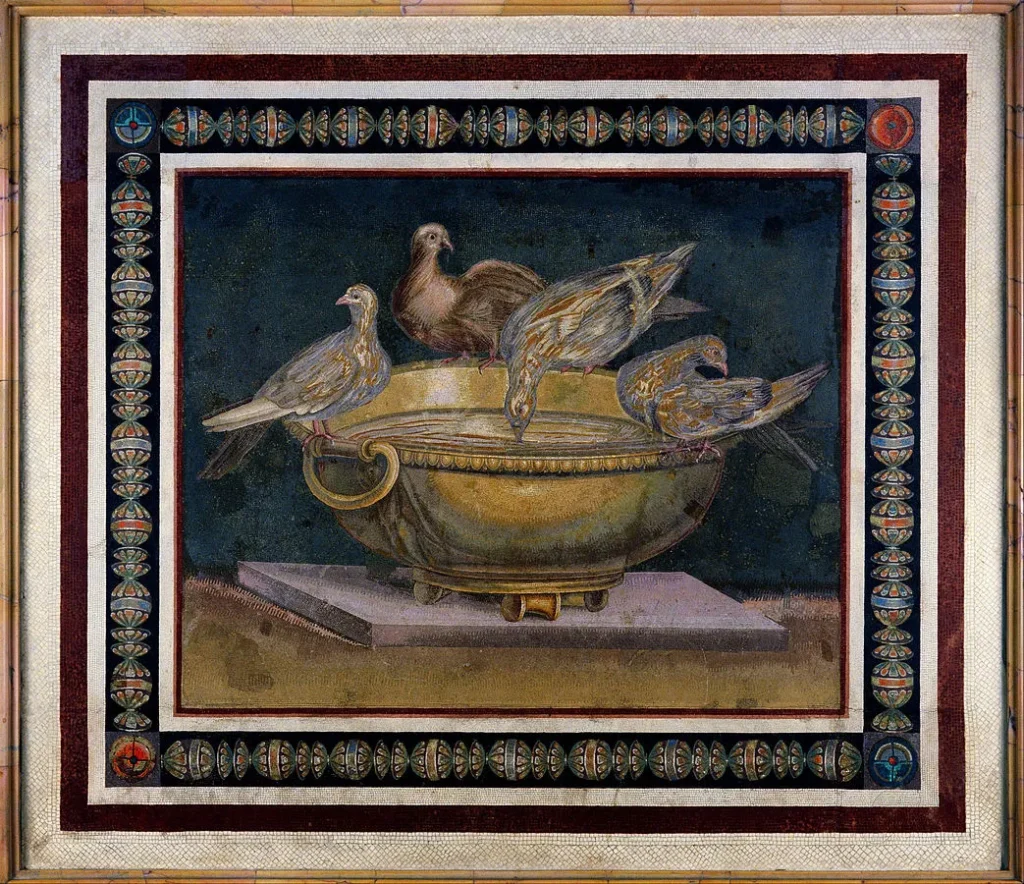
Pliny the Elder’s Natural History, composed around 77-79 AD, supplements Vitruvius by naming specific mosaicists and describing celebrated works. Pliny identifies Sosus of Pergamon as the only mosaic artist whose name entered literary tradition, describing his Asarotos oikos (Unswept House) and the doves drinking from a bowl with such precision that later scholars have identified Roman copies in Italy. These two texts together document both the physical construction methods and the artistic culture of Roman mosaic workshops.
Foundation Layers From Statumen To Nucleus
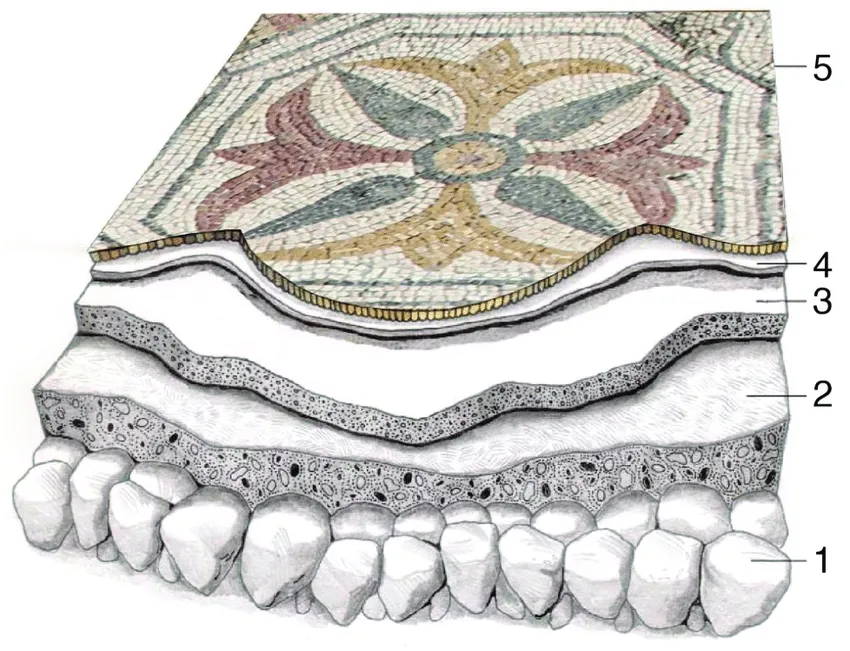
Roman mosaicists built pavements on multi-layered foundations designed to prevent settling, cracking, and moisture damage. Vitruvius describes the lowest layer, the statumen, as composed of large stones that formed a stable base. This layer sat directly on compacted earth or, in wealthy installations, above hypocaust heating systems that provided both support and drainage.
Above the statumen (1), workers laid the rudus (2), a layer more than 20 centimeters thick consisting of broken bricks mixed with lime and compacted down. The rudus provided a solid, flat surface for the mosaic itself and is considered separate from the mosaic proper. Chemical analysis of surviving mortar from sites like Roman Britain shows that the rudus used lime and brick aggregates in roughly 1:1 proportions by weight, with the brick fragments providing pozzolanic properties that made the mortar hydraulic and resistant to water.
The nucleus (3) formed the next layer, approximately 15 centimeters thick and composed of three parts crushed tile or potsherds to one part lime according to Vitruvius. This finer layer used smaller brick aggregates than the rudus and created a smooth surface. The uppermost setting bed (4), only a few centimeters thick, held the tesserae (5) themselves. When mosaics are lifted for conservation, the setting bed and nucleus come away together as they constitute the mosaic itself, while the rudus and statumen remain in place.
Tesserae Production And Material Sources
Tesserae, the Latin term for the individual cubes or tiles that compose mosaics, were cut from a variety of materials depending on regional availability and the desired color palette. In Roman Britain, mosaicists used local Cotswold limestones for greys and creams, Lias limestone from the Severn Valley for blues, greensands for greens, sandstones for yellows and browns, Purbeck marble for dark blues and reds, and Kimmeridge shale for blacks. Manufactured materials like Samian pottery and roof tiles provided red tesserae.
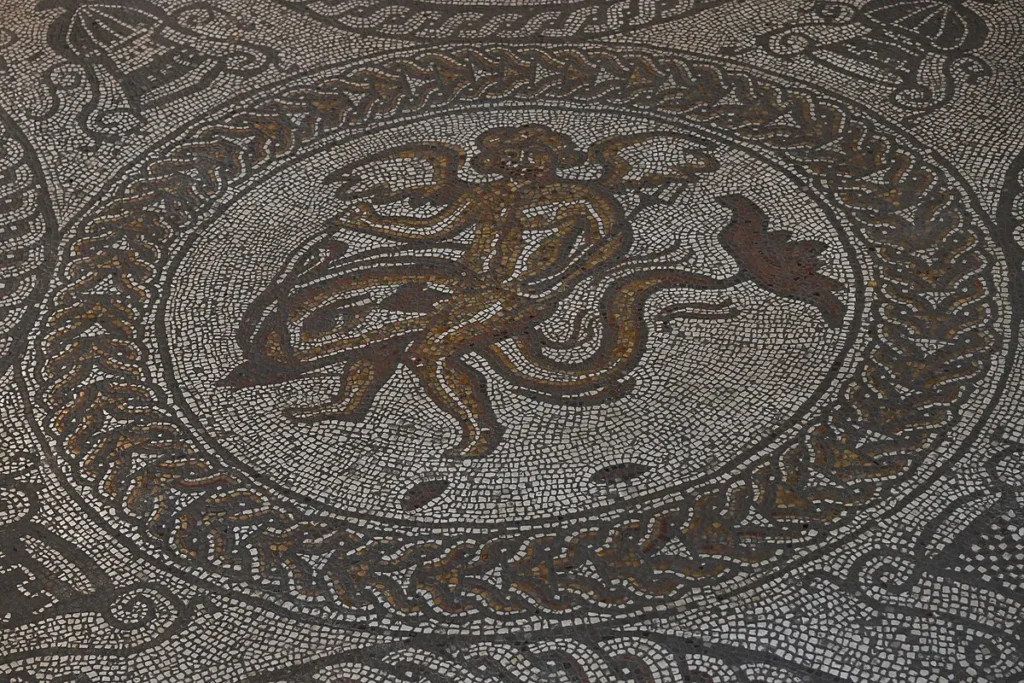
The cutting of tesserae took place either in stonemasons’ workshops or at the installation site. Workers used hammers and chisels (or a specialized tool called a hardie) to split stone into roughly cubic shapes. At Fishbourne Palace, analysis of tesserae revealed that some were cut from dateable Samian pottery sherds; when the Cupid on a Dolphin mosaic was lifted for conservation in 1979, the patterned designs on the reverse of the pottery fragments allowed archaeologists to date the mosaic to 150-160 AD. Large mosaics required over a million individual pieces, necessitating teams of laborers to produce sufficient quantities.
Tesserae were transported in large double trays that allowed mosaicists to organize pieces by color and size. Glass tesserae, though less common in Britain, appear in elite installations like Fishbourne, where clear glass highlights the hare’s back and red glass marks Actaeon’s legs on the Seasons mosaic. The size of tesserae varied by technique: opus tessellatum used larger cubes (0.5 to 2.0 centimeters), while opus vermiculatum employed tiny pieces for detailed figural work.
Opus Tessellatum And Opus Vermiculatum Techniques
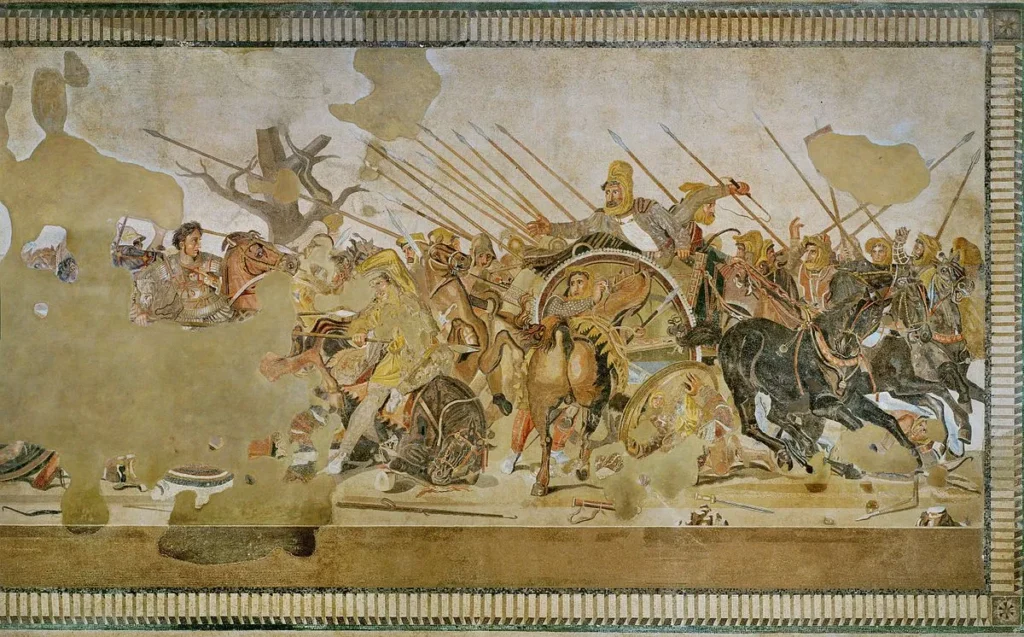
Roman mosaicists distinguished between several named techniques based on tesserae size, arrangement, and intended effect. Opus tessellatum utilized square or rectangular tesserae arranged in grid patterns to create geometric designs and background fields. This technique suited large areas and could be executed relatively quickly by teams of workers following measured layouts. The term technically applied to all floors made from small, cut pieces.
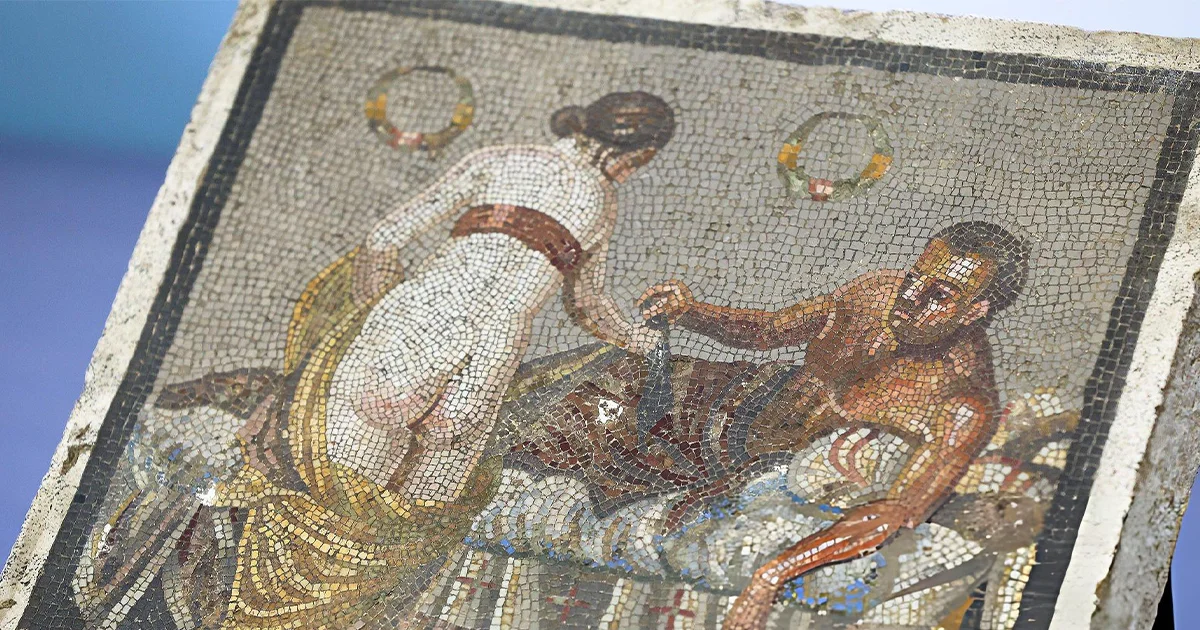
Opus vermiculatum (from vermiculus, meaning “little worm”) arranged tiny, irregular tesserae in curved lines that followed the contours of figures, creating shaded, three-dimensional effects in portraits and mythological scenes. The Cupid on a Dolphin mosaic at Fishbourne demonstrates this technique with tesserae of yellow and orange limestone, ceramic fragments, chalk, and grey shale arranged to model the dolphin’s body and Cupid’s form. The celebrated mosaic from Hadrian’s Villa depicting doves on a bowl, possibly copying Sosus’s second-century BC original, uses only colored marble cubes without glass in a remarkable demonstration of opus vermiculatum skill.
Additional techniques included opus sectile, in which larger stone pieces were cut and fitted like puzzle pieces to create architectural or geometric patterns, and opus musivum, specifically denoting wall mosaics made from glass tesserae. Opus signinum referred to coarse single-color floors in utilitarian spaces. These technical terms appear in both ancient sources and modern archaeological literature, allowing precise description of construction methods.
Direct Versus Indirect Installation Methods
Mosaicists employed two primary methods for placing tesserae, each with distinct advantages and limitations. The direct method involved pressing tesserae immediately into a fresh mortar bed prepared on the floor or wall surface. This approach allowed the artist to see the mosaic develop and adjust the design in real time, making it convenient for creating patterns and ensuring proper spacing. Workers could use underpaintings on the wet plaster as guides, following the outlines and color notations to position each piece correctly.
The direct method’s main disadvantage was the difficulty of maintaining an evenly flat surface unless tesserae of uniform thickness were used. Wall mosaics in particular required careful attention to prevent sagging or slumping before the mortar set. Archaeological evidence shows that walls were often prepared with waterproofing layers of tar or resin, followed by two layers of coarse mortar mixed with straw or sand, and finally a smooth layer that received the painted design and tesserae.
The indirect method achieved superior flatness by inverting the process. Artists laid tesserae face-down on a flat table or floor surface, arranging the design in reverse. Once complete, workers placed a wooden frame around the composition and poured mortar over the back. After the mortar hardened, the entire panel could be flipped to reveal a perfectly planar surface, though horizontally mirrored from what the artist saw during creation. This technique suited table tops, portable panels, and intricate designs where tile sizes varied, as was common when tesserae were cut by traditional hammer-and-hardie methods.
Built out of a love for history, kept free from distractions.
Spoken Past is an independent project shaped by curiosity, care, and long hours of research. Reader support helps keep it maintained, carefully researched, and open to everyone.
Pattern Books And Design Transfer
The remarkable uniformity of mosaic designs across the Roman Empire, from Britain to Syria, suggests that mosaicists used portable pattern books containing standard motifs and compositions. These pattern books consisted of parchment sheets or thin wooden boards (since perished) that carried geometric designs, mythological scenes, and decorative borders. Clients could select from available designs, and craftsmen adapted the patterns to fit specific room dimensions and local tastes.
Pattern books were not intended for exact copying but provided models and suggestions, allowing considerable scope for individual interpretation and regional variation. The mobility of craftsmen also contributed to design dissemination; mosaicists traveled from site to site carrying their knowledge of techniques and repertoires of patterns. The same themes and motifs recur throughout the Roman world, with adjustments in execution quality, material availability, and artistic skill producing local character within a shared visual language.
Before laying tesserae, artists prepared detailed underpaintings on the smooth mortar layer. Archaeological discoveries of these underpaintings beneath both floor and wall mosaics confirm that the design was fully drawn in wet plaster, providing a precise guide for positioning each tessera. Analysis of an opus vermiculatum emblema fragment in the British Museum revealed traces of Egyptian blue pigment, hematite, and carbon black, indicating that a fully colored drawing was executed on fresh mortar to guide the mosaicist. This painting phase required significant artistic skill and represented a critical step in translating design to finished pavement.
Emblemata As Prefabricated Panels
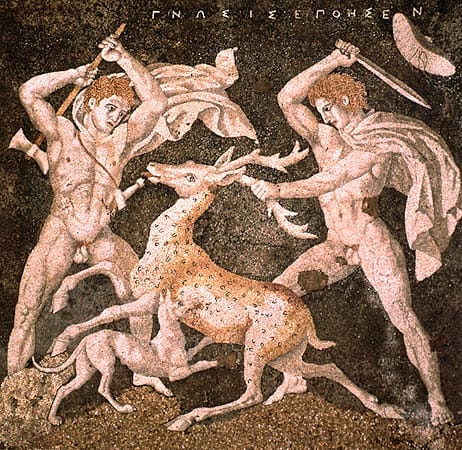
Between the third century BC and the second century AD, workshops in the eastern Mediterranean specialized in producing emblemata, small detailed panels made using opus vermiculatum that served as focal points in larger pavements. These panels were custom-made in stone or terracotta trays to facilitate transport and placement, functioning as prefabricated artworks that could be shipped to distant clients. The trays protected the delicate tesserae work during transit and allowed the emblema to be set into a prepared recess in a simpler surrounding pavement.
The association of emblemata with named artists like Dioskourides of Samos and the location of finds such as the floor fragment by Hephaistion at Pergamon point to workshops concentrated in Pergamon, Alexandria, and other major Hellenistic centers. Sosus of Pergamon, active in the second century BC, was the most celebrated producer of these panels. His native city of Pergamon became famous for its mosaic workshops, and Pliny’s descriptions of Sosus’s works are sufficiently precise that scholars recognize Roman copies, including the doves mosaic discovered at Hadrian’s Villa in 1737.
The British Museum holds a large unidentified emblema fragment still in its original terracotta tray, allowing detailed study of construction methods. Scientific analysis of this piece confirmed the use of Egyptian blue and other pigments for the underpainting and provided data on mortar composition and manufacturing processes. By the first century AD, the production of emblemata had spread throughout the empire, though the eastern Mediterranean remained the primary source for the finest examples.
Workshop Organization And Labor Division
The creation of Roman mosaics required coordination among multiple specialized trades. The process involved:
- Quarrymen and material suppliers who sourced stone, extracted clay for tiles, and produced glass
- Stonemasons who cut tesserae using hammers and hardies
- Artists who designed compositions and created pattern books
- Skilled mosaicists (pictor imaginarius) who executed the underpainting and laid tesserae
- Laborers who prepared foundations, mixed mortar, and transported materials
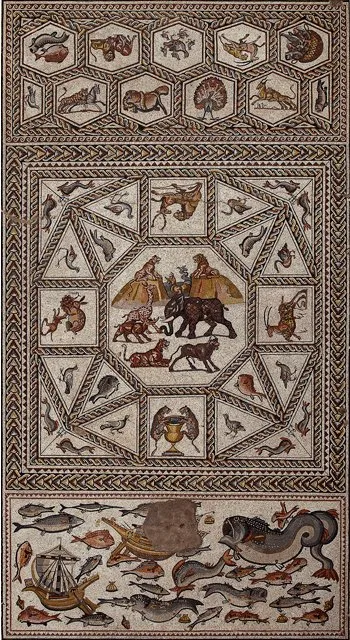
Large installations like the Lod mosaic in Israel, which covers 180 square meters, would have required teams working in coordinated phases. The Lod pavement was discovered in 1996 during road construction and dated to approximately 300 AD based on pottery and coins in the debris layer covering the floor. The size and complexity of this private villa pavement demonstrates the scale of labor mobilization needed for elite commissions.
Evidence from Fishbourne Palace shows that different craft traditions operated in Roman Britain. The earliest geometric mosaics at Fishbourne, dating to 75 AD, were created by continental craftsmen brought to Britain shortly after the Roman conquest. These workers trained local apprentices, and later pavements show increasing complexity and the development of regional styles within the broader Roman tradition. The palace contains twenty mosaic floors that remain in their original positions, providing rare evidence of workshop practices and the evolution of mosaic art over several generations.
Dating Methods And Archaeological Evidence
Archaeologists use multiple methods to date Roman mosaics and verify their construction contexts. Stratigraphic analysis of the debris layers covering pavements provides terminus ante quem dates; the Lod mosaic was sealed by collapse debris containing third- and fourth-century pottery and coins, indicating it was laid around 300 AD and abandoned within a century. When pavements are superimposed, as occurs at Fishbourne where one mosaic lies directly atop an earlier one, the stratigraphic sequence reveals phases of renovation and changing taste.
Tesserae materials offer additional dating evidence. At Fishbourne, the Cupid on a Dolphin mosaic incorporated fragments of Samian pottery, a mass-produced red-gloss ware with dateable typological sequences. When the mosaic was lifted for conservation, specialists examined the pottery decoration on the reverse of the sherds and assigned a date of 150-160 AD. This precision demonstrates how reused materials preserve chronological information within the mosaic fabric.
The Antioch excavations conducted by Princeton University and partner institutions from 1932 to 1939 recovered numerous mosaic pavements and established methodologies for recording find contexts. Field books, find cards, and photographs from these excavations document the discovery circumstances of each pavement, allowing later scholars to reconstruct the original building plans and date phases. The Antioch mosaics, now distributed among museums including the Princeton University Art Museum, provide a corpus for studying regional workshop traditions in Syria from the second to sixth centuries AD.
Regional Variations In Materials And Style
While Roman mosaics shared common techniques and compositional formulas, regional workshops adapted practices to local conditions. In Britain, materials were rarely imported specifically for mosaic work, though chippings and waste from marble or glass used in sculpture and architecture might be incorporated. British mosaicists developed a palette based on indigenous stones: Cotswold and Lias limestones, Forest of Dean sandstones, Purbeck marble, and Kimmeridge shale. This resulted in a characteristic British appearance distinct from the more colorful Mediterranean pavements that used exotic marbles and extensive glass.
The choice between polychrome and black-and-white designs also varied regionally and chronologically. Fishbourne’s earliest mosaics from 75 AD employ simple black-and-white geometric patterns characteristic of the Neronian-Flavian period, while later floors incorporate color and increasingly complex interlace and guilloche borders. By the second century AD, figural panels with mythological subjects had become popular in Britain, as evidenced by the Cupid on a Dolphin and Seasons mosaics at Fishbourne.
Eastern provinces like Syria maintained closer connections to Hellenistic traditions and continued producing elaborate polychrome pavements through Late Antiquity. The Lod mosaic exemplifies this eastern Mediterranean style with its detailed renderings of land animals, fish, and two Roman ships executed in a rich palette. The pavement’s technical quality and iconographic sophistication indicate that specialized workshops in cities like Antioch and Alexandria continued to dominate high-end production even as mosaic craft spread to western provinces.