In AD 79, when Vesuvius buried Pompeii, one of the workshops sealed beneath ash was not a temple, tavern, or senator’s house. It was a laundry. On the Via dell’Abbondanza, the so-called Fullonica of Stephanus preserved basins, work areas, and architectural changes that show how a Roman home had been turned into a place for washing, degreasing, drying, and finishing cloth. Roman fullers worked in a trade that sounds bizarre to modern readers because one of its best-known ingredients was urine.
The claim is basically true, but it is often told badly. Roman laundry was not a joke about dirty people failing to understand hygiene. It was an urban craft built around wool, water, alkalis, labor, and waste products that could be made useful. Stale urine mattered because its chemistry helped loosen grease and dirt from cloth. It was not the only material in the process, and it was not magic. Fullers also used water, absorbent earths, pressure, brushing, rinsing, drying, and sometimes sulphur treatments.
The real question is not whether Romans used urine. It is why a smelly waste product became useful enough to collect, discuss, tax, and build a craft around.
The Fullonica Was a Workshop, Not Just a Wash Tub
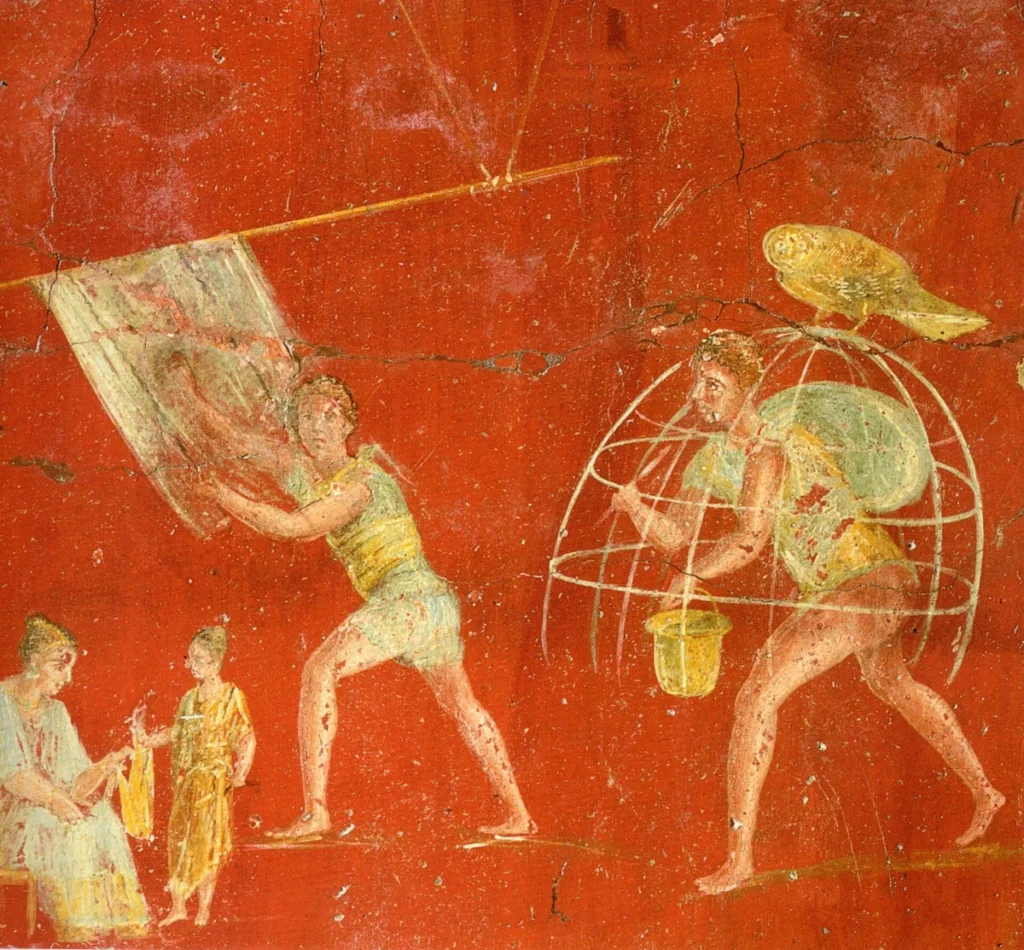
A fuller, or fullo, was a professional cloth cleaner and finisher. The job was broader than modern laundry. Fullers handled newly woven cloth that needed scouring and finishing, and they also cleaned garments that had already been worn. In a society where wool was central to everyday clothing, that mattered. Wool holds oil, sweat, dust, smoke, and smell. Light-colored wool showed dirt quickly, especially in warm Italian cities.
William Smith’s 1875 classical dictionary entry on the fullo is old, but still useful as a collection of ancient references. It draws on Pliny, Seneca, Martial, Suetonius, legal material, and Pompeian evidence to describe fullers as people who washed, scoured, and finished cloth. It should be checked against modern scholarship, but it shows that fulling was not a modern invention projected backward. Romans and later classical scholars recognized it as a distinct urban trade.
The basic work began with soaking and trampling. Cloth was placed in vats or basins and worked by feet. This was repetitive physical labor, designed to force liquid through the fibers and loosen dirt. Ancient references to the fuller’s stamping motion make sense in this context. The worker’s body was part of the equipment.
After soaking and treading came rinsing and finishing. Garments could be brushed, stretched, smoothed, whitened, dried, and pressed. Some treatments involved sulphur fumes, especially where whitening was desired. The fullonica was therefore not simply a dirty corner where urine was poured over clothing. It was a workplace with stages.
The Archaeological Park of Pompeii gives one of the clearest site-based descriptions. At the Fullonica of Stephanus, a private house had been adapted into a laundry. The atrium basin was modified for washing, the roof was used as a drying terrace, and the rear of the building held basins where clothes could be treated. That conversion shows planning, cost, and confidence in the business.
This matters because it corrects the usual caricature. Roman fullers did not operate as comic figures in a marginal world of bad smells. They worked in modified buildings, used equipment, handled customer property, and served an urban clothing economy.
Why Stale Urine Worked on Roman Clothes
The short answer is that stale urine becomes alkaline. As urine decays, urea breaks down and produces ammonium compounds and ammonia. Alkalis help separate grease, sweat, and dirt from fibers. That is why Roman laundry urine was useful. Fullers did not need modern chemistry to notice that aged urine worked differently from plain water.
The chemistry was practical, not symbolic. Wool garments accumulated body oils and environmental dirt. Water alone could not easily remove all of that. An alkaline liquid helped lift greasy material from the fibers, especially when combined with pressure, treading, rinsing, and absorbent substances such as fuller’s earth.
Ancient sources and later classical reference works support the basic use of urine in fulling. Smith’s entry says fullers used human and animal urine mixed with water as an alkaline cleaning agent. That statement fits the broader ancient evidence, although the exact procedures varied and are not always described in technical detail.
Pliny the Elder’s Natural History is one ancient text worth checking carefully for materials used in cleaning, cloth treatment, nitrum, earths, sulphur, and urine. Pliny is not a modern laboratory manual. His work mixes observation, report, natural history, craft knowledge, and inherited claims. Still, it is one of the primary bodies of evidence behind many discussions of Roman material practice.
Modern chemistry sharpens the explanation but also complicates it. Michael Witty’s article “Ancient Roman Urine Chemistry”, published in Acta Archaeologica, notes that ammonium accumulates in decaying urine as a dilute chemical agent. It also notes a problem: decayed urine contains other material too, including malodorous compounds and bacterial debris. That makes the old simple statement, “urine cleaned clothes because it contained ammonia,” incomplete.
Witty proposes that first-century Romans may have concentrated useful ammonium compounds from decayed urine, possibly through the formation of struvite, a crystalline ammonium-containing material. His experiment uses materials that could have existed in the Roman world, including ash and bittern salts. This is a chemical reconstruction, not direct proof that every fullonica made struvite. It should be treated as a plausible experimental proposal, not as established archaeological fact.
That distinction is important. The evidence strongly supports stale urine as a fuller’s material. The idea that fullers routinely converted urine into a dry, purified powder remains interpretive. It may help explain how useful ammonium could be separated from some of the foulest parts of rotten urine, but the archaeological record has not yet shown that this was standard workshop practice.
Pompeii Shows Where the Smelly Work Happened
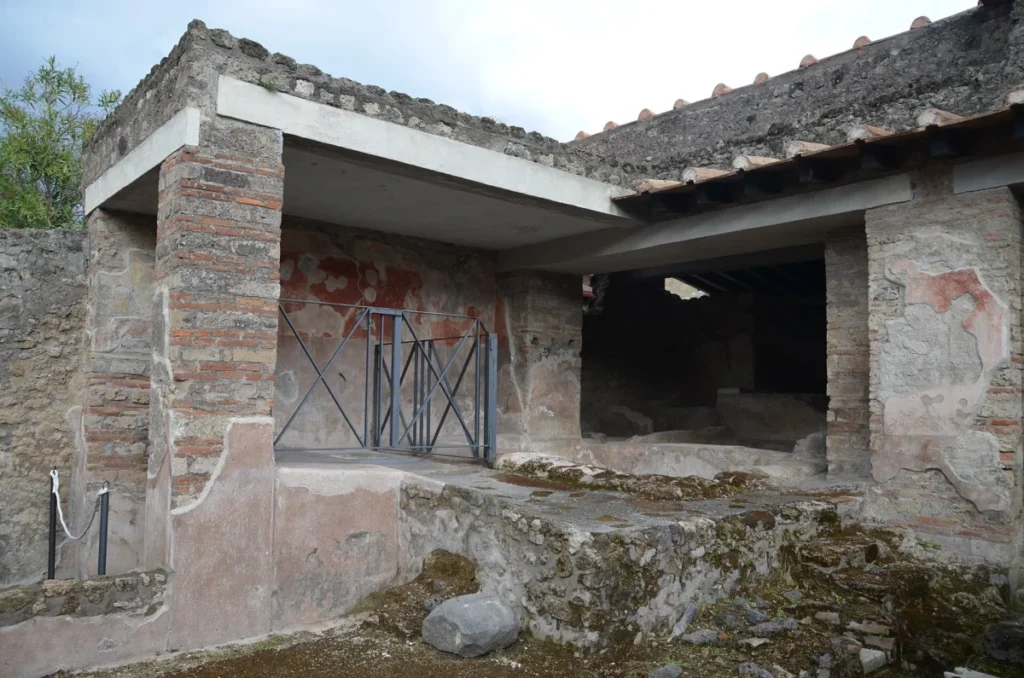
The Fullonica of Stephanus is important because it locates ancient Roman laundry inside a real city. Pompeii was buried in AD 79, but before the eruption it was a living town with houses, shops, bakeries, taverns, public buildings, street fountains, workshops, and constant traffic. The fullonica belonged to that urban pattern.
The Pompeii park’s account describes the workshop as a converted house. That is significant. A domestic building was not simply abandoned and filled with tubs at random. It was remodeled for work. The atrium area was adapted for washing. A roof terrace helped with drying. Rear spaces were reorganized around basins.
Those physical details answer part of the search intent better than any anecdote. Roman fullers needed water, drainage, sunlight, containers, labor space, and places for garments to sit during treatment. They were not only “using urine.” They were managing textiles through a sequence of operations.
Miko Flohr’s The World of the Fullo: Work, Economy, and Society in Roman Italy is the major specialized modern study to consult for fulling as work and as part of the Roman economy. The uploaded front matter and contents identify its focus on evidence for fulling, the economy of the trade, the fulling process, workshop organization, urban environment, and the social world of the fullers. For this article, it is safest to use it as a guide to the scholarly scope of the subject unless the full relevant chapters are available for detailed citation.
The Pompeii evidence also helps with smell. Fullonicae probably smelled unpleasant at least some of the time. Wet wool, stale urine, ash, earths, wastewater, and sweat would not produce a neutral workspace. Yet the fact that fulling workshops could operate inside dense urban areas suggests that the smell was managed, periodic, or tolerated as part of city life. The workshop was not necessarily an isolated industrial zone.
That point does not sanitize the trade. Ancient Roman laundry involved dirty clothing and foul substances. But the archaeology argues against imagining every fullonica as an unlivable stink pit. The more careful interpretation is that fullers worked in a smelly but useful trade that cities accepted because clean clothing mattered.
Built out of a love for history, kept free from distractions.
Spoken Past is an independent project shaped by curiosity, care, and long hours of research. Reader support helps keep it maintained, carefully researched, and open to everyone.
Urine Was Waste, Resource, and Taxable Commodity
Roman cities produced urine constantly. People used chamber pots, private latrines, public latrines, street disposal systems, and other arrangements that connected bodily waste with urban infrastructure. In that environment, urine could be more than waste. For fullers, it was a chemical resource.
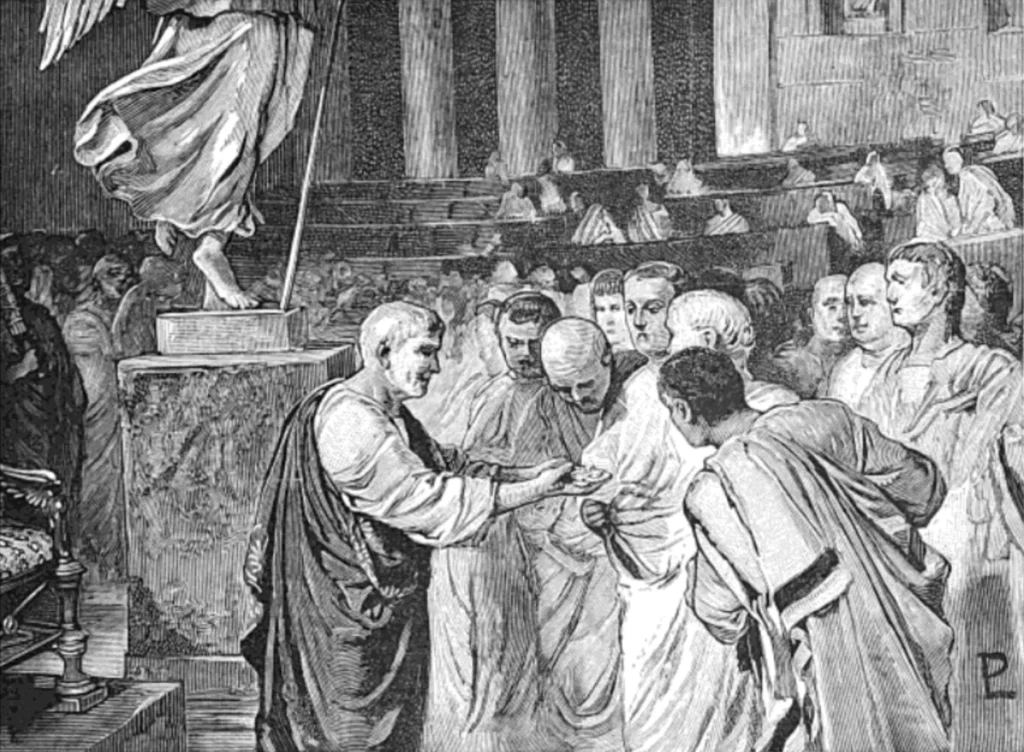
The famous imperial anecdote belongs to Vespasian, who ruled from AD 69 to 79. Suetonius tells the story in his Life of Vespasian. When Titus criticized his father for imposing a charge connected with urine, Vespasian supposedly held up money from the first payment and asked whether the smell offended him. Titus said no. Vespasian replied that it came from urine.
This is the source behind the later phrase often rendered as “money does not stink.” The neat proverb is a later compression of the anecdote, not the exact form of Suetonius’ whole story. It should be used carefully. Suetonius gives a memorable imperial scene, not a complete administrative description of the tax.
Still, the story makes economic sense. If urine had value for trades such as fulling, then revenue from its collection or use could attract state attention. Witty’s article also raises a practical problem: liquid urine is bulky, heavy, and foul. If any process concentrated its useful ammonium compounds, transport and taxation might have been easier. That remains a hypothesis, but it points to the right kind of question. Ancient economies depended not only on luxury goods, but also on waste flows, urban services, and ordinary craft supplies.
The popular claim that fullers placed jars in streets for passersby to urinate into should be handled with caution. Ancient literary references and older scholarship support the idea that urine collection existed in public or semi-public settings. But the evidence does not justify turning every Roman street into a row of laundry jars.
Pompeii provides a useful warning. At the Building of Eumachia near the Forum, a large jar under a landing has sometimes been interpreted as a urine-collection vessel for fullers. The Pompeii park also notes another possibility, drawn from Vitruvius, that a vessel in such a position could have had an acoustic function. This does not disprove urine collection. It shows that artifacts can have more than one plausible interpretation.
The safest statement is this: Roman fullers used stale urine, and they could obtain it from urban waste systems. Some collection may have happened in public or semi-public places. Specific claims about street-corner jars need source-by-source checking.
The Trade Was Dirty, Skilled, and Socially Awkward
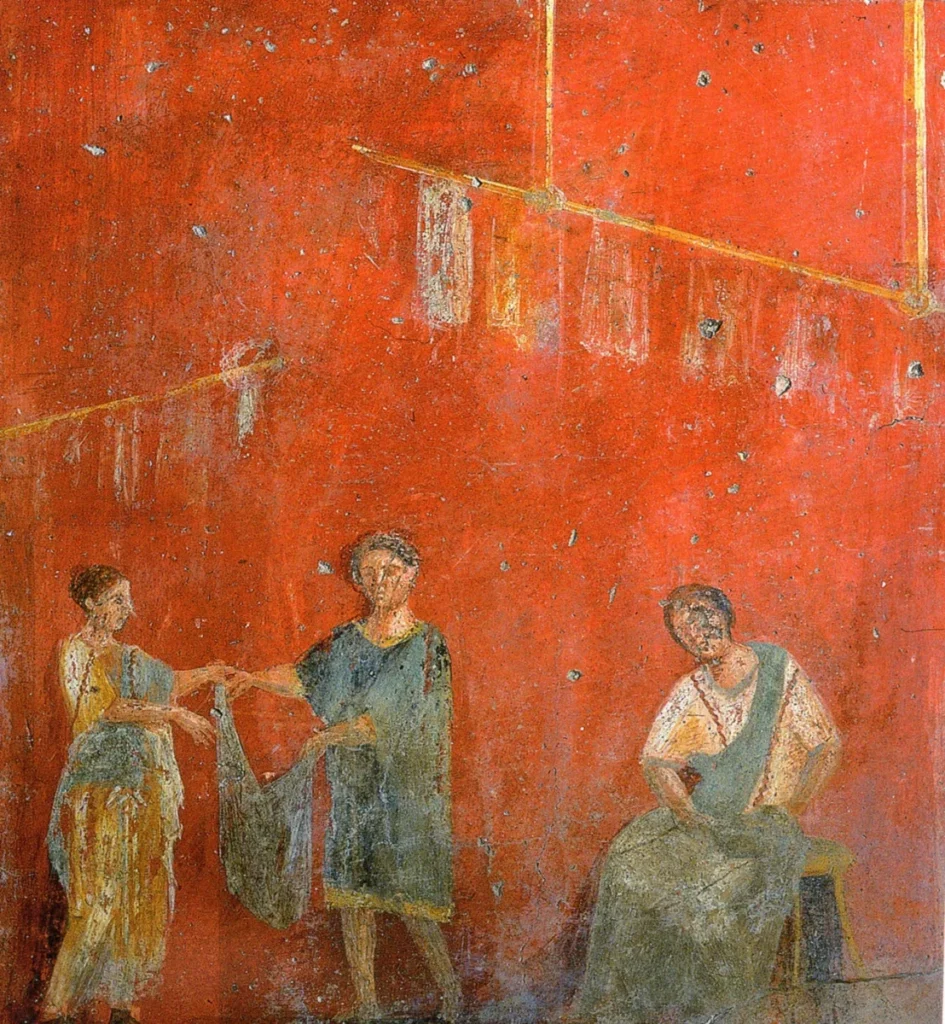
Roman fullers occupied a difficult social position. Their work was necessary. Their customers wanted clean garments, well-finished cloth, and respectable appearance. At the same time, the trade involved dirty clothes, urine, foot labor, wastewater, and smells. That combination invited jokes, discomfort, and status anxiety.
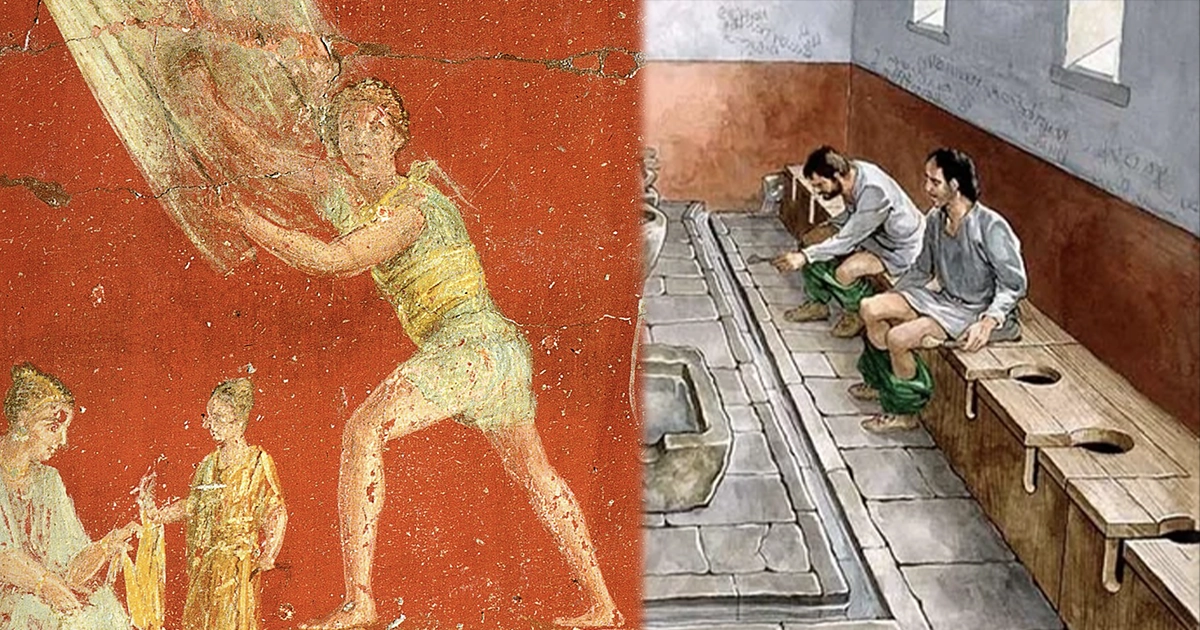
The labor was physically demanding. Workers stood in basins and trod soaked textiles. They handled wet wool, which becomes heavy. They rinsed, lifted, stretched, brushed, carried, and dried cloth. In Pompeii, visual evidence from fullery contexts shows workers engaged in practical tasks. The trade was done by bodies, not by machines.
It was also skilled work. Too much treatment could damage cloth. Too little left grease, dirt, or odor behind. A fuller needed to know how long to soak, how hard to tread, when to rinse, how to dry, and how to finish different textiles. This was craft knowledge learned through practice.
Legal evidence adds another layer. Fullers handled other people’s property. A cloak, tunic, or wool cloth could be expensive. If a garment was damaged, lost, or returned in poor condition, the result could be more than irritation. Roman legal sources discussed responsibility for artisans and service providers. That context fits the fuller’s position as a worker trusted with valuable objects.
The social unease around fulling also appears in jokes and anecdotes. Urine was useful, but it was embarrassing. Suetonius’ Vespasian story works because money, public waste, imperial taxation, and social disgust are all present at once. The humor depends on a Roman audience understanding both the value and the low status of the substance.
Yet fullers were not invisible. Fullonicae occupied real urban space. Some were in prominent areas. Pompeian evidence and the discussion around the Building of Eumachia show that cloth workers could be linked to public buildings, patronage, and civic life, even when the precise interpretation of individual features is debated.
That tension is central to the topic. Roman fullers were associated with a dirty material, but their work produced cleanliness. They handled foul liquids so that others could appear presentable in public.
What the Evidence Really Shows
The best answer is direct. Yes, Romans used urine to clean clothes, especially in the work of fullers. They used stale urine because its decay produced alkaline ammonium compounds that helped loosen grease and dirt from textiles. The process also depended on treading, rinsing, drying, brushing, and finishing.
Several surrounding claims are well supported. Fulling was an established trade in Roman Italy. Pompeii preserves physical evidence for fullonicae, including the Fullonica of Stephanus. Ancient authors and later classical reference works connect fullers with urine. Suetonius preserves a famous anecdote associating Vespasian with revenue from urine. Modern chemistry explains why stale urine had cleaning power.
Other claims need caution. It is possible that some fullers or related workers processed urine in more sophisticated ways than simply letting it rot in a container. Witty’s struvite hypothesis offers a chemical model for how ammonium could be concentrated with materials available in the first century AD. But this is not the same as direct evidence from a Roman fullonica showing routine struvite manufacture.
The smell question also needs balance. Fullonicae likely smelled unpleasant during parts of the process. Decayed urine, wet wool, and wastewater would have been hard to ignore. But the placement of some workshops within city neighborhoods suggests that odor was tolerated or managed rather than constantly overwhelming.
The street-jar story is plausible in broad outline but often overstated in popular retellings. Urine collection existed because the material had value. Specific vessels and collection systems require careful interpretation. A jar in an archaeological context is not automatically proof of public urination for laundry.
Ancient Roman laundry was therefore not a primitive mistake or a grotesque curiosity. It was practical chemistry in a premodern city. Roman fullers used an available waste product because wool garments needed degreasing, because alkaline materials worked, and because urban economies often turned refuse into raw material. In the basins of a fullonica, stale urine became one part of a wider process that transformed dirty cloth into garments fit to wear again.