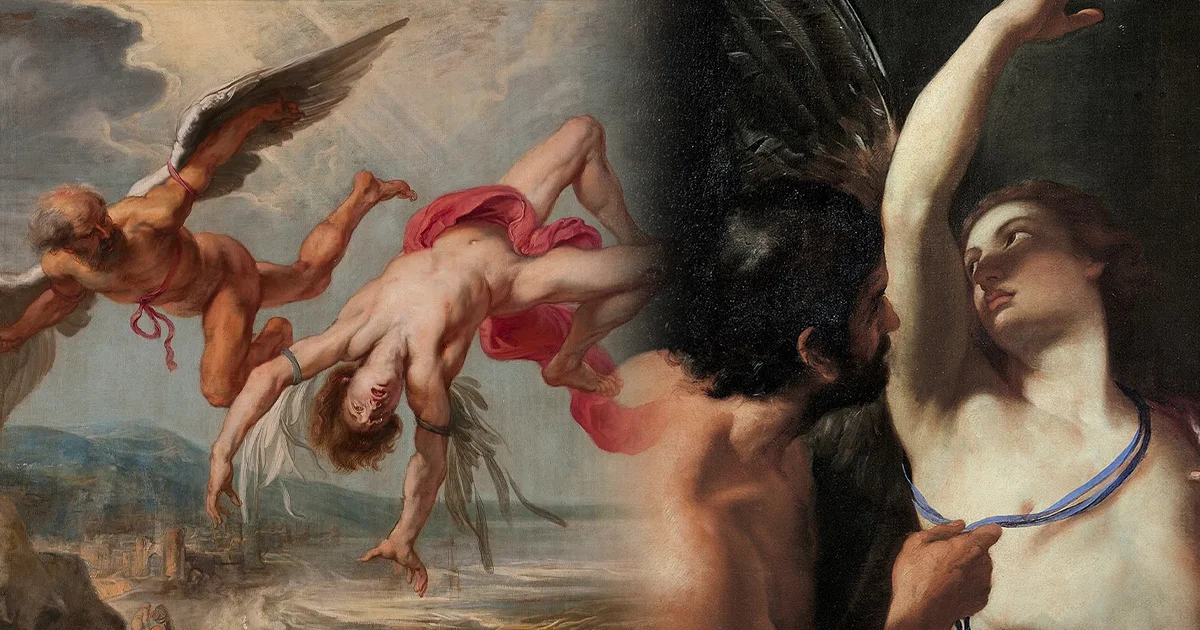
A grieving craftsman stands on a foreign shore, calling for a son who no longer answers, until he sees only scattered feathers drifting on the water below. That artisan is Daedalus, a figure who in Greek and Roman storytelling is at once the most celebrated maker of devices, the architect of the Labyrinth, the killer of his own nephew, the adviser of Ariadne and Theseus, and the inventor whose work helps him flee one king while destroying his own child. Ancient poets and mythographers return to him whenever they want to think about invention, jealousy, and the dangerous ambition that lets a human being try the realm of birds and gods.
To understand Daedalus in that wider sense, it is necessary to follow him from his beginnings in Athens, through his crime against his apprentice, to his service at the Cretan court of Minos, the building of the Labyrinth and the wooden cow, his involvement with Ariadne and Theseus, the flight with Icarus, and his last refuge in Sicily. Along the way, Greek and Roman authors also turn him into a figure of speech for poetic and philosophical daring, so that his wings and his maze become part of the language of ancient art itself.
Athens and the young craftsman
The oldest stories make Daedalus an Athenian artisan, already famed for his skill before he ever reaches Crete. He belongs to the world of tools, temples, and stone, a man whose reputation rests on the power to shape matter into new forms that look almost alive.
In this setting Daedalus takes on a nephew as apprentice, a boy called variously Talos or Perdix, who quickly proves just as inventive as his teacher. Watching the spine of a fish, the youth notices how the notched backbone could be turned into a cutting edge and from that observation he designs a saw; later he pins two metal arms at a joint so that one leg stays fixed while the other traces circles, the basic compass used by builders. Those details are important because they show how, in the ancient imagination, technical breakthroughs often come from close attention to natural patterns rather than from pure abstract thought.
Crime against Perdix
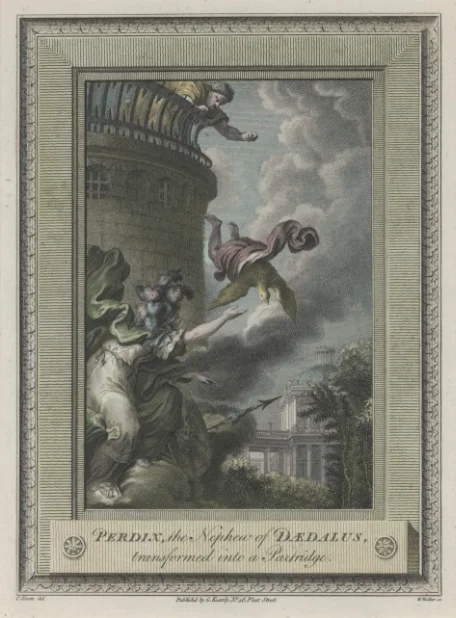
The success of the nephew’s inventions wounds Daedalus where he is most proud, in his standing as master artisan. Instead of rejoicing in the new tools, he feels his own position threatened, and jealousy turns into action when he lures the boy to the top of Athena’s citadel and pushes him off, pretending afterward that it was simply a fall.
A goddess intervenes before the body hits the ground, changing the child into a partridge that bears his name. The bird’s habits recall the story: it flies low, avoids high branches, and builds nests near the ground, as if it still remembered the shock of the drop. This metamorphosis spares the youth but exposes Daedalus’ crime, so that he must leave Athens under a cloud of guilt, already marked as someone whose love of craft can lead to violence against his own kin. Later, when that same bird watches Icarus’ burial and claps its wings in a kind of harsh joy, the ancient poet makes clear that one lost son is being mourned in front of the survivor of another attempted killing.
Daedalus and the Labyrinth of Knossos
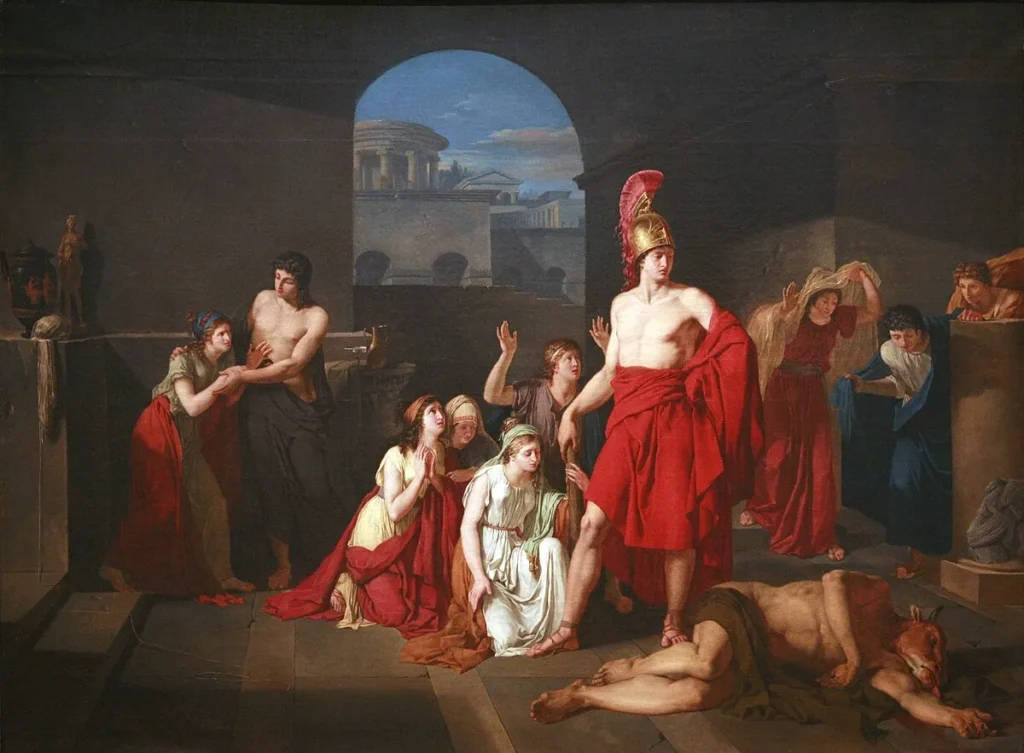
In exile Daedalus comes to Crete, where his talents make him indispensable to King Minos and his family. Here he moves from the workshops of Athens into the charged environment of a royal court, with its expectations of display, its sacrificial demands, and its conflicts between divine command and human desire.
When a splendid bull sent from the sea is not sacrificed as it should be, and the queen Pasiphae falls in love with the animal, Daedalus provides the device that lets this forbidden passion be acted out. One tradition, summarized by later retellings, has him construct a hollow wooden cow in which Pasiphae can hide so that the bull mounts the contraption, and from that union the Minotaur is born, a creature half man and half bull who will later haunt his builder’s life. Already at this point Daedalus is not just solving a technical problem; he is supplying the means for a transgression that neither gods nor men can easily accept.
Minos now needs a way to confine the monstrous offspring he has unwillingly acquired, and once again Daedalus is summoned. The structure he constructs is the Labyrinth, a dense network of corridors and rooms so arranged that the person inside cannot easily retrace the route to the entrance. A Roman epic compares its twisting passages to the river Maeander in Asia Minor, which doubles back on itself so many times that its waters seem to meet themselves and waver between source and sea, a simile designed to capture both the physical complexity of Daedalus’ design and the sense of wandering without a clear path.
Within this maze the Minotaur lives and feeds, and the king of Athens is forced to send groups of youths and maidens at regular intervals as a tribute to Crete. In some accounts they are twelve in number, in others fourteen, but in every version they enter the Labyrinth as victims and do not return, which means that Daedalus’ masterpiece functions as a killing ground as well as a marvel of architecture. Ancient authors do not ignore the impressiveness of this construction, yet the stories insist that the beauty of its pattern cannot be separated from the terror of those who walk its halls in fear.
Works attributed to Daedalus in Crete
- The wooden cow that allows Pasiphae’s union with the bull, leading to the birth of the Minotaur and binding Daedalus to the royal family’s most troubling secret.
- The Labyrinth at Knossos, a stone maze whose deceptive turns confine the Minotaur and trap the Athenian victims sent to Crete, while also becoming a model for later descriptions of intricate buildings and poems.
- The choreography of a circling dance, later remembered on Delos, in which Theseus and his companions trace the pattern of the Labyrinth on open ground, turning Daedalus’ knowledge into ritual movement rather than stone.
Built out of a love for history, kept free from distractions.
Spoken Past is an independent project shaped by curiosity, care, and long hours of research. Reader support helps keep it maintained, carefully researched, and open to everyone.
Daedalus Ariadne and Theseus
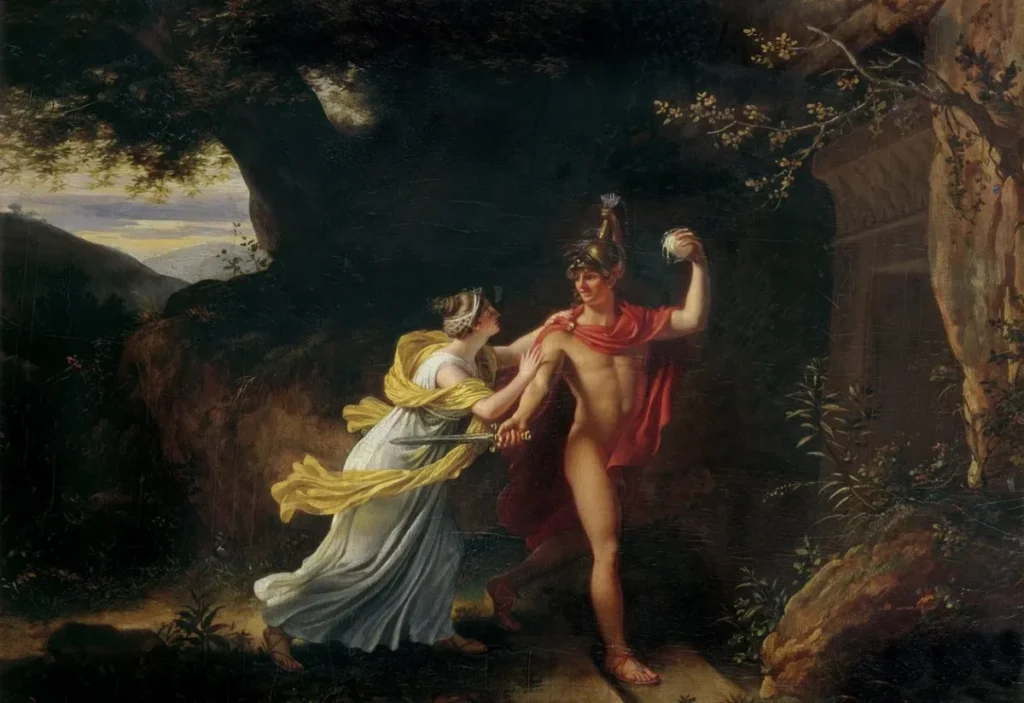
The tribute of Athenian youths continues until Theseus, son of King Aegeus, volunteers to sail with the next group in the hope of killing the Minotaur and ending the humiliation of his city. On Crete he catches the eye of Ariadne, Minos’ daughter, who cannot bear to see such a youth thrown away in the darkness under the palace. She seeks out Daedalus, asking him how escape from the maze might be possible, since none of the previous victims has found the way.
In one influential retelling Daedalus explains that the Labyrinth is built with a strict regularity: the corridors may twist, and the sequence of left and right turns may confuse the mind, but there is never more than one way forward at any point. The problem, he says, is not that the structure itself lacks order, but that those inside cannot see the pattern, and so they panic and wander as if they were lost beyond recall. He tells Ariadne that a simple ball of thread, tied at the entrance and unwound as Theseus walks inward, will allow the hero to retrace his steps and lead the others back out once the Minotaur is dead.
Ariadne passes this knowledge and the thread to Theseus, who fastens the line, moves through the cold corridors until he finds the sleeping beast, and kills it after a struggle. The Athenians then follow the thread back to the door, escape with Ariadne, and sail away from Crete under cover of night, taking with them not only their lives but also the secret of the maze’s inner logic. Later, on Delos, Theseus and his rescued companions perform a circling dance that imitates the windings of the Labyrinth, a dance Daedalus himself is said to have taught, which keeps the memory of his structure alive even after the monster’s death.
Flight of Daedalus and Icarus
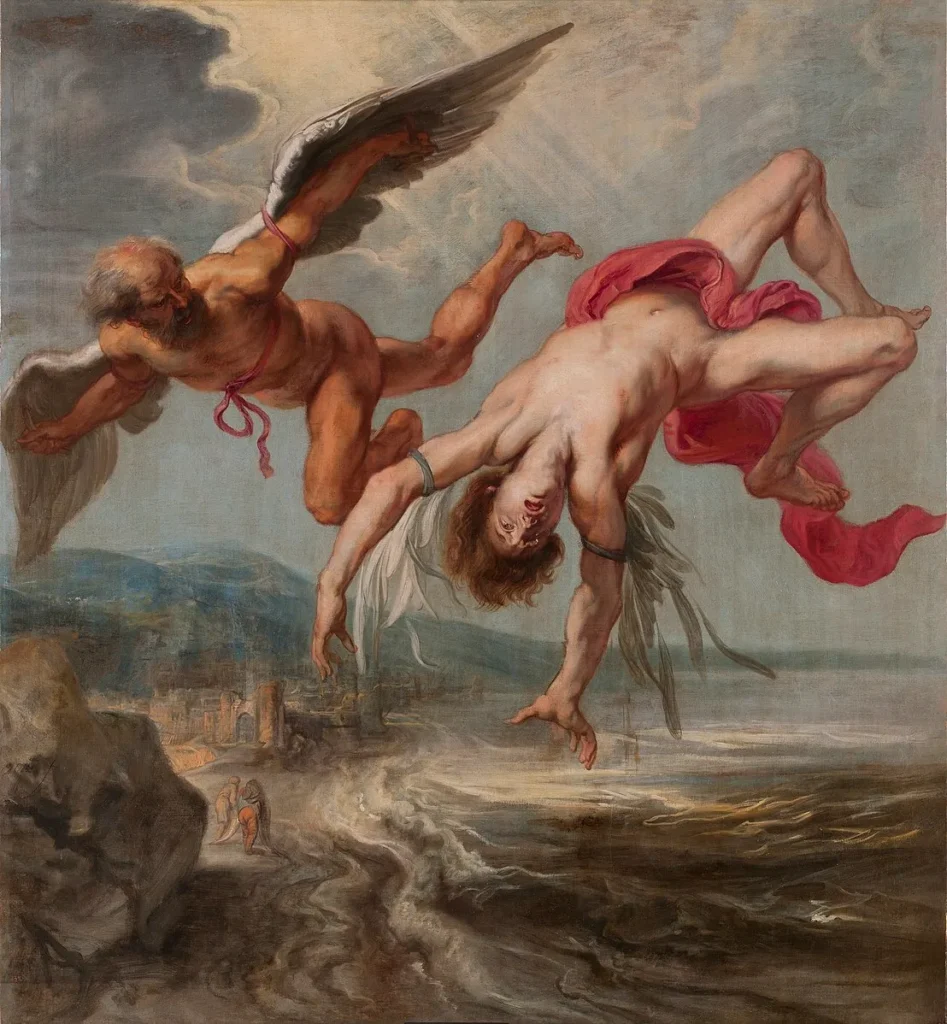
After Theseus’ escape, Minos cannot ignore the fact that someone at his own court betrayed the secret of the Labyrinth. Ariadne is gone, the beast is dead, and suspicion falls naturally on the architect who alone understood how the pattern hangs together. Daedalus now finds himself as much a prisoner of Crete as any Athenian victim had been, confined to the island by royal power and the surrounding sea.
In response he turns his art to a new problem: how to leave a guarded island when ships and harbors are closely watched. The solution is to look to the air, where no human boundary has yet been set, and to construct wings from feathers and wax that can lift a man above both palace and sea. The epic that narrates this moment lingers on the careful gradation of the feathers from small to large, giving the wings a natural slope like a hillside, and compares them to the reeds of a rustic flute, another simple device that turns a natural form into a tool for human hands.
Before they fly, Daedalus gives his son Icarus a detailed warning. He explains that flying too low will let the sea’s dampness clog the feathers, while flying too high will bring the wax too close to the sun, and he insists that the safest path lies between those extremes, in a middle course that avoids both dangers. He also instructs the boy to follow his lead, making himself in effect a guide through the sky just as he had once guided others through stone.
At first the plan succeeds: father and son rise above the island, and distant rustics below drop their fishing rods, staffs, and plow handles to stare upward, believing that these figures who walk the air must be gods. Icarus, however, begins to delight in the height of his own flight, feels drawn upward by desire for the sky, and forgets the rule he has been given, so that the heat softens the wax, the feathers fall away, and he plunges into the sea calling on his father for help that cannot reach him in time. Daedalus, seeing feathers floating on the waves, curses his own skills, buries the body on a nearby shore, and gives the place a name that remembers his son’s fall.
Other ancient poems use this flight as an image of human overreach or artistic ambition. Roman lyric makes Daedalus and Icarus a warning to the poet who would attempt a higher genre than is safe, while elegiac and didactic works compare the guidance Daedalus offers to the advice a teacher gives his pupils, advice that may be disobeyed with ruinous results. In every case, the wings are both a triumph of craft and a reminder that technique cannot guarantee control over the people who use it.
Sicily and the end of exile
The same epic that tells of the flight does not leave Daedalus on that mourning shore forever. After the burial it has him seek refuge with King Cocalus in Sicily, which becomes a new place of safety for a craftsman now twice entangled in royal affairs, first in Athens and then in Crete. This move shifts him out of the direct reach of Minos, although other versions of the myth, mentioned but not fully retold in the surviving scholarship, hint that the Cretan king pursues him even there and meets a violent death.
By the time the Roman poet finishes his Cretan sequence, Daedalus has built the Labyrinth, provided the clue to Ariadne and Theseus, escaped Crete by air at the cost of his son, and found shelter at another foreign court. His life reads as a chain of exiles and new beginnings, each driven by the collision between his inventions and the desires or fears of powerful rulers, and each leaving a trace in place names, dances, and proverbial images of wings and mazes.
Daedalus in ancient poetry
Beyond narrative myth, Daedalus appears in a range of Greek and Roman texts as a symbol for wider themes. Roman epic sets a sculpted image of his Labyrinth on the doors of a temple in Italy, using the maze with its “inextricable error” as an emblem of the poem’s own complex structure and the hero’s upcoming descent to the underworld. Later in another epic, the extended simile that compares the Labyrinth to the river Maeander turns Daedalus’ design into an analogy for the poem’s flow, twisting yet purposeful, and for the poet’s own play with ambiguity and change.
Other poets treat Daedalus as an example of artistic boldness that comes close to hubris. In Latin lyric the image of the craftsman who dares the air with wings recurs when the speaker warns himself not to attempt too lofty a song, or when he dreams of growing feathers and leaving earth behind, an ambition that always carries the memory of Icarus’ fall alongside it. Scholars in the articles you supplied note that some ancient readers group Daedalus with other “failed” artists, such as Orpheus, who nearly rescues his wife from the dead, or the weavers and singers punished for challenging the gods, since in each case daring brings both momentary success and final loss.
Within the long Cretan cycle, Daedalus also stands beside Minos, Pasiphae, Ariadne, Phaedra, and the Minotaur as one of the figures that later antiquity and late antique writers could use to think about rule, desire, and the tension between human reason and animal violence. While kings, queens, and monsters embody power and passion, Daedalus embodies skill: the capacity to build enclosures, devices, and pathways that can confine or liberate, depending on who holds the knowledge of their design.
Ancient authors who use Daedalus
- Epic poets use Daedalus to mark the center of their works, placing him at structural turning points and making his Labyrinth a model for narrative complexity, especially in accounts of Crete and Book 8 of a well‑known Roman epic.
- Lyric poets turn the flight of Daedalus and Icarus into a comparison for poetic ambition, warning against an ascent in song that might melt the wax of human limitation.
- Philosophical and rhetorical writers refer to the Labyrinth and Ariadne’s thread as images for the mind trying to find order in confusion, using Daedalus’ work as a figure for both the problem and its solution.
Taken together, these uses show that the ancient world did not see Daedalus as a minor background character but as a central figure in thinking about how technique, intelligence, and moral responsibility interact. Within the limits of the surviving sources, he is the Athenian artisan who kills his nephew in jealousy, the Cretan architect who builds both cow and maze, the adviser whose knowledge lets Ariadne and Theseus escape, the father whose wings carry him away while dropping Icarus into the sea, and the aging exile in Sicily whose name continues to stand for both the heights and the dangers of craft, so that any account of Daedalus must hold those aspects together rather than isolate just one.