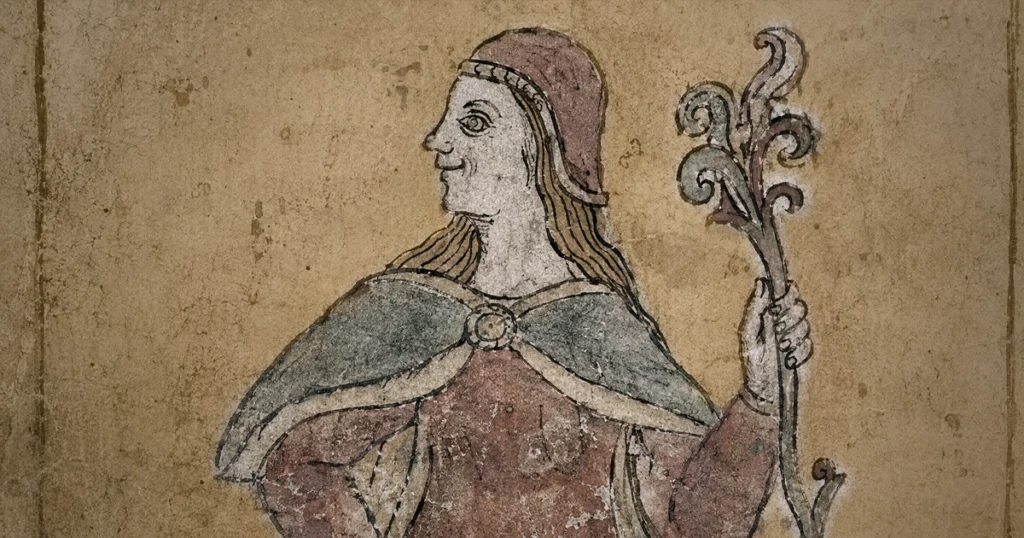
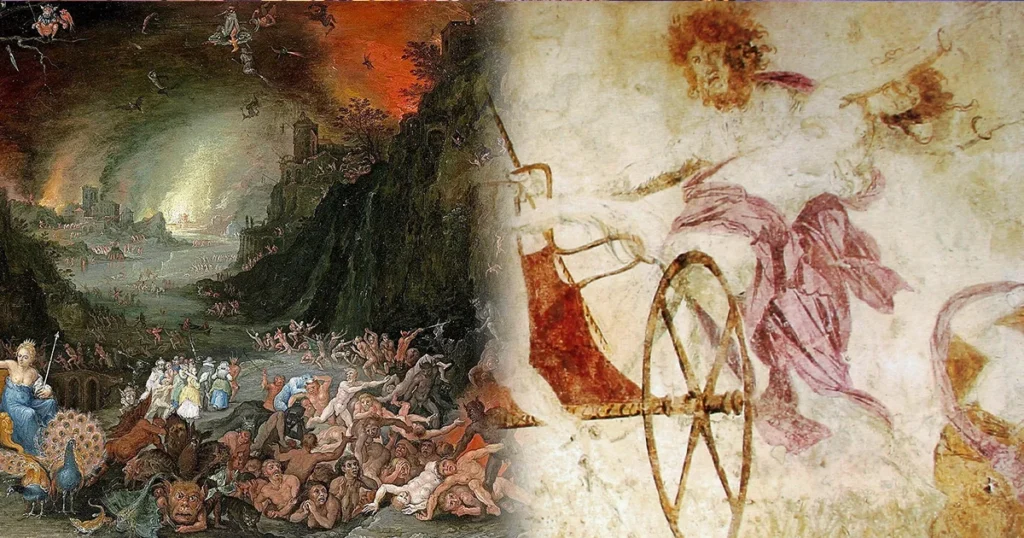
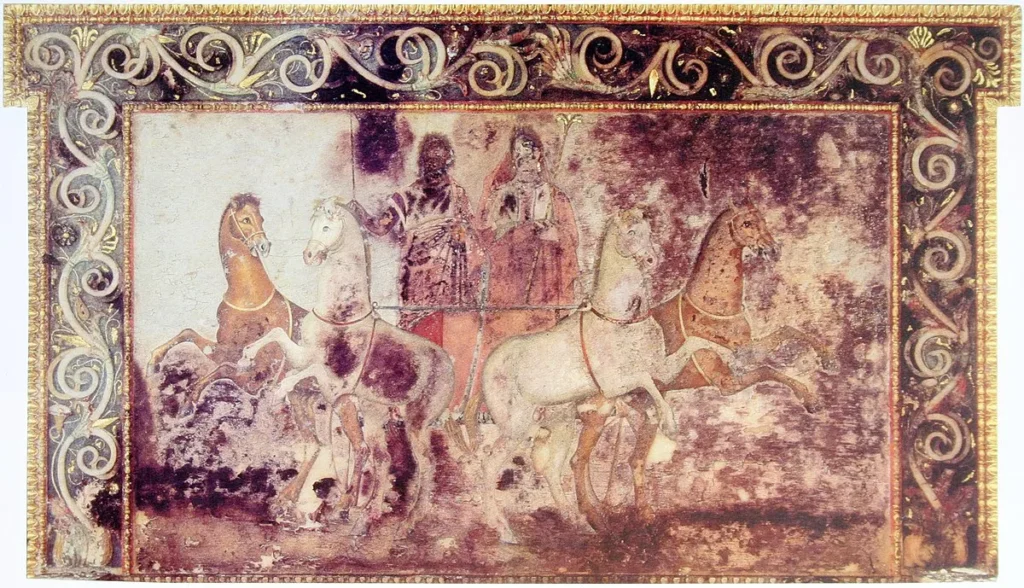
Hades Was Not Hell. A fourth-century fresco from a Macedonian tomb shows Hades and Persephone riding in a chariot, calm and formal, not monstrous at all. The king and queen of the dead hold court with the gravity of rulers, not the fury of tormentors. That is the first correction. For most Greeks, Hades was not a furnace of punishment. It was the place where nearly everyone went, a civic fact of the cosmos, with its own roads, gates, ferries, and judges. Some souls suffered, a few found bright meadows, many wandered as quiet shades. The picture changed across centuries and cities, yet it never became the Christian Hell.
Greek evidence begins early and it is rich: Homeric poetry around the late eighth to early seventh century BCE, archaic hymns, Hesiod, classical Athenian vase-painting and funerary art, inscriptions on grave markers, the gold tablets buried with initiates in southern Italy and Greece, later philosophical myths from Plato and others, and a constant stream of local practice that archaeologists recover from cemeteries and sanctuaries. Sources disagree at points, which matters. Change over time is the rule. Even so, several stable ideas structure the map: death separates ψυχή, the animating breath, from the body; Hermes guides the newly dead; Charon ferries them across a river; judges assign a place; Elysium or the Isles of the Blessed hold a lucky few; Tartarus is a prison for monsters and a handful of notorious offenders; most souls pass into a neutral region that later writers call the Asphodel Meadow.
What did ordinary Greeks think happened after death?
The earliest full account is Homer’s Odyssey, Book 11, where Odysseus descends to the house of Hades. He sacrifices at the edge of the world, calls up the dead, and speaks with his mother and with Achilles. The dead are shadows, without strength, who gain voice and brief memory when they drink blood. Homer names the rivers, the gates, and the figure of Minos who judges. He does not describe fire or a universal sentence of pain. The mood is sober and gray. Even Achilles says he would rather be a living farmhand than a dead king. That line captures early Greek feeling: death is a loss of agency more than a courtroom drama. For a readable English text, the Odyssey can be consulted in the Perseus Digital Library’s Scaife viewer, Book 11. The link is embedded above in this sentence.
By the classical period, Athenians spoke of the Asphodel Meadow as the default fate. A rare few heroes go to Elysium. Titans and mythic criminals are bound or punished in Tartarus. The division is not a strict moral binary for every citizen. It is a cosmic sorting that singles out extremes, then leaves most people in the middle. Later, Plato will intensify the moral logic in philosophical myths that teach lessons about justice. Even then, his stories are pedagogy, not dogma enforced by a priesthood.
Was Hades a god or a place?
Both. Hades, also called Pluto, is the god who rules the lower world. Hades is also the generalized name for that realm. Greeks used both without confusion. The place had landmarks, rivers such as Acheron and Cocytus, the fire river Phlegethon, the boundary river Styx, and Lethe, the water of forgetting. Cerberus guards the gate. Hermes Psychopompos, Hermes the Guide, conducts souls to the entry. Minos, Rhadamanthys, and Aeacus judge. The setup is consistent across centuries, yet it allows for different stories about what happens next.
How many afterlives did the Greeks imagine?
Several, and they overlap.
-
Homeric Hades: a shadowy, communal existence for almost all, with brief punishments for famous offenders and exceptional fates for a tiny group of heroes.
-
Heroic Immortality: heroes receive cult on earth and can share a blessed state after death, which explains heroic tombs, sacrifices, and festivals.
-
Elysium or the Isles of the Blessed: a bright, rare destination for favorite mortals of the gods. The criteria are not consistent. Genealogy, divine favor, and heroic status matter most.
-
Mystery-cult blessedness: initiates of Eleusis or Dionysiac-Orphic groups expected a better lot after death, sometimes described as a life among the blessed. The Orphic tablets show directions for the soul’s travel.
-
Philosophical cycles and judgments: especially in Plato’s Gorgias, Phaedo, and Republic, souls face structured assessments and long cycles of reward and penalty or reincarnation. These are teaching myths, not city law.
-
Skeptical rejection: Epicureans deny post-mortem sensation. For them, death is the end of feeling. That position shaped debates in the Hellenistic and Roman periods.
The result is not a single orthodoxy. It is a menu of models that poets, philosophers, and worshipers used for different needs.
If Hades was not Hell, who was punished?
The famous cases are almost always mythic figures, not ordinary citizens. Tantalus starves under fruit he cannot reach. Sisyphus strains forever to roll his stone. Ixion turns on a wheel. Danaids fill leaky jars. These stories exemplify hybris punished, oath-breaking blamed, or hospitality abused. They do not announce a universal destiny for non-initiates or sinners at large. Plato expands the idea to make his moral point. Earlier poetry and art keep the punishments as cautionary tales attached to names everyone knows.
What did burial and mourning look like in practice?
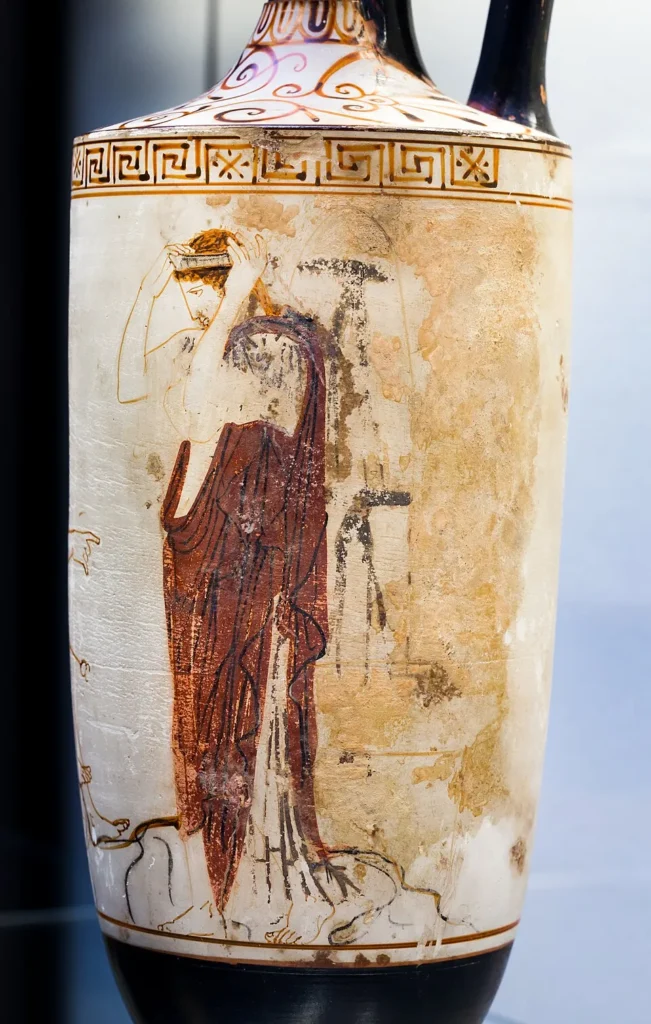
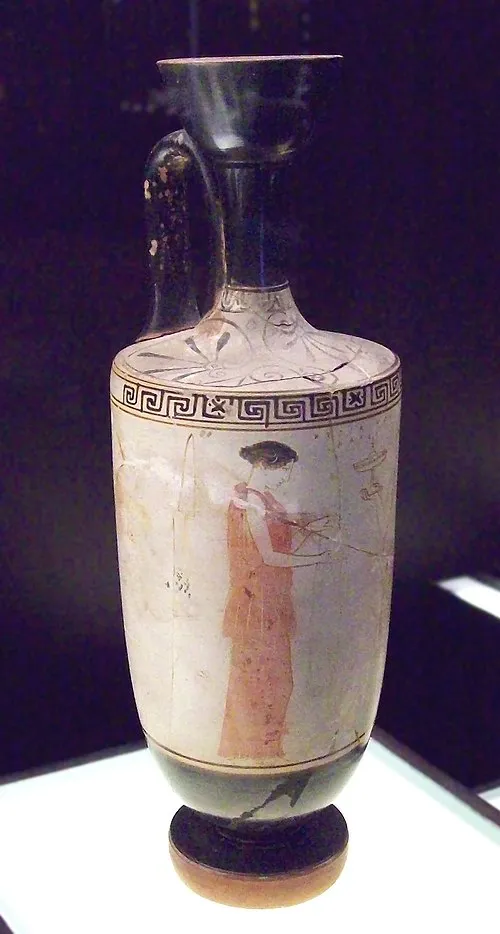
Athenians in the fifth century BCE followed a sequence that law and custom tried to regulate. Family members washed and laid out the body at home, the prothesis. Friends visited. The next day, the ekphora, a procession to the cemetery, carried the body on a cart or in a litter. Cremation and inhumation both appear, with periods where one predominates. On black- and red-figure vases from the late sixth and fifth centuries, mourners extend hands toward stelai, the tall grave markers that lined roads like the Street of Tombs in the Kerameikos. White-ground lekythoi, slim oil flasks painted with quiet visits to the grave, were placed with the dead or used as offerings. Solon and later lawmakers set limits on display, wailing, and expenditure, which tells us that funerals drew crowds and stirred feelings that the city sometimes wanted to calm.
Who guided the soul, and how?
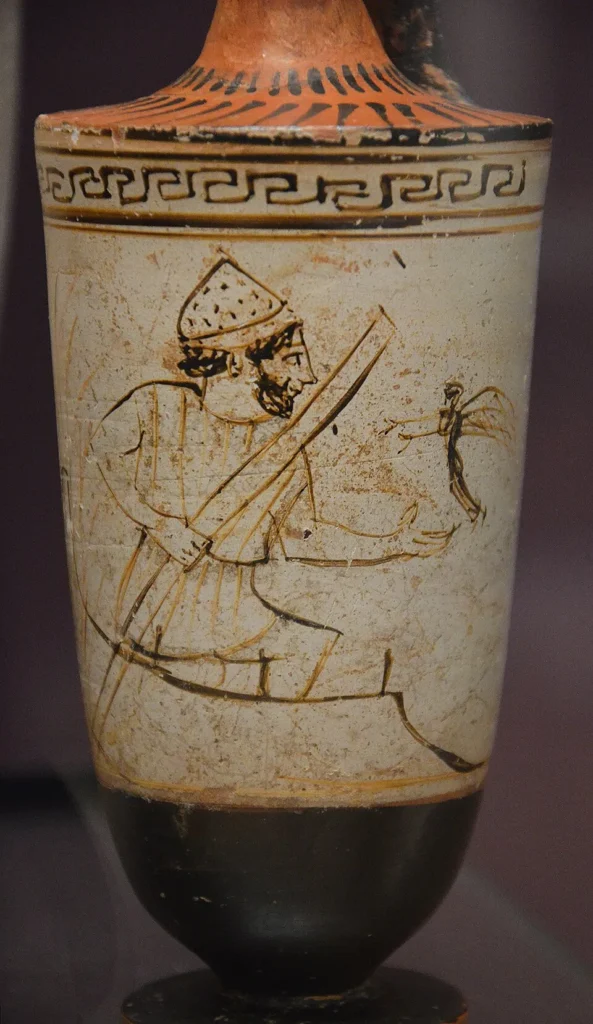
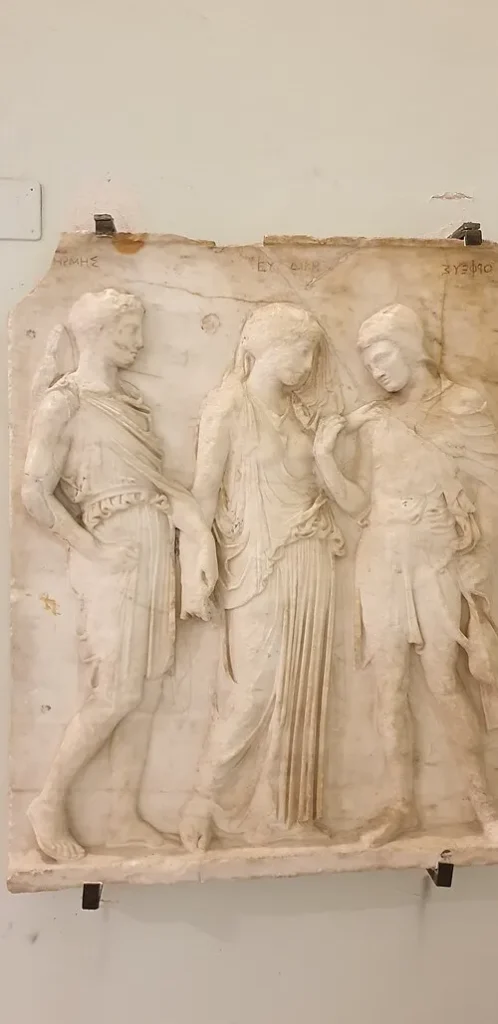
Hermes, in his role as Psychopompos, escorted the newly dead to the boundary. Vase-painters show him with traveler’s hat and staff, sometimes touching the hand of the deceased, sometimes turning the body toward the path. He is not a judge. He is an orderly conductor who moves souls from the house to the gate. The ferryman Charon receives them. Some burials contain a coin placed in the mouth or near the head. The custom is not universal in Greece, but it is common enough in some regions and periods that Roman writers later made “Charon’s obol” a proverb. Vase scenes show Charon leaning on his pole beside reeds, the bank of the Acheron. The visual language is consistent: Hermes brings, Charon ferries, the soul moves on.
Did Greek funerals make heroes?
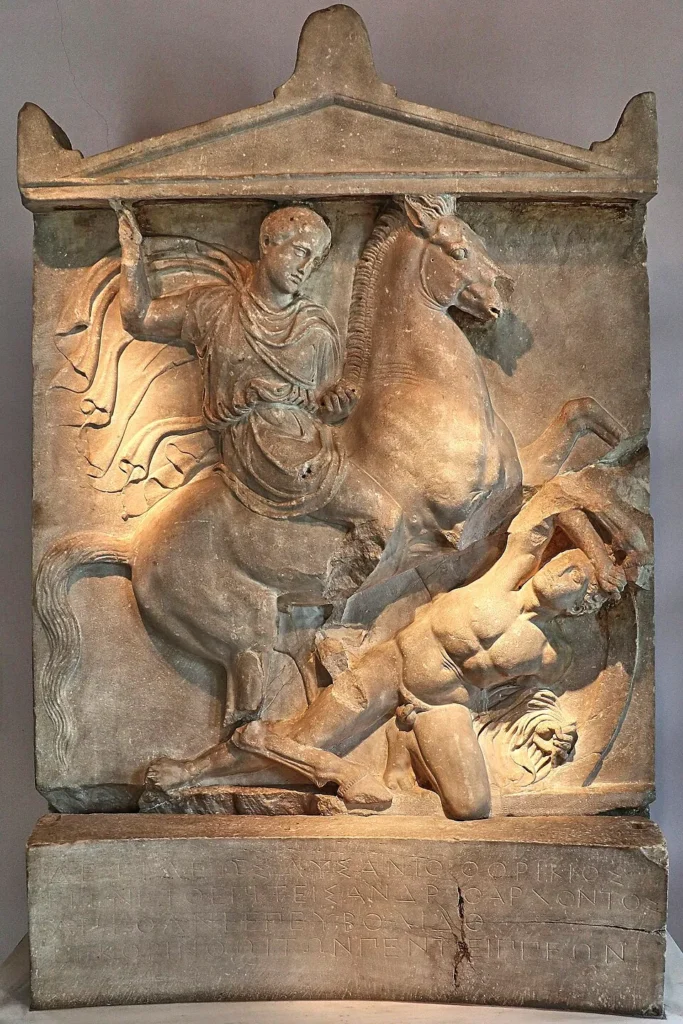
Sometimes. Citizens who died in battle could receive public burial and monuments that lifted them toward heroic memory. The relief of Dexileos at Athens shows a mounted youth striking down an enemy. The inscription places him in a specific battle year, 394 BCE, and records his deme, Thorikos. Elsewhere, tombs of local heroes became cult centers where offerings were made and the dead acted as protectors. Heroization did not require divinity in the strict sense. It required memory, location, and ritual. That overlap matters for the afterlife. A person could be a shade in Hades and a power at his or her tomb at the same time.
What did Greeks think the underworld looked like?
Poetry and art give a coherent map. After burial and the last rites, Hermes guides the soul to the river. Charon ferries it across. Cerberus guards the gate but can be lulled by song or food. Inside, plains and groves spread out, often called the Asphodel Meadow. The judges assign a place. Elysium is green and bright. Isles of the Blessed lie at the edges of the world. Tartarus is walled and deep, more of a prison compound than an all-inclusive inferno. Five rivers set moral tone through names: Pain, Wailing, Fire, Hate, and Forgetfulness. The vocabulary is moral, but the architecture is civic. There are roads, queues, and posts. Greek writers imagined the land of the dead with the same clarity they used to describe cities and harbors.
What about the Eleusinian Mysteries?
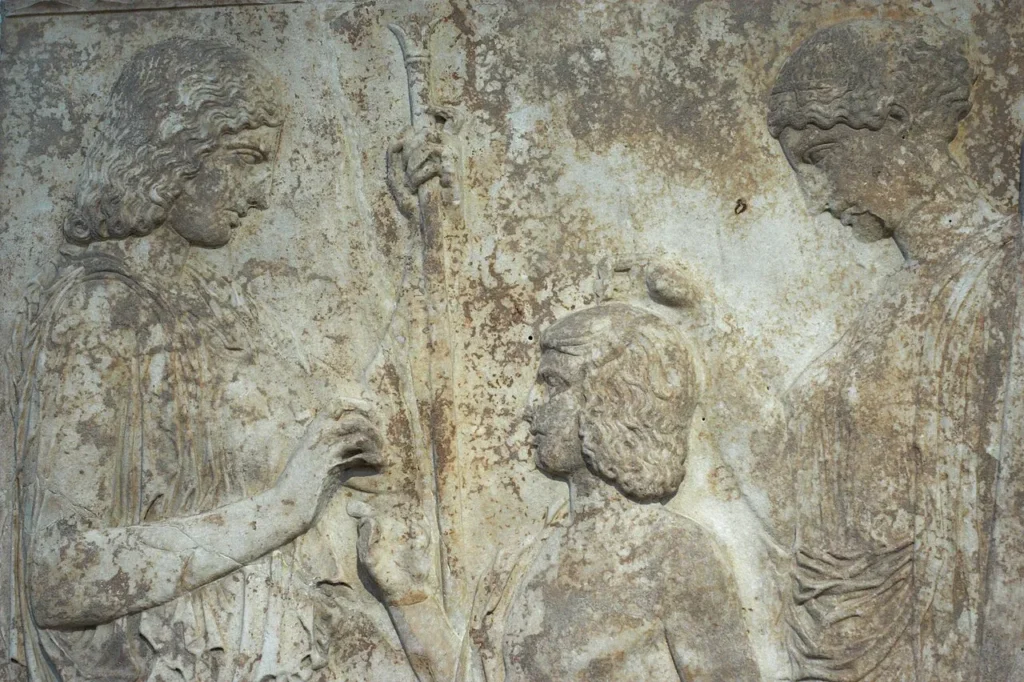
At Eleusis, initiates of Demeter and Persephone sought a better future after death. Public festival and secret rite coexisted. Initiation was open to men and women, slaves and free, provided they spoke Greek and had not committed murder. The promises were worded carefully in inscriptions and in later accounts. Initiates expected to fare better in Hades. The content of the rites was secret by law, yet the Great Eleusinian Relief and many classical texts show the mythic frame clearly: Demeter and Persephone bless Triptolemos, who spreads agriculture. Torches, sheaves of grain, and the theme of return shaped the rite. For an introduction to Greek mystery cults by a major museum, the Met’s essay “Mystery Cults in the Greek and Roman World” offers a concise overview and images from the collection.
What do the Orphic gold tablets tell us?
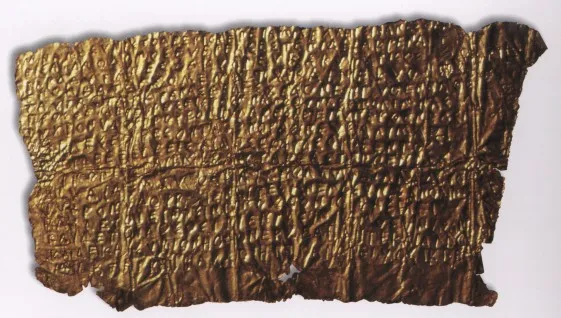
Dozens of thin gold tablets, lamellae, have been found in graves from southern Italy to Crete and Thessaly, fourth century BCE and later. They are small, often the size of a business card, inscribed with directions for the soul. Many carry a memorable exchange: “I am a child of Earth and of starry Sky, but my race is of Heaven. You yourselves know this.” They warn the soul to avoid the spring of Lethe and to seek instead the pool of Mnemosyne, Memory. Some tablet texts anticipate a form of judgment and a reward among the blessed. Others speak of a cycle of rebirth. The tablets are not a single scripture. They are family resemblances: poems and instructions for groups whose rituals promised post-mortem benefits tied to Dionysus, Persephone, and a myth of dismemberment and return. The Hipponion tablet is among the best preserved and makes the geography of choice absolutely clear, left versus right, forgetting versus memory.
Did Plato invent moral judgment after death?
He did not invent it, but he sharpened it and made it central to philosophical education. The Myth of Er at the end of the Republic tells of a soldier who died in battle and returned to life with a report of a cosmic sorting, punishments and rewards, and a cycle of choice that sends souls back into new bodies. The Gorgias ends with a tale of naked souls judged by men who cannot be fooled by clothes and rank. The Phaedo speaks of a cosmos that allocates, cleanses, and releases by degrees. Plato used these stories to teach that justice matters even when no one is watching. His audience would have recognized the Homeric map and the Eleusinian promise. He repurposed both to make a vivid moral case.
What did Epicureans say?
They cut against the grain. For Epicureans, the soul is material and dissolves at death. No sensation, no fear, no punishment, and no reward. The purpose of philosophy is to relieve fear, including fear of the gods and of death. This view circulated widely in the Hellenistic period and under Rome. It does not leave many traces in funerary art, for obvious reasons, yet it shaped debates. Greek afterlife thought was a conversation, not a creed, and voices like this are part of that conversation.
How did household and civic rituals carry the dead?
The dead remained members of the community. Families visited tombs with offerings, often oil or small cakes. Annual observances, such as the Athenian Genesia, honored ancestors at the city scale. Vases show women at stelai, men conversing with the sculpted figures as if they were present. The handshake motif, dexiosis, on many grave reliefs shows the living and the dead in a formal farewell that also reads as a continuing relationship. The dead watched and protected. The living fed memory with visits and gifts. This steady practice did more social work than any single doctrine of the soul’s path.
What about children and infants?
Burials of infants and young children are common in Greek cemeteries. Some are in handmade jars or small larnakes. Grave goods often include toys or miniature vases. Iconography on lekythoi shows mothers at graves, older men in mourning, and occasionally a domestic scene that suggests continuity rather than rupture. Greek afterlife thought made space for stages of life by how it marked the tomb, not by building a separate theology for the young.
Enjoying Spoken Past?
I created Spoken Past to share my love of history. I research, write and develop everything myself, and I want my articles and basic guides to remain free for everyone.
If you enjoy my work, please consider supporting Spoken Past with a small donation.
Is Tartarus just the Greek word for Hell?
No. Tartarus is a distinct space, often imagined as far below Hades as the earth is below the sky. It is a prison for Titans and for famous criminals who offended gods directly. Later writers add others. It is not the default destination for the wicked citizen. The geography matters. Greeks preserved a spectrum: prison for monsters, meadows for most, fields of joy for a few, and a sharp gate that separates the living from the dead.
Where did the coin in the mouth come from?
The idea that every Greek burial included a coin for Charon is too neat. Coins appear in many graves and in several positions, mouth, hand, near the head, or simply in the fill. The practice varies by region and period. White-ground lekythoi and red-figure vases confirm the ferry and the pole more clearly than coins do. The phrase “Charon’s obol” became a handy label, and Roman writers loved it, but the archaeology shows diversity on the ground.
Did the Greek afterlife have a concept like purgatory?
Not as an official, universal station. Plato’s myths describe cycles of cleansing and education. Mystery cults promise purification, a gentler passage, or a better destination. Poets occasionally speak of rivers or wanderings that clear faults. None of this becomes a fixed, compulsory stage for all souls. Greek thinking prefers pathways rather than a single, centralized process.
How we know: texts, images, and graves together
No single source can carry the weight. Homer and Hesiod provide a baseline from the archaic period. Tragedy gives scenes of mourning and stakes in the living city. Vase-painters, especially in Athens around 500 to 430 BCE, created a standard grammar for funerary scenes. White-ground lekythoi serve as a catalog of gestures: approach, farewell, gift, turning away. Inscriptions fix names and legal limits on display. Archaeology preserves tomb architecture, grave goods, and patterns of cremation and inhumation across time. Orphic gold tablets provide instructions from within dead communities, which is rare. Philosophers add frameworks that sometimes align with practice and sometimes push against it. Alignments are strongest where three lines meet: what poets describe, what painters draw, and what graves preserve.
What did a katabasis teach Greeks?
A descent to the underworld allowed poets to talk about memory, limits, and loss. Odysseus learns restraint and the cost of his choices. Heracles drags a monster up as proof of strength. Orpheus shows the fragility of trust and the pull of rules that even love cannot break. These tales do not add a new geography. They rehearse the same map and highlights, the gate, the judges, the meadows, the few punished or blessed, and the impossibility of staying below. All living visitors must return, which implies a rule that the dead must stay. Transgression is possible and always costly.
What exactly was “Elysium,” and how did it differ from the “Isles of the Blessed”?
The terms overlap, and authors use them flexibly. In some traditions, Elysium lies at the world’s edge as a region within Hades for the favored dead. In others, especially Hesiod, the Isles of the Blessed are a separate place where heroes live under Cronus. Both are green, temperate, and free from toil. Both exclude most people. No author turns them into a reward for an everyday moral checklist. Genealogy, divine favor, and the continuity of heroic cult on earth weigh heavily.
Who judged the dead, and what standard did they use?
Minos, Rhadamanthys, and Aeacus are standard names. In Homer, Minos sits with a golden scepter and settles cases. Later authors add jurisdiction: Aeacus for Europe, Rhadamanthys for Asia, with Minos as the one who casts the decisive vote. These are narrative devices and civic metaphors applied to a cosmic court. Plato builds an ethic around them. Vase-painters rarely depict the judges, which suggests that process mattered less to Greek viewers than the passage itself and the presence of Hermes and Charon.
What role did Persephone play?
Persephone is queen and seasonal visitor. Her return to Demeter in spring explains the yearly cycle. Her presence in Hades makes the realm administratively stable and less frightening. At Eleusis she is a patron of initiates. In Orphic material, she appears as mother of the reborn soul or as a gatekeeper to memory’s spring. Persephone does not punish. She rules and receives. That difference structures Greek comfort with the underworld. The ruler is stern, but not malicious. The queen sits, holds a torch, and presides. The state of the dead is regular, which is the opposite of the chaos that true hell imagery prefers.
How did Greek views interact with later Roman and Christian ones?
Roman artists and poets adopted the Greek map. Vergil’s Aeneid describes a descent that combines Homeric landmarks with Roman moralizing. Imperial reliefs and sarcophagi show Heracles with Cerberus or Orpheus in Hades. Early Christian writers later opposed their own final judgment and heaven-hell polarity to a pagan world they often simplified. They preserved Greek names, Hades and Tartarus, as labels, which sometimes confuses modern readers. The continuity of vocabulary masks a major shift in structure. Greek afterlife thought offered several routes and outcomes. Christian teaching pressed toward a single timeline and a final separation of saved and damned.
Myth vs Evidence: common claims tested
-
“Hades means Hell.” False in the Greek context. Hades is a god and a realm for the dead as a whole. Punishment exists for a small set of offenders, but the default is neutral or dim, not fiery torment.
-
“Every Greek burial used a coin for Charon.” Coins appear regularly, sometimes in the mouth, sometimes elsewhere, yet the practice varies by region and period. Vase art and texts are stronger witnesses to the ferry than the coin is.
-
“Only the rich could enter Eleusis.” Initiation was open to men and women, free and enslaved, provided they spoke Greek and were not murderers. Cost and travel limited participation for some, but the rite was not class-exclusive by law.
-
“Orphic tablets give one unified doctrine.” The tablets share phrases and imagery, but their texts vary. They belong to related groups that promised post-mortem benefits through Dionysiac or Persephonean rituals.
-
“Greeks feared the dead and avoided graves.” They feared pollution from new death, and cities regulated mourning, yet family visits and offerings to tombs were normal. The dead remained in the social world through ritual attention.
Regional differences and changes over time
-
Archaic period: Homeric model dominates. Neutral Hades, few punishments, rare joy. Heroization grows around local tombs and cults.
-
Classical Athens: strong emphasis on public burial for war dead, white-ground lekythoi in household ritual, regulation of mourning, Eleusinian initiation broadly accessible, and a rich iconography of Hermes and Charon.
-
Southern Italy and Sicily: Orphic-Dionysiac groups leave tablets and unusual grave goods that point to doctrinal concerns about memory and choice after death.
-
Hellenistic and Roman periods: philosophical schools compete, Epicurean denial of afterlife, Stoic cosmic cycles, and Platonic myths recycled for moral instruction. Roman art multiplies scenes of Orpheus, Heracles, and the judges, sometimes adding more explicit moral sorting.
Throughout, one principle stays steady: the afterlife is integrated into civic and family ritual. Greeks do not separate doctrine from practice. The grave and the festival carry the belief.
So what did “salvation” mean to a Greek?
Greeks did not use the term as Christians later would. Relief came in several forms: a better lot in Hades promised by initiation; heroic memory at a tomb that kept the dead active among the living; avoidance of shameful post-mortem stories, since reputation mattered both before and after death; and in philosophical circles, escape from bodily cycles through education and virtue. Salvation was plural, local, and often expressed through ritual participation rather than a single confession of faith.
A quick guide to the cast of the Greek underworld
-
Hades and Persephone: rulers of the dead.
-
Hermes Psychopompos: guide of souls to the boundary.
-
Charon: ferryman across the river.
-
Cerberus: guardian at the gate.
-
Minos, Rhadamanthys, Aeacus: judges who assign places.
-
The Rivers: Acheron, Cocytus, Phlegethon, Styx, and Lethe, each with symbolic force.
-
The Regions: Asphodel Meadow for most, Elysium or Isles of the Blessed for the rare fortunate, Tartarus as a deep prison for mythic criminals and Titans.
Each figure works like an official in a well-run city. That administrative flavor is what makes Greek afterlife thought so different from later hells.
Reading the images in Greek funerary art
Painters and sculptors turn doctrine into small, teachable signs.
-
Approach and farewell: a woman reaches toward a stele, or two figures clasp hands. This means the living still relate to the dead.
-
Hermes with staff: the guide stands at the threshold, calming the passage.
-
Charon with pole: reeds and a simple skiff set the scene. No fire, no whirlpools, just a routine crossing.
-
Offerings and oil flasks: white-ground lekythoi were made for funerary use and often left at the grave. Their very fragility speaks to the one-time gift.
-
Hero on horseback: like Dexileos, a citizen can be remembered as more than a shade through public commemoration.
-
Torches and grain: Eleusis signals hope through agricultural symbols. Persephone’s return is the model for a gentler afterlife.
These images were not elite puzzles. They were visible on household vessels and cemetery streets. Anyone in Athens could read them.
Two helpful starting points in modern resources
-
For a museum-level overview of mystery cults and their promises about death, see the Met’s essay, “Mystery Cults in the Greek and Roman World,” by Kiki Karoglou. The piece surveys Eleusis and related rites with clear images and references.
-
For the foundational Greek picture of Hades, read Odyssey Book 11 in the Perseus Digital Library’s Scaife viewer. The episode shows the earliest full map in action, with Hermes, the dead, and the idea of judgment present yet quiet.
Both resources are open and reliable, and they let you compare texts with the objects you see in museums.