

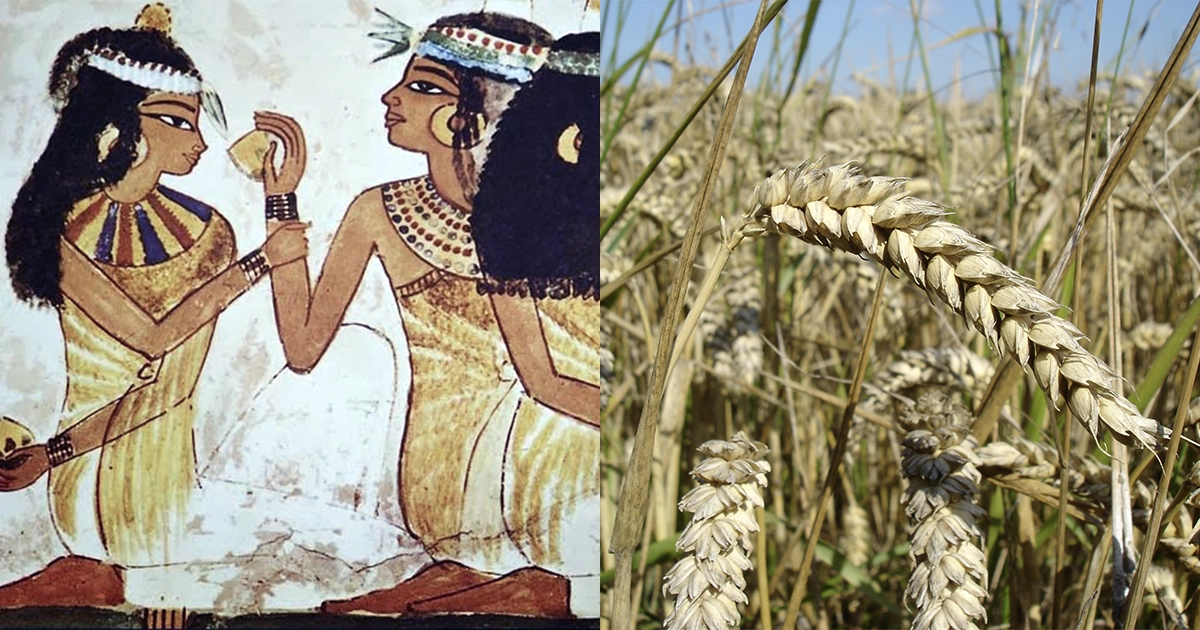
Around 1350 BCE, an Egyptian medical text described a test in which a woman urinated on grain over several days. If the grain sprouted, she was expected to bear a child. If one cereal sprouted before the other, the sex of the child could supposedly be known. The ancient Egyptian pregnancy test sounds like a folk custom, but it survives in medical papyri rather than in a joke, fable, or modern internet myth.
That is why the question matters. The test sits between observation, fertility symbolism, and early reproductive medicine. It was not a modern laboratory test, and it did not detect human chorionic gonadotropin, the hormone measured by modern pregnancy tests. Yet a twentieth-century experiment found that urine from pregnant women could sometimes promote grain germination when urine from men and non-pregnant women did not.
The careful answer is not that Egyptians had a fully accurate pregnancy test. It is also not that the method was nonsense. The evidence points to partial accuracy for detecting pregnancy, but poor reliability for ruling pregnancy out and no reliable value for predicting fetal sex.
The Papyrus Instructions Behind the Grain Test
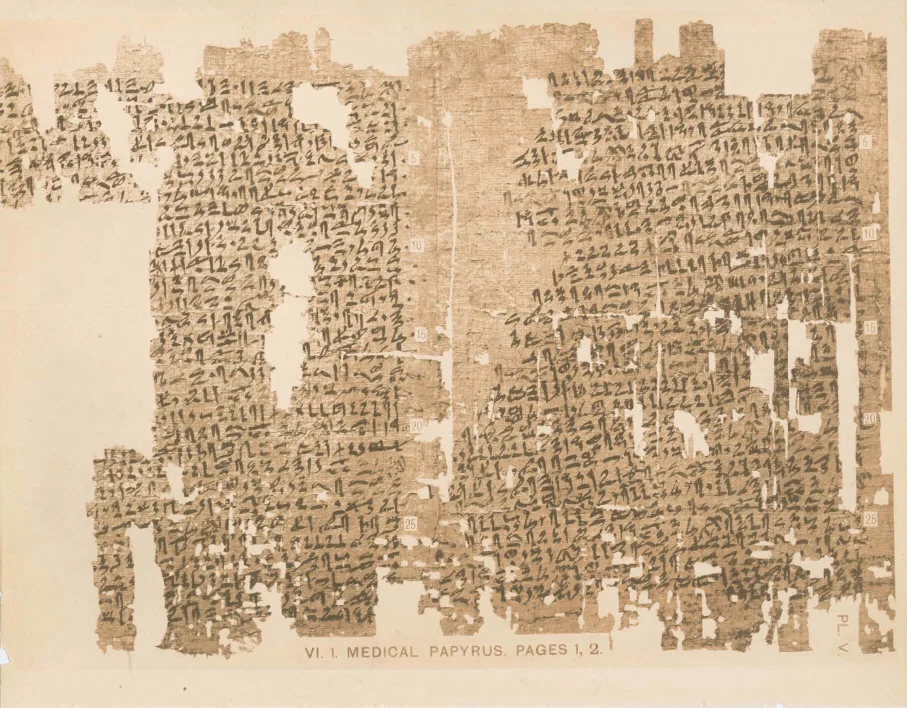
The best-known version of the test comes from Egyptian medical papyri, especially Berlin Papyrus 3038, the Kahun medical tradition, and material connected with Papyrus Carlsberg. These were part of a written medical culture that included fertility, gynecology, conception, and diagnosis. The clearest modern discussion remains the 1963 article by P. Ghalioungui, Sh. Khalil, and A. R. Ammar, “On an Ancient Egyptian Method of Diagnosing Pregnancy and Determining Foetal Sex,” published in Medical History.
The instruction itself is simple. A woman who might be pregnant waters grain with her urine. If the grain grows, she will bear a child. If one kind of grain grows first or more strongly, it indicates a boy. If the other grows first or more strongly, it indicates a girl. If neither grows, she is not expected to bear.
This is where many popular accounts become too tidy. The test is often summarized as “urinate on wheat and barley.” That version is broadly recognizable, but the ancient cereal terms are not entirely settled. Ghalioungui and his co-authors noted that translators have differed over whether the relevant grains should be read as wheat, barley, spelt, or emmer. The NIH Office of History summarizes the test as wheat and barley, which is the form most familiar in modern histories of pregnancy testing.
The uncertainty matters because the test made two separate claims. First, grain growth indicated pregnancy. Second, the specific grain that grew indicated fetal sex. These claims should not be judged together. One may preserve a real observation, while the other may reflect symbolic classification, translation history, or later tradition.
The Kahun medical papyrus also gives the topic a specific archaeological setting. The UCL Digital Egypt page identifies the Kahun Medical Papyrus, also called the Gynaecological Papyrus, as material in the Petrie Museum of Egyptian Archaeology, with a translation by Stephen Quirke. The papyrus is associated with Lahun in the Faiyum region, a site excavated by Flinders Petrie in the late nineteenth century. It belongs to the broader world of Middle Kingdom and later Egyptian medical writing, where women’s reproductive health received sustained scribal attention.
The point is not that every instruction in these texts was medically sound. The point is that the ancient Egyptian pregnancy test was written, transmitted, and copied within a professional medical tradition. It was not only an isolated household superstition.
What the Test Was Supposed to Prove
The test addressed a practical question: would a woman bear a child? In ancient Egypt, that question had medical, household, legal, and social weight. Fertility affected family continuity, inheritance, marriage expectations, and religious ideas about birth and regeneration.
The method also made cultural sense. Egyptian life depended on agriculture, irrigation, seeds, and the visible transformation of dry grain into living growth. Linking human fertility to plant fertility was not an arbitrary metaphor. A body that could produce a child and a seed that could sprout both belonged to a world where water, growth, and generation were central images.
That does not mean the test was only symbolic. The ancient instruction used an observable result. The grain either germinated or it did not. Someone could watch the process, compare outcomes, and preserve the result as a diagnostic sign. Ancient medicine often worked this way. A procedure could combine symbolic reasoning with empirical observation.
This mixed character is important for evaluating ancient Egyptian medicine. It should not be flattened into “magic” or promoted as modern science before its time. Egyptian medical papyri include practical treatments, bodily observations, ritual language, plant and mineral remedies, and divine causation. These categories were not always separate in the ancient world.
A partially accessible review by Ronit Haimov-Kochman, Yael Sciaky-Tamir, and Arye Hurwitz, “Reproduction Concepts and Practices in Ancient Egypt Mirrored by Modern Medicine,” confirms from its abstract and available preview that Egyptian medical texts dealt with reproduction, contraception, pregnancy diagnosis, and childbirth. Because the full article is not openly accessible here, its details should be used cautiously. It is enough to show that the grain test belonged to a wider body of reproductive medical thought, not to a one-off curiosity.
The test also had a long afterlife. The 1963 Medical History article traces related grain-and-urine tests into later Greek, Arabic, and European medical traditions. A Smithsonian Magazine report on the Papyrus Carlsberg material notes that the “wheat and barley” test persisted in later tradition. Smithsonian is a secondary report, so it should not replace the papyrus publications or the 1963 experiment, but it is useful for showing why the story still circulates.
The continuity does not prove accuracy. Bad medical ideas can survive for centuries. But long transmission does suggest that the test remained meaningful to patients, healers, or scribes across different medical cultures.
Built out of a love for history, kept free from distractions.
Spoken Past is an independent project shaped by curiosity, care, and long hours of research. Reader support helps keep it maintained, carefully researched, and open to everyone.
The 1963 Experiment and What It Actually Found
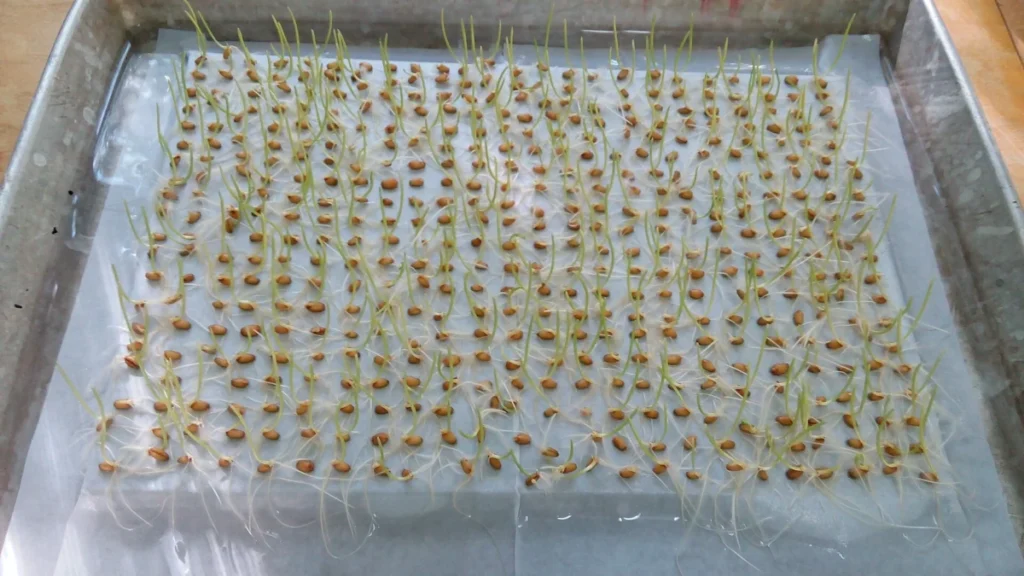
The strongest evidence for accuracy comes from the 1963 test by Ghalioungui, Khalil, and Ammar. Their study is important because it did not simply repeat the ancient claim. It tested urine samples on seeds and compared the results.
The researchers received 48 urine samples from the Department of Gynecology and Obstetrics at Ain Shams University Hospital. Forty came from pregnant women, six from non-pregnant women, and two from men. The urine samples were then tested at the Department of Plant Physiology of Egypt’s National Research Centre. Wheat and barley seeds were placed on filter paper in Petri dishes, and the researchers compared germination using urine and distilled water controls.
The result was neither full confirmation nor total failure.
Urine from the men and non-pregnant women did not produce the relevant grain growth. Additional tests using urine from twenty non-pregnant people on seeds grown in soil also produced no growth. Among the forty pregnant samples, twenty-three produced growth approximating the controls, five produced poor growth, and twelve produced no growth.
This is the key distinction. The ancient Egyptian pregnancy test could produce a meaningful positive sign. If grain sprouted under the conditions of the experiment, pregnancy was a plausible explanation. But the test was not dependable as a negative test. Twelve pregnant women produced no growth, and five more produced weak growth. A woman could be pregnant and still get a result that the papyrus instruction would treat as negative or uncertain.
The NIH history page gives a useful summary: in the 1963 experiment, urine from pregnant women promoted grain growth about 70 percent of the time, while urine from men and non-pregnant women did not. That figure is often repeated, but it needs context. “Seventy percent accurate” can mislead readers into thinking the test was a simple ancient equivalent of a home pregnancy test. It was not. The original study showed a pattern, not a reliable diagnostic system.
The likely mechanism is also not settled. Modern pregnancy tests detect human chorionic gonadotropin, or hCG. The Egyptian grain method did not do that. The NIH page suggests that elevated estrogens in pregnant women’s urine may have played a role in seed growth. Ghalioungui and his co-authors were cautious, arguing that normal urine appeared to inhibit germination and that some pregnant urine samples seemed to reduce or neutralize that inhibition. They did not identify a single responsible substance with certainty.
The test is best described as a crude biological assay. It used a living organism, the seed, to respond to urine. That does not make it chemically specific. It means that pregnancy-related changes in urine may sometimes have produced a visible effect.
Why the Boy or Girl Prediction Failed
The fetal-sex claim is the weakest part of the test.
In the commonly repeated version, barley means a boy and wheat means a girl. Other versions and translations are less stable, partly because the cereal names and sex associations are disputed. Ghalioungui and his co-authors made clear that this claim should be separated from the pregnancy diagnosis claim. A test can have partial value for one question and fail on another.
The 1963 experiment did not support fetal-sex prediction. In some cases, one grain grew better than the other, and some individual results happened to match the child’s sex. But the pattern did not rise above chance. The researchers concluded that the sex of the unborn child could not be predicted from which cereal grew more strongly.
This failure is not surprising. Pregnancy changes urine chemistry in ways that might affect seed germination. Fetal sex would not be expected to create a simple, reliable difference that makes barley or wheat sprout first. The sex-prediction part of the test may have depended more on symbolic or linguistic classification than on biological observation.
The 1963 article mentions a philological explanation associated with Hermann Grapow, in which the sex associations of the grains may have been connected to grammatical gender or linguistic categories. This remains an interpretation, not a proven origin story. It does, however, show why a medical procedure could acquire a symbolic second meaning.
Later versions complicate the picture further. In the tenth century CE, Ali ibn Abbas al-Majusi, known in Latin as Haly Abbas, described a related grain-and-urine method in Arabic medical literature. In that version, the procedure could be used to test sterility within a couple, but it did not always include fetal-sex prediction. The idea of urine affecting seeds survived, while the interpretation changed.
That long afterlife is historically important. It shows that the test was adaptable. It could move from Egyptian papyri into later medical systems, but it did not remain fixed in one exact form. Popular retellings that present one stable recipe from ancient Egypt to the modern world are therefore too simple.
How Accurate Was the Ancient Egyptian Pregnancy Test?
The most precise answer is this: it was partly accurate when grain growth occurred, but not reliable enough to confirm every pregnancy or exclude pregnancy when nothing sprouted. The fetal-sex prediction was not supported by modern testing.
The ancient evidence proves that Egyptian medical texts preserved a urine-and-grain test for pregnancy. The test appears in papyrus traditions associated with Berlin Papyrus 3038, the Kahun medical material, and Papyrus Carlsberg. The Papyrus Carlsberg Collection at the University of Copenhagen provides important institutional context for the Copenhagen papyri, which include major Egyptian manuscript material acquired in the twentieth century.
The University of Copenhagen research portal lists Sofie Schiødt’s 2021 doctoral thesis, Medical Science in Ancient Egypt: A Translation and Interpretation of Papyrus Louvre-Carlsberg. The record identifies the thesis as a two-volume study of Papyrus Louvre-Carlsberg, a major Egyptian medical manuscript. The full thesis was not accessible from the portal record used here, so its detailed arguments should not be claimed without upload or full access.
The modern evidence proves less than many summaries imply, but more than skeptics might expect. The 1963 experiment showed that urine from many pregnant women allowed grain growth when urine from men and non-pregnant women did not. That supports partial diagnostic value. It does not show that the method always detected pregnancy. It does not show that ancient Egyptian practitioners understood hormones. It does not validate fetal-sex prediction.
The later tradition proves that the idea traveled. Greek, Arabic, Latin, and European medical texts preserved related urine-and-seed procedures. That transmission may reflect inherited respect for Egyptian medicine, repeated observation, symbolic fertility logic, or a mixture of all three.
Speculation begins where the sources stop. It is plausible that pregnancy-related urinary hormones affected germination. It is plausible that repeated observation gave the test practical appeal. It is plausible that symbolic fertility thinking shaped the method. None of those possibilities should be presented as a fully proven origin.
That makes the ancient Egyptian pregnancy test neither a miracle of lost science nor a simple myth. It was a medical procedure preserved in papyri, tested in the twentieth century, and shown to contain a limited empirical core. A woman’s urine, a few grains, and several days of waiting produced an answer that could sometimes be right, often uncertain, and historically revealing.