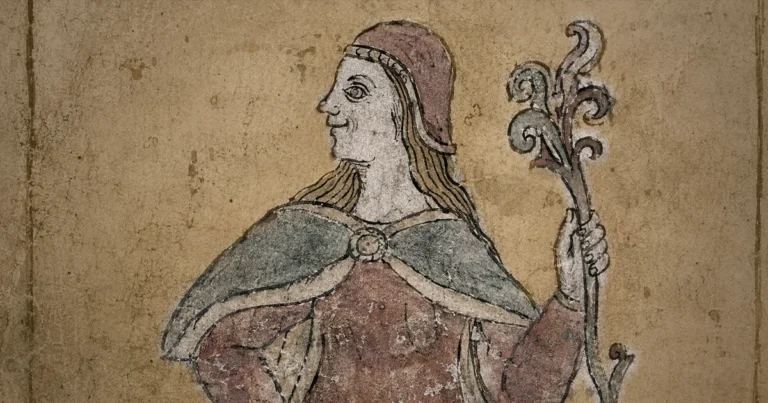


Around 3200 BCE, scribes working in the temple precinct at Uruk, a city on the alluvial plain of what is now southern Iraq and almost certainly the largest urban settlement on earth at the time, began pressing a sharpened reed into moistened clay in a new and deliberate way. They were not writing poetry. They were recording barley rations, labour allocations, and livestock counts. The earliest texts from Uruk are administrative documents, not literature, and that fact explains more about why cities like Uruk emerged than any number of grand narratives about human ambition. Ancient history is the long account of how communities solved concrete problems at scale: how to feed thousands of people who no longer fed themselves, how to settle disputes between strangers, how to preserve agreements across generations, and how to keep canals flowing and roads passable through seasons of war, flood, and drought. This pillar post maps that terrain. It covers the formation of the first cities, the invention and function of writing, daily life beyond the palace, trade, warfare, belief, and the long continuity between the ancient world and the one we inhabit now. Each section is a gateway into deeper reading. Follow the threads that interest you most.
Where ancient history begins and what it covers
The question of when ancient history begins has a practical answer: it begins where writing begins, because writing is what allows us to study a society in its own words rather than entirely through its material remains. That places the starting point in the late fourth millennium BCE, in southern Mesopotamia, with the proto-cuneiform tablets from Uruk. But farming, permanent settlement, and complex ritual predate writing by millennia across multiple regions, and archaeologists rightly resist collapsing all of that under the label of prehistory as though it had no history worth telling. In practice, the study of ancient history covers everything from the earliest urban experiments of the Uruk period, roughly 4000 to 3100 BCE, through to the transformation of the late antique Mediterranean in the fifth and sixth centuries CE.
The conventional endpoint, the fall of the Western Roman Empire in 476 CE, is a political convenience more than a historical reality. Roads, aqueducts, municipal law, field systems, and liturgical calendars inherited from the Roman period continued to organise life in western Europe for centuries after Odoacer deposed Romulus Augustulus. In the east, what we call the Byzantine Empire, the Greek-speaking continuation of the Roman state centred on Constantinople, carried Roman institutions forward for another thousand years. The study of ancient history and the study of the medieval world are not separated by a wall. They are separated by a degree of institutional density, and even that gradient is uneven across regions.
From villages to cities: the first urban revolution
The city of Uruk, excavated continuously by German teams since 1912 under the auspices of the German Archaeological Institute, reached a surface area of approximately 250 hectares by around 3200 BCE. Nothing comparable existed anywhere else on earth. Its monumental core comprised two precinct complexes, the Eanna district dedicated to the goddess Inanna and the Anu district atop a stepped terrace, each containing large mud-brick buildings decorated with mosaics of painted clay cones pressed into the walls. Workshops for mass-producing standardised bevelled-rim bowls cluster around these precincts, suggesting centralised distribution of rations to a labour force working for the temple institution. The city was threaded by canal networks that functioned simultaneously as transportation arteries and irrigation infrastructure, connecting the urban core to surrounding agricultural zones and to the wider Euphrates river system.
What caused this concentration of population and resources? The debate has run for a century. Scholars following the model developed by Robert McCormick Adams of the University of Chicago emphasise institutional factors: the temple as an economic organiser attracted population to its orbit, generating specialisation and surplus that in turn attracted more population. Others stress environmental change, specifically a drying-out of the alluvial plain in the mid-fourth millennium that pushed dispersed farming communities toward the more reliable water management that only large coordinated settlements could provide. The most robust answer is probably that both processes reinforced each other, and that Uruk’s extraordinary scale then generated a further dynamic by which its material culture, administrative tools, and architectural conventions spread outward through trade, colonisation, and imitation across a vast arc from the Nile Delta to the Iranian plateau.
Uruk was not unique in kind, only in scale. By the third millennium BCE, urban centres had emerged independently in the Nile Valley, where the annual flood regime enabled a different but equally intensive agricultural surplus. Cities like Mohenjo-daro and Harappa in the Indus basin planned streets on perpendicular grids with sophisticated brick-lined drainage systems. Along the Yellow River in northern China, early states combined bronze-casting ritual with increasingly formalised political hierarchies. These societies did not know each other, at least not directly. They solved similar problems of scale with broadly similar institutional tools, centralised storage, specialist craft production, administrative record-keeping, and shared ritual, because the logic of large-scale food-sharing communities generates similar pressures regardless of geography.
Writing, numbers, and the skeleton of the early state
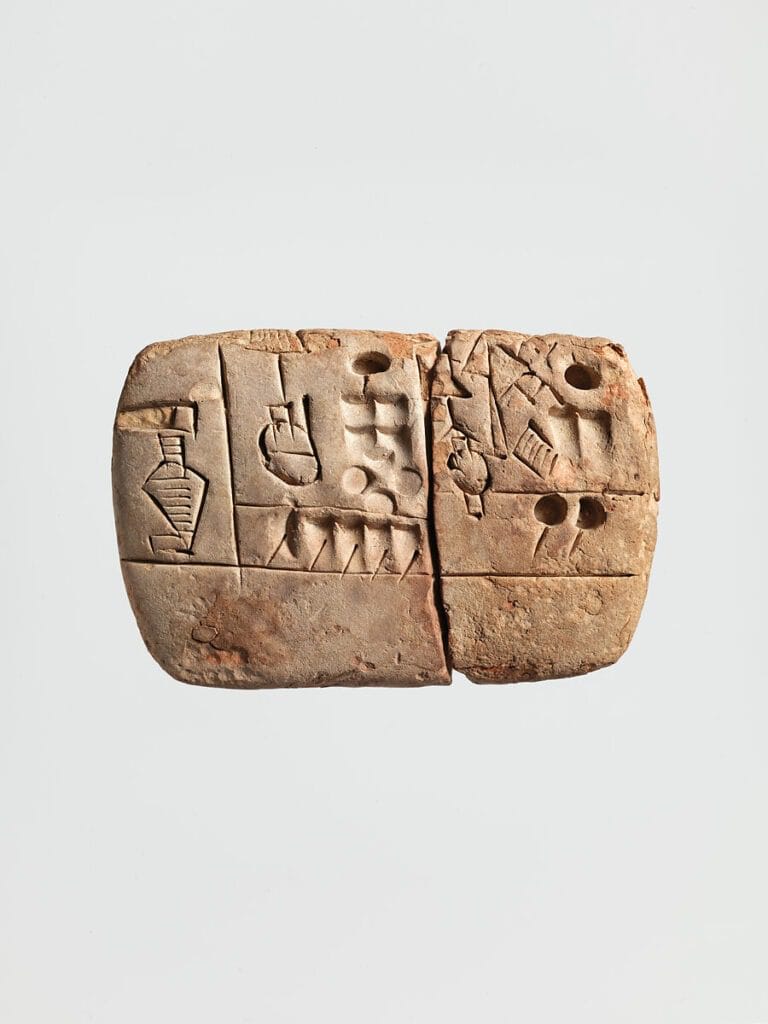
Writing was not invented to record literature. The vast majority of the earliest texts from Uruk are administrative in nature, and literature, religious texts, and historical documents do not appear until the mid-third millennium, roughly seven hundred years after the first clay tablets. The scribes of the Uruk IV period, around 3300 BCE, pressed pictographic signs into clay to record quantities of grain and numbers of sheep. Over several centuries, through a process that linguist Jean-Jacques Glassner of the CNRS has traced in detail, the signs became progressively more abstract and wedge-shaped, better adapted to fast stylus strokes than to careful pictographic drawing. By around 2600 BCE, cuneiform could encode the full range of Sumerian speech, and scribes began recording epic poetry alongside ration lists.
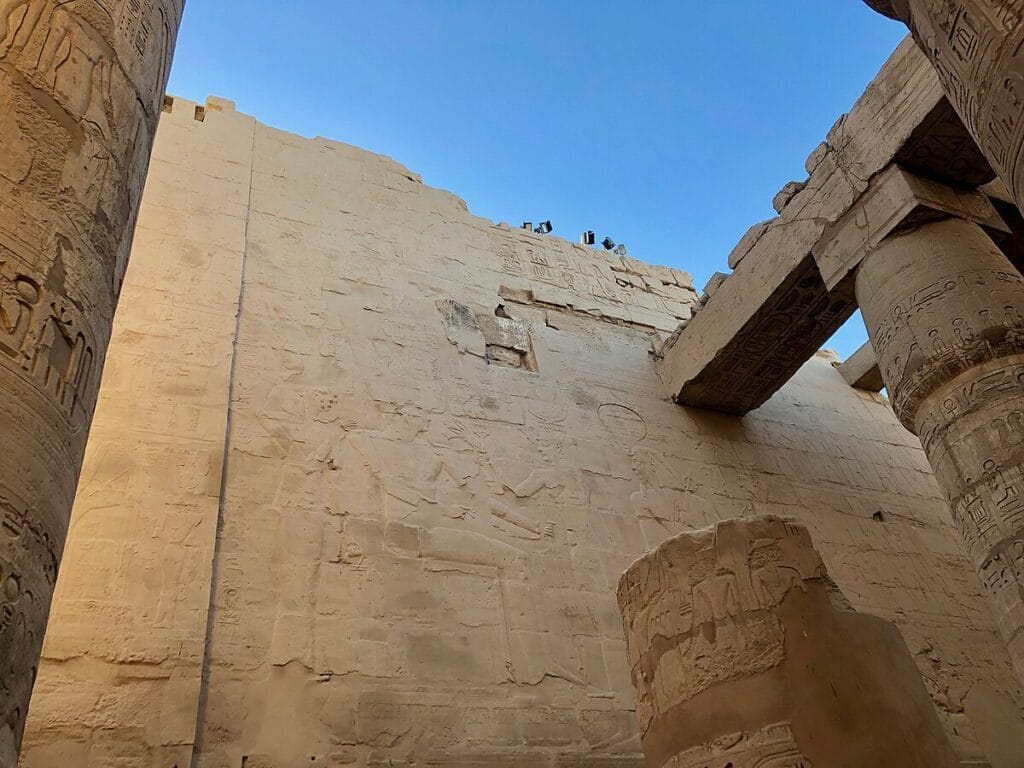
In Egypt, hieroglyphic writing emerges in the late fourth millennium BCE, initially on objects marking royal ownership and prestige, name tags, labels on pottery, seal impressions, before expanding into funerary texts and monumental inscription. In the Indus Valley, a script of approximately four hundred signs appears on stamp seals, pottery, and copper tablets from sites including Mohenjo-daro and Harappa, but it remains undeciphered and its relationship to any known language family is still contested. In China, the earliest clearly legible Chinese characters appear on oracle bones from the Shang period, roughly 1250 to 1050 BCE, incised as questions addressed to royal ancestors about harvests, warfare, and ritual propriety.
The alphabet represents a late and geographically specific development. Proto-Sinaitic inscriptions from Egyptian turquoise mines in the Sinai peninsula, dating to around 1850 to 1550 BCE, represent the earliest probable alphabetic writing: a small set of acrophonic signs, each representing the initial consonant of the word for the thing it depicts. From that root, through Phoenician and Aramaic transmission, descend Hebrew, Arabic, Greek, Latin, and the Indic scripts. The alphabet’s genius was radical simplification: thirty signs instead of hundreds, learnable without a professional scribal class, which is why it spread so successfully through merchant and administrative networks across the first millennium BCE.
Daily life beyond the palace and the temple
Ancient history suffers from a systematic survivor bias. Stone buildings and bronze objects last; mud walls, wooden looms, leather sandals, and reed baskets do not. Official inscriptions record kings, gods, and military campaigns; they rarely record what a linen weaver in a provincial Egyptian town ate for breakfast or how a Mesopotamian household managed sick children in winter. Reconstructing ordinary life requires combining the textual record with the more democratic evidence of archaeology: the contents of rubbish pits, the animal bones discarded in hearths, the carbonised grain from storage jars, the loom weights clustered in corners of domestic rooms, and the wear patterns on grinding stones.
Households in Mesopotamian cities typically organised around a central courtyard, with rooms opening off it for sleeping, storage, cooking, and craft work. Extended family members, dependent workers, and sometimes enslaved individuals shared these spaces. Women managed textile production at a scale that made cloth one of the primary commodities in long-distance trade. The Mari archive, a collection of about seventeen thousand cuneiform tablets excavated from the palace of Mari on the middle Euphrates and dated to around 1800 BCE, includes detailed records of cloth production managed by palace women’s quarters, specifying the quality, quantity, and destination of finished textiles in language as precise as any modern inventory system.
Food is a window into economy, ecology, and social hierarchy simultaneously. Barley dominated the Mesopotamian diet as both grain and fermented beer. Wheat, lentils, onions, and fish supplemented it. In the Mediterranean world, the triad of grain, oil, and wine structured not only diet but agricultural investment, religious ritual, and trade pattern. Salt, expensive to produce and essential for preservation, shaped the economics of coastal communities from the Adriatic to the Red Sea. Spices and aromatics moved through long-distance networks that connected India to the Levant centuries before the classical period typically receives credit for inaugurating that trade.
Built out of a love for history, kept free from distractions.
Spoken Past is an independent project shaped by curiosity, care, and long hours of research. Reader support helps keep it maintained, carefully researched, and open to everyone.
Trade networks and the movement of people and goods
Ancient trade networks operated at distances that routinely surprise modern readers. Tin, essential for making bronze, does not occur naturally in Mesopotamia, Egypt, or the Aegean. The tin used in Near Eastern bronzes of the third millennium BCE travelled from sources in Afghanistan, Anatolia, and possibly Cornwall. Lapis lazuli, the vivid blue stone used in jewellery and inlaid decoration from Mesopotamia to Egypt, came exclusively from mines in the Badakhshan region of what is now northeastern Afghanistan, some 4,000 kilometres from the Nile Delta. Obsidian from volcanic sources in Anatolia appears at sites across the Levant and Cyprus by the eighth millennium BCE, carried by sea and land routes that predate writing by several thousand years.
The Uluburun shipwreck, excavated off the coast of southern Turkey by the Institute of Nautical Archaeology beginning in 1984, provides the single most vivid snapshot of Late Bronze Age trade in the fourteenth century BCE. The ship carried ten tonnes of copper ingots in the standardised ox-hide shape characteristic of Cypriot smelting, one tonne of tin, a tonne of terebinth resin, ebony logs, glass ingots in cobalt blue, turquoise, and lavender, hippopotamus and elephant ivory, gold and silver jewellery, and storage jars of at least seven distinct cultural provenances including Cypriot, Egyptian, Canaanite, and Mycenaean. The ancient Mediterranean was not a collection of isolated civilisations. It was an integrated economic system.
Mobility also included forced movement on a vast scale. Enslaved people, deportees from conquered populations, and war captives appear consistently in administrative records and artistic programmes from Mesopotamia, Egypt, Greece, and Rome. The Code of Hammurabi, inscribed on a diorite stele now in the Musée du Louvre in Paris and dated to roughly 1754 BCE, devotes extensive sections to the legal status of enslaved persons, their purchase, manumission, and the penalties for harbouring runaways. Honest ancient history requires keeping this dimension in continuous view, not to condemn the past by present standards alone, but because forced labour was frequently the mechanism by which the most celebrated monuments and administrative systems were built and sustained.
Collapse, transformation, and the Late Bronze Age crisis
The late thirteenth century BCE saw one of the most dramatic systems failures in ancient history. Between approximately 1200 and 1150 BCE, palace centres across the eastern Mediterranean ceased to function within the span of a few decades. Mycenae, Tiryns, and Pylos were destroyed or abandoned. The Hittite Empire, which had contested Syria with Egypt for a century, collapsed entirely, its capital Hattusa burned and deserted. Ugarit, the great trading port on the Syrian coast, was destroyed around 1185 BCE and never reoccupied. Egypt survived but contracted: its Levantine empire was lost, its administrative complexity diminished, and the New Kingdom entered a long terminal phase. Linear B writing disappeared with the Mycenaean palaces and would not reappear until the Greek alphabet emerged around 800 BCE.
Historians and archaeologists have proposed a range of causes: drought across the eastern Mediterranean, documented in pollen sequences and tree rings from multiple sites; seismic activity; disruption of the tin trade that supplied bronze; movements of the groups Egyptian sources call the Sea Peoples; and internal social strain from decades of intensive redistribution within the palace systems. Eric Cline of George Washington University, in his widely cited 2014 study of the Bronze Age collapse, argues persuasively that no single cause suffices and that the failure was systemic: a web of interdependencies so tight that disruptions in multiple nodes simultaneously overwhelmed the capacity of any individual state to compensate.
What followed was not darkness in any simple sense. Farmers still farmed. Sailors still navigated by the same coastlines. Craft skills survived in communities that no longer had palace bureaucracies to record them. The Phoenician cities of Tyre, Sidon, and Byblos expanded into the commercial vacuum the palace collapse created and within a century or two had established trading posts and colonies from Cyprus to Sardinia to southern Spain. The alphabet, adapted from Canaanite consonantal script, spread with Phoenician trade networks and was adopted by Aramaic, Hebrew, Greek, and eventually Latin. Collapse reorganised, and the reorganised world was in certain respects more connected than its predecessor.

Greece, Persia, and the Hellenistic world
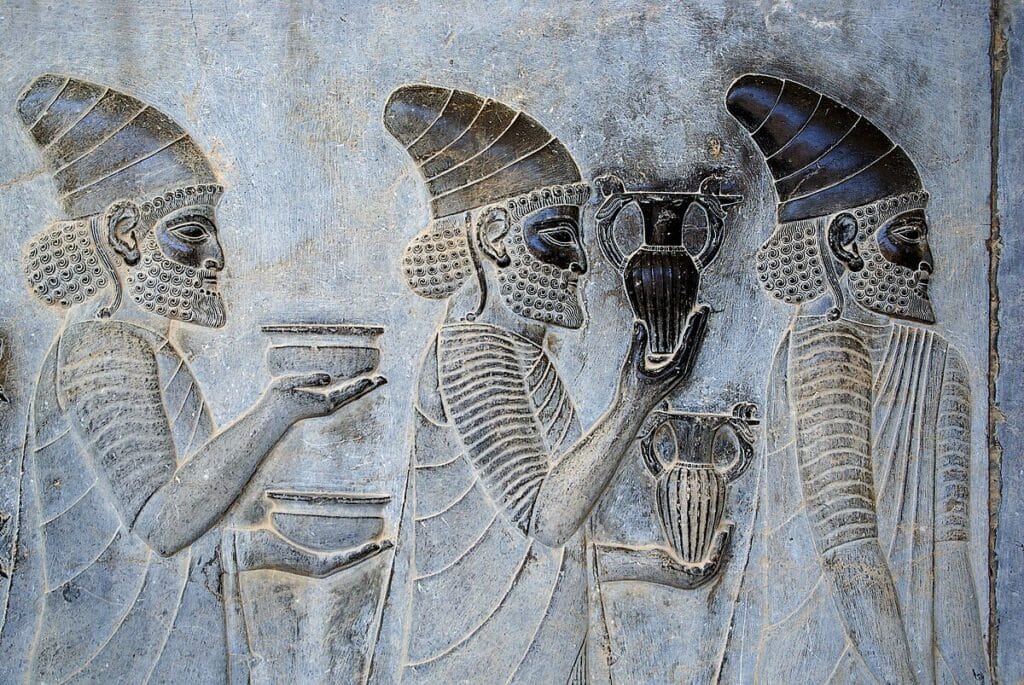
The Persian Achaemenid Empire, founded by Cyrus II in 550 BCE and reaching its greatest extent under Darius I and Xerxes I in the early fifth century, represents one of the most sophisticated administrative experiments in ancient history. At its height the empire stretched from Thrace in the west to the Indus in the east, encompassing dozens of distinct languages, religions, and legal traditions. Darius organised this diversity through a system of satrapies, provincial governorships connected by a Royal Road running roughly 2,700 kilometres from Sardis in western Anatolia to Susa in Iran, serviced by relay stations that could move a royal messenger across the full distance in as little as seven days. Administrative correspondence was conducted in Aramaic, which functioned as a bureaucratic lingua franca across the empire’s western half, while local languages and scripts continued in daily use alongside it.
The Greek city-states developed a different relationship between political identity and scale. Athens, Corinth, Sparta, and the hundreds of other poleis that dotted the Aegean and its colonies were small enough that citizens could in principle know each other, which generated political experiments, including Athens’ radical direct democracy of the fifth century, that were impossible to imagine at imperial scale. The tensions and contradictions of Greek city-state culture, between freedom and slavery, between democratic ideals and imperial extraction from subject allies, are visible in the sources precisely because those sources are so diverse and self-reflective. Herodotus, Thucydides, Aristophanes, and Plato produce a body of political self-examination without close parallel in the ancient world.
Alexander III of Macedon’s campaigns between 334 and 323 BCE dissolved the Persian Empire and spread Greek language and material culture from Egypt to Bactria. The successor kingdoms, Ptolemaic Egypt, Seleucid Asia, and Antigonid Macedonia, created a world in which Greek was the language of administration, scholarship, and elite culture across an enormous arc, while local languages, religions, and customs continued beneath that Hellenic overlay. The great Library of Alexandria, founded under Ptolemy I Soter in the early third century BCE, was a conscious project to collect and systematise the accumulated learning of the ancient world, including Greek, Egyptian, Babylonian, Jewish, and Persian texts translated and catalogued in the same institution.
Rome, infrastructure, and the bridge to late antiquity
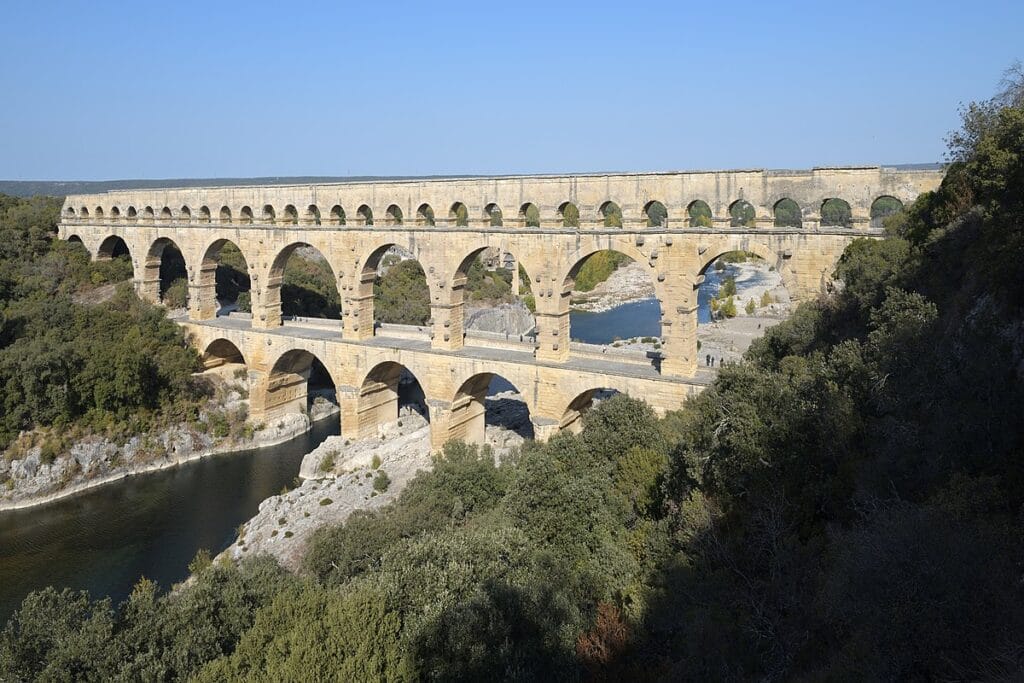
Rome’s most durable contribution to the ancient world was not its armies but its infrastructure and its law. Roman roads were built to military specification, cambered for drainage, layered with gravel, sand, and flat stone, and maintained by a system of provincial obligation, but they functioned just as effectively for merchants, pilgrims, and postal couriers. The cursus publicus, the imperial courier service established by Augustus, could move official correspondence from Rome to the Syrian frontier in as little as three weeks. The aqueducts that supplied Rome itself delivered an estimated one million cubic metres of fresh water per day to a city of perhaps a million inhabitants, a per-capita supply comparable to many modern cities. The Pont du Gard in southern Gaul, built in the first century CE to carry the Nîmes aqueduct across the Gardon River, is still standing and structurally sound two thousand years later.
Roman law achieved something equally durable. Beginning with the Twelve Tables of the mid-fifth century BCE and elaborated over seven centuries of juristic commentary, Roman law developed concepts of legal personhood, contract, property, and inheritance that were transmitted through Justinian I’s sixth-century codification, the Corpus Juris Civilis, into the legal systems of medieval Europe. The legal framework within which a French notary drafts a contract today is in traceable intellectual descent from the jurists of the Roman Empire.
Late antiquity, roughly the third through seventh centuries CE, is no longer treated by historians as a story of decline and fall. Peter Brown of Princeton University, whose work since the 1970s has fundamentally reshaped the field, demonstrates that the period saw extraordinary creativity in religious thought, artistic form, and institutional adaptation. Christianity spread through the Roman Empire’s existing networks, roads, cities, and administrative hierarchies, and then reorganised those networks around its own institutions. When the Western Roman state fragmented under pressure from Gothic, Vandal, and Hunnic military power in the fifth century, what dissolved was a fiscal and military apparatus. Latin literacy, Roman law, the Christian ritual calendar, and episcopal administration survived and in many cases strengthened.
How to read ancient history well
Good ancient history is a disciplined practice, not a treasure hunt for inspiring quotations. Several habits will help you get more from the sources and the scholarship. Read primary sources in translation whenever possible, Thucydides’s History of the Peloponnesian War, the Mari archive letters, Sima Qian’s Records of the Grand Historian, before reading secondary interpretations of them. Primary sources have texture, uncertainty, and bias that summaries flatten. When you encounter a secondary claim such as “the Romans believed” or “the Athenians valued,” ask who is making that claim and on what evidence. Ancient societies were not monolithic, and generalisations that hold for the elite male literary record often fail for women, enslaved people, provincial populations, and the rural poor who constituted the majority in every ancient state.
Numbers deserve particular scepticism. Ancient population estimates are notoriously unreliable. Casualty figures in ancient narratives are regularly inflated for rhetorical effect. Economic data is fragmentary and unevenly distributed across time and region. When an author speaks with certainty about quantities in the ancient world, look for the methodological footnote. When uncertainty is acknowledged explicitly, that is usually a sign the author is working carefully. The ancient world is rich enough without embellishment, and its genuine complexity, the contradictions between democratic ideals and slave economies, between universal religious claims and intense local particularity, between imperial ambition and provincial resilience, is far more interesting than any simplified narrative allows.
Finally, pay attention to what has changed in the scholarship recently. Archaeological science, including isotope analysis, ancient DNA, high-resolution geospatial survey, and residue analysis, is producing results at a pace that outstrips the textbook summaries. Genetic studies of ancient populations are reshaping the story of who moved where and when across Eurasia. The ancient world is not a fixed body of knowledge. It is an ongoing investigation into the deep roots of the world we inhabit, and it rewards curious, patient, and precise attention.
Sources: Metropolitan Museum of Art, “Uruk: The First City” (2003), https://www.metmuseum.org/essays/uruk-the-first-city; Metropolitan Museum of Art, “The Origins of Writing” (2004), https://www.metmuseum.org/essays/the-origins-of-writing; Eric H. Cline, 1177 B.C.: The Year Civilization Collapsed (Princeton University Press, 2014); Peter Brown, The World of Late Antiquity: AD 150-750 (Thames and Hudson, 1971); Jean-Jacques Glassner, The Invention of Cuneiform Writing in Sumer, trans. Zainab Bahrani and Marc Van De Mieroop (Johns Hopkins University Press, 2003); George F. Bass et al., “The Bronze Age Shipwreck at Ulu Burun: 1986 Campaign,” American Journal of Archaeology 93, no. 1 (1989): 1-29, https://doi.org/10.2307/505396; Persepolis Fortification Archive Project, Oriental Institute, University of Chicago, https://oi.uchicago.edu/research/projects/persepolis-fortification-archive.