
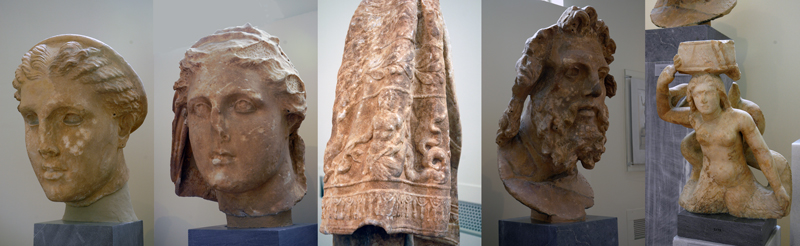
Among the forgotten goddesses of the ancient world, several held positions of real institutional power before political and religious change stripped them from the transmitted record. Pausanias visited the sanctuary at Lycosura in Arcadia during the second century CE and found a colossal cult group still standing: Demeter and Despoina seated side by side, flanked by Artemis and the Titan Anytos, all carved from a single block of stone. He was told that Despoina was the mistress of the sanctuary, that initiates knew her true name, and that outsiders did not. The sanctuary had theatre-like seating, a forecourt with multiple altars, and a layout specifically designed for mystery ritual. This was not a minor local shrine. It was a major functioning sanctuary in a region with its own deep religious tradition, and Despoina’s true name died when the oral transmission chains of her mystery cult broke. She is one of many goddesses whose cults were real and well-attended, but whose names fell out of the tradition that later ages chose to preserve.
How forgotten goddesses actually disappeared
A goddess did not vanish from ancient religion the way a species goes extinct under a single catastrophic event. The process was slower, more political, and usually left visible traces in coins, stelae, and inscriptions that the literary tradition simply stopped carrying. Syncretism was the most common mechanism: a local goddess was reframed as an aspect of a larger pan-regional deity whose worship the dominant culture promoted. Britomartis, the Cretan net-goddess and huntress, became Diktynna, then Artemis Diktynna on coins and inscriptions, until the original cult figure was legible only to specialists and her separate identity had effectively been dissolved into someone else’s dossier.
Functional takeover worked differently. When the bureaucratic culture of the Neo-Assyrian and Neo-Babylonian courts elevated Nabu as the patron of scribal knowledge, no formal decree abolished the worship of the Sumerian scribal goddess Nisaba. Royal patronage, institutional prestige, and curriculum authority simply flowed toward Nabu instead. Schools trained scribes in Nabu’s tradition. Temples dedicated to Nabu received court funding. Over generations, the institution that had kept Nisaba’s hymns alive and taught her praises in colophon formulas was replaced by an institution that did not carry her name forward. Textual canonisation finished the job that institutional politics started. When specific bodies of text hardened into school-taught authoritative tradition, the deities prominent in those texts received continuous transmission and the deities peripheral to them did not.
Despoina and Dione: two goddesses edited by standardisation
Despoina’s disappearance operated through a mechanism the mystery cult itself built in. Keeping the goddess’s true name secret was a deliberate religious choice, and the same secrecy that gave the cult its power made it uniquely vulnerable to the loss of personnel who held the knowledge. Initiates who knew the name were obligated not to reveal it to outsiders. When the oral transmission chains of the Lycosura mystery broke, the name broke with them. The architecture survived. The statue group survived in fragments now held at the National Archaeological Museum in Athens. But the central fact the ritual was built around could not outlast the community that guarded it.
Dione’s case operated through editorial pressure of a different kind. At Dodona in northwestern Greece, Zeus shared his great oak oracle with Dione as his consort, and lead oracle tablets recovered from the site invoke both deities together. Some ancient genealogies made Dione the mother of Aphrodite by Zeus, which would make her one of the most significant figures in the entire Greek divine family. As the canon of twelve Olympians crystallised across the classical period, driven by artistic programmes like the Temple of Zeus at Olympia and school texts that stabilised family relationships into teachable diagrams, Zeus became paired with Hera as the canonical royal couple. Aphrodite’s birth from sea-foam in Hesiod’s Theogony sidelined the Zeus-Dione genealogy. Dione continued to appear in local religious practice at Dodona, where the oracle tablets name her. She vanished from the summary version that later ages transmitted as Greek mythology.
Britomartis, Aphaia, and Bendis: island geography and immigrant religion
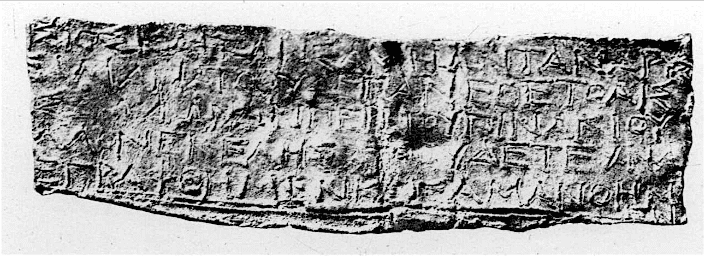
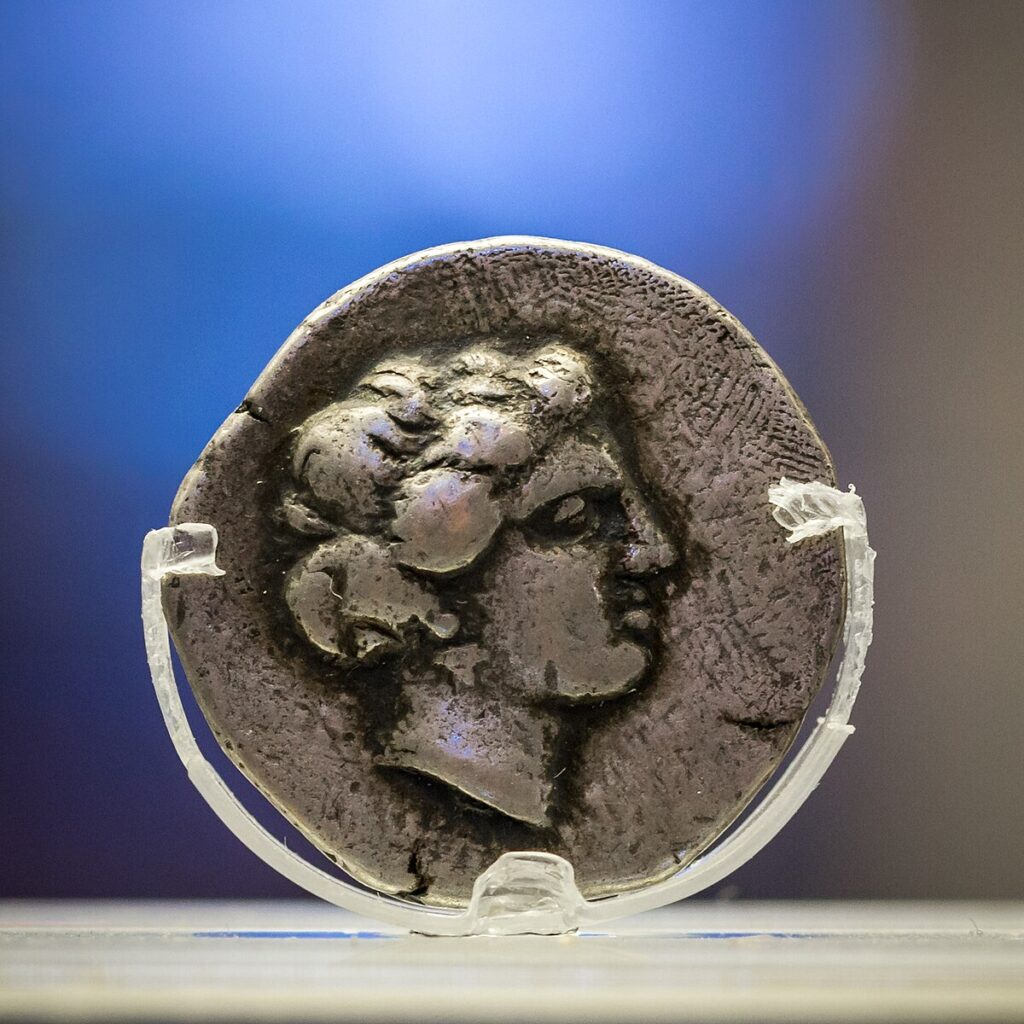
Britomartis was a Cretan huntress and protector of fishermen whose name likely derives from a pre-Greek substrate language. Her most distinctive myth describes her leaping from a cliff into fishermen’s nets to escape pursuit, an act that transformed her from mortal to divine and connected her to sea-rescue and the equipment of the fishing trade. Cretan coins from cities including Phalasarna show her head labeled as Artemis Diktynna, which marks the endpoint of a process that had already absorbed her identity into the Olympian system while preserving her name as an epithet. The temple at Aptera and inscriptions from Kydonia document active cult, but the local character of that cult made it invisible to the Athenian and Roman writers who produced the summarising handbooks from which most modern knowledge derives.
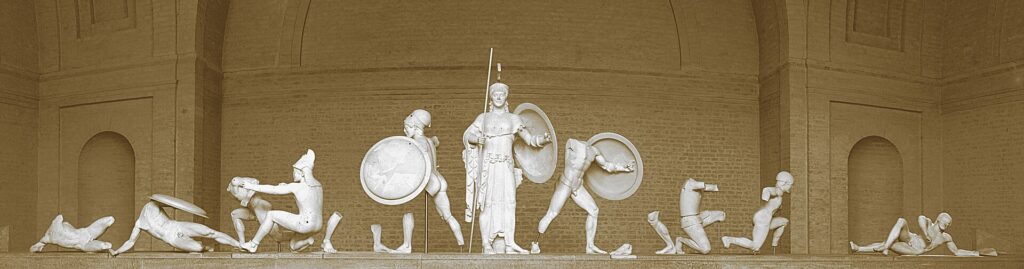
Aphaia’s temple on Aegina, whose pediment sculptures are now in the Glyptothek in Munich, is one of the best-preserved early fifth-century Greek sanctuaries outside Athens. The pedimental programme showing Trojan War battles dates to around 505 to 480 BCE and indicates substantial wealth and civic investment in this goddess’s cult. Yet Aphaia is barely named in surviving literary sources. The sculptural programme tells us that someone on Aegina in 500 BCE considered Aphaia important enough to commission a two-pediment programme of heroic scale. The literary tradition never caught up with that investment.
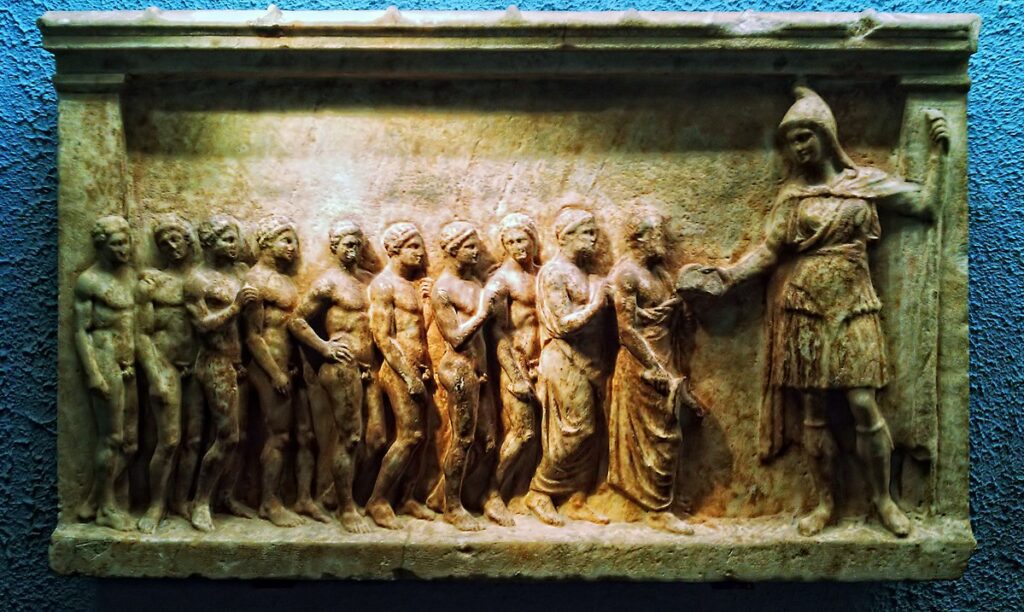
Bendis arrived in Athens with Thracian merchants and settlers in the fifth century BCE, and the city’s formal response was generous. The Athenian Assembly granted the Thracian orgeones, the cult association responsible for her rites, the right to establish a sanctuary at the Piraeus and to hold a public torch race in her honour. Plato opens the Republic at a moment when Socrates and his companions have just attended the Bendideia, which tells us the festival was significant enough to serve as narrative framing for the most philosophically ambitious text of the classical period. Attic marble reliefs dedicated to Bendis, showing a booted Phrygian-capped huntress, survive in Athens and Istanbul. When the Thracian merchant diaspora at the Piraeus eventually assimilated and the orgeones dissolved, the institutional base that had maintained Bendis’s separate identity dissolved with it, and Artemis absorbed what remained.
Built out of a love for history, kept free from distractions.
Spoken Past is an independent project shaped by curiosity, care, and long hours of research. Reader support helps keep it maintained, carefully researched, and open to everyone.
Nisaba and Asherah: two goddesses removed by institutional change
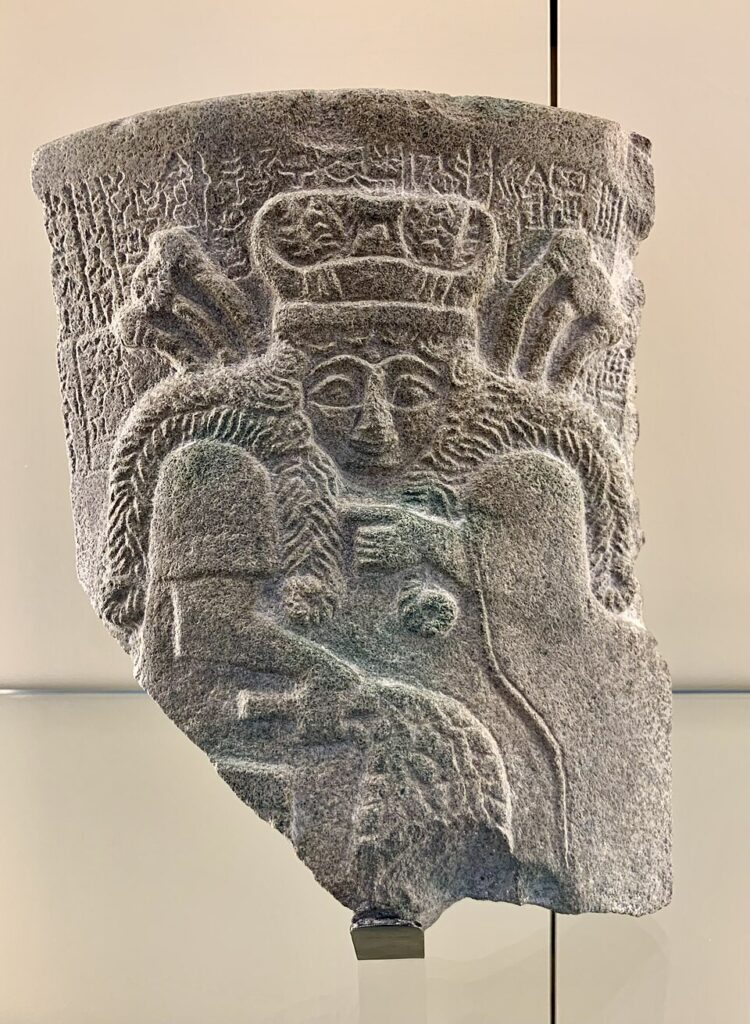
Nisaba governed writing, grain, accounting, and measurement in the Sumerian theological system, and her prominence in the Early Dynastic and Ur III periods is visible in colophon formulas that closed administrative and literary texts with “praise to Nisaba,” treating her name as a mark of scribal completion. A vessel fragment in the Pergamon Museum in Berlin, inscribed for Entemena ruler of Lagash around 2430 BCE, shows a horned goddess that many scholars identify as Nisaba, placing her visual life in the middle of the third millennium BCE. As the Neo-Babylonian and Neo-Assyrian courts centralised scribal education in institutions directing their theological loyalty toward Nabu, the texts scribes copied, practiced, and memorised were texts in Nabu’s tradition. Nisaba’s praise formulas survive in earlier tablets but stopped appearing in new production. The institutional machinery that had transmitted her name simply moved to other uses.
Asherah’s disappearance is documented more explicitly and more bitterly because it was contested in the very texts that record it. Ugaritic tablets from the fourteenth and thirteenth centuries BCE present Athirat, whose name appears in Hebrew as Asherah, as the consort of El, mother of the divine assembly, and one of the most powerful figures in the Levantine pantheon. The discovery of inscriptions at Kuntillet Ajrud in the northern Sinai in 1975 to 1976 produced storage jar texts dated to around 800 BCE that include the phrase “by YHWH of Samaria and his Asherah” in blessing formulae. Scholarly debate over whether “his Asherah” names a goddess or a cult object remains active, with researchers including Ze’ev Meshel, who led the original excavation, arguing for the cult object interpretation and others including William Dever arguing for the divine consort reading. What the inscriptions establish beyond serious dispute is that in the northern Israelite religious world of the early eighth century BCE, some form of Asherah-related practice was associated with YHWH worship. The Deuteronomistic reform texts of the later seventh century BCE record the cutting down of Asherah poles and the removal of Asherah cult objects from the Jerusalem temple during the reigns of Hezekiah and Josiah, which means the object of reform was real, present, and embedded in official worship before it was removed.
Qetesh, Tanit, and the Egyptian place-goddesses
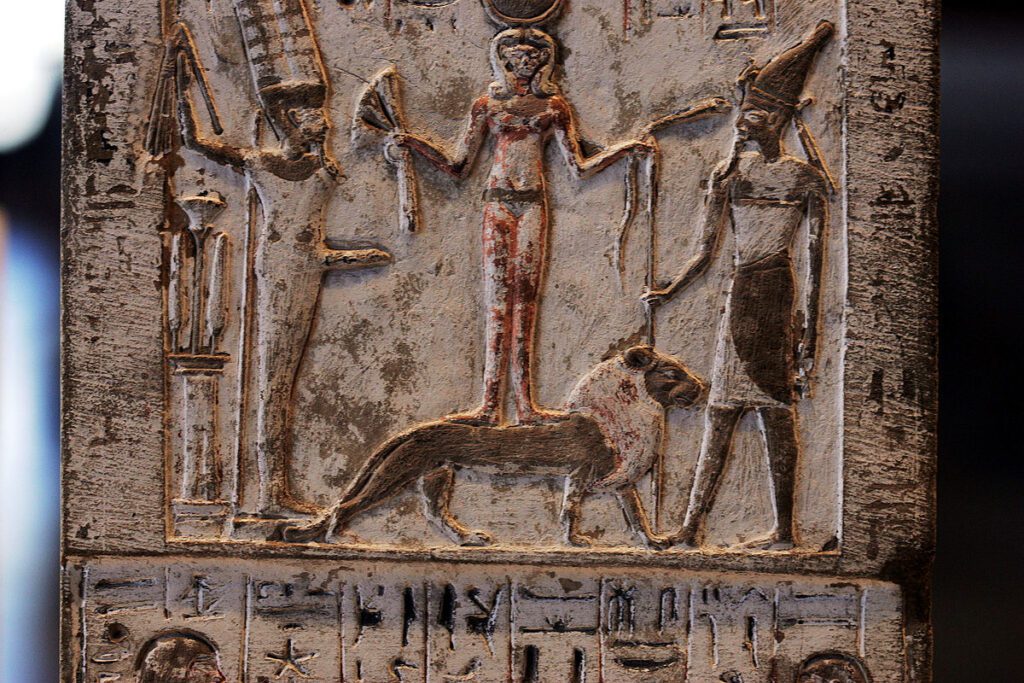
Qetesh arrived in Egypt from the Levant during the New Kingdom, when Egyptian military expansion into Canaan and Syria brought sustained contact with Levantine religious traditions. Her standard iconography showed a nude woman standing on a lion’s back, holding lotus flowers in one hand and a serpent in the other, flanked on the Winchester stela by Min to her left and the Syrian warrior god Resheph to her right. This composite framing made her visual identity readable across Egyptian and Levantine audiences simultaneously. Votive stelae in her honour appear in the Deir el-Medina workers’ village at Thebes, meaning her worship reached artisan communities rather than remaining confined to court contexts. When the religious landscape of the Third Intermediate Period consolidated around the great theological complexes of Isis, Hathor, and Amun, the imported Levantine goddess had no institutional anchor to sustain her distinct identity.
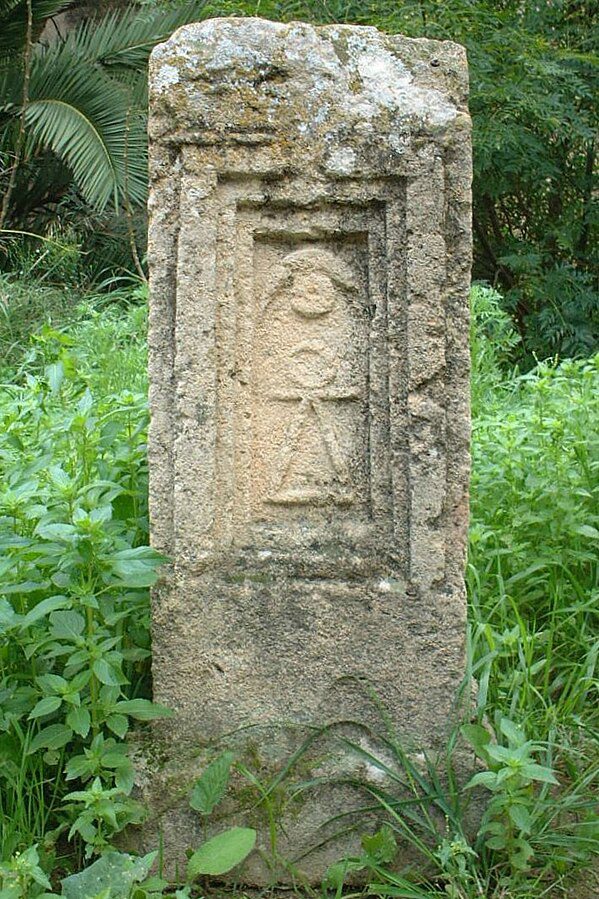
Tanit at Carthage held a very different position: she was a state goddess, paired with Baal Hammon on public monuments and named in dedicatory inscriptions across the Punic Mediterranean from Spain to Sicily. Her distinctive triangle-and-bar-and-circle glyph appears on thousands of stelae in the Tophet sanctuary field at Carthage and at other Punic sites. The Roman destruction of Carthage in 146 BCE and the subsequent Romanisation and Christianisation of North Africa dismantled the social institutions that transmitted Tanit’s narrative tradition while the durable stone stelae survived. The sign of Tanit is one of the most recognisable symbols in ancient Mediterranean epigraphy and one of the most contextually empty: identified everywhere, understood nowhere in terms of the theology it once supported.
Egypt’s place-bound goddesses present a different category of disappearance. Renenutet as the cobra of the harvest, Meretseger as the guardian of the Theban necropolis peak, Anuket as the Nile at Aswan, and Satet as the flooding waters at Elephantine were not suppressed or absorbed. They were simply too local to survive the shift from place-specific ritual observance to pan-imperial theological narrative. Meretseger was intensely relevant to every family in the Deir el-Medina community, whose dead were buried on her mountain. She was irrelevant to anyone in Memphis or Tanis who had no relationship to that specific landscape. When the religious literature that received sustained scribal transmission focused on the theologically universal narratives of Osiris, Isis, and Horus, the place-goddesses stayed in their places, and the places eventually stopped talking.
What the disappearance of forgotten goddesses reveals about religious memory
Institutional anchoring is the single strongest predictor of survival across all the cases above. Deities whose worship was embedded in well-funded, court-connected, textually productive institutions survived in the transmitted record. Deities whose worship was maintained by diaspora communities, local guilds, place-specific ritual calendars, or mystery cult secrecy were vulnerable to the loss of exactly those structures without any theological attack being required. When the Thracian orgeones who maintained Bendis’s cult at the Piraeus dissolved as a corporate body, the cult dissolved with them. No one suppressed Bendis. The community that had been her institutional anchor simply stopped existing as a distinct group.
The material record recovers what the textual record drops. Coins, stelae, dedication inscriptions, architectural remains, and votive objects document a goddess’s presence and importance in a community without needing any literary transmission to do so. Aphaia’s temple pediments tell us she mattered enormously to fifth-century Aegina even though classical literature nearly ignores her. The Kuntillet Ajrud storage jars tell us Asherah-related practice was embedded in northern Israelite worship even though the canonical biblical text, produced by traditions that actively opposed that practice, suppresses her. The lead oracle tablets from Dodona name Dione alongside Zeus even though the Olympian summary tradition made Hera the canonical partner. Reading the material record as a primary source rather than an illustration of the literary record is the method that brings these goddesses back into view.
The recovery should be done carefully. Inventing narrative content to fill gaps, creating myths for goddesses whose cults left only objects and names, produces a new fiction rather than restoring an old truth. What the evidence actually shows is ritual function: Nisaba as the patron of correct scribal completion, Meretseger as the power that punished tomb robbers and healed the workers she protected, Despoina as the unnamed centre of a mystery that mattered enough to build a theatre for. Ritual function is full religious life. It does not need a narrative myth attached to it to count as genuine ancient religion, and it does not need modern invention to make it worth recovering.
Sources: Pausanias, Description of Greece, Book 8 (Arcadia), trans. W.H.S. Jones, Perseus Digital Library, Tufts University; Ze’ev Meshel, Kuntillet Ajrud (Horvat Teiman): An Iron Age II Religious Site on the Judah-Sinai Border (Israel Exploration Society, 2012); Religion at Kuntillet Ajrud, Religions 10:3 (MDPI, 2019); William G. Dever, Did God Have a Wife? Archaeology and Folk Religion in Ancient Israel (Eerdmans, 2005); Stephanie Dalley, Myths from Mesopotamia (Oxford University Press, 2000); Mark S. Smith, The Origins of Biblical Monotheism: Israel’s Polytheistic Background and the Ugaritic Texts (Oxford University Press, 2001); Jan N. Bremmer, Greek Religion and Culture, the Bible and the Ancient Near East (Brill, 2008).