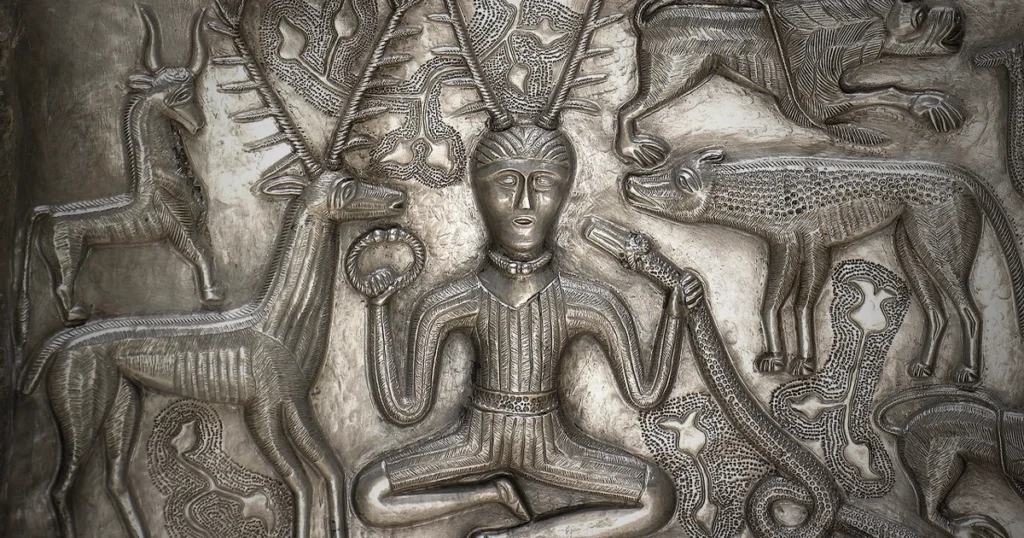
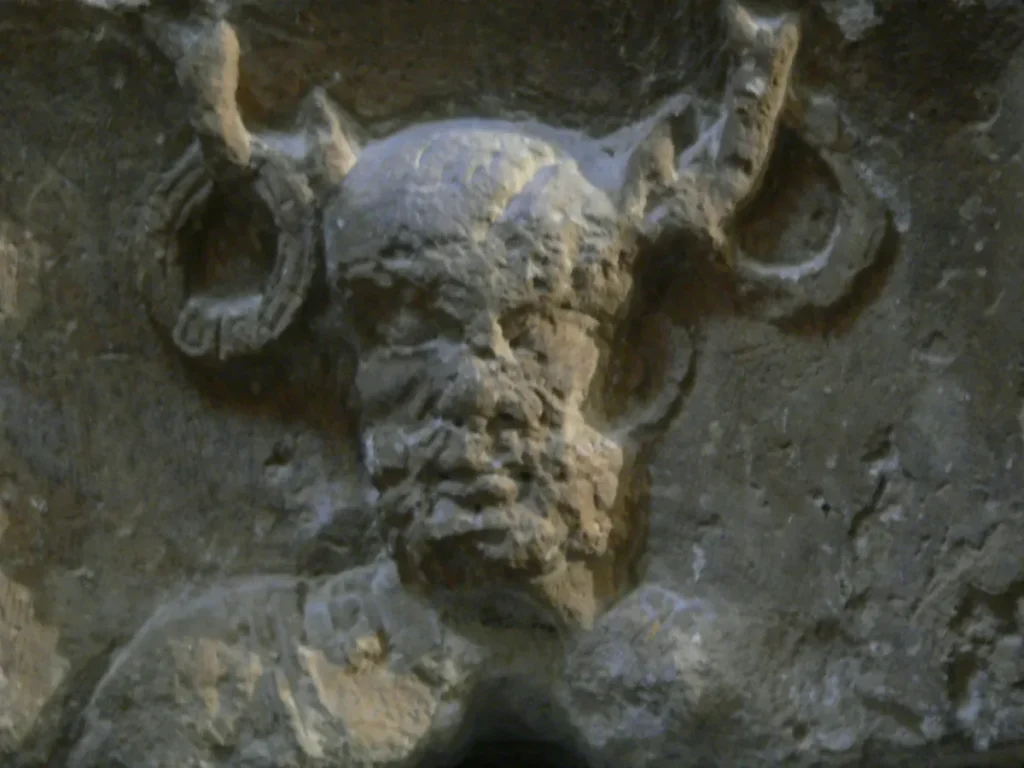
In 1710, workers beneath Notre-Dame in Paris uncovered sculpted stone blocks reused inside a Late Roman wall. The blocks had once formed part of a monument raised by the boatmen of the Parisii, the people whose name survives in Paris. One damaged panel carried the name Cernunnos beside an antlered figure whose horns held Celtic neck rings known as torcs.
That fragment matters because the evidence for Cernunnos is surprisingly thin. Modern books and online mythology guides often describe him as the Celtic horned god of nature, fertility, wealth, or the underworld. Ancient sources are far less direct. No surviving myth explains his role. No classical author gives a detailed account of his worship. What survives instead are inscriptions, reliefs, and ritual objects from Roman Gaul and Iron Age Europe.
The strongest evidence comes from the Pillar of the Boatmen, a 1st-century Gallo-Roman monument from ancient Lutetia. Other finds, including the Reims altar and the Gundestrup Cauldron, show similar antlered figures and animal imagery. Yet those comparisons also raise an important historical problem. Which images truly represent Cernunnos, and which are modern attempts to connect separate traditions into a single Celtic god?
What Evidence Do We Have for Cernunnos?
Cernunnos was a horned Gallo-Roman deity known mainly from the Pillar of the Boatmen in Paris. Other supposed images of the god are identified through visual comparison rather than secure inscriptions.
That distinction is essential. Historians separate named evidence from comparative evidence. Named evidence includes inscriptions that directly identify a figure. Comparative evidence relies on shared visual features such as antlers, torcs, animals, or seated posture.
The name Cernunnos survives most clearly on the Pillar of the Boatmen. According to the French Ministry of Culture, the monument was dedicated to Tiberius Caesar Augustus and Jupiter by the boatmen of the territory of the Parisii. The surviving blocks combine Roman and Gallic divine figures, making the monument one of the clearest examples of Gallo-Roman religion.
The Musée de Cluny identifies the pillar as a 1st-century votive monument from Roman Paris. The context matters. This was not an isolated tribal shrine deep in the countryside. It stood in a Romanized urban setting tied to trade, public religion, and imperial authority.
The surviving Cernunnos panel shows a bald, bearded figure with antlers and torcs hanging from the horns. The inscription itself is incomplete, but enough survives for the identification to be accepted. Without this monument, modern historians would have far less certainty that the antlered figure represented a deity called Cernunnos.
The pillar also includes Roman gods such as Jupiter and Vulcan alongside Gallic figures including Esus, Smertrios, and Tarvos Trigaranus. This mixture reflects the religious blending common in Roman Gaul after Caesar’s conquest.
Why the Pillar of the Boatmen Is Central to the Debate
The Pillar of the Boatmen matters because it gives historians a rare combination of image, inscription, location, and date.
The monument dates to the reign of Tiberius, who ruled from 14 to 37 CE. It was discovered beneath Notre-Dame on the Île de la Cité, the historic center of Paris. The blocks had been reused in a later defensive wall, which helped preserve them.
The inscription records a dedication to Jupiter and the emperor by the nautae Parisiaci, the boatmen of the Parisii. River trade shaped the economy of Roman Lutetia, and the monument reflects the status of a professional guild operating within the Roman imperial system.
The French Ministry of Culture describes Cernunnos on the pillar as bald, bearded, antlered, and associated with torcs. Those torcs are important symbols in Celtic art. They appear in elite burials, divine imagery, and depictions of warriors. Their placement on the antlers suggests wealth, power, or sacred status.
The monument also reveals how local religion adapted under Roman rule. Roman and Gallic gods appear together rather than replacing one another completely. This process is often called interpretatio Romana, where local deities were described or represented through Roman religious forms.
That mixed setting complicates simple ideas about “pure” Celtic mythology. The surviving evidence for Cernunnos comes largely from the Roman period, not from an untouched pre-Roman religious world.
Was Cernunnos a Nature God or Fertility God?
Modern descriptions often call Cernunnos a nature god, fertility god, or lord of animals. Those labels are possible interpretations, but ancient evidence does not define him so clearly.
Ancient religions rarely organized gods into neat categories. A deity could overlap with fertility, trade, warfare, protection, healing, or local identity depending on place and context.
No surviving literary source explains Cernunnos directly. Julius Caesar’s De Bello Gallico describes the gods of Gaul through Roman equivalents such as Mercury, Mars, Apollo, Jupiter, and Minerva, but he does not mention Cernunnos by name. Lucan’s Pharsalia refers to Esus, Taranis, and Teutates, but again not Cernunnos.
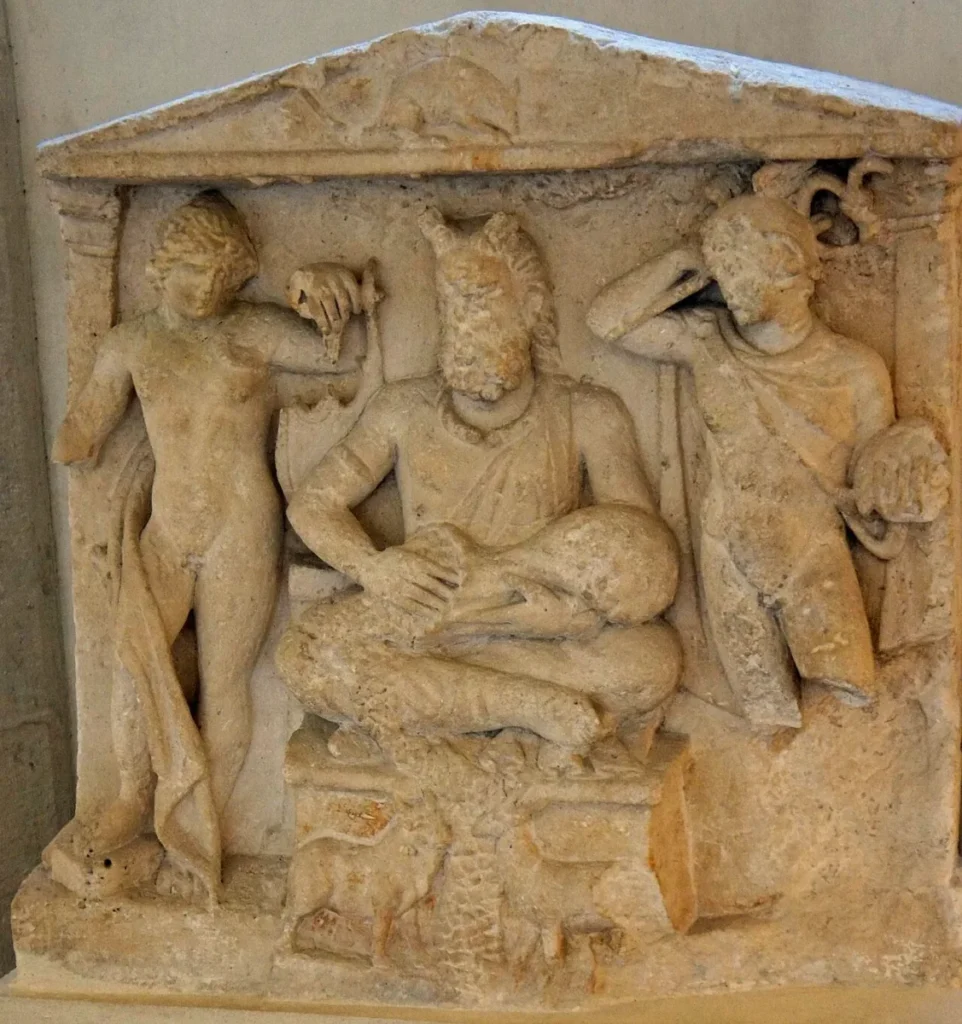
The strongest support for later interpretations comes from visual evidence. One important example is the Reims altar, also called the Stèle de Cernunnos, held by the Musée Saint-Remi.
The relief shows an antlered figure seated cross-legged between Apollo and Mercury. A deer and bull appear below. The figure is associated with a torc and a sack that may symbolize wealth or abundance. The French Ministry of Culture database notes that a fertility interpretation is probable, but not certain.
That caution matters. The relief strongly suggests connections with animals and prosperity, but it does not provide a written explanation of the god’s role. Historians can identify recurring themes in the imagery, yet they cannot fully reconstruct lost myths or rituals from visual evidence alone.
The Reims relief also demonstrates how local deities appeared alongside Roman gods in Gallo-Roman art. Apollo and Mercury frame the antlered figure within a broader religious landscape shaped by both Celtic and Roman traditions.
Enjoying Spoken Past?
I created Spoken Past to share my love of history. I research, write and develop everything myself, and I want my articles and basic guides to remain free for everyone.
If you enjoy my work, please consider supporting Spoken Past with a small donation.
Is the Gundestrup Cauldron Figure Really Cernunnos?
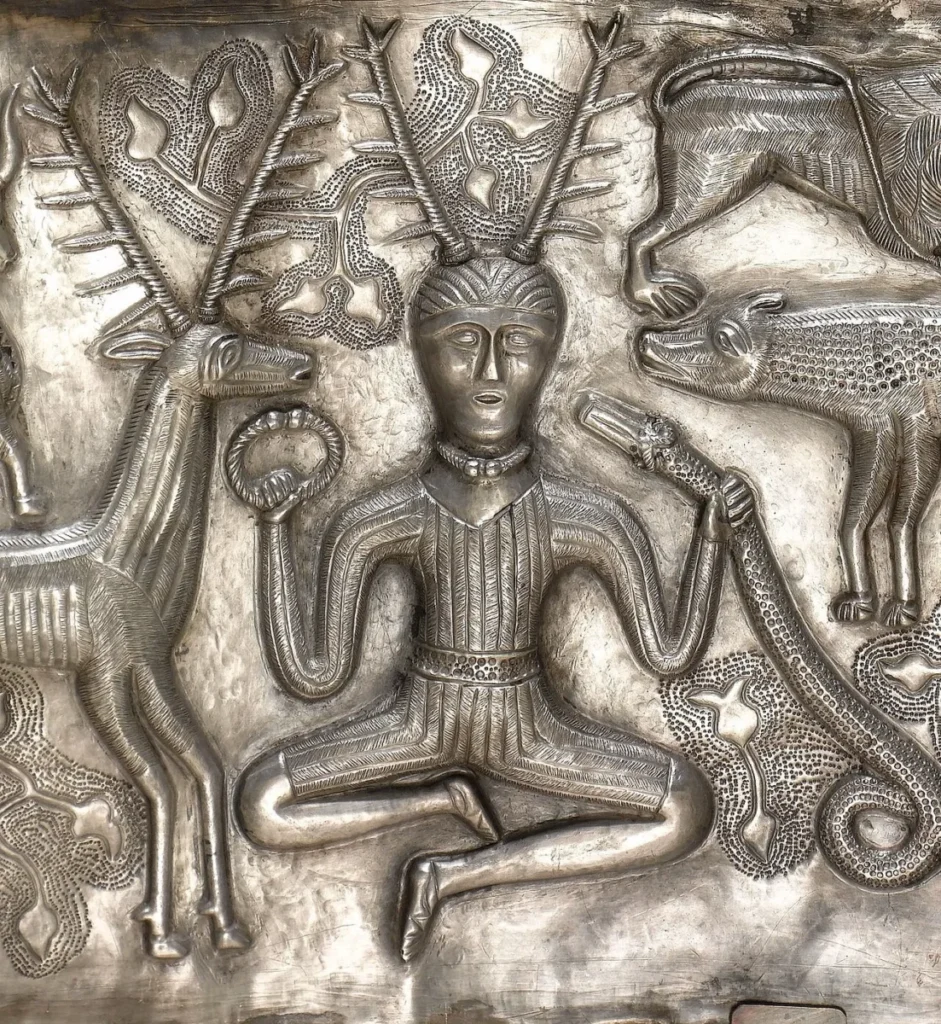
The antlered figure on the Gundestrup Cauldron is often identified as Cernunnos, but the object itself never names the figure.
The Gundestrup Cauldron was discovered in 1891 in a peat bog near Gundestrup in northern Denmark. The National Museum of Denmark states that the silver vessel had been dismantled before deposition and likely held ritual importance.
The cauldron is not straightforwardly “Celtic” in origin. The museum notes that its style and silverworking techniques probably connect it to Thracian craftsmanship in southeastern Europe. At the same time, the imagery includes objects associated with Celtic culture, including the carnyx war trumpet.
One inner plate depicts an antlered seated figure surrounded by animals. The National Museum’s interpretation describes the figure as “a god with antlers” who may have been associated with wild animals and the forces of nature.
The similarities to later Cernunnos imagery are obvious. The figure is antlered, seated, and linked with animals. Yet the cauldron contains no inscription naming the deity. Historians therefore treat the identification as plausible rather than certain.
This distinction is important because modern mythology writing often treats the Gundestrup figure as unquestioned proof of Cernunnos worship across Celtic Europe. The evidence supports comparison, not certainty.
The object itself reflects a wider Iron Age world shaped by trade, migration, warfare, and artistic exchange. It cannot be reduced to a single national or religious tradition.
What the Reims Altar Reveals About Gallo-Roman Religion
The Reims altar expands the evidence beyond Paris and shows how antlered divine imagery circulated within Roman Gaul.
Ancient Reims, known as Durocortorum, was one of the major cities of Roman Gaul. The altar discovered there in 1837 presents another antlered figure connected with animals and prosperity.
Unlike the Pillar of the Boatmen, the Reims relief does not rely mainly on inscriptional evidence. Its importance lies in iconography, meaning the study of visual symbols and figures.
The seated figure’s antlers resemble those on the Paris monument. The torc reinforces the connection to Celtic elite and divine imagery. The sack held by the figure has encouraged interpretations involving abundance, wealth, or offering. Below him appear a deer and bull, animals often associated with strength, fertility, and the natural world.
Yet the relief still leaves major questions unanswered. Historians do not know the exact rituals associated with the figure. They cannot reconstruct a complete mythology from the surviving evidence. Even the meaning of the cross-legged posture remains debated.
The altar instead demonstrates how religion in Roman Gaul blended local and imperial traditions. A figure resembling Cernunnos appears between Apollo and Mercury rather than outside the Roman religious framework. This combination reflects cultural adaptation rather than strict separation between “Roman” and “Celtic” religion.
How Modern Mythology Expanded the Image of Cernunnos
Modern ideas about Cernunnos are much broader than the surviving ancient evidence. The historical figure preserved in archaeology became part of later romantic, occult, and neopagan interpretations.
The secure evidence remains limited. Historians can point to the named inscription on the Pillar of the Boatmen and to related antlered imagery in places such as Reims and the Gundestrup Cauldron. Beyond that, many modern claims become speculative.
Ancient evidence does not clearly identify Cernunnos as a universal god of forests, animals, death, rebirth, or masculine energy. Those ideas emerged much later through interpretation and reconstruction.
At the same time, the ancient material is genuinely striking. An antlered divine figure appears repeatedly in Gallo-Roman and Iron Age imagery. Torcs, animals, and seated poses recur often enough to suggest a recognizable religious type.
The fascination surrounding Cernunnos comes partly from those gaps in the evidence. Unlike Greek or Norse mythology, where long literary traditions survive, Celtic religion is known largely through archaeology, inscriptions, and outside observers. Much was lost before it could be recorded.
The surviving fragments still reveal an important historical reality. In Roman Gaul, local religious traditions did not disappear immediately after conquest. They adapted, merged with Roman forms, and continued in public monuments and ritual art. Cernunnos survives because those stone and silver objects endured long after the religious world that produced them vanished.