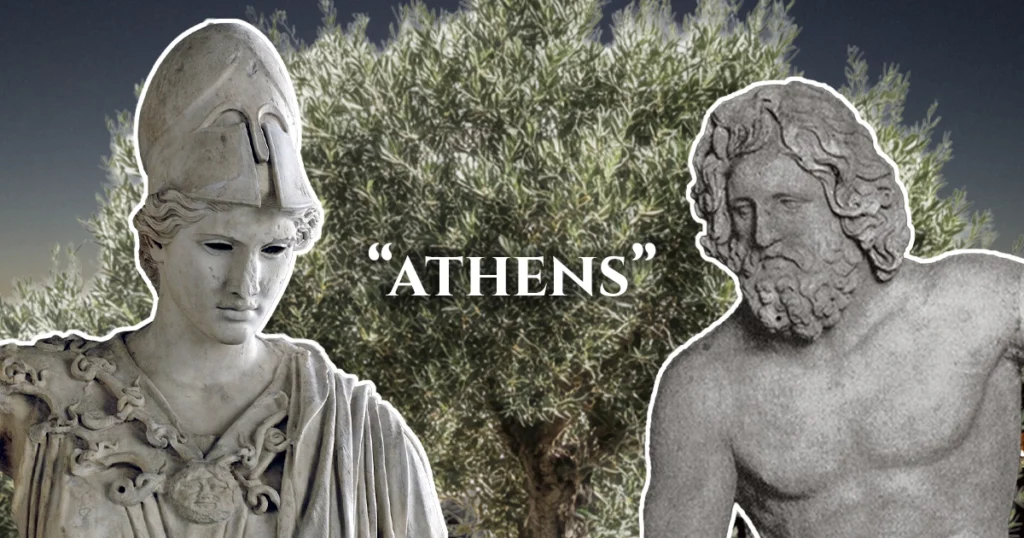
The Athena and Poseidon contest for Athens is the myth in which Athena wins the patronage of Attica after offering the olive tree, while Poseidon makes his claim with seawater, a wave, or in some later versions a horse. Ancient sources did not treat the story as one fixed tale. They used it to explain the city’s name, its sacred landscape, and the unusual fact that Athena and Poseidon both remained present in Athenian cult.
The clearest early evidence is topographical rather than narrative. In Herodotus, Histories 8.55, the Acropolis shrine of Erechtheus contains an olive tree and a pool of salt water, which Athenians said Athena and Poseidon had set there as tokens when they contended for the land. Later sources give fuller versions of the same claim, but Herodotus shows that by the fifth century BC the myth already had physical markers on the Acropolis.
What Apollodorus Says About the Contest
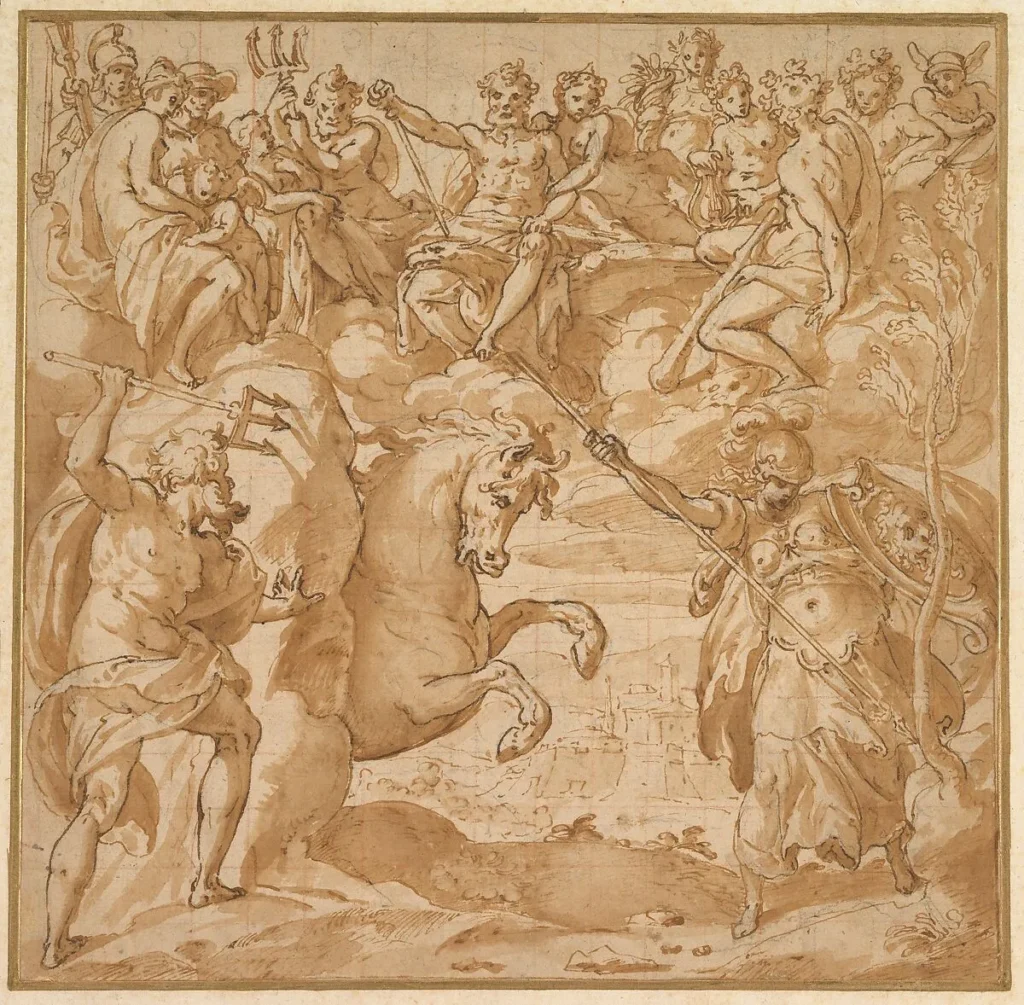
The fullest surviving ancient narrative of the Athena and Poseidon contest for Athens comes from Pseudo Apollodorus in the Bibliotheca 3.14.1, a mythological compendium generally dated to the first or second century CE. It is late as a text, but it preserves older mythographic material and records competing versions.
According to Apollodorus, the gods resolved to take possession of cities, each receiving a territory tied to their own worship. Poseidon came to Attica first. He struck the middle of the Acropolis with his trident and produced a sea called the Erechtheis. Athena came after him and, with Cecrops as witness, planted an olive tree in the Pandrosium.
When the two gods disputed possession of the land, Zeus appointed arbiters. Apollodorus identifies them as the twelve gods, while rejecting other versions in which Cecrops, Cranaus, and Erysichthon judged the case. The verdict went to Athena because Cecrops testified that she had planted the olive first. Poseidon then flooded the Thriasian plain and laid Attica under the sea.
A later note attached to Apollodorus adds a ritual detail that many retellings omit. The Athenians said the contest took place on the second day of the month Boedromion, and they left that day out of the civic calendar. That detail is not evidence that the myth happened as history. It is evidence that the story had a ritual and civic life beyond simple storytelling.
What Pausanias Saw on the Acropolis
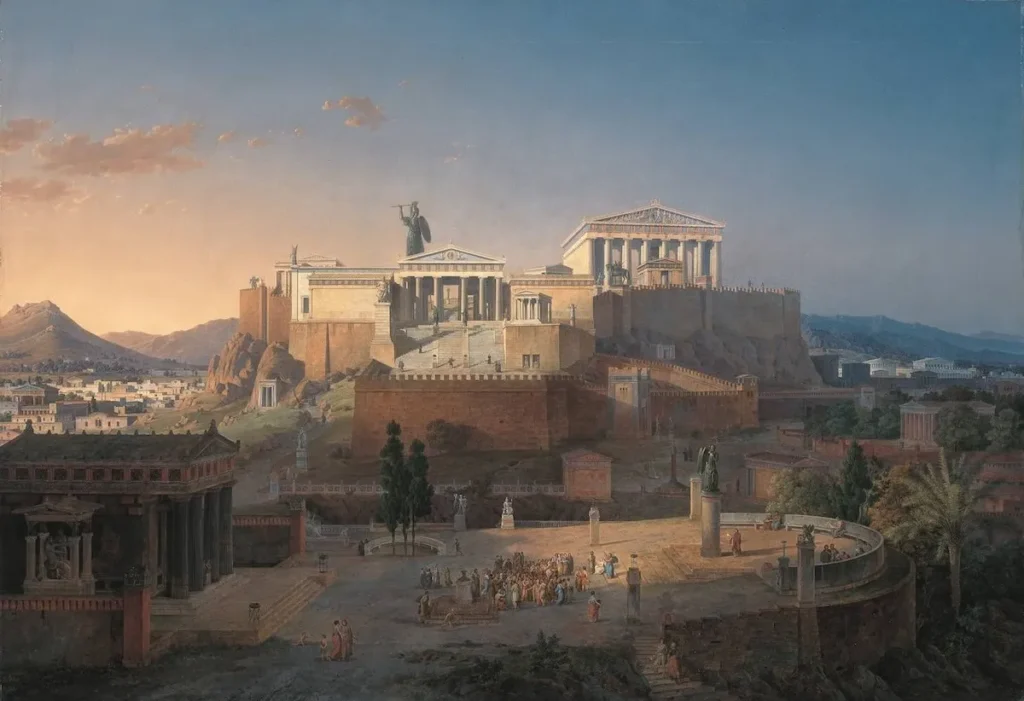
Pausanias visited Athens in the second century CE and recorded what was still being shown on the Acropolis. In Description of Greece 1.24.5 and 1.26.5, he describes two separate sites tied to the contest.
The first is the Parthenon’s west pediment. Pausanias says the rear pediment represented the contest for the land between Athena and Poseidon. The second is the Erechtheion, where he saw a cistern of seawater. He says the cistern made a sound like waves when a south wind blew, and that the rock beside it showed the outline of a trident. These appeared, in local legend, as evidence for Poseidon’s claim.
The sacred olive tree belonged to Athena’s side of the evidence. Pausanias says the Athenians treated the olive as the testimony the goddess produced when she contended for the land. He also records the story that, after the Persians burned Athens in 480 BC, the olive grew again from the burnt stump.
This is where evidence and interpretation need to stay separate. Pausanias is valuable as a witness to the objects and places Athenians showed in his time. He is not proving that a divine contest occurred. He is showing that the Acropolis preserved the myth through cult objects, local memory, and sacred topography for centuries.
Key Variants in the Athena and Poseidon Contest for Athens
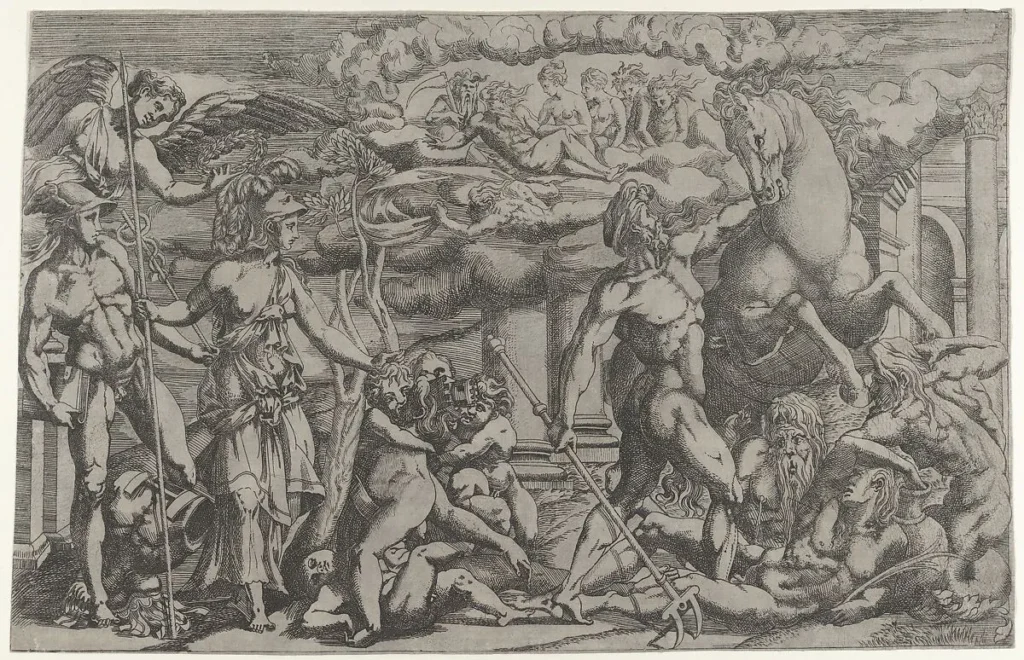
The story did not move through antiquity in one clean form. The judge, Poseidon’s gift, and the political meaning of the verdict changed between sources.
In Apollodorus, the arbiters are the twelve gods. Other traditions make Cecrops the judge, or name a mortal panel of Cecrops, Cranaus, and Erysichthon. Pausanias, when describing the west pediment, mentions Kekrops and Erechtheus among the figures present in the scene. Hyginus, Fabulae 164 gives another Roman version in which Jupiter judges, Minerva wins by planting the olive, and Neptune is prevented from flooding the land.
Poseidon’s gift also varies. The Greek topographical tradition emphasizes seawater on the Acropolis. Common modern retellings interpret that gift as weaker because salt water cannot be used as drinking water, but the primary sources do not always make that practical argument explicit. Ovid and later Latin traditions introduce the horse as Poseidon’s competing gift. That version gives Poseidon a symbol of warfare, speed, and aristocratic prestige, but it should not be merged uncritically with the saltwater version.
A separate tradition survives through Varro, as reported by Augustine in City of God 18.9. In that version, the citizens vote. The men vote for Neptune, the women vote for Minerva, and Minerva wins by one vote because there is one more woman than man. Neptune floods the land in anger. The Athenians then punish the women by taking away the vote, ending maternal naming, and denying them the name Athenians.
That voting version should be handled carefully. It is not found in Apollodorus or Pausanias, and it reaches us through a Roman antiquarian tradition quoted by a Christian author. It may preserve older material, but it may also reflect Roman era interpretation of gender, civic identity, and political order. The evidence does not allow certainty.
Enjoying Spoken Past?
I created Spoken Past to share my love of history. I research, write and develop everything myself, and I want my articles and basic guides to remain free for everyone.
If you enjoy my work, please consider supporting Spoken Past with a small donation.
The Erechtheion and the Material Evidence
The Erechtheion, constructed between 421 and 406 BC, became the architectural setting for much of this sacred evidence. The Acropolis Museum description of the Erechtheion says the building replaced the older temple of Athena Polias, had a unique design, and was divided between an eastern section for Athena Polias and a western section for Poseidon Erechtheus, Hephaistos, and the hero Boutes.
The building did not serve one simple cult. It gathered multiple sacred presences on uneven ground. The eastern section housed the wooden cult statue of Athena Polias, the city’s most sacred image of Athena. The western section preserved the cult of Poseidon Erechtheus and the places associated with Poseidon’s trident mark and saltwater. The nearby sacred olive tree belonged to Athena’s claim.
Interpretation can go further, but it should remain interpretation. The Erechtheion made the rivalry visible without erasing the loser. Athena’s victory explained the city’s patronage. Poseidon’s continued presence showed that losing the contest did not remove him from Athenian religious life.
Did Athena Name Athens, or Did Athens Name Athena?
The myth says Athena named the city after herself when she won. Apollodorus states this directly. Ancient audiences could repeat that explanation while still preserving other layers of cult and place memory.
Modern scholarship often reverses the myth’s logic. Gregory Nagy, writing on Athena as a name of person and place for Harvard’s Center for Hellenic Studies, argues that the goddess was named after Athens, or more precisely after the citadel or Acropolis where she was worshipped, rather than the city being named after her. Nagy connects this argument to Mycenaean evidence and to the broader Greek pattern of local goddesses whose names are tied to their places of worship.
That does not make the Athena and Poseidon contest for Athens useless as evidence. It changes the kind of evidence it provides. The myth is not a reliable linguistic history of the word Athens. It is a civic story that explains why the city’s divine identity centered on Athena, why the olive tree mattered, and why Poseidon still had a claim marked into the same sacred rock.
What the West Pediment Could and Could Not Show
The Parthenon’s west pediment is the most important surviving visual treatment of the Athena and Poseidon contest for Athens, although it survives only in fragments. The Acropolis Museum catalogue entry for Poseidon’s torso dates the sculpture to 437 to 432 BC and attributes it to Pheidias’ workshop.
The museum identifies the figure as a mature man, probably Poseidon, turning toward Athena, leaning back, and raising the right hand that would have held the trident. It also notes the main uncertainty. Poseidon may be shown pulling the trident from the rock after creating the saltwater spring, or striking the rock again to flood the city.
The surviving fragment cannot decide between those moments. The torso was found in 1835 in front of the west side of the Parthenon. The museum says it appears to have fallen during the Venetian bombardment of 1687. The rest of the torso, including the back, shoulders, and collarbones, is represented in Athens by plaster casts of originals now in the British Museum.
The west pediment still shows what the myth meant for Athens. On the city’s central temple to Athena, the story of her victory over Poseidon was made monumental. But the damaged state of the sculpture also limits what can be said. The pediment confirms that the contest was central to Athenian visual culture. It does not preserve every detail of the version the sculptors intended.