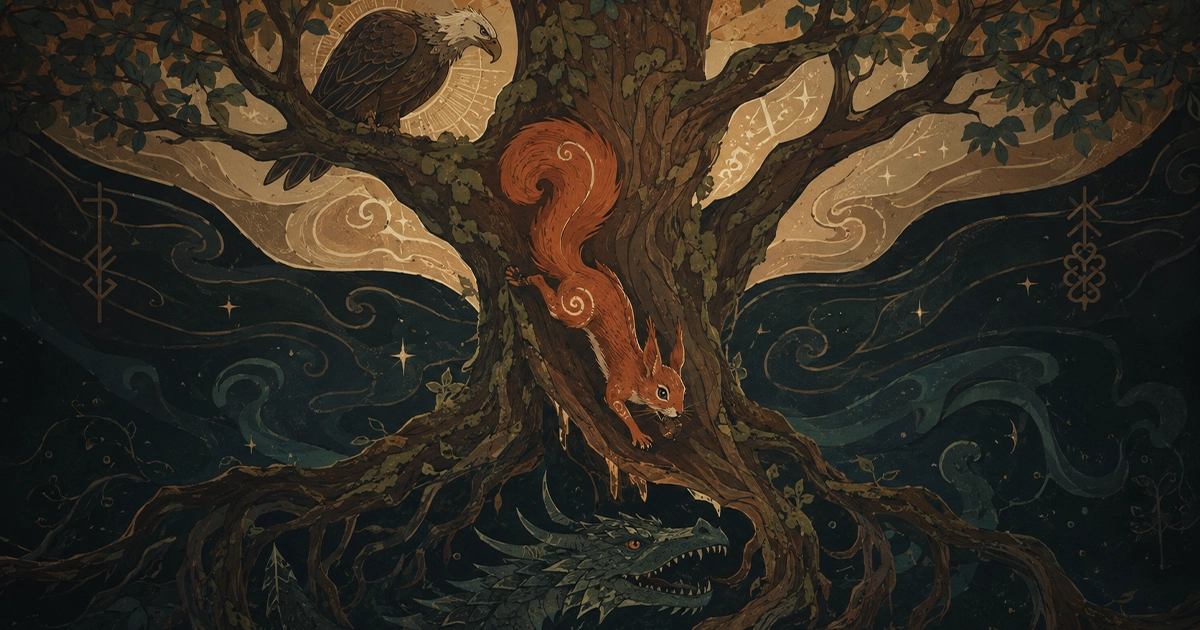
A single stanza in a 13th-century Icelandic poem is almost everything we have. Stanza 32 of Grímnismál, preserved in the Codex Regius manuscript and translated by Henry Adams Bellows as part of the Poetic Edda, names Ratatoskr as a squirrel running up and down the ash tree Yggdrasil, carrying the eagle’s words down to the dragon Níðhöggr below. That is the complete testimony of the older poetic tradition. Ratatoskr appears nowhere else in the Poetic Edda, on no identified runestone, in no skaldic verse, and in no source independent of those two 13th-century Icelandic texts. For a creature that has become one of the more recognizable figures in popular Norse mythology, the evidentiary base is remarkably thin. Understanding what Ratatoskr actually represents requires separating what the poems say from what the later prose writer Snorri Sturluson added, and separating both of those from the interpretations scholars have layered on top in the centuries since.
The Two Sources and Nothing Else
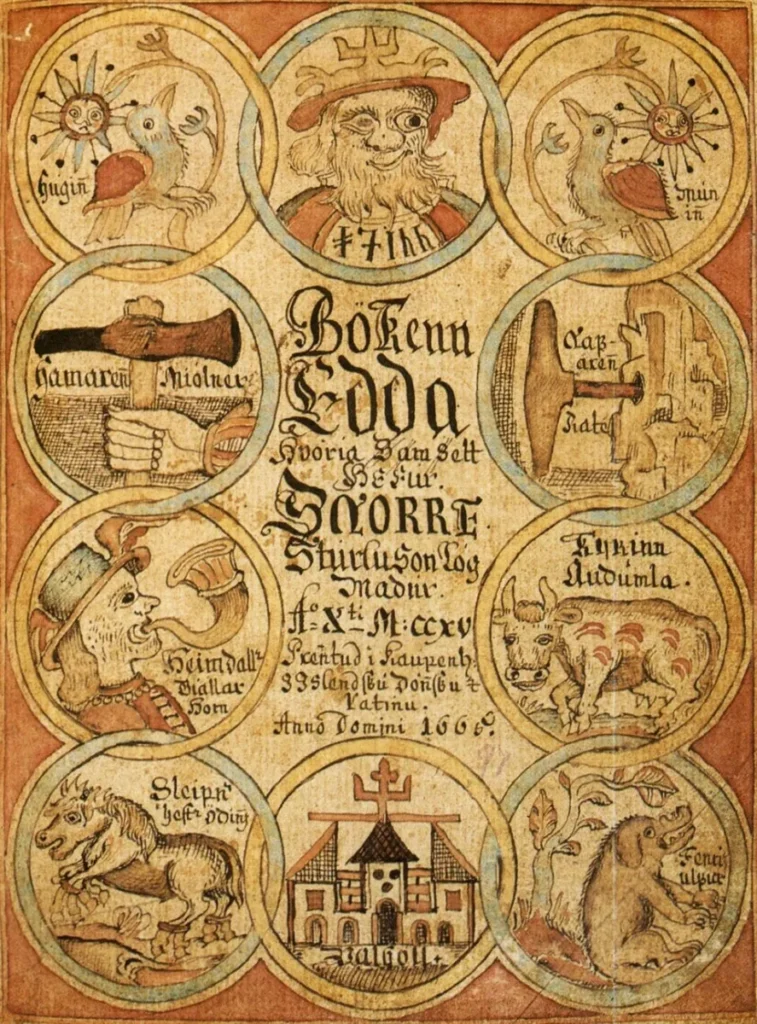
Norse mythology survives primarily through two overlapping collections of 13th-century Icelandic literature. The first is the Poetic Edda, a compilation of older mythological and heroic poems drawn mainly from the Codex Regius, a manuscript written around 1270. The second is the Prose Edda, written by the Icelandic scholar, lawspeaker, and historian Snorri Sturluson around 1220, which retells and interprets mythological material partly drawn from those same poems.
Ratatoskr is attested in exactly one place in the Poetic Edda: Grímnismál stanza 32. The poem is a catalogue of cosmological and mythological knowledge delivered by Odin, disguised as Grímnir and tortured between two fires, to a young prince named Agnar. In the Bellows translation, the stanza reads that Ratatoskr is the squirrel who runs on the ash tree Yggdrasil, bearing the eagle’s words from above and telling them to Níðhöggr beneath. The Old Norse text names the squirrel plainly: Ratatoskr heitir íkorni, “Ratatoskr is the squirrel named.” Nothing in the stanza describes motivation, personality, or deliberate mischief. The squirrel runs and carries words. That is all.
The second attestation comes from chapter 16 of Gylfaginning, the opening mythological section of Snorri’s Prose Edda. Here Snorri retells the same basic scene but adds a significant detail. In Anthony Faulkes’s standard translation, Snorri describes the squirrel running up and down the ash tree and carrying öfundarorð between the eagle and Níðhöggr. The word öfundarorð means envious, malicious, or spiteful words. Snorri frames Ratatoskr not merely as a messenger but as a deliberate instigator, carrying words designed to provoke hostility between the two creatures.
The critical scholarly point, noted in the commentary tradition around Grímnismál 32 and in Rudolf Simek’s Dictionary of Northern Mythology, is that this characterisation appears to be Snorri’s own addition. The stanza that Snorri himself was almost certainly working from contains no such implication. Since no other source gives Snorri independent testimony about the squirrel’s intentions, the malicious gossip framing is best understood as an interpretive embellishment by the author of Gylfaginning, not a tradition preserved from pagan antiquity.
The Eagle Above, the Dragon Below, and the Squirrel Between
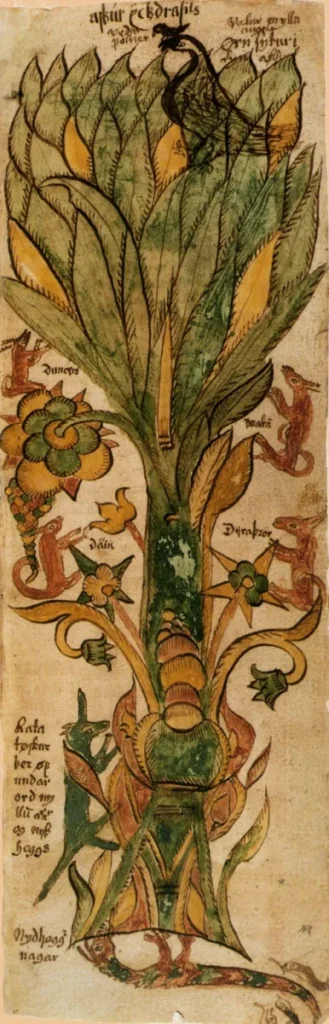
Yggdrasil is the immense ash tree at the centre of Norse cosmology, its branches extending over all the worlds and its three roots reaching into the realms of the gods, the frost giants, and the dead. Grímnismál is among the primary sources for the tree’s description, listing in successive stanzas the creatures living on and within it.
At the top of the tree sits an eagle, a being Snorri later names as wise, with a hawk called Veðrfölnir perched between its eyes. Beneath one of the three roots, in the realm associated with Niflheim, the dragon Níðhöggr gnaws perpetually at the root. Stanza 35 of Grímnismál notes that Yggdrasil suffers greatly, more than humans know, as a stag gnaws its top and the dragon gnaws it below. The tree is under constant assault from multiple directions, and its health is tied to the continuation of the cosmic order.
Between these two creatures at opposite ends of the vertical axis runs Ratatoskr. The eagle is positioned at the highest point of the tree. Níðhöggr is at the lowest, in the underworld. The squirrel occupies the trunk itself, the connecting structure between top and bottom. In structural terms, Ratatoskr is a mediating figure traversing the axis between the uppermost and lowest realms of the Norse cosmos.
Whether this position is cosmologically significant or incidental is genuinely uncertain. Simek suggested that the squirrel may simply be an ornamental detail in the Grímnismál catalogue, one figure among many in an enumeration of cosmological inhabitants. Other scholars have proposed more interpretive readings, that the eagle and Níðhöggr represent opposing forces of order and chaos, and that the squirrel’s movement between them reflects some deeper structural tension in the Norse worldview. These readings are plausible as interpretations but cannot be confirmed from the primary sources alone.
The Name and What It May Mean
The Old Norse name Ratatoskr is itself a subject of philological debate. The consensus interpretation, reflected in scholarship including Simek’s reference work, reads the name as meaning something close to “drill-tooth” or “bore-tooth.” The element toskr relates to a tusk or tooth, and rata is associated with the drill Rati, which appears in Hávamál stanza 104 as the tool Odin used to bore through rock to steal the mead of poetry. On this reading, Ratatoskr’s name emphasises a piercing, penetrating tooth, perhaps appropriate for a squirrel and perhaps carrying some further resonance with Odin’s own mythological drilling.
A dissenting view was put forward by the 19th-century Norwegian scholar Sophus Bugge, who proposed that the name derived from Old English roots, raet meaning rat and tusk meaning tusk, suggesting the name was borrowed from an Old English tradition. This etymology has not gained wide acceptance in modern scholarship, but it illustrates how even the name of this creature sits in interpretive uncertainty.
What neither etymology resolves is any deeper question about the squirrel’s mythological role. Names in Old Norse mythology sometimes carry obvious functional resonance. Níðhöggr means roughly “malice striker” or “he who strikes with malice,” and if Ratatoskr genuinely means “drill-tooth,” the name might hint at a creature whose words bore or pierce, which would fit Snorri’s later characterisation of it as a spreader of malicious speech. But this reading requires layering an interpretation of Snorri’s embellishment back onto the etymology, which is a circular kind of reasoning the sources do not support on their own.
Snorri’s Addition and the Problem of Medieval Interpretation
Snorri Sturluson was born in 1179 and died in 1241, assassinated in his cellar at Reykholt, Iceland, on the orders of the Norwegian king. He wrote the Prose Edda approximately two centuries after the Viking Age had ended and in a Christian Iceland that had converted around the year 1000. His project in Gylfaginning was partly antiquarian and partly literary: to preserve the mythological knowledge that skaldic poets needed to understand the kennings and allusions embedded in traditional verse.
This context matters for evaluating everything Snorri says about Norse mythology, including Ratatoskr. As the Faulkes critical edition of Gylfaginning makes clear, Snorri was working from poems very similar to the ones that survive today, but he was also a 13th-century Christian intellectual interpreting pre-Christian material through his own literary and cultural framework. He was not a practitioner of the religion he described, and there is no reason to assume his expansions on the poetic sources reflect traditions he had independent access to rather than his own interpretive intelligence.
The word öfundarorð, the envious or malicious words that Snorri attributes to Ratatoskr’s role, does not appear in Grímnismál 32. It is Snorri’s gloss. The distinction matters because the gossiping, troublemaking squirrel that most modern retellings present as the traditional Ratatoskr is substantially Snorri’s creation rather than a figure attested in the older poetic record. This does not make Snorri wrong, exactly. He may have had access to oral traditions that no longer survive, and his interpretation may reflect genuine beliefs. But it cannot be confirmed, and the difference between messenger and malicious gossip is not a trivial one.
The commentary tradition around Grímnismál 32 notes that scholars going back to Bellows in 1923 have flagged this exact problem. Bellows himself observed in his notes that the idea of Ratatoskr representing the undying hatred between sustaining and destroying elements of the universe seemed, as he put it, a trifle far-fetched as a reading of the single stanza.
What Ratatoskr Is Not
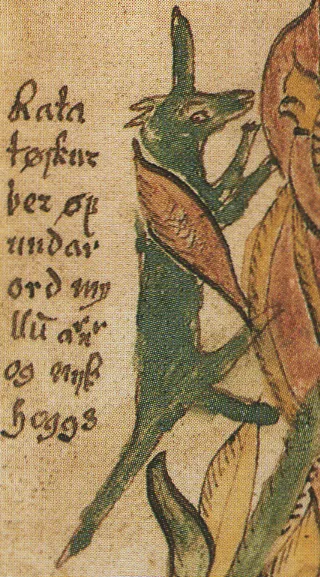
Because the source base is so limited, it is worth being direct about what cannot be claimed. Ratatoskr is not attested as a trickster figure in any source independent of Snorri’s embellishment. There is no saga, no skaldic poem, no runic inscription, and no archaeological object that can be confidently identified as representing the squirrel. Unlike Níðhöggr, who appears in Völuspá as well as Grímnismál and the Prose Edda, giving that creature a richer textual base, Ratatoskr’s entire existence in the primary sources amounts to one stanza and one prose paragraph, both drawing on the same original.
There is also no evidence of cult, ritual, or religious practice associated with Ratatoskr. The creature plays no role in any narrative. It does not appear in the events leading to Ragnarök in the way that Níðhöggr does, gnawing at the root until the world ends. It is not involved in any interaction with gods, giants, or humans. In Grímnismál it is enumerated alongside four stags that nibble the highest branches and the many serpents beneath the roots: a catalogue entry in a long list of cosmological inhabitants rather than a character with a story.
The modern image of Ratatoskr as a mischievous, scheming creature running gleefully between enemies to cause chaos is an extrapolation from Snorri’s single-sentence expansion of a four-line stanza, filtered through centuries of retelling. That image may be vivid and internally consistent, but it rests on a very narrow foundation, and the older poem does not support it with anything close to the same clarity.
Ratatoskr remains what Grímnismál made it: a squirrel on the world tree, running between the eagle and the dragon below, carrying words between creatures that occupy opposite ends of the Norse cosmos. Whether that role was cosmically significant, functionally ornamental, or something Snorri correctly elaborated from traditions now lost is a question the surviving sources cannot answer.