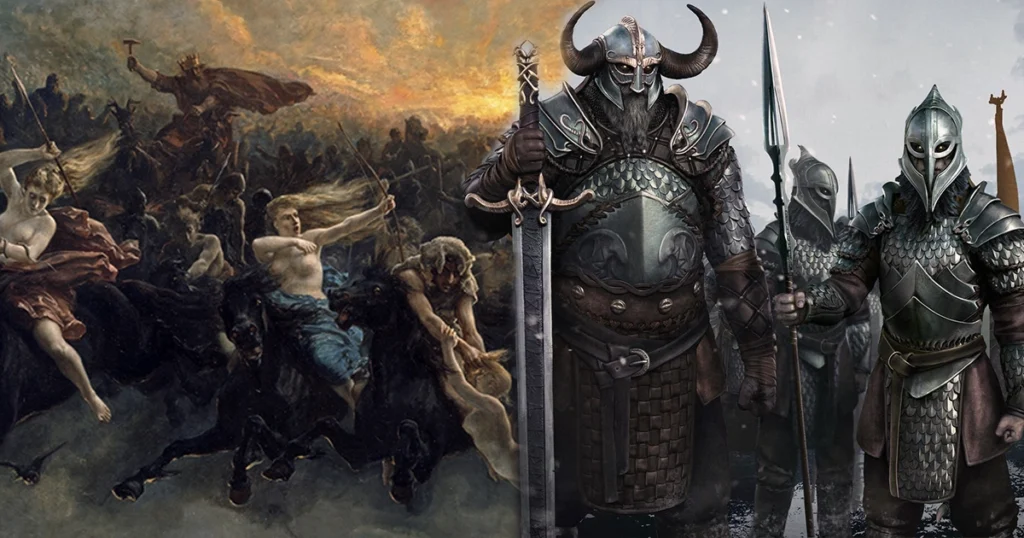
In chapter 41 of Gylfaginning, the mythological section of the Prose Edda, a figure called Gangleri asks what the chosen warriors do in Valhalla when they are not drinking. The answer is immediate and specific: every day, the einherjar arm themselves, ride into the courtyard, and fight one another until they fall. When dinner time arrives, their wounds are healed and they ride back to feast. This is not punishment or purgatory. It is sport, but it is also preparation. Odin’s army of the dead exists for one purpose: to fight at Ragnarök, the final battle that the sources say the gods will lose.
That combination is the core of the concept. Valhalla is not simply a warrior’s paradise. It is a military program with a known outcome, run by a god who has already heard the prophecy and recruits anyway. The belief is attested across different kinds of Old Norse evidence, from tenth century skaldic praise poetry to Snorri Sturluson’s systematic mythology, written in Iceland around 1220 CE. Understanding what those sources say, and where they diverge or go silent, is essential to understanding what Odin’s dead warriors really were.
What the Word Einherjar Means in the Sources
The Old Norse term einherjar is plural. The singular is einheri. It is often translated as “lone fighters” or “those who fight alone,” but that translation sits awkwardly beside the role given to them in the surviving narratives. They do not act as isolated champions. They train together, feast together, and march together at Ragnarök as Odin’s gathered host.
The singular form einheri appears in a striking context in Lokasenna, a poem preserved in the Poetic Edda tradition. Loki uses the term of Thor, who is not a dead warrior dwelling in Valhalla. That single usage complicates any rigid definition. It may point to a broader older sense connected with exceptional fighting status, but that remains interpretation rather than proof.
The narrative role is clearer than the etymology. These warriors belong to Odin. They are selected from the dead, brought to Valhalla, trained through combat, fed through supernatural abundance, and held in readiness for the world’s final battle. The meaning of the name may be debated, but the function of the group is consistent: they are the dead turned into an army.
Tenth Century Poems Show the Idea Before Snorri
The fullest surviving description comes from Snorri, but the idea of dead warriors entering Odin’s hall is older than his thirteenth century account. Two tenth century praise poems, Eiríksmál and Hákonarmál, are crucial because they show the Valhalla framework operating in political poetry before Snorri’s mythological synthesis.
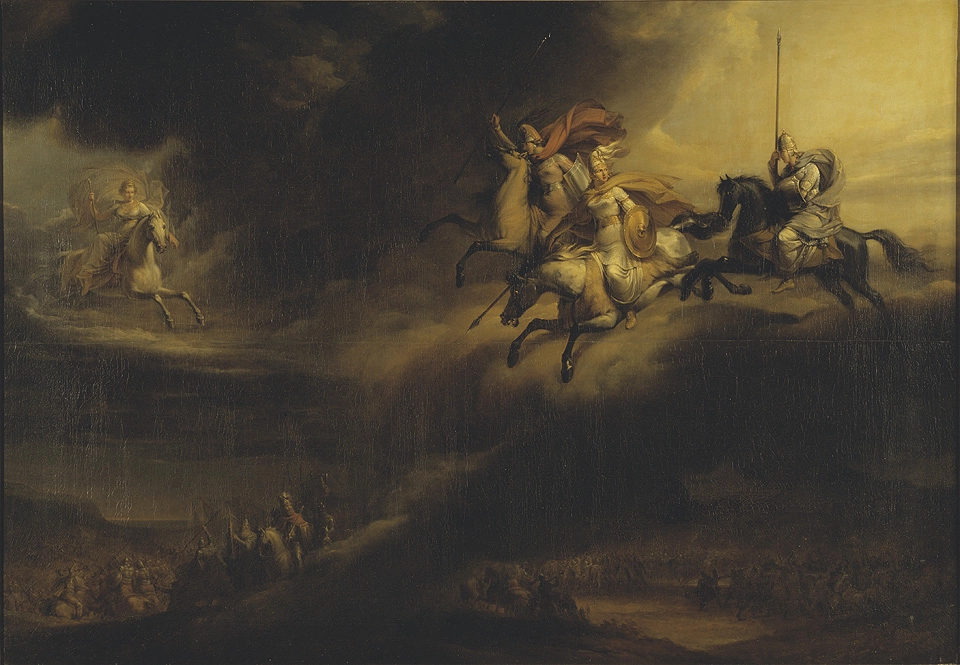
Eiríksmál was composed after the death of Eric Bloodaxe, usually placed around 954 CE. Only part of the poem survives. In it, Odin wakes and says he has prepared Valhalla for a slain army. He commands the warriors there to rise, set out benches, prepare drinking vessels, and get ready because a great king is coming. The warriors in Odin’s hall are already present, already organized, and already waiting.
Hákonarmál was composed by Eyvindr skáldaspillir after the death of King Hákon the Good at the Battle of Fitjar, usually dated to about 961 CE. The poem describes Odin sending the valkyries Göndul and Skögul to choose Hákon from the battlefield and bring him to Valhalla. In this poem, the afterlife framework is not abstract doctrine. It is applied to a named historical king.
These poems establish several important points. First, the warrior afterlife was not invented by Snorri. Second, the belief could be used in elite court poetry for historical rulers. Third, valkyries selecting battlefield dead for Odin was already part of the poetic framework by the middle of the tenth century.
There is also a political complication. Hákon the Good was a Christian king, yet Hákonarmál presents him as received into Odin’s hall. The poem is not evidence that Hákon privately believed in Valhalla. It is evidence that the pagan warrior afterlife remained culturally powerful enough to honor a Christian ruler in Norse courtly terms.
Snorri’s Valhalla Is Both Feast Hall and Barracks
Snorri Sturluson’s Gylfaginning, written in Iceland around 1220 CE, gives the most detailed surviving account of the warriors in Valhalla. Snorri was a Christian politician, landowner, historian, and poet writing more than two centuries after Iceland’s official conversion to Christianity in 1000 CE. His account is indispensable, but it is not a transparent record of Viking Age religion.
In Gylfaginning, Snorri presents Norse mythology through a question and answer dialogue. A king called Gylfi, disguised as Gangleri, questions three enthroned figures who represent aspects of Odin. The format lets Snorri organize older mythological material into a systematic handbook. His aim was partly literary. He wanted to preserve mythological knowledge needed to understand skaldic poetry.
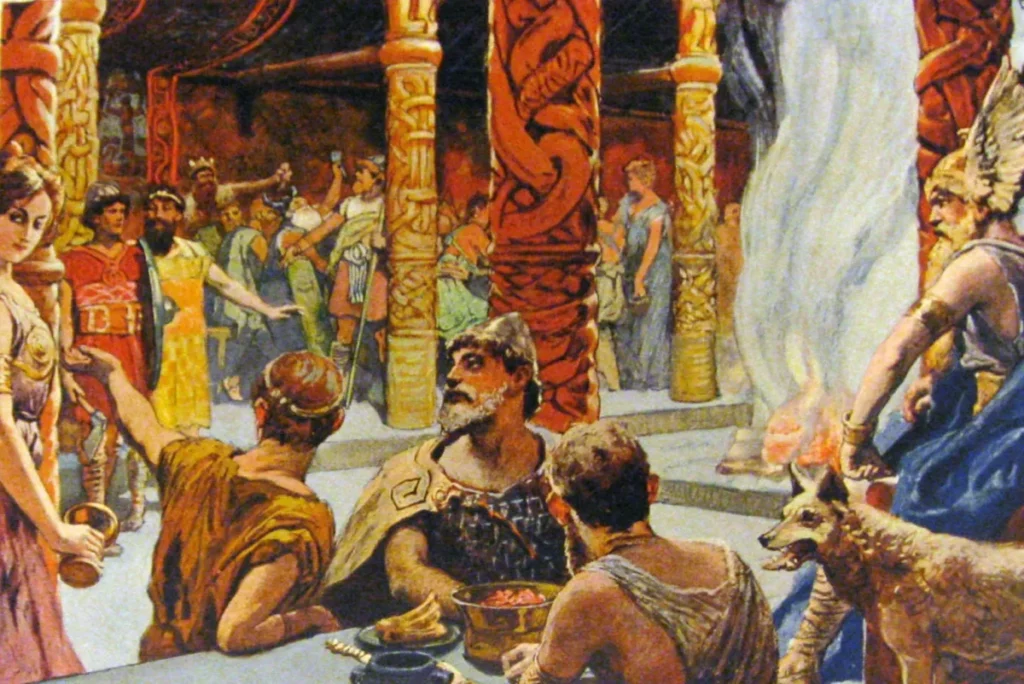
Several chapters describe Valhalla. Chapter 20 identifies Odin as the god of the slain and ruler of those who fall in battle. Chapter 36 describes the vast architecture of Valhalla, including the famous claim that 800 warriors will march out of each of its 540 doors at Ragnarök. Chapter 38 says the warriors eat the flesh of the boar Sæhrímnir, cooked each day and restored again. Chapter 39 says they drink mead from the goat Heiðrún, who feeds on the branches of the world tree.
Chapter 41 gives the daily routine. The dead warriors dress for battle, fight in the courtyard, cut one another down, and are restored in time for the evening feast. Snorri supports this description by citing older eddic verse, especially material connected with Grímnismál, a poem centered on Odin in disguise and rich in mythological catalogues.
The mythic mechanism is clear. Valhalla is both feast hall and training ground. Its pleasures are not separate from its military function. The endless meat, endless mead, and endless healing maintain a host that can practice death every day without being diminished before Ragnarök.
Enjoying Spoken Past?
I created Spoken Past to share my love of history. I research, write and develop everything myself, and I want my articles and basic guides to remain free for everyone.
If you enjoy my work, please consider supporting Spoken Past with a small donation.
Valkyries Chose the Dead for Odin’s War
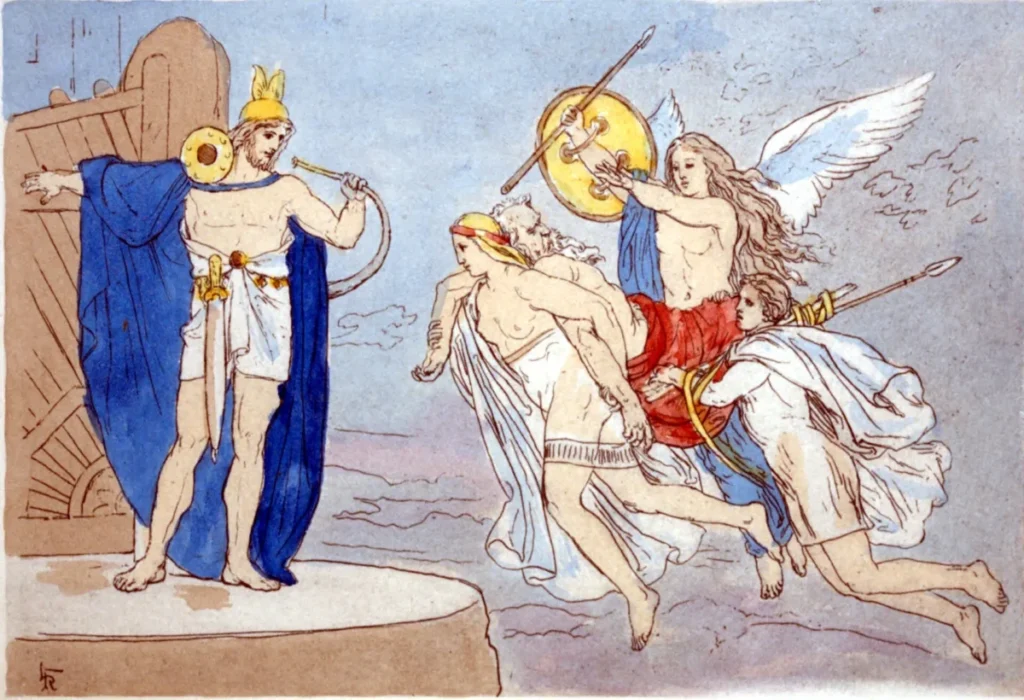
The warriors of Valhalla are not randomly chosen. Valkyries select them from battlefields. Their name is commonly understood as “choosers of the slain,” and their role in the poems is active rather than decorative. In Hákonarmál, Odin sends valkyries to choose Hákon. In Eiríksmál, Odin prepares for the arrival of Eric Bloodaxe and the warriors who accompany him.
The surviving sources do not give a complete rulebook for admission to Valhalla. The recurring pattern is battlefield death, royal status, heroic reputation, and Odin’s choice. The poems do not present Valhalla as a general moral reward for good conduct. It is a destination connected to martial death and divine recruitment.
This distinction matters because modern summaries often flatten Valhalla into a heroic heaven for Vikings. The sources are more specific. Odin is collecting fighters because Ragnarök is coming. The Prose Edda makes that purpose explicit. In chapter 51, the gods and their allies ride to the field of Vígríðr, where they face Fenrir, the Midgard Serpent, Surtr, Loki, and the forces gathered against them.
The outcome is not victory. Odin is killed by Fenrir. Thor kills the Midgard Serpent but dies after taking nine steps. Freyr falls to Surtr. The world burns and sinks. The army Odin has gathered is immense, but not enough to prevent catastrophe.
This is not presented as a logical failure inside the myth. It is part of the tragic structure of the Norse eschatological imagination. Odin gathers knowledge, weapons, allies, and the battle dead. He still cannot cancel fate.
What Snorri May Have Systematized
The strongest evidence for the warrior afterlife comes from multiple sources, but the most detailed version comes from Snorri. That creates a source problem. Snorri wrote in a Christian Icelandic literary culture long after the conversion period. He knew older poetry and used it extensively, but he also arranged, clarified, and systematized material that may have circulated in more variable forms.
The numbers attached to Valhalla are a good example. The 540 doors and 800 warriors from each door produce a vast army, but the precision may reflect Snorri’s organizing style. It should not automatically be treated as evidence for a fixed pre Christian doctrine shared across Scandinavia.
The same caution applies to the complete integration of Valhalla’s daily combat, supernatural food, valkyrie selection, and Ragnarök deployment into one coherent system. Some of those elements are independently supported by older poetry. Others are most fully described by Snorri. The safest reading is that Snorri preserves genuine older mythic material while also giving it a late medieval Icelandic structure.
The key separation is this: the evidence shows that Odin, Valhalla, valkyries, and selected battlefield dead were part of tenth century Norse poetic culture. The interpretation that Valhalla functioned as a fully systematized military training institution depends most heavily on Snorri’s thirteenth century prose account.
Hel’s Dead and the Limits of Germanic Parallels
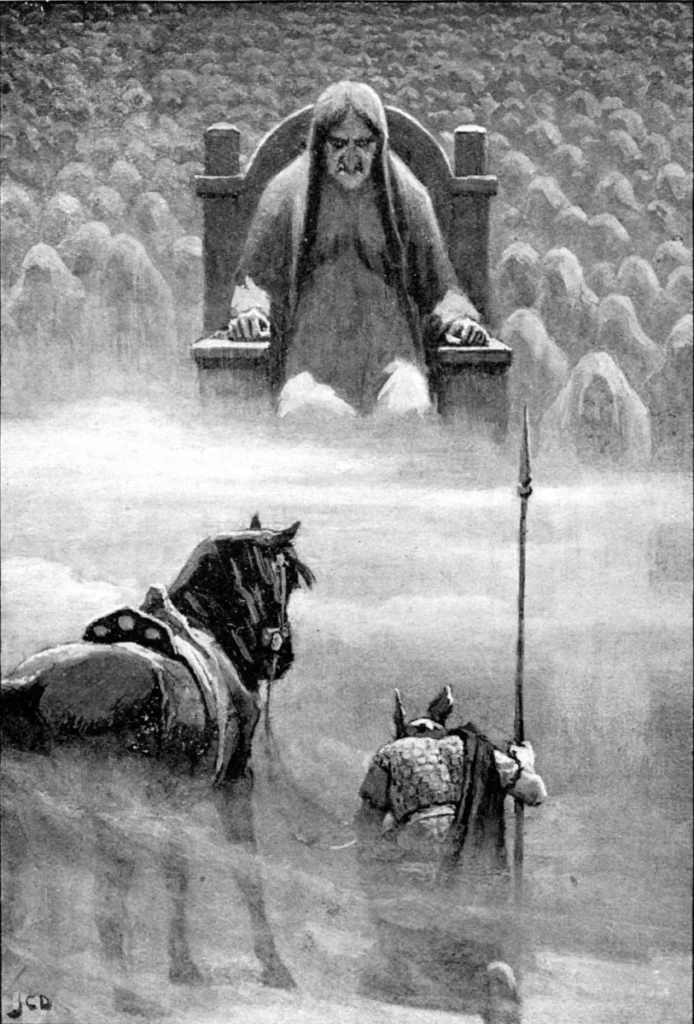
Not all the dead go to Valhalla. The sources present several afterlife destinations, and they do not always organize them in a single tidy system. Those who die of sickness or old age are often associated with Hel, the realm ruled by the figure of the same name. At Ragnarök, Snorri describes hostile forces arriving from the direction of Hel, including Loki and the ship Naglfar.
This creates a powerful contrast. Odin has his chosen battle dead. Hel has another population of the dead. At Ragnarök, the categories of the dead become part of the cosmic conflict. The myth sorts people not only by moral worth, but by mode of death, divine claim, and eschatological alignment.
Scholars have also compared Odin’s dead warriors with wider Germanic traditions. One frequently mentioned parallel is the Harii, a group described by Tacitus in Germania, written around 98 CE. Tacitus says they used dark shields, painted bodies, and night attacks to create terror. Some scholars have connected the Harii to later ideas of spectral warrior bands or Odin associated hosts. This remains speculation, not a demonstrated line of continuity.
The same caution applies to comparisons with the Wild Hunt, a later medieval and folkloric tradition in which a supernatural host rides through the night. The resemblance is suggestive: a terrifying company of riders, the dead, and sometimes an Odin like leader. But similarity is not proof. This belongs in comparative interpretation, not in the category of direct historical survival.
What can be said with more confidence is narrower and stronger. The Norse sources preserve a distinctive image of dead warriors chosen by valkyries, housed in Odin’s hall, trained through daily combat, and fed for a battle already foretold. The tenth century poems show that the basic warrior afterlife was active before Snorri. Snorri’s Gylfaginning gives the fullest account of the training system. Together, they make Valhalla less a reward than a barracks for the end of the world.