
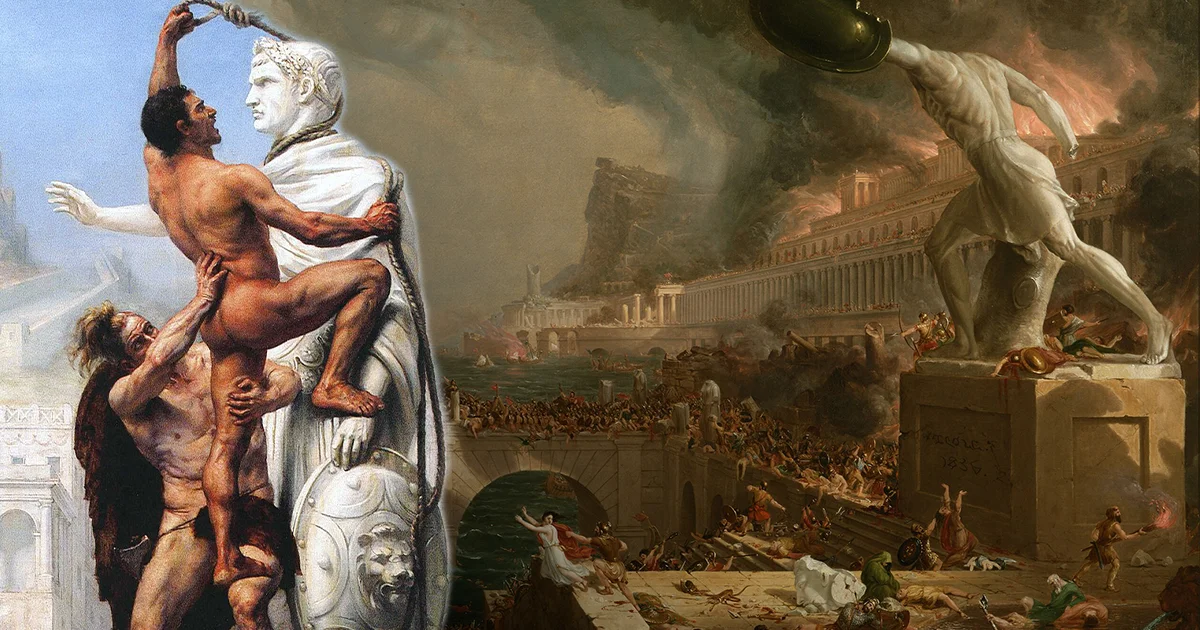
Most historians give 476 CE, when the general Odoacer deposed the boy emperor Romulus Augustulus in Italy, as the formal answer to the question “when did the western roman empire fall.” However, both ancient writers and modern scholars show that this fall drew out over several generations, from third‑century crises to sixth‑century new kingdoms, rather than a single night of collapse.
Already by the late fourth century, Roman power in the West rested on fragile foundations, even though emperors and generals still spoke confidently about defending “the human race” under Roman arms. Meanwhile, authors like Ammianus Marcellinus and the military writer Vegetius described overstretched frontiers, reliance on allied barbarian troops, and towns that strengthened walls in fear of sieges, signs that the old balance had shifted long before 476.
Late Roman power under pressure
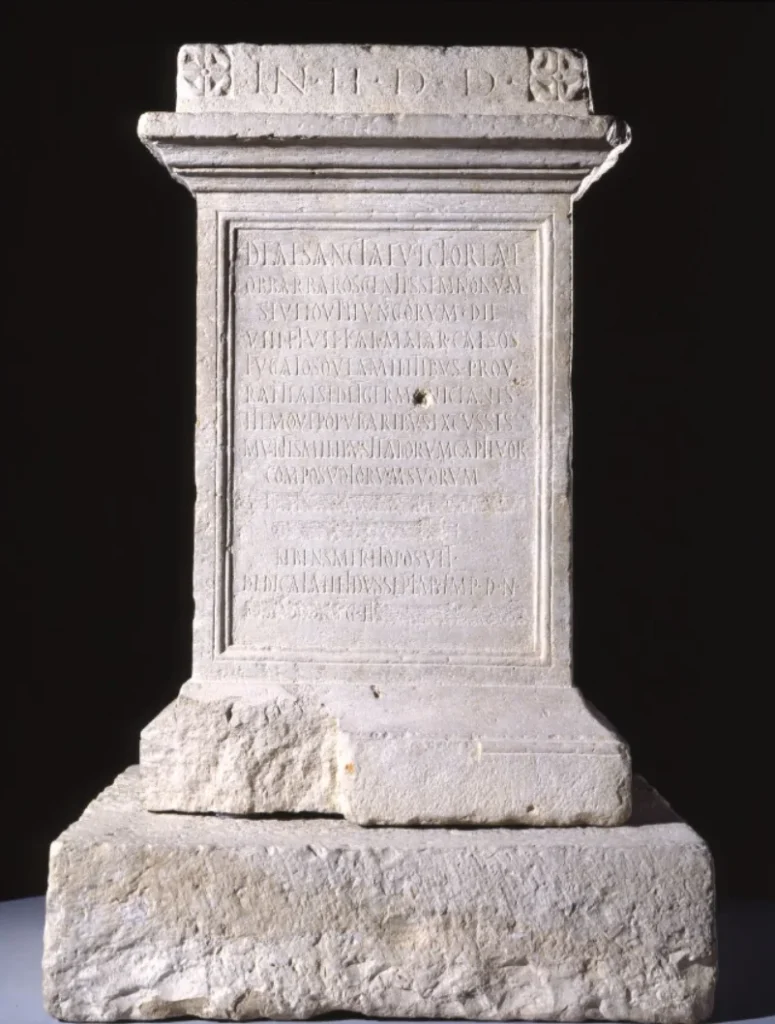
In the third century, civil wars and repeated invasions shattered the old security of the Rhine and Danube frontiers, forcing emperors such as Aurelian and Diocletian to improvise new defensive lines and depend more heavily on non‑Roman soldiers. For example, the Augsburg victory altar of 260 CE, raised after fighting the Iouthungi in Raetia, already shows provincial governors relying on local militias and hastily armed civilians to push back raiders.
Later, writers like Eutropius and the anonymous author of De rebus bellicis stressed how emperors struggled to fund armies, build fortifications, and keep provincial populations loyal amid chronic warfare. Additionally, Vegetius urged stronger discipline and better training, while also admitting that emperors now expected cities to endure sieges and keep long‑term food stores, a very different mindset from the high empire.
By the early fifth century, major regions of the western provinces effectively slipped from direct imperial control, even if the imperial court still claimed authority on paper. In contrast to the first and second centuries, emperors could no longer quickly crush usurpers or push back every invading group, especially once military power concentrated in a few strongmen such as Stilicho and later Aetius.
Goths, Vandals, and new western kingdoms
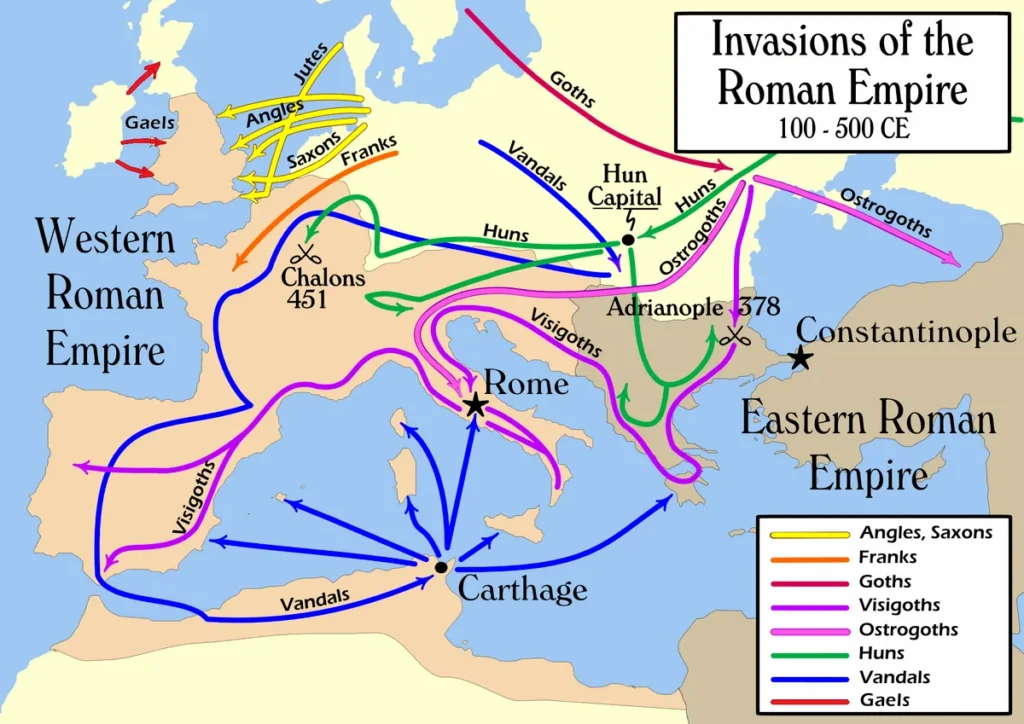
From the late fourth to the mid‑fifth century, Roman governments repeatedly settled large migrant groups inside imperial territory as allied foederati, hoping to turn dangerous outsiders into border guards. For example, after the disastrous battle of Adrianople in 378, Gothic groups gained land in the Balkans, and by 418 Visigoths received a formal base in Aquitaine, where their kings started to act less like guests and more like regional rulers.
Similarly, Burgundians obtained territory in Sapaudia near modern Geneva, while Sueves entrenched themselves in north‑western Spain, and Franks expanded their hold over northern Gaul. Additionally, British elites ejected imperial officials in the early fifth century, leading late writers like Zosimus and Gildas to describe Britain and parts of Armorica finding their own solutions with local leaders and incoming Saxon groups.
The Vandals illustrate both Rome’s tactical flexibility and its long‑term weakness, since they moved from the Rhine to Spain and finally to North Africa within a single generation. Hydatius, a bishop writing in Gallaecia, recorded how Vandal, Suevic, and Alan forces carved up Spain, while imperial generals leaned heavily on Visigothic allies and still failed to restore lasting control.
Key structural blows before 476 included:
- The loss of effective control in Britain and parts of northern Gaul around the early 400s, as local elites and warlords replaced imperial governors.
- The Visigothic settlement in Aquitaine, which turned a former enemy into a semi‑independent power base in south‑western Gaul.
- The migration of Vandals, Sueves, and Alans into Spain, with permanent Suevic rule in Gallaecia and shifting Vandal control further south.
- The crossing of the Vandals into Africa in 429, culminating in their seizure of Carthage and Roman fleets in 439.
- Growing Visigothic and Frankish autonomy in Gaul, where fifth‑century chronicles increasingly treat them as powers in their own right.
410: Alaric and the sack of Rome
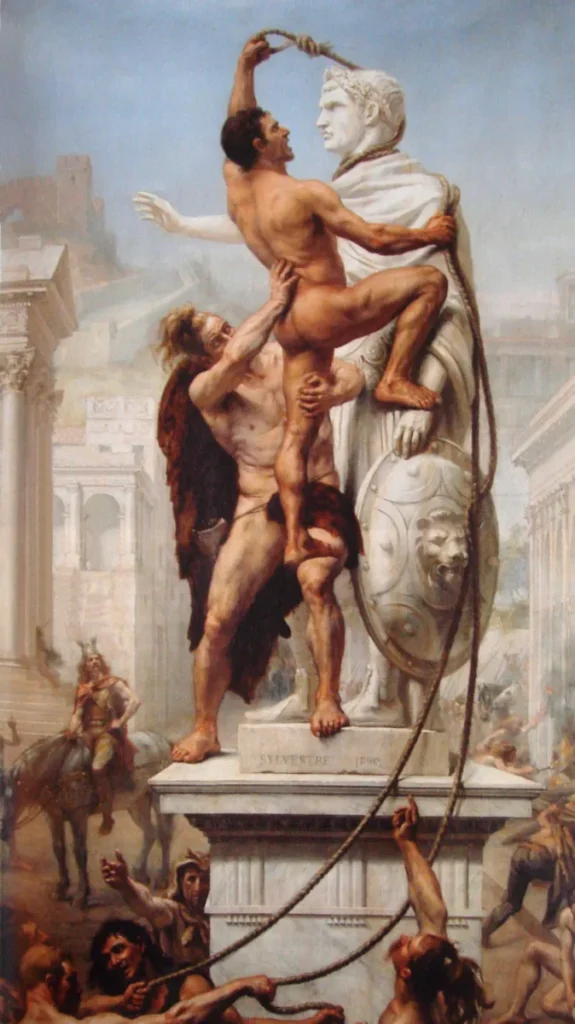
The first shock that many later writers saw as a “collapse of rome” in the West came in 410, when Alaric’s Visigothic army captured the city of Rome itself. According to late antique authors used by Neil Christie, Alaric used sieges and blockades of ports and canals to starve the capital of grain before forcing his way into the city.
The sack of 410 lasted only a few days, and archaeology in Rome suggests more looting and hostage‑taking than systematic destruction of buildings, yet the psychological impact was immense. For example, Augustine in City of God wrote partly in response to pagan claims that abandonment of traditional gods had led to disaster, while Orosius compiled an apologetic history that framed the sack within a longer sequence of wars and plagues.
Nevertheless, from a structural point of view, imperial government survived 410, and emperors continued to reign from Ravenna, while senatorial and ecclesiastical institutions persisted in Italy. In contrast, the real long‑term damage lay in the continued loss of secure tax bases and recruiting grounds in frontier provinces, as more regions fell under semi‑independent Gothic, Burgundian, and Frankish leaders.
455: Geiseric’s sack and the loss of Africa
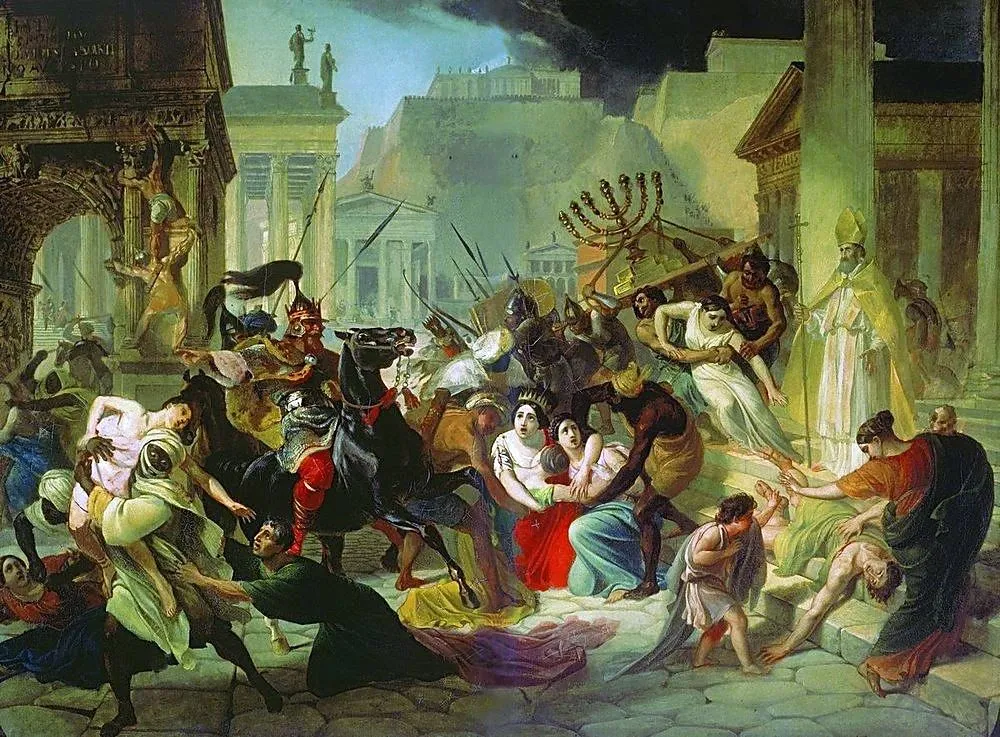
A second major milestone came in 455, when the Vandal king Geiseric seized Rome amid dynastic chaos following the murder of Emperor Valentinian III. The historian Priscus reports that Geiseric judged the old treaty void once Valentinian and his powerful general Aetius were dead, and he sailed from North Africa to Italy at a time when the western government lacked a strong army or fleet.
Geiseric’s forces entered Rome almost unopposed after the death of the usurper Petronius Maximus, then spent two weeks stripping the city of movable wealth and captives, including empress Eudoxia and her daughters. Victor of Vita later described long lines of captives taken to Africa, families split by sale and deportation, and bishops selling church plate to ransom freeborn Romans from slavery.
North Africa’s loss mattered even more than the treasures carried off in 455, because African grain and oil underpinned the western state’s finances and the food supply of Rome. Additionally, the Vandals seized Roman fleets and ports, established their own urban‑focused kingdom, and used naval power to raid Sicily, Italy, and even Greece, which further fractured the economic unity of the western Mediterranean.
Built out of a love for history, kept free from distractions.
Spoken Past is an independent project shaped by curiosity, care, and long hours of research. Reader support helps keep it maintained, carefully researched, and open to everyone.
476: When did the Western Roman Empire fall?
In a typical roman empire timeline used in classrooms, 476 CE appears as the key entry for the end of the western line of emperors, largely because of events in Italy around Romulus Augustulus and Odoacer 476 CE. After a series of weak emperors controlled by military strongmen, the general Orestes placed his young son Romulus on the throne in Ravenna, hoping to rule in his name.
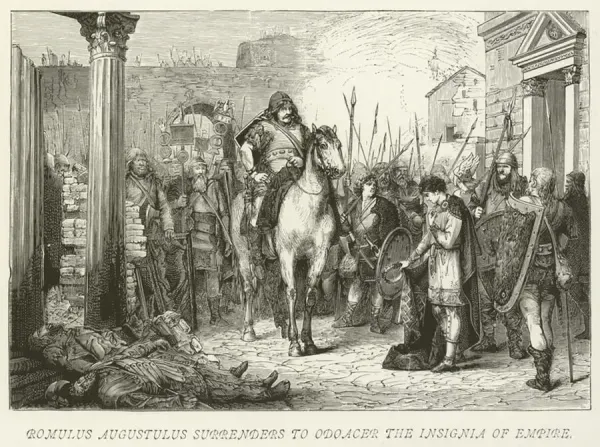
When Orestes could not satisfy his troops’ demands for more land, a commander of mixed “barbarian” background, Odoacer, led a revolt, killed Orestes, and forced Romulus Augustulus to abdicate in 476. Christie notes that Odoacer spared the boy’s life, granted him a comfortable pension and villa near Naples, and then chose to rule Italy as king rather than maintain a hollow western imperial court.
Odoacer sent the imperial insignia to the eastern emperor Zeno in Constantinople and had Italian elites declare that they no longer needed a separate western emperor, since one ruler in the East could represent both halves of the empire. In Gibbon’s classic narrative, this dethronement of Romulus Augustulus serves as the dramatic full stop for the fall of western roman empire, yet Christie stresses that institutions and daily life in Italy did not disappear overnight.
To show how different dates capture different aspects of the process, historians often highlight several candidates for the “fall”:
- 410 CE: Alaric’s sack of Rome, signaling that the capital could no longer rely on distant armies or inviolable status.
- 429–439 CE: Vandal conquest of North Africa and Carthage, which permanently cut a vital fiscal and grain supply base.
- 455 CE: Geiseric’s sack of Rome, demonstrating the city’s vulnerability to seaborne attack and Vandal naval power.
- 468 CE: Failure of the huge joint east‑west expedition against the Vandals, which exhausted remaining western resources.
- 476 CE: Deposition of Romulus Augustulus and end of a resident western emperor in Italy.
- 480 CE: Murder of Julius Nepos in Dalmatia, the last man with a plausible legal claim to the western purple.
Life in Italy under Odoacer
Although later writers often treated 476 as a clean break, Christie underlines that Odoacer governed Italy in recognizably Roman ways. He took the Roman title of patrician from Zeno, maintained the senate, applied Roman law, and minted coinage that still followed imperial models, while only some lesser coin series bore his own image.
Odoacer redistributed some land to his soldiers, especially in northern Italy, yet much agriculture still relied on local Italian landowners and tenants. Meanwhile, bishops and urban churches continued to act as key civic leaders, and Odoacer even negotiated with the Vandals to regain Sicily in return for tribute, restoring an important granary and shipping hub.
At the same time, Italy’s geographic reach shrank, as Odoacer withdrew remaining forces from provinces such as Noricum and ceded further Gallic territory to the Visigoths. The Life of St Severin by Eugippius gives a vivid picture of frontier communities along the Danube, where Roman troops and civilians faced pressure from Rugians and other groups, yet still clung to old Roman titles, forts, and Christian cult sites as long as they could.
Theoderic, Ravenna, and a Roman‑style Gothic kingdom
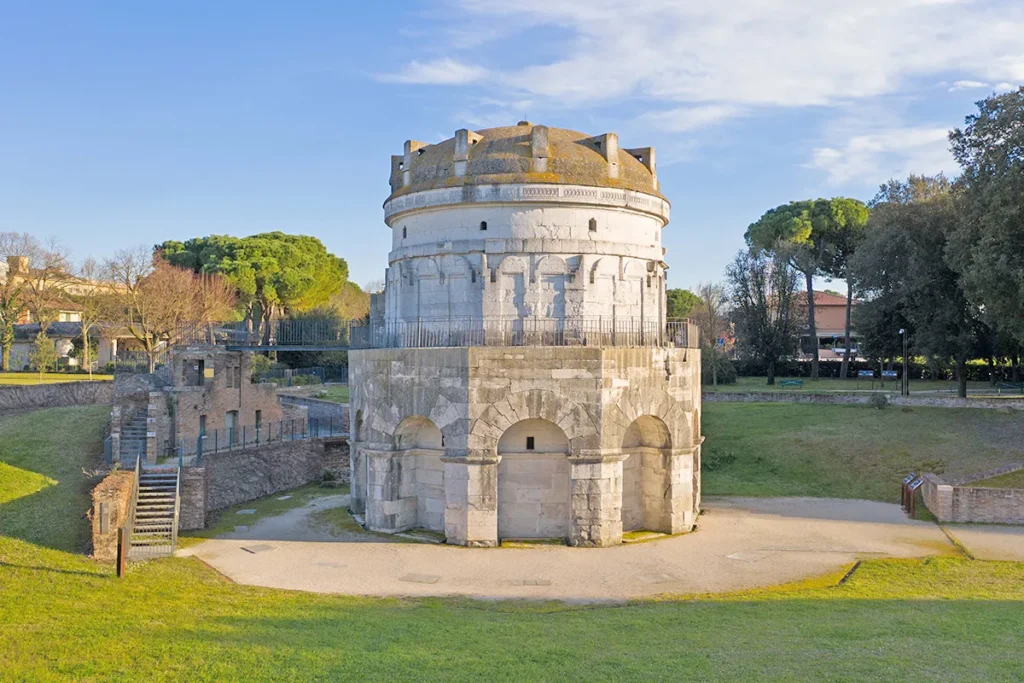
Events in the 470s and 480s also unfolded around the Ostrogoths, another Gothic group that had served as eastern Roman allies and enemies in turn. After years of conflict in the Balkans, Emperor Zeno encouraged the Ostrogothic king Theoderic to lead his people into Italy to remove Odoacer, in effect exporting a dangerous ally rather than confronting him near Constantinople.
Theoderic invaded Italy in 488, defeated Odoacer over several campaigns, and entered Ravenna after a negotiated truce, only to kill Odoacer at a banquet and assume full control. Nevertheless, Theoderic presented himself as a restorer of order, ruling as king but upholding Roman law, relying on Roman aristocrats and administrators such as Cassiodorus, and maintaining good relations with the senate.
Archaeology at Ravenna shows intense building under Theoderic, including churches, palaces, and city walls that used fresh marble and imported Eastern Mediterranean stone, rather than simply stripping older Roman structures. Similarly, the coexistence of an Arian Gothic cathedral with an Orthodox complex in the city illustrates how a Gothic royal court superimposed itself onto an existing Roman Christian urban landscape rather than sweeping it away.
A long ending in the Western provinces
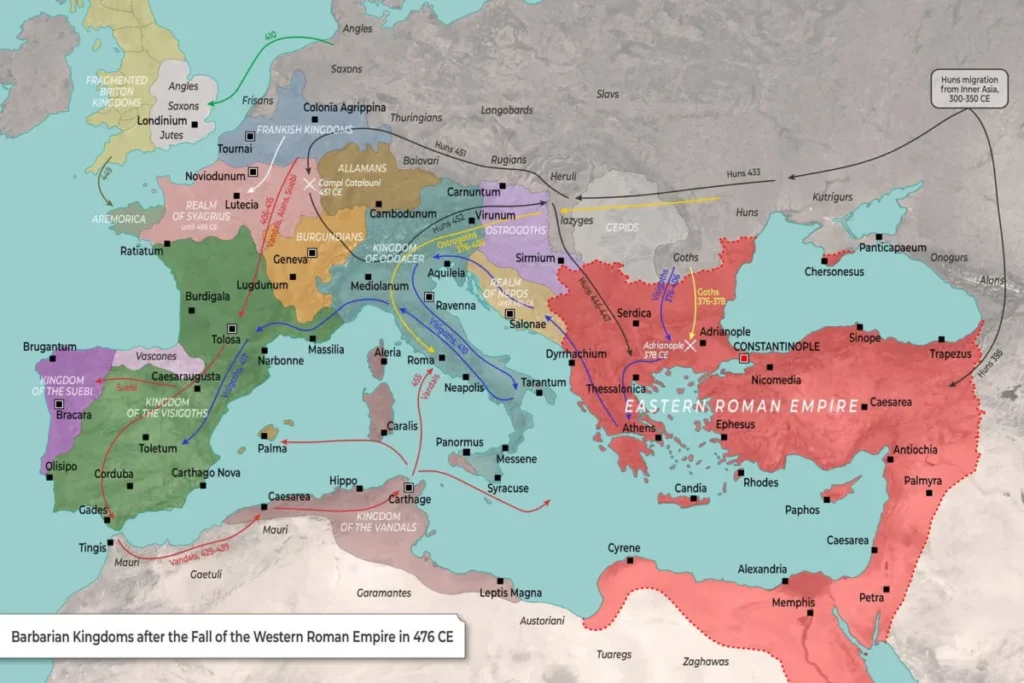
Beyond Italy, the “long ending” of Roman rule in the West varied dramatically from region to region, which is why answering precisely when did the western roman empire fall depends on where one looks. In Gaul and Spain, bishops like Hydatius and later Gregory of Tours describe Franks, Visigoths, and Burgundians using Roman titles, issuing Roman‑style law codes, and settling into former provincial spaces, even as civil wars and local massacres continued.
In North Africa, Vandal kings relied on Roman provincial elites, towns, and trade networks, even while persecuting Nicene clergy and diverting tax revenues to their own court. Similarly, in post‑Roman Britain and frontier regions such as Noricum, archaeology reveals smaller hilltop centers, local churches, and reused Roman town sites that signal both sharp economic contraction and stubborn continuity of memory.
Christie argues that, by about 500, most former western provinces functioned as separate kingdoms, yet many urban sites, Christian institutions, and legal habits still bore a strong Roman imprint, so the story mixes losses with transformations. Gibbon’s grand narrative of the decline and fall of the Roman Empire fixed 476 as a powerful symbol, yet even he filled volumes with the centuries‑long sequence of invasions, civil wars, and religious conflicts that led up to it, not a single momentary collapse.
Modern scholars therefore often speak of the fall of western roman empire as both a political event and a prolonged transformation across the third to sixth centuries, rather than a simple date on a line. So, when someone asks “when did the western roman empire fall,” 476 CE remains the clearest formal answer, but the real story stretches from earlier frontier crises to the rise of Gothic, Vandal, Frankish, and other kingdoms that carried parts of Rome into a new world.