
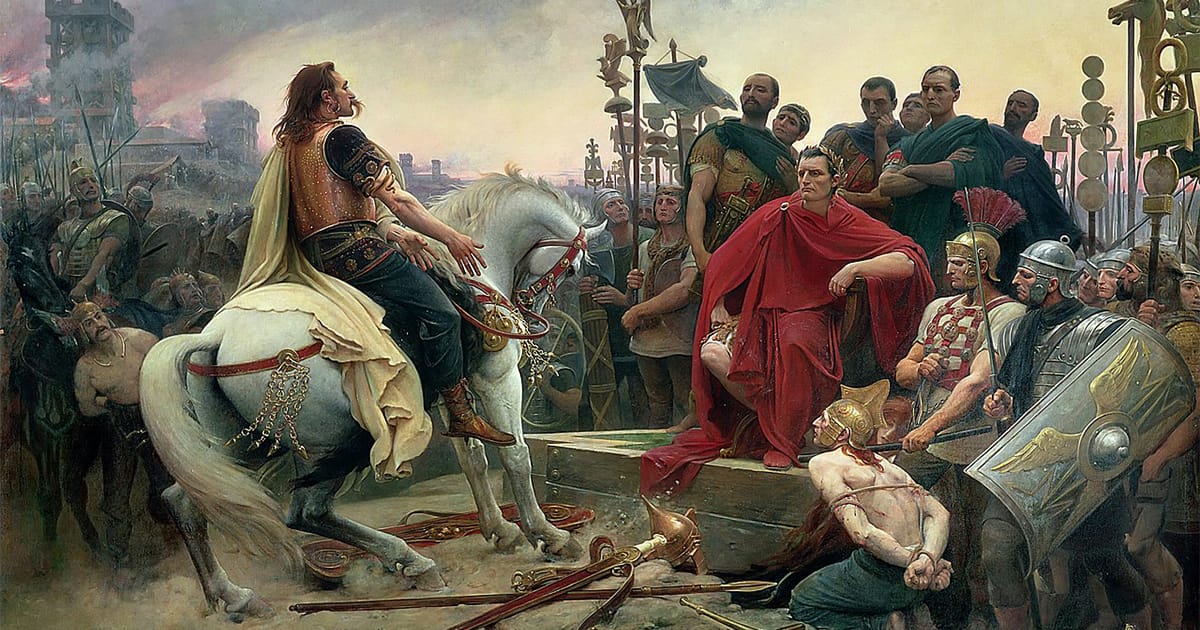
In 52 BCE, a Gallic chieftain named Vercingetorix surrendered his weapons to Julius Caesar at Alesia after a siege that had lasted two months and produced Roman casualties Caesar’s own account underreported significantly. When the event was later staged in Caesar’s Roman triumph of 46 BCE, Vercingetorix walked in chains through the Forum while actors carrying placards announced the conquest of Gaul to spectators who had been reading about it for years in Caesar’s own dispatches. The crowd already knew the story. They had been told it, chapter by chapter, in Caesar’s preferred version, long before the general returned to Rome to receive his honours. That gap between the event and its public representation, and the deliberate work Julius Caesar put into controlling everything that crossed it, is the subject of this article.
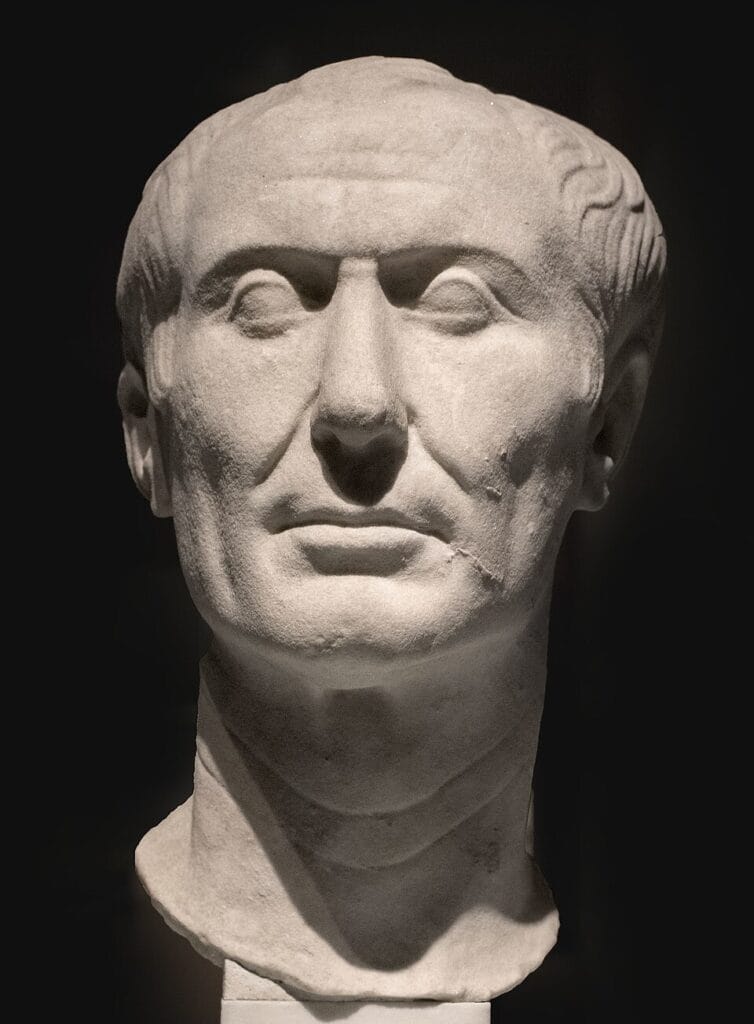
The Commentarii: How Julius Caesar Wrote His Own History in Real Time
The eight books of the Commentarii de Bello Gallico, composed between 58 and 50 BCE while Caesar was conducting the campaigns they describe, are among the most technically sophisticated pieces of political communication produced in the ancient world. The prose is deliberately plain: short declarative sentences, concrete vocabulary, almost no rhetorical ornament. That plainness was the strategy. Christopher B. Krebs of Stanford University, in his chapter for the Cambridge Companion to the Writings of Julius Caesar, demonstrates that Caesar’s stylistic choices were not the natural habits of a busy general but a calculated authorial programme designed to create the appearance of objective reportage while delivering a deeply partial account of events.
The most revealing technical choice was the third person. Caesar never wrote “I sent the cavalry.” He wrote “Caesar sent the cavalry.” The grammatical distance between author and actor created the impression that an impartial recorder was observing a great commander from outside, rather than that the great commander was writing his own press releases. Roman readers were sophisticated enough to know, intellectually, that Caesar was the author. The third person construction worked anyway because it created a reading experience of detachment that first-person narrative could not replicate. It is the same reason that modern politicians speak about themselves in the third person at press conferences: the form overrides the content.
Couriers carried completed sections of the Commentarii back to Rome in installments, where literate slaves read them aloud in the taverns and bathhouses through which Roman political information circulated. Enemy casualty figures in the text consistently dwarfed Roman losses. Tribal leaders who submitted to Caesar were described as wise and realistic. Those who continued to resist were labeled with vocabulary implying treachery or irrationality. Geography in the text was organised to make every battlefield sit near a river that formed a convenient natural frontier, presenting conquest as the establishment of defensible safety lines rather than personal military ambition dressed as strategic necessity. The language, as Krebs shows, performed the function of a modern political data visualisation: it took complex, morally ambiguous military events and rendered them as a simple story with a clear hero, a clear threat, and a clear outcome that had been inevitable from the start.
Spectacle at Scale: The First Triumvirate and Political Branding
Before Caesar had written a word of the Commentarii, he had already demonstrated a talent for transforming political transactions into public performances. His election as pontifex maximus in 63 BCE, defeating two significantly more senior candidates for the most prestigious religious office in Rome, was the culmination of a decade of deliberate public exposure built on borrowed money and prosecutorial theatre. Caesar funded a series of extortion trials against provincial governors in the 70s BCE using money borrowed from Marcus Licinius Crassus at interest rates that would have been alarming by any normal commercial standard. The verdicts, which he mostly lost, were less important than the venues. Trials were conducted in open-air courts in the Forum surrounded by spectators, and each dramatic cross-examination pushed his name into the private letter networks through which Roman political intelligence circulated.
The informal arrangement of 59 BCE among Caesar, Crassus, and Pompey was managed from the beginning as a series of staged public events. Pompey’s marriage to Caesar’s daughter Julia took place in a ceremony on the Capitoline steps in full view of the city. Grain distributions timed to coincide precisely with the vote on Caesar’s agrarian bill cost over twenty-three million sesterces in a single week, more than the combined annual income of most senatorial families. Contemporary sources noted that diners sent home from public banquets carried ceramic bowls impressed with a small figure of Venus, the first documented instance of mass-produced political merchandise distributed at genuinely popular scale. Each gift created a recipient who had now materially benefited from Caesar’s political programme, converting an abstract ideological alliance into a concrete economic relationship.
Money as Message: The Portrait Denarius of 44 BCE
The most technically audacious piece of political communication Caesar produced was also the smallest. In early 44 BCE, weeks before the Ides of March, he authorised the minting of silver denarii carrying his own portrait on the obverse, crowned with a laurel wreath, with the legend DICT PERPETVO running around the edge. Numismatic tradition in Rome had reserved living portraits on coinage for Hellenistic monarchs in the eastern kingdoms. No Roman statesman had ever placed his own face on Roman currency while alive. By breaking that convention, Caesar inscribed a specific constitutional claim into the physical medium of every financial transaction in the empire.
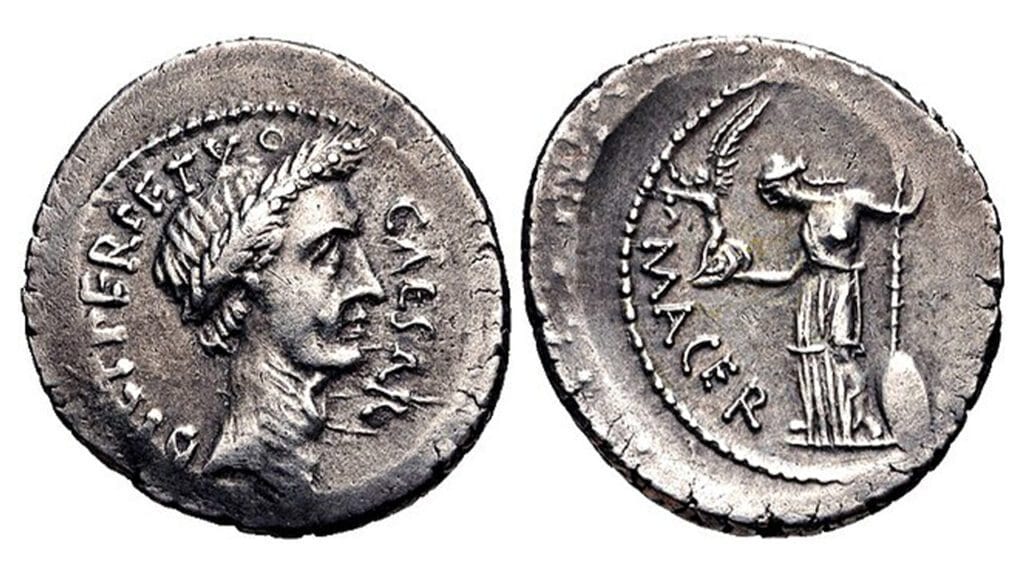
The British Museum’s collection of Caesar-era coinage documents several distinct issue types from this period, with reverse imagery varying between Venus Victrix, Aeneas carrying Anchises, and the priestly implements of the pontificate. Each reverse connected the obverse portrait to a different strand of Caesarian self-presentation: divine descent through Venus, Trojan ancestry through Aeneas, and religious authority through the pontifical symbols. Numismatists estimate that millions of examples were struck in under eight weeks, distributed through legion payrolls in Spain, Macedonia, and Syria. Each coin moved from soldier to innkeeper to farmer through the normal channels of commerce, carrying its constitutional claim to audiences who had never read a Commentarius and would never attend a triumph.
Built out of a love for history, kept free from distractions.
Spoken Past is an independent project shaped by curiosity, care, and long hours of research. Reader support helps keep it maintained, carefully researched, and open to everyone.
Architecture as Permanent Argument: The Forum Iulium and Curia Julia
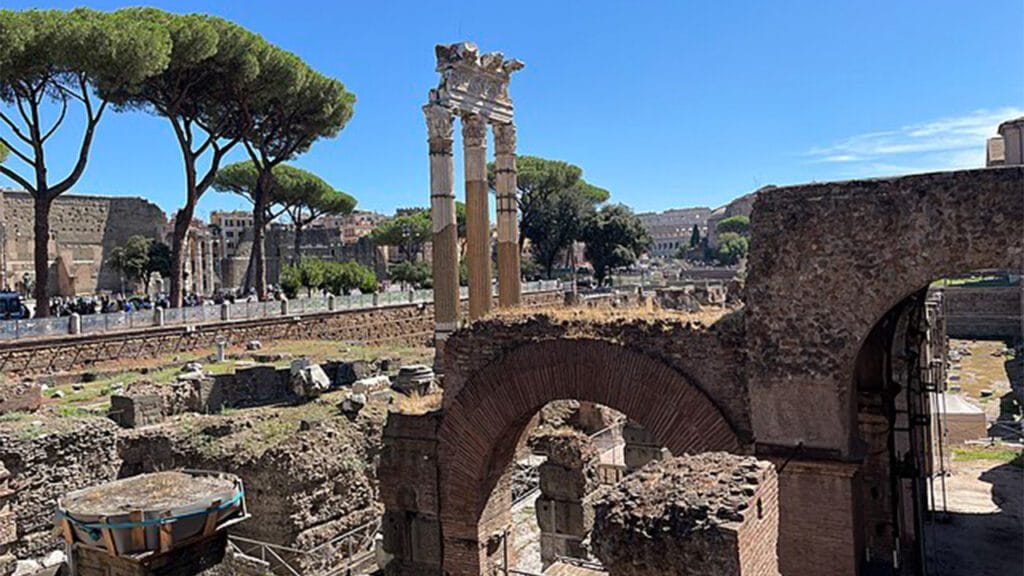
Money from the Gallic campaigns funded marble. Caesar began purchasing the land for his forum complex in 54 BCE, reportedly spending sixty million sesterces on site clearance alone before a single stone was laid. The Forum Iulium, dedicated on 26 September 46 BCE as part of the quadruple triumph celebrations, provided traders with new commercial colonnaded space while engineering every visitor’s sight line toward a cult statue of Venus Genetrix at the far end. The architectural sequence was not decorative. It was argumentative. You entered a commercial space, moved through it on its designed axis, and arrived at the divine ancestor of the Julian line. Commerce and genealogy occupied the same physical progression.
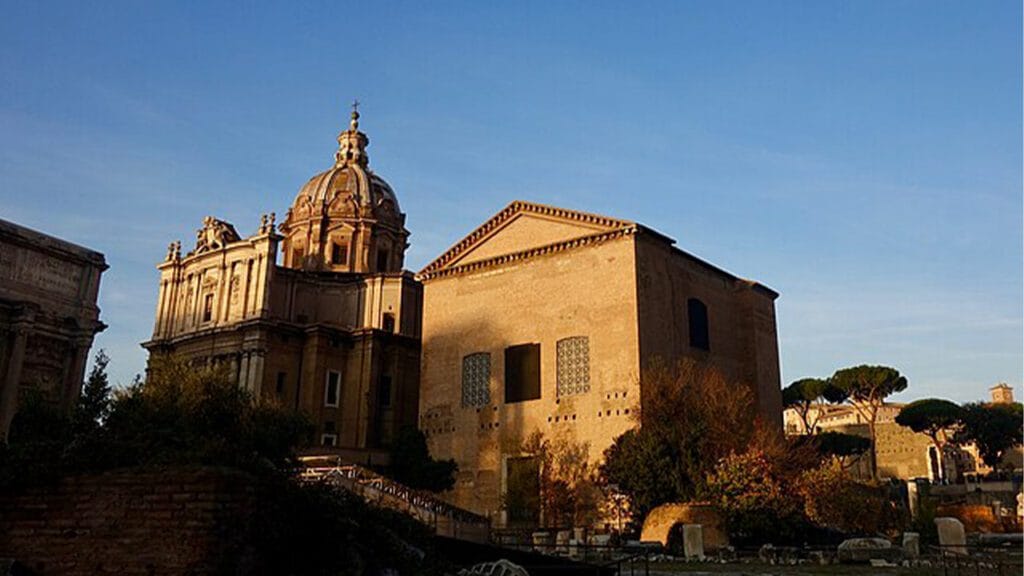
Adjacent to the forum, Caesar began construction of the Curia Julia, the new senate house, on a site alignment that positioned his personal rostra in visual dominance over the assembled senators. The carved reliefs on the structure depicted Aeneas carrying his father Anchises from the burning city of Troy, the founding myth that anchored Julian family claims to divine origin. Diana Kleiner’s analysis of Caesarian architectural propaganda in the American Journal of Archaeology documents how the entire forum complex created a physical environment in which conducting the Republic’s daily business meant moving through corridors of dynastic narrative before reaching one’s seat. To enter the Curia Julia was to walk into an argument about who Rome’s natural rulers were, rendered in permanent stone rather than ephemeral text.
Clemency, the Acta Diurna, and the Rubicon Narrative
After Pharsalus in 48 BCE, Caesar’s enemies expected confiscations and executions as the standard consequence of backing the losing side in a Roman civil conflict. Caesar did something more structurally damaging to the Republic: he forgave them publicly and made sure everyone knew. Letters of thanks from Marcus Junius Brutus and from Cicero were allowed to circulate through Roman letter networks. Invitations to dinner, extended to men who had commanded armies against him, were accepted in public and discussed in private correspondence that Caesar knew would be preserved and copied. Clementia, the quality of leniency toward those in one’s power, was traditionally a right of the Roman people exercised through its tribunes, not of any individual magistrate. By performing it at the scale of an institution, Caesar absorbed a collective civic virtue into his personal political identity in a way that no constitutional grant of power could have achieved.
In 59 BCE, as consul, Caesar had formalised the Acta Diurna, the daily official gazette posted on whitened boards in the Forum. Suetonius confirms the origin in his Life of the Deified Julius, noting that Caesar ordered the acts of both the senate and the people to be compiled and published daily. Under his direction, military dispatches from Gaul joined the same noticeboard as marriage announcements and gladiatorial schedules, giving frontline propaganda the identical institutional legitimacy as civil administration. A merchant arriving from Carthage or Antioch encountered Caesar’s version of events in Gaul on the Forum noticeboard before he had spoken to a single returning soldier, guaranteeing that the commander’s framing preceded every competing account.
The Rubicon crossing of January 49 BCE was managed the same way. Caesar sent proclamations into every Etruscan hill town and Adriatic port ahead of the army, declaring that the Senate’s tribunes had been illegally threatened and that he marched to restore constitutional order rather than seize personal power. Pompey’s headquarters responded days behind, permanently playing narrative catch-up in a conflict where the first version of events consistently set the terms of all subsequent interpretation. Within three months Spain had surrendered without a major engagement, and Caesar attributed the outcome to local enthusiasm for his cause rather than to the speed of his legions, shaping the historical record before any alternative account had the time to establish itself.
The Assassination and the Story That Outlasted It
On the Ides of March, 44 BCE, twenty-three senators stabbed Julius Caesar twenty-three times in the portico of the Theatre of Pompey. The conspirators had spent months planning the act and almost no time planning the morning after. Mark Antony moved into the resulting silence immediately. At the public funeral, he displayed the blood-soaked toga on the Rostra and read aloud the provisions of Caesar’s will: his private gardens on the Tiber bequeathed permanently to the Roman people, three hundred sesterces to every Roman citizen. Plutarch and Appian both record what followed in the crowd. The conspirators, who had prepared a constitutional argument but not a communications strategy, found themselves answering a question they had not anticipated: whether a man who had given Rome his gardens could reasonably be called a tyrant.
The rumour networks that Caesar’s apparatus had spent two decades cultivating continued operating without him and in his favour. Brutus had been spared after Pharsalus by Caesar’s explicit clemency. That fact, circulating through tavern conversation and private letters in the days after the assassination, reframed his participation in the killing from principled republican resistance into personal betrayal of received mercy. The Senate moved to outlaw tyrannicide graffiti but copies of the will had already spread through the apartment buildings of the Subura. Augustus, adopting the Julian name and claiming the inheritance, spent the following fifteen years mining the accumulated image bank: the laurel coins, the Venus cult, the Julian calendar reform of 46 BCE whose name for the seventh month still carries Caesar’s in the word July. He presented himself not as the founder of a new political system but as the man completing what his adoptive father had already begun. The Commentarii, available in full at the Perseus Digital Library at Tufts University, remain the opening document of that unfinished programme, the first chapter of a story whose final chapter would be written by emperors who understood that Caesar had already shown them how.