
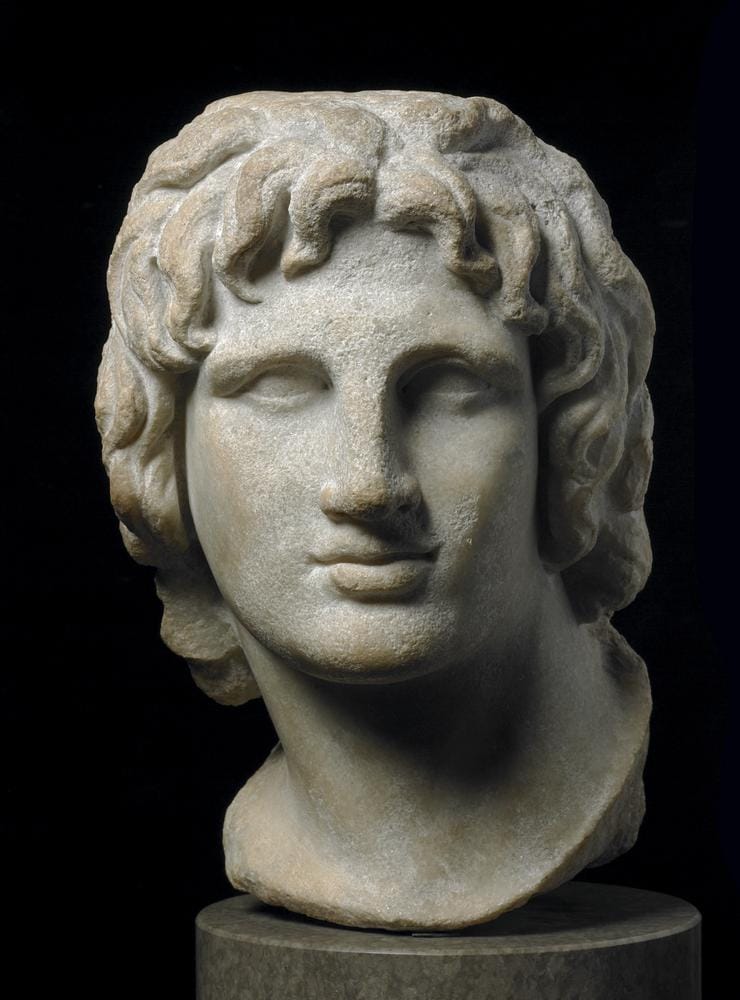
A marble bust in the Istanbul Archaeological Museum, carved in the late fourth century BCE and likely based on portraits made during his lifetime, shows a young man with his chin tilted upward and his hair swept to one side in the anastole style that Alexander’s court sculptor Lysippos made into the king’s visual signature. That image has been reproduced so many thousands of times that it now precedes the man. Before anyone reads a sentence about Alexander the Great, they have already formed an impression shaped by two thousand years of mythmaking, Roman nostalgia, Renaissance glorification, and modern popular culture, and that impression is wrong in several specific and demonstrable ways. This article examines what the five major ancient sources, the battlefield evidence, and the medical literature actually tell us about the Macedonian king who conquered Persia in eleven years, founded over twenty cities, and died at thirty-two in Babylon having never lost a pitched battle.
What the Legends Say and What the Sources Actually Show
The myth of Alexander the Great begins with his birth and does not stop at his death. Olympias, his mother, told him from childhood that Zeus himself had fathered him in the form of a serpent, a claim Alexander appears to have deployed selectively as political branding rather than private belief. When the oracle of Amun at Siwa in Egypt greeted him as son of the god in 331 BCE, Alexander absorbed the title without visible irony and immediately issued coins and propaganda that used it. Whether he believed it privately is unknowable. What the sources make clear is that he understood the cognitive value of divine parenthood in cultures where kings required divine legitimacy to govern, and he performed the belief with the same tactical intelligence he applied to everything else.
The most repeated legend about Alexander, that he wept because there were no more worlds to conquer, does not appear in any of the five primary sources. Arrian, whose Anabasis of Alexander drew on the eyewitness accounts of Ptolemy and Aristobulus and is the most reliable text we have, records nothing of the kind. Plutarch, writing six centuries after the events, attributes the sentiment to a philosophical demonstration by Anaxarchus about infinite parallel worlds, which Alexander reportedly found moving for entirely different reasons. The weeping conqueror is a Roman-era invention that tells you more about Roman anxieties about imperial overreach than about anything Alexander said or felt. The actual moment when Alexander turned back, at the Hyphasis River in 326 BCE, was driven by a genuine army mutiny and a run of unfavourable sacrificial omens. He sulked in his tent for three days and then accepted the reality that the men who had been marching for eight years would not go further east.
The claim that he was completely undefeated requires a similar qualification. He was undefeated in pitched battles between organised armies, which is the format for which ancient generalship was evaluated. He was not undefeated in every engagement. He was wounded seriously multiple times in sieges and skirmishes, most critically at the Mallian town in India in 325 BCE, where an arrow pierced his lung and he fell inside the walls with only a handful of men around him. The wound came close to killing him. His survival owed more to the immediate response of his bodyguard Peucestas than to any divine protection. “Undefeated” is accurate for one specific format of warfare. As a summary of a life that included botched siege assaults, devastating logistical failures, and the deaths of thousands of his own men from preventable causes, it requires careful handling.
Pella and the Education That Made Him Dangerous
Macedonia in 356 BCE was a frontier state that the Greek city-states of the south regarded with a mixture of envy and contempt. King Philip II had survived an arrow through his eye socket during the siege of Methone, lost the sight in that eye permanently, and emerged as one of the ancient world’s most tactically inventive generals. His central innovation was the sarissa, an infantry pike between fifteen and eighteen feet long, too long and heavy for individual combat but devastating when held in a tightly drilled phalanx six men deep. Polybius, writing a century and a half later, described the resulting wall of overlapping bronze points as a formation that no cavalry charge could break from the front and no infantry could reach without dying in the outer three ranks first. Philip built the weapon system. Alexander built the mind that would use it in ways Philip had not imagined.
Aristotle arrived at the Macedonian court when Alexander was approximately thirteen and tutored him for three years at the sanctuary of the Nymphs at Mieza. The curriculum was designed for command. Botany identified medicinal plants under different climatic conditions, directly relevant to campaign surgeons operating thousands of kilometres from home. Meteorology determined campaign seasons and the annual windows when mountain passes became passable. Ethics provided a philosophical vocabulary for the civilising mission Alexander would later use as imperial justification. Aristotle gave him an annotated copy of the Iliad that Alexander reportedly kept in a jewelled casket taken from Persian spoils alongside a dagger, treating it as an object his education had prepared him to value for the same reason: beautiful and operationally useful simultaneously.
The taming of Bucephalus, documented by Plutarch, demonstrates Alexander’s method in miniature. The horse feared its own shadow, shying violently on bright days. Alexander turned Bucephalus to face the sun, eliminating the shadow, then mounted him. Philip reportedly told his son that Macedonia was too small a kingdom for him. Whether the scene happened exactly as Plutarch describes six centuries later hardly matters. It captures a pattern that runs through every major decision of the campaigns to follow: identify the specific mechanism generating the obstacle, eliminate it, then act. He read the horse the way he would later read armies, cities, and mythologies.
The Campaigns: What He Actually Did and How He Did It
In spring 334 BCE, Alexander crossed the Hellespont with approximately forty-seven thousand men and the operating principle that Asia’s wealth would pay Macedonia’s wages. His first act on Asian soil was theatrical: he hurled a spear into the beach to claim the continent as spear-won land, then detoured to Troy to make offerings at the tomb of Achilles. This was not nostalgia. It was advertising, designed to frame the campaign as the fulfilment of Homeric destiny in the minds of observers across the Greek world before a single Persian had been killed. Every subsequent piece of propaganda he issued built on that frame.
The Battle of the Granicus River established the tactical pattern he would refine over the next decade. The Persian satraps defending Asia Minor had positioned their cavalry at the top of a steep riverbank, expecting a conventional Greek infantry-first advance. Alexander sent the Companion Cavalry directly across the river at an oblique angle, generating a contact line that disrupted the Persian formation before it could exploit its height advantage. A Persian nobleman named Spithridates cut through Alexander’s helmet crest with a curved scimitar and was about to deliver a killing blow when Cleitus the Black drove a spear through Spithridates’ raised arm. It was the first recorded instance of Alexander placing himself in personal danger that most commanders would have considered operationally unnecessary. The pattern would repeat throughout the campaigns and would eventually produce the arrow wound at the Mallian town that nearly ended everything.
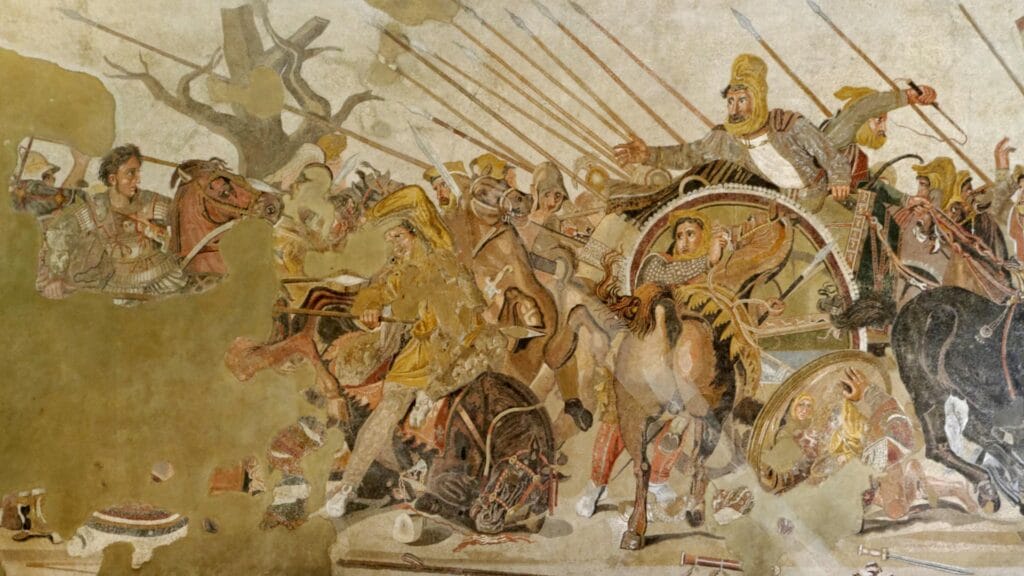
At the Battle of Issus in November 333 BCE, Darius III handed Alexander the victory before the armies met by choosing a coastal plain between the sea and the Cilician mountains, no more than two and a half kilometres wide at its narrowest point. That width eliminated the Persian numerical advantage entirely. Alexander’s smaller army could not be outflanked because there was no room. Alexander led the Companions in a diagonal charge that broke the Persian left and drove at Darius’s golden chariot. Darius fled. His mother, wife, and daughters were captured and treated by Alexander with complete royal dignity, a decision that was simultaneously humane and calculated to reach every court between the Aegean and the Indus with the same message.
The siege of Tyre in 332 BCE is one of the most technically ambitious military operations in ancient history. Tyre was an island city half a kilometre offshore with walls thirty metres high on the seaward face. Alexander ordered the construction of a causeway from the mainland to the island, a project that took seven months, required the demolition of the entire old mainland settlement for rubble, and demanded constant engineering adaptation as construction moved into progressively deeper water. Siege towers mounted on ships provided elevated fire platforms. Tyrian divers cut anchor cables during the night. When the walls finally fell in July 332 BCE, Alexander executed approximately eight thousand defenders and sold thirty thousand into slavery. The severity was a message addressed to every city still calculating whether to resist.
Built out of a love for history, kept free from distractions.
Spoken Past is an independent project shaped by curiosity, care, and long hours of research. Reader support helps keep it maintained, carefully researched, and open to everyone.
Gaugamela: The Battle That Actually Won the Persian Empire
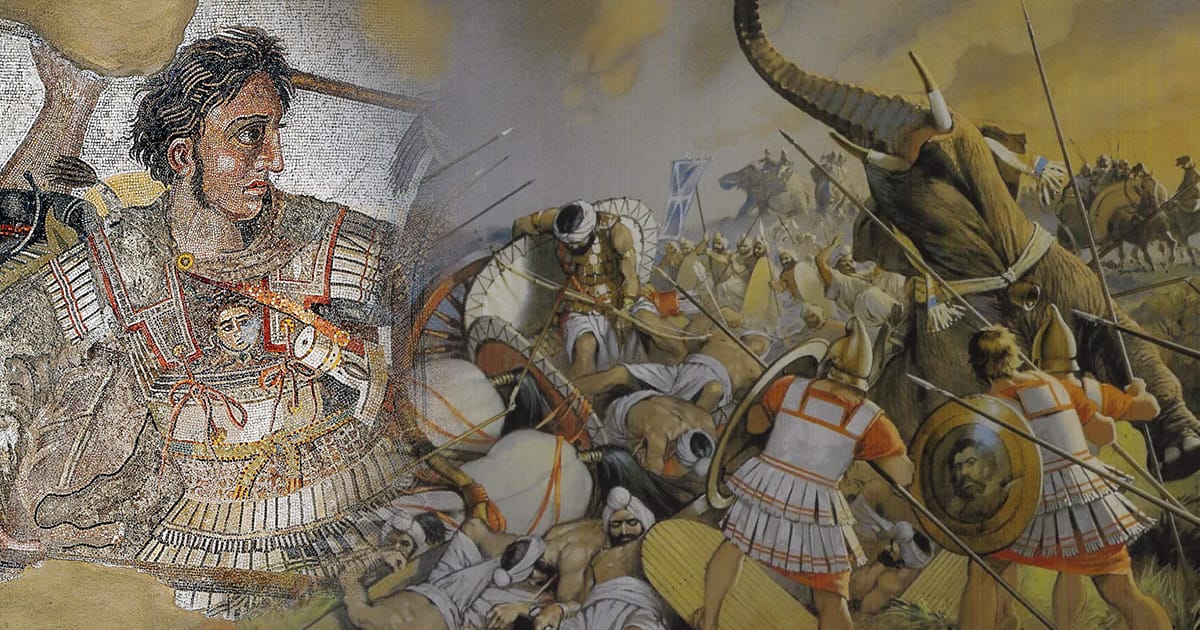
At Gaugamela on 1 October 331 BCE, Darius III had chosen his ground carefully. The plain near modern Erbil in northern Iraq was flat and cleared of obstacles to give his scythed chariots a clean run, wide enough for his cavalry to attempt encirclement on both flanks. Modern historians place his effective strength at between sixty thousand and one hundred thousand men. Alexander commanded approximately forty-seven thousand. The tactical problem was that any conventional advance would be outflanked on both sides by the sheer width of the Persian line, and Alexander had to solve it before the engagement began.
His solution was an oblique advance to the right that forced Darius to extend his left wing to match and stretched the Persian formation, introducing gaps between units that had not existed at the start. When the Companion Cavalry had drawn enough Persian horsemen out of position to open a seam in the Persian centre, Alexander led the Companions and the elite hypaspist infantry in a dense wedge formation directly at Darius’s gilded chariot. The scythed chariots, Darius’s planned shock weapon, had already been neutralised by a drill Alexander had prepared in advance: his infantry opened lanes in the formation when the vehicles charged, allowing them to pass through harmlessly while javelin throwers and light infantry cut down the drivers on either side. This required mass physical coordination under direct attack that no improvised army could replicate. Darius, seeing the wedge closing, fled. The Persian army collapsed around his absence.
Babylon opened its gates within days. Susa followed. Persepolis fell in January 330 BCE. Whether the palace burned there in a drunken revel instigated by the Athenian courtesan Thais, as Diodorus and Curtius describe, or as deliberate theatre of regime change, as Arrian implies, is a genuine scholarly debate without a clean resolution. What both camps agree on is that the fire served Alexander’s political purposes regardless of its origin. It announced the end of Achaemenid rule more effectively than any proclamation, and he was declared King of Asia at the Esagila temple in Babylon shortly afterward with the administrative machinery of the Persian Empire largely intact and working under new management.
The Private Man Behind the Legend
The ancient sources preserve enough detail about Alexander’s personal relationships to complicate the marble bust considerably. Hephaestion, his closest companion from childhood and fellow student at Mieza, occupied a position in Alexander’s life that ancient sources describe with varying degrees of explicitness and that modern scholars have debated for two centuries. What survives beyond the debate is the intensity. When Hephaestion died of fever at Ecbatana in 324 BCE, Alexander’s grief was public, prolonged, and administrative: he ordered the mane and tail of every horse in the army cut short, banned flutes and music throughout the camp, executed the physician who had failed to save Hephaestion, and sent to the oracle at Siwa asking whether Hephaestion should be worshipped as a god or honoured as a hero. The oracle said hero. Alexander ordered hero shrines built in every major city of the empire.
The killing of Cleitus the Black at a drunken banquet in Samarkand in 328 BCE shows a different register. Cleitus, the man who had saved Alexander’s life at the Granicus, mocked Alexander’s Persian courtly manners and his adoption of divine pretensions during a drinking session. Alexander, drunk and enraged, threw a spear through him. The remorse that followed was genuine and prolonged. He refused to eat or drink for three days and had to be talked back to functioning by his companions. The episode is significant not because a king killed a general in a drunken rage, which was not historically unusual, but because of what it reveals about what Alexander had become by 328 BCE: a man in whom military brilliance, absolute power, physical courage, and a hair-trigger temper under alcohol had fused into something genuinely dangerous to everyone around him, including the people he loved.
The proskynesis controversy in 327 BCE, in which Alexander attempted to introduce the Persian court custom of prostrating oneself before the king and was publicly resisted by the Greek members of his court, including the historian Callisthenes, Aristotle’s nephew, captures the central tension of the later campaigns. Alexander had spent a decade absorbing the cultural identities of every people he conquered, functioning simultaneously as Macedonian king, Greek hegemon, Egyptian pharaoh, and Persian Great King. The Macedonians and Greeks in his court found this flexibility increasingly intolerable. Callisthenes refused to prostrate himself, was later implicated in a conspiracy, died in custody, and became a martyr figure for the Greek officers who resented the empire Alexander was building. The empire required cultural synthesis. The men who had conquered it on horseback wanted their king to stay Macedonian.
Death in Babylon and What the Medical Evidence Actually Shows
On 10 June 323 BCE, a Babylonian astronomical diary recorded the death of a great king in the palace of Nebuchadnezzar II. Alexander the Great was thirty-two years old. He had been ill for twelve to fourteen days following a drinking party. The royal diaries, the closest thing we have to a contemporary medical record, detail high fever, progressive weakness, difficulty speaking, an expressionless face, and gradual loss of consciousness across several days. That symptom progression is the primary evidence in the scholarly debate about his cause of death, and it has generated two serious competing hypotheses.
Researchers David Oldach and colleagues at the University of Maryland, in their peer-reviewed clinical analysis published in the New England Journal of Medicine, concluded that the symptom picture most closely matches typhoid fever caused by Salmonella typhi, which was endemic in Babylon where sewage and water systems were not separated. The key clinical feature they identify is the typhoid state, an expressionless delirium that ancient sources describe in terms matching the presentation precisely. John Marr and Charles Calisher, in a subsequent paper in the CDC journal Emerging Infectious Diseases, proposed West Nile encephalitis, citing the mass death of ravens outside Babylon’s walls shortly before Alexander’s illness, an event Plutarch records. Both hypotheses are more consistent with the clinical timeline than poisoning, which the ancient sources raised and popular culture has amplified. Toxins capable of killing a healthy thirty-two-year-old do not require eleven days to do so.
His reported final words, “to the strongest,” appear only in sources written two centuries or more after the fact and compress an administrative catastrophe into four convenient words. What actually happened was that his senior commanders met immediately after his death and could not agree on a successor. Perdiccas assumed interim guardianship of the empire. Ptolemy hijacked the funeral cortege on its way to Macedonia and rerouted it to Egypt, where the body became a political relic visited by Julius Caesar, Augustus, and Caligula over the following three centuries. The empire fractured into the Ptolemaic kingdom in Egypt, the Seleucid Empire across Asia, the Antigonid dynasty in Macedonia, and a series of hybrid Greco-Bactrian kingdoms that sent Buddhist sculptures wearing Greek clothing as far east as Gandhara. The Hellenistic world that followed connected the Aegean to the Indus Valley in a single linguistic and commercial network that shaped every major civilisation that came after it.