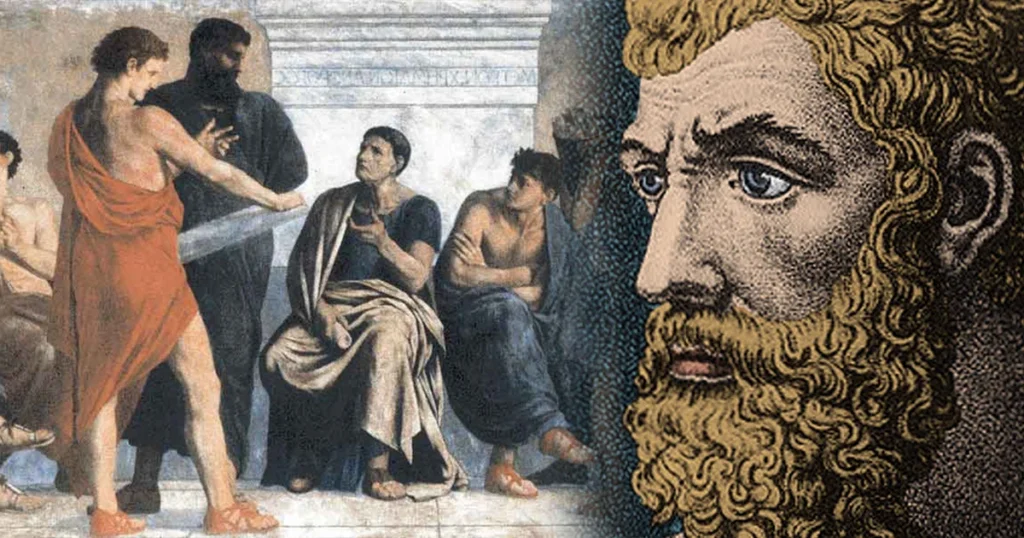
The Athenian ephebeia was a period of military service and civic training for young male citizens of Athens. In the late fourth century BCE, an eighteen-year-old whose citizenship had been approved could spend the next two years under public supervision, learning to use weapons, guarding the harbour and patrolling the countryside of Attica. These young men were called ephebes, from the Greek word for someone who had reached young manhood. The programme belonged to a city whose political system depended on citizens serving as soldiers as well as making decisions in the assembly and law courts.
The best-documented version of the ephebeia operated between about 335 and 322 BCE. Athens had been defeated by Philip II of Macedon at Chaeronea in 338 BCE, and Macedonian power increasingly constrained its independence. The Athenians nevertheless invested public money in training a new generation to defend their territory. Their first year centred on the fortified port of Piraeus; their second took them through the rural forts and border districts of Attica. The training linked the city, its harbour, its sanctuaries and the land on which its food and security depended.
The surviving evidence also shows why the institution needs careful explanation. An ancient constitutional account describes its officers, rations, weapons and legal rules in unusual detail, while inscriptions preserve the names of ephebes and the oath they swore. Earlier Athenians had served as young patrolmen, but historians disagree about whether those men belonged to an institution identical to the later ephebeia. The programme also changed dramatically after Macedonian intervention. By the Hellenistic and Roman periods, the same name referred to a shorter and increasingly selective education that still preserved military exercises and public religious duties.
Who Could Become an Athenian Ephebe?
The first step was enrollment in a deme, one of the local communities through which Athenian citizenship was recorded. In the fourth century BCE a legitimate citizen father alone was insufficient. Since the citizenship law associated with Pericles, normally both parents had to be Athenian citizens. At eighteen, the young man’s fellow demesmen voted under oath on his age and legal birth. The city council then examined the registration, a process known as dokimasia, or scrutiny. This was a public judgment about membership of the citizen body, with real consequences for the person being examined.
The surviving account in the Constitution of the Athenians, chapter 42, says that a candidate judged too young was sent back to the boys’ age group. A person rejected as not freeborn and properly entitled to citizenship could appeal to a court. Its description of the penalty for a failed appeal is severe: the state could sell the unsuccessful claimant into slavery. The passage is evidence of how jealously Athens policed citizenship, although it cannot tell us how frequently that extreme outcome occurred.
Women, enslaved people and resident foreigners, called metics, were outside the fourth-century citizen ephebeia. Athenian democracy was participatory for a restricted male citizen population, and military service reflected that exclusion. Within the eligible group, the state’s provision of maintenance and equipment reduced some barriers faced by poorer citizens. That did not erase differences in family wealth, health, influence or opportunities. Nor can we assume from the law alone that every eligible young man completed service in practice. Scholars have debated the actual participation rates using surviving rosters and estimates of the citizen population.
It is misleading to say that ephebes became citizens only after graduation. The constitutional text places their enrollment at eighteen, before training began. During the following two years they were already registered citizens, but their service restricted the exercise of certain legal and civic activities. At the end, the text says, they took their place among the other citizens. The distinction matters: the ephebeia trained a newly admitted citizen to undertake the full responsibilities of adulthood; it was not simply a school awarding citizenship to someone who previously lacked it.
Was the Ephebeia Founded in 335 BCE?
Athenians had been sending young men to guard roads, countryside and frontier posts long before the famous two-year programme. The orator Aeschines, quoted in a scholarly epigraphic commentary, who was born around 390 BCE, claimed that he spent two years as a peripolos, a patrolman, in the 370s and could call his fellow ephebes and officers as witnesses. In 411 BCE, during the Peloponnesian War, Thucydides mentions men of the peripoloi and their commander. These references show earlier forms of organised patrol service, but they do not describe the entire administrative and educational system set out in the later constitutional account.
The distinction remains disputed. John L. Friend’s study of the fourth-century institution argues for a formal creation around 335 BCE, while Nicholas Sekunda, reviewing Friend’s book and its inscriptions, maintains that the earlier evidence cannot be dismissed so easily. A useful way to express the evidence is that the extensive, state-financed ephebeia is securely documented from the 330s, even if some of its duties, terminology and ceremonies are older. The surviving oath itself is called ancestral, which says something about how Athenians presented the institution, but does not date every element of its training system.
A law associated with a politician named Epicrates is often connected to the reform of 335 BCE. The precise political motivation is debated. The defeat at Chaeronea three years earlier had exposed Athens’ vulnerability, and Alexander’s destruction of Thebes in 335 BCE made the consequences of Macedonian power unmistakable. Both events form part of the background, but there is no surviving official statement that proves a single cause for the reform. The programme developed under the political and financial leadership of Lycurgus, an Athenian statesman active after Chaeronea, who was not the legendary Spartan lawgiver of the same name.
The stone records are especially valuable here. A dedication made by ephebes enrolled in 334/3 BCE names a tribal officer and the generals responsible for Piraeus and the countryside. Another dedication of 333/2 BCE records ephebes honouring senior commanders. Such documents show actual cohorts, officials and public honours rather than a later author’s reconstruction. They are also the reason the programme can be dated much more confidently in the 330s than in earlier centuries.
How Athens Organised Two Years of Training
The ephebes did not form an independent army led by private tutors. Their supervisors were selected through civic institutions. According to the Constitution of the Athenians 42.2–4, fathers from each of the ten tribes nominated three suitable men over forty, and the assembly elected one sophronistes, usually translated as a supervisor or controller, from each tribe. A single kosmetes oversaw the entire group. The assembly also elected two athletic trainers and instructors in the use of specific weapons.
The tribal arrangement mattered because Athenian citizens were organised politically and militarily into ten tribes. Training and eating alongside men from one’s tribe made the unit manageable and brought together young citizens from different demes. The sophronistai received a daily allowance of one drachma, and each ephebe received four obols for maintenance. Since a drachma contained six obols, the figures show a defined public budget for the programme, not simply an expectation that each family would pay all the costs. The supervisors collected the allowance for their tribes and purchased common provisions.
During the first year, the ephebes visited the city’s sanctuaries and moved to Piraeus, the fortified port several kilometres southwest of Athens. Some guarded Munychia, a strategic hill and harbour area; others guarded Acte, the coastal promontory of the port. The harbour housed Athens’ naval installations and connected the city to trade, imported grain and military shipping. A young man’s service there placed him at a point that mattered to the city’s survival. The ancient text describes guarding as part of the first year, so the tidy modern division between a year of classroom training and a year of real duty is too sharp.
Athenian sources do not preserve an ordinary ephebe’s daily timetable. We know the officials, broad activities, pay and places from formal records. We do not know exactly when each recruit woke, how often he practised a particular exercise, what he ate at every meal or how officers punished routine misbehaviour. Accounts that confidently reconstruct fixed morning swimming sessions or daily weapon drills go beyond what this evidence establishes.
The Ephebic Oath and What It Required
The ephebic oath bound young Athenians to defend their fellow citizens, obey the city’s laws and honour its ancestral cults. Its fullest fourth-century inscription was dedicated by a priest at Acharnai, a deme north of Athens. The stone, dated approximately 335–325 BCE, preserves both the ephebic oath and another oath presented as having been sworn before the battle of Plataea. The inscription and its annotated translation allow us to read the civic promise without relying entirely on later summaries.
The oath begins with the duty not to disgrace sacred weapons or abandon the person standing beside the speaker in the line. It promises to defend sacred and lawful things, to pass the homeland on in a better condition, to obey lawful authorities and to resist attempts to destroy the laws. It ends with an obligation to honour ancestral religious practices. Its language joined battlefield solidarity to the political survival of the city. The commitment to defend the laws was particularly pointed in a Greek world where coups, external intervention and changes of constitution were familiar dangers.
The Acharnai inscription invokes Aglauros, Hestia, Enyo, Enyalios, Ares, Athena Areia, Zeus, Thallo, Auxo, Hegemone and Heracles, as well as the boundaries of the homeland and its crops: wheat, barley, vines, olives and figs. These witnesses reveal a conception of civic duty extending from divine protection to the actual territory and agriculture of Attica. The land was not an abstract patriotic symbol. Its fields and boundary forts were precisely what ephebes might be ordered to defend.
The orator Lycurgus invoked the oath in his prosecution of Leocrates around 330 BCE. Leocrates had left Athens after Chaeronea, and Lycurgus argued that this departure violated the promises made by a citizen. The argument is preserved in the scholarly discussion of Against Leocrates 76–79 in Jon Mikalson’s Religion in Hellenistic Athens. Lycurgus was an advocate trying to persuade a jury, not a neutral observer; his use of the oath demonstrates its political force without proving that every charge he made was fair.
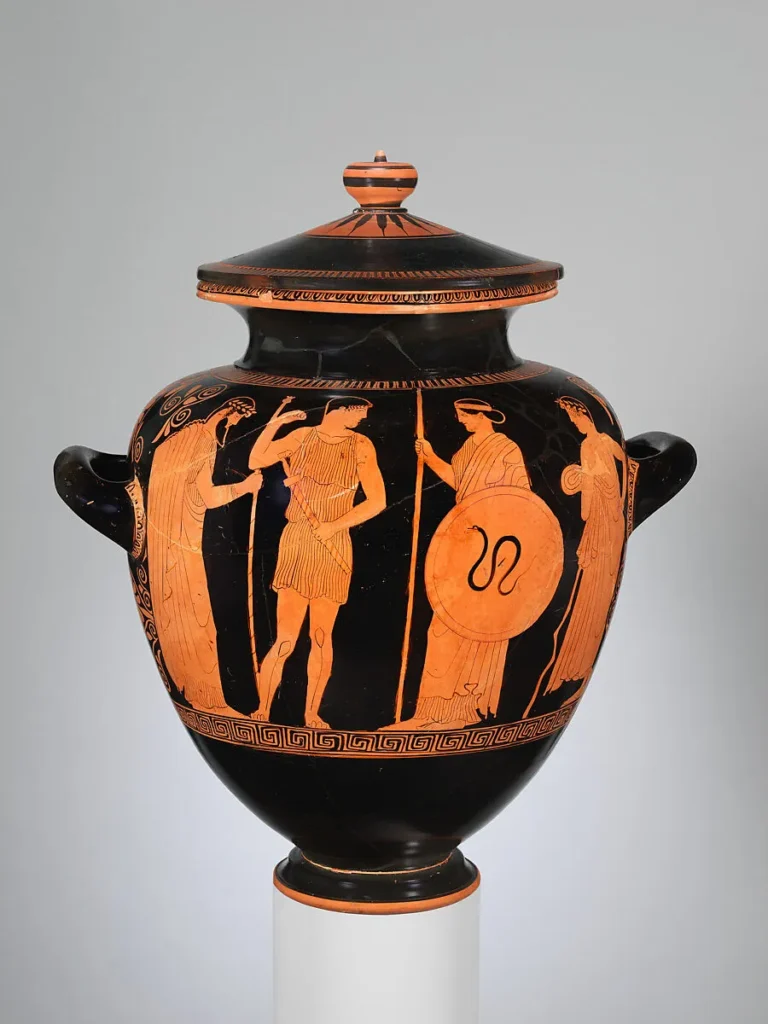
The oath is commonly associated with the sanctuary of Aglauros, a mythic daughter of the early Athenian king Cecrops. Ancient testimony connects the ceremony to her cult, but the precise gestures of the oath-takers cannot be reconstructed from the Acharnai text. Modern descriptions of recruits touching an officer’s hand while holding particular weapons are often presented with more certainty than the surviving evidence permits. A vase showing a warrior preparing to depart for battle is evocative, but it is not a documentary image of the fourth-century oath ceremony.
What Did Ephebes Actually Learn?
The official curriculum combined athletic exercise with military techniques. The constitutional account specifically names fighting in heavy armour, archery, javelin throwing and operating a catapult. That last skill is important. By the fourth century BCE Greek warfare involved siege engines and more specialised weapons than the familiar picture of two lines of hoplites meeting with spears. Training men in several forms of combat gave the city more flexibility in defending ports, walls and outposts.
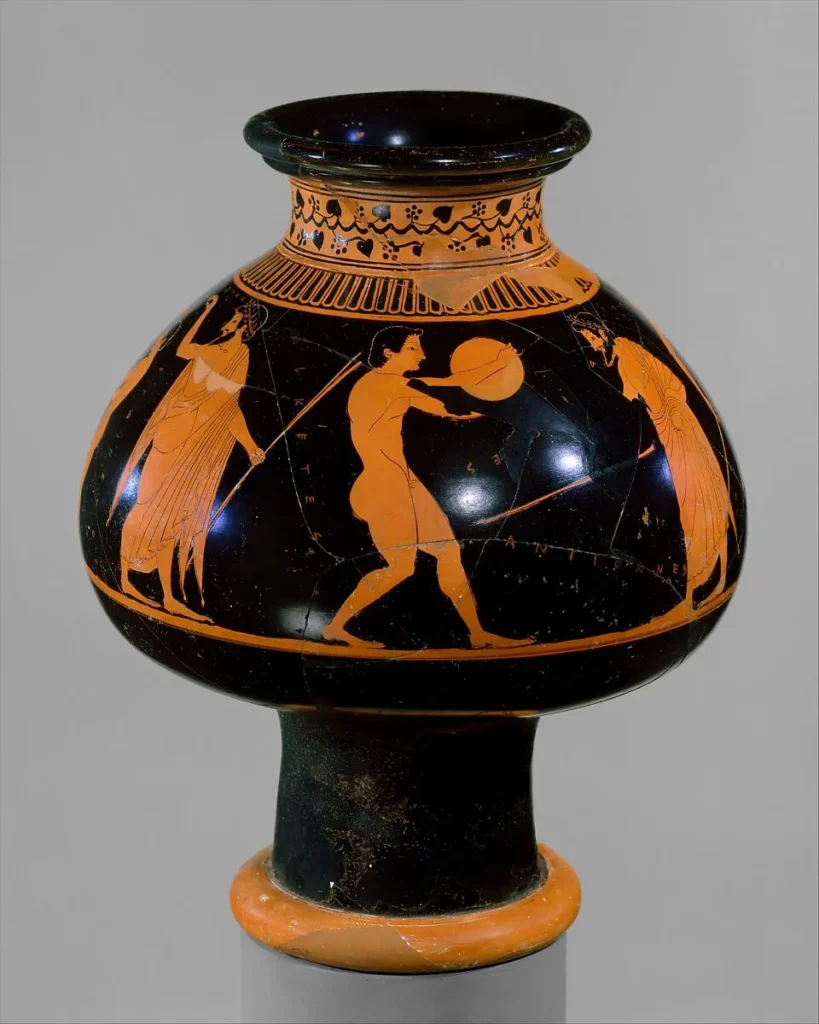
Athletic work took place in gymnasia, spaces used for exercise and instruction. Running, wrestling and throwing events were familiar in Greek physical culture. An earlier vase attributed to Oltos, now in the Metropolitan Museum of Art, shows named athletes practising the discus, long jump and javelin under supervision. It dates to about 520–510 BCE, nearly two centuries before the documented Lycurgan programme. The scene helps explain what a Greek athletic setting looked like, but cannot be treated as a depiction of an ephebic class in 335 BCE.
Physical training was also political because access to time, facilities and equipment had traditionally favoured the wealthy. In his scholarly study “Sport and Democracy in Classical Athens,” David M. Pritchard explains how public funding of the late-fourth-century ephebeia helped bring non-elite citizens into structured athletic and military exercise. The city paid instructors and maintenance allowances rather than leaving the entire programme to family resources. That is a substantial change, even if the surviving rosters do not establish perfectly equal participation.
Athens’ naval power makes swimming plausible as a useful skill, but usefulness is not evidence that a specific compulsory swimming syllabus existed. Likewise, an athletic vase cannot establish the hour of day when ephebes wrestled. The best evidence supports a demanding combination of athletic and military preparation without allowing a minute-by-minute reconstruction.
The Shield, Spear and Public Display
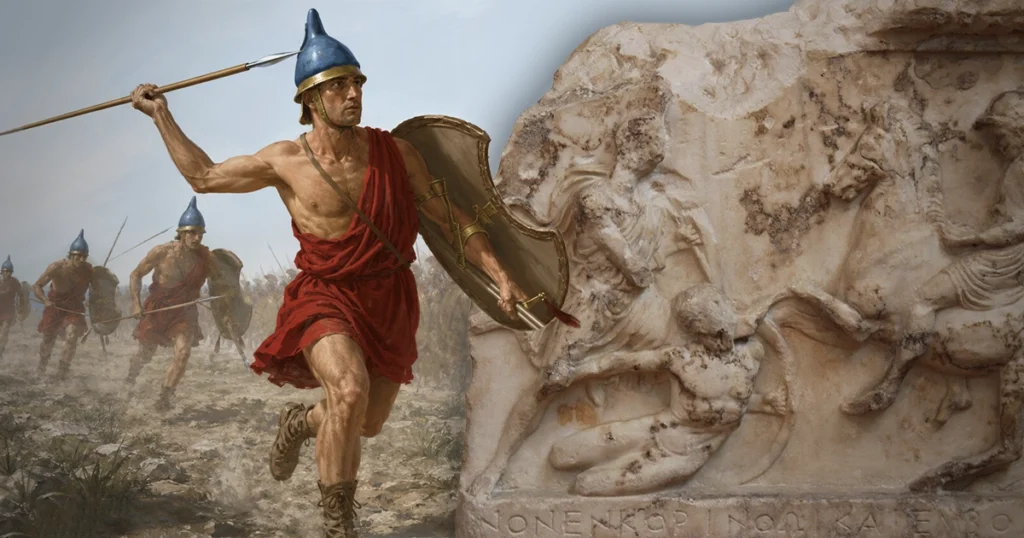
Near the end of their first year, the young men demonstrated military manoeuvres before the assembled people in a theatre. The constitutional account says that the city then gave them a shield and a spear. The presentation was public, connecting the equipment of the citizen-soldier with the authority of the citizen assembly. It also signalled the next stage of service, when the men would spend more time on patrols and in forts.
The shield was the large round aspis associated with heavily armed Greek infantry, and the spear was the principal weapon of the hoplite. A soldier’s kit might also include a helmet, body armour and a sword, depending on period and circumstances. But the surviving description of the public issue specifies a shield and spear, not a shield and short sword. Replacing the spear with a xiphos changes a concrete and well-attested detail of the ceremony.
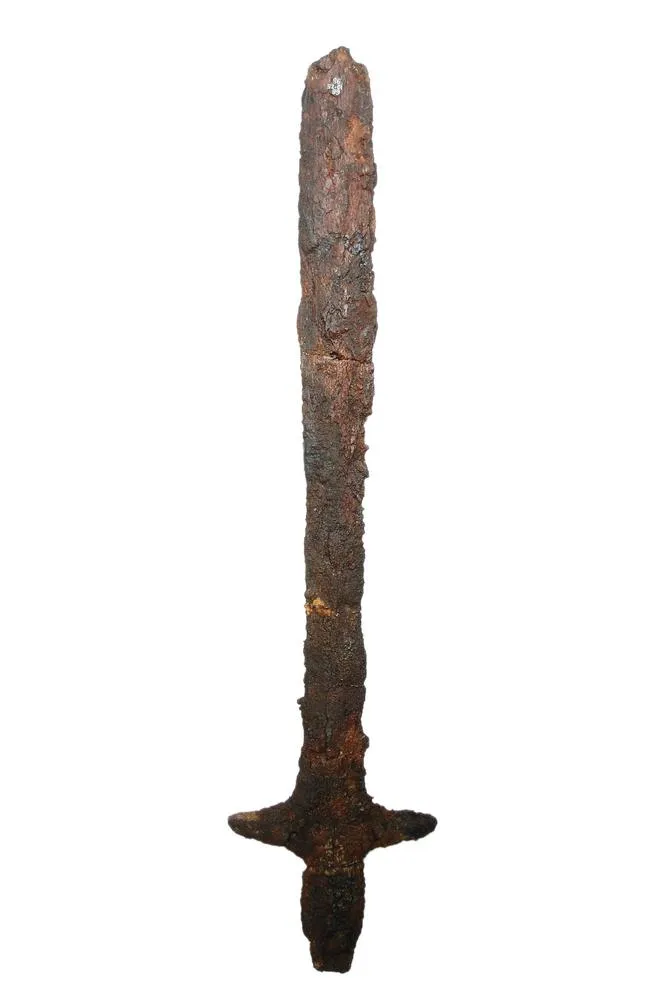
A surviving iron short sword in the British Museum, excavated at Ialysos on Rhodes, has a leaf-shaped blade and is catalogued as probably of the xiphos type. The museum gives a broad Classical to Hellenistic date and records its surviving length as 55 centimetres. It is a useful example of a weapon from the Greek world, not proof that Athenian ephebes were issued that particular type at graduation.
Modern descriptions sometimes claim that every ephebe had to learn to interlock shields into an unbroken wall or that swords were drilled in a fixed sequence of close-quarter movements. Hoplite formations and weapon practice are historically real, but these exact exercises are not described in the ephebic regulations available to us. What the evidence securely establishes is a publicly supervised training programme, a demonstration of military skill and state provision of two specified weapons.
Enjoying Spoken Past?
I created Spoken Past to share my love of history. I research, write and develop everything myself, and I want my articles and basic guides to remain free for everyone.
If you enjoy my work, please consider supporting Spoken Past with a small donation.
Guarding the Borders of Attica
The second year took ephebes beyond the port and into the countryside. The constitutional text says that after the public display and receipt of arms they patrolled the territory and spent time in forts. Attica included mountains, farmland, coastal routes and borders facing neighbouring regions. Its defence required more than protecting the walls of Athens itself. Patrols could watch roads and passes, help secure agricultural communities and respond to threats against outlying districts.
Fortified sites such as Eleusis, Phyle, Rhamnous and Panakton belonged to the broader defensive landscape of Attica, although the evidence for ephebes at each location varies by date. Ephebic dedications found at frontier sites show that young men and their officers served beyond the city. The notes to a fourth-century ephebic dedication discuss inscriptions from Panakton and Rhamnous, while a separate military dedication from Eleusis illuminates the work of patrol commanders. These records do not justify assigning a permanent, fixed distribution of recruits among every fort in every year.
The older term peripoloi referred to patrolmen, and peripolarchoi were their commanders. Aeschines’ claim to have served as a peripolos decades before 335 BCE shows that the work had a history of its own. It is sometimes suggested that wealthy youths with full armour served in forts while poorer youths became lightly armed patrolmen. The city supplied equipment precisely because it wanted recruits from beyond the richest families.
For the ephebes, frontier service meant practical experience of the territory named in their oath. A man raised in the city might find himself responsible for a pass, a coastal watch or a rural garrison. The state expected him to know that Athens was more than its urban centre. Its independence depended on roads, grain fields, ports and the network of communities whose members made up the citizen body.
Rights, Duties and Discipline During Service
Ephebes occupied an unusual position in the legal life of Athens. The Constitution of the Athenians says that they were exempt from taxes during their two years and normally could neither bring lawsuits nor be sued. The stated purpose was practical: court proceedings could provide an excuse to leave their assigned duties. There were exceptions for inheritance disputes, heiresses and inherited priesthoods. Those exceptions show that family property and religious responsibilities could not simply be suspended for two years.
It is often assumed that the young men were completely excluded from the assembly and jury courts throughout training. Their service certainly restricted their availability, and other Athenian rules placed age qualifications on particular civic functions. Yet the passage describing the ephebeia explicitly discusses taxes and lawsuits; it does not supply the comprehensive ban on every form of political attendance sometimes attributed to it. We should avoid turning a practical period of public service into a precisely defined loss of all citizenship rights without supporting legal evidence.
The programme was disciplined through its elected supervisors and military instructors, but the sources do not establish that repeated infractions automatically led to expulsion and permanent loss of citizenship. Such a penalty would be far too consequential to assert without an ancient regulation or securely interpreted inscription. Inscriptions from later periods praise ephebes for good order, obedience and effort. Those praises show what the city wanted to reward, not a complete catalogue of punishments.
The four-obol daily allowance also needs context. It was intended for maintenance, and the sophronistes bought provisions for a common tribal mess. The amount is evidence of a state-supported institution, not proof that poorer participants enjoyed the same living conditions as sons of wealthy households. Athenian citizenship could unite men in common military obligations while leaving substantial inequalities intact.
Religious Festivals and the Training of Citizens
Religion was part of Athenian public life, and the ephebeia introduced young men to civic cults. The first-year circuit of sanctuaries appears in the constitutional account, while the oath names gods, ancestral rites and the territory of Attica. The young citizen learned to connect his obligations to the community with places where the community made sacrifices, celebrated festivals and remembered its dead.
The evidence becomes especially detailed in the Hellenistic period. Honorary decrees describe ephebes taking part in processions, making sacrifices, competing in torch races and honouring soldiers who had died for Athens. A study of the later institution in Zahra Newby’s “Performing the Past: Salamis, Naval Contests and the Athenian Ephebeia” discusses a decree of 123/2 BCE recording an armed race connected with the Epitaphia, a festival honouring the war dead, and a visit to the battlefield burial mound at Marathon. Those activities brought young men into direct contact with the memory of earlier Athenian wars.
An inscribed decree honouring the ephebes of 80/79 BCE is unusually explicit. It praises their participation in civic processions and sacrifices at the Mysteries, the Dionysia and other festivals, as well as their physical training and guard duties. Another decree of 37/6 or 36/5 BCE describes competitions at the Theseia and Panathenaic celebrations, together with sacrifices and instruction. These are not merely picturesque details: they show the city publicly recognising the ephebes as performers of religious obligations.
The chronological distinction is essential. A ceremony attested in 80 BCE cannot automatically be projected unchanged back to 335 BCE. In reality, the inscriptions show an evolving institution. Religious participation was important throughout its history, but the exact calendar and duties varied with period and political circumstances.
How Macedonian Rule Changed the Ephebeia
Athens lost the Lamian War against Macedonian forces in 322 BCE. Macedonian troops occupied Munychia, one of the very places where the ephebes had trained, and the city’s political arrangements were restricted. This was a serious problem for a publicly funded force whose oath emphasised defending the laws and territory of Athens. The historian John L. Friend argues, on the basis of a gap in the inscriptional record, that the formal ephebeia was discontinued under Macedonian-backed regimes. The surviving dedications are numerous before 322/1 and resume only after the democratic restoration of 307/6 BCE. This is a persuasive interpretation of the gap, although the absence of inscriptions cannot prove that no young Athenian received military instruction in the intervening years.
The published abstract of Friend’s research on abolition and renewal makes that argument explicitly. After democracy was restored in 307/6 BCE, the institution reappeared, but the balance of costs and obligations changed. During the first third of the third century BCE the service became voluntary and was reduced to one year. Recruits increasingly had to provide their own equipment, making the programme less accessible to poorer citizens. The exact timing of each reform is not settled by a single surviving law.
Numbers illustrate the scale of the change. In Pritchard’s discussion of the evidence, later third-century cohorts of roughly twenty to fifty are contrasted with the much larger late-fourth-century groups. Those figures come from inscribed lists and demographic reconstruction, so they are estimates rather than a complete census of every eligible young man. They nonetheless support the view that the Hellenistic ephebeia was no longer a near-universal, publicly financed citizen military programme.
This transformation did not eliminate military activity. The later ephebes still trained with weapons and appeared in public demonstrations. But the smaller cohort increasingly served as an elite network, combining athletic and martial instruction with philosophy, rhetoric, literature and participation in prominent festivals. Families with resources could give their sons an education that also advertised their attachment to Athenian traditions.
The Ephebeia Under Rome
The institution survived Athens’ incorporation into the Roman world. Inscriptions of the first century BCE describe teachers of rhetoric and grammar, philosophical lectures, weapons practice, sacrifices and public service. In the decree honouring Hedylos, superintendent of the ephebes in 80/79 BCE, the young men praise his generosity in arranging instruction and paying expenses from his own funds. Such honours tell us that wealthy benefactors could sustain an institution once funded much more broadly by the democracy.
Its membership also changed. By the second century BCE the ephebeia admitted some youths from non-Athenian families, identified in inscriptions by categories such as xenoi, foreigners, and later epengraphoi, additional registrants. The programme had become a way to participate in prestigious Athenian education and civic culture without necessarily sharing the old route from citizen registration to military duty. The extent and status of these admissions changed over time, so it would be wrong to say that every foreign student received Athenian citizenship.
In the Roman imperial period ephebes could take part in staged naval contests recalling the battle of Salamis. Newby’s study of ephebic reliefs from the first to third centuries CE shows how images and inscriptions invoked Athens’ victory over Persia. These performances celebrated a military past that remained central to Athenian identity long after the city had lost the independence enjoyed in the fifth century BCE. They also gave participants and their families a prominent place in public commemorations.
The surviving records do not support a confident statement that the ephebeia ended at a particular point in the late third century CE. Its organisation and visibility changed over the imperial period, and the evidence becomes less continuous. What can be traced securely is a long institutional history, from a fourth-century public military programme to a Roman-era education that still used weapons, ceremonies and the city’s historical memory to define what an accomplished young man should be.
What the Ephebeia Reveals About Athenian Citizenship
The clearest fourth-century evidence is remarkably practical: the assembly elected supervisors, the city paid for food, instructors taught archery and catapult use, recruits guarded the harbour, and the state presented shields and spears before sending them into the countryside. The oath added a moral and political claim to those arrangements. A citizen was expected to stand by his companions, defend the laws, respect the gods and preserve the land that sustained the community.
That civic ideal existed alongside exclusion. Women, enslaved people and non-citizen residents could not enter the classical citizen corps, and wealth continued to shape opportunities even among citizens. When Athens lost political autonomy, the institution’s public funding and broad recruitment weakened. Its later survival among smaller and wealthier groups shows how the same civic language could serve very different social realities.
The inscriptions give this history a human scale. They record named youths thanking their officers, communities honouring cohorts, and young men making offerings at sanctuaries. The ephebeia was therefore neither an unchanging military academy nor a symbolic rite without practical duties. Across centuries it was a changing arrangement through which Athenians decided how the next generation should serve, remember and represent their city.