
Between 58 and 50 BC a Roman governor in northern Italy turned a border command into a sustained conquest of most of Gaul. These campaigns, remembered collectively as the Gallic Wars, pulled a huge region between the Rhine, Pyrenees, Atlantic, and Alps into Rome’s orbit and created the military base for Caesar’s later dominance in Roman politics.
Almost everything known about these campaigns comes from Caesar’s own Commentarii de Bello Gallico, which present each campaigning year in a spare, report‑like narrative intended for a Roman audience. Other Latin sources and archaeology fill gaps, but for the sequence of operations, the people involved, and the way Romans claimed to fight these wars, Caesar’s commentaries remain the essential core.
Rome and Gaul before Caesar
By the mid first century BC Romans and Gauls already had a long, violent history that framed later events in Gaul. A Gallic army had sacked Rome in the early fourth century BC, and later Celtic and Germanic migrations had crushed several Roman forces before finally being defeated by Roman commanders in Italy and southern Gaul.
In the second century BC Rome pushed north, annexing Cisalpine Gaul in the Po Valley and then creating a province in southern France, linked to Italy by the Via Domitia and dotted with colonies such as Narbo. Alliances with tribes like the Aedui, and punitive campaigns against others like the Allobroges and Arverni, pulled central and eastern Gallic politics into Roman calculations well before Caesar arrived.
At the same time Gallic society itself was changing. Many tribes in southern and central Gaul developed oppida that functioned as proto‑towns, minted coinage, and adopted some Mediterranean styles of political organization and trade, with large volumes of wine flowing north in return for grain, iron, hides, and slaves. This contact produced both cooperation with Roman merchants and deep anxieties among Romans, who remembered earlier disasters and now watched new tribal coalitions and German mercenaries appear along their frontiers.
Caesar’s command in Cisalpine and Transalpine Gaul
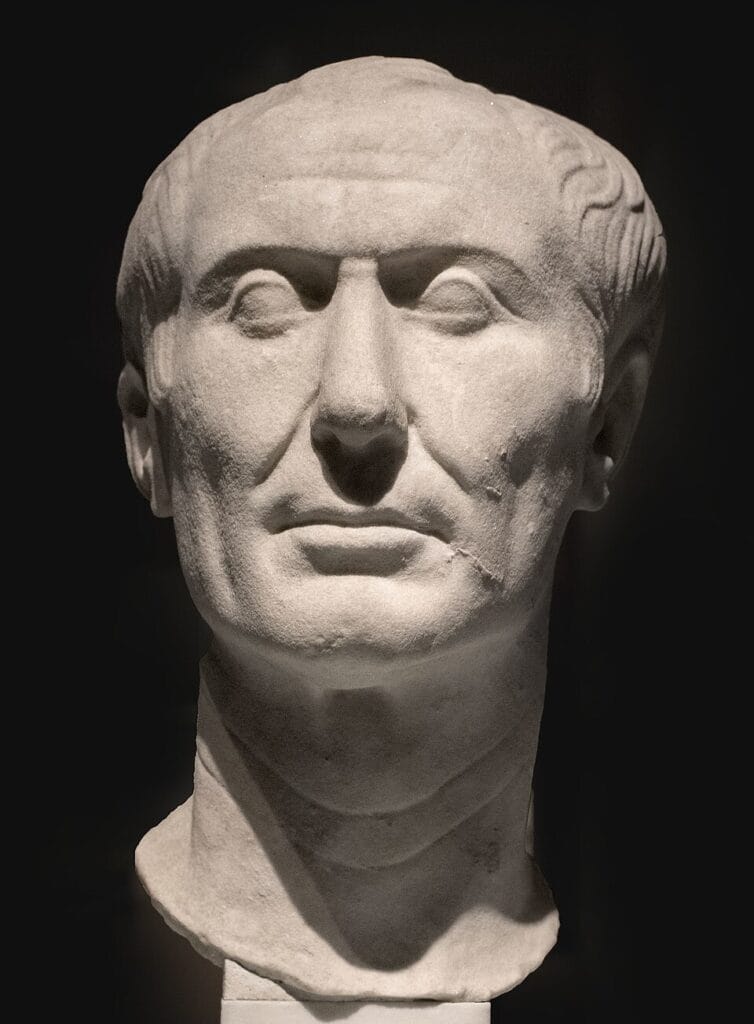
In 59 BC Julius Caesar secured a five‑year command over Cisalpine Gaul and Illyricum, soon enlarged to include Transalpine Gaul after the sudden death of that province’s governor. Under this arrangement he controlled at least four legions stationed in northern Italy and southern Gaul, and could recruit more from the region’s population.
Caesar entered this command heavily indebted and with limited independent record as a field commander. In the competitive politics of the late Republic, a governor needed military victories, loyal soldiers, and spoils from new provinces to rival figures such as Pompey and Crassus, so some form of aggressive campaigning was expected from him.
Circumstances in Gaul soon offered both motives and pretexts. The Aedui had recently been beaten by a coalition of Arverni, Sequani, and the German king Ariovistus, who then settled near the Rhine, and the Helvetii in Switzerland prepared a mass migration west that threatened both Roman allies and the stability of central Gaul. Against this backdrop, Caesar could present intervention as defense of allies and the province, even as it clearly served his own ambition.
Helvetii migration and the first campaigns
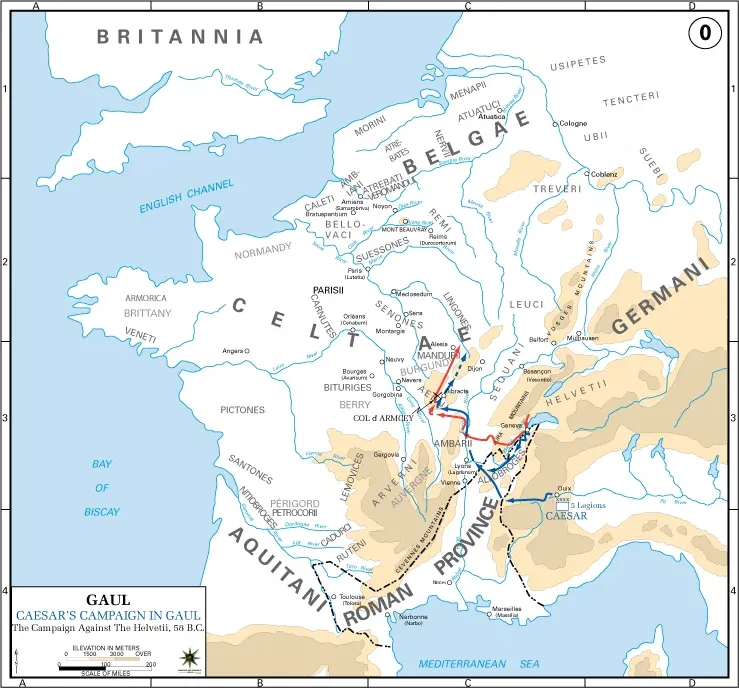
In 61–58 BC the Helvetii prepared to abandon their homeland in the Swiss plateau, stockpiling grain for three years and assembling wagons to move their whole population into western Gaul. In 58 BC they burned their settlements behind them and advanced toward the Rhône, intending to pass near or through the Roman province to reach new lands.
Caesar blocked this route by destroying the bridge at Geneva and constructing fortifications along the Rhône, so the Helvetii turned north into central Gaul instead. He then raised two new legions, marched them across the Alps, and attacked one Helvetian column as it crossed the Saône, inflicting heavy losses before following the main body toward Bibracte, an Aeduan oppidum.
The decisive battle came near Bibracte, where Caesar deployed a triplex acies of four veteran legions on a slope and placed his less experienced troops and auxiliaries on high ground behind. After hours of close combat and a crisis on the Roman right when Helvetian allies outflanked his line, Caesar used the flexibility of legionary formations to turn reserves and rear ranks against both fronts, eventually routing the enemy and slaughtering many of their families around their wagon‑laager.
After the battle he pursued the remnants, compelled their surrender, and ordered them back to their devastated homeland to prevent German tribes from occupying the vacated territory. The victory impressed both allies and rivals in Rome, since he could now claim to have ended a mass migration that threatened the province and to have avenged an earlier Helvetian victory over a Roman consul.
Soon after, Caesar turned against Ariovistus, whose Germans had seized Sequani land and menaced the Aedui. After tense negotiations and a clash of armies near today’s Vosges region, Roman infantry under Caesar on the right and redeployed reserves on the left broke the German line and drove survivors back to the Rhine, with many killed in the river during the rout. With the Helvetii forced home and Ariovistus driven across the Rhine, Caesar could present the first year’s operations as successful defense of allies and suppression of long‑standing threats.
Conquest of Belgic and western Gaul
In 57 BC Caesar pushed north against the Belgae, a loose coalition of tribes in what is now northern France and Belgium. Some tribes such as the Remi aligned themselves with Rome, providing intelligence and supplies, while others mobilized a large confederate army and briefly besieged the Reman oppidum of Bibrax before falling back when a Roman relief force approached.
Rather than one set‑piece battle, the Belgic campaign combined maneuver, controlled use of pitched battle, and rapid exploitation of tribal divisions. When a great Belgic host disbanded for lack of supplies, Caesar struck individual tribes in turn, forcing surrenders from the Suessiones and Bellovaci and imposing terms that included hostages and, in some cases, subordination to loyal neighbors.
The Nervii, however, chose open battle and planned an ambush on the Sambre, using wooded country and hedged fields to conceal a massive force near the Roman camp. Their sudden attack caught the legions entrenching, with some units just arriving and others scattered, but Roman training allowed soldiers and centurions to form lines without waiting for orders and to fight through a dangerous double‑front engagement until reinforcements from the rear and reserve legions arrived.
Caesar later describes the Nervii as nearly annihilated, though later revolts show that this was at least an exaggeration, perhaps reflecting the impression formed immediately after the battle. Still, the victory broke organized Belgic resistance for the moment and encouraged further tribal submissions.
In 56 BC attention shifted to the Atlantic coast. The Veneti, a maritime trading people in Armorica, detained Roman officers sent to collect grain, hoping to exchange them for hostages previously given to Caesar and to renegotiate their relationship with Rome. Because their hilltop strongholds lay on peninsulas accessible mainly by sea, and their stout oak‑built ships handled Atlantic tides and storms better than Roman galleys, an ordinary land campaign could not subdue them.
Caesar responded by requisitioning ships from allied communities and having a fleet built on the Loire, then fought a major naval battle in which Roman crews used grappling hooks to cut rigging and disable Venetic masts and sails, turning the fight into close‑quarters boarding where their infantry skills counted. Once their fleet was destroyed, the Veneti could not shift populations by sea between strongholds, and Caesar punished them harshly, executing leaders and selling much of the population into slavery as an example.
At the same time Roman forces under lieutenants campaigned in Aquitania and on the north‑western coast, using local intelligence, careful siege work, and infantry discipline to force surrenders from further tribes and extend Roman power to the Atlantic.
Built out of a love for history, kept free from distractions.
Spoken Past is an independent project shaped by curiosity, care, and long hours of research. Reader support helps keep it maintained, carefully researched, and open to everyone.
Chronology of Caesar’s campaigns in Gaul
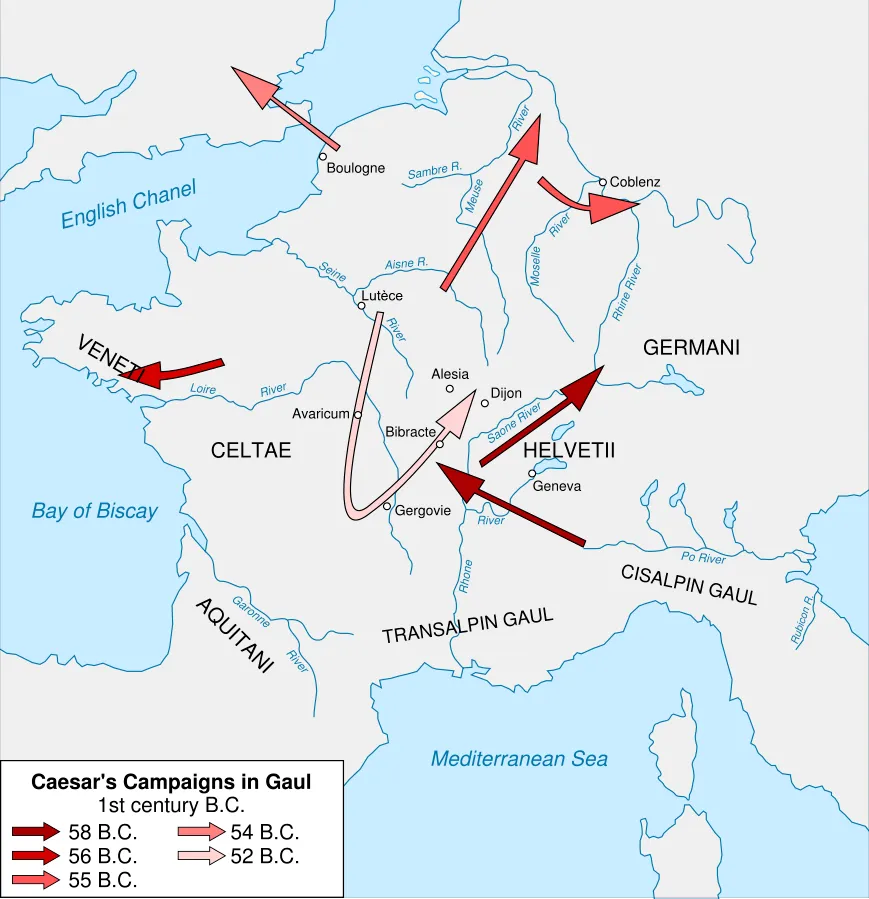
The main phases of the campaigns can be summarized year by year.
- 58 BC: Defeat and forced return of the migrating Helvetii, then victory over Ariovistus and expulsion of his Germans beyond the Rhine.
- 57 BC: Operations against the Belgic coalition, including the Nervian ambush on the Sambre and the collapse or submission of several northern tribes.
- 56 BC: Naval and land campaigns against the Veneti and their allies, together with actions in Aquitania and along the Channel coast.
- 55 BC: First bridging of the Rhine to intimidate Germans, and a brief first expedition to Britain late in the season, followed by a massacre of migrating German tribes that had crossed into Gaul.
- 54 BC: Second, larger expedition to Britain and consolidation in northern Gaul, followed by serious winter attacks on scattered Roman camps, including the destruction of one legion and five cohorts under Sabinus and Cotta.
- 53 BC: Punitive campaigns against rebellious Belgic tribes and a second crossing of the Rhine; continued Roman efforts to overawe German groups and stabilize Gaul before the governorship expired.
- 52 BC: General uprising under Vercingetorix, sieges at Avaricum and Gergovia, and the decisive double siege at Alesia.
- 51–50 BC: Mopping‑up operations against remaining centers of resistance, such as Uxellodunum, and the gradual reorganization of Gaul into provinces under tighter Roman control.
Expansion to the Rhine and Britain
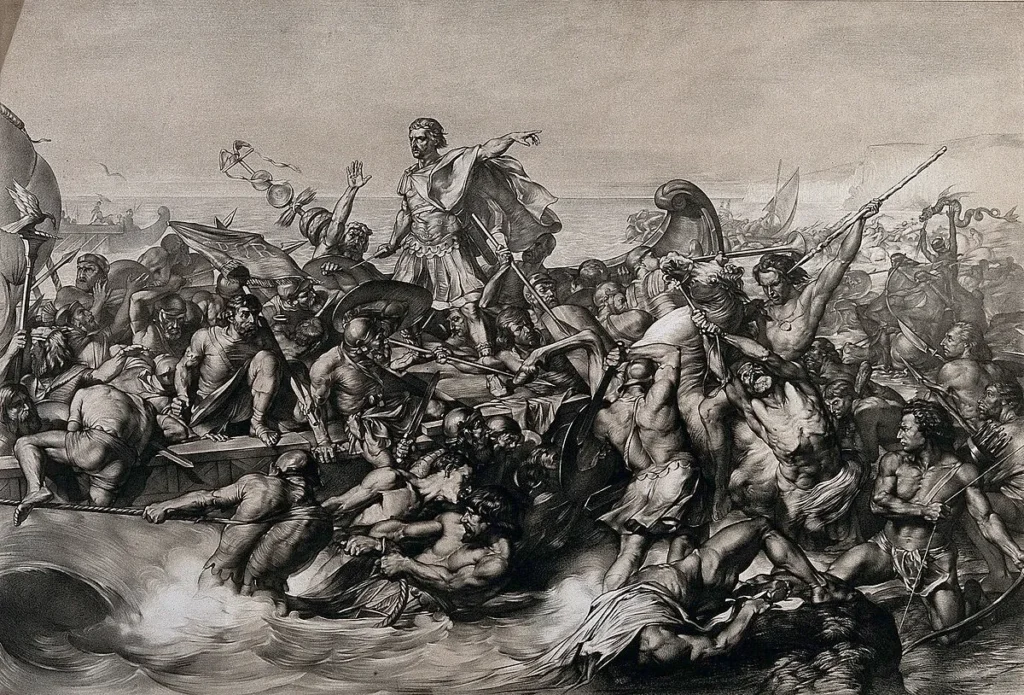
By 55 BC Caesar claimed that Gaul itself was largely pacified, so further glory and security were to be sought at its margins. In that year two German tribes, the Usipi and Tencteri, crossed the Rhine seeking land and clashed with Roman‑allied cavalry, which allowed Caesar to present a harsh punitive campaign as self‑defense and frontier discipline.
After luring these migrants into negotiations and then attacking their camp, Roman forces killed many men, women, and children and drove others into the Rhine, a slaughter that even some contemporaries criticized. To overawe other Germans, Caesar then built a timber bridge across the Rhine in about ten days, marched briefly into German territory burning empty settlements, and withdrew after less than three weeks, having demonstrated the reach of Roman engineering and arms.
Late in the same season he led two legions to Britain, arguing that British support to Gaul justified the expedition, though the opportunity for unprecedented achievement at the edge of the known world clearly played a role. A difficult landing under attack from British chariots, storms that damaged his fleet, and the failure of his cavalry to reach the island restricted operations, so he took hostages and tribute promises and then withdrew before winter.
In 54 BC a larger force of five legions and more cavalry returned, crossed the Thames against resistance led by Cassivellaunus, and defeated coalitions of British tribes in several actions, again taking hostages and nominal tribute before leaving. These expeditions did not create permanent occupation, but they enhanced Caesar’s prestige at Rome and extended Rome’s diplomatic network into the island.
Vercingetorix and the climax of the Gallic Wars at Alesia
Despite Caesar’s claims that Gaul was quiet, his dispersal of legions into many winter quarters in 54 BC and their demands for grain placed heavy pressure on local populations. Failures of harvest and resentment of requisitions contributed to scattered attacks on Roman camps, most disastrously the destruction of Sabinus and Cotta’s force by the Eburones under Ambiorix, which showed that Roman power could still be seriously challenged.
In 52 BC discontent coalesced into a major revolt led by Vercingetorix of the Arverni, who aimed to unify Gallic resistance and adopted a strategy that targeted Roman logistics. He persuaded tribes to adopt scorched‑earth tactics, burning surplus grain, fields, and many settlements to deny Caesar’s army supplies and force it into disadvantageous positions or retreats.
The early stages of this uprising saw brutal episodes on both sides. At Cenabum a Gallic attack destroyed Roman merchants and civilians, prompting severe Roman reprisals; at Avaricum, after a long siege complicated by marshy terrain and strong Gallic defenses, Caesar’s men stormed the town and massacred most inhabitants, including civilians, in part from pent‑up fury after weeks of hunger and hardship under Vercingetorix’s supply strategy.
A setback followed at Gergovia, where complex terrain and miscommunication led Roman troops to assault too far up the slopes and suffer heavy casualties, giving Vercingetorix his greatest field success and encouraging more tribes to join him. Yet later in the year Vercingetorix allowed himself to be trapped in Alesia, a strongly placed hilltop oppidum but still vulnerable to a determined siege.
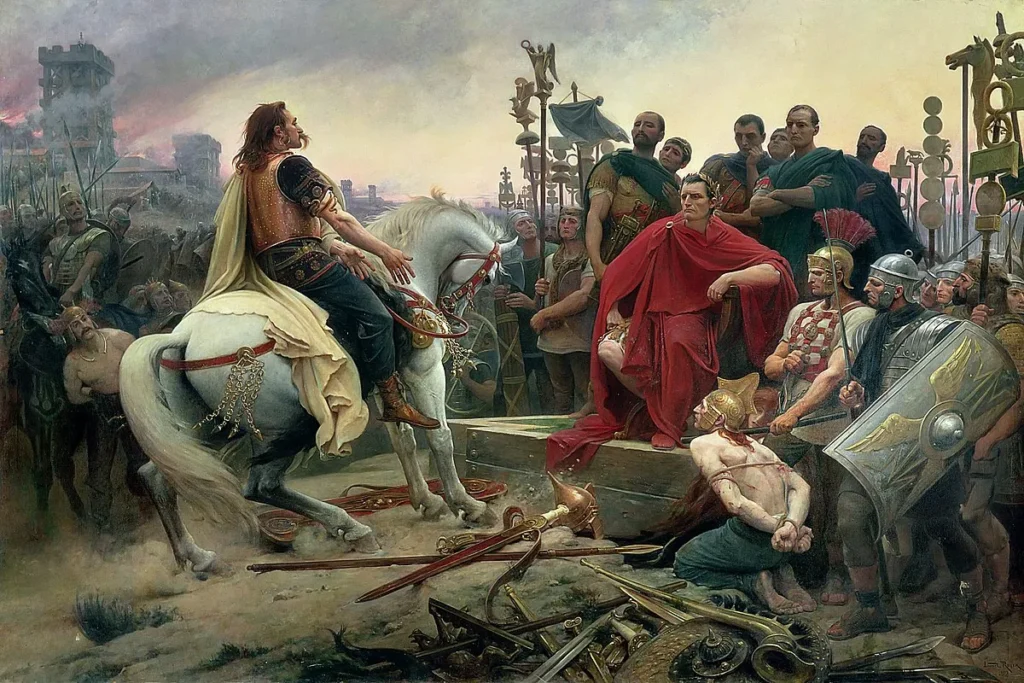
Around Alesia Caesar constructed an enormous double ring of fortifications: one facing inward against the besieged, another facing outward against a relief army expected from remaining free tribes. These lines included ditches, ramparts, towers, and concealed obstacles, and they forced the relief force to assault prepared positions while the garrison tried to break out in coordination.
After intense fighting and several near breakthroughs where Roman reserves had to be rushed to threatened sectors, the relief army failed to fracture the outer lines and eventually broke apart, while sorties from Alesia were driven back inside. With supplies exhausted and further help impossible, Vercingetorix surrendered, and although resistance continued in some regions, organized pan‑Gallic opposition never again reached the same scale.
Roman and Gallic ways of war
The Gallic Wars pitted a professional, long‑service Roman army against warbands and coalitions drawn from a warrior society with different priorities and constraints. Legionaries served for many years, received standardized equipment at state expense, and trained under centurions who enforced discipline on campaign and in winter quarters, while Gallic warriors equipped themselves according to wealth and status and could not remain long in the field because their households needed labor at home.
Roman heavy infantry fought in flexible formations built around cohorts, using large shields, mail armor, and a combination of pila and short swords designed for work in close order and at short range. In contrast, many Gallic warriors favored long slashing swords that required space, dramatic individual display, and looser formations, which could be effective in charges but vulnerable when pressed into confined or broken ground where Roman tactics and shield‑wall discipline excelled.
Caesar also relied on a mix of allied and auxiliary troops, especially Gallic and German cavalry, archers, and slingers, whose performance varied but improved over time as he recruited more reliable contingents and combined mounted troops with light infantry for shock and pursuit. Gallic forces, for their part, drew strength from elite cavalry and, in Britain, chariot warfare, and they adapted their strategies, sometimes offering pitched battle, sometimes favoring guerrilla tactics, supply raids, or the exploitation of forests, marshes, and hill forts.
Siegecraft and engineering gave Rome a further edge. Roman armies could throw up fortified camps every night, construct siege ramps and towers against oppida, and manage river crossings and large‑scale earthworks such as the double lines at Alesia and the bridges over the Rhine. Gallic defenders answered with strong timber‑and‑stone walls, counter‑mines, and local devices such as nooses, sharpened stakes, and concentrated missile fire, and by the middle of the war they had learned to build large siege works of their own around Roman winter camps.
Writing and timing of the Gallic War
Alongside his military efforts Caesar cultivated his reputation at Rome by shaping how those efforts were reported. During the wars he sent letters and dispatches to the Senate and to influential individuals, and by the later 50s BC he had begun to circulate the seven books of the Gallic War as polished commentarii that narrated each year’s operations in the third person.
Ancient testimony and internal clues suggest that these books were not written all at once but probably in several clusters, often during winters when Caesar stayed in Cisalpine Gaul or at Bibracte to handle provincial administration and legal business. Some passages in the early books speak as if Gaul had been fully pacified after only a few campaigns, language that sits awkwardly beside later narratives of major revolts and suggests that the first two books may have been composed before the full extent of later resistance was known.
Other sections, especially comments on the faithfulness or treachery of individual Gallic leaders, seem to have been written or revised in light of later events, indicating that even when Caesar aimed to present annual reports he allowed knowledge from subsequent years to color earlier episodes. By the mid 40s BC Cicero could already praise these commentaries for their clear, unadorned style, while noting that they provided material that others might later turn into more elaborate histories, showing that contemporaries understood them both as reports and as crafted self‑presentation.
The commentaries also make consistent use of ethnic and spatial categories that align with broader Roman ideas about empire. They sharply distinguish between Gaul and Germany, cast many northern peoples as restless, dangerous neighbors, and present Roman campaigns as protective, punitive, or preemptive actions that defend allies and secure a peaceful interior against threats from outside, a pattern that helps justify the scale and severity of the Gallic Wars to Roman readers.
In this context the Gallic Wars emerge as both a series of hard‑fought campaigns across a diverse landscape and a narrative project that framed those campaigns within Roman expectations about danger, honor, and control. The evidence from Caesar’s own text, read alongside other ancient testimony preserved in the attached studies, allows a fairly clear view of how an ambitious governor used alliances, pretexts, and military superiority to conquer much of Gaul, while still leaving open many questions about Gallic experiences and motives that the Commentarii de Bello Gallico were never intended to record, but which remain essential to any full understanding of the Gallic Wars.