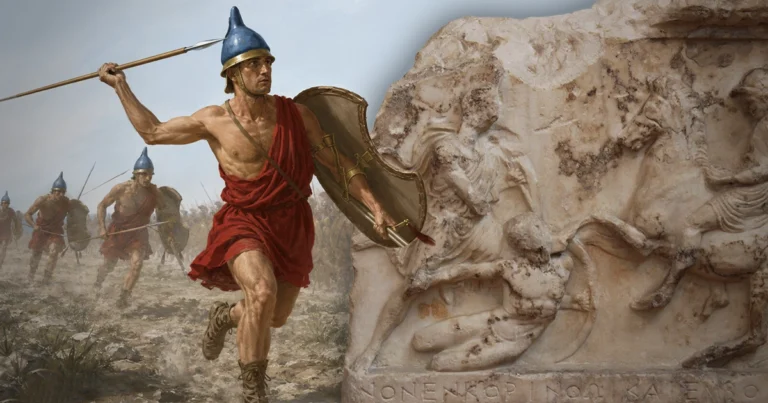

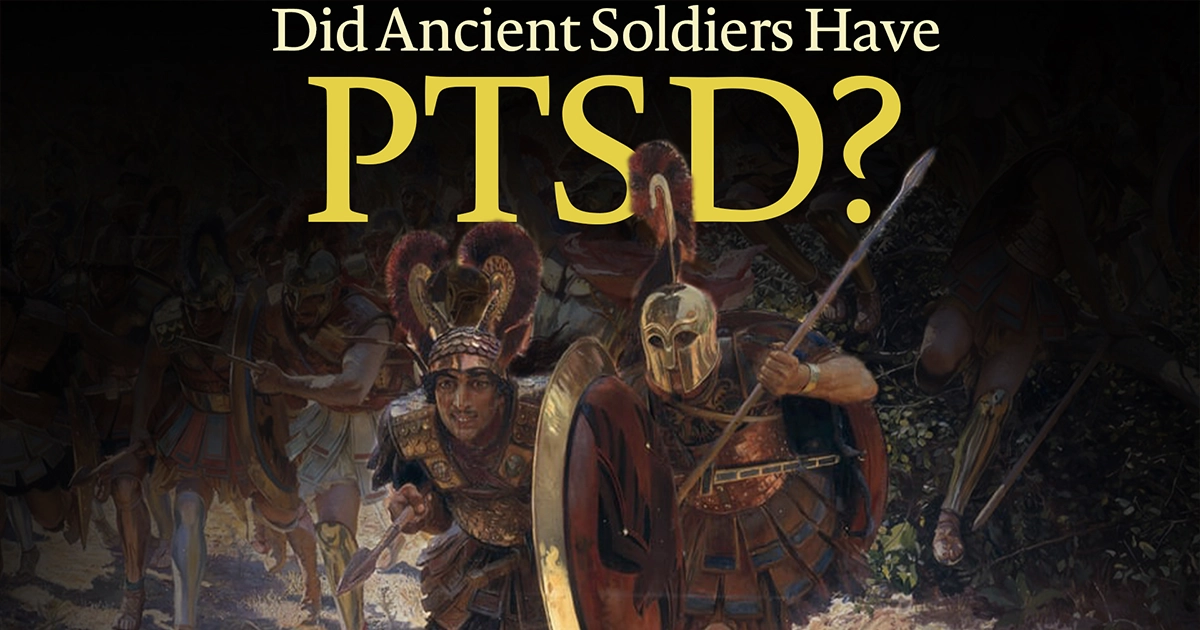
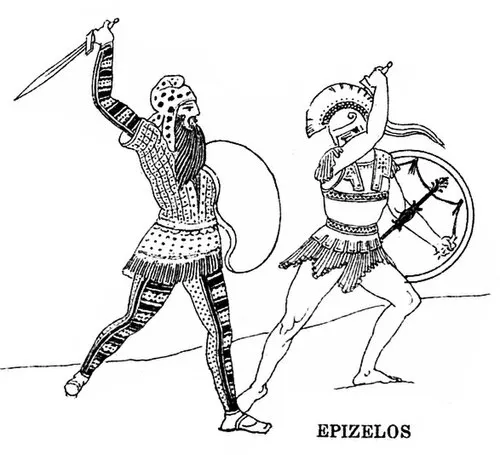
In 490 BC, at the Battle of Marathon, an Athenian spearman named Epizelus lost his sight in the middle of combat. No sword touched him. No spear, no arrow, no stone. He simply went blind, and stayed that way for the rest of his life. Herodotus recorded in his Histories at 6.117 that Epizelus later described seeing a phantom warrior whose beard covered his entire shield, a figure that passed him by and killed the man at his side instead.
For decades, physicians and historians have returned to this account and asked the same question: did ancient soldiers have PTSD? The answer, it turns out, depends entirely on who you ask. Scholars arguing about it have radically different ideas about what the evidence proves, how it should be read, and whether the question itself is even the right one to be asking. This article lays out the key cases from Greece, Rome, and Mesopotamia, the leading voices on each side of the debate, the neuroscience complicating the picture, and why no clear consensus exists even now.
The Soldier Who Went Blind: What the Epizelus Account Actually Proves
The case of Epizelus at Marathon is the single most cited piece of evidence in the ancient PTSD debate, which makes it worth examining with real precision rather than just repeating the standard summary.
What Herodotus Wrote and What He Did Not
Herodotus tells us that Epizelus was fighting bravely when he was suddenly deprived of sight in both eyes without being struck by any weapon. The blindness was permanent. Epizelus himself explained it in supernatural terms: a divine warrior had appeared before him, killed the man at his side, and left him blind. Herodotus offers no medical interpretation. He presents the episode as evidence of divine intervention at Marathon, a miracle the Athenians commemorated in public paintings on the Stoa Poikile in the Agora. The story circulated for generations not as a record of psychological suffering but as proof that the gods had fought for Athens.
Modern clinicians reading this account tend to identify it as conversion disorder, which is the clinical term in DSM-5 for functional neurological symptom disorder. This describes neurological symptoms, including blindness, paralysis, or mutism, that have no detectable physical cause but arise from extreme psychological stress. The mechanism is neurological: under conditions of acute terror, the brain’s threat-response system can suppress visual processing as part of a broader dissociative reaction. The blindness is physiologically real. The damage occurs in the cortex, not the eye. And in some cases it does not resolve.
Why the Case Is Weaker Than It Looks
The problem is that Herodotus is the only source for this story, and he was writing roughly forty years after the battle itself. In their widely-read 2014 paper published in Early Science and Medicine, psychiatrists Walid Khalid Abdul-Hamid and Jamie Hacker Hughes describe the Epizelus account as documenting “psychogenic mutism following the Marathon Wars,” using clinical language Herodotus never used and would not have recognised. Classicist Owen Rees made this point forcefully in a 2020 article in Medical Humanities, arguing that scholars consistently strip the Epizelus episode of its religious and cultural context to extract the symptoms they want and discard the supernatural framework that Herodotus and Epizelus himself considered the entire point. Epizelus did not describe trauma. He described an encounter with the divine. Calling that PTSD retrospectively is, Rees argues, a form of confirmation bias dressed up as diagnosis.
The honest position is that the Epizelus account is suggestive and nothing more. It cannot be confirmed, the source is a single writer working from decades-old oral tradition, and the cultural meaning of the episode in Athens was entirely different from anything a modern clinician would intend by applying a DSM-5 label to it.
Before Greece: Assyrian Cuneiform Tablets and the Oldest Evidence
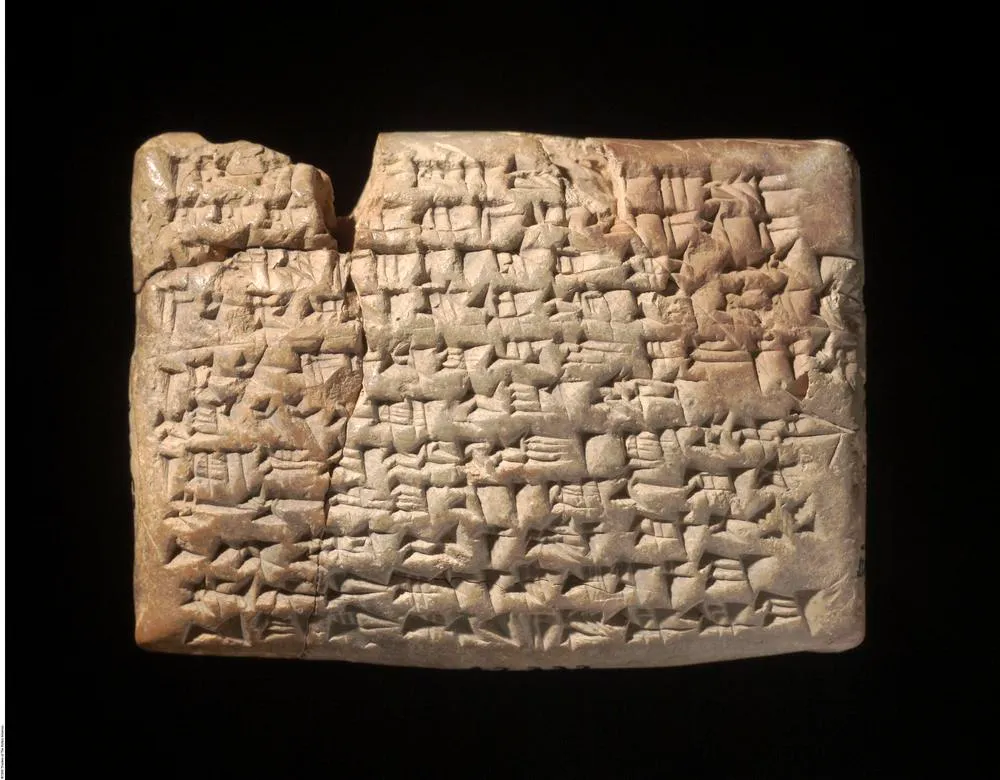
Long before the Greeks fought at Marathon, soldiers in the Assyrian Empire were leaving behind records of what happened to them after battle. And those records, written in cuneiform on clay tablets, contain descriptions that some scholars now argue represent the earliest documented evidence of combat trauma in any source we possess.
The Three-Year Rotation and What It Produced
The Assyrian military, which dominated present-day Iraq and much of the Near East between roughly 1300 BC and 609 BC, ran its army on a structured rotation system. Citizens from towns and villages across the empire were conscripted on a three-year cycle: one year performing military service, one year assigned to public works and construction, and one year at home farming and raising families. Because Assyrian kings launched fresh military campaigns nearly every spring, the men who survived this rotation repeated it across decades of their working lives. The cumulative exposure to close-quarters killing was enormous and relentless.
What the Tablets Describe
In their paper, Abdul-Hamid and Hughes examined cuneiform medical texts translated and analyzed by scholars JoAnn Scurlock and Burton Andersen in their 2005 volume Diagnoses in Assyrian and Babylonian Medicine. These texts, some dating to approximately 1300 BC, describe soldiers returning from battle with a cluster of symptoms attributed by Assyrian physicians to ghost affliction, specifically the ghosts of enemy soldiers killed in combat, which were believed to follow the killer home and attack him from within. One tablet records: “If in the evening, he sees either a living person or a dead person…and becomes afraid; he turns around but…his mouth is seized so that he is unable to cry out to one who sleeps next to him.” Other entries describe altered mental states, an inability to speak coherently, depression falling on the patient “at regular intervals,” and what the texts call “wandering about,” a phrase Scurlock and Andersen interpret as describing disorientation and dissociation.
Abdul-Hamid and Hughes map these descriptions onto DSM-5 symptom clusters: the nighttime visions of the dead correspond to intrusive flashbacks, the mutism and dissociation to emotional numbing and avoidance, the depression and forgetfulness to the mood and cognitive disturbances associated with chronic PTSD. The Assyrians had no clinical framework for any of this. Their explanation was supernatural, and their treatment combined pharmacological remedies administered by one type of healer, the asu, with ritual exorcism performed by a second type, the ašipu, who recited incantations, made offerings, and performed ceremonies designed to drive the ghost of the dead enemy away from the living patient. The two practitioners often worked together simultaneously, and the medical texts describe this as an intentional combined approach.
The Limits of This Evidence
The methodological difficulty is significant. Scurlock and Andersen had already grouped these specific tablet entries under the heading “Post-Traumatic Stress Syndrome” in their 2005 volume before Abdul-Hamid and Hughes published their paper. Critics have pointed out that this means the 2014 paper did not independently identify these cases as PTSD-compatible. It extracted a label that two earlier scholars had tentatively suggested and presented it as a new discovery without adequately engaging with the interpretive assumptions embedded in that original labelling. The cuneiform evidence is genuinely striking. But the argument that it definitively proves ancient PTSD rests on a chain of interpretive decisions, each of which is contestable.
Did Ancient Soldiers Have PTSD? The Roman Problem
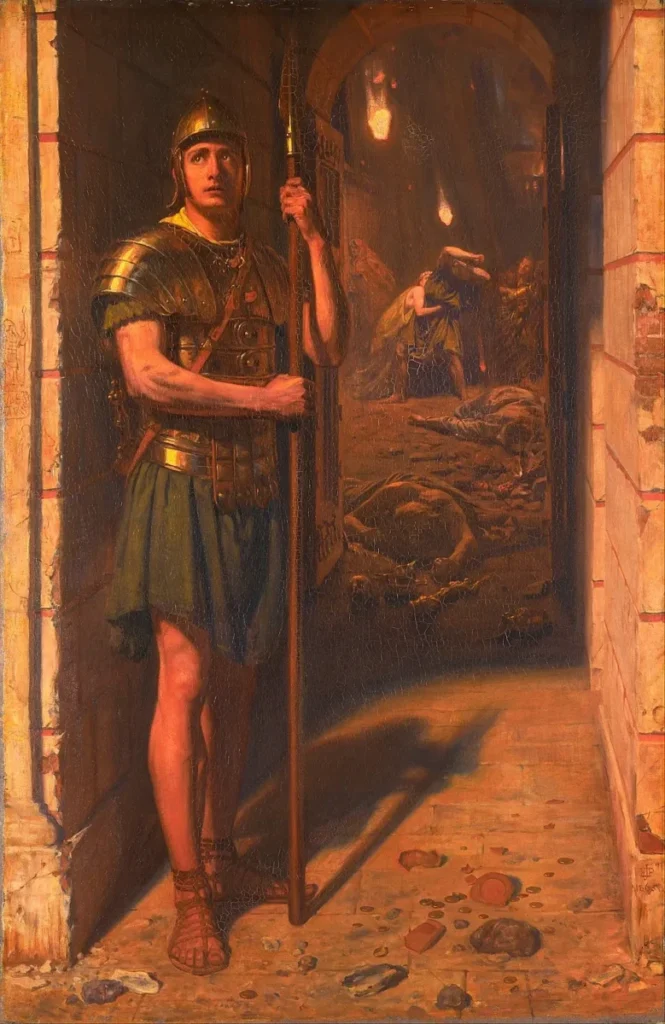
The Roman military produced men who spent years, sometimes entire adult lifetimes, in active combat. Legionaries under Caesar campaigned from Gaul to Egypt. Auxiliaries on the Rhine frontier served twenty-five-year terms before receiving citizenship and discharge. The scale of Roman military experience was enormous. The question of Roman soldier mental health therefore carries real weight, and the evidence is, as historian Aislinn Melchior argues in her 2011 article published in Greece and Rome, frustratingly and systematically thin.
The Silence That Speaks
Roman military writing almost never describes the interior emotional life of the fighting man after battle. Caesar’s accounts of the Gallic and Civil Wars are precise and detailed on tactics, logistics, and command decisions, and almost entirely silent on how his soldiers felt when they came home. As Melchior points out in her article, this silence is not accidental. Roman literary culture simply did not produce the introspective veteran memoir as a form. The Greeks had tragedy and the Odyssey, both of which engaged directly and repeatedly with the psychological cost of homecoming. The Romans had no equivalent tradition, and this structural absence in the sources makes it extremely difficult to assess the psychological states of individual soldiers.
What we do have are inscriptions. Veterans who returned from campaigns and settled in colonies across the empire left behind epitaphs and dedications that occasionally use language scholars have tried to read as evidence of psychological distress. Some of these inscriptions describe men who became prominent in their communities, led civic life, and appear to have reintegrated successfully. This creates its own interpretive problem: successful reintegration does not prove the absence of trauma, but it does complicate the picture that advocates of the ancient PTSD hypothesis tend to present, which focuses almost exclusively on negative outcomes.
What Caesar’s Accounts Do and Do Not Show
Melchior’s article draws extensively on the corpus Caesarianum, the body of writing produced by Caesar and his associates, to explore how Roman soldiers responded to combat stress. Caesar describes men who were afraid before battle, men who needed encouragement, and men who performed acts of extraordinary and apparently reckless courage under extreme duress. He describes a soldier at the siege of a Gallic oppidum who grabbed the upper edge of an enemy shield with one hand and stabbed downward into the face of the man holding it. He describes reserve lines composed of veterans specifically because experienced soldiers could watch comrades being killed and wounded without breaking formation, something Caesar treats as a learned professional capacity rather than as evidence of psychological damage.
The raw ingredients for trauma were clearly present. Roman legionaries fought in extremely close proximity to the enemy, using the short gladius in a manner that required direct physical engagement, often at a distance of less than a metre. The psychological mechanism of close killing, the inability to distance oneself from the direct responsibility for another person’s death, was built into the standard Roman tactical system. But Melchior argues that this observation does not, by itself, constitute evidence that Roman soldiers developed what DSM-5 now classifies as PTSD. The stressors existed. The responses to those stressors remain largely undocumented.
Built out of a love for history, kept free from distractions.
Spoken Past is an independent project shaped by curiosity, care, and long hours of research. Reader support helps keep it maintained, carefully researched, and open to everyone.
Why Helmet Design and Concussion May Change Everything
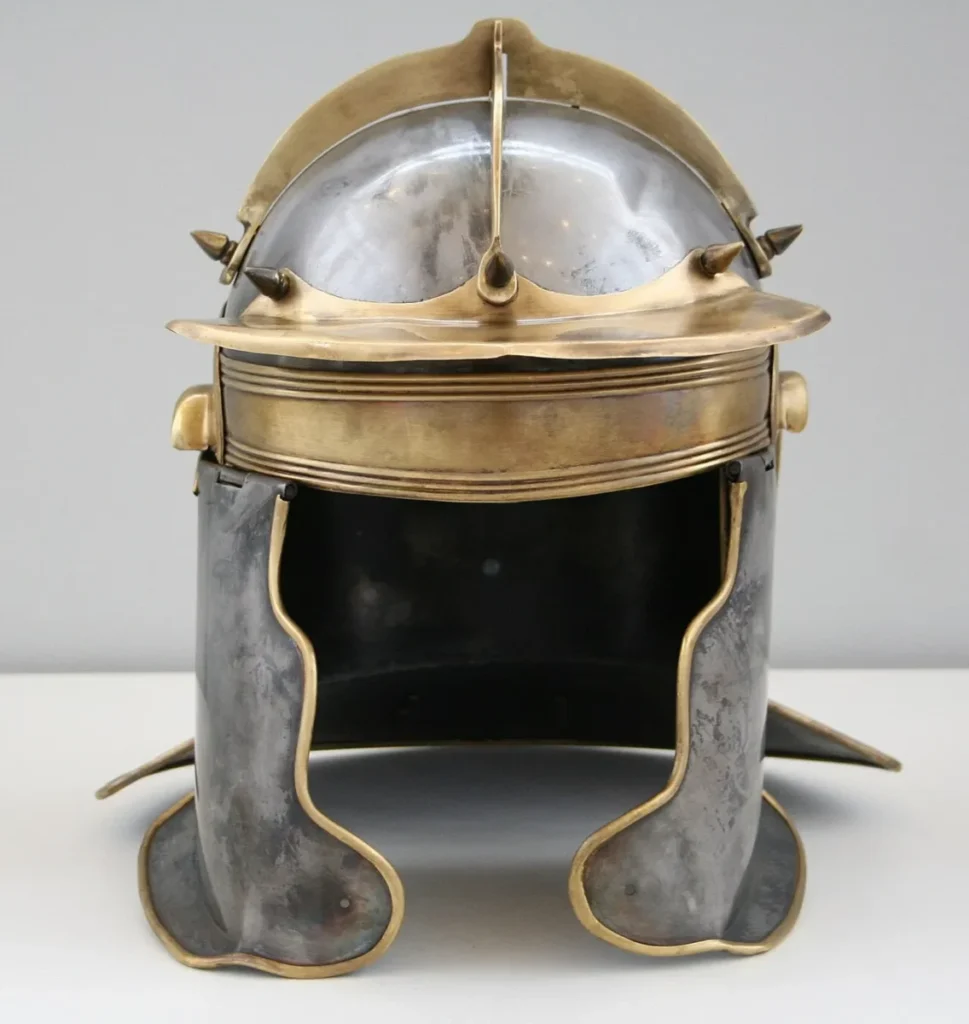
One of the most technically interesting arguments in this debate comes not from classical studies but from neuroscience, and it has the potential to reshape how historians approach the entire question of ancient combat trauma.
The Concussion Connection
A 2008 study published in the New England Journal of Medicine, following 2,525 soldiers returning from deployment in Iraq, found that soldiers who suffered concussive injuries causing loss of consciousness showed PTSD symptoms at a rate of 43.9 per cent. Soldiers who suffered concussive injuries without losing consciousness showed symptoms at 27.3 per cent. Soldiers who were injured but suffered no concussion at all showed symptoms at 16.2 per cent, still elevated above baseline, but substantially lower than the concussion groups. The study identified a strong and significant correlation between traumatic brain injury and subsequent psychological disorder, a relationship now understood to work through neuroinflammation, disruption of the default mode network, and damage to the prefrontal cortex structures responsible for emotional regulation and threat-response modulation.
Melchior was one of the first ancient historians to take this data seriously and apply it to the question of Roman soldier mental health. Her argument is straightforward: the weapons that Roman soldiers faced, primarily edged blades, spears, and arrows, were unlikely to produce the high rates of concussive brain injury associated with blast explosions and percussion. Roman helmets, particularly the Montefortino and Imperial Gallic types that covered the cranium, cheeks, and neck, were specifically engineered to deflect and absorb the force of downward cutting blows. The combination of weapon type and helmet design suggests that Roman legionaries experienced head trauma at rates substantially lower than those of modern soldiers exposed to improvised explosive devices and artillery. If the correlation between concussion and PTSD holds across time periods, this would imply that ancient combat, despite its closeness and brutality, may actually have produced lower rates of the specific neurological conditions now associated with PTSD than modern industrial warfare does.
What This Argument Cannot Settle
This is a hypothesis, not a conclusion. The 2008 study was preliminary, and the relationship between traumatic brain injury and PTSD is still being refined. The argument also applies most cleanly to Roman legionary warfare and sits less comfortably with the experience of cavalry soldiers, men struck by sling-stones, or veterans of sieges where collapsing structures and falling debris could produce blunt head trauma without edged weapons being involved at all. The concussion argument is genuinely illuminating, but it addresses one possible mechanism for PTSD rather than ruling out the disorder entirely.
The Universalists Against the Relativists: What the Debate Is Really About
The deepest disagreement in this field is not really about Epizelus or the cuneiform tablets or Roman helmet design. It is about a foundational question in historical method: can we apply a diagnostic category invented in 1980 to describe the experiences of people who lived and fought thousands of years before that category existed?
Jonathan Shay and Lawrence Tritle: The Case for Universalism
The universalist position holds that PTSD is a product of human neurobiology rather than cultural construction, and that because human neurology has not changed significantly over three thousand years, the same combat experiences that produce the disorder today would have produced it in antiquity. The psychiatrist Jonathan Shay developed this argument most influentially in his 1994 book Achilles in Vietnam, in which he read Homer’s Iliad alongside accounts from Vietnam veterans he was treating clinically. Shay’s goal was not primarily historical but therapeutic: he used ancient epic to help his patients articulate experiences for which they lacked language, and he found the parallels between Achilles and traumatised modern soldiers genuinely illuminating for clinical purposes.
Lawrence Tritle, a Vietnam veteran and classicist at Loyola Marymount University, extended the argument in his 2000 book From Melos to My Lai, drawing direct parallels between the experiences of ancient Greek warriors and modern veterans. Tritle identified the Spartan commander Clearchus, described by Xenophon as “warlike and a lover of war to the highest degree,” as potentially displaying the compulsive attraction to combat that some theorists associate with PTSD-related hyperarousal. He argued that Xenophon’s description represents the first known historical case of PTSD in the western literary tradition.
The Problems Melchior and Others Have Identified
The critical response to Shay and Tritle has been extensive and pointed. As Melchior argues, the universalist approach depends on two assumptions that are both difficult to prove: that the stressors faced by ancient soldiers were similar enough to modern ones to produce similar outcomes, and that the psychological makeup and cultural conditioning of ancient soldiers was similar enough to that of modern soldiers to produce similar responses to comparable stimuli. Neither assumption is obviously true.
Melchior points to the radically different social and psychological environment in which Roman soldiers grew up. In ancient Rome, infant mortality rates ran at approximately three hundred per thousand. The public execution of criminals was a regular urban spectacle. Gladiatorial combat, animal hunts, and the display of executed bodies were features of ordinary civic life. Thomas Palaima has observed that modern developed societies hide death systematically from view, creating a sharp gap between civilian and combat experience that Roman citizens simply did not have. A Roman legionary had grown up in a world saturated with violence, death, and bodily suffering in ways that a modern American soldier generally had not. Whether this cultural conditioning created psychological resilience, a different kind of vulnerability, or something else entirely is a question the evidence cannot answer.
The universalist position is also undermined, as Melchior notes, by the absence of the sources that would confirm it. The argument that Roman soldiers must have suffered PTSD because they were exposed to combat is circular reasoning, not historical evidence.
Sources
Aislinn Melchior, “Caesar in Vietnam: Did Roman Soldiers Suffer from Post-Traumatic Stress Disorder?”, Greece and Rome 58.2 (2011), pp. 209-223. Available at https://www.jstor.org/stable/41306157 and https://doi.org/10.1017/S0017383511000052
Walid Khalid Abdul-Hamid and Jamie Hacker Hughes, “Nothing New Under the Sun: Post-Traumatic Stress Disorders in the Ancient World”, Early Science and Medicine 19.6 (2014), pp. 549-557. Available at https://doi.org/10.1163/15733823-00196p02
Herodotus, Histories 6.117, trans. A.D. Godley. Available at the Perseus Digital Library, Tufts University: https://www.perseus.tufts.edu/hopper/text?doc=Perseus:text:1999.01.0126:book%3D6
JoAnn Scurlock and Burton R. Andersen, Diagnoses in Assyrian and Babylonian Medicine: Ancient Sources, Translations and Modern Medical Analyses (University of Illinois Press, 2005). Details at https://www.press.uillinois.edu/books/catalog/46fhb4rn9780252029455.html
C.W. Hoge et al., “Mild Traumatic Brain Injury in U.S. Soldiers Returning from Iraq”, New England Journal of Medicine 358 (2008), pp. 453-463. Available at https://www.nejm.org/doi/full/10.1056/NEJMoa072972
Lawrence Tritle, From Melos to My Lai: War and Survival (Routledge, 2000). Details via https://www.routledge.com/From-Melos-to-My-Lai-War-and-Survival/Tritle/p/book/9780415184182