Quick look:
In the shadow of Rome’s most famous monuments stand dozens of lesser-known ancient roman buildings that shaped the empire’s architectural vocabulary and daily life. From intimate riverside temples to sprawling bath complexes that once served thousands, these structures survived not because they were the most celebrated in antiquity, but because their robust construction allowed them to endure centuries of flood, fire, and quarrying.
Many outlasted the empire itself. Their brick and concrete shells were repurposed by medieval Romans who built churches, fortresses, and houses directly into the ancient walls, preserving the footprint even as the function changed completely.
By the early fourth century, when the last great imperial building campaigns ended, Rome’s urban fabric held hundreds of temples, theaters, baths, and civic halls. Each reflected the ambitions of the patrons who commissioned them, from Republican senators to emperors seeking to outdo their predecessors.
What follows brings together ten sites that remain visible today. Each offers a window into how Romans built, gathered, and worshiped across five centuries of imperial rule, yet each tends to be overshadowed by more famous neighbors.
1. Theatre of Marcellus
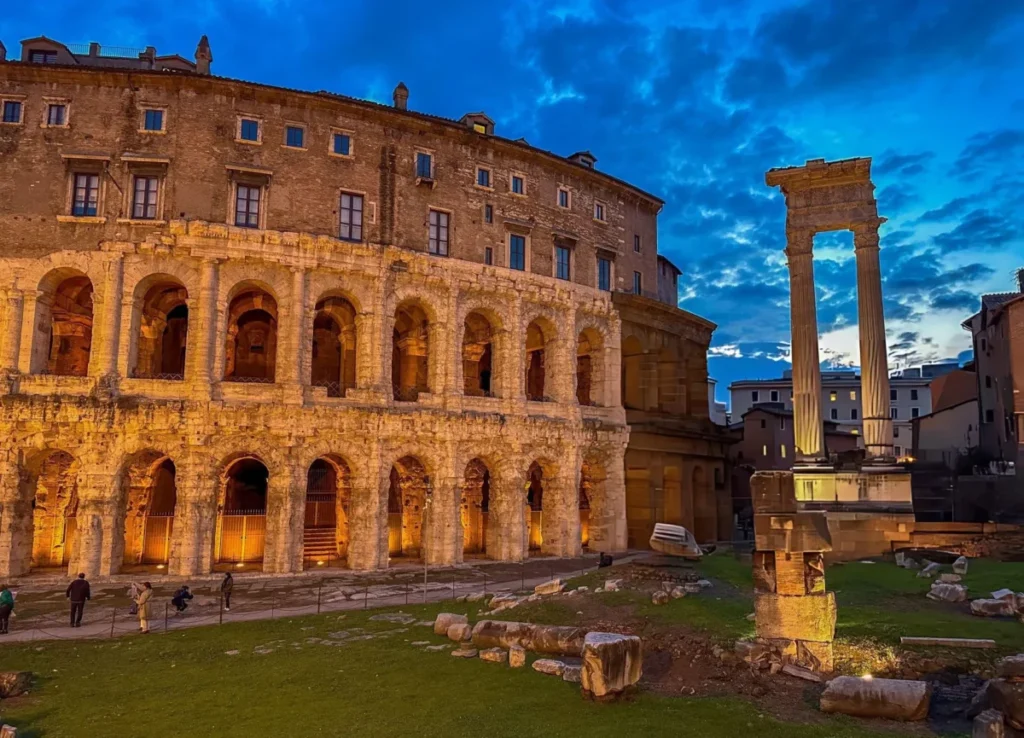
Julius Caesar first planned this permanent stone theatre in the 50s BC as a rival to Pompey’s Theatre, completed just years before. Caesar wanted to outdo his political opponent with an even grander venue, but he was assassinated in 44 BC before construction could begin.
Augustus took over the project and completed it between 13 and 11 BC. He dedicated it to the memory of his nephew Marcellus, who had died young in 23 BC and was meant to be Augustus’ heir and successor.
The Theatre of Marcellus could seat about 20,500 spectators in its curved banks of seating. This made it Rome’s second most important theatrical venue after Pompey’s and just before Balbus’ theatre, which opened the same year on the other side of the Field of Mars.
The curving facade that still rises beside the Tiber shows two superimposed arcades of travertine limestone. The lower level features half-columns in the Tuscan order, while Ionic capitals crown the upper arcade. This design of stacked arcades between engaged columns became the architectural template for later Roman amphitheatres.
Most famously, the Flavian Colosseum built half a century later deliberately echoed Marcellus’ rhythm of arches, pilasters, and horizontal entablatures. The theatre essentially taught Roman architects how to organize massive curving facades with repeating bay units, a lesson applied to amphitheatres across the empire.
The theatre stood in a prime location between the Circus Flaminius and the Temple of Apollo Medicus Sosianus. It anchored the southern edge of the monumental zone along the Tiber, visible to anyone approaching from the river or moving between the Capitoline and the great temples on the Field of Mars.
In the eleventh and twelfth centuries, the Pierleone family converted the standing arcades into a fortress. Later the Savelli and Orsini families built a Renaissance palazzo on top of the ancient structure, essentially treating the theatre as a ready-made foundation platform.
The original semicircular plan, stage building, and surrounding porticus are known partly from fragments of the Severan Marble Plan of Rome. The theatre’s footings survive embedded in the palazzo walls that rise above the visible arcades today, preserving the ancient curve in the modern streetscape.
2. Temple of Portunus
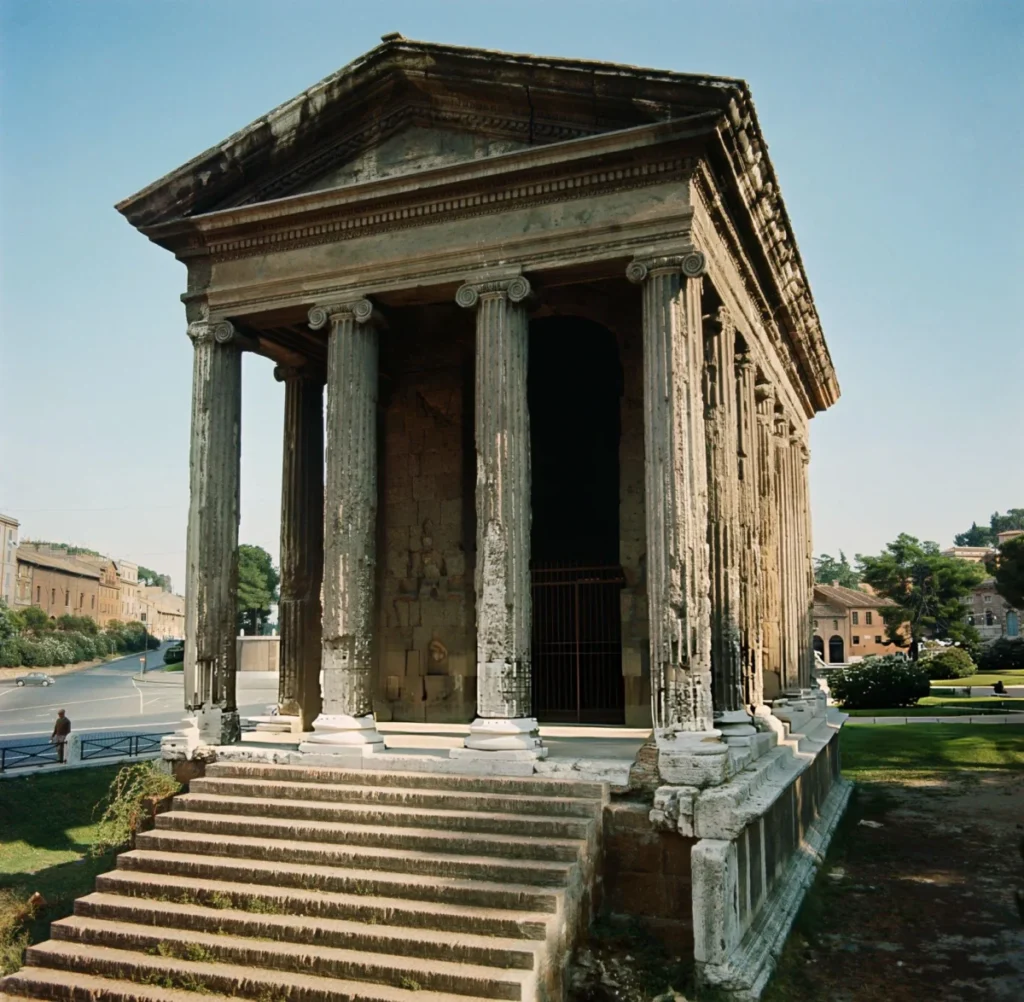
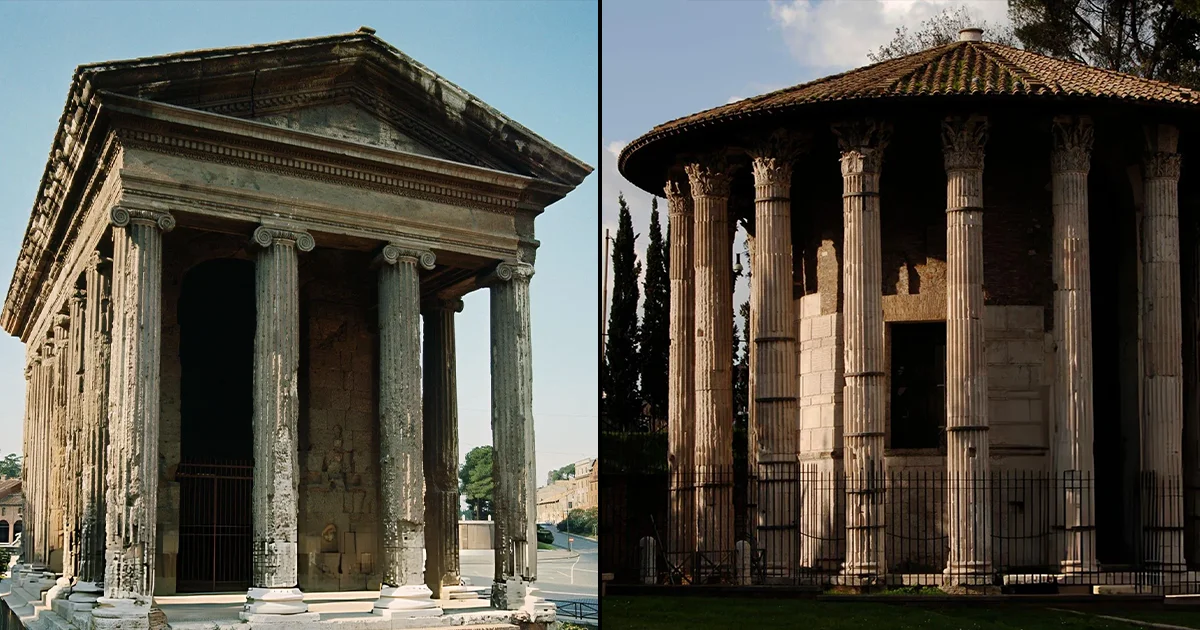
At the Forum Boarium near the river harbor, the small rectangular Temple of Portunus dates to the late second or early first century BC. It was erected on its high podium in the traditional Italic style, with a deep frontal porch and engaged columns along the sides of the closed cella.
The god Portunus was associated with harbors, keys, and gateways. The temple’s position beside the Tiber crossing linked cult to function in a district crowded with markets, wharves, and the Pons Aemilius, the main bridge leading toward the Forum.
The building shows a careful mixture of materials characteristic of Republican construction. The podium core used local tufa, while the columns and entablature employed travertine limestone, all originally covered with fine stucco to create a uniform white surface.
The four freestanding columns of the porch carry Ionic capitals, their fluted shafts framing the doorway into the cella. The side and rear columns are engaged, meaning they are half-round and bonded into the cella wall, a distinctly Italic feature that sets this temple apart from Greek models where all columns stand free.
The structure survived intact because it was converted into a Christian church, probably by the ninth century. This preserved the column shafts, entablature, and overall podium layout even as the interior was adapted for new liturgy and the cella doorway was modified to suit Christian processional needs.
By the early Middle Ages, the temple’s original dedication to Portunus had been forgotten. It was sometimes called the Temple of Fortuna Virilis, a misidentification that persisted until nineteenth-century scholarship clarified the correct dedication based on Renaissance drawings and ancient literary sources.
The temple remains one of the best-preserved examples of the late Republican Italic temple type. It demonstrates how Greek-inspired columns and decorative details were combined with the high podium and frontal emphasis characteristic of Roman sacred architecture, where the building is designed to be viewed primarily from the front rather than from all sides.
3. Round Temple at the Forum Boarium
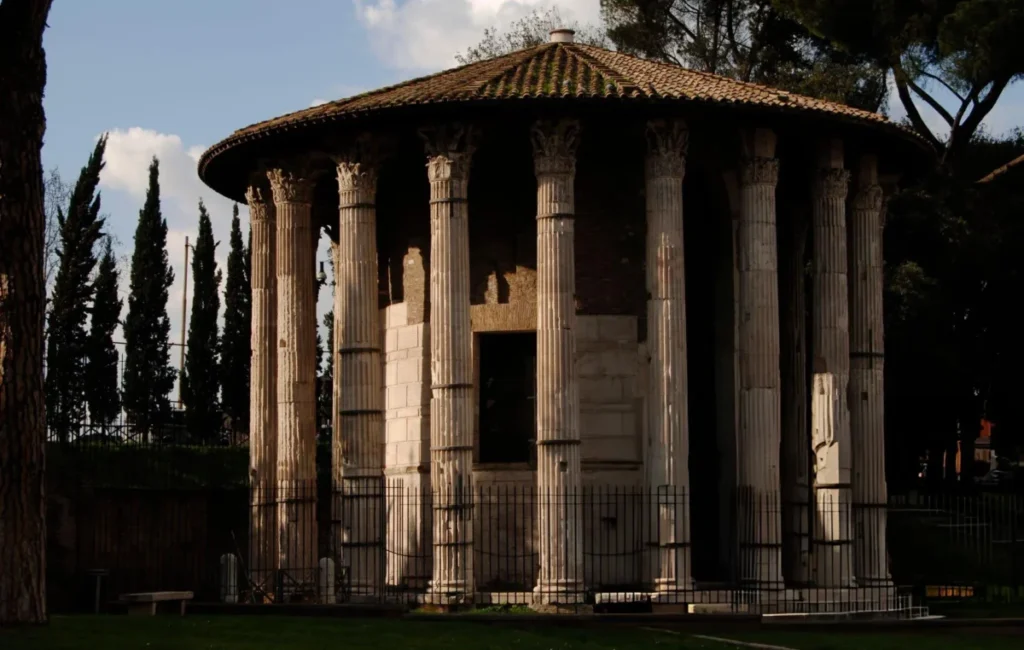
Close to the Temple of Portunus stands a small circular marble shrine, often called the Temple of Hercules Victor, though its original dedication remains uncertain. Built in the late second century BC, possibly in the 120s, the round temple consists of a ring of twenty Corinthian columns surrounding a cylindrical cella.
All elements sit on a low stepped podium of tufa blocks. The use of fine Greek Pentelic marble rather than local tufa, along with the high quality of the column bases and capitals, points to wealthy patrons with access to imported stone and skilled Greek craftsmen, possibly from Athens or Asia Minor.
The circular plan and peristyle colonnade recall Greek tholos temples, particularly those at Delphi and Epidaurus. This design was adapted here to a Roman riverside setting thick with altars, warehouses, and porticoes serving the commercial life of the Forum Boarium, where cattle and other goods changed hands daily.
The temple’s columns stand about 10 meters tall with elegantly carved Corinthian capitals featuring acanthus leaves. The entablature above shows a frieze decorated with bucrania, garlands, and ritual implements, connecting the building to sacrificial cult practices even though the specific deity honored remains debated.
Like its neighbor, this temple also escaped demolition by serving Christian purposes in late antiquity and the Middle Ages. The peristyle was partially enclosed with brick walls between the columns, and the cella was adapted for a church dedicated to various saints over the centuries.
The colonnade remains largely intact today. Visitors can still walk around the outside of the drum to see how the white marble columns frame the enclosed circular core, creating a delicate ring of stone that has survived more than two millennia despite floods, earthquakes, and medieval reuse.
The building demonstrates the influx of Greek architectural forms and craftsmen into Rome during the second century BC. This was the period when Rome was conquering the Hellenistic kingdoms of the eastern Mediterranean and bringing back not just treasure and slaves, but also artistic ideas and skilled workers who transformed Roman building practices.
4. Baths of Caracalla
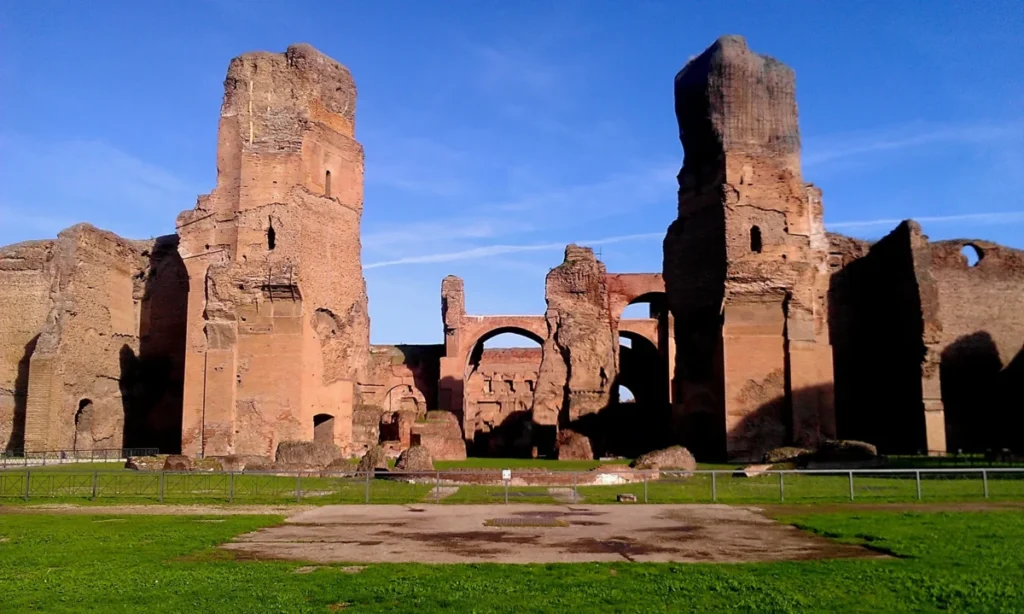
South of the Aventine Hill, the Baths of Caracalla occupy a broad artificial platform that once carried one of Rome’s largest bathing complexes. Construction began around AD 212 under the emperor Caracalla and was substantially complete by AD 216, though his Severan successors added finishing touches through the 220s.
The central block contained a sequence of vaulted halls for cold, warm, and hot bathing. A huge open-air swimming pool, the natatio, anchored the north side. The frigidarium featured a massive cross-vaulted hall with cold plunge pools in the side chambers.
The tepidarium and caldarium followed, with increasingly sophisticated heating systems. Hypocaust floors raised on brick pilasters allowed hot air from furnaces to circulate beneath the bathers’ feet, while hollow wall tiles carried heat up through the walls themselves.
The complex was flanked by two symmetrical exercise courts, or palaestrae, where Romans could wrestle, box, or practice athletic drills before bathing. Semicircular exedras framed the whole composition and opened toward gardens and porticoes around the perimeter, creating a vast recreational landscape.
Water arrived through a dedicated branch of the Aqua Marcia aqueduct, rebuilt and extended specifically to serve these baths. The water then ran through hidden channels and massive cisterns beneath the floors before reaching the great pools and fountains in the bathing halls above.
The surviving brick and concrete walls still outline the immense scale of imperial ambition. The frigidarium alone measured roughly 58 by 24 meters, with vaults soaring to a height estimated at over 30 meters, creating an interior volume comparable to a Gothic cathedral.
Rooms could accommodate thousands of bathers at once in a single afternoon. Estimates suggest the complex could handle 1,600 bathers at any given time, with total daily capacity perhaps reaching 6,000 to 8,000 people as groups rotated through the bathing sequence.
The Severan architects pushed both size and decoration further than earlier bath builders. Walls were lined with colored marble veneer in geometric patterns, employing porphyry from Egypt, Numidian yellow giallo antico from Tunisia, and Carystian green from Euboea, creating dazzling chromatic effects.
Floor mosaics depicted athletes, sea creatures, and geometric designs. Hundreds of statues filled the halls and gardens, including the famous Farnese Bull and Farnese Hercules now in Naples, which were excavated from the ruins in the sixteenth century.
Even after regular imperial patronage declined in the later third and fourth centuries, the baths remained operational. Their robust brick construction allowed large sections to stand through late antiquity and into the medieval period, long after the marble cladding and statues had been quarried or lost to lime kilns.
Built out of a love for history, kept free from distractions.
Spoken Past is an independent project shaped by curiosity, care, and long hours of research. Reader support helps keep it maintained, carefully researched, and open to everyone.
5. Baths of Diocletian
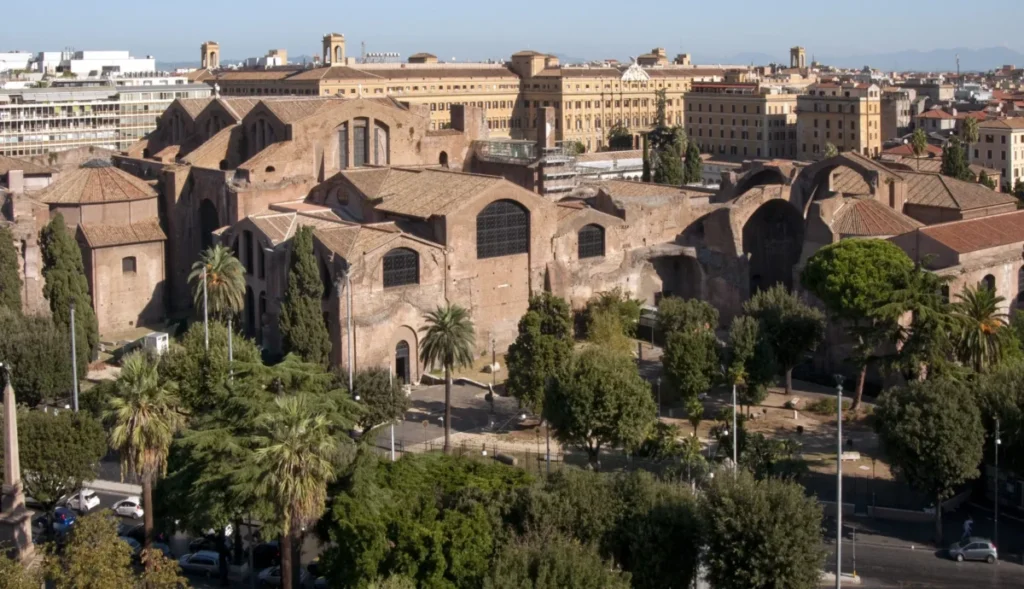
On the Viminal Hill, the Baths of Diocletian spread across an enormous platform measuring 356 by 316 meters and covering eleven hectares. This made them the largest bath complex ever built in Rome, surpassing even the Baths of Caracalla in sheer size and capacity.
Inscriptions date the dedication to between May 1, AD 305, and July 25, AD 306. The texts credit the co-emperor Maximian with purchasing the land around AD 298 when he visited the city, clearing a densely populated residential quarter to make room for the massive construction project.
The central bathing block followed the same canonical sequence as Caracalla’s Baths. A huge open-air swimming pool anchored the composition, followed by a massive vaulted frigidarium with cross vaults supported on eight enormous granite columns, each nearly 15 meters tall and weighing about 100 tons.
A small tepidarium provided the transition to the vast caldarium on the south side, which took maximum advantage of solar heating by facing toward the sun. Secondary rooms for changing, massage, and lounging filled out the symmetrical plan on either side of the central axis.
The complex drew water from the Aqua Marcia. Engineers augmented the aqueduct’s flow specifically for these baths and collected the supply in a vast cistern under what is now Piazza dei Cinquecento, just outside Termini train station.
The baths served a densely populated zone on the northern edge of the city, near the Viminal and Quirinal hills. They continued to function until the sixth century, reportedly accommodating seats for 3,000 bathers at a time, with total capacity perhaps three times that number as Romans cycled through the bathing sequence.
In 1563, Michelangelo converted the nucleus of the frigidarium and its flanking halls into the church of Santa Maria degli Angeli. The architect recognized the structural strength and grandeur of the ancient vaults and adapted them with minimal intervention, essentially inserting a church into the Roman shell.
The interior was extensively refashioned again in 1749 by Luigi Vanvitelli, who rotated the axis and added Baroque decoration. However, the spaces still convey the scale of the ancient cross-vaulted halls, with their colossal columns of pink Egyptian granite standing as they did in the fourth century.
Parts of the outer enclosure wall survive around the perimeter. The octagonal hall at one corner, now a church called San Bernardo, preserves its ancient concrete dome. Other sections house the Museo Nazionale Romano, displaying sculpture, mosaics, and architectural fragments recovered from sites across the city.
6. Villa of the Quintilii
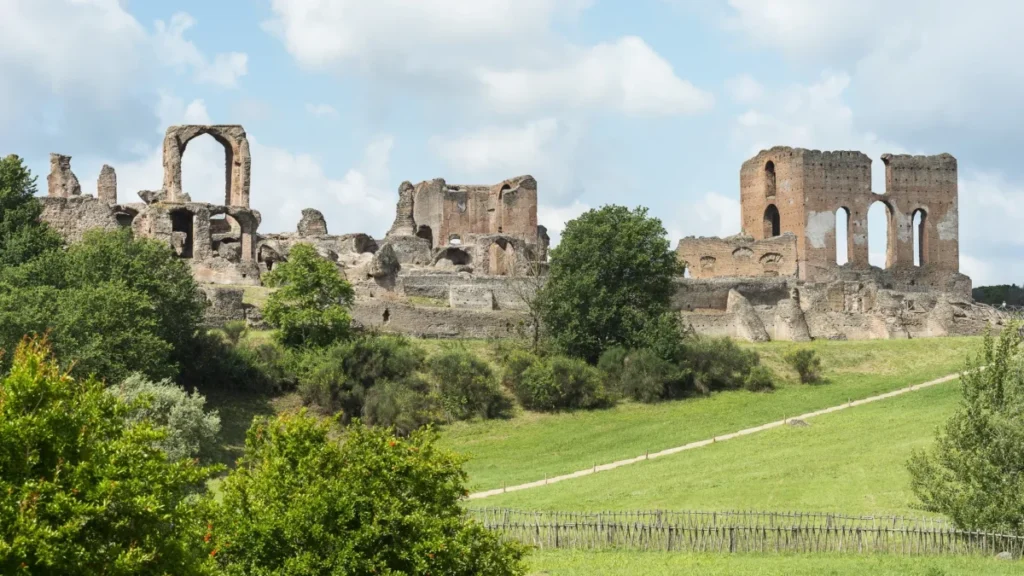
Along the Via Appia about eight kilometers outside the Aurelian walls, the Villa of the Quintilii occupies a commanding plateau with sweeping views back toward Rome and out across the Campagna countryside. The estate belonged originally to the senatorial Quintilii brothers, Sextus Quintilius Condianus and Sextus Quintilius Valerius Maximus, who were consuls together in AD 151.
The Quintilii were enormously wealthy, with estates scattered across Italy and the provinces. They invested heavily in this Appian property, transforming it into a showcase of senatorial luxury with formal reception halls, elaborate gardens, and a private bath complex that rivaled smaller public thermae.
The property passed into imperial hands under dramatic circumstances. In AD 182, the emperor Commodus executed both brothers on charges of conspiracy, though the real motive was probably to seize their spectacular villa and its rich holdings for the imperial estate portfolio.
After the confiscation, the villa became an occasional imperial residence. Later emperors added new structures and expanded the complex, turning it into one of the great suburban palaces surrounding Rome, comparable to Hadrian’s Villa at Tivoli though smaller in scale.
The sprawling complex grew around a core of formal reception halls at the highest point of the plateau. These featured apses, colonnaded courtyards, and water features designed to impress visitors arriving along the Via Appia, demonstrating the owners’ wealth and cultivated taste through architectural display.
The villa included its own elaborate bath suite on the north side of the main residential block. The baths featured the standard sequence of rooms for cold, warm, and hot bathing, with sophisticated hypocaust heating systems and service corridors that paralleled in miniature the arrangements of major urban thermae.
A nymphaeum with cascade fountains, multiple dining rooms with mosaic floors depicting seasons and hunting scenes, and terraced gardens extended the architectural presence deep into the surrounding landscape. The villa essentially became a small city unto itself, complete with service quarters, storage facilities, and housing for the large staff required to maintain such an estate.
A hippodrome or small circus attached to the villa allowed for private races and equestrian exercises. This feature became increasingly common in late imperial villas, reflecting the aristocracy’s passion for chariot racing even in private suburban settings.
Even after the senatorial lifestyle declined in late antiquity, the core masonry structures continued to stand above the fields. Their brick and concrete walls marked the line where suburban luxury once dominated the ancient road, and travelers could see the ruins for miles as they approached Rome from the south.
7. Tomb of Caecilia Metella
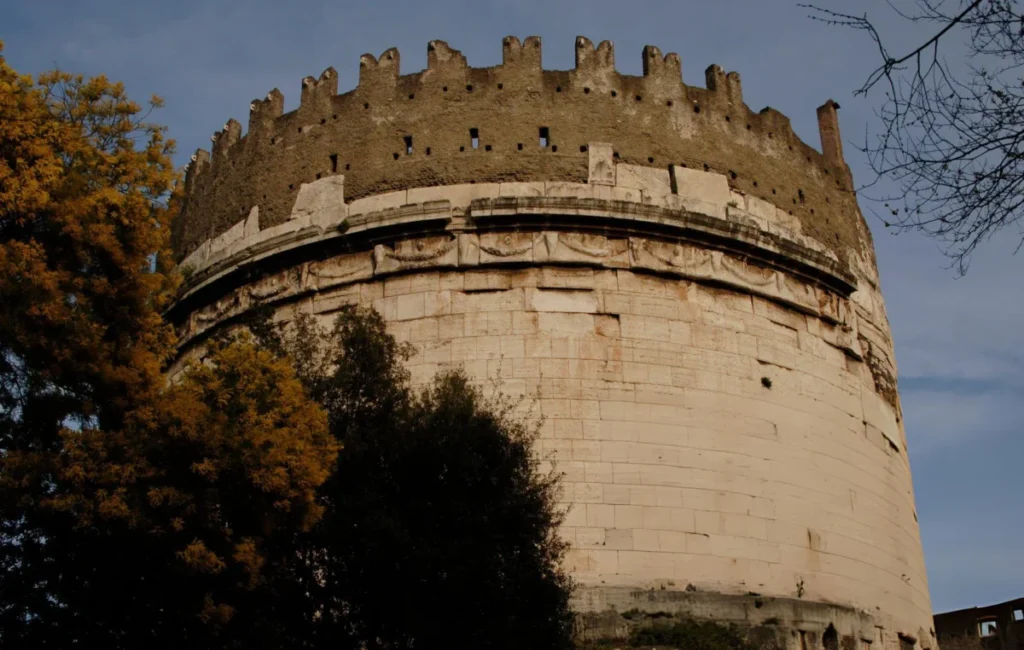
On the Via Appia about three kilometers from the Aurelian walls, the cylindrical Tomb of Caecilia Metella rises like a stone tower on a square travertine base. The massive drum measures about 30 meters in diameter and stands nearly 11 meters high above its base, creating a landmark visible from a considerable distance along the ancient highway.
The tomb was built in the first half of the first century BC, probably in the 50s or 40s. An inscription carved in large letters near the top records the name Caecilia Metella, daughter of Quintus Caecilius Metellus Creticus who conquered Crete in 69 to 67 BC, and possibly wife of the triumvir Marcus Licinius Crassus’ son.
The structure formed part of a long line of funerary monuments that lined the first miles of the Via Appia outside the city walls. Roman law prohibited burial within the pomerium, the sacred boundary of the city, so major roads leading out of Rome became corridors of commemoration where aristocratic families competed to build the most impressive tombs.
The tomb’s design recalls the great cylindrical mausolea of Hellenistic rulers, particularly those in Asia Minor. It was scaled down but still monumental, with walls thick enough to carry either an earthen tumulus or a conical stone roof above the burial chamber inside.
The travertine blocks of the exterior wall were originally covered with white marble revetment, now lost. A decorative frieze of ox skulls and garland swags ran around the upper portion of the drum, just below the inscription, adding a traditional Roman funerary motif to the otherwise Hellenistic design.
In the Middle Ages, the Caetani family fortified the tomb as part of their efforts to control traffic and collect tolls on the Via Appia. They added crenellated battlements to the top of the drum and built a castle complex around the base, complete with defensive walls and a fortified gate across the road itself.
The ancient cylinder became the keep of this fortified outpost. The massively thick walls made it nearly impregnable, and the Caetani held it as a strategic stronghold well into the Renaissance period, using it to project power over the Campagna countryside.
Yet the Republican core, with its travertine blocks and original inscription, continued to broadcast its ancient origins. People in the early medieval period knew it primarily as a military stronghold rather than a tomb, but the building’s form and the fragmentary inscription preserved memory of its original funerary purpose even through centuries of adaptive reuse.
8. Circus of Maxentius
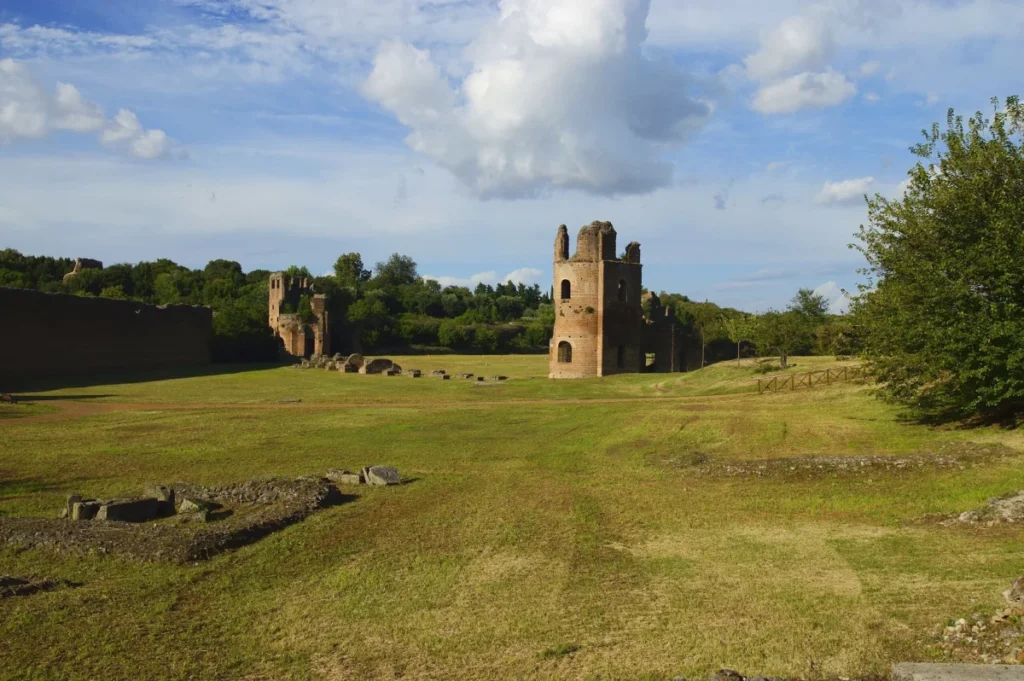
About a kilometer beyond Caecilia Metella’s tomb, the Circus of Maxentius stretches along the slope beside the Via Appia. It formed part of a suburban complex that also included an imperial palace and a circular mausoleum, all built between AD 307 and 312 by the emperor Maxentius who controlled Rome during those years.
The circus measures roughly 520 meters long and 92 meters wide. It could accommodate chariot races with a full complement of twelve starting gates, called carceres, at the west end. The central barrier, or spina, ran down the middle with turning posts, called metae, at either end around which the chariots would race in a counterclockwise direction.
The standing walls and the outline of the spina remain clearly traceable in the landscape. Archaeological excavations have revealed the substructures of the seating, which rose in tiers on either side of the track and could have held perhaps 10,000 spectators, making this a relatively intimate venue compared to the Circus Maximus in the city, which seated well over 100,000.
The adjacent circular mausoleum was likely intended for Maxentius’ young son Romulus, who died at age four in AD 309 and was deified by his grieving father. The tomb’s rotunda design echoed the great mausolea of earlier emperors, particularly that of Augustus, signaling Maxentius’ claim to legitimate imperial authority.
The palace occupied the hillside between the circus and mausoleum. Excavations have uncovered audience halls, private apartments, baths, and service quarters, suggesting that this was a fully functional suburban residence where Maxentius could escape the political pressures of the city while remaining close enough to return quickly if needed.
The circus represents one of the last great imperial building projects along the Via Appia. Maxentius erected it when he was promoting himself and his rule as a new beginning for Rome through deliberate revivals of ancient traditions and monumental construction projects that recalled the glory days of the early empire.
Chariot racing remained a central spectacle in the early fourth century. Placing a private circus beside a palace and tomb continued the tradition of suburban imperial estates like Hadrian’s Villa at Tivoli, where emperors could indulge their passions for entertainment and display away from the crowded, politically charged atmosphere of the urban center.
After Maxentius died in battle against Constantine at the Milvian Bridge in AD 312, his name was subject to official damnation of memory. His monuments were either demolished, rededicated, or allowed to decay without maintenance, depending on their visibility and symbolic importance.
However, the circus walls and spina persisted in the landscape. They outlined the ancient track long after the last race had been run, giving later travelers a visceral sense of the scale on which fourth-century emperors entertained themselves outside the city walls, even as the specific history and patron’s identity faded from memory.
9. Mausoleum of Augustus
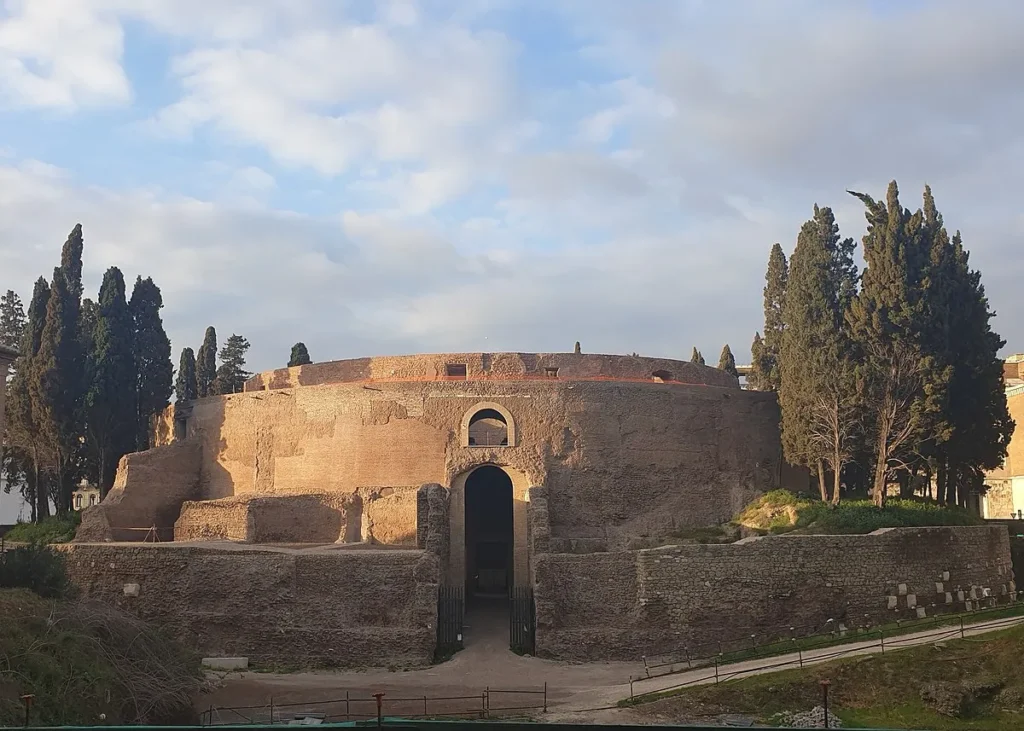
On the northern Field of Mars near the Tiber, the Mausoleum of Augustus was completed in 28 BC as part of Augustus’ earliest building projects after his victory at Actium. It became the largest tomb in the Roman world at that time, deliberately designed to surpass all previous funerary monuments and establish a new standard for imperial commemoration.
The structure consists of concentric rings of concrete and tufa walls, reinforced by massive semicircular buttresses that tie the rings together. All originally faced with white travertine limestone, the mausoleum rose to a height estimated at about 45 meters, making it one of the tallest structures in the city and visible from across the Field of Mars.
Ancient sources describe it as a great earthen tumulus thickly covered with trees, with a bronze statue of Augustus at the summit. The historian Strabo, writing in 7 BC, emphasized the impression of natural and monumental grandeur combined, as if the mound itself were a sacred hill rising from the flat flood plain.
The design may have referenced multiple traditions simultaneously. The tumulus form recalled Etruscan princely tombs, linking Augustus to Italy’s ancient past. The scale and stepped profile, if it had one, may have evoked Hellenistic royal tombs, particularly the famous Mausoleum of Halicarnassus. Some scholars suggest Augustus actually modeled it on the lost tomb of Alexander the Great in Egypt, which would have appealed to his self-image as Alexander’s heir and Rome’s new world conqueror.
The circular plan measured roughly 89 meters in diameter. A narrow entrance passage on the south side led visitors through the massive outer wall to vaulted corridors that curved around the interior, finally opening to a central burial chamber where the most important family members’ ashes were deposited in golden urns.
Augustus’ ashes joined those already interred in AD 14. His nephew Marcellus had been the first burial in 23 BC, followed by Marcus Agrippa in 12 BC, then Drusus the Elder in 9 BC, and Augustus’ adopted sons Lucius and Gaius Caesar in AD 2 and 4. The emperor Tiberius, Livia Augusta, and other Julio-Claudians followed across the first century AD.
By the fourth century, the entrance was flanked by two obelisks of red Aswan granite, originally erected by the pharaohs and brought to Rome by Augustus. One now stands in front of Santa Maria Maggiore, the other forms part of the Horse Fountain on the Piazza del Quirinale, testifying to the mausoleum’s later dismantling.
In the Middle Ages, the Colonna family converted the mausoleum into a fortress. It was destroyed in 1167 during factional fighting and then quarried extensively for building materials, with the travertine facing systematically stripped from the concrete core.
The ruins were transformed repeatedly afterward. In the sixteenth century, the Soderini family bought the site and laid out ornate gardens within the circular enclosure. In the eighteenth century, it became an arena for bullfights. In the nineteenth century, it hosted circus and theatrical performances. From 1907 until 1936, it housed the Augusteo concert hall with seating for 3,500.
The Fascist regime cleared the site in 1937 as part of Mussolini’s campaign to glorify ancient Rome. The excavation exposed the ancient footings and cleared away centuries of accumulated debris and later construction, though it also imposed a starkly modern interpretation on the ruins that remains controversial.
10. Temple of Antoninus and Faustina
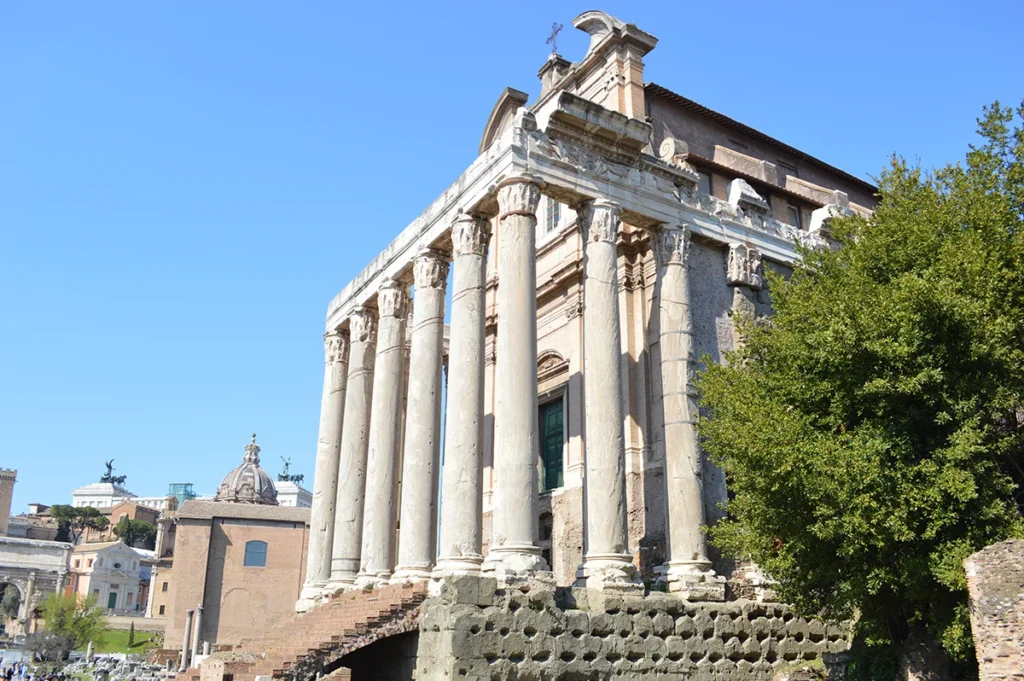
In the Roman Forum near the Via Sacra, the Temple of Antoninus and Faustina stands out immediately with its six tall columns of Carystian green marble across the front and two more at the sides. The temple occupies a prominent position near the Basilica Paulli and the later Temple of Peace, visible to anyone moving along the Via Sacra between the Forum valley and the imperial palaces on the Palatine.
The temple was built by the emperor Antoninus Pius for his wife Faustina after her death and deification in AD 140. The initial inscription on the frieze read simply “For Deified Faustina, by decree of the Senate,” recording the Senate’s formal authorization of her apotheosis and cult.
When Antoninus himself died and was deified twenty years later in AD 161, his name was added to the dedication. Workers chiseled off the frieze above Faustina’s line and carved “For Deified Antoninus and…” above the original text, joining the couple in a single temple cult that honored them both as divine protectors of the imperial family and the state.
The Corinthian order rises about 17 meters tall, with column shafts of roughly 14 meters standing on bases and crowned with elegantly carved capitals. The architectural quality represents top-tier imperial craftsmanship, employing expensive colored marble from imperial quarries in Greece and Italy.
Beautifully sculpted friezes of griffins, acanthus scrolls, and candelabra decorate the entablature along the sides. These carvings remain remarkably well-preserved, protected from weathering by the church construction that enclosed the cella in later centuries.
The cella once housed colossal cult statues of the deified couple, probably seated on thrones in the manner of Jupiter and Juno. Fragments of both statues were found during excavations in front of the temple in the early twentieth century and are now displayed in the porch, giving visitors a sense of the enormous scale at which imperial cult images were carved.
The high podium of dark grey tufa shows the temple’s construction in the traditional Italic manner, raised well above street level and approached by a broad frontal staircase. The podium was originally faced with white marble slabs held in place by metal clamps, creating a uniform gleaming base for the colorful columns and marble entablature above.
In the seventh or eighth century, the temple was converted into the church of San Lorenzo in Miranda. The conversion preserved the marble columns, entablature, and podium even as the interior was gutted and adapted for Christian worship. The baroque pediment added in 1602 still rises behind the ancient Corinthian capitals, creating a layered composition of Roman and Christian architectural elements.
The robust tufa podium and cella walls survived all these transformations, though they are pockmarked by holes made by medieval blacksmiths and builders searching for iron and lead clamps. These scars testify to centuries of recycling and reuse, when ancient monuments served as quarries for valuable metals even as their basic structures were preserved for new purposes.
The temple’s survival demonstrates the process by which many ancient roman buildings endured into the modern era. Adaptive reuse, rather than conservation, kept them standing through the Middle Ages and Renaissance, ensuring that structures like this remain among the most recognizable and accessible monuments in the Forum today.