A soldier stops beside a line of roadside tombs, takes off his clothes and urinates around them. His travelling companion watches him become a wolf and run into the trees. When the companion returns the next day, the soldier is lying in bed with a wound in his neck, exactly where a wolf was stabbed during the night. The episode comes from the Satyricon, a Latin work usually dated to the first century CE. It is one of the fullest surviving ancient stories about a human being who changes into a wolf.
The storyteller is Niceros, a former slave attending the extravagant dinner of another freedman, Trimalchio. His account occupies the end of chapter 61 and most of chapter 62 in modern editions of the Satyricon. Niceros insists that the events happened to him when he was still enslaved. The author places his testimony among jokes, arguments, performances and spectacular courses of food, so that the reader must listen to a frightening story through the voice of a man who is also trying to hold the attention of a difficult room.
The setting changes the meaning of the tale. A wolf in the darkness is frightening, but Niceros is equally concerned about being laughed at by educated guests. The details he offers as evidence, especially the petrified clothes and the soldier’s matching wound, make the account persuasive within its fictional world while exposing the speaker to ridicule. Reading the passage closely also reveals what the story can and cannot tell us about ancient beliefs. Its werewolf belongs to Roman literature, although many of its ingredients also appear in Greek and Roman folklore.
Who wrote the Satyricon?
The surviving Satyricon is a fragment of a much larger work. Its narrator, Encolpius, moves through a disorderly world of sexual rivalries, dubious friendships, opportunism and elaborate pretence. The prose is interrupted by poetry, parody and extended speeches. The section known as the Cena Trimalchionis, or Trimalchio’s Dinner, is unusually substantial and gives readers an extended view of a wealthy freedman entertaining his guests. It is fictional satire, although the details of its language and social encounters are valuable evidence for what a Roman writer expected readers to recognise.
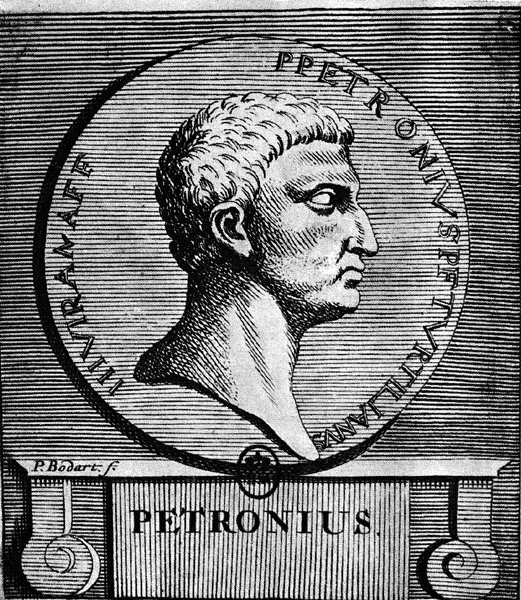
The author is traditionally called Petronius Arbiter. He is often identified with the Petronius described by the historian Tacitus in Annals 16.18–19. Tacitus says this courtier governed Bithynia, subsequently held the consulship and became an intimate of the emperor Nero. His judgement in matters of luxury made him an elegantiae arbiter, an arbiter of elegance. After the powerful Tigellinus accused him of connections with a conspiracy, Petronius was denied a defence and died in 66 CE, opening and binding his veins while conversing with friends. Tacitus also reports that he sent Nero a sealed account of the emperor’s sexual excesses.
The identification is plausible, but it is not a documented fact. Tacitus does not name the Satyricon, and the surviving text does not identify its author as the man who died in 66. Some linguistic and cultural features suit a Neronian setting, but the precise date and the author’s identity remain debated. It is therefore misleading to treat the werewolf tale as a literal recollection of a dinner that the imperial courtier attended. The episode is a deliberately written performance by an author whose ability to imitate different kinds of speech is central to the work.
That distinction also matters for the story’s historical value. Niceros does not speak in the measured style of an official historian. His sentences are crowded with oaths, jokes, familiar expressions and concrete details about money, bodies and food. The contrast with the polished literary framing is part of the pleasure of reading him. Petronius gives a man with little formal prestige an opportunity to tell the most memorable story at a rich man’s table.
Why a werewolf appears at Trimalchio’s dinner
Trimalchio is an ex-slave whose fortune allows him to stage an evening of almost limitless excess. Food arrives disguised as other food, entertainers interrupt the meal, and the host repeatedly demonstrates how much wealth and attention he can command. The narrator Encolpius and his companions, who possess literary education but not Trimalchio’s resources, respond with a mixture of astonishment, embarrassment and contempt. The dinner exposes a Roman tension between money, inherited standing and the cultural habits through which people claimed refinement.
For former slaves, public respect was particularly important. Manumission could give a person freedom and opportunities to acquire property, yet the legal and social consequences of enslavement did not simply disappear. Earlier in the dinner, the freedman Hermeros angrily answers the laughter of better-educated guests by listing his property, financial independence and hard-won respectability. His speech, in chapters 57–58 of the surviving text, helps explain why Niceros is cautious. A dinner guest could win admiration with an entertaining story or become the next object of mockery.
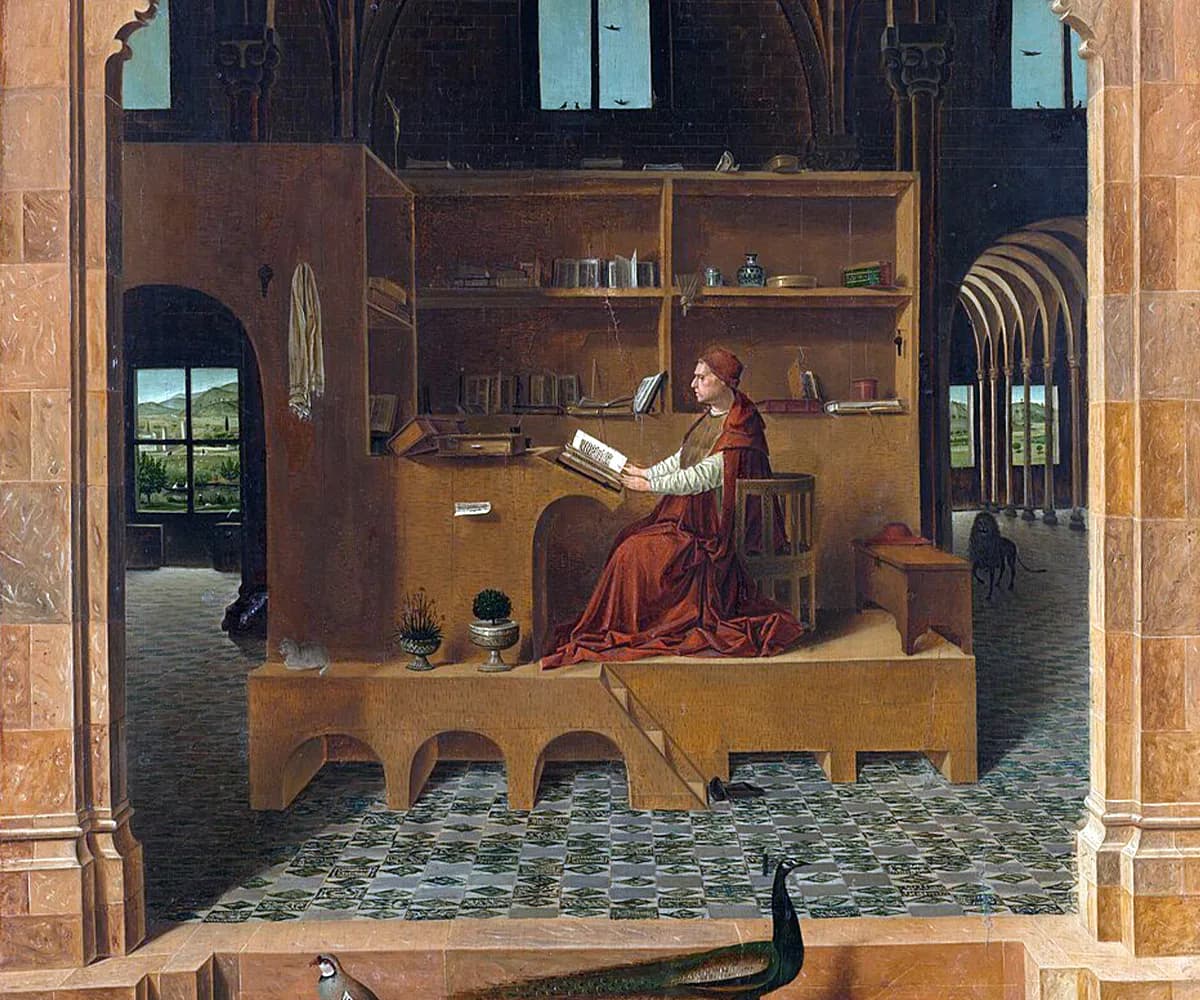
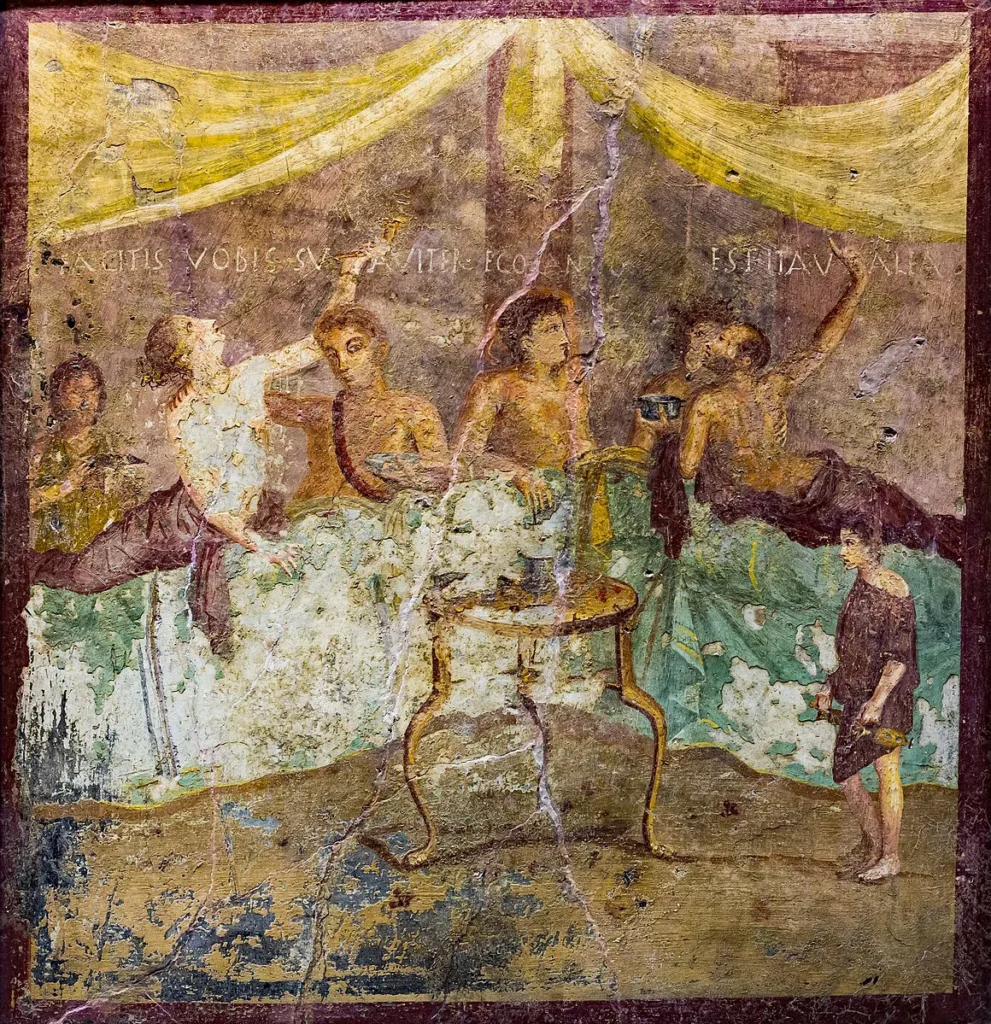
Roman dining rooms were built for conversation and display. Guests could recline on couches while servants moved among them, and the host could control who spoke and what happened next. A Pompeian wall painting from the House of the Triclinium, now in the Naples archaeological museum, even shows diners with words inscribed above their heads. It is not a picture of Trimalchio’s fictional feast, but it makes the social setting easier to imagine: eating, talking and performing could be inseparable parts of an evening.
Niceros is asked to tell a story
The werewolf episode begins when Trimalchio notices that Niceros is unusually quiet. He asks him to recount something that happened to him. Niceros responds enthusiastically, but admits that he fears the scholastici, the educated men present, will laugh at him. He decides to proceed anyway, preferring laughter to contempt. This small exchange is easy to overlook, although it establishes that the storyteller knows how his audience might judge both the tale and his manner of telling it.
Niceros recalls the time when he was enslaved in a household near a narrow lane. He had formed a relationship with Melissa of Tarentum, the wife of an innkeeper named Terentius. He insists that he valued her kindness and generosity rather than merely pursuing sex. When her husband died at a country property, Niceros wanted to visit her. His own master had gone to Capua on business, leaving him an opportunity to travel. The soldier who accompanies him is a guest of the household, a man Niceros describes as exceptionally brave.
The soldier, the graves and the transformation
They set off around cockcrow, while the moon is so bright that Niceros compares it to midday. The journey takes them along a road bordered by tombs. In Roman Italy, graves and funerary monuments often stood outside settlements beside roads where passers-by could see them. For the purposes of Niceros’s story, the location is especially uncomfortable: the living are travelling past the dead in the hours before sunrise. His companion begins relieving himself near the grave markers, and Niceros waits, singing and counting the stones.
When Niceros looks back, the soldier has stripped and put his clothes beside the road. He urinates in a circle around them and immediately becomes a wolf. There is no long description of bones stretching or flesh changing. The transformation is stated as a sudden fact, followed by the animal’s howl and flight into the woods. The plainness of the narration gives the audience almost no time to prepare for it. Niceros, by contrast, is so terrified that he says he stands as though already dead.
The abandoned clothing is important. Niceros tries to take it, only to discover that it has turned to stone. The account never explains the mechanism or says how the soldier later recovers his human shape. The sequence does, however, connect the man’s human appearance with the garments he has left behind. In Daniel Ogden’s discussion of ancient werewolf motifs, clothing can act as the outer human layer that a shapeshifter removes, and wounds can link the animal to the person beneath. His chapter is available here as an abstract, not as a freely accessible full text, so more specific readings of the urine circle should not be presented as quotations from the inaccessible chapter.
Niceros draws his sword and continues to Melissa’s farm. He says he attacks the shadows as he goes, a boast that can sound courageous or absurd depending on the listener. The Latin wording at this point contains a notorious textual difficulty. A 2022 study by T. Boggio proposes a new reading of the disputed letters matavitatau, treating part of the passage as an exclamation. That proposal is one scholarly interpretation, not a settled reconstruction. Even without deciding between editions, the scene clearly presents a man who is badly frightened and tries to defend himself against things he cannot identify.
Enjoying Spoken Past?
I created Spoken Past to share my love of history. I research, write and develop everything myself, and I want my articles and basic guides to remain free for everyone.
If you enjoy my work, please consider supporting Spoken Past with a small donation.
The wound that gives the soldier away
Melissa is astonished that Niceros has arrived so late. A wolf, she tells him, entered the property and attacked the livestock, drawing blood like a butcher. One of the household’s slaves struck the animal in the neck with a spear, but it escaped. Niceros is shaken by the news. At daybreak he leaves for his master’s house and passes the place where the soldier’s clothes had lain. The garments are gone; a pool of blood remains. The night’s two apparently separate incidents now begin to fit together.
When Niceros reaches home, the soldier is in bed, with a doctor treating a wound to his neck. He concludes that the man is a versipellis, literally someone who turns or changes the skin or pelt. In this context the word refers to a human wolf-shapeshifter. Niceros finishes by saying that he would never again share a meal with the soldier, even under threat of death. He invites the other guests to believe what they wish, then swears that the gods may punish him if he is lying. The strongest oath of personal truthfulness comes at the end of the account, after its extraordinary details have been presented.
The matching injury is an ingenious ending because it supplies the kind of corroboration a listener might demand. Niceros did see the soldier transform, but no one else at the dinner witnessed it. Melissa supplies independent news of a wounded wolf, and the doctor supplies a wounded human body. The narrative encourages its listeners to connect these observations. Of course, the coincidence would prove nothing outside the fiction. Within the tale, it turns a frightened man’s claim into a story with witnesses and physical traces. Ogden identifies the carried-over wound as one of the characteristic motifs of ancient and later werewolf stories, while caution is necessary when tracing every parallel back to the first century.
Niceros’s final refusal to eat with the soldier is more than a flourish. He has learned that an apparently ordinary companion can conceal a dangerous identity. In a story told over dinner, the discovery destroys the possibility of dining together. The meal at which Niceros now speaks is therefore a particularly apt place to announce the break. He can still share food with Trimalchio and the other guests, but he cannot imagine doing so with a man whose human appearance no longer feels trustworthy.
Werewolves before and after Petronius
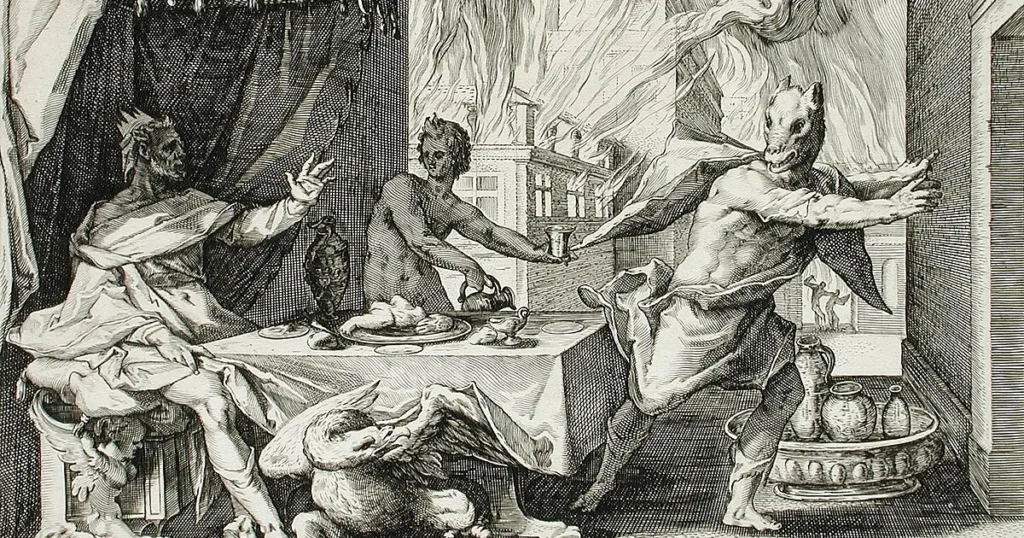
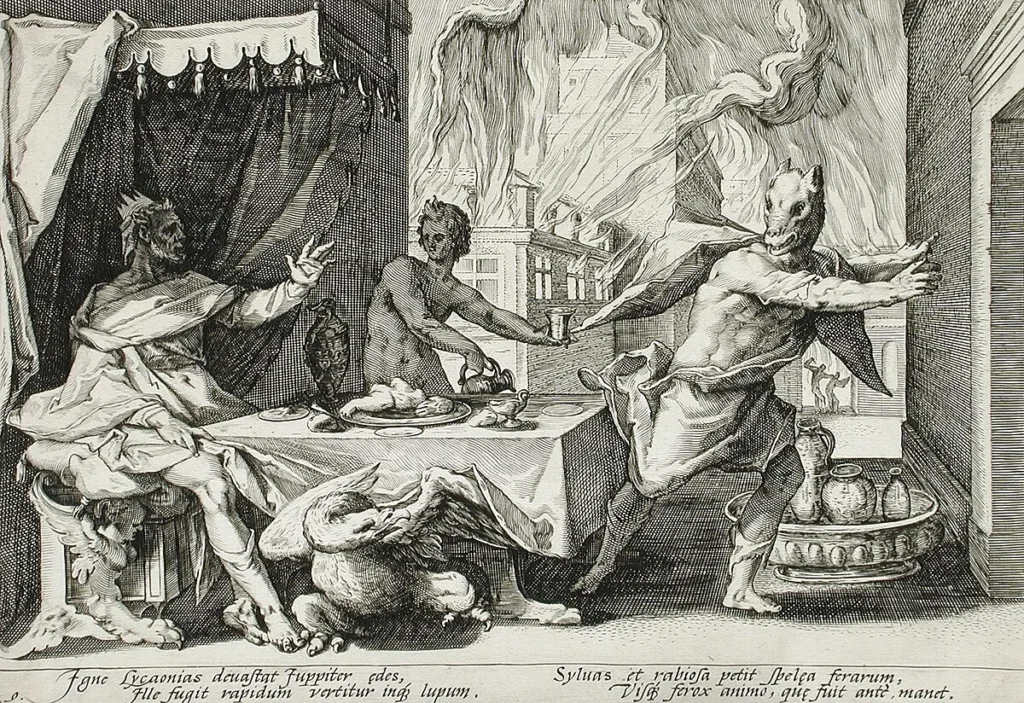
The soldier is not the first human wolf in surviving classical literature. In Ovid’s Metamorphoses 1, written decades before the likely date of the Satyricon, the Arcadian king Lycaon tests whether his guest is really Jupiter by attempting to murder him and serving human flesh. Jupiter destroys his house, and Lycaon flees into the countryside, where his features and violent appetites become those of a wolf. This is a story about impiety and divine punishment. Niceros’s soldier undergoes no announced punishment and is not accused of sacrilege. The two narratives share a transformation, but their causes and purposes are different.
Other accounts connect wolf-changing with the worship of Zeus Lykaion on Mount Lykaion in Arcadia. The traveller Pausanias, Description of Greece 8.2, says that Lycaon sacrificed a human infant and became a wolf. He also reports a tradition in which a person changed into a wolf at the sacrifice to Zeus and returned to human form after nine years if he had avoided human flesh. Pausanias is recording what was said about the rites, not independently establishing that such transformations occurred. The relationship between the stories, rituals and actual practices has remained a subject of scholarly debate.
Pliny the Elder provides a useful contrast because he explicitly refuses to endorse the belief. In Natural History 8.80–82, he says that claims of people becoming wolves and returning to human shape should be regarded as false. He nevertheless records a Greek account attributed to Euanthes: a man chosen by lot leaves his clothes on an oak, swims across water, lives as a wolf for nine years and may eventually recover his human form and the same clothing. The story shows that clothing and the return from wolf to human were already prominent features of the traditions Pliny knew. Pliny’s encyclopaedia was completed after the usual proposed date for the Satyricon; we cannot assume that Niceros’s fictional audience knew Pliny’s written account.
It is tempting to combine all these passages into one ancient werewolf mythology, complete with a single ritual, transformation rule and means of recovery. The sources do not support that. Ovid offers a punishment myth; Pausanias preserves local traditions about Arcadia; Pliny reports stories he doubts; Petronius makes a fictional dinner guest narrate an encounter. Ogden’s introduction to The Werewolf in the Ancient World argues that shared folklore is crucial for understanding their resemblances. A scholarly review by Scott Bruce also notes the scarcity of detailed ancient werewolf narratives and questions how securely some much later parallels can be projected backwards. The distinction matters whenever a modern explanation claims to know exactly what all Romans believed.
The comedy is in Niceros’s voice
The werewolf’s behaviour is described briefly. Niceros’s behaviour receives far more attention. He announces his relationship with Melissa, assures listeners that his motives were respectable, praises the soldier’s courage, panics among the tombs, tries to collect the petrified clothes, swings his sword at shadows and reaches the farm scarcely able to speak. These details make the narrator visible to the dinner guests. He wants them to feel his fear, but he also wants to remain a man worth listening to. The story can be frightening and funny without either effect cancelling the other.
Niceros’s speech is carefully differentiated from the narrator’s. He uses colloquial vocabulary and bodily imagery, swears repeatedly and introduces the places and people as if his companions already know them. Melissa is not a distant heroine from epic; she is someone whose former house Niceros expects the other diners to recognise. The soldier is not given an elaborate genealogy. He is a guest who agreed to accompany him for part of a journey. This density of ordinary particulars is a persuasive technique: a seemingly impossible event is placed inside a recognisable world of inns, households, roads and errands.
The social stakes of the performance have attracted scholarly attention. Maria Plaza’s article, “Derision and Conflict in Niceros’ Story” (2001), explicitly addresses the relation between the story and the possibility of ridicule. Its full text was not available in the sources checked for this rewrite, so the present reading rests principally on the primary passage, not on a purported verification of Plaza’s detailed argument. More recent work has also returned to the language of the scene. Giulio Vannini’s 2025 study examines colloquial features and textual problems, while Pietro Vesentin’s 2025 article proposes a connection between Niceros’s initial silence and ancient beliefs about wolves taking away a person’s voice. Both were accessible as institutional abstracts rather than full articles, and Vesentin’s interpretation should be understood as a proposal.
What the Pompeian banquet paintings can show
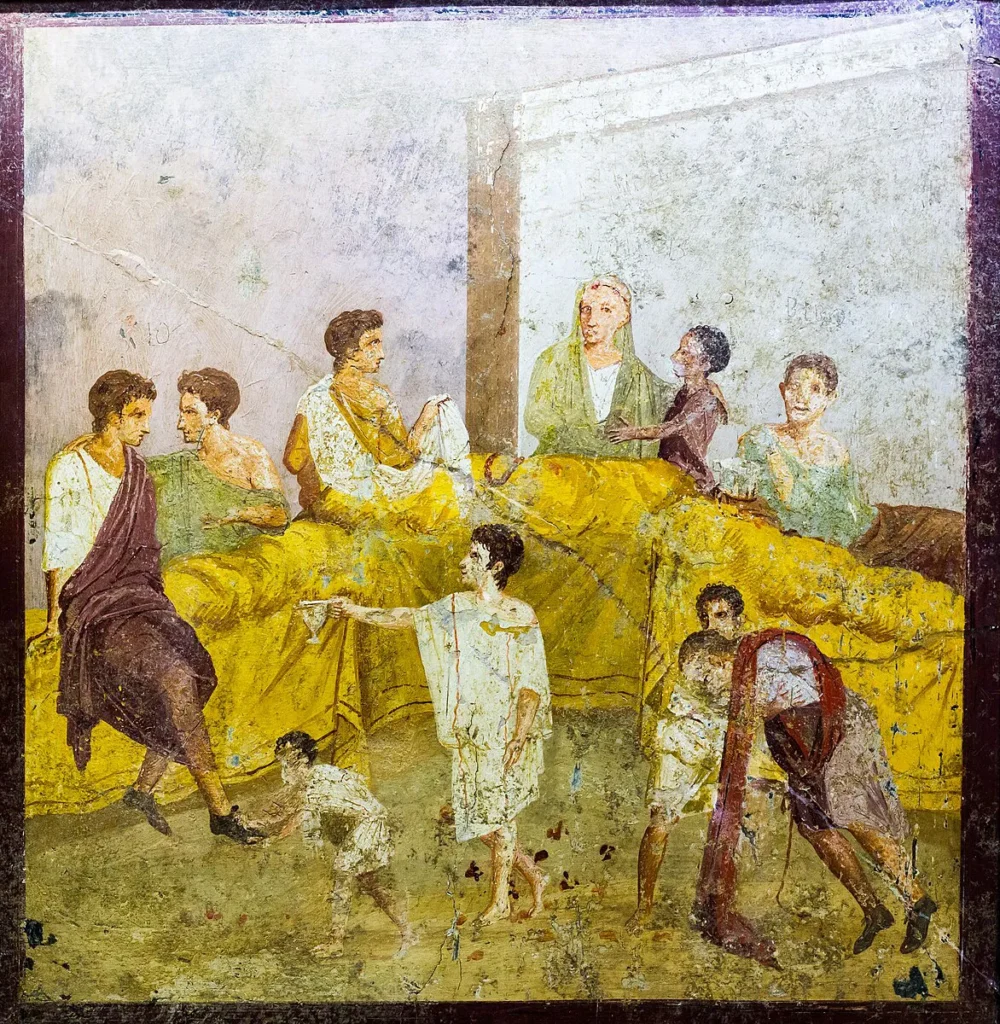
The two original banquet images retained with this article come from a real Pompeian dining room, but they do different jobs. One depicts diners reclining and a servant attending them. Another, from the same House of the Triclinium, shows a later moment in the meal, including a guest vomiting while a servant supports him. The latter image has short inscriptions cut into the painted surface above the figures. The photographic record identifies it as museum inventory 120029 and describes the inscriptions as resembling speech bubbles.
Those paintings are contemporary material for Roman convivial culture, not illustrations of a specific passage of Petronius. Their figures and inscriptions are evidence that a dining scene could be depicted as talkative, noisy and sometimes indecorous. They cannot establish what happened at a particular dinner in the Satyricon, nor should they be treated as proof that every Roman feast resembled Trimalchio’s. The first-century paintings are also distinct from the sixteenth-century engraving of Lycaon preserved elsewhere in this article. That engraving depicts a classical myth but is itself an early modern interpretation, a distinction that matters when using images to explain ancient evidence.
Trimalchio answers with another frightening story
When Niceros finishes, the listeners are astonished. Trimalchio says that the account has made his hair stand on end and insists that Niceros is a trustworthy man. He then takes control of the conversation with a supernatural story of his own, preserved in chapter 63. In his youth, he says, a beloved boy died in the household where he was enslaved. While the family mourned, terrifying night creatures arrived. A strong Cappadocian slave rushed outside with a sword and struck at one of them, but returned badly injured or afflicted. When the mourners examined the boy’s body, it had been replaced by a bundle of straw.
The creatures in Trimalchio’s account are witches or night beings, not another group of werewolves. The story resembles Niceros’s in its structure: a witness recalls an event from slavery, an apparently ordinary scene turns supernatural, and bodily traces are offered as proof. Trimalchio’s tale also competes with Niceros’s. The host confirms the guest’s story and then presents himself as a man who knows an equally extraordinary one. By the end of the exchange, the company has kissed the table and prayed that the nocturnal beings will leave them alone on their journeys home.
That reaction complicates any claim that the feast simply laughs away its fears. The dinner is comic, and its guests are frequently ridiculous, yet the passage depicts them responding to supernatural stories with genuine alarm inside the fictional scene. Petronius allows readers to observe both the belief of the characters and the possible amusement of an audience reading their speeches. The text does not tell us whether the author himself believed in werewolves, nor does it permit a survey of Roman opinion. It shows how a story of transformation could be made persuasive, entertaining and socially consequential in the same few pages.
Niceros has one advantage over the many later accounts of ancient werewolves: we can still hear him tell the story almost in full. The moonlit road, the clothes turned to stone, the blood beside the graves and the soldier’s bandaged neck survive because a Roman author placed them in a scene about people speaking to one another. The monster is unforgettable, but so is the man who insists that he saw it, and who fears that the people listening to him may laugh.