
In August 2022, James Sweet, then president of the American Historical Association, published a brief column expressing concern that historians were letting present-day political commitments distort their reading of evidence. The response was fierce, with some colleagues calling the piece deeply flawed and others defending it as a necessary intervention. The speed and intensity of that debate reflect how contested the concept of presentism in ancient history remains, even among specialists. Presentism, broadly defined, is the habit of reading past evidence through present assumptions, values, and categories without first doing the work of reconstructing what those words, objects, and institutions meant to the people who made them. It is not the same as asking modern questions of ancient material. It is the error of importing modern answers before the historical work has been done. For anyone studying ancient Greece, Rome, Egypt, or Mesopotamia, the problem is not occasional or marginal. It is structural, built into the languages we use, the categories our disciplines inherited, and the political pressures under which public history now operates.
Defining presentism in ancient history without collapsing into relativism
The clearest account of what makes presentism in ancient history methodologically damaging comes from Herbert Butterfield’s 1931 study The Whig Interpretation of History. Butterfield argued that British historians of the nineteenth century had constructed a narrative of the past as an inexorable march toward constitutional liberty and Protestant individualism. The problem was not that they asked modern questions but that they graded the past according to how closely it anticipated their own present. Everything that looked like a step toward liberal democracy was progressive. Everything that did not was reactionary. Butterfield called this approach a form of abridgement that destroyed the actual texture of historical experience by sorting it into a simple moral hierarchy derived from the endpoint.
For ancient history specifically, David Armitage of Harvard University has argued, in his 2022 chapter “In Defense of Presentism” in History and Human Flourishing (Oxford University Press), that the term has become so contested that it is now used simultaneously to mean at least four different things: reading the past through the lens of present concerns, claiming present relevance for historical findings, studying the recent past, and the philosophical position that only present objects exist. These different meanings produce entirely different methodological prescriptions. The solution is not to avoid all present-informed questions but to be explicit about when you are reconstructing ancient meanings and when you are applying ancient findings to modern debates, and never to confuse the two steps.
The practical boundary is relatively clear: describe what a practice was and did within its ancient context first, then evaluate it against present standards in a separate analytical move. The danger lies in skipping the first step, or in performing it so briefly that modern categories are doing the descriptive work before the ancient material has been fully examined. As the classicist Robin Lane Fox put it in a different context, making the past intelligible to the present requires doing justice to both, and when you allow preoccupation with one to crowd out the other, you stop being a historian.
Translation drift and the danger of loaded words
The most common entry point for presentism in ancient history is translation. Every major concept in ancient political, religious, and social life has been translated into English using words that carry thick modern associations, and those associations routinely misrepresent the ancient reality.
The most studied case is the Greek word dēmokratia. The standard English translation is “democracy,” and for most readers that word immediately conjures universal suffrage, secret ballots, separation of powers, individual rights, and representative institutions. Classical Athenian dēmokratia had none of these features. It used sortition (selection by lot) rather than election for most offices, because election was considered an oligarchic procedure that favoured the wealthy and well-connected. It required male citizens to attend and vote in person at the Assembly, the ekklesia, which met roughly forty times per year on the Pnyx hill and could be attended by all adult male citizens. It excluded women, enslaved people, and metoikoi (resident foreigners) from political participation entirely. Adult male citizens probably constituted no more than thirty percent of the total adult population of Attica. Greg Anderson of Ohio State University, in his 2018 monograph The Realness of Things Past (Oxford University Press), argues that even calling Athenian dēmokratia a “political system” imposes a modern analytical category that did not exist in Athens: it was, he suggests, better understood as a way of life that integrated social, natural, and sacred being in ways that modern political vocabulary cannot capture without distortion.
The same problem appears in Latin. The word pietas is routinely translated as “piety” or “duty,” but both translations flatten a concept that Virgil and Cicero treated as an active, socially embedded, and politically significant obligation simultaneously owed to family, gods, and state. Moses Finley of Cambridge University, in his influential 1973 study The Ancient Economy, demonstrated that projecting modern market categories (supply, demand, market price, profit motive) onto Greek and Roman economic behaviour produced systematic distortions, because ancient economic activity was embedded within kinship networks, temple obligations, patronage relationships, and conquest in ways that modern economic vocabulary cannot accommodate without misrepresentation.
Category confusion in ancient law, religion, and economy
Modern analytical categories rest on distinctions that ancient societies did not consistently draw. The line between sacred and secular, between public and private, between state and market, between law and religion: these were not fixed boundaries in ancient Athens, Rome, Babylon, or Egypt. When historians import these distinctions into their analysis without acknowledging that they are modern constructions, the evidence begins to look incoherent when it is actually integrated by a different logic.
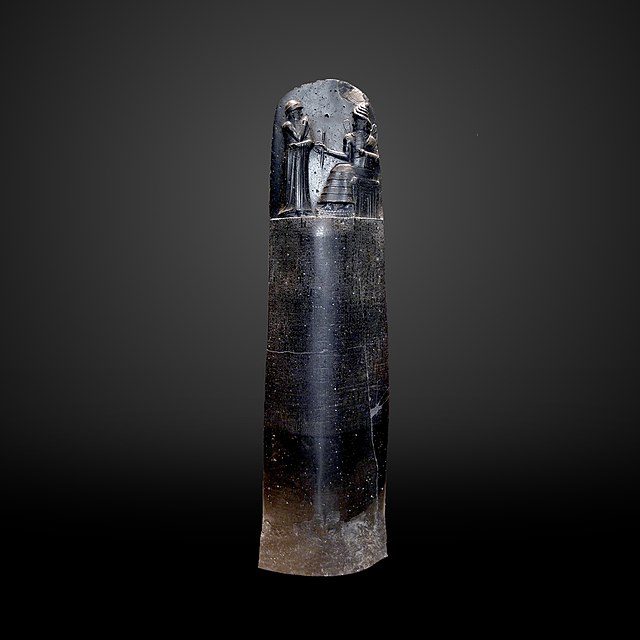
The Code of Hammurabi is regularly described as a law code in the modern sense, a collection of statutes prescribing legal outcomes for specific situations. This framing misses most of what is actually happening in the text. The prologue claims that the god Marduk appointed Hammurabi to deliver justice to the land, and the epilogue calls down divine curses on any future ruler who damages or ignores the inscribed laws. The stele is not legislation. It is a royal monument that presents the king’s just rule as a cosmological fact endorsed by the gods, with specific cases as illustrations of that justice rather than as binding precedent. Scholars including Martha Roth of the Oriental Institute, Chicago, have noted that many of the cases in the Code do not correspond to known Babylonian legal practice and were probably never intended as enforceable statutes. The text is propaganda for royal justice as a concept, not a law code in any modern procedural sense.
Ancient Greek religion presents similar difficulties. Modern English uses “religion” to refer primarily to a set of beliefs about gods and an afterlife, derived from a Protestant framework that places inner conviction at the centre of religious experience. Ancient Greek cult was organised around practice: sacrifices, festivals, processions, libations, oaths, and games, all of which created social bonds, civic time, and obligations between communities and their gods. Whether a worshipper privately believed in the gods they were sacrificing to was largely irrelevant to the public validity of the ritual act. When modern historians describe the Greek relationship to the gods as one of “belief,” they import a post-Reformation category that the ancient evidence does not support and that actively misrepresents how Greek religion functioned as a social institution.
Moral anachronism, slavery, and the limits of ethical judgment
One of the most debated questions in the field concerns moral anachronism: whether it is legitimate to judge ancient people by modern ethical standards, and if so, what that judgment actually tells us about the past. The question is practically urgent because ancient Greek democracy was built on enslaved labour, Roman imperial expansion involved systematic violence and exploitation, and nearly every ancient civilisation treated women’s political participation as unthinkable.
Presentism does not require ignoring these facts. It does require keeping two analytical moves separate. The first is historical reconstruction: what did enslavement in Athens actually look like, how was it structured, who was enslaved and under what conditions, what forms of resistance existed, and how did enslaved people understand their own situation? This work requires close reading of ancient sources, comparison with epigraphic and archaeological evidence, and constant attention to whose perspective is captured and whose is not. The second move is ethical evaluation: was ancient slavery wrong? The answer is yes, plainly and without qualification. But the evaluation is most productive when it follows the reconstruction rather than replacing it, because a judgment attached to a caricature of the past teaches nothing about either history or ethics.
The presentist trap in discussions of ancient slavery is the reverse error: projecting modern racial constructs backward onto ancient categories of status and origin. Ancient Greek and Latin do not have vocabulary equivalent to modern racial categories. Enslaved status in Athens was determined by capture in war, birth to an enslaved mother, or purchase from outside Attica, not by a system of heritable racial classification. The onomastic and epigraphic evidence assembled by scholars including Keith Bradley in Slavery and Society at Rome (Cambridge University Press, 1994) shows that enslaved populations in Rome came from all over the Mediterranean and beyond, with no consistent ethnic or phenotypic profile. Describing ancient enslavement as “slavery” is accurate in the sense that it involved forced labour and the legal treatment of persons as property. Describing it as “racial slavery” in the modern American sense imports a specific historical formation that did not exist in antiquity and obscures the actual mechanisms through which ancient enslaved status was created and maintained.
Built out of a love for history, kept free from distractions.
Spoken Past is an independent project shaped by curiosity, care, and long hours of research. Reader support helps keep it maintained, carefully researched, and open to everyone.
Source selection bias and the archive we inherit
Presentism in ancient history is not only a problem of interpretation. It is also a problem of what evidence survives, and which evidence historians have chosen to study. The ancient archive is radically skewed toward certain kinds of sources: literary texts by elite male authors, court art and public monuments, inscriptions set up by governments or wealthy individuals, objects made from durable materials found in contexts that archaeologists had reason to excavate. The experience of women, enslaved people, agricultural labourers, and the urban poor is largely recoverable only indirectly, through the distorting lens of sources that barely noticed them except as background or as legal problems.
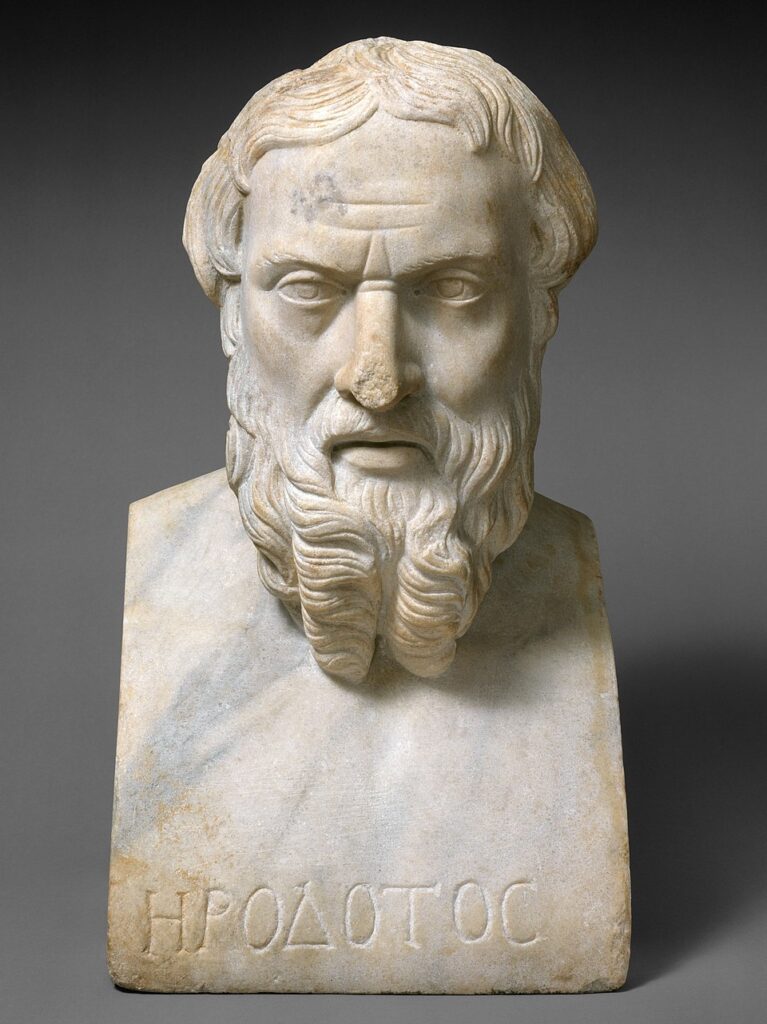
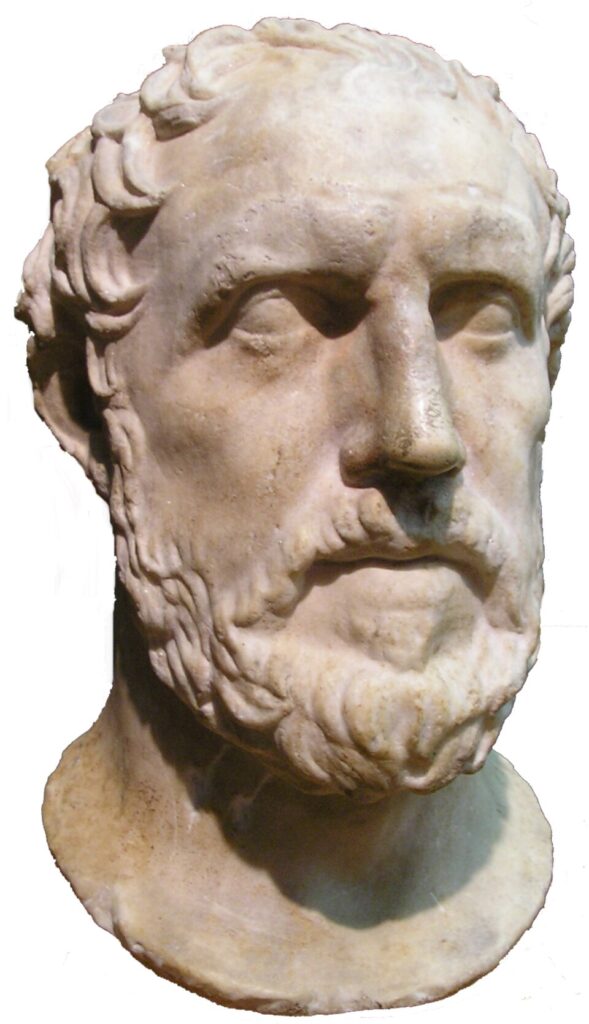
This survivorship bias amplifies presentism because it makes the past look more like an elite record than it actually was. When historians rely exclusively on Thucydides and Xenophon for Athenian history, they are studying what two conservative Athenian men of the late fifth and early fourth centuries BCE chose to record about public events. When they add inscriptions from the Athenian Agora excavations, conducted by the American School of Classical Studies at Athens since 1931, they start to recover different voices: commercial transactions, religious dedications by craftsmen, boundary markers for public and sacred space, and the everyday language of a city that Thucydides and Xenophon had no particular interest in documenting.
Papyri from Roman Egypt, collected in major holdings at the universities of Oxford, Michigan, and Florence, provide the most direct access to the non-elite ancient world available to modern scholars. They record private letters, contracts, petitions to officials, accounts, and magical texts in a language, Koine Greek and later Coptic, used by people who could not have written the literary sources. The contrast between these papyri and the literary tradition is a constant methodological check on any generalisation derived from elite sources alone. The Papyri.info database maintained by a consortium of institutions makes tens of thousands of these texts available in digitised and transcribed form, and it is an underused resource in discussions of ancient social history.
Teleology and the roads ancient history did not take
Teleological thinking, the assumption that historical events were moving toward a predetermined outcome, is one of the most persistent forms of presentism in ancient history because it is largely invisible. It operates through the use of words like “inevitable,” “destined,” and “would eventually,” and through the structure of narrative itself, which imposes sequence and causation on events that were experienced by participants as genuinely open.
The Roman empire is a standard example. Narratives of Roman history regularly imply that the expansion of Rome from a small Latin city-state to the ruler of the Mediterranean world was somehow a foreordained process. This framing elides centuries of contingency: the near-destruction of Rome by the Gauls in 390 BCE, the repeated near-victories of Carthage during the Second Punic War (218 to 201 BCE), the civil wars that ended the Republic, and the multiple points at which the empire could have fragmented under different circumstances. The contingency is not marginal to the history. It is the history. Understanding why Rome succeeded requires taking seriously the moments when it nearly did not, and that requires suppressing the backward knowledge that it eventually did.
Greek democracy is subject to similar teleological distortion. Because modern Western political systems claim a historical connection to Athenian dēmokratia, there is pressure to read its development as progress toward something that was always coming. In fact, the Athenian democratic system was contested throughout its existence, was overthrown twice in the fifth century BCE (the oligarchic coups of 411 and 404 BCE), was only one of many constitutional arrangements across the Greek world, and was treated with deep suspicion by most Greek political thinkers, including Plato and Thucydides, who lived under it. Reading it as a proto-liberal democracy in development imposes on it a significance and a direction that Athenians themselves would not have recognised.
Museums, headlines, and the public pressure to draft antiquity into modern arguments
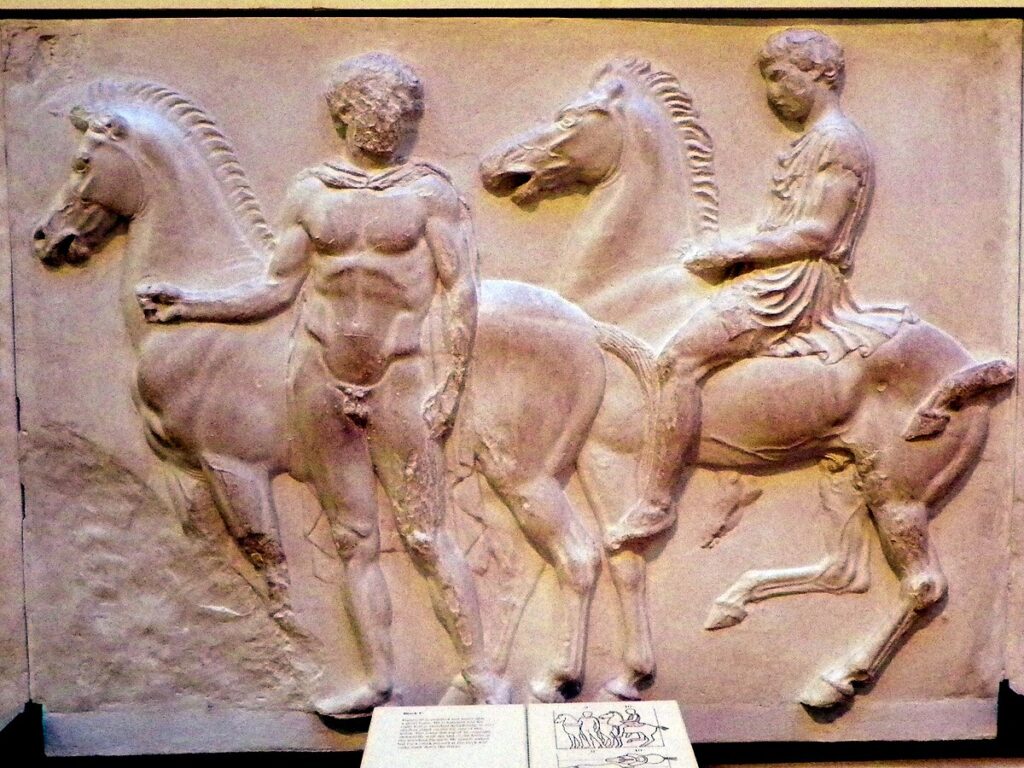
The debate over the Parthenon sculptures in the British Museum is probably the most widely discussed contemporary case where public pressure and present-day political arguments push ancient material into frameworks that it did not originally inhabit. The sculptures were removed from Athens by Lord Elgin between 1801 and 1812 under a contested Ottoman permit. Whether they should be returned to Athens is a legitimate legal, ethical, and political question about present-day cultural property rights and colonial acquisition. It is also a question about the Parthenon’s meaning in the twenty-first century. What it is not straightforwardly about is what the frieze meant in fifth-century BCE Athens, where it was carved. The British Museum’s Parthenon galleries display the panels in a context designed for maximum visual impact, which is in some respects a form of presentism: prioritizing the experience of modern viewers over the ritual and civic contexts in which the frieze was originally embedded and largely invisible to viewers at ground level below the Acropolis.
This is not an argument that the sculptures should stay in London, or that they should be returned. It is an observation that the historical question (what did these objects mean in their original context?) and the contemporary political question (where should they be now?) are different questions that require different methods, and that conflating them is itself a form of presentism. Museum display practices can reinforce the conflation by presenting ancient objects as if their primary purpose were to speak to modern visitors, rather than as material evidence of ancient communities that must be read with contextual care.
The methodological safeguard is the same one that applies across every area of presentism: describe what an object or text was, who made it, for whom, in what context, and for what purpose before evaluating it by present standards. Caption objects with date, place, material, and function. Trace the object’s history from its original site to its current location. Name the ideological interests that shaped its collection, display, and interpretation. Then evaluate. The evaluation will be better for the prior work, and the history will be better for the subsequent evaluation.
A practical method for reading ancient evidence without presentist distortion
The most effective defence against presentism in ancient history is not a commitment to value-free scholarship, which is impossible, but a commitment to making the analytical process explicit and auditable. Every interpretation rests on a chain of inferences: from the transcription of a text, through its translation, through comparison with parallel sources, through material context, to the historical claim. Presentism enters most easily at the translation and comparison stages, where modern categories are closest to hand. Making each step visible allows readers to identify where modern assumptions have been imported and to assess whether the inference holds without them.
Triangulating between source types is essential. Literary texts by elite authors should be read alongside inscriptions, papyri, coins, and archaeological reports. The divergence between what Thucydides says happened and what the physical evidence from the Agora excavations shows was happening in Athens is itself historically informative. The divergence between Roman imperial rhetoric and what provincial documents record about actual conditions in the empire is where much of the most productive recent Roman history has been done, in the work of scholars including Greg Woolf of UCLA, whose Rome: An Empire’s Story (Oxford University Press, 2012) uses provincial and epigraphic evidence to produce an account of empire from below as well as from the centre.
Glossing key terms is not pedantry. When you write dēmokratia and immediately explain that this term designated a specific Athenian political arrangement and not liberal democracy in the modern sense, you are not hedging. You are doing the historical work that makes the subsequent analysis reliable. The same applies to pietas, Ma’at, me (the Sumerian concept of cultural powers structuring civilised life), nomos, and dozens of other ancient terms that have been deformed by centuries of inadequate translation. The glossary is a methodological commitment, not a concession to academic caution.
Finally, reflexivity about the historian’s own position is not self-indulgence. Noting that your training is in Roman law and not in Egyptology, that you read Latin but not Demotic, that your interest in ancient democratic institutions was formed partly by the political debates of your own time: these acknowledgments are data points that help readers evaluate the analysis you are offering. They do not undermine authority. They define its limits, and defined limits are more trustworthy than undefined ones. The historian who claims to read the ancient world with no present-day perspective is not being rigorous. They are being opaque about the perspective they actually have.
Sources: Herbert Butterfield, The Whig Interpretation of History (G. Bell and Sons, 1931); David Armitage, “In Defense of Presentism,” in Darrin M. McMahon, ed., History and Human Flourishing (Oxford University Press, 2022), at academic.oup.com; Sarah Maza, “Presentism and the Politics of History: Revisiting the 2022 James Sweet Affair,” Past and Present 265, no. 1 (2024), at academic.oup.com; Greg Anderson, The Realness of Things Past: Ancient Greece and Ontological History (Oxford University Press, 2018), reviewed at bmcr.brynmawr.edu; Moses Finley, The Ancient Economy (University of California Press, 1973), described at cambridge.org; Keith Bradley, Slavery and Society at Rome (Cambridge University Press, 1994); Loic Loison, “Forms of Presentism in the History of Science,” Studies in History and Philosophy of Science 53 (2016): 30-38, at sciencedirect.com; Papyri.info, the papyrological navigator, at papyri.info; British Museum, Parthenon galleries, at britishmuseum.org; Greg Woolf, Rome: An Empire’s Story (Oxford University Press, 2012).