
The Rosetta Stone is a broken temple stela inscribed with one decree written three times, once in Egyptian hieroglyphs, once in Egyptian demotic, and once in Greek. People focus on it because the Greek section could be read immediately, and the text itself says the decree was written in three scripts and set up in temples, which created a rare fixed point for matching scripts and language. The main question is not whether the stone is famous, but what it actually is, what it says, why it was made in three scripts, and why that combination allowed hieroglyphs to be read again.
What the Rosetta Stone is
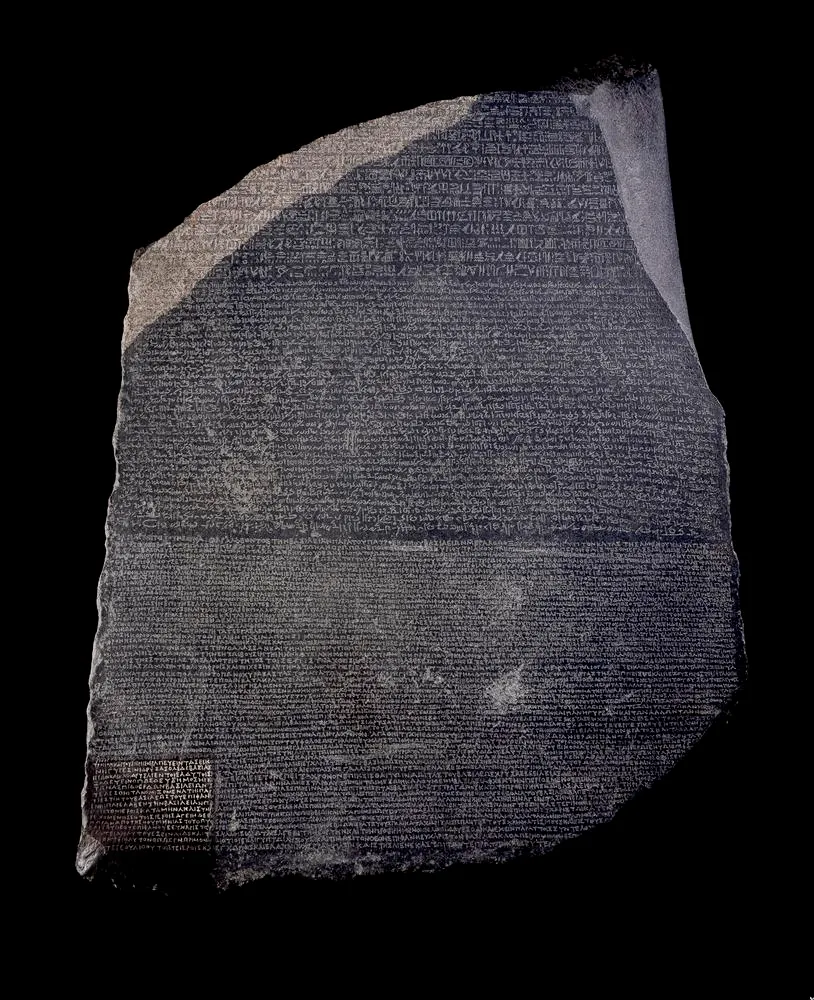
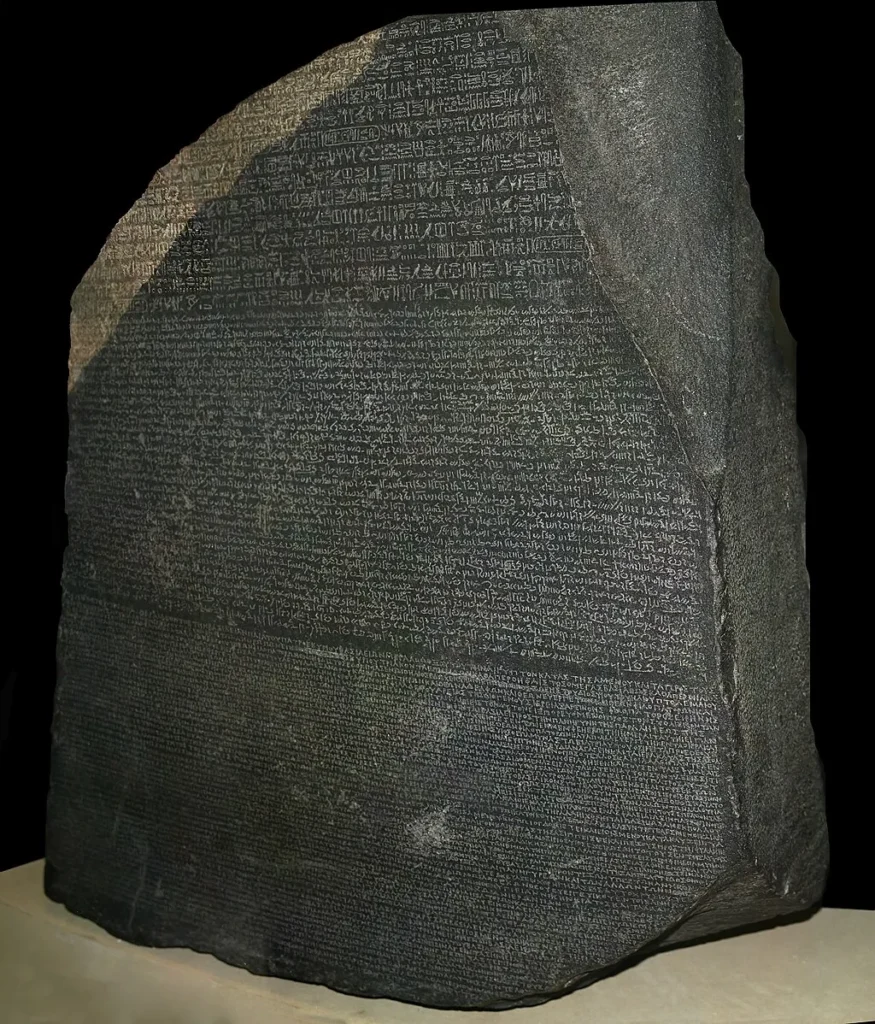
The surviving fragment is an irregular slab of dark, hard stone about 112.3 cm tall, 75.7 cm wide, and 28.4 cm thick, with an estimated weight of about 762 kg. Scientific examination described it as a quartz-bearing rock with feldspar, mica, and amphibole, and not basalt as it was often labeled in older descriptions. The front is smoothed and slightly inclined, and the signs are lightly incised rather than deeply carved.
The back surface is roughly finished, with chisel marks visible, which suggests it was meant to stand upright against a wall so only the inscribed face mattered. Its familiar “black-and-white” look is not the stone’s original appearance, since later museum treatments filled incisions and applied protective materials that affected surface color and legibility. Later cleaning removed modern infill and returned the surface closer to its natural dark gray, which can appear less immediately “print-like” to modern eyes.
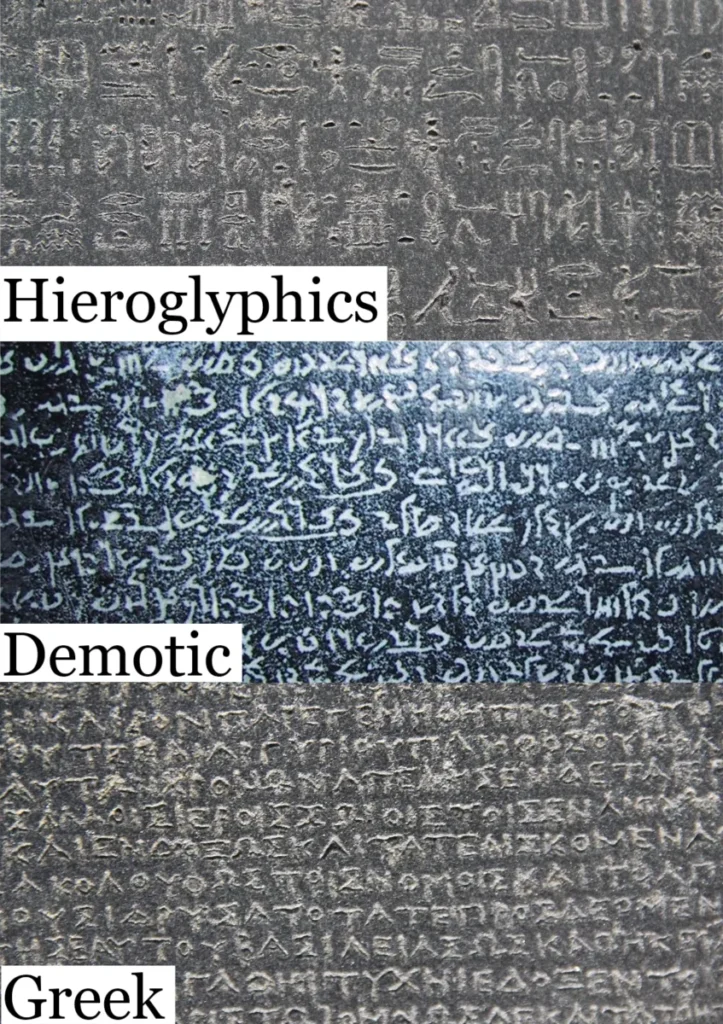
The text is arranged in three horizontal registers. The top register is hieroglyphic and heavily damaged, the middle register is demotic and more complete, and the bottom register is Greek and also more complete than the hieroglyphic section. This uneven survival matters because it shaped which parts scholars could work with first, and it limits what the stela can show us directly about the missing lines.
How the stela originally looked
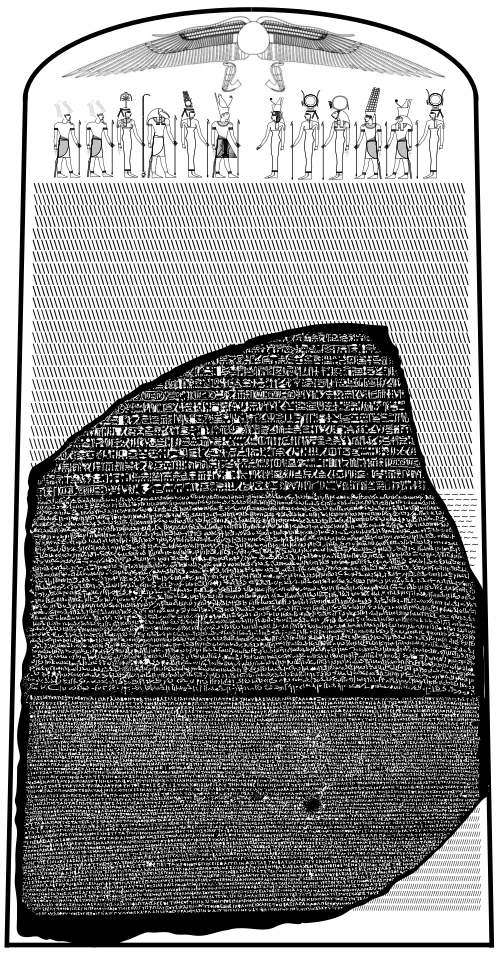
The object now called “the stone” began as a stela, a carved monument designed to preserve an official text in a temple setting. Only some original edges survive along the left side, much of the right side, and most of the bottom, while the top and upper right are broken away. This is why the current shape looks abrupt and unfinished, even though the original monument was carefully planned.
Reconstruction based on other stelae and other copies of the same decree indicates a taller monument with a rounded top. The upper zone likely included a winged sun-disk and a carved scene in Egyptian style, with figures and captions that are now lost on this fragment. The surviving hieroglyphic line 14 includes a sign that helps indicate the stela’s original form, reinforcing the reconstruction.
The decree itself says the stela was to be placed “beside the image” of the honored ruler in temples, which implies a designed relationship between text, cult statue, and temple space. The text would have been readable outside in daylight, even without pigment, which supports the idea that it was displayed in an outer area of a temple complex rather than hidden deep inside. This matters because the stela functioned as public communication within a restricted sacred space, not as hidden priestly knowledge.
Where the stone came from
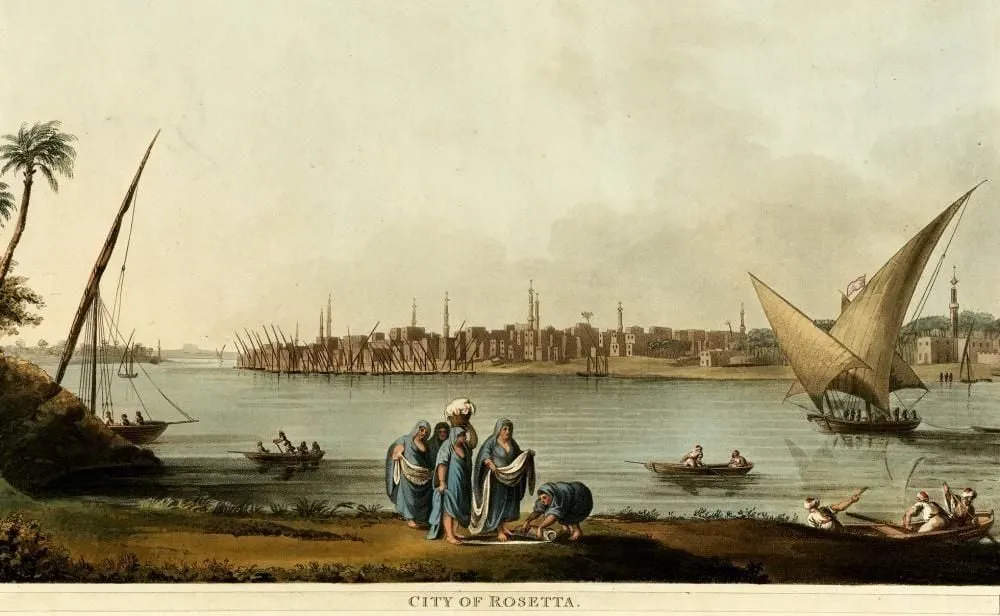
The fragment now called the Rosetta Stone was never originally at Rosetta. The town of Rosetta (Rashid) stands on land that did not exist in Ptolemaic times, being the result of later sedimentation in the Nile Delta. The stela probably came from an older temple site further inland, possibly the ancient city of Sais nearby on the same branch of the Nile, a major religious center with royal connections.
At some unknown point, the already broken stela was moved and incorporated into later construction, where it remained hidden until French soldiers demolishing an old wall during fortification work in July 1799 recognized it as an inscribed monument. The discovery happened during Napoleon’s occupation of Egypt, when a French engineer officer named Pierre François Xavier Bouchard was supervising construction work at the coastal fort. Bouchard immediately recognized the significance of a stone inscribed in three scripts, one of them recognizable Greek.
The stone was quickly transported to Cairo and deposited with the Institut d’Égypte, the body of scholars and scientists who had accompanied Napoleon’s military expedition. News of the discovery spread rapidly among French savants, and efforts to copy the inscriptions began almost immediately because hand-copying the lightly incised text was difficult. French scholars developed innovative methods to reproduce the text, treating the stone like a printing block or engraved plate to produce impressions. By autumn 1800, these printed copies had reached Paris and begun circulating among European scholars, which turned out to be crucial because the actual decipherment would be done from copies rather than from direct examination of the stone itself.
How the stone reached England
The French occupation ended in defeat between 1801 and 1802, and the stone’s fate became entangled in the surrender negotiations. Under the terms of the French capitulation, British forces demanded that antiquities collected in Egypt be handed over. The French general Jacques-François Menou tried to argue that the Rosetta Stone was his personal property, but British negotiators rejected this claim and insisted on its surrender.
The stone was turned over to British representatives including Colonel Tomkyns Hilgrove Turner in September 1801, transported to Alexandria, and shipped to England aboard HMS L’Egyptienne, arriving at Portsmouth in February 1802. It was briefly deposited with the Society of Antiquaries in London before being officially donated to the British Museum by King George III in June 1802. The stone has remained in the museum ever since, apart from being moved to shelter during the two World Wars and a brief loan to Paris in 1972 for the 150th anniversary of the hieroglyphic decipherment.
Painted inscriptions on the sides of the stone record this transfer in nationalistic terms, with one edge reading “CAPTURED IN EGYPT BY THE BRITISH ARMY 1801” and the other “PRESENTED BY KING GEORGE III.” These nineteenth-century texts became part of the stone’s history, marking its role not just as ancient evidence but as modern trophy.
The decree and its political context
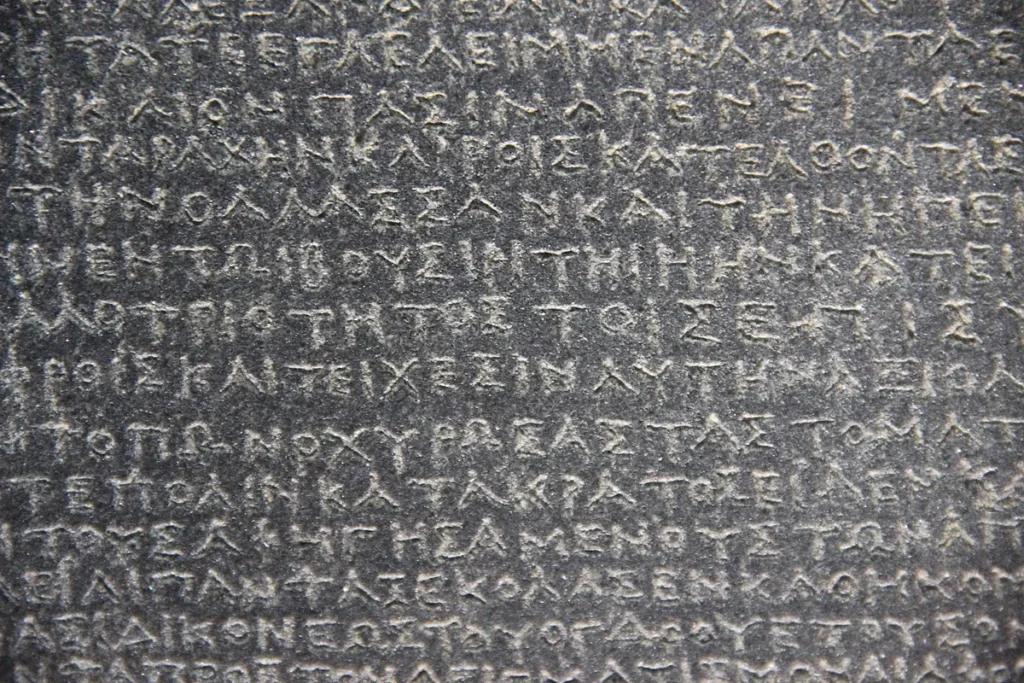
The text records a priestly decree concerning the cult of Ptolemy V Epiphanes, dated to 27 March 196 BC according to the Greek version. Memphis was the traditional religious capital of Egypt, and the decree frames itself as the collective voice of priests gathered from temples across the country for a royal ceremony of accession and coronation. The opening lines give elaborate royal titles in all three scripts, then launch into a long recital of the king’s benefactions to temples, clergy, and the Egyptian people.
These benefactions are not vague praise but specific administrative and financial measures: tax reductions, cancellations of arrears, exemptions from various fees and levies, protection of temple endowments and income, and increases in support for temple activities and festivals. The decree lists relief measures item by item, creating a detailed record of what the crown granted and what the temples received in return. This level of specificity matters because it shows the decree functioning as a binding contract, not just ceremonial flattery.
The decree also addresses disorder and violence without flinching. It recounts military action against rebels, the siege and capture of a fortified town, and the punishment of those who opposed the king’s rule. The text treats these acts as restoration of order rather than conquest, framing the king as the agent who repairs chaos and brings Egypt back to its proper balance.
The political context behind these claims was fragile. The years before the decree saw revolt in the Delta and the south, external military pressure from rival Hellenistic powers, and instability at court following the death of the previous ruler and the violent removal of the boy-king’s mother. The king at the time of the decree was only thirteen years old, which meant that priestly support carried extra weight for a dynasty trying to maintain control over a restive kingdom.
What the priests received in exchange
In exchange for the king’s recorded generosity, the priests grant honors and establish a formal royal cult. The decree orders that statues of the king be installed in temples, honored daily alongside divine images, and carried in processions during festivals. It mandates new festivals tied to the king’s birthday and accession day, specifies monthly observances with offerings and garlands, and directs that these practices be implemented across the temple network in a standardized way.
The decree also inserts the king’s cult into priestly identity itself by ordering priests to add a new priestly title linked to the king’s cult to their official names and to inscribe that title on their personal seal rings. This is administration dressed as piety, a bargain made durable by carving it into hard stone and placing it where priests and officials would see it regularly. The goal was not just to record the agreement but to embed it into daily temple practice and priestly self-presentation.
The decree concludes with explicit instructions for its own reproduction and display. It commands that a copy be inscribed on hard stone in sacred script (hieroglyphs), document script (demotic), and Greek letters, then set up in temples of the first, second, and third rank beside the image of the king. This publication strategy is not decorative, it is a command that made the decree visible and enforceable across different temple tiers and different reading communities.
Built out of a love for history, kept free from distractions.
Spoken Past is an independent project shaped by curiosity, care, and long hours of research. Reader support helps keep it maintained, carefully researched, and open to everyone.
Why three scripts were needed
Ptolemaic Egypt was ruled by a dynasty of Macedonian origin that took over the Egyptian throne after Alexander the Great’s conquest in 332 BC. Greek became the language of the court and government, based in the newly founded city of Alexandria on the Mediterranean coast. The native Egyptian temples, however, continued to function as powerful institutions with their own lands, income, administrative systems, and a priestly class that preserved Egyptian scripts, ritual knowledge, and traditional culture.
The result was a bilingual state where Greek dominated secular administration while Egyptian scripts and language remained central to temple life and religious authority. The three-script design of the decree reflects this layered reality. Greek made the decree legible to the ruling elite and administrators who operated in the Greek-language sphere of government.
Demotic made it readable to the broader Egyptian literate population, particularly those involved in practical administration, legal documents, and day-to-day record-keeping. Hieroglyphs placed the decree in the sacred register used for temple inscriptions, ritual texts, and formal monumental display, a script associated with divine speech and priestly learning. The physical arrangement on the stone reinforces this hierarchy, with hieroglyphs occupying the top register closest to the traditional decorative zone where gods and kings would have been depicted, demotic in the practical middle position, and Greek at the bottom where it could be read by anyone approaching the monument.
However, the three versions are not mechanical translations of each other. The sources emphasize that the Egyptian hieroglyphic text uses archaic, formal language tied to centuries of temple tradition, while the demotic version uses a register closer to contemporary written Egyptian, and the Greek uses its own administrative vocabulary and phrasing conventions. Even terminology for the same concept can vary, as when different Egyptian versions use different inherited words for “Greeks,” reflecting separate textual traditions.
This means the Rosetta Stone does not work like a modern bilingual dictionary where each word maps neatly to one equivalent. The versions are parallel in content and purpose, but they differ in phrasing, diction, and structure, which complicated the later effort to read the scripts but also made the monument more interesting as evidence of how translation and equivalence actually worked in a multilingual state. The challenge for later scholars was to extract repeatable patterns from texts that were similar but not identical.
Why hieroglyphs stayed unread for centuries
For more than fourteen centuries, the ability to read Egyptian hieroglyphs had been lost. The last known hieroglyphic inscription was carved in AD 394 at the temple of Philae, marking the end of a writing tradition that had lasted more than three millennia. The breakdown came with religious change, as Christianity displaced the old temple religion and the hieroglyphic script became associated with pagan gods and dangerous knowledge.
Temples were abandoned, converted to churches, or quarried for building material, and the priestly schools that taught hieroglyphic reading and writing ceased to function. The Egyptian language itself continued in a later form called Coptic, written largely with Greek letters plus a few signs borrowed from demotic, and Coptic remained a living language well into the first millennium AD before being gradually replaced by Arabic after the Islamic conquest in the seventh century. But knowledge of the older scripts died with the institutions that had maintained them.
European scholars from the Renaissance onward faced three major obstacles to reading hieroglyphs. First, they had inherited profoundly mistaken ideas about how the script worked, particularly the belief that hieroglyphs were purely symbolic or conceptual rather than phonetic. This idea went back to Greek and Roman writers who treated Egyptian writing as a system of allegorical pictures where each sign represented an abstract idea rather than a sound.
A late antique treatise attributed to Horapollo, which was rediscovered in the fifteenth century and widely published, reinforced this misunderstanding by offering symbolic interpretations of hieroglyphs that were mostly fantasy. For example, Horapollo claimed that a hieroglyph of a vulture meant “mother” because there are supposedly no male vultures in nature, and that a hare meant “open” because hares never close their eyes. These interpretations were occasionally correct about the meaning of individual signs, but they were completely wrong about how the signs functioned in the writing system.
Second, scholars lacked access to large quantities of accurately copied hieroglyphic texts, which meant they could not test hypotheses by looking for patterns across multiple inscriptions. Third, they had no direct knowledge of the ancient Egyptian language, which made it impossible to check whether proposed readings produced real Egyptian words or pure nonsense. These three barriers worked together to keep hieroglyphs impenetrable.
The symbolic tradition and its failures
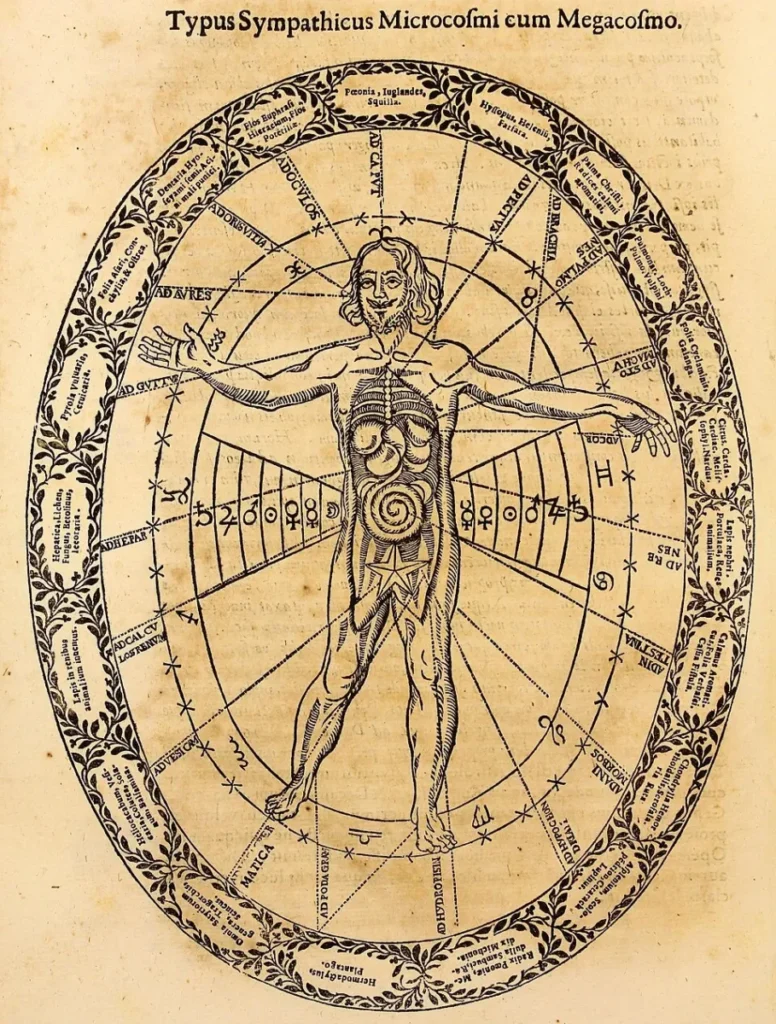
The symbolic interpretation led to spectacular failures. The Jesuit scholar Athanasius Kircher, one of the most learned men of the seventeenth century, published elaborate interpretations of hieroglyphic inscriptions that read simple royal names as mystical meditations on divine power and cosmic harmony. His reading of one obelisk inscription, which is now known to contain the name and titles of Pharaoh Apries, began with phrases like “the supreme spirit and archetype infuses its virtues into the soul of the sidereal world.”
Kircher was not a fool, and his knowledge of languages, philosophy, and comparative religion was immense. He correctly recognized that Coptic was descended from the language of the Pharaohs, and he made real contributions to preserving Coptic linguistic knowledge. But he was working within the only conceptual framework available to him, and without something like the Rosetta Stone to anchor interpretation in repeatable evidence, there was no way to escape that framework.
The problem was not lack of intelligence but lack of a method grounded in testable patterns. Kircher could “read” hieroglyphs in any direction, starting from the beginning or the end of a line, and produce equally elaborate symbolic interpretations either way. This flexibility meant his readings could never be proven wrong, but it also meant they could never be proven right, because there was no constraint forcing the interpretation to match the evidence.
How the Rosetta Stone changed the method
The immediate advantage of the Rosetta Stone was that the Greek text could be translated, revealing the decree’s subject, purpose, and date. The translation also confirmed that the inscription recorded the same text in three scripts, as stated in the decree’s closing lines, and it provided a short list of names and titles that would appear repeatedly in all three versions. Royal names like Ptolemy and Alexander, place names like Egypt and Memphis, and titles like “king” and “priest” became fixed targets that scholars could search for in the Egyptian scripts.
The demotic section became the first focus of serious work because it was better preserved than the damaged hieroglyphic text and because it looked less like symbolic pictures, which made it harder to slip into allegorical interpretation. Two scholars, the French Orientalist Silvestre de Sacy and the Swedish diplomat Johan Åkerblad, used similar methods in the early 1800s. They searched for repeated clusters of demotic signs that appeared in roughly the same positions as repeated names in the Greek text, particularly the name Ptolemy which occurs eleven times in the Greek inscription.
By isolating these sign-groups and matching them to the Greek spellings, they proposed tentative phonetic values for individual demotic signs, treating the script as if it were alphabetic like Greek. This approach succeeded for names but failed for the rest of the text because demotic is not a pure alphabet. It is a mixed script that uses some signs for sounds, other signs for whole words, and additional signs to clarify meaning or grammatical function, much like hieroglyphs themselves.
The assumption that demotic must be completely different from hieroglyphs, with demotic being alphabetic and hieroglyphs being symbolic, prevented early scholars from recognizing that both scripts actually operated on similar mixed principles. Breaking through this barrier required recognizing visual similarities between some demotic signs and corresponding hieroglyphic signs. This suggested that demotic was not a completely independent invention but a cursive development from hieroglyphic writing, somewhat like the relationship between printed and handwritten letters in modern scripts.
The breakthrough with cartouches
If demotic contained phonetic elements descended from hieroglyphs, then hieroglyphs themselves might also contain phonetic elements, not just in foreign names but throughout the script. This realization challenged fifteen centuries of European certainty that hieroglyphs were purely symbolic, and it opened the path to treating them as a real writing system capable of recording language rather than just encoding mystical secrets. The cartouches, the oval rings enclosing groups of hieroglyphs, became the testing ground for phonetic readings.
Earlier scholars had suggested that cartouches might contain royal names, and the Rosetta Stone provided clear cases where a cartouche should correspond to a known Greek name. By comparing the hieroglyphs inside a cartouche with the Greek spelling of Ptolemy, scholars could propose sound values for individual signs. If a sign appeared in multiple cartouches at positions corresponding to the same sound in different Greek names, that strengthened the hypothesis.
If the same phonetic values could be used to read other royal names known from Egyptian history, not just Greek names from the Ptolemaic period, that would prove the phonetic principle was general rather than a special trick used only for foreign words. The method required constant testing and correction. Proposed phonetic values had to work across multiple inscriptions, not just the Rosetta Stone, and readings had to produce words that sounded like plausible Egyptian when checked against Coptic vocabulary.
Knowledge of Coptic turned out to be essential because it preserved a later stage of the Egyptian language in a readable script, giving scholars a way to test whether their proposed hieroglyphic readings yielded real Egyptian words or meaningless strings of sounds. The process was slow, contentious, and full of false starts, but it was driven by evidence rather than speculation because the Rosetta Stone and other monuments provided repeated, checkable patterns that forced hypotheses to succeed or fail on empirical grounds.
What the stone actually proved
The Rosetta Stone did not, by itself, “solve” Egyptian hieroglyphs. The hieroglyphic section on this particular fragment is badly damaged, the three versions are not word-for-word translations, and the decree represents one narrow genre of late priestly language rather than the full range of Egyptian writing across three millennia. But the stone provided what was absolutely necessary for decipherment: a long bilingual text with repeated names and formulas, anchored to a readable control language, preserved on a single monument that could be studied and copied.
It forced speculation to become testable by supplying repeated evidence. If a scholar proposed that a certain hieroglyph represented a certain sound, that proposal could be checked against multiple occurrences of the same name on the stone and against other inscriptions. If the proposal produced consistent, Egyptian-sounding words when applied broadly, it survived. If it produced nonsense, it had to be abandoned or corrected.
This discipline of repeated testing is what finally broke the symbolic interpretation tradition and replaced it with a working knowledge of how hieroglyphs actually functioned as a writing system. The Rosetta Stone is the missing key to hieroglyphs in this precise, limited, but decisive sense: it provided the anchored, repeatable evidence that made real decipherment possible rather than endless speculation. It turned a lost script into a readable writing system by giving scholars a way to test, correct, and build knowledge step by step. That is its true importance, and why it remains the most famous inscribed stone in the world.
Sources and further reading
- Parkinson, Richard B. Cracking Codes: The Rosetta Stone and Decipherment. 1st edition. Berkeley: University of California Press, 1999. ISBN 0520223063 and 0520222482. PDF provided by user.
- Ray, John. The Rosetta Stone and the Rebirth of Ancient Egypt. London: Profile Books, paperback edition, 2008. ISBN 978-1-86197-339-9. PDF provided by user.
- “Reading the Rosetta Stone.” Extended text provided by user.
- Buchwald, Jed Z. “Thomas Young and the Decipherment of Egyptian …” Article PDF provided by user.
Primary ancient sources:
- The Memphis Decree as preserved on the Rosetta Stone, in Greek, demotic, and hieroglyphic versions, dated 27 March 196 BC, as translated and discussed in the works above.
- Horapollo, Hieroglyphika (late antique Greek treatise on hieroglyphs, discussed as a major influence on symbolic misinterpretation).
- Classical accounts of Egyptian writing by Diodorus Siculus and other Greek and Roman authors (discussed and quoted in the provided sources).