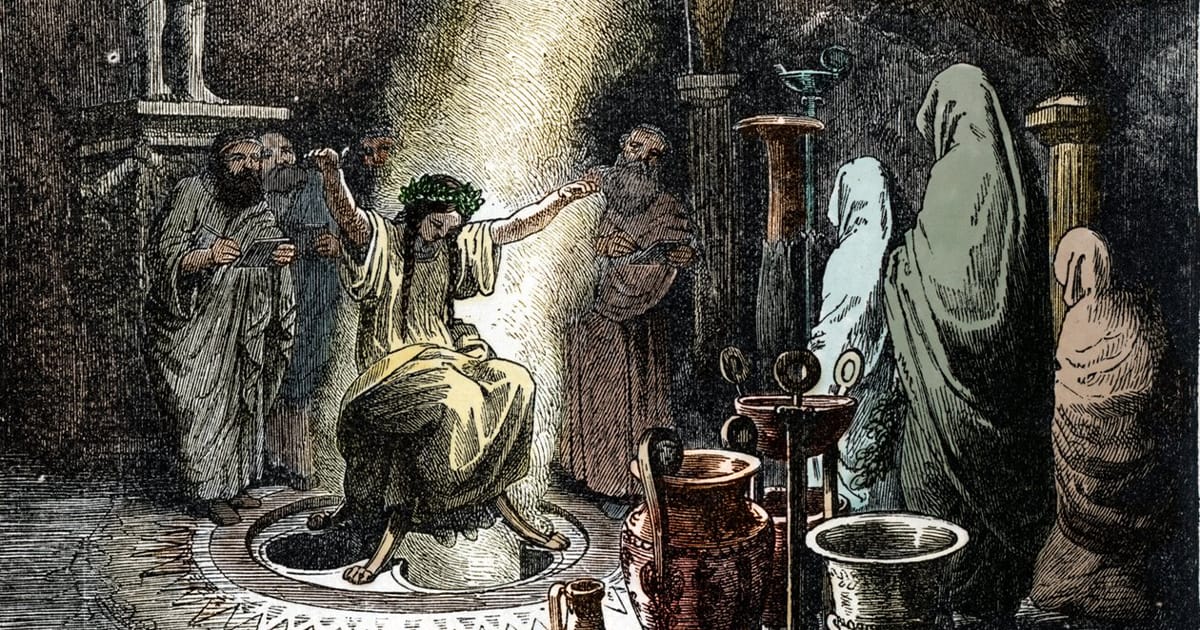
Every major decision in the ancient Greek world came with a prior question: what does Apollo say? Before Sparta voted for war in 431 BCE, its envoys walked up the Sacred Way at Delphi and waited to hear a woman answer. Before Syracuse was founded on the coast of Sicily, its settlers carried a founding tablet citing Apollo as their urban planner. Before Xerxes’ fleet met the Athenian navy at Salamis, the Athenians had already asked the Oracle of Delphi whether they should fight or flee. The oracle that shaped these decisions was not a remote theological abstraction. It was a specific institution on a specific limestone cliff in the region of Phocis, operated by a rotating series of local women called the Pythia, maintained by a professional priestly staff with real political intelligence about the entire Greek world, and powered, modern geology has confirmed, partly by gases rising through active fault lines beneath the temple floor. This article examines what actually happened inside the adyton chamber, why it worked for a thousand years, and why the answers it gave could end kingdoms.
Why Delphi? The Geography of Sacred Neutrality
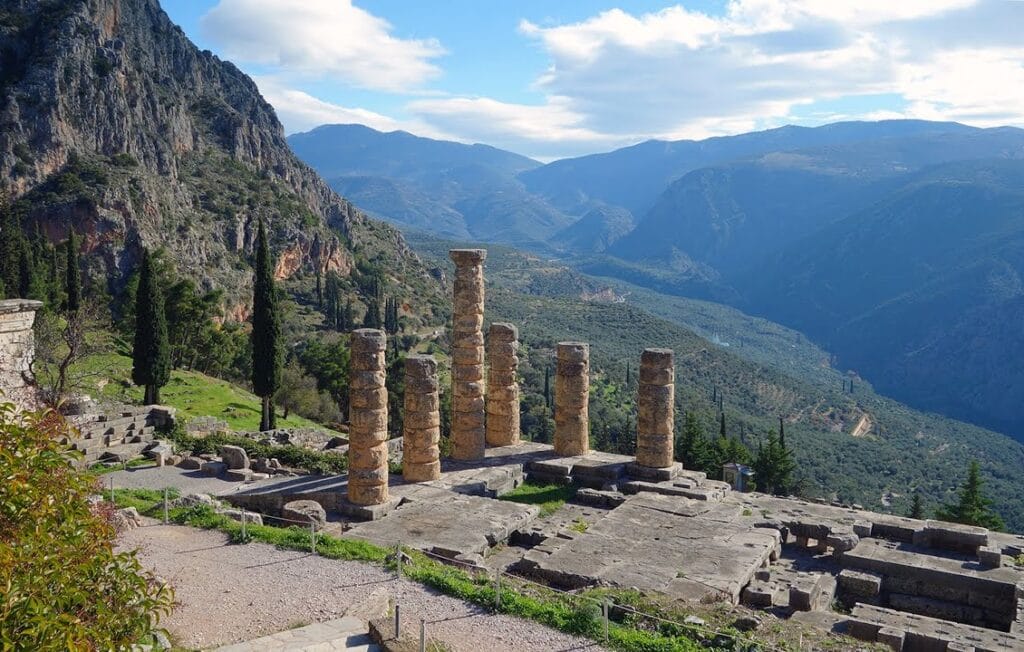
The site’s physical location was its first political advantage. Delphi sits at roughly 570 metres on the southern slope of Mount Parnassus, wedged onto a narrow limestone terrace with cliffs rising above and a steep drop falling toward the Pleistos valley below. No single city-state controlled that high ground. Spartans, Athenians, Corinthians, and Thessalians all arrived as supplicants on equal footing, none able to claim home advantage. The Amphictyonic League, a confederation of twelve regional tribes, held formal guardianship and staged the Pythian Games every four years at the site, with victors earning laurel crowns cut from Apollo’s sacred tree. That combination of physical inaccessibility and inter-tribal management made Delphi the closest thing the ancient Greek world had to a neutral international institution.
Before Apollo, the myth said, an earth goddess had held the site, her authority symbolised by a great serpent called Python. Apollo killed the serpent, claimed the cliff, and assumed the role of prophetic mediator between gods and humans. That founding myth functioned as political history encoded in religious language. The transition from chthonic earth-goddess cults to the Apolline sanctuary corresponded to the rise of city-state networks that needed a legitimising authority standing outside any single polity. The priests who designed the sanctuary’s institutional structure in the eighth and seventh centuries BCE understood this function precisely and built their operating procedures around it.
What Happened Inside the Adyton: The Ritual Mechanics
Consultations were restricted to the seventh day of each month, Apollo’s birthday according to Delphic tradition, and were suspended entirely during the three winter months when the god was said to travel to the land of the Hyperboreans in the far north. That calendar meant approximately eighty-four consultation days per year. The sanctuary managed demand through a queuing system built on precedence and payment. States that had previously donated major gifts held the privilege of promanteia, meaning they moved to the front of the line ahead of private individuals regardless of when they arrived. Kings paid substantially more than farmers. The sanctuary’s financial records, partially preserved in inscriptions recovered during the French excavations that began in 1891, show that the fee structure was graduated, flexible, and efficiently enforced.
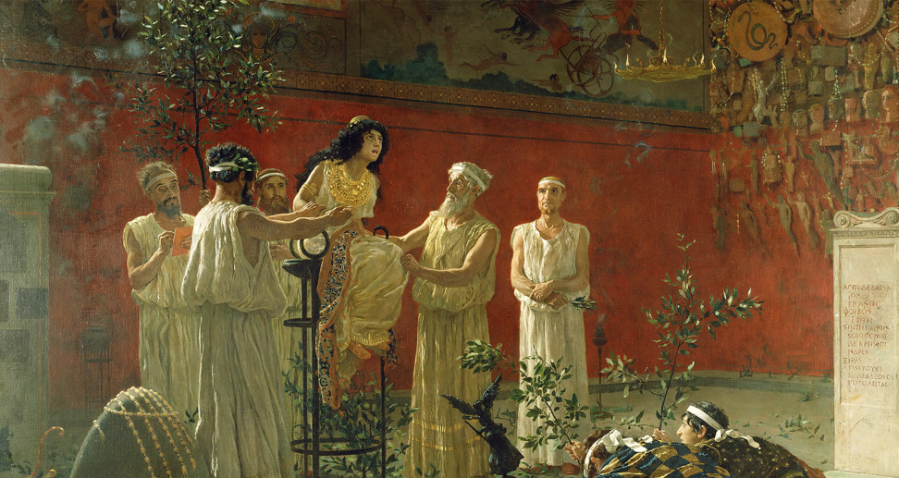
The day of consultation began before sunrise with a goat test. An animal was sprinkled with cold water from the Cassotis spring that ran beneath the sanctuary precinct. If the goat shivered, Apollo was judged to be present and proceedings continued. If it stood unmoved, the day was cancelled and suppliants returned to the inns of the town below. When the omen was favourable, priests led the goat to the main altar, performed the sacrifice, and burned thigh bones wrapped in fat on a fire fed with laurel and barley. The Pythia, meanwhile, bathed in the Cassotis spring, dressed in her ritual wool gown and laurel garland, and descended to the adyton, the inner chamber set below the main temple floor, where she seated herself on a bronze tripod positioned directly over the geological fissure at the centre of the room.
What happened next is the subject of a sustained interdisciplinary debate. Plutarch, who served as a priest at the sanctuary in the first century CE and left the most detailed firsthand descriptions, wrote that the Pythia’s voice became “not her own, yet not wholly other,” suggesting a partial rather than total dissociation from normal consciousness. He also described the chamber as smelling sweetly on active consultation days, a detail that matched nothing in the botanical environment of the site but aligned precisely with the chemical properties of light hydrocarbon emissions from geological fissures. Jelle De Boer of Wesleyan University and John Hale of the University of Louisville led a four-year geological survey of the site that identified active fault lines intersecting directly beneath the adyton and confirmed ethylene, methane, and ethane in spring water samples taken from below the temple. Ethylene in low concentrations produces exactly the euphoric, dissociated, verbally active state that Plutarch and other ancient observers described.
A 2023 peer-reviewed study by Frigerio, published in the journal Time and Mind, complicated the picture further by arguing that the “laurel” the Pythia chewed before consultations was more likely oleander than the sweet bay traditionally assumed. Oleander, which was grouped under generic “laurel” terminology in ancient sources, produces clinical symptoms including visual disturbance, altered heart rhythm, and dissociative states that match ancient descriptions more precisely than sweet bay, which is essentially harmless. The debate between geological gas theories, botanical theories, and those scholars, including Joseph Fontenrose and Scott Scullion, who argue that the ancient accounts of trance were largely literary invention rather than literal description, remains genuinely unresolved. What all camps agree on is that the priestly apparatus surrounding the Pythia, the hosioi who transcribed her utterances and the priests who rendered them into polished dactylic hexameters, held enormous interpretive control over the final form of every response delivered to questioners.
The Intelligence Network Behind Every Oracle of Delphi Response
The sanctuary’s durability across a thousand years of Greek political history rested on something more substantial than religious awe. Delphi was the best-informed institution in the ancient Mediterranean. Envoys arrived continuously from Libya, the Black Sea, Sicily, Magna Graecia, Asia Minor, and Egypt carrying questions about military campaigns, colony sites, constitutional reforms, and personal disputes. Each envoy was interrogated at length by the priestly staff before being allowed to pose his formal question. The priests who composed the oracle’s responses therefore worked from an accumulated intelligence base that no individual city-state possessed: real-time information about harvest conditions, political tensions, inter-state alliances, and military preparations across the entire Greek world.
Lisa Maurizio of Bates College, in her foundational analysis of the Pythia’s institutional role published in the Journal of Hellenic Studies, argued against the traditional view that the Pythia was a passive vessel and the priests were the real authors of oracles. Maurizio’s reading of the ancient evidence suggests that the Pythia presented oracles in their final form, in verse or prose depending on the consultation, and that Greek writers deliberately understated her active contribution in order to preserve the fiction that Apollo spoke through her without human mediation. The deliberate ambiguity of the oracle’s language, which modern readers often treat as evidence of cynical hedging, was partly an epistemological caution. The priests knew how much they did not know, and they understood that a prediction too specific to misinterpret was also too specific to survive being wrong.
The Croesus episode illustrates both the information advantage and the structural protection of ambiguity. Herodotus records that Croesus first tested the oracles of the Greek world by asking each one, on a specified day, what the Lydian king was doing at that exact moment. He was boiling tortoise and lamb together in a bronze pot, a dish so deliberately improbable that no one could plausibly guess it. Delphi alone answered correctly. Convinced of the oracle’s authority, Croesus paid the sanctuary in gold and asked whether he should attack Persia. The oracle said a great empire would fall if he crossed the Halys River. He crossed. The empire that fell was his own. Herodotus records that Croesus returned to Delphi with the complaint and received the answer that the god had spoken truth, and that Croesus had failed to ask which empire was meant. The structure of the exchange, which placed full interpretive responsibility on the questioner, was not a rhetorical trick. It was the oracle’s constitutional arrangement with every ruler it ever advised.
Built out of a love for history, kept free from distractions.
Spoken Past is an independent project shaped by curiosity, care, and long hours of research. Reader support helps keep it maintained, carefully researched, and open to everyone.
Salamis, Sparta, and the Decisions That Shaped Classical Greece
In 480 BCE, with Xerxes’ army already through the pass at Thermopylae and marching south, the Athenians sent an emergency embassy to Delphi. The first response was catastrophic: flee, build a wall of wood, weep for your city. The ambassadors, as formal suppliants, were permitted to approach the sanctuary a second time and ask for a more hopeful answer. The second response mentioned a wooden wall that would not be taken and the phrase “divine Salamis will wreath the sons of women.” The general Themistocles argued before the Athenian assembly that the wooden wall meant ships and the reference to Salamis was a promise of victory rather than a lament. Older citizens who remembered an earlier wooden palisade built on the Acropolis interpreted the oracle differently and remained behind its walls when the fleet sailed. Xerxes burned the Acropolis and killed everyone who had stayed. The fleet destroyed the Persian navy at Salamis in September 480 BCE. The ambiguity of the oracle’s second response meant that both the correct interpretation and the disastrously wrong one were defensible from the text.
The Spartan constitutional tradition carried a similar relationship with Delphi. The lawgiver Lycurgus, whose historical existence modern scholars regard as uncertain, was said in the ancient sources to have received the Great Rhetra, Sparta’s foundational constitutional document mandating equal land allotments, iron currency, and mandatory communal meals, directly from Apollo at Delphi. Whether Lycurgus existed or not, the attribution of these reforms to Apolline authority served a clear function: it insulated Sparta’s harshest social arrangements from internal dissent for centuries. An elder Spartiate who objected to the compulsory mess system was not arguing against a policy decision but against an explicit divine command, a position that carried social consequences no ordinary political opposition faced.
Greek colonisation carried Delphi’s authority across the entire Mediterranean. When a city-state prepared to send a founding expedition to establish a new settlement, it consulted the oracle first for the departure date, the founding oaths, and sometimes specific site details. Syracuse, Byzantium, and Cyrene all carried founding charters citing Apollo as their legitimizing authority. This was not ceremonial decoration. Apollo’s sanction provided the settlement with legal standing before the gods of its new territory, eased the fears of settlers who worried about offending local divine powers they had never encountered, and gave the founding city political cover if the colony later needed military support from the mother state.
The Sacred Way as Political Scoreboard
Walking up the Sacred Way from the sanctuary entrance to the Temple of Apollo in the fifth century BCE, a visitor passed a continuous display of inter-state rivalry rendered in marble and bronze. The Athenians erected a monument displaying Persian weapons captured at Marathon, the shields and helmets hung at eye level so that every subsequent pilgrim, including Spartan ones, was reminded of who had borne the first weight of the Persian invasion. The Siphnians constructed an entire treasury building in Parian marble, funded from the profits of their island’s gold and silver mines before those mines flooded irreversibly around 525 BCE. The Spartan treasury stood nearby, relatively plain on its exterior, announcing its donors’ contempt for Athenian ostentation as clearly as any inscription.
Philip II of Macedon’s manipulation of the sanctuary in the 350s BCE shows how adroitly a sufficiently powerful operator could weaponise Delphi’s institutional authority. The Third Sacred War began in 356 BCE when the Phocians seized and cultivated land sacred to Apollo in the Crissaean plain, an act the Amphictyonic League had formally prohibited. Philip entered the conflict on Delphi’s side, positioning himself as Apollo’s military protector. When the war ended in 346 BCE with a Macedonian victory, Philip held a seat on the Amphictyonic Council, had established precedent for Macedonian military intervention in central Greek affairs, and could present his subsequent political pressure on Athens and Thebes as the enforcement of sacred law rather than naked Macedonian expansion. The American School of Classical Studies at Athens has documented comparable patterns of institutional manipulation in its broader archaeological work on Greek sanctuary politics.
Decline, Silence, and What the French Found Underground
Delphi’s authority eroded gradually across the Hellenistic and Roman periods. Competition from mystery cults that offered initiates direct personal relationships with their deities undercut the oracle’s appeal among individuals seeking spiritual rather than political guidance. Sulla plundered the sanctuary’s gold reserves in 86 BCE to fund his Italian campaigns, damaging its financial independence permanently. Nero removed five hundred bronze statues during his Greek tour of 67 CE while simultaneously offering gifts, a combination that Plutarch, writing from his position as an active priest of the sanctuary, found characteristic of Roman relations with Greek sacred institutions: simultaneously destructive and reverential. Hadrian rebuilt sections of the precinct and had coins struck showing him holding a miniature omphalos, but imperial restoration of the physical plant could not restore the information network and inter-state authority that had made the oracle politically indispensable.
Theodosius I’s edict of 394 CE, enforcing Nicene Christianity as the empire’s sole legitimate religion and banning pagan sacrifice, closed the sanctuary permanently. The altar fires went cold. The medieval village of Kastri grew directly over the ancient precinct, preserving the ruins under centuries of habitation until the French School at Athens received an Ottoman excavation concession in 1891 and relocated the entire village downhill to expose the site beneath it. Their teams mapped over twenty treasury buildings, traced the water conduit system, and recovered hundreds of lead curse tablets and inscriptions recording consultations, donations, and civic decrees from every period of the sanctuary’s active operation. A geochemical survey conducted in 2001 by De Boer, Hale, and their colleagues confirmed the presence of psychoactive gas emissions in spring water samples, providing the physical explanation for the altered states that the ancient sources had described without understanding. Where the myth of Apollo placed a divine presence, geology placed a hydrocarbon vent. The oracle worked, in part, because the ground beneath it was genuinely strange.