In the autumn of 2001, geologist Jelle de Boer of Wesleyan University published a paper in the journal Geology that quietly overturned nearly a century of scholarly consensus. The paper identified active fault intersections running directly beneath the Temple of Apollo at Delphi and confirmed the presence of light hydrocarbon gases in the spring waters of the site. The Pythia Delphi scholars had long dismissed as a figure of religious theater turned out to be something far more chemically specific. What the ancient Greeks described as divine breath rising from a sacred chasm was, in measurable geological terms, a real phenomenon. This article examines the tectonic evidence, the ancient literary record, the chemical properties of the gases involved, and the serious scholarly objections that keep this debate alive.
The 1890s Excavation That Got It Wrong
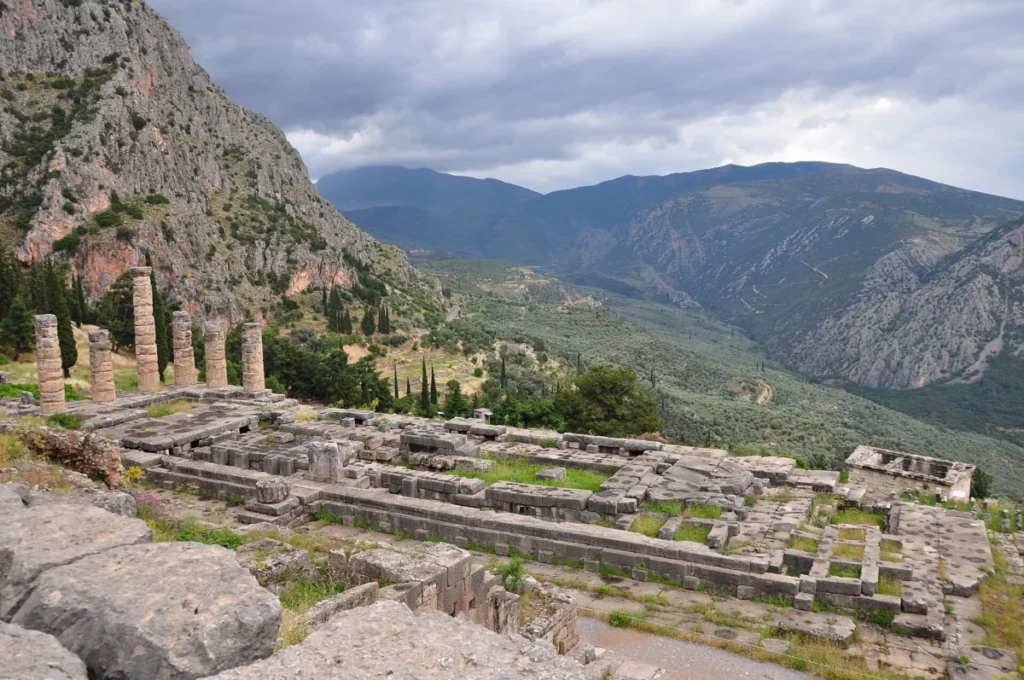
When French archaeologists arrived at Delphi in the early 1890s to begin systematic excavation of the sanctuary, they carried with them certain confident expectations. They anticipated finding the famous chasm beneath the Temple of Apollo, the rocky fissure that ancient writers from Strabo to Plutarch had described as the source of the sacred pneuma, the breath that sent the Pythia into her prophetic trance. What the French team found instead appeared to undermine the entire tradition.
The excavation revealed the foundations of the fourth-century temple, fragments of fallen column drums, and, crucially, no visible fissure in the bedrock beneath the inner sanctum. The center of the temple had no stone floor, only a thick deposit of natural clay, which the excavators interpreted as evidence that no underground chasm had ever existed. Pierre Amandry, one of the most authoritative figures to emerge from that French project, published a comprehensive study in 1950 maintaining that the gaseous vent tradition was geologically impossible. He argued that such emissions occur in volcanic regions, not in the limestone formations of Mount Parnassus.
Amandry’s authority shaped the field for decades. By the 1970s, Joseph Fontenrose’s influential book The Delphic Oracle (University of California Press, 1978) had consolidated the skeptical position. Most academic treatments of Delphi written between 1950 and 1995 categorically stated that no intoxicating gas had ever existed inside the Temple of Apollo, and that the ancient accounts reflected myth, metaphor, or deliberate priestly fraud.
The problem with that consensus, as de Boer and his colleagues later demonstrated, was that the French excavators had not looked carefully enough at the geology beneath their own dig site.
What the Faults Beneath Delphi Actually Tell Us
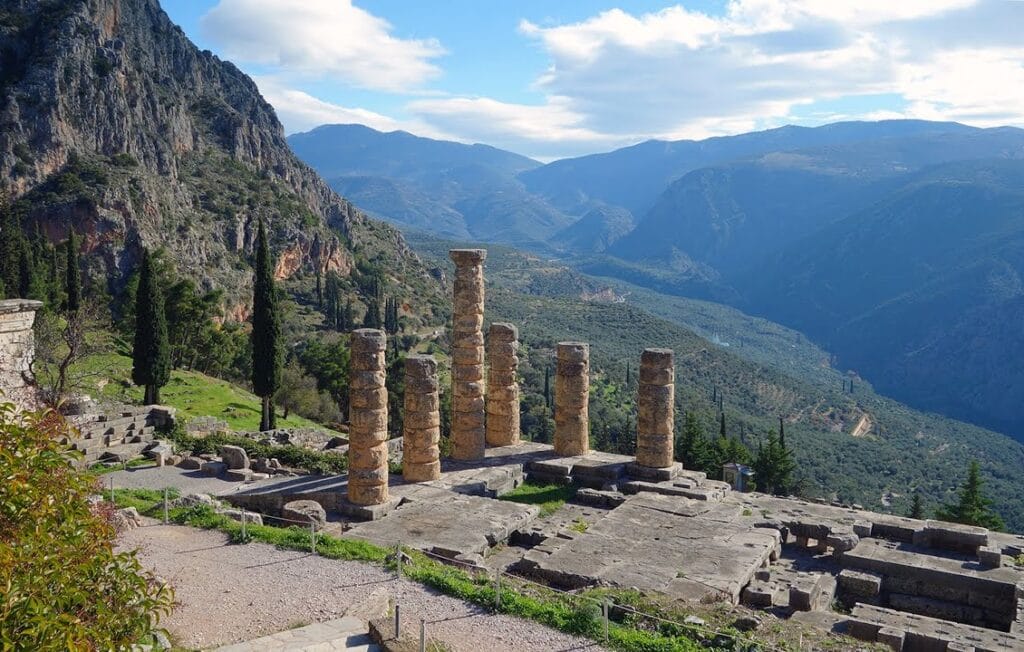
The physical setting of Delphi is geologically extraordinary. The sanctuary sits on the southern slopes of Mount Parnassus, directly above one of the most seismically active rift zones in the Mediterranean world. The Gulf of Corinth Rift, a zone of active crustal extension trending roughly east to west, has produced some of the highest recorded earthquake magnitudes in Greece, with events exceeding magnitude 6 documented multiple times in the modern era alone.
Two distinct fault systems intersect directly beneath the temple site. The Delphi Fault, an east-west trending normal fault that bounds the Mount Parnassus massif to the south, dips southward and shows clear evidence of recent movement including displaced Quaternary slope deposits and offset archaeological structures. The Kerna Fault runs in a roughly northwest-to-southeast direction and crosses the Delphi Fault at the precise location of the Temple of Apollo. In their 2001 paper in Geology, de Boer, archaeologist John Hale, and geochemist Jeffrey Chanton mapped this intersection and confirmed that three springs emerge from the ground along the fault line, all flowing in a northwest-to-southeast pattern that follows the geological direction of the Kerna Fault and passes directly beneath the temple foundations.
The Limestone and Its Petrochemical Content
The bedrock underlying Delphi consists of Late Cretaceous limestone approximately 100 million years old, formed on the floor of a shallow tropical sea and subsequently thrust upward by the collision between the Eurasian and African tectonic plates. This limestone contains significant layers rich in bitumen, a naturally occurring mixture of hydrocarbons derived from ancient marine organic matter. When fault movement generates friction along the contact surfaces between rock masses, that friction heats the lighter volatile fractions within bituminous layers. The heated fractions vaporize and migrate upward through fractures in the overlying rock, dissolving into groundwater as they rise. They eventually reach the surface as components of spring water.
Luigi Piccardi of Italy’s National Research Council arrived at complementary conclusions independently in a 2000 paper, also published in Geology, through fault mapping rather than geochemical analysis. Piccardi documented that the Delphi Fault cuts directly through the Shrine of Athena Pronaia, the oldest sacred precinct at the site, and that an offset of approximately 30 centimeters is still visible in the west wall of the main altar structure there. He identified this as evidence of coseismic surface rupture during the great earthquake of 373 BC. Crucially, Piccardi also noted documented travertine deposits and reported gas emissions in the archaeological literature for the area, both consistent with hydrothermal activity along an active fault.
Why the Seasonal Pattern Matters
One detail in the ancient sources had always puzzled scholars. The oracle at Delphi did not operate during the three winter months. Ancient writers explained this as Apollo’s annual departure to the northern land of the Hyperboreans, but the geochemical evidence offers a more physical explanation. Gas emissions of the type identified at Delphi are regulated partly by groundwater temperature and flow rate. During winter, precipitation accumulates on Mount Parnassus as snow and ice, reducing the temperature of groundwater percolating through the fault zone. Colder water dissolves less gas and releases it more slowly. As spring temperatures rise and snowmelt increases groundwater flow, more hydrocarbon gas dissolves into the circulating water and more is released when that water reaches the surface. The seasonal schedule of the oracle, nine sessions per year held only in spring, summer, and autumn, corresponds precisely to the period when hydrocarbon gas emissions would be at their most active.
Enjoying Spoken Past?
I created Spoken Past to share my love of history. I research, write and develop everything myself, and I want my articles and basic guides to remain free for everyone.
If you enjoy my work, please consider supporting Spoken Past with a small donation.
The Pythia Delphi Tradition in the Ancient Written Record
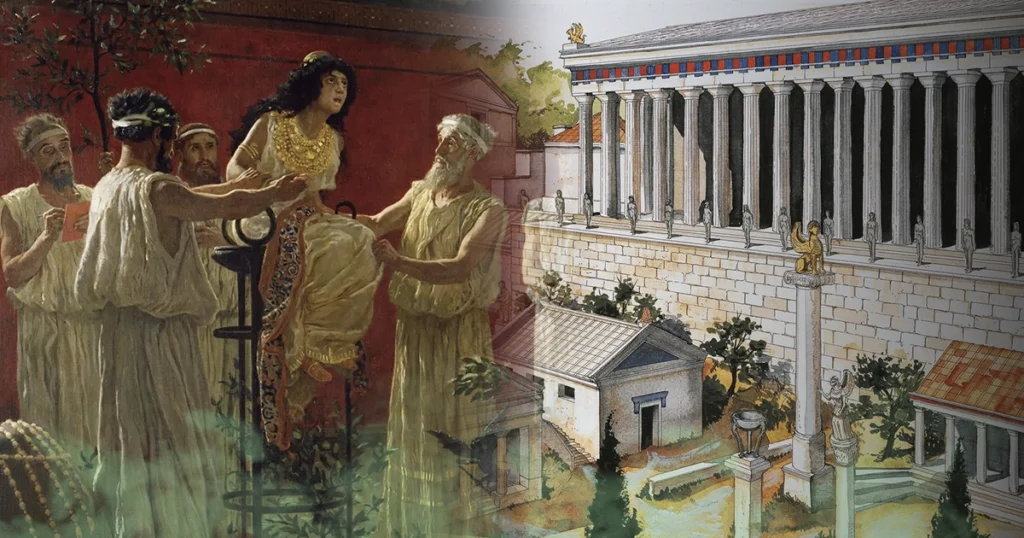
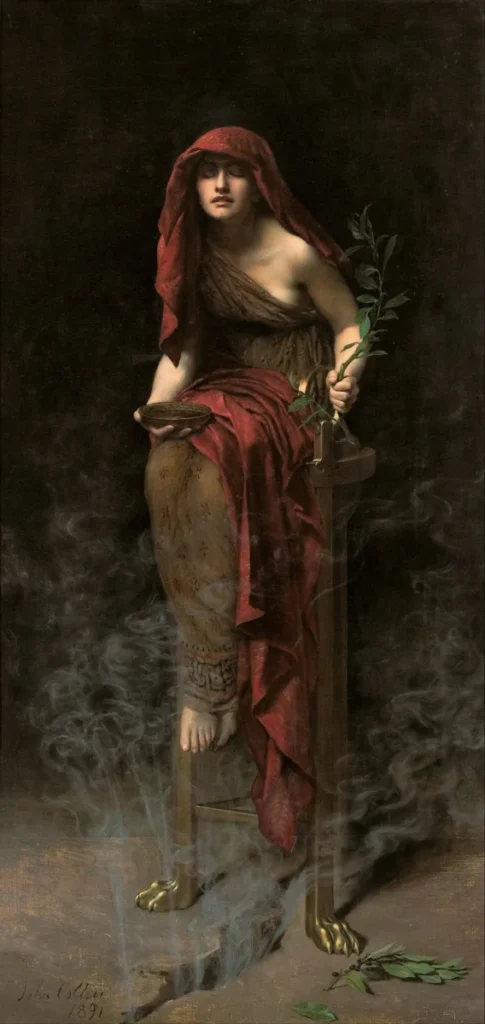
The ancient literary evidence for the pneuma and the chasm is far more extensive and consistent than the French excavators acknowledged. The geographer Strabo, writing in the late first century BC, described the seat of the oracle as a cave hollowed deep into the earth with a narrow mouth from which pneuma arose, inspiring divine frenzy, and noted that a high tripod was placed over this mouth for the Pythia to mount. The historian Diodorus of Sicily, also writing in the first century BC, added that the spring called the Cassotis plunged underground and emerged inside the adyton of the temple, where its influence made the women prophetic. Plutarch, who served as an actual priest of Apollo at Delphi around 100 AD, wrote extensively about the pneuma in his essay De Defectu Oraculorum (On the Obsolescence of Oracles), comparing the god Apollo to a musician, the Pythia to his instrument, and the pneuma to the plectrum that drew sound from her.
What the Adyton Actually Was
The adyton, a Greek term meaning literally “do not enter,” was the small inner sanctum of the Temple of Apollo. It sat physically lower than the main temple floor, accessed by a descending ramp or staircase. Visitors who came to consult the oracle never entered this space. They waited in a separate antechamber while the Pythia alone occupied the adyton, seated on a bronze tripod straddling a fissure or vent in the floor. The enclosed, sunken design of this chamber would have served a specific physical function if gas was rising from the ground. Heavier-than-air gases would pool in low-lying enclosed spaces. Even gases with a density close to air, released continuously from a vent directly beneath a seated occupant, would maintain elevated concentrations around that occupant far more effectively in a small recessed room than in open air. Archaeological evidence cited by Spiller, Hale, and de Boer in their 2002 paper in the Journal of Toxicology: Clinical Toxicology suggests that at some point the Greeks may have actively concentrated the emissions by capping the vent and funneling gas through a directed opening, with the tripod positioned directly above it.
Ethylene as an Anesthetic: The Medical Case
Gas chromatographic analysis of spring water samples collected from the Kerna Spring, less than 200 meters northwest of the temple, and from travertine deposits in the adyton area identified three light hydrocarbon gases: methane, ethane, and ethylene. The travertine deposits, which are calcareous mineral formations built up by the evaporation of spring water over centuries, contained trapped methane and ethane. Spring water analysis showed ethylene at a concentration of 0.3 nanomoles per liter, slightly exceeding the ethane concentration of 0.2 nanomoles per liter. Ethylene is chemically less stable than ethane or methane and would degrade more readily over the centuries within travertine deposits, which explains why it appeared in the water but not the rock.
Ethylene (C2H4) was a major clinical anesthetic gas from the 1930s through the 1970s, before being replaced by less flammable alternatives. At concentrations between roughly 20% and 80% mixed with oxygen, it produces full surgical anesthesia within two minutes of inhalation. At lower concentrations, well below the levels used for surgery, it produces the first stage of anesthesia: a pleasant altered mental state characterized by relaxation, mild euphoria, free association of ideas, amnesia of events during exposure, and rapid and complete recovery after the gas source is removed. This first anesthetic stage was sometimes called the excitement or amnesia phase. Toxicologist Henry Spiller, reviewing the historical descriptions of normal mantic sessions, found them strikingly consistent with this profile.
Plutarch described the Pythia during normal sessions as calm, coherent enough to respond to questions, though speaking in altered tones and patterns, and with no memory of her utterances afterward. Lucan’s account of a session conducted for the Roman general Appius Claudius around 49 BC describes the Pythia entering the adyton and being overtaken by a powerful force, moving erratically, scattering the tripods, and losing voluntary control of her movements before eventually delivering her prophecy. Spiller and colleagues compared these descriptions with documented clinical responses to ethylene intoxication. Two of the twelve subjects in Luckhardt and Carter’s pioneering 1923 clinical study of ethylene, published in the Journal of the American Medical Association, required physical restraint due to excitement and combative behavior, exactly paralleling Plutarch’s account of sessions that went badly wrong.
Why the Scientific Debate Has Not Closed
The geological evidence is genuinely compelling. The tectonic setting is exactly right. The spring chemistry shows hydrocarbon gases. The ancient literary record is consistent. And yet the ethylene-intoxication hypothesis remains scientifically contested, and that contest deserves serious attention.
Foster and Lehoux, writing in Clinical Toxicology in 2007, raised two central objections. The first was quantitative. The ethylene concentration detected in the Kerna Spring water, 0.3 nanomoles per liter or approximately 8.42 micrograms per cubic meter, is not dramatically unusual for surface water. A person following an alkylate-fueled lawnmower is reportedly exposed to ethylene at around 2.5 nanomoles per liter. Urban traffic exposure runs around 0.32 nanomoles per liter. Neither lawnmower operators nor city drivers report trance states. Foster and Lehoux argued that the de Boer team provided no measurement of the Kerna Spring’s flow rate, no calculation of how much ethylene might be released by agitation as the spring water reached the surface, and no estimate of how such gas would accumulate rather than simply dispersing, given that ethylene is marginally lighter than air and therefore unlikely to pool in low-lying spaces.
The second objection was logical. The de Boer team’s comparison table, which placed ancient descriptions of the Pythia alongside clinical descriptions of mild anesthesia, contained what Foster and Lehoux identified as a petitio principii, a circular argument. The trance state described by ancient sources can only be attributed to ethylene if you already assume ethylene was present in intoxicating quantities. The same behavioral profile could in principle arise from self-induced hyperventilation, ritual fasting, psychological expectation, or any number of other causes that produce superficially similar altered states.
A third challenge came from the flammability problem. Ethylene has a lower flammability limit of approximately 2.7% in air. The concentrations required for anesthetic effects begin at roughly 20%. A permanently burning sacred flame in the adyton, which some ancient sources suggest existed, would likely have ignited explosive concentrations before they could build to anesthetic levels. No ancient account records any explosion or fire inside the temple.
The de Boer team acknowledged that present-day gas concentrations may not reflect ancient conditions, given that geological activity and seismic shifts would alter venting patterns significantly over a millennium of oracle operation. That acknowledgment is scientifically reasonable. It is also, as Foster and Lehoux noted, unfalsifiable: if contemporary measurements showing low concentrations are dismissed because ancient concentrations were probably higher, the hypothesis becomes immune to empirical challenge. The honest position, which serious scholars on both sides of this debate generally accept, is that the geological framework is well-established while the specific identity of the intoxicating agent remains genuinely open.