
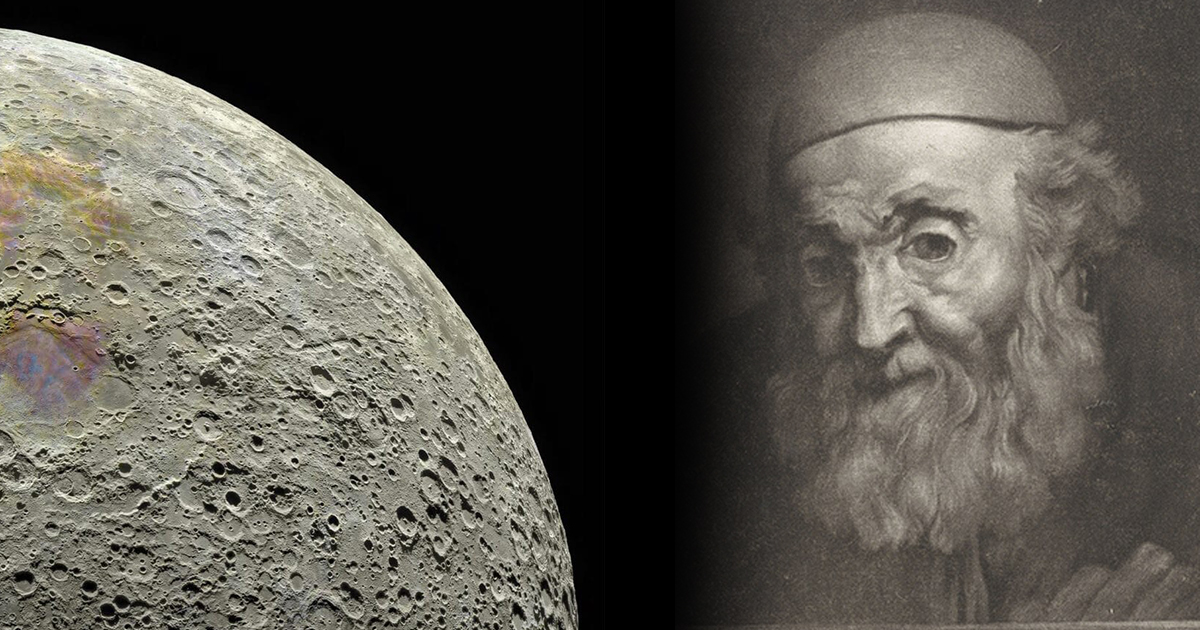
In the opening lines of a short prose fiction written around AD 160, a Syrian-born Greek author named Lucian of Samosata announces that he is about to tell a story containing not a single word of truth. He then describes, in precise navigational language, how a crew of fifty sailors departs from the Pillars of Heracles, sails westward into uncharted ocean, and is hurled by a waterspout onto the Moon, where they are immediately conscripted into an interplanetary war over the colonisation of the Morning Star. The work is called Alēthē diēgēmata in Greek, rendered in Latin as Vera Historia, and known in English as A True Story. It is the earliest surviving work of fiction to include space travel, alien life, and organised warfare between the Moon and the Sun, and it has been read continuously from antiquity to the present. This article examines what kind of work A True Story actually is, what its satirical targets are, how its major episodes work, and why classicists and science fiction scholars continue to debate its place in the history of literature.
Who Was Lucian and Why Did He Write This?
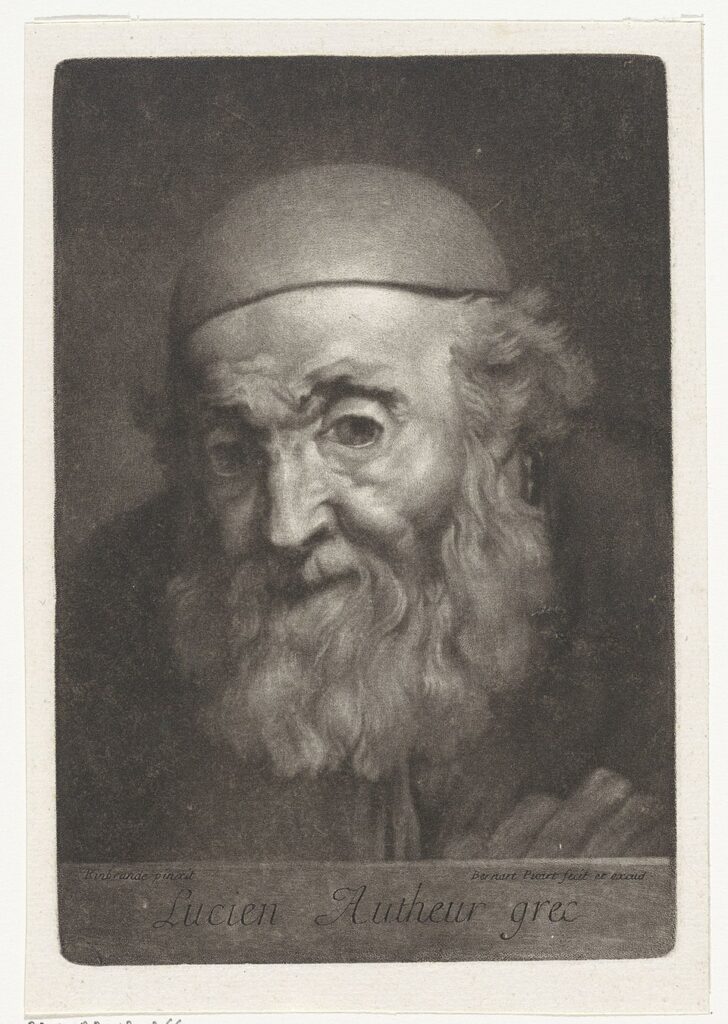
Lucian was born in Samosata, a city on the upper Euphrates in what is now southeastern Turkey, probably around AD 125. He wrote in fluent, elegant Attic Greek, the literary prestige dialect of the Hellenistic world, despite coming from a provincial Aramaic-speaking background. This position, an outsider performing the cultural authority of Classical Athens, infuses almost everything he wrote with an ironic self-awareness that scholars working in the tradition established by R. Bracht Branham have called “the comedy of tradition.” Lucian made his career as a travelling sophist, delivering public lectures and rhetorical displays across the empire, before settling in Athens and later accepting an administrative post in Egypt.
He flourished during what historians of Greek literature call the Second Sophistic, a period from roughly the first to the third century AD when Greek intellectuals in the Roman Empire devoted enormous energy to performing and displaying Classical Greek culture. In that milieu, the ability to write in a style indistinguishable from Plato or Thucydides was itself a social credential. Lucian both mastered this performance and mocked it. More than eighty works attributed to him survive, a larger corpus than almost any other ancient prose writer, spanning comic dialogues, rhetorical exercises, literary criticism, and fiction.
A True Story belongs to a cluster of works, including the shorter Icaromenippus, in which Lucian uses impossible journeys as the vehicle for his satire. His stated targets in the preface are ancient writers who presented marvels as sober geography: Ctesias of Cnidus, who recorded fantastic Indian fauna in his Indica; Iambulus, who described utopian islands in the southern ocean; and Herodotus, whose Histories contain passages on distant peoples that later readers regarded with justified scepticism. Lucian announces that his text is the only honest one of the genre, because it openly confesses that every word is a lie.
The Moon War and the Machinery of Satire
After the waterspout delivers the crew to the Moon, King Endymion of the Moon explains the political situation with complete diplomatic gravity. He has long been at war with King Phaethon of the Sun over the right to colonise the Morning Star, which is uninhabited and fertile. Endymion wants to plant a colony there and populate it with the poorest citizens of the Moon, who need land. Phaethon has blocked every attempt out of what Endymion calls jealousy. The travellers, who have just arrived from nowhere on a ship driven by a storm, are immediately absorbed into the Moon’s army.
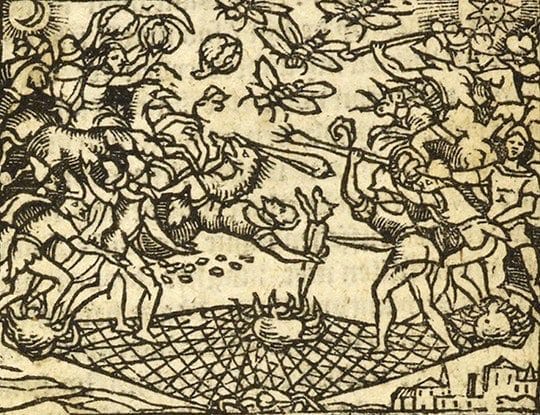
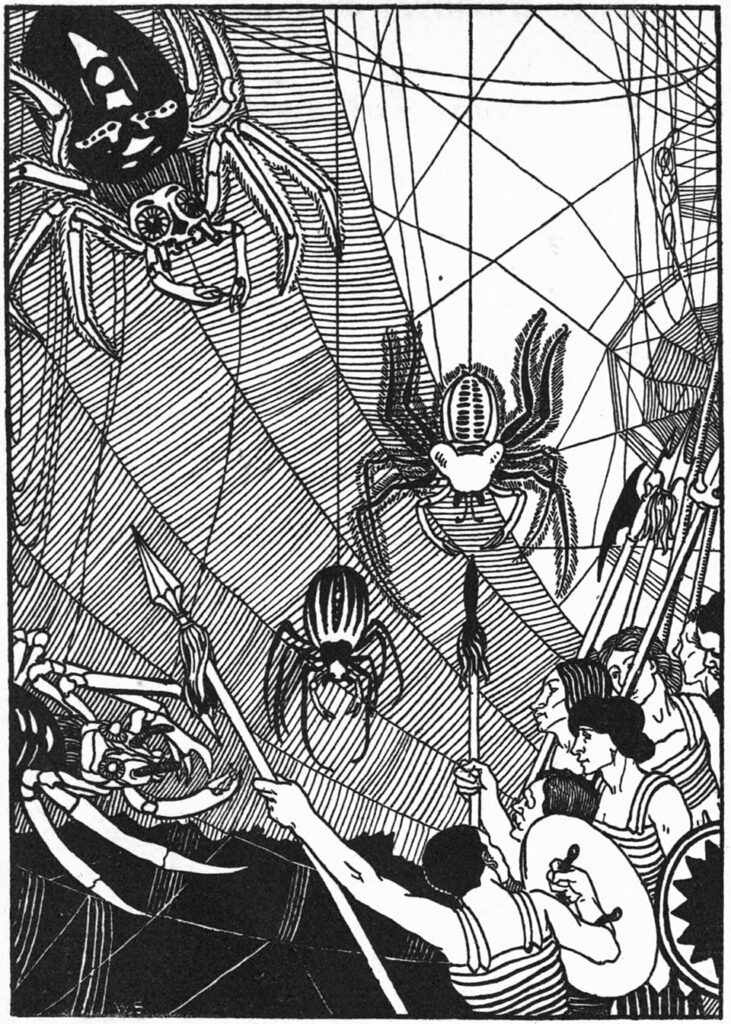
The catalogue of troops that follows is military epic deployed for comedy. The Moon’s cavalry rides Hippogypians, enormous three-headed vultures with wingspans wider than a warship’s mainsail. The flea cavalry mounts fleas the size of twelve elephants. Salad-wing fighters ride birds covered with lettuce leaves and herb feathers. The Sun’s army replies with armies of Mushroom-shield warriors and Acorn-dogs, creatures that are part canine, part wood-ant. The spider corps of the Moon weaves a continuous web between the Moon and the Morning Star, creating a stable battlefield platform in open space, across which infantry can form lines and charge.
The battle reaches its crisis when the Sun’s forces generate a cloud cover over the Moon, blocking light and demoralising Endymion’s forces. A truce follows. The terms are negotiated formally, with ambassadors, written articles, and witnesses. The web is dissolved; captives are exchanged; the Morning Star remains uncolonised, pending future negotiation. Lucian gives this entire episode the narrative apparatus of a proper Thucydidean war narrative: troop numbers, tactical movements, the decisive moment, and diplomatic resolution. The joke is structural. Every element of serious historiography is present, but the content is designed to be physically impossible. The gap between form and content is where the satire lives.
Aristoula Georgiadou of Pennsylvania State University and David H. J. Larmour of Texas Tech University, in their landmark 1998 commentary Lucian’s Science Fiction Novel: True Histories, published by Brill as part of the Mnemosyne Supplements series, argue that this gap is precisely what makes the work intellectually serious. Lucian is not merely amusing his audience with grotesque imagery. He is demonstrating, systematically, that the same literary conventions used to produce the appearance of truth in Thucydides or Herodotus can be deployed to narrate the obviously impossible. The reader who notices this should become a more careful reader of all ancient historical prose.
Moon Society and the Ethnographic Joke
After the armistice, Lucian describes Moonite society in the voice of a careful travel reporter. The Moonites are all male. There are no women. Children are gestated in the calf of the leg rather than the womb, a detail Lucian deploys with deadpan precision, including the duration of the pregnancy and the manner of delivery. Men nurse from a bladder of their own milk attached to the heel. When a Moonite dies, he does not leave a corpse; he dissolves into air like smoke. The wealthy eat roasted frogs; the poor make do with mushrooms.
This is not biology. It is the ancient ethnographic genre turned against itself. Greek and Roman ethnographic writing, from Herodotus onward, described distant peoples by systematically inverting Greek domestic customs: different marriage practices, different burial rites, different foods, different gender arrangements. The further from Greece, the more thoroughly reversed. Lucian applies the exact same method to the Moon, producing customs that are clearly constructed by the same logic as real ethnography but that reveal, by being so obviously invented, how manufactured all ethnographic strangeness is. Karen ní Mheallaigh of the University of Exeter, in her 2014 Cambridge monograph Reading Fiction with Lucian, argues that A True Story treats the Moon as a hyperreal space, a place so strange that it forces readers to recognise the familiar mechanisms operating in texts they had assumed were simply factual.
The Moon episode also includes a more pointed social satire. Endymion keeps a court. He has aristocrats, advisors, and problems of political legitimacy. His war with the Sun is essentially a colonial dispute over empty land. Lucian’s narrator participates in it without evident moral discomfort, joining the army and fighting in the first engagement. The flat, uncommented participation is part of the satire: colonisation is here stripped of the ideological scaffolding that makes it sound like civilisation and rendered as simple territorial competition between kings, neither of whom is obviously right.
The Whale, the Cheese Island, and the Logic of Escalation
After leaving the Moon, the narrative descends through a series of escalating impossibilities. The crew is swallowed by a whale described as approximately 200 stades long, roughly 37 kilometres by ancient measurement. Inside the whale’s mouth and stomach, they find an entire ecosystem: forests, farmland, a river, multiple warring tribes of fish-men who have been living inside the animal for generations, and a complete social order with its own politics, farms, and customs. The travellers fight a war against the dominant fish-man faction, burn a forest to smoke out the opposition, and eventually force the whale’s mouth open with a timber prop, sailing out into open sea.
The episode is a compressed parody of colonial adventure and ethnographic discovery. The travellers arrive in an unknown territory, immediately identify a dominant faction, ally with an underpowered one, conduct a military campaign, and depart without apparent obligation to the people they have left behind. The internal ecosystem of the whale functions as a satirical model of how ancient travel writers described distant islands: the further the location from the Mediterranean, the more elaborately self-contained and implausible the social structure. Lucian makes the mechanism visible by rendering the container literally impossible.
The Sea of Milk and the Cheese Island come next. The crew sails into water that turns white, then soft, then solidifies around an island made of compressed cheese. The island has vines that produce milk rather than wine. A shrine bears a dedication to Galatea, the sea-nymph associated with white water and milk in Greek mythology. Lucian records the island’s dimensions, the taste of the milk, and the height of the cheese before sailing on. The episode’s comedy depends entirely on the precision. Lucian reports the impossible with the same documentary detail he has used for the whale measurements, the Moon battle formations, and the Moonite dietary customs. Applying consistent empirical style to escalating absurdities trains readers to notice how much of any marvellous report rests on nothing except a confident authorial voice and a tidy set of numbers.
Built out of a love for history, kept free from distractions.
Spoken Past is an independent project shaped by curiosity, care, and long hours of research. Reader support helps keep it maintained, carefully researched, and open to everyone.
The Island of the Blessed and the Punishment of Liars
Near the end of Book Two, the travellers reach the Island of the Blessed, the traditional Greek afterlife paradise. Homer is there. Odysseus is there. Achilles and Patroclus dwell in ease. The island has rivers of wine, cups that grow on trees like fruit, and a season that never shifts from spring. Lucian’s narrator sits next to Homer at a banquet and asks him questions about his life and his compositional methods. Homer’s answers are given matter-of-factly, resolving centuries of Alexandrian scholarly controversy about the poet’s biography in a sentence or two.
The satirical edge cuts in two directions. The Island of the Blessed is, among other things, a parody of utopia as a literary genre. Plato does not live there. He has gone to his own imaginary republic, a place that, the narrator notes, does not actually exist anywhere and therefore cannot be visited. Pythagoras has abandoned his dietary rules and eats whatever is offered. Socrates nearly gets expelled from the feast for continuing to conduct ironic cross-examinations of the other diners. The philosopher who spent his life questioning everything cannot, even in paradise, stop being the questioner, and paradise finds this annoying. It is a fond portrait of a genuine intellectual habit rendered as a social nuisance.
Herodotus and Ctesias, the travel writers whose tall tales Lucian targeted in his preface, are not on the Island of the Blessed. They are in the Island of the Wicked, the underworld’s punishment zone, suffering appropriate torments for their literary crimes. The point is clear and mean in a cheerful way: the writers who confused wonder with truth are not celebrated for expanding the imagination. They are punished for deceiving their readers. A True Story, which confesses its lies upfront, is therefore the most honest book in the genre, and its author belongs at the feast rather than the dungeon.
The Isle of Dreams and the Map of Narrative Credibility
Before reaching the Island of the Blessed, the travellers pass through the Isle of Dreams, a set piece that is perhaps the most conceptually precise in the entire work. The island’s capital city has a Temple of Night and a Temple of the Cock, a Well of Sleep and a Well of Wakefulness, twin shrines to Truth and Falsehood standing side by side at the city centre. The gates through which the island’s residents depart are the same ivory and horn gates described in Book Nineteen of Homer’s Odyssey, through which false and true dreams exit to visit sleeping humans. The inhabitants include Sleep himself as king, his subordinate Antiphon who serves as dream-interpreter, and a range of supernatural assistants responsible for different varieties of dreaming.
This passage works as a self-commentary on the entire book. Lucian has literally mapped the place where stories go when they leave their source and travel toward an audience, describing the architecture of narrative authority as a city with specific buildings and gates. The reader who has been trained throughout the book to track how marvels get their credibility finds in the Isle of Dreams a diagram of the problem. True and false dreams exit through different gates, but both gates are in the same city. You cannot tell them apart by their point of origin; you have to inspect them on arrival. The same applies to any text that presents itself as a record of wonders.
Karen ní Mheallaigh’s analysis in Reading Fiction with Lucian treats the Isle of Dreams as the theoretical centrepiece of the work, the place where Lucian makes explicit what he has been doing throughout: constructing a fictional world governed by consistent internal rules in order to force the reader to examine the rules that govern belief in any narrative, fictional or historical. This reading situates A True Story not just as clever entertainment but as a genuine contribution to ancient literary and epistemological debate.
A True Story and the Science Fiction Debate
Whether A True Story qualifies as science fiction depends on which definition you apply, and the definitions scholars use for science fiction are genuinely disputed. The most widely cited theoretical criterion comes from the work of Darko Suvin, who defined science fiction through the concept of cognitive estrangement: the deployment of a novum, a genuinely new element, that forces the reader to experience the familiar world as strange by presenting an alternative governed by discernible rules. Scholars who accept this definition, including those who have worked on Lucian’s text through Georgiadou and Larmour’s Brill commentary, have argued that A True Story satisfies it.
The Moon in Lucian’s text is not supernatural. It has a king, an army, a political dispute, and a geography. It operates according to rules: Moonites produce children by a specific biological mechanism, they eat specific foods, they die in a specific way. The spider web is deployed as infrastructure rather than magic, built to a military specification to solve a logistics problem. The interplanetary war has terms, a truce, and an outcome. These are the features of world-building in the sense that modern science fiction theory identifies, not fantasy in the sense of the arbitrary miraculous but speculation in the sense of a different physical or social arrangement applied consistently.
The objection that Lucian was not proposing testable hypotheses about lunar geology is true but beside the point. Neither was Jonathan Swift in Gulliver’s Travels, which routinely appears on lists of early science fiction. The question is not whether the author believed the Moon was habitable but whether the narrative uses the Moon’s habitability to generate genuine thought experiments about power, credibility, and social organisation. On that criterion, A True Story passes. The 2022 Bryn Mawr Classical Review of the most recent scholarly edition of the Greek text noted, critically, that the possibility of categorising the work as science fiction remains underexplored in classical scholarship, which suggests the conversation is still very much open.
The Voice of the Text and Its Afterlives
One reason A True Story reads as fresh to modern audiences is its narrative voice. Lucian’s narrator is neither a naive innocent overwhelmed by wonders nor a wizened sage explaining them. He is a careful, slightly detached reporter who measures distances, counts soldiers, records the taste of cheese, and describes the anatomy of the whale’s interior with the same tone he would use for a port inspection. The joke is always that this voice is reporting things that cannot exist. But the voice never cracks. It never signals its own absurdity. This sustained deadpan is itself a craft technique, and it requires real comic discipline to maintain across sixty pages of escalating impossibility.
That technique was directly inherited. Cyrano de Bergerac’s L’Autre Monde of 1657, one of the first European narratives to describe multiple methods of reaching the Moon, deploys exactly this dry reportorial voice for its speculative natural philosophy. Jonathan Swift’s Gulliver’s Travels of 1726 uses it throughout, with Gulliver’s clinical sea-captain prose rendering Lilliput and Brobdingnag in the same register as Lucian’s Moonites. Both works have been read as direct inheritors of the Lucianic tradition, and both were composed by authors who knew the Greek text well. Nineteenth-century illustrators including William Strang and Aubrey Beardsley, working on the 1894 English edition, reinvented the visual vocabulary of the spider battles and whale interior for a Victorian readership already primed for Jules Verne.
The full text of A True Story, in A. M. Harmon’s Loeb Classical Library translation with parallel Greek, is available through the Loeb Classical Library. Readers who want to pursue the scholarly debate in depth should start with Georgiadou and Larmour’s Brill commentary and then move to ní Mheallaigh’s Cambridge monograph for the most sustained recent treatment of how Lucian constructs fictionality as a reading experience rather than simply a genre label. What neither work disputes is that Lucian produced something genuinely original: a text that is simultaneously a parody of a genre and an instance of it, a lie that teaches you to read more carefully, and a journey to impossible places that maps the real territory of how stories make themselves believed.
Sources: Lucian of Samosata, Alēthē diēgēmata (A True Story), trans. A. M. Harmon, Loeb Classical Library vol. 14 (Cambridge, MA: Harvard University Press, 1913), available via Loeb Classical Library; Aristoula Georgiadou and David H. J. Larmour, Lucian’s Science Fiction Novel: True Histories. Interpretation and Commentary, Mnemosyne Supplements 179 (Leiden: Brill, 1998), reviewed at doi:10.2307/631852; Karen ní Mheallaigh (University of Exeter), Reading Fiction with Lucian: Fakes, Freaks and Hyperreality (Cambridge: Cambridge University Press, 2014), doi:10.1017/CBO9781139941594; review of the 2022 Clay and Brusuelas edition of the Greek text, Bryn Mawr Classical Review 2022.04.40; A. Georgiadou and D. H. J. Larmour, “Lucian and historiography: De Historia Conscribenda and Verae Historiae,” ANRW 2.34.2 (1994), 1448-509; on Lucian’s principles of historical composition, Classical Quarterly (2025).