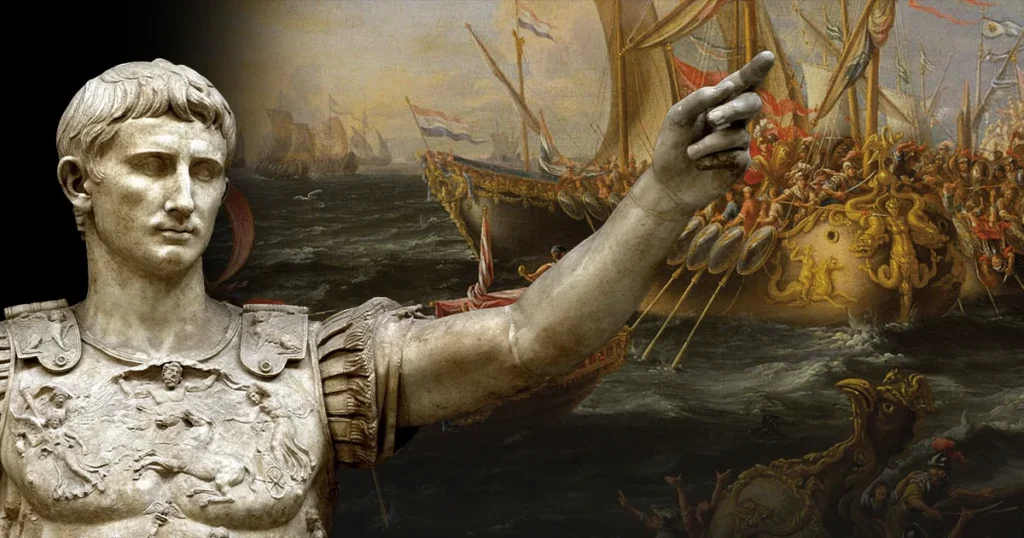
On 2 September 31 BCE, Octavian and Mark Antony met in a naval battle off the western coast of Greece that would decide who controlled the Roman Mediterranean. Octavian was Julius Caesar’s adopted son; Antony had once been Caesar’s ally and then Octavian’s partner in government. Antony’s fleet also included ships supplied by Cleopatra VII, queen of Egypt. Antony and Cleopatra escaped with some vessels, but the majority of the fleet and the army stationed nearby eventually passed into Octavian’s hands. The sea battle decided the campaign in Greece, but Antony’s position had been weakening for months before the fleets fought.
Marcus Vipsanius Agrippa, Octavian’s principal military partner, had spent the preceding months putting Antony at a disadvantage. Agrippa had already proved himself in naval warfare around Sicily. Rather than waiting for a single confrontation, Agrippa seized ports and interfered with the routes bringing supplies from the eastern Mediterranean to Antony’s army in Greece. Disease, desertions and a growing shortage of trained rowers added to the difficulty. By September, Antony had to decide what his remaining ships could still achieve against an opponent who was steadily restricting his movements.
The most disputed part of Actium concerns the escape itself. Ancient accounts describe Cleopatra’s squadron sailing away through the fighting and Antony following her. They differ over whether the movement was planned beforehand as a breakout or undertaken when the battle began to go badly. That distinction affects how we judge Antony’s final naval operation, but it does not change what followed. Octavian held the sea, Antony’s forces in Greece were lost, and the struggle ended in Egypt the next year.
Why Octavian and Antony were fighting
The rivalry between these former allies had begun after Julius Caesar’s assassination in 44 BCE. Antony was then a consul and one of Caesar’s senior political associates. Octavian, Caesar’s young great-nephew and adopted heir, claimed his place in the Roman political struggle. In 43 BCE the two joined Marcus Aemilius Lepidus to form the Second Triumvirate, a three-man government with exceptional powers. Together they defeated Caesar’s assassins, Brutus and Cassius, at Philippi in 42 BCE. Yet their victory left enormous armies in the hands of three leaders and the Republic’s institutions increasingly unable to control them.
After Philippi, Octavian consolidated his position in Italy and the western provinces, while Antony commanded Rome’s eastern territories. There Antony formed a personal and political partnership with Cleopatra. Egypt could provide ships, grain, money and a reliable base for further eastern campaigns; Cleopatra in turn needed Roman protection for her dynasty and her children’s prospects. This made her alliance with Antony a substantial military asset. Octavian’s supporters, however, used that relationship to suggest that a Roman commander had allowed a foreign queen to govern his decisions.
Disputes over provincial commands, military manpower and resources had already strained the partnership. Antony’s marriage to Octavian’s sister Octavia was supposed to hold the alliance together, but he eventually repudiated her. By 32 BCE the conflict had become open war. Octavian publicized what he said was Antony’s will, including provisions benefiting Cleopatra’s children and a request for burial at Alexandria. He presented these claims as signs that Antony’s allegiance had shifted away from Rome. Suetonius, writing much later, recounts the public reading of the will, but his account establishes how the episode was represented rather than independently confirming every allegation made in the campaign.
The declaration of war was formally made against Cleopatra, even though Antony and his Roman legions were the real military opposition. That choice allowed Octavian to call himself Rome’s defender in a conflict that was fundamentally another civil war. Decades of fighting had made the claim of protection from a foreign threat politically useful. Defeating the queen would also eliminate the only Roman rival capable of contesting Octavian’s authority. Cassius Dio’s account of the propaganda before the war shows how each side argued over who could legitimately speak for the Roman state.
How Agrippa trapped Antony near Actium
Antony concentrated his forces on the western Greek coast, from which he could threaten Italy across the Adriatic. His ships lay around the entrance to the Ambracian Gulf, a sheltered inlet reached by a narrow channel beside Actium. On land he had experienced Roman legions; at sea he commanded allied vessels supplied by several eastern territories. Yet an army based there still needed food for its soldiers, crews for its warships and fodder for its horses. Supplying all three meant maintaining shipping routes and ports spread across a considerable distance, and those were the connections Agrippa chose to attack.
Agrippa struck at the supply network well before the September battle. Dio, Roman History 50.11-14 describes his capture of Methone in the southwestern Peloponnese, the interception of transports, and the subsequent taking of Leucas, Patrae and Corinth. Each place mattered because of its position. Methone exposed shipping coming north from Egypt and the eastern Mediterranean; Leucas guarded nearby island approaches south of Actium; Patrae and Corinth interfered with routes around the Peloponnese. Antony could still try to bring in supplies and reinforcements, but each loss made those journeys more dangerous and less dependable.
Octavian also crossed from Italy and fortified a camp north of the gulf, facing Antony’s anchorage across the channel and watching the passage to the open sea. The opposing camps stood on different sides of the inlet. Octavian had not completely sealed off the gulf, and Antony still had a formidable army ashore. Even so, Octavian’s fleet could challenge traffic through the entrance while Agrippa’s other operations cut into the routes that supported Antony farther away. By the time the fleets met, the two commanders had spent months fighting over provisions, harbours and the ability to move freely along the coast.
Conditions in Antony’s camp worsened over the summer. Dio reports disease and interruptions to the grain supply. Plutarch, Life of Antony 62-63 describes warships short of crews, with men inexperienced at sea pressed into the rowing benches. Allies and officers began leaving Antony; among them was Gnaeus Domitius Ahenobarbus, a senior Roman supporter whose defection carried political weight. Neither account measures the losses in men and supplies precisely, but both describe an army increasingly difficult to maintain.
Antony continued to challenge the enemy. He moved troops across the channel and fought skirmishes, and Plutarch describes an attempt to disguise how few trained sailors remained. Antony supposedly armed rowers and stood them on the decks so that his ships looked fully manned. Whether or not the display deceived anyone, the account points to a practical difficulty. Big warships needed coordinated rowers, officers able to handle formations and soldiers ready to fight on deck. Possessing a powerful-looking fleet was of limited use if too few men could operate it properly.
Why Marcus Agrippa mattered
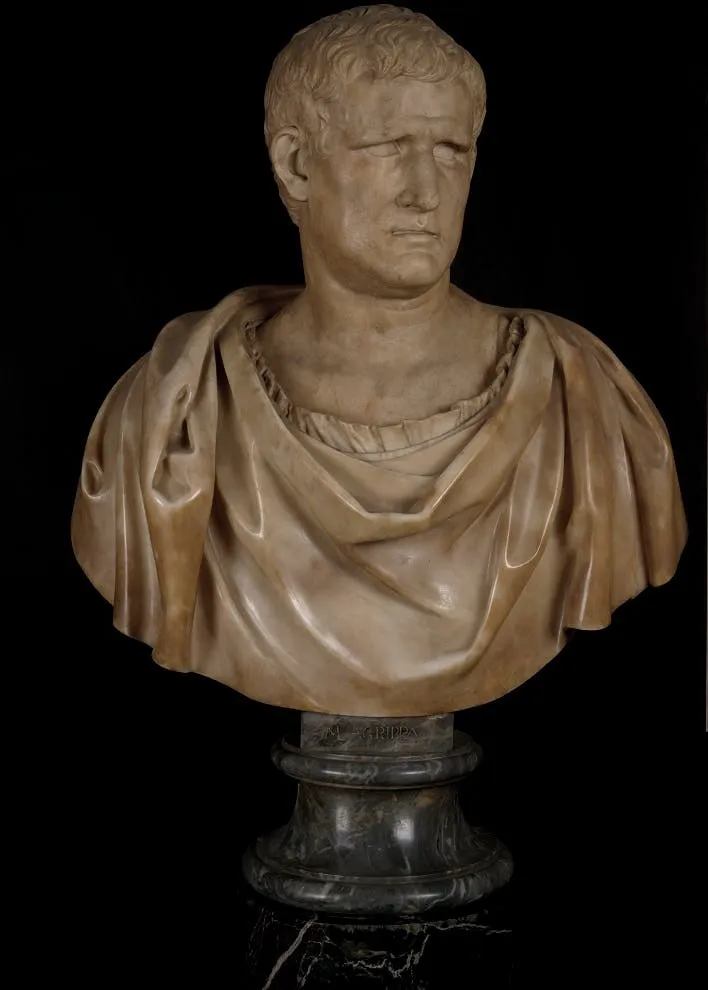
Agrippa’s importance was established long before Actium. In 36 BCE, five years earlier, he had led Octavian’s fleet against Sextus Pompeius, whose hold over Sicily and the surrounding waters threatened the supply of food to Italy. That success left Octavian with naval resources and an admiral experienced in coordinating landings, ships and attacks along a coast. His Sicilian campaign had shown the value of limiting an enemy’s routes and supplies before attempting to defeat his ships in battle.
He applied that experience again in Greece. Capturing ports steadily narrowed Antony’s choices while Octavian’s own ships could continue to operate from a secure base. Dio names Agrippa as the commander of Octavian’s navy and records his contribution to the discussions before Actium. When Octavian considered letting the enemy sail away and giving chase, Agrippa objected: ships being rowed might fail to catch vessels moving under sail. Better to meet Antony at the point of escape, while his fleet remained within reach. The advice shows that Agrippa was thinking about the conditions of pursuit, not merely the strength of the two battle lines.
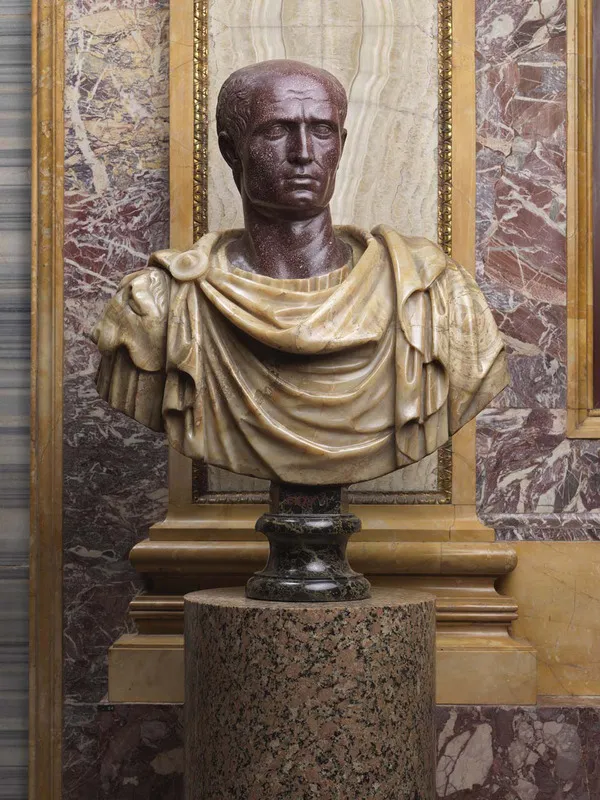
That does not mean Agrippa invented all the tactics used at Actium. Claims that he originated missile attacks, coordinated assaults or the employment of lighter galleys against bigger ships go beyond the surviving evidence. Roman sailors had long used artillery, boarding equipment and warships of different sizes. Agrippa’s skill lay in bringing those existing means together, first to undermine Antony’s coastal supply arrangements and then to defeat the force that finally sailed out against him.
How many ships fought at Actium?
The size of the rival fleets is difficult to pin down. Plutarch gives Antony an initial force of at least 500 warships against Octavian’s 250, figures for the wider campaign rather than a confirmed list of ships fit to fight in September. He also says Antony burned Egyptian vessels he could not crew, retained sixty belonging to Cleopatra and chose his strongest remaining ships for combat. Other ancient figures and modern estimates differ. One common reconstruction gives Antony approximately 230 effective battle vessels and Octavian several hundred, but neither figure should be mistaken for a securely preserved fleet register.
Ancient warship names can also mislead modern readers. A quinquereme belonged to a class of large oared vessels; the word did not necessarily describe five separate tiers of oars stacked vertically. Rowing arrangements differed, and these ‘fives’ were appreciably larger than the small galleys employed for scouting or fast attacks. Some of Antony’s vessels were exceptionally big, with elevated decks or towers from which soldiers and archers could fight. Their engines could throw bolts or stones, making an approach particularly dangerous for any enemy ship within range.
Octavian had numerous manoeuvrable vessels, including types known as Liburnians, named for a maritime tradition of the eastern Adriatic. Yet the familiar contrast between his small boats and Antony’s giant floating fortresses is too simple. Octavian also possessed heavy ships, while Antony commanded lighter classes as well. The practical imbalance was that Antony had concentrated his available crews in fewer substantial vessels. Octavian could send more ships against their oars, sides and exposed men, forcing them to defend several approaches. Plutarch and Dio describe that problem, although the two authors differ about particular actions.
Why Antony chose to fight at sea
A naval engagement was not the only strategy available to Antony. He still had a capable army ashore, and his commander Publius Canidius Crassus reportedly advised him, according to Plutarch, to send Cleopatra away and march into Macedonia or Thrace. There the Roman legions could operate on ground more familiar to them. Moving inland, however, would surrender the coastal ports and shipping on which Antony’s coalition depended. It might also cut him off from the Egyptian money and supplies that could keep the war going. Antony had to weigh the advantages of his legions against the supplies and Egyptian support that he risked losing by leaving the coast.
The ancient accounts make Cleopatra’s influence hard to judge. Plutarch depicts her pressing for a sea battle against other military advice while preparing an escape. Dio instead says she favoured returning to Egypt and persuaded Antony to fight his way through any ships blocking the route. Both writers composed their histories under the Roman Empire, when Cleopatra had already become a symbol in stories about Antony’s supposed weakness. Their reports remain useful, but neither man’s interpretation of her intentions can be read as neutral testimony from someone present at the council of war.
One preparation has particular importance: Antony carried sails aboard his fighting ships. Oars normally gave warships the close control needed in battle, regardless of the direction of the wind. Plutarch says Antony insisted on bringing sails so that a fleeing enemy could not get away. Sails would also be necessary for a fleet breaking into open water and heading south toward Egypt. The same equipment, however, could enable a withdrawal if a genuine attempt to win the battle failed. Its presence supports several interpretations and cannot establish Antony’s plan on its own.
Carsten Hjort Lange, in a 2011 reassessment of Actium notes the tension between the accounts of an attempted victory and a planned escape. Most ancient narratives suggest Antony fought to win until Cleopatra departed, whereas an influential modern interpretation views the operation primarily as a breakout. The surviving evidence does not settle the disagreement. Any explanation must take account of Antony’s depleted provisions, his surviving army and the fact that the operational plan itself has not survived.
Enjoying Spoken Past?
I created Spoken Past to share my love of history. I research, write and develop everything myself, and I want my articles and basic guides to remain free for everyone.
If you enjoy my work, please consider supporting Spoken Past with a small donation.
The battle on 2 September 31 BCE
The fleets drew up outside the gulf’s entrance on 2 September. Antony’s vessels emerged through the confined passage and faced Octavian’s line without immediately charging it. According to Plutarch, Agrippa commanded Octavian’s left, Octavian the right and Lucius Arruntius the centre. On Antony’s side, commanders included Gaius Sosius and Marcus Insteius. Once hundreds of ships moved into their separate wings and squadrons, no single commander could direct each encounter. Much of the fighting depended on officers responding locally to a changing situation.
Plutarch and Dio give different descriptions of how the battle began. Plutarch says Antony’s left advanced as the wind rose, while Octavian’s right rowed back to draw the heavy opposing vessels away from the protection of the strait. Dio describes Octavian’s wings spreading in a crescent, making Antony advance lest his fleet be surrounded. Both accounts point to a struggle over the spacing and shape of the lines. Antony’s ships needed to stay close enough to support each other; Octavian’s commanders wanted space in which to approach them from different directions.
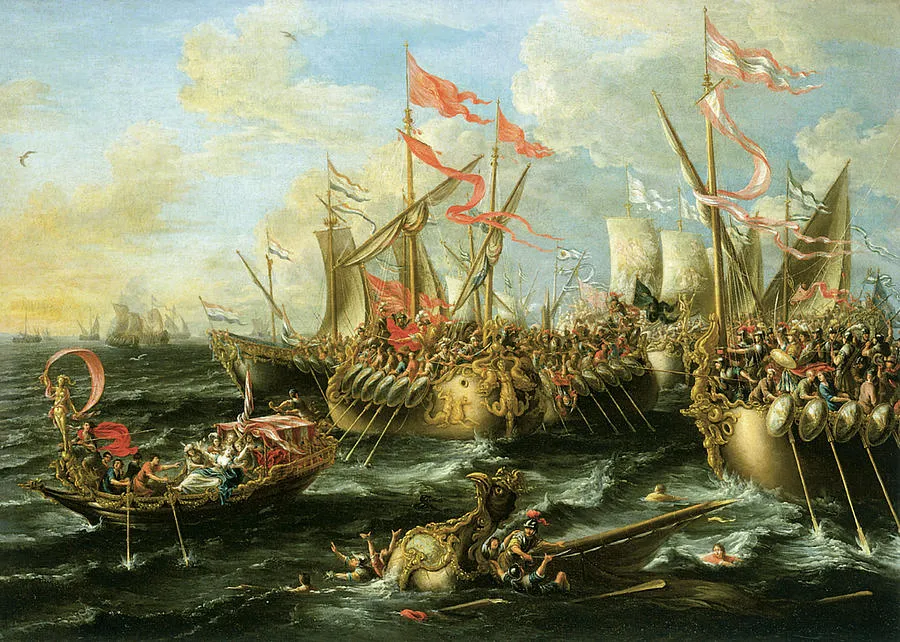
Antony’s biggest warships could defend themselves fiercely. Troops on raised decks and towers could shoot down at approaching attackers, while grappling devices could secure a ship long enough for its marines to board an opponent. Thick timbers and bronze-covered rams were difficult to break apart. In Plutarch’s description of the combat, several Octavian ships sometimes gathered around a single enemy vessel and struck it with spears, missiles and fire. Plutarch likens the fighting to an assault on a fortified position. His comparison conveys why confronting a larger warship was so dangerous even when it was outnumbered.
Dio’s account of Octavian and Agrippa’s deployment shows another side of the same struggle. Smaller galleys could rush in, damage oars or hulls, and pull away before the larger ship’s crew caught them with grappling gear. A different vessel could then strike from another side. Neither advantage was absolute. Heavy ships threatened anything caught beside them, while lighter craft could manoeuvre and choose another approach. Dio’s narrative in Book 50 explains the tactical choices available, though it cannot be used as a precise chart of every ship’s course.
The fighting also took place beyond the gulf, rather than entirely in its narrow entrance. The channel restricted how Antony could deploy or return, but once the fleet emerged its wings spread into the waters outside. Ships advanced, withdrew and searched for openings across a wider area. Our sources do not allow exact calculations of their relative speed, the wind at every stage or the timing of individual turns. Reconstructions that specify such details with confidence go further than the ancient descriptions permit.
Why Cleopatra left the battle, and why Antony followed
Cleopatra’s sixty vessels waited behind Antony’s principal line. As the fighting continued, they hoisted sails, passed through the combat and headed for open water. Plutarch says their movement disrupted the fleet and that Antony left in a smaller craft before joining Cleopatra. He condemns Antony for leaving men still fighting on his behalf. Later accounts often made the episode a lesson about a commander undone by his attachment to a queen. That moral judgment, however, does not tell us securely what the two leaders intended that morning.
There are reasons to consider a prearranged escape. Cleopatra’s ships seem to have been positioned to depart and were carrying important resources. If the aim was to return to Egypt, a favourable wind would help them outrun pursuers dependent on oars. Antony may have hoped to retain Cleopatra, the money and enough ships to continue resistance from another base. On this reading, the fighting opened a passage rather than aiming at the total destruction of Octavian’s fleet. Yet the sources disagree, and no operational order survives to establish what Antony intended before the fighting began.
Dio himself offers evidence of the uncertainty. Before describing the battle, he says that Antony and Cleopatra intended to force a passage and return to Egypt. Later, at the moment of departure, he blames her fear and Antony’s bewilderment. Dio’s conflicting explanations show how hard it is to recover the commanders’ intentions from narratives composed long after the battle. Whether the departure was planned or improvised, it left Antony’s remaining ships and the legions ashore deprived of the commander on whom their position depended.
Those who remained at sea continued fighting after Antony departed. Plutarch says resistance lasted for hours, and Dio too describes prolonged combat. Octavian’s sailors ultimately employed incendiary missiles against the heavier vessels. Fire was particularly destructive aboard timber ships crowded with people and rigging, yet Dio presents its use as part of a difficult battle, not a swift finishing stroke. Antony’s flight shaped the outcome, but it did not cause an entire fleet to surrender without resistance.
What happened to Antony’s fleet and legions?
We cannot establish the losses with modern precision. Plutarch reports no more than 5,000 dead and 300 ships captured, attributing the second figure to Octavian’s own account. Other traditions differ, and a claim of 300 captures does not tell us how many ships remained usable afterward. The wider result is less doubtful: Antony had lost most of the navy needed to maintain his position in Greece. The vessels that reached safety with him could do little for the large army still ashore.
Plutarch numbers that army at nineteen legions and 12,000 cavalry. Such figures should not be converted directly into a total number of soldiers, since we do not know how close each unit was to full strength. Canidius retained command after the fleet’s defeat. According to Plutarch, Antony 68, the troops stayed assembled for seven days even after hearing that Antony had escaped. Canidius then left, and his men submitted to Octavian. This surrender stripped Antony of the largest surviving body of troops under his command, turning the naval reverse into a collapse of military authority on land.
That transfer of allegiance was an essential part of the victory. Both sides had Roman soldiers whose loyalties had shifted among commanders during years of civil conflict. Antony’s men were Romans, not a foreign army beaten by Rome. With their leader absent and Octavian controlling nearby ports and sea routes, continuing the war offered them little prospect. The army’s submission explains as much about Octavian’s ultimate success as the ships taken or destroyed during the battle itself.
Why Actium did not end the war immediately
Antony and Cleopatra returned to Alexandria, still a wealthy capital and the centre of their remaining power. Octavian did not take the city in September 31 BCE. He dealt with his troops and the consequences of Actium before advancing into Egypt in 30 BCE. Suetonius, Augustus 17 notes that soldiers demanded rewards and release from service, demands the victor had to manage. Even with Antony’s principal army gone, Octavian depended on men who expected their commander to honour the obligations incurred during the war.
By the summer of 30 BCE, Antony’s remaining resistance in Egypt had crumbled. Some forces defected as Octavian approached, and Alexandria fell. Antony took his own life after being falsely informed that Cleopatra was dead. Cleopatra later died by suicide as well, though the familiar story that a snake killed her cannot be demonstrated securely from the ancient evidence. Spoken Past’s article on Cleopatra’s final days examines the accounts and their disagreements in greater detail.
Egypt’s Ptolemaic monarchy ended with Cleopatra, and the kingdom came under Roman rule. Octavian gained access to its rich agricultural output and revenues while removing the royal government that had bankrolled Antony. In his own record of achievements, Res Gestae 27, Augustus stated simply that he had added Egypt to the authority of the Roman people. That economical claim conceals the succession of military victories and political choices behind the conquest, while making clear how the victor wished it to be recorded.
How Octavian turned a civil war into a victory for Rome
Octavian’s presentation of Actium helped him build a new political order. He had fought Antony’s Roman soldiers in a civil war, yet he could celebrate a victory over Cleopatra as though he had rescued Rome from an outside enemy. Such language was valuable to a leader seeking lasting control without openly admitting that the Republic had been destroyed. The Senate bestowed the name Augustus on Octavian in 27 BCE. His provincial and military arrangements then formed what historians call the Principate, the system examined in Spoken Past’s account of Augustus and the Principate.
Augustus also left a monument at the site of Actium. Nearby he founded Nicopolis, the ‘city of victory,’ and raised a large trophy on the hill occupied by Octavian’s camp. The surviving stonework includes sockets for the bronze rams removed from captured warships. Those fittings make the naval victory tangible and offer physical evidence about the dimensions of some vessels used by Antony and Cleopatra. The archaeological park’s account of the monument describes its two terraces, dedicatory inscription and surviving ram settings.
Archaeologists continue to examine the complex. A three-volume study edited by the archaeologist Konstantinos Zachos was completed with the publication of its third volume in February 2026. The books address its architecture, altar decoration and Augustan political imagery. The publisher’s description of the 2026 volume establishes those subjects, but their detailed scholarly arguments cannot be checked from the publisher’s description alone. The monument reveals how Augustus chose to display victory; it cannot reconstruct each tactical decision of the battle on 2 September.
Literature helped turn Actium into a story about Rome’s triumph. On the shield of Aeneas in Book 8 of Virgil’s Aeneid, Augustus appears in a vast confrontation against enemies presented as exotic outsiders. Horace’s Ode 1.37 celebrates Cleopatra’s defeat but grants her a measure of dignity at her death. Neither poem is a firsthand description of naval combat. Both show how writers living under Augustus recast a civil war between Roman leaders as a contest against an eastern monarchy.
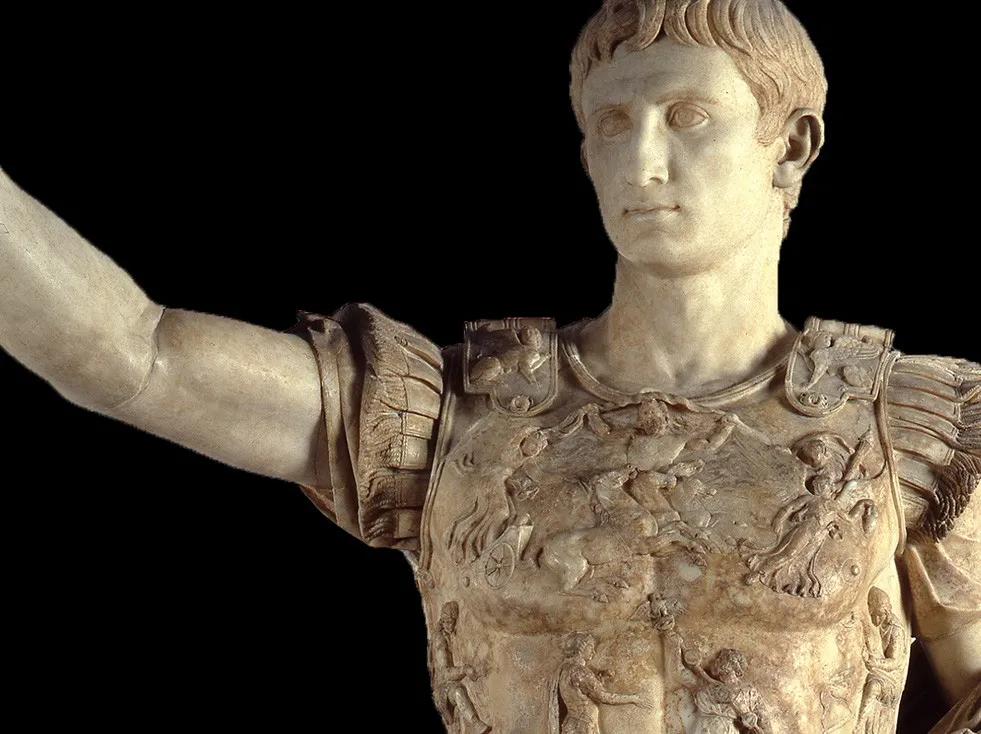
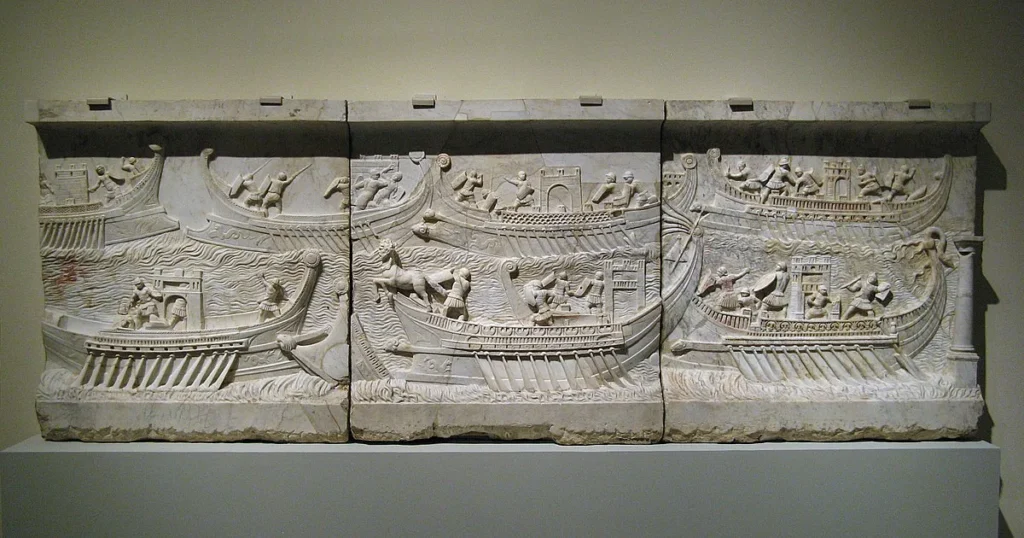
Later artists worked with that inherited image. A seventeenth-century painting of the sea battle by Lorenzo Castro, now held by Royal Museums Greenwich, represents its violence but cannot serve as an archaeological record of Roman naval construction. Some surviving Roman reliefs commemorating Actium have themselves undergone substantial restoration. These works illuminate the long history of representing the battle, but their details cannot prove the fleets’ formations, speeds or exact weapons in 31 BCE.
What really decided the Battle of Actium?
By 2 September, the previous months of fighting had put Antony at a serious disadvantage. Agrippa’s capture of ports and attacks on supply lines had made it harder to feed Antony’s forces, while crew shortages and defections weakened them further. At sea, Octavian’s commanders used the manoeuvrability of their vessels to challenge Antony’s heavily armed ships. Cleopatra and Antony escaped, but their departure did not save the main fleet or the army left in Greece. Octavian secured the surrender of that army after his naval victory. Taken together, these events explain why Antony could no longer match his rival’s military power.
Antony’s original intention remains uncertain. A commander seeking to win outright abandoned forces that might otherwise have continued fighting; a commander planning to break through saved part of his fleet and the Egyptian queen but sacrificed much of the strength needed to wage another campaign. Either interpretation leads to the same result. Octavian emerged from Actium with the resources and troops to finish the war, while Antony returned to Egypt without the forces that had sustained his challenge. The battle gave the future Augustus his decisive advantage, although the outcome had been taking shape throughout the preceding campaign.