
In the third century BCE, a Ptolemaic queen made a vow: if her husband came home safely from war, she would cut off her hair and dedicate it to the gods. Ptolemy III returned from the Third Syrian War. Berenice II kept her promise, and the lock was laid in a coastal temple associated with the deified queen Arsinoe. The following morning it was gone. The court astronomer Conon of Samos (a mathematician of genuine standing, not a flatterer) pointed at a faint spray of stars near Leo and Boötes and announced that the gods had accepted the offering. The constellation we now call Coma Berenices, Berenice’s Hair, still carries her name in every star atlas ever printed. More than a century later, the Roman poet Catullus translated a Greek court poem about the Lock of Berenice into Latin elegiacs and gave the story a second life as one of the most technically accomplished short poems in the Western tradition. This post traces how a haircut became a miracle, a miracle became a poem, and why both still matter to anyone who has ever looked at a faint patch of sky and wanted it to mean something.
Why a queen’s hair was never just personal
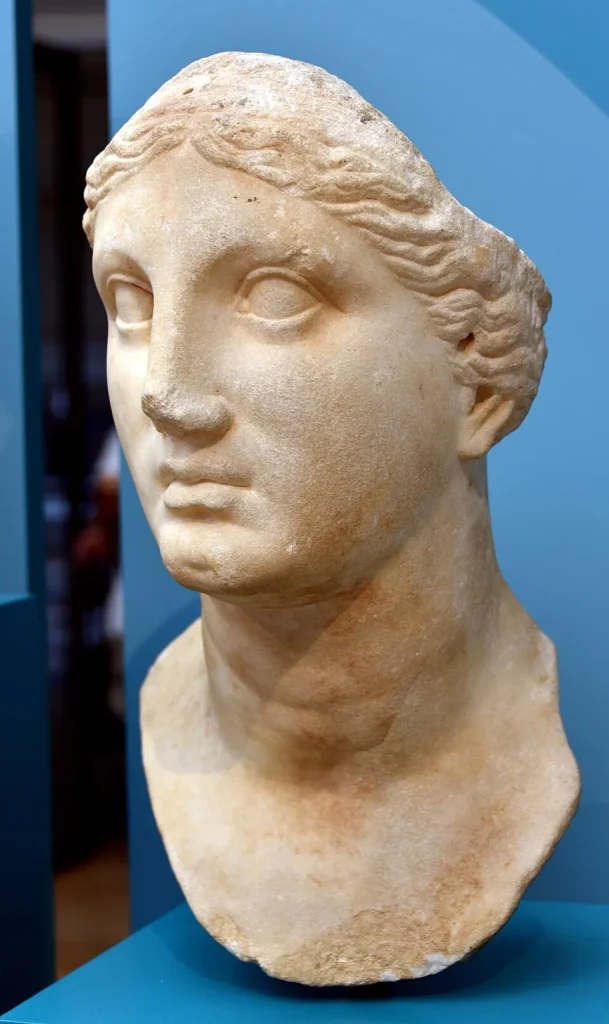
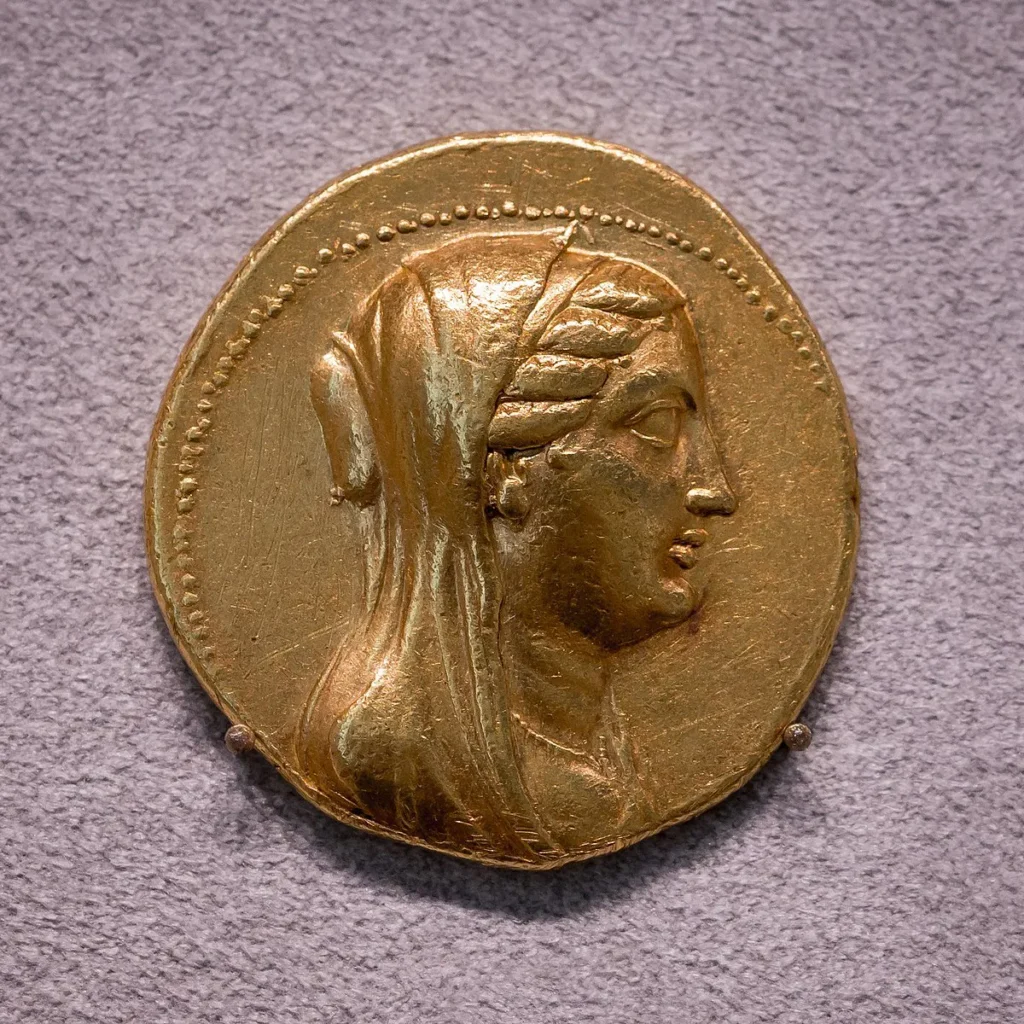
Berenice II was not simply a royal wife making a private bargain with a goddess. In the Ptolemaic court, the bodies of ruling women were instruments of policy. Queens appeared on coins, received divine cult in temples, and were publicly associated with goddesses whose protection extended over sea lanes, harvests, and the fate of armies in the field. When Berenice vowed her hair for the safe return of Ptolemy III, the gesture was simultaneously intimate and political: a promise that touched the queen’s own body made the kingdom’s survival a personal transaction between the ruling house and the divine order. Hair was not incidental to this. Braided, perfumed, crowned, and displayed in every official appearance, it was the most visible component of a Ptolemaic queen’s public identity. To cut it off was to deposit a piece of the visible self into the hands of a goddess who could convert it into safety, victory, or glory.
The dedication was made at a sanctuary on the Zephyrium headland near Alexandria, associated with Arsinoe II, Berenice’s Ptolemaic predecessor, worshipped there under the name Arsinoe-Aphrodite. The choice of location was deliberate. Arsinoe was a model of Ptolemaic queenly power, a woman who had been both mortal and divine, whose sanctuary faced the sea across which Ptolemy III had sailed. To place the offering there was to place Berenice’s vow inside a lineage of royal piety stretching back a generation, and to ask Arsinoe-Aphrodite to protect the same waters that had carried the king away. When the lock vanished the following morning, Conon’s identification of the new asterism was the perfect completion of the political theatre the vow itself had staged.
Conon of Samos and the astronomer as royal storyteller
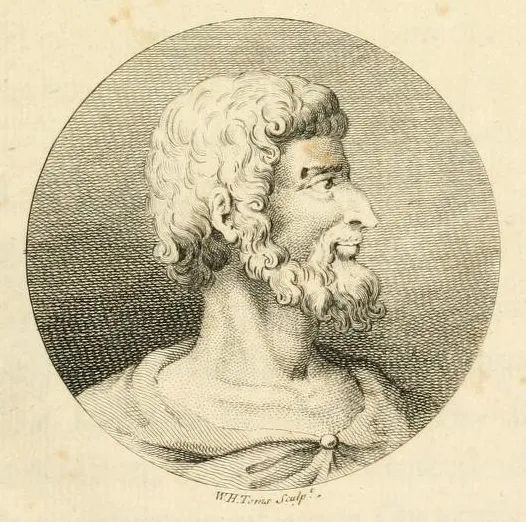
Conon of Samos was a working mathematician and astronomer at the Ptolemaic court, a colleague of Archimedes, who praised his abilities in letters that survive. He was not a court flatterer who happened to know the sky. He was a scientist of the first rank in an institution, the Mouseion and Library of Alexandria, that invested seriously in astronomical observation and mathematical theory. When Conon identified the faint spray of stars near Leo and Boötes as Berenice’s Hair, he was doing exactly what court astronomers at Alexandria were uniquely positioned to do: lending the weight of rational, credentialed knowledge to a story the court needed told. In a culture that read celestial phenomena as indicators of divine attention, a scientist who certified a new asterism was not simply complimenting the queen. He was providing rational authentication for the claim that the gods had accepted her sacrifice.
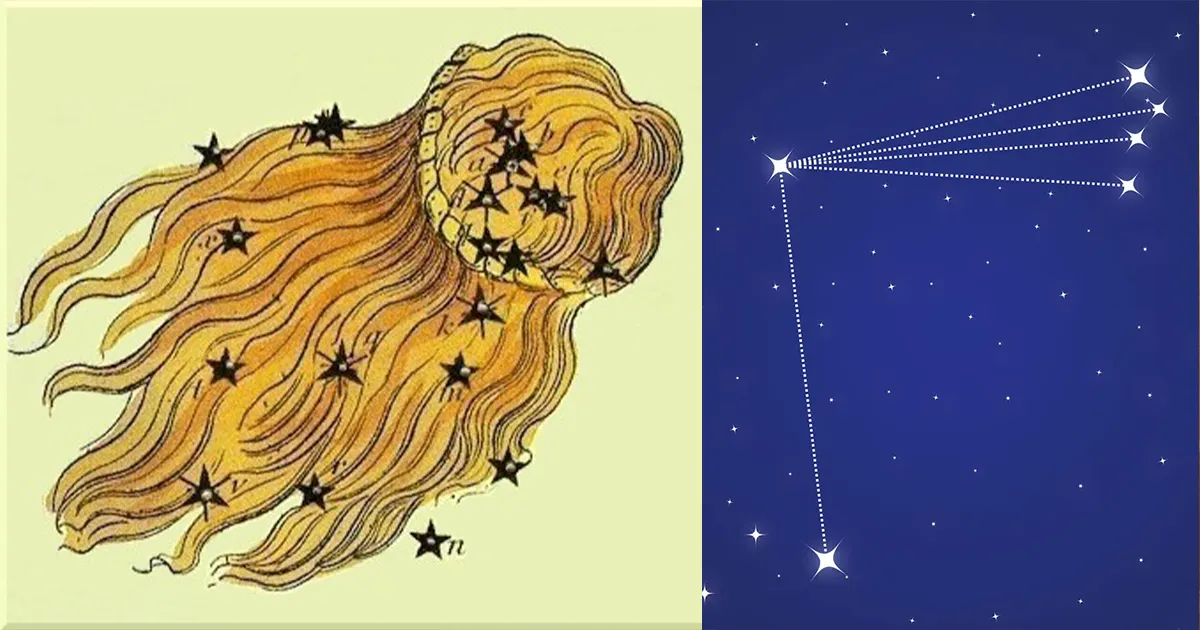
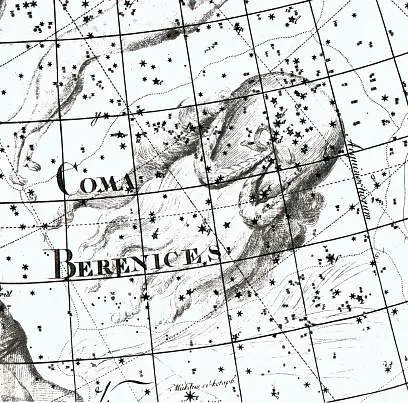
The asterism itself is real. The group of stars later formalised as Coma Berenices lies between Leo and Boötes in the northern spring sky, a loose, hazy patch best seen from dark sites, dominated by an open star cluster at roughly 280 light-years’ distance. In the second century CE the astronomer Claudius Ptolemy still listed these stars among those of Leo in his Almagest. The constellation’s independent formal status grew during the Renaissance, when globe-makers including Caspar Vopel began depicting it as a distinct figure around 1536. The International Astronomical Union recognised Coma Berenices as one of the 88 modern constellations in 1930. The name that Conon gave to a faint patch of sky in the third century BCE has outlasted the dynasty that commissioned it, the language in which it was first announced, and every political system that has governed Egypt since.
What Callimachus made of it, and why Catullus cared
The Greek court poet Callimachus of Cyrene, working at the Library of Alexandria roughly between 270 and 240 BCE, included a poem about the Lock of Berenice in his Aetia, a collection of poems about origins and causes. The Aetia was the defining work of Alexandrian aesthetic taste: learned, compressed, polished, and self-consciously anti-epic. Callimachus is the poet most associated with the dictum that a large book is a large evil. Meaning that poetic greatness resides in precision and selectivity rather than in scale. The Lock of Berenice poem is a perfect expression of that aesthetic. It takes an episode from the political life of the current ruling house, frames it through astronomical and mythological learning, and compresses the entire narrative into elegiac couplets that make the miniature feel monumental. The original Greek survives only in fragments preserved on papyrus, but enough remains to confirm that Catullus, writing in the 50s BCE, was working closely from the Greek text rather than freely reimagining it.
Catullus belonged to the circle the Romans called the neoterics, the new poets, who in the mid-first century BCE were transforming Roman literary culture by insisting on Alexandrian standards of polish, compression, and learned allusion against the older tradition of heroic verse. For this audience, a translation of Callimachus was a manifesto as much as a poem. Stephanie West, in her 1985 article on Catullus 66 published in Classical Quarterly, examined the points at which Catullus departs from Callimachus deliberately, arguing that the Roman poet was not simply translating but actively interpreting — making choices about emotional temperature and erotic directness that go beyond what the political occasion of the Greek original required. Those choices are what make the Latin poem worth reading independently, rather than merely as evidence for the lost Greek.
Built out of a love for history, kept free from distractions.
Spoken Past is an independent project shaped by curiosity, care, and long hours of research. Reader support helps keep it maintained, carefully researched, and open to everyone.
The Lock of Berenice speaks: personification as political device
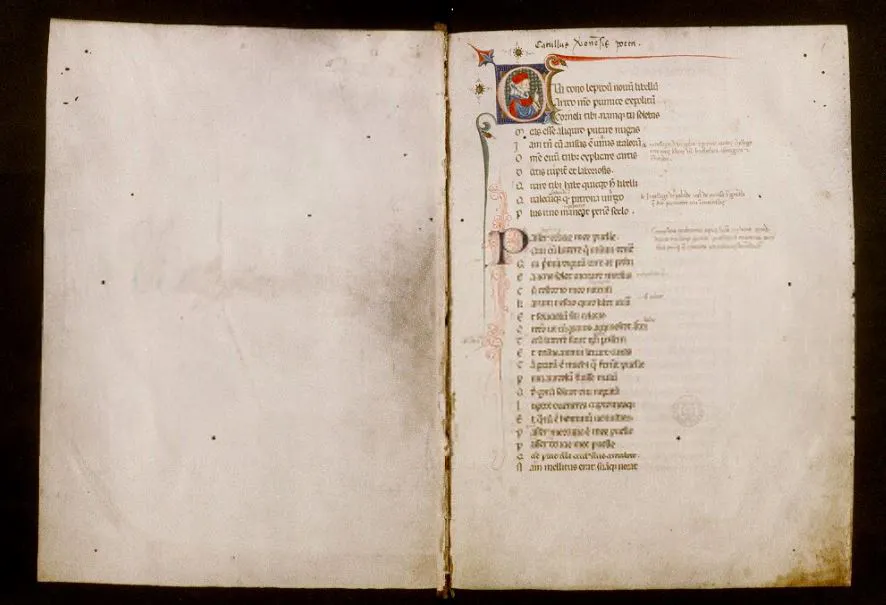
Catullus’s Poem 66 is one of the strangest poems in the Latin corpus in a way that is easy to miss on first reading: the speaker is the lock itself. The hair narrates its own story in the first person across 94 lines of elegiac couplets. It knows the weight of the queen’s head and the scent of the royal oil in which it was dressed. It identifies Conon as the astronomer who certified its ascent. It addresses Arsinoe-Aphrodite to account for its origins. It turns to Berenice in a passage of unusual erotic warmth, praising her conjugal fidelity in terms that are both politically appropriate and genuinely tender. And at the poem’s close it addresses women directly, instructing them to offer it perfumes as long as their marriages are happy, and withholding the blessing from those who are unfaithful.
The device of the speaking object had a tradition in Latin literature, cups, tablets, doors, and thresholds were given voices in Roman poetry. The device works here for a specific political reason. A queen cannot preach her own virtue without appearing immodest. A lock that testifies to the queen’s piety, fidelity, and love for her husband performs all the work of a royal proclamation in the register of intimate, domestic speech. That combination (the ceremonial and the personal delivered through a single small object) is the technical genius of the poem’s construction, and Catullus exploits it fully. The poem in which a lock praises a queen’s conjugal fidelity was also written by a poet whose own love poetry is full of infidelity, obsession, and loss. Whether the irony was deliberate is impossible to establish. What is clear is that Catullus brought to Callimachus’s court poem an emotional temperature the political occasion did not strictly require, and that temperature is what makes it worth reading today.
How elegiac couplets carry epic weight in miniature
Catullus writes Poem 66 in elegiac couplets, the alternating hexameter and pentameter lines that Roman poets associated primarily with love poetry and personal narrative. The choice of metre is not incidental. It signals to a Roman reader that what follows will be intimate and compressed rather than grand and expansive in the Homeric manner. And yet the content is in every other respect epic in character: a named historical figure, a divine vow, a miraculous event, an astronomical discovery, and an extended address to Aphrodite. Catullus is simultaneously writing a love poem and an origin story for a constellation, a court poem and a mythological narrative, a work of learned Alexandrian poetics delivered at Roman lyric speed. The elegiac metre keeps all of these registers from tipping into pomposity. Every time the hexameter line builds toward something grand, the pentameter line pulls it back to the scale of a private, domestic moment.
Peter Green, in his 2005 translation of Catullus for the University of California Press, noted that what makes Poem 66 unusual even within Catullus’s own corpus is the density of named reference it manages without becoming a catalogue. Conon, Arsinoe, Berenice, Ptolemy, Zephyrium, Leo, Boötes, and multiple divinities all appear within ninety-four lines, and every proper noun is doing at least two kinds of work: grounding the poem in a specific historical and geographical reality while simultaneously activating a chain of mythological and political associations that enrich the emotional register of the surrounding lines. C.J. Fordyce’s 1961 Oxford University Press commentary on Catullus, still a standard reference, describes this quality as Alexandrian technique delivered with Roman economy. The best summary of what is happening in the poem that criticism has produced.
The politics beneath the perfume
Reading Poem 66 as purely literary is a choice, but not a neutral one. The poem was born in a political context and the political content is present on every page, handled with such elegance that it does not announce itself as propaganda while performing every function that propaganda is designed to perform. The lock certifies that Berenice kept her vow, which certifies that the ruling house honours its commitments to the gods. It certifies that the queen’s love for her husband was genuine and her fidelity absolute, which certifies that the royal succession is unimpeachable. It certifies that the gods responded by elevating the offering to the sky, which certifies that the divine order approves of the Ptolemaic house. And it certifies that Conon (a named scientist of genuine reputation) witnessed the divine response, providing rational, observable evidence for an audience that might otherwise find the miracle convenient.
What Callimachus understood was how to make political content feel emotionally true. What Catullus understood was how to make Greek political content feel Roman and personal simultaneously. The lock’s voice is intimate enough that you forget, for stretches, that you are reading royal self-promotion. That forgetting is the poem’s highest technical achievement. A queen’s vow becomes a love story becomes a star, and by the time the lock addresses you directly and tells you to offer it perfume, you have already accepted all of the political premises on which the poem’s entire world depends.
How to find Berenice’s Hair in the night sky
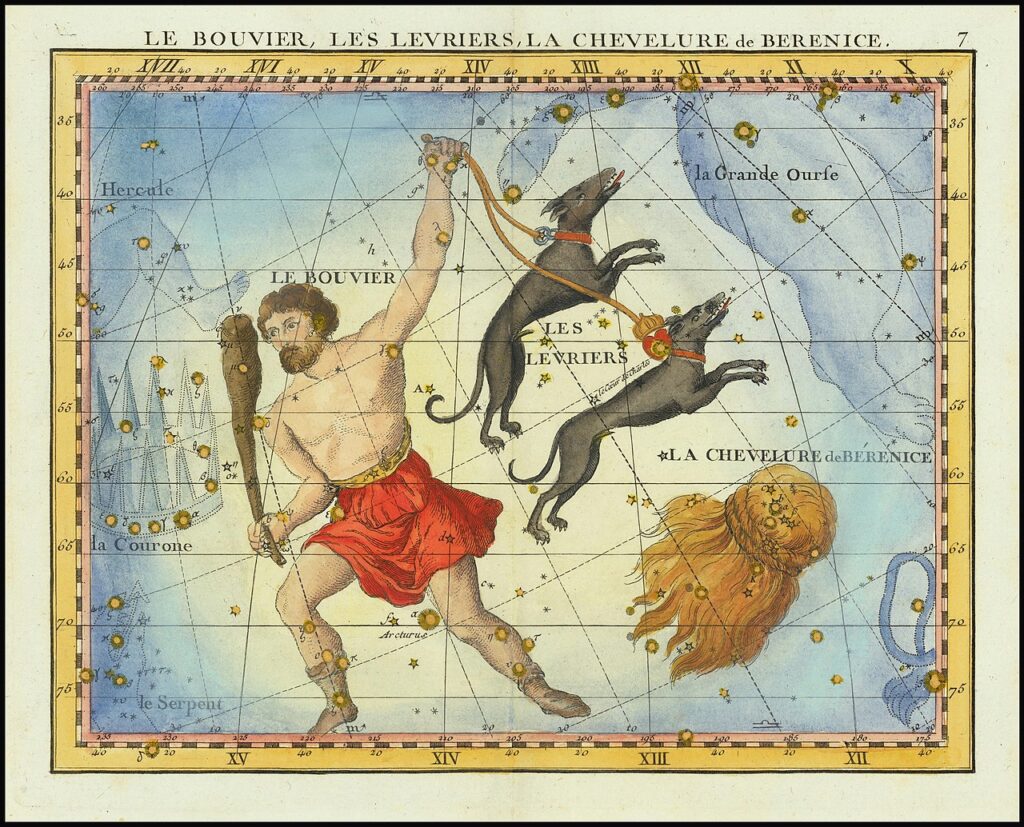
Coma Berenices has no stars brighter than magnitude 4.3, which means it requires relatively dark skies and a patient eye. From a dark site on a spring evening, it appears as a loose, hazy patch between the tail of Leo to the west and the bright star Arcturus in Boötes to the east. If you draw a line from Arcturus toward Leo’s tail and stop halfway, you are looking at it. The faintness is part of what made it plausible as the destination for a queen’s offering: it is there if you look, but you must want to see it. Johann Bode’s 1801 Uranographia, one of the great star atlases of the pre-photographic era, draws the constellation explicitly as flowing hair. The ancient metaphor made literal in copper engraving and preserved in every subsequent atlas that has taken it up.
The name that Conon gave to that faint patch of sky in the third century BCE has outlasted the dynasty that commissioned it, the language in which it was first announced, and every political system that has governed Egypt since. The poem that Callimachus wrote about it, and that Catullus translated into Latin, survived the collapse of both the Ptolemaic court and the Roman Republic that destroyed it. A lock of hair is still in the sky. That is an unusually good return on a single vow.
Primary sources: Catullus, Poem 66, Latin text with facing translation at Poetry in Translation; Callimachus, Aetia fragments, ed. and trans. Susan A. Stephens, Cambridge Greek and Latin Classics, Cambridge University Press, 2015. Secondary sources: Stephanie West, “Venus Observed? A Note on Callimachus, Fr. 110,” Classical Quarterly, Vol. 35, No. 1, 1985; C.J. Fordyce, Catullus: A Commentary, Oxford University Press, 1961; Peter Green, trans., The Poems of Catullus, University of California Press, 2005; Kathryn Gutzwiller, A Guide to Hellenistic Literature, Blackwell, 2007.