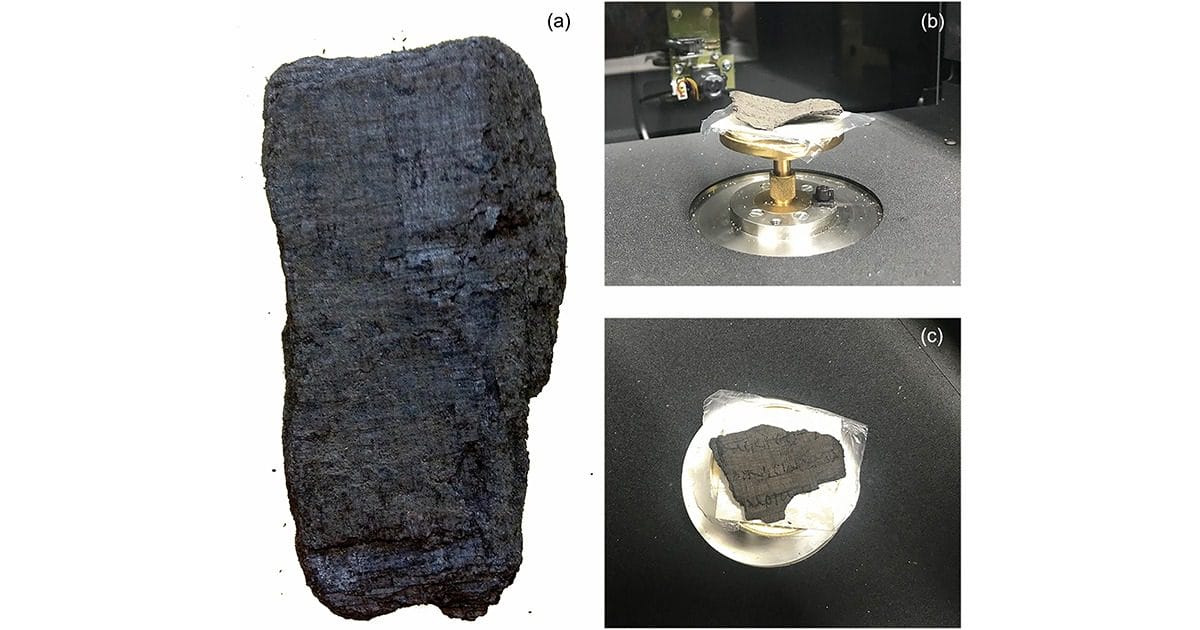
On the afternoon of 24 August 79 CE, the pyroclastic surge that had already buried Pompeii swept northwest along the Bay of Naples and engulfed the seaside town of Herculaneum. The heat of the volcanic material at ground level exceeded 300 degrees Celsius in the first wave, according to volcanological studies of the deposits conducted at the site since the 1980s. Wood burned. Metals bent. And in an elegant two-storey villa at the edge of town, almost certainly the property of Lucius Calpurnius Piso Caesoninus, Julius Caesar’s father-in-law, a library of papyrus scrolls was baked into the consistency of charcoal. The Herculaneum scrolls that emerged from that event are the only intact ancient library to survive from the classical world. They were discovered in 1752, sat unread for nearly three centuries, and defeated every attempt to open them without destroying them. Then, between 2023 and 2025, a combination of micro-CT imaging, artificial intelligence, and open scientific competition produced a transformation in their decipherment that no papyrologist alive in 1990 would have thought possible. This article explains the technology, the breakthroughs, and what the scrolls are now beginning to say.
The Herculaneum Scrolls and the Villa of the Papyri
The Villa of the Papyri was excavated not by archaeologists but by tunnellers working for the King of Naples. Beginning in 1750, teams of workers drove horizontal shafts through the hardened volcanic deposits at the site, following walls by touch in near-complete darkness and removing objects by feel. The villa they uncovered was extraordinary: it contained more than 90 marble and bronze sculptures, including the famous Drunken Satyr and the Seated Hermes now in the National Archaeological Museum of Naples, as well as hundreds of papyrus scrolls packed into shelving units and wooden cases. The majority of the scrolls were retrieved between 1752 and 1754, though excavations continued intermittently through the nineteenth century and the villa remains only partially excavated today.
The scroll count has never been precisely settled. Estimates range from about 1,000 to 1,785 distinct items when fragments are included, though many of those are themselves portions of larger rolls that broke apart during the eruption or during retrieval. The majority of the collection went to the Royal Library at the Palazzo Reale in Portici, then later to the Biblioteca Nazionale in Naples, where most of it remains. Smaller groups were gifted or sold to other institutions: three scrolls went to the Bodleian Libraries at Oxford, a handful to the Institut de France in Paris, and some fragments to the British Library in London.
The contents of the scrolls that could be read through conventional means turned out to be overwhelmingly philosophical: Greek texts, predominantly works of and commentaries on Epicurean philosophy. Philodemus of Gadara, a poet and Epicurean philosopher who lived in the first century BCE and spent time at precisely the kind of elite Roman villa the site represents, is the author most frequently identified in the legible portions. His works address pleasure, perception, music, poetics, rhetoric, and the gods. The library appears to have been a working philosophical resource, a private institution for the serious intellectual life of its owner rather than a display collection.
The question of what the unread scrolls contain is tantalising. Most Epicurean texts have been lost entirely. What we know of Epicurus himself comes largely through Diogenes Laertius, writing centuries after the philosopher’s death, and through brief quotations in other authors. If the sealed scrolls contain works by Epicurus directly, or major texts by his close successors, or works from entirely different philosophical schools that happened to be in the villa’s collection, the intellectual history of antiquity would need to be substantially revised. Richard Janko, a distinguished professor of classical studies at the University of Michigan, has described the potential of the collection in exactly those terms: not improvement at the margins but possible rewriting of the history of ancient thought.
Why Two Centuries of Attempts Failed
The physical state of the scrolls explains the problem precisely. The pyroclastic material that preserved them also carbonised them. A Herculaneum scroll does not look like a book or a document. It looks like a log of charcoal in roughly cylindrical form, dark brown to black throughout, with a texture that crumbles when handled. The layers of papyrus have been fused together by the carbonisation process, and the carbon ink with which the text was written is chemically similar to the carbonised papyrus itself. There is no colour difference between text and background that the eye or a standard X-ray can detect.
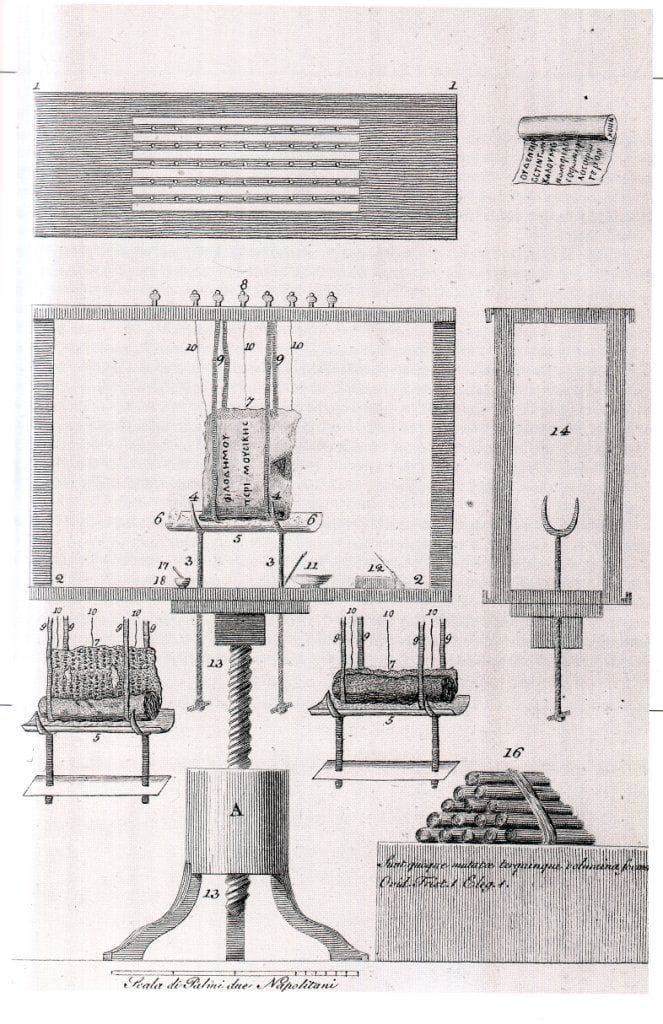
Early attempts to read the scrolls involved literally cutting them apart or slowly peeling away layers. Father Antonio Piaggio, a Vatican librarian sent to Naples in 1753, spent years constructing a device of silk threads and weights that could incrementally unroll portions of the more pliable scrolls by applying constant gentle tension. His machine, now preserved in Naples, successfully retrieved partial texts from some of the less fragile specimens over decades of painstaking effort. But the process was extraordinarily slow, required ideal conditions for each scroll, and destroyed any specimen too brittle to survive the unrolling. Many of the scrolls were lost to Piaggio’s machine and similar efforts. By the late nineteenth century, the academic community had largely accepted that the sealed scrolls would remain unread.
The twentieth century brought X-ray imaging. But early X-ray methods separate materials by density, and carbon ink on carbon papyrus produces no useful density contrast. Multispectral imaging worked on some of the partially opened fragments where text was already visible at the surface, but it offered nothing for sealed rolls. Computed tomography (CT) scanning, which produces three-dimensional volumetric images of the interior of an object, revealed the internal structure of the scrolls in extraordinary detail: every compressed layer, every crack, every pocket where volcanic gases had pushed layers apart. Yet the text remained invisible. Seeing the structure of the scroll was not the same as reading what was written on it.
Virtual Unwrapping: Brent Seales and the Technique That Changed Everything
The decisive insight came from a computer scientist who had been working on the problem of damaged manuscripts for over two decades. Brent Seales, the Alumni Professor of Computer Science at the University of Kentucky and founder of EduceLab, a heritage science laboratory established with a $14 million National Science Foundation infrastructure grant, had spent years developing what he called virtual unwrapping: a computational pipeline that takes a CT volume of a rolled or folded document and mathematically models the surfaces within it, as though the sheet of papyrus were a three-dimensional shape floating in space rather than a physical object to be touched. His software, Volume Cartographer, identifies the internal geometry of a scroll layer by layer, maps it as a surface, and then unfolds that surface into a flat two-dimensional image, without cutting or touching anything.
In 2015, Seales and his team proved the concept definitively by using virtual unwrapping on the En-Gedi scroll, a severely damaged Hebrew manuscript found in 1970 in a storage room at the ancient synagogue of Ein Gedi in Israel. The scroll had been reduced to a compact block of carbonised material and had been held in storage for decades, considered permanently unreadable. Seales’s pipeline revealed it to be the beginning of Leviticus, in a text now identified as one of the oldest Hebrew biblical manuscripts outside the Dead Sea Scrolls. The methods worked. The question was whether they could be extended to the very different problem of carbon ink on carbon papyrus.
The carbon ink problem was the central obstacle. Standard CT imaging detects tissue or material by how strongly it absorbs X-rays, which depends on density. Carbon ink and carbonised papyrus fibres have similar densities. But Seales and his team, working with increasingly high-resolution scanning equipment, noticed that ink leaves a subtle physical trace on papyrus beyond its chemical composition. When ink was applied to a sheet of papyrus in antiquity, it sat on top of the fibres and altered the micro-texture of the surface. In the volumetric data from a CT scan, this alteration produced a tiny, consistent signal in the geometry of the fibre layer: not a density difference but a shape difference. A machine learning model trained on fragments where ink was already visible at the surface could then learn to recognise this geometric signature and flag it in the sealed portions of the same scroll.
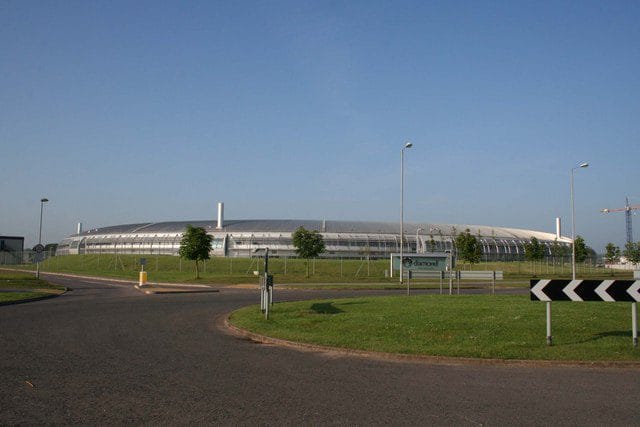
The Oxford scroll PHerc. 172 proved particularly valuable for this method because of an anomaly in its ink. When scanned at the Diamond Light Source synchrotron at the Harwell Science and Innovation Campus in Oxfordshire in July 2024, the ink on PHerc. 172 showed greater contrast than any previously scanned Herculaneum scroll. Diamond Light Source operates the I12 beamline, a high-energy X-ray instrument running at photon energies between 53 and 150 keV, significantly more powerful than hospital CT scanners, and capable of resolving features at the micron scale within a sealed carbonised object. The Diamond team and the Vesuvius Challenge researchers believe the ink on PHerc. 172 may contain trace amounts of a denser material, possibly a lead-based compound, that makes it more visible in high-energy X-rays than the purely carbon-based inks used on other scrolls.
Built out of a love for history, kept free from distractions.
Spoken Past is an independent project shaped by curiosity, care, and long hours of research. Reader support helps keep it maintained, carefully researched, and open to everyone.
The Vesuvius Challenge and the Power of Open Competition
In March 2023, Seales partnered with Silicon Valley entrepreneurs Nat Friedman and Daniel Gross to launch the Vesuvius Challenge: a global open competition offering more than one million dollars in prize money for measurable progress in reading the sealed scrolls. Seales and his team released thousands of high-resolution CT scan volumes of two complete scrolls and four fragments from the Institut de France collection, along with the Volume Cartographer software and extensive documentation of the virtual unwrapping pipeline. Anyone in the world with suitable computing resources and skills could attempt the problem.
The competition attracted over 1,000 competing teams. The crucial strategic insight behind the open release was that the problem of ink detection in carbon-on-carbon papyrus was, at its core, a machine learning challenge that would benefit enormously from many different approaches tried in parallel. Seales’s team had done the foundational work and built the pipeline, but the specific problem of training a neural network to recognise the micro-textural signature of ancient Greek letterforms in a CT volume was exactly the kind of task where competitive diversity produces rapid refinement. Different teams tried different model architectures, different training strategies, and different methods of handling the noise and distortion inherent in scanning a 2,000-year-old charcoal cylinder.
By August 2023, six months after the competition launched, contestants Luke Farritor, then a 21-year-old computer science student from Nebraska working as a SpaceX intern, and Youssef Nader, a biorobotics graduate student in Berlin, had each independently identified the same Greek word from within a sealed, never-opened scroll. The word was πορφύραc: purple, or more precisely, clothes of purple dye. Farritor won the first letters prize of $40,000. Nader placed second. Julian Schilliger, a robotics student from Zurich who had also won multiple progress prizes for improving the segmentation software, joined them to form the grand prize team. In February 2024, the Vesuvius Challenge organisers announced that the three students had successfully identified over 2,000 Greek letters from within the scroll, meeting the competition’s threshold of recovering four legible passages of at least 140 characters each. They shared a grand prize of $700,000.
The significance of the competition model extended beyond the prize. By releasing the data publicly and requiring winning contestants to publish their methods and code, the competition built a cumulative shared knowledge base. Every improvement in segmentation or ink detection was available to the next team that tried the problem. The National Endowment for the Humanities, which had funded critical stages of Seales’s foundational work, noted that the competition demonstrated how open data and modest prize funding could accelerate years of careful technical research into months. The collaboration between computer vision specialists and papyrologists that the competition forced into existence is itself a scholarly product that will outlast any individual finding.
PHerc. 172 and the Oxford Breakthrough
The most recent and arguably most significant breakthrough as of early 2025 came not from the Institut de France scrolls that had been the competition’s original focus, but from a scroll that had been sitting in an Oxford library for nearly two centuries. PHerc. 172, one of three Herculaneum papyri in the Bodleian Libraries’ collection at the University of Oxford, was donated in the early nineteenth century by Ferdinand IV, King of Naples. It had been examined, catalogued, and found essentially illegible by conventional means. It was not considered a priority for study.
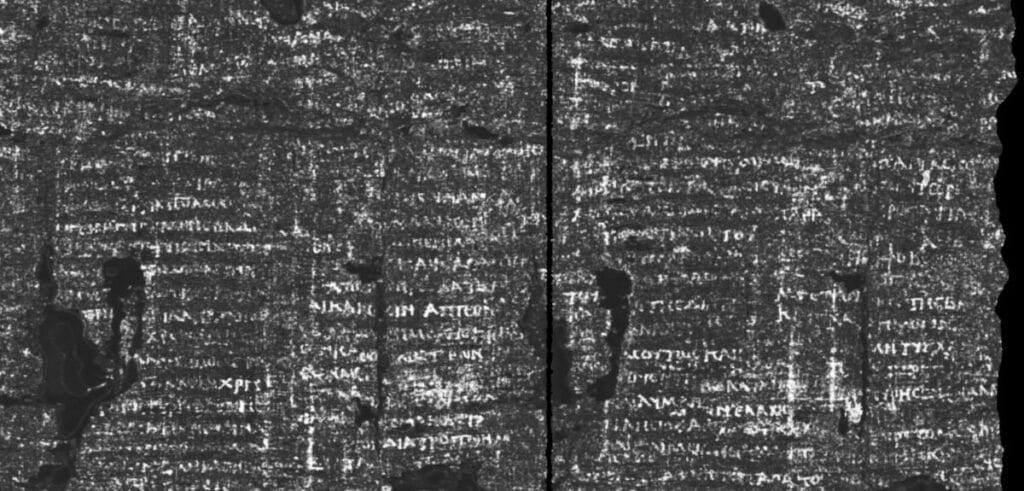
When the Bodleian and the Vesuvius Challenge team arranged for PHerc. 172 to be scanned on Diamond Light Source’s I12 beamline in July 2024, the results were immediately different from anything seen before. The ink signal in the high-energy scan was strong enough to be processed with existing AI models almost directly, without the weeks of model refinement that other scrolls had required. The Vesuvius Challenge team, working with AI tools developed during the 2023 and 2024 competition phases, generated a virtually unwrapped image of the interior of the scroll showing clearly legible columns of Greek text. On 5 February 2025, the University of Oxford announced the result as a historic breakthrough: the first image of the inside of PHerc. 172, seen for the first time since 79 CE.
The words deciphered from the initial image included διατροπή (disgust), ἀδιάληπτος (foolish or unceasing), φοβ (fear), and βίου (life). Federica Nicolardi, assistant professor of papyrology at the Università degli Studi di Napoli Federico II and one of the leading papyrologists working on the collection, confirmed that the vocabulary, style, and thematic content were consistent with the works of Philodemus. The word “foolish” (ἀδιάληπτος in the sense of the morally or intellectually deficient person) is a recurring technical term in Philodemus’s Epicurean ethics. The appearance of words related to fear and disgust alongside it suggests a text engaged in the characteristically Epicurean project of analysing which emotions are rational responses to reality and which are distortions that prevent a person from living well.
Brent Seales, commenting on the result from his EduceLab at the University of Kentucky, described PHerc. 172 as containing more recoverable text than any previously scanned Herculaneum scroll. The combination of its relatively dense ink composition and the power of the Diamond I12 beamline had produced a data set that the existing AI pipeline could process more efficiently than anything before it. Researchers are continuing to refine the segmentation of the scroll’s inner layers, hoping to reach the innermost portion where the colophon, the ancient equivalent of a title page giving the work’s name and author, may be preserved intact.
What the Scrolls Actually Say, and What Comes Next
The texts deciphered so far cluster around questions of pleasure, perception, and the good life in the Epicurean tradition. The passage identified by the Vesuvius Challenge grand prize winners in 2024 discusses how the scarcity or abundance of pleasures such as food, music, and fragrance affects the degree of pleasure they produce. This is recognisable Epicurean territory: the philosophical tradition founded by Epicurus in Athens in the late fourth century BCE held that the highest good was ataraxia, a state of undisturbed mental calm achieved through moderate pleasures rather than excess or deprivation, and that the mismanagement of appetite and fear were the primary causes of human suffering. Philodemus was working through these ideas in considerable technical detail, and what the scrolls offer is a closer view of that working-through than any source currently available to scholars.
Whether the sealed scrolls contain texts from outside Epicureanism is not yet known. The library was almost certainly built around Philodemus’s own interests, and his interests were primarily Epicurean. But ancient libraries were not catalogued with the precision of modern ones, and an educated Roman patron would have expected his library to reflect intellectual breadth. Some papyrologists have proposed that an entirely separate main library may exist deeper within the villa, which has never been fully excavated. The parts of the Villa of the Papyri that have been excavated represent perhaps a third of the original structure, based on the ground-penetrating radar surveys conducted by the project managed in conjunction with the Herculaneum Conservation Project.
In July 2025, the scale of institutional commitment to the project reached a new level when Seales and a team of collaborators including Federica Nicolardi and computational scientist Vincent Christlein were awarded a European Research Council Synergy Grant of approximately 11.5 million euros, supporting the project named “UnLost: Uncovering Lost Knowledge from the Ancient Library of Herculaneum.” The six-year grant, one of the largest and most competitive in European science funding, will allow the team to apply and expand the virtual unwrapping pipeline to hundreds of carbonised scrolls across the collections at Naples, Oxford, Paris, and London, dramatically scaling what has so far been a scroll-by-scroll process into something closer to a systematic programme of library recovery.
The implications for classical scholarship are not rhetorical. More Epicurean text would allow historians to trace the development of the school’s ideas across generations in ways that cannot be done from the fragments currently available. Works by authors entirely unknown from other sources could change the picture of what ancient intellectuals were reading and debating. And the methodological precedent has already begun to extend beyond Herculaneum: Youssef Nader has noted promising results applying the Herculaneum-trained models to Egyptian papyri, and Seales has identified the carbonised scrolls found in a Byzantine church at Petra, Jordan, in 1993, and portions of the Dead Sea Scroll collection with compressed fragments, as candidates for the same pipeline. What began as an attempt to read a single ancient library is becoming a general technology for the recovery of written knowledge from extreme physical damage.
Primary sources: University of Oxford, Bodleian Libraries, “Inside of Herculaneum scroll seen for the first time in almost 2,000 years” (2025); Vesuvius Challenge competition documentation and prize announcements (2023 to 2025). Secondary sources: Diamond Light Source, “Diamond Light Source uncovers ancient text from the Oxford Herculaneum scroll” (2025); National Endowment for the Humanities, “Students Decipher 2,000-Year-Old Herculaneum Scrolls” (2024); W. Brent Seales, EduceLab, University of Kentucky; University of Kentucky Research, “UK’s Brent Seales, global team secures Europe’s top research grant to digitally decode Herculaneum scrolls” (2025).