Table of Contents
Who Pan Is In Greek Myth
Role in the Greek pantheon
Pan is the god of the wild countryside. His ground is caves, pine slopes, rocky gullies, and goat paths where herders water flocks and hunters follow tracks. He looks after herds and the people who live with them. He keeps company with mountain nymphs. He is the bright snap of reed-pipe music and the quick spark of desire.
Set him beside the better-known Olympians and the contrast is plain. Zeus rules the sky, Poseidon the sea, and Athena the city and its laws. Pan does none of that. He does not sit in a marble hall or decide wars. He shapes how people feel and act in untamed places: the alertness that keeps you safe, the ease that settles in a shaded hollow, the lift in the chest when music carries across a ridge at dusk. Ancient poets treat him as fully divine—simply not urban. He moves easily among the high gods when a story needs him: neighbor and ally to Artemis in the hunt, a ready helper in the noisy companies of Dionysus, and close in nature to Hermes, who knows every track. Pan’s power is intimate and local. He is not a distant lawgiver; he is the presence you notice on the hillside right now—the cool wind at your neck, a laugh from the thicket, a clear phrase from a pipe that changes the mood of the path you’re on.
Wild places and sudden fear
Greek storytellers say the wild has its own manners. A branch snaps where you can’t see. A rock booms somewhere up the ravine. Your heart jumps as if watched. The Greeks named that flash of unreasoning dread “panic,” after Pan. It rises fast in open country and fades just as quickly. Pan is not cruel for its own sake. He is the author of surprise in places where people are not in charge of the script.
So a hunter’s hand wobbles just as he draws the bow. A traveler quickens pace when the trail enters the pines. A girl startles, then laughs, then runs because something playful seems to tug at her sleeve. That trembling edge is Pan’s wordless voice. When people treat the place with respect—move quietly, spare the spring, leave a small gift or song—he answers with favor: calm animals, rich milk, a good rest in shade, and music when the hour calls for it. When they blunder and ignore the ways of the ground, he answers with a quick lesson in humility that sends them home wiser than they came.
Core literary sources
The earliest full portrait of Pan appears in the Homeric Hymn to Pan. It places his birth in Arcadia, sets him running with mountain nymphs, and lingers on the bright voice of his reed pipes. Later lyric and pastoral poets keep him in that world. Pindar calls on him as a bringer of song and dance. Theocritus puts him just offstage at shepherds’ singing contests, where herders beg him not to break the spell with a sudden shout. Hellenistic and later writers often fold him into the traveling retinue of Dionysus, a rolling chorus that crosses hills and islands by torchlight. Prose authors such as Pausanias note shrines and reliefs—especially in Arcadia and in the caves beneath the Athenian Acropolis—and repeat local tales about his upbringing and loves. Across these sources Pan stays remarkably consistent: a god of uplands and caves, playful and erotic, confident in music, and generous to people who respect the habits of the wild.
Names and titles of Pan
What his name suggests. Ancient writers offered two main readings of “Pan.” Some heard “all,” hinting at a presence that runs through all of nature. Others tied the name to pasture and flocks. Poets often let both ideas stand: Pan as the spirit of everything that grows and bleats, and Pan as the sum of countryside life. Either way, the name fits the figure the myths present—not a specialist of one element, but the patron of edges and borderlands where city order gives way to open country. Short hymns and dedications add plain descriptors that fix the image: swift, goat-footed, lover of pipes, cave-dweller, friend of nymphs, keeper of herds.
How people addressed him locally. In Arcadia, worshipers used practical, place-bound titles that told you exactly where and how to honor him: Pan the Herdsman, who protects pasture and knows where wolves test a fence; Pan the Goat-Tender, a surefooted guide on ledges; Pan of Mount Lykaion and Pan of Mount Mainalos, tied to specific peaks with their caves, springs, and rock shelves. These titles point to shrines a shepherd could actually reach—a stone bench for a libation of milk or a small gift of honey—and they underline a larger truth: Pan is not distant. You speak to him where the wind slips through the hollies and the trail falls quiet.
Singular Pan and the Pans
Greek sources speak both of one Pan and of many Pans. Hymns and prayers address a single god who hears requests and protects herds. Vase paintings and later stories sometimes multiply him into a small chorus of rustic spirits—miniature Pans with pipes and shaggy legs—much like satyrs. Function explains the split: when a tale needs a named deity with will and voice, Pan stands alone; when it needs a lively crowd to flank Dionysus or to fill a hillside dance, the Pans appear. The plural does not cancel the singular any more than a grove cancels the single tree at its center. It’s a poet’s way to show abundance in the countryside: many Pans for the swarm of little shocks and delights off the road, one Pan for the mind and intention behind them.
Birth and parentage traditions
Hermes and Dryope
One line makes Pan the son of Hermes and Dryope, a woodland nymph. Hermes meets her deep in the hills; their child arrives already marked by horns and hooves. Hermes, delighted, brings the newborn to the gods. The pairing fits: Hermes belongs to roads, crossings, and lucky meetings; Dryope belongs to rooted places and trees. Their child is the meeting point—track and grove in one. This lineage also explains Pan’s closeness to Hermes: the wild god borrows the messenger’s quickness and understands the speech of people who live by paths and flocks.
Hermes and Penelope
Another, deliberately provocative tradition names Penelope as Pan’s mother. Some versions keep Hermes as the father; others name Odysseus; a few even claim there were two different Penelopes to soften the shock. The point is local pride and Pan’s habit of overturning expectations. If Penelope has an Arcadian identity in these tellings, then Arcadia can claim Pan’s birth. The rumor also suits Pan’s character: he is forever unsettling neat reputations.
Other local claims
Elsewhere, storytellers adjust the family tree to fit a shrine or rite. Some call him a son of Zeus and Hybris, reading his unruly force as divine overflow. Others give him mortal or nymph mothers tied to a named spring or cave. In Arcadian towns especially, ancestry becomes a map: different lines for different places, all pointing to the same truth that Pan is native to high country and herding life. Greek myth is comfortable with variants when each illuminates a corner of the god.
How the gods received him
All versions agree about the welcome. Hermes carries the strange, charming infant to the divine gathering; laughter breaks out—not mockery, delight. The baby has a ruddy beard, tiny horns, hooves, and a cry already close to music. He is neither fully like the Olympians nor wholly other, and the blend pleases them. From the start, Pan belongs to two worlds. He can sit at a divine banquet and slip back to the mountain before the cups are empty. That double footing explains how easily he works beside Artemis and Dionysus: he knows their ways and remains the best guide to the hills they enter.
Childhood in Arcadia
Nursed by mountain nymphs
Pan’s first companions are nymphs. They bathe him in cold springs, teach him steps that suit rock and root, and fix his habits for life: approach with mischief, retreat with a laugh, keep company without trying to own it. They are not decoration; they are the local spirits that give a landscape a face. Their care turns a mountain child into the god of that mountain world. Later scenes—Pan piping while nymphs dance—echo those lessons. His music is social at its core. He plays not to dominate a stage, but to set a rhythm for a small circle of friends moving among trees and cliffs. In Pan’s case, nurses, not tutors, shaped the art.
Mount Lykaion and Mount Mainalos
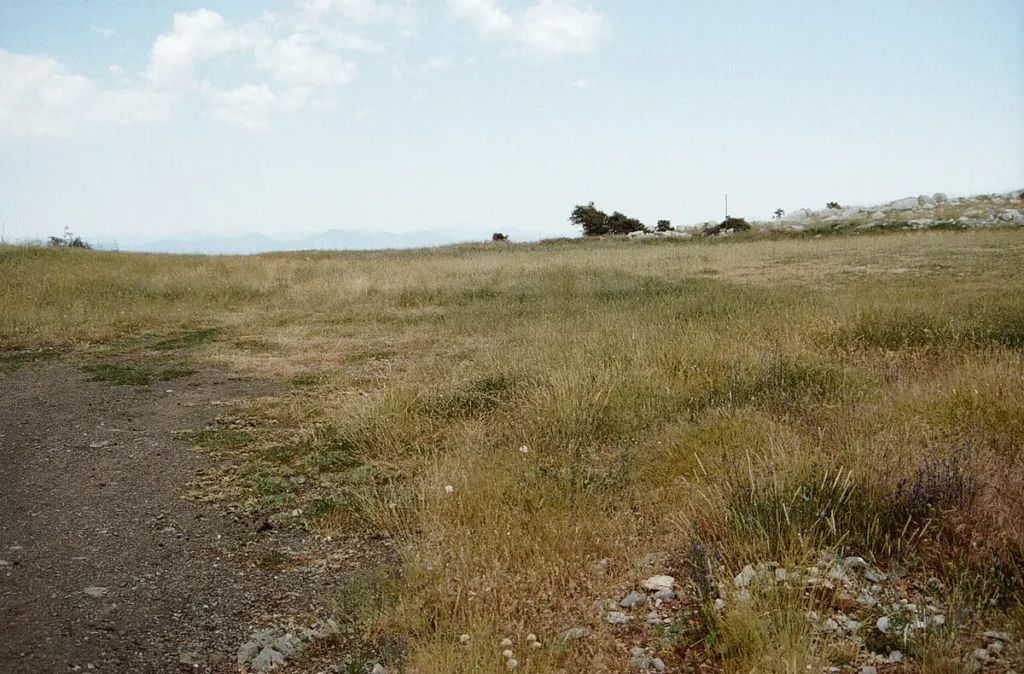
Arcadia names its mountains the way sailors name winds, and two peaks shape Pan’s early world: Mount Lykaion and Mount Mainalos. Lykaion carries old rites to Zeus on its high, clear summits where storms build. Mainalos runs long with pine and cedar, ridges that throw back shouts and the sound of pipes.
Stories put Pan’s first lessons on these heights. He learns to cross loose stone as if it were level ground. He finds cold-mouthed caves and turns them into shelter. He memorizes where springs still run in drought and which slopes hold grass when the valley is burned brown. Later worship follows that training: shrines to Pan sit on these slopes and in their caverns, and local tales picture a god who knows a shortcut no map can show.
First skills in music and hunting
Two skills define the young god: tracking and tuning. Hunting teaches patience, how to read broken twigs and hoof marks, and when to pivot fast when a hare doubles back or a boar wheels. Music teaches another patience. Reeds must be cut, measured, bound, and tuned to one another. The panpipes look simple; they are not. Together, those arts let Pan set the mood of the hills. He can feed people who live by meat and milk, then settle their nerves with a tune that moves like water. Greek myth admires gods who give more than one gift. Pan’s Arcadian schooling makes him useful and delightful at once.
Appearance and attributes
Goat legs, horns, and beard
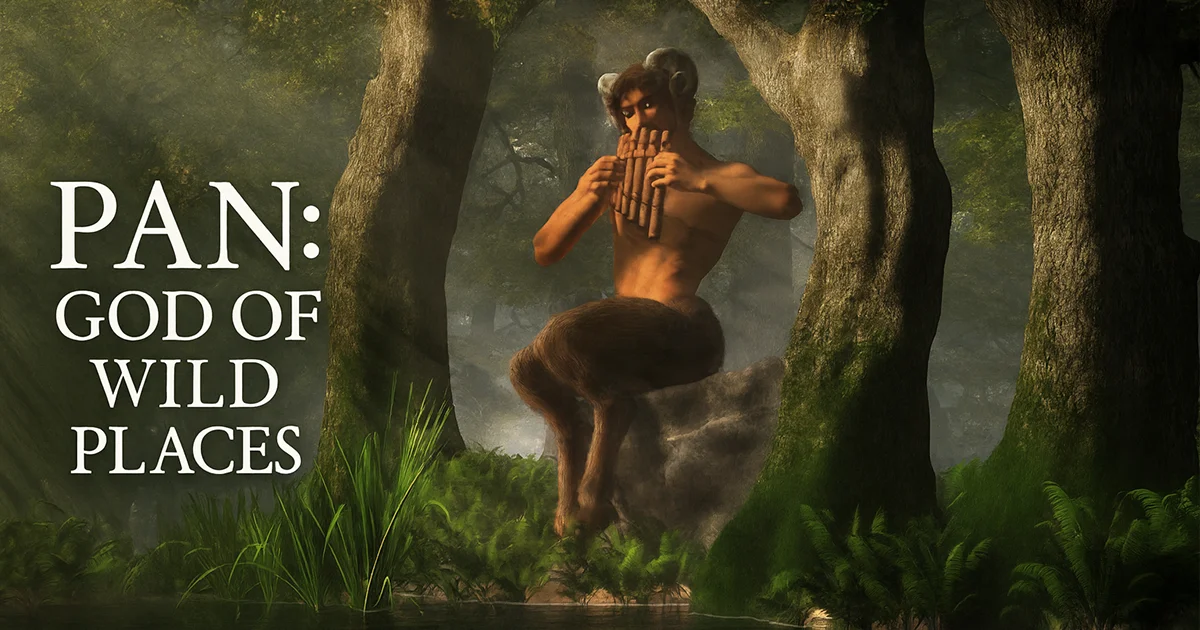
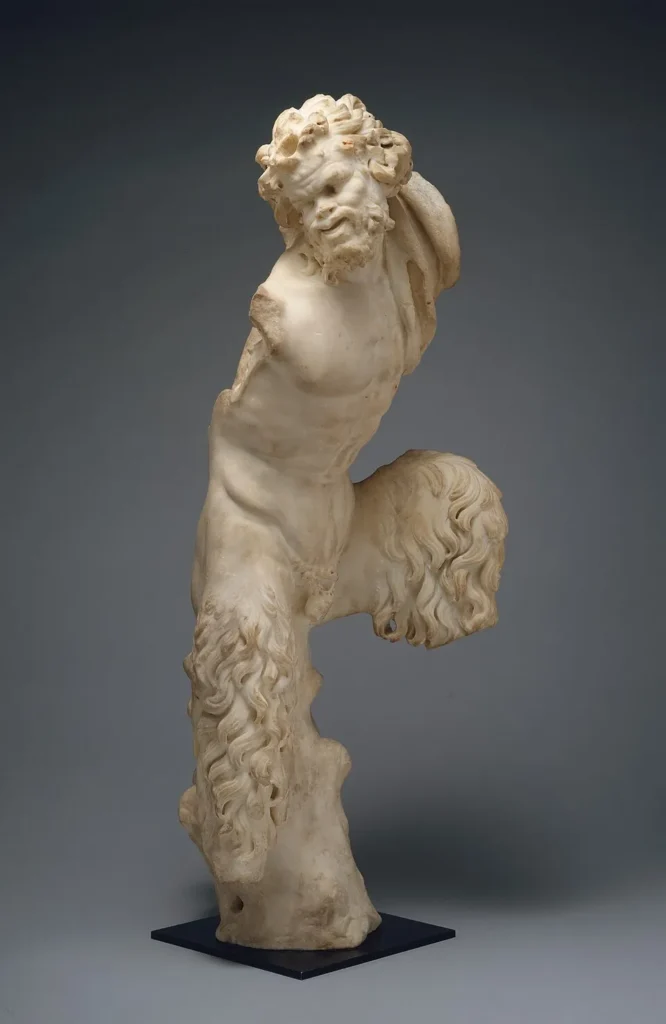
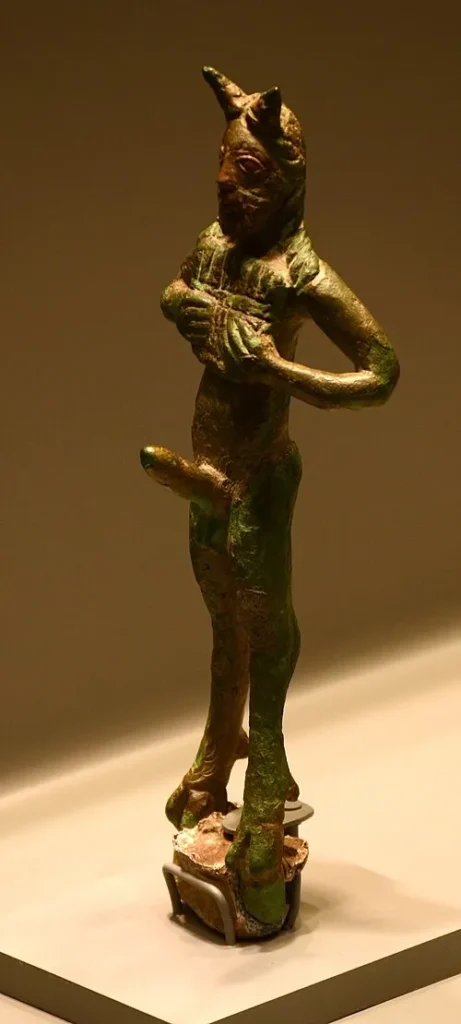
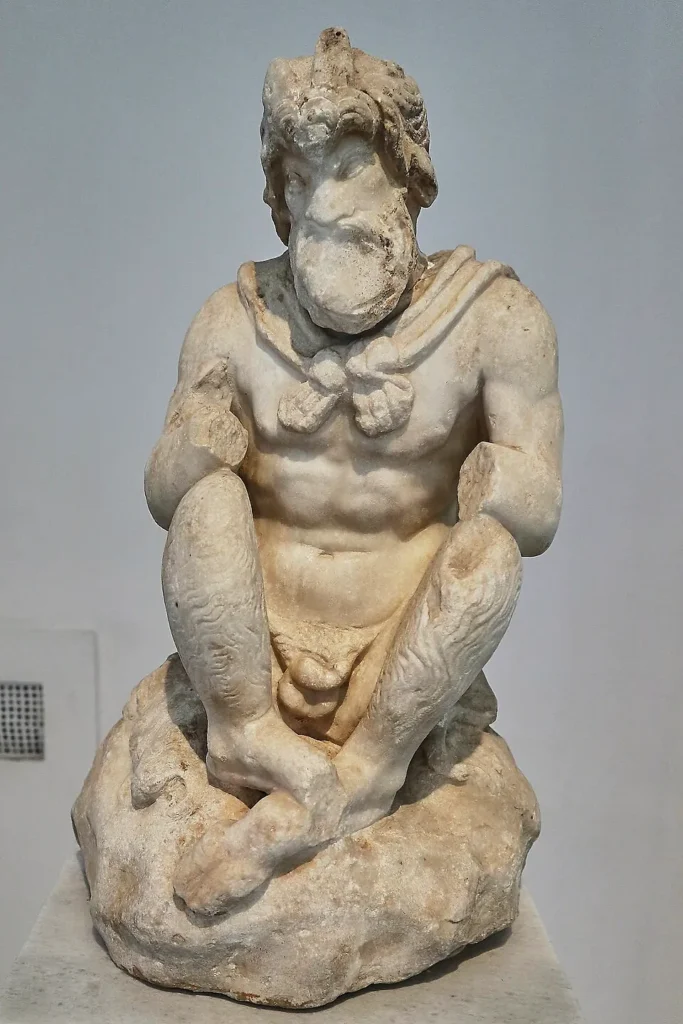
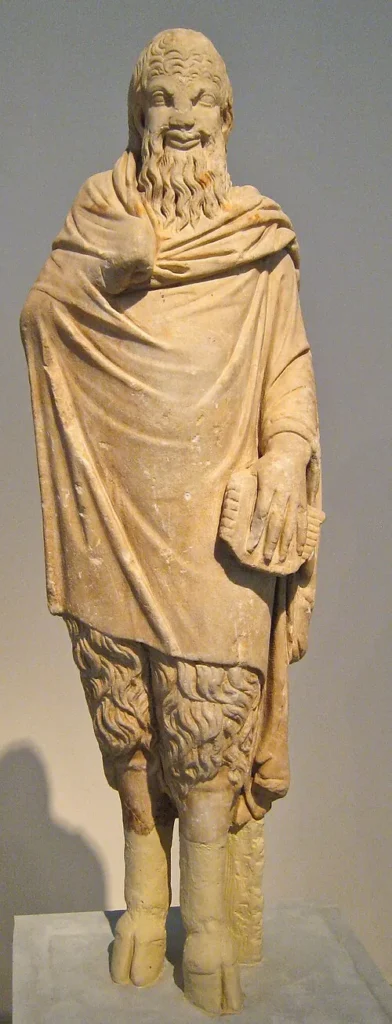
Ancient artists return to one image again and again: goat legs with cloven hooves, a strong human torso, a goat’s beard, and small horns at the temples. The face is quick—smiling, intent on a nymph, or startling an onlooker with a shout. The body makes a point. Hooves and horns suit steep, rough country. The human chest and face let him speak with gods and mortals. Satyrs share parts of this look, but Pan is tighter and more practical—less riotous, more at home with herds. Add a kid-skin over the shoulder, a small pouch, or a crook, and the message sharpens: this is the god of working nature, half wild and half neighbor.
The panpipes
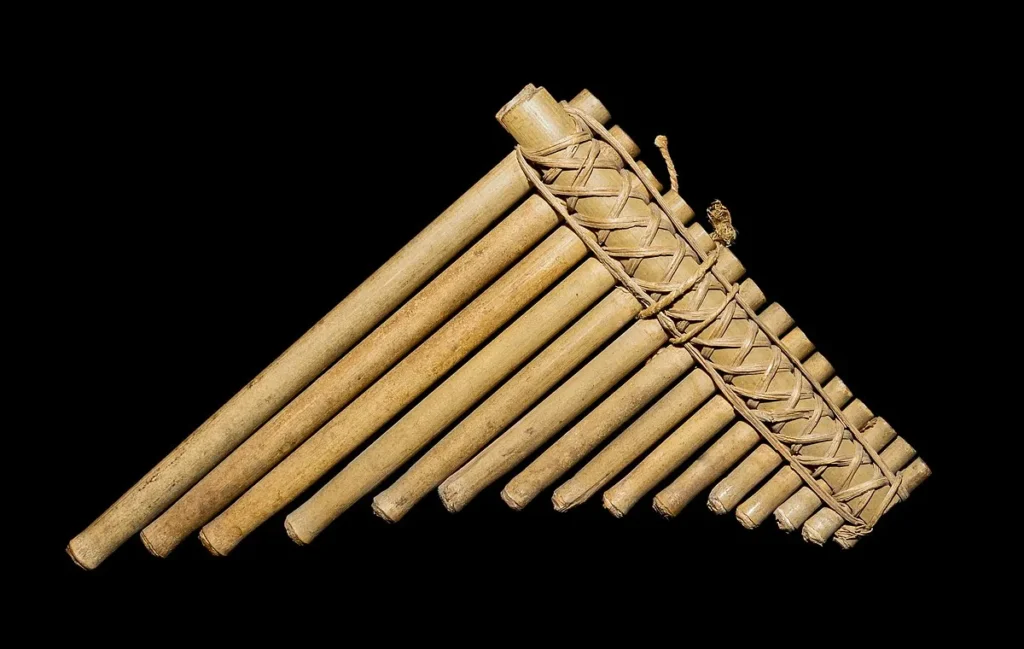
Pan’s panpipes are a row of reeds cut to different lengths and bound flat. Each tube plays one note; together they make a scale that can hop like a kid or sway like grass in wind. Myths say Pan shaped the first set after a loss and turned it into song. The materials fit his world: reeds from stream edges; wax and cord from a herder’s kit. Steady breath turns the bundle into a clear voice that charms nymphs and settles kids on a slope. In art, a little ladder of reeds at his belt is enough to name him.
Staff, pouch, and hillside tools
Pan is usually shown with working gear, not weapons. A throwing stick for hares hangs from his arm. A short shepherd’s crook fits the hand that can snag a kid by the hind leg. A small pouch rides a strap across his chest. These are more than costume. They mark a god who knows the job. The tools sit easy on him; they don’t turn him into a soldier. They underline that Pan’s authority comes from knowing ground and season. He wins people’s company because he understands their work—and because he can sweeten an hour with music made from breath and reeds.
Pan And The Nymphs
Companionship and dance
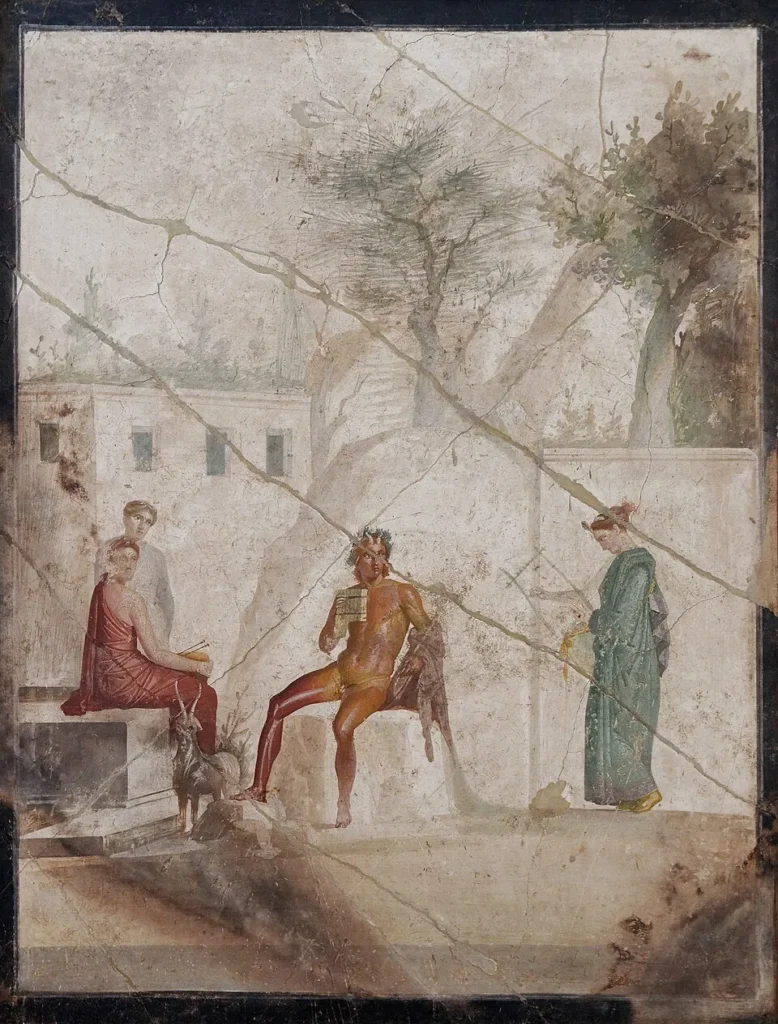
Nymphs are Pan’s steady company. In stories and on ancient walls you see them lean toward his music, fall into step, and answer with lyre or hand drum. It’s a trade: he sets the rhythm; they give it shape. A stumble becomes a dance figure, a braid of flowers keeps time, and the whole scene feels communal rather than solitary. Pan, who roams alone by habit, is at his best when he draws a small circle of friends and everyone goes home thinking the hills were kind today.
Echo and the jealous lovers
Echo, a mountain nymph whose voice answers other voices, sometimes crosses Pan’s path. The tales split. In a few, she rejects him and pays for it when local herdsmen, stirred up by the god, drive her away until only her voice remains. In gentler versions, Echo and Pan are simply neighbors in sound: his reeds send out a line; she carries it across ravines. One strand warns how play can turn cruel. The other shows a natural duet—pipes and echo—that teaches singers to listen. If Pan loves Echo, it is because the land repeats his music back to him.
Pitys and the pine tree
Another nymph, Pitys, is pursued by the North Wind. Pan tries to shield her, but the chase ends in change: the earth receives her as a pine. The bond remains. Pan binds his pipes with pine resin and rests in the shade of a tree that hums with the very wind that once threatened her. The story fits a favorite Greek pattern: a person becomes part of the landscape, and the land keeps the memory. When a pine creaks on a ridge, those who know the tale hear both Pan’s comfort and the wind’s old demand.
The Syrinx Story
The chase of Syrinx
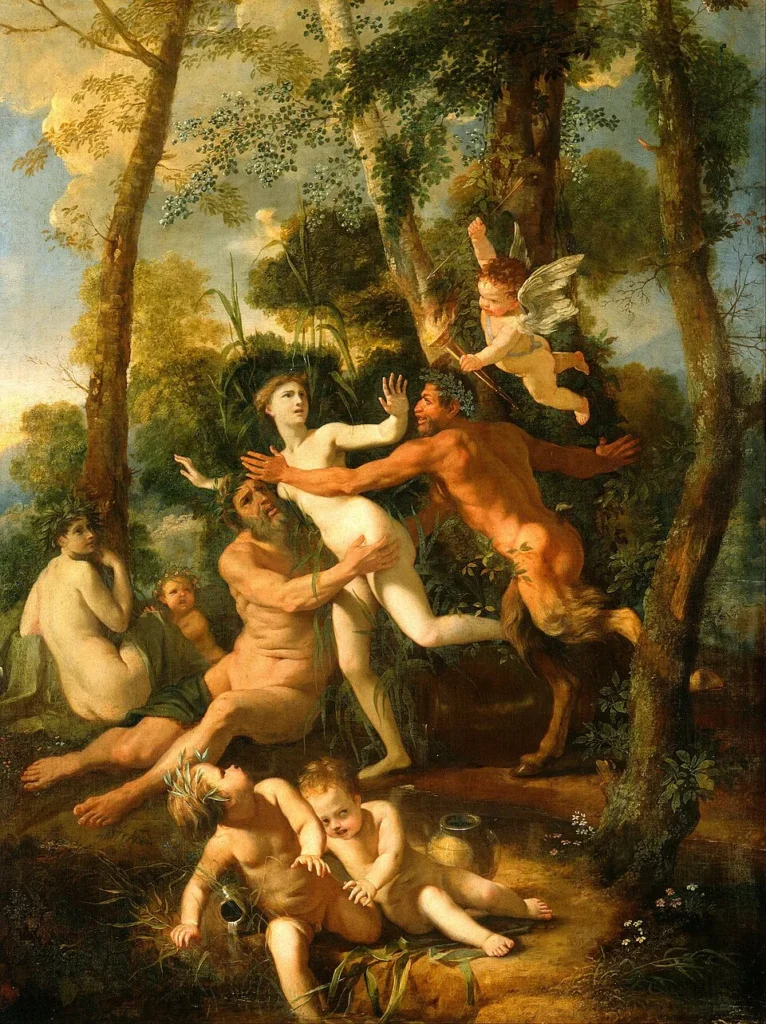
Syrinx, a nymph loyal to the hunt and to river paths, is the figure most tied to Pan’s identity. He sees her and gives chase; she runs, not because he is monstrous, but because her vows point another way. Chases in Greek myth test character. Pan pleads and follows; Syrinx holds her course and calls for help at a river’s edge. What happens next defines them both.
Transformation into reeds
The river nymphs answer by changing Syrinx into reeds. Pan reaches for her and finds only hollow stems trembling in the current. The change preserves her choice and checks his pursuit. The reeds themselves become a new voice: they sing when wind moves through them. Some versions say Pan hears that note and understands—she is still there, not as a body he can hold, but as a sound he can learn.
Making of the pipes
Pan cuts several reeds, measures them, and binds them with wax and cord. He sets them by length and tunes them to one another. He names the instrument for Syrinx so the origin is never lost. From then on, the riverbank is not just a place of flight. It is a workshop. Breath turns grief into form. The pipes hang at his belt and rise to his lips whenever shade falls and friends gather.
Voice And Music Of Pan
Enchantment of herds and hunters
When Pan plays, the hills answer. Sheep bunch and settle; goats take sure steps along rock ledges; hounds pause and listen. People feel it too. A clear line of notes carries across a valley, and voices grow steadier. Hunters clean their spears before deciding whether to go back out. The music isn’t a spell that forces the will. It’s company that sets a mood. The phrases are short enough to match a step, and the scales feel cut from the place itself. That is why listeners say, long after, that the god passed by.
Musical challenges and encounters
Music draws rivals and students. Sometimes Pan teaches a talented herdsman who will carry the craft to the next meadow. Sometimes a country singer calls for a friendly match, and Pan answers with a tune that keeps circling back like a birdcall. There are sterner contests too, with a city judge choosing between polished technique and the rough magic of the hills. Whatever the verdict, Pan keeps the uplands. His voice belongs to people who work with animals and stone, and it sounds most right where their lives do.
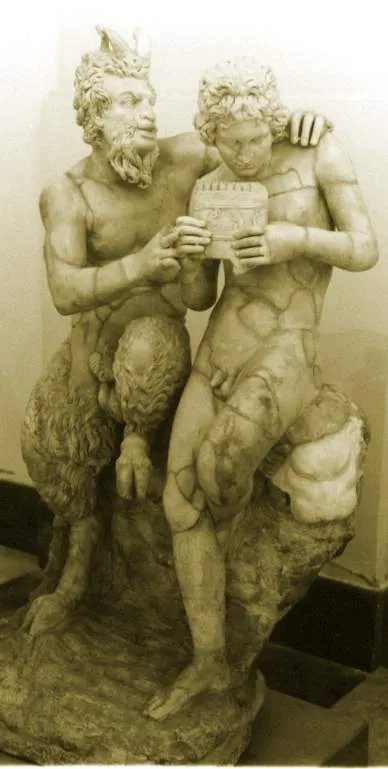
Ties with Apollo and pastoral song
Stories like to pair opposites to see what each can do. Pan’s music is often set beside Apollo’s. Apollo carries the city’s lyre and leads formal hymns. Pan carries panpipes cut from reeds and writes short, earthy phrases that fit a walking pace. When they meet, the question is simple: what counts as the better art. A human judge might choose Apollo’s smooth measure and then be scolded for ignoring the native speech of the hills. Other tellings refuse a verdict and let both stand: Apollo for temples and processions, Pan for ridges and springs. The point is not rivalry but recognition. Pastoral song is complete on its own terms. When the two part on good terms, the story settles into a peace the Greeks liked: city and upland keeping their own music with confidence.
Pan And The Gods
Kinship with Hermes
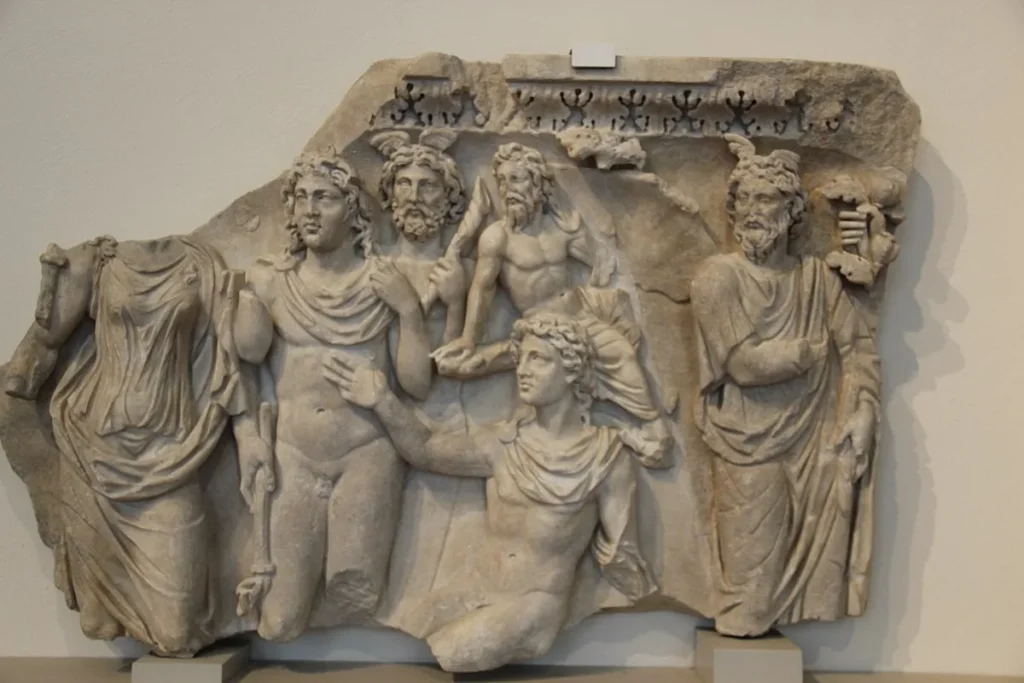
Many accounts make Pan the child or close kin of Hermes, and even when they don’t, the likeness is clear. Hermes rules chance meetings and borderlines. He knows the feel of a road at sunrise and the hush of an unexpected cave. Pan lives in those same places, not as a traveler but as a resident. They work well together: one carries news, the other prepares the welcome. Both care about sound—Hermes strings a lyre, Pan binds reeds—and both know how quickly a tune can change a day’s mood. In stories they share glances over jokes the countryside understands faster than Olympus does.
Association with Dionysus
Pan moves easily inside the wandering company of Dionysus: night walks, torchlit dances, laughter that shakes off fear. He doesn’t dissolve into frenzy. He brings the steadiness he learned from slopes and herds, and he can calm a scene as readily as he can quicken it. This link widens his profile. He is not only the god of caves and flocks; he also belongs to ecstatic rites where music and group motion matter. At dawn, when the revels break, Pan is the one who knows the quiet path home.
Friendship with Artemis of the wild
Artemis hunts with bow and hounds; Pan follows the same deer on legs that know every ridge. Their friendship reads like a pact. She guards the dignity of the animals she favors; he respects that balance. Pan is no poacher. He knows when to let a herd pass untouched and when to take one animal for the fire. In tales that put them together, the forest feels alert but not hostile. She supplies oath and rule; he supplies local sense and a tune that keeps mortal companions from losing their nerve in the thicket.
Pan And Selene
Wooing the moon goddess
Selene, the moon who lights mountain paths at night, sometimes receives Pan’s attentions. The match surprises at first and then feels right. Pan belongs to twilight: goats returning, first stars showing. Selene owns that hour. One story says Pan won her with wit, not force—wrapping himself in fresh white fleece so he glowed in moonlight, a rustic answer to her cool shine. It’s two kinds of beauty in one scene: the sky’s pale fire and the warm charm of a god whose world smells of resin and goat.
Gifts, tricks, and disguises
Pan courts with what his life provides. Clean wool that catches light, a wreath of pine and thyme, even a quick disguise as a fine white ram—gestures that suit night air and rocky ground. In Greek stories, such tricks reveal character rather than hide it. When Pan gleams with borrowed whiteness, it is still clearly Pan. The point is not deceit but aptness. Selene, who sees everything from above, appreciates craft that grows from a specific hillside. The gifts are simple and exactly right.
Children and meanings
A few late sources give them children; more often the pair functions as a symbol. They bring ground and sky together: moonlight above, herds still moving by that light below. The match softens Pan without weakening him. He is no longer only the gust that startles a grove or the chase that ends in reeds. He is also a suitor who can judge a time, shape an appearance, and turn his own world’s wealth into courtship.
Built out of a love for history, kept free from distractions.
Spoken Past is an independent project shaped by curiosity, care, and long hours of research. Reader support helps keep it maintained, carefully researched, and open to everyone.
Pan And Sudden Fear
Origins of panic
The Greeks named a sharp, irrational fear after Pan. Panic was not moral failure. It was the wild answering back—a shock from the margins that unstitched resolve. Early storytellers set it where boundaries thin: ravines that amplify sound, pine stands where wind becomes a voice, ridgelines where you think you hear hoofbeats behind you. Herds taught the lesson first. Goats and sheep graze in hush, one head jerks, brush cracks, and the whole mass surges. Greeks watched that chain and gave it a god.
Sacred silence at noon
Pan keeps noon. Shepherds avoided loud work then because the god was said to sleep and disliked being woken. The rule is practical as well as pious. In the heat, rock shimmers, insects whine, and small noises echo too far. Step into a ledge’s shade and your own breath sounds large. So custom became courtesy: no calls, no songs, no hard footfalls at mid-day. Wake the god and the reply may be the same quick dread that seizes a flock.
Shouts that scatter enemies
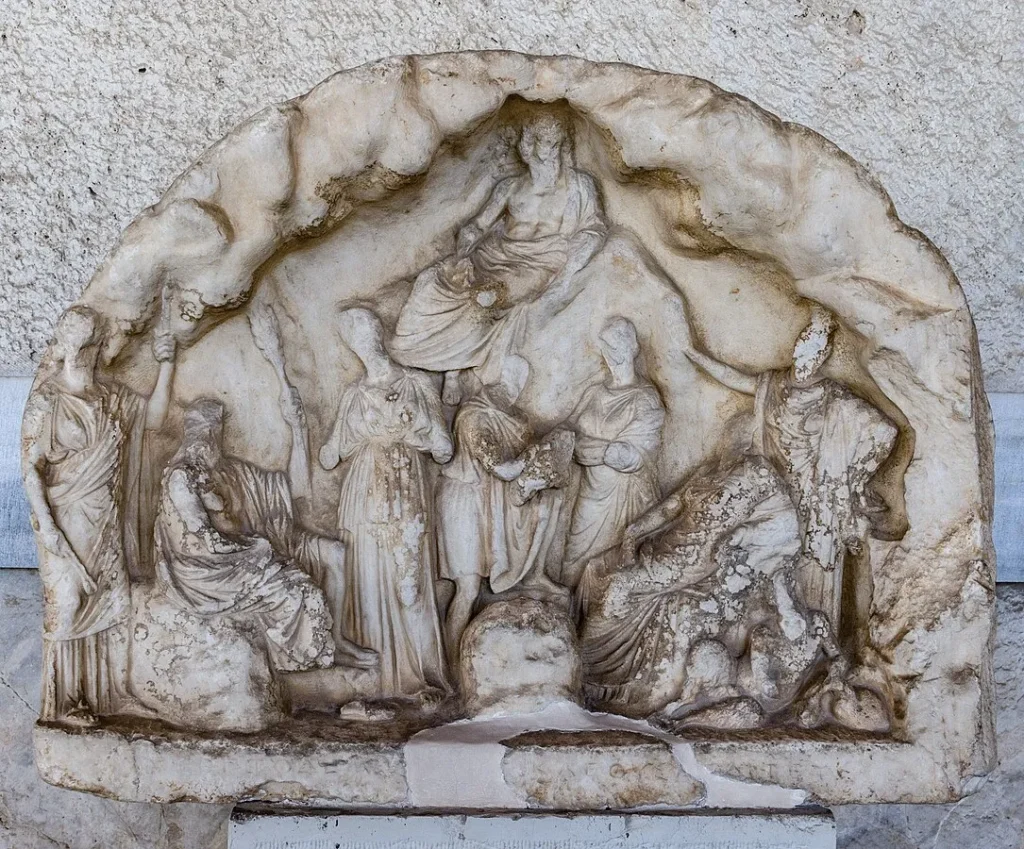
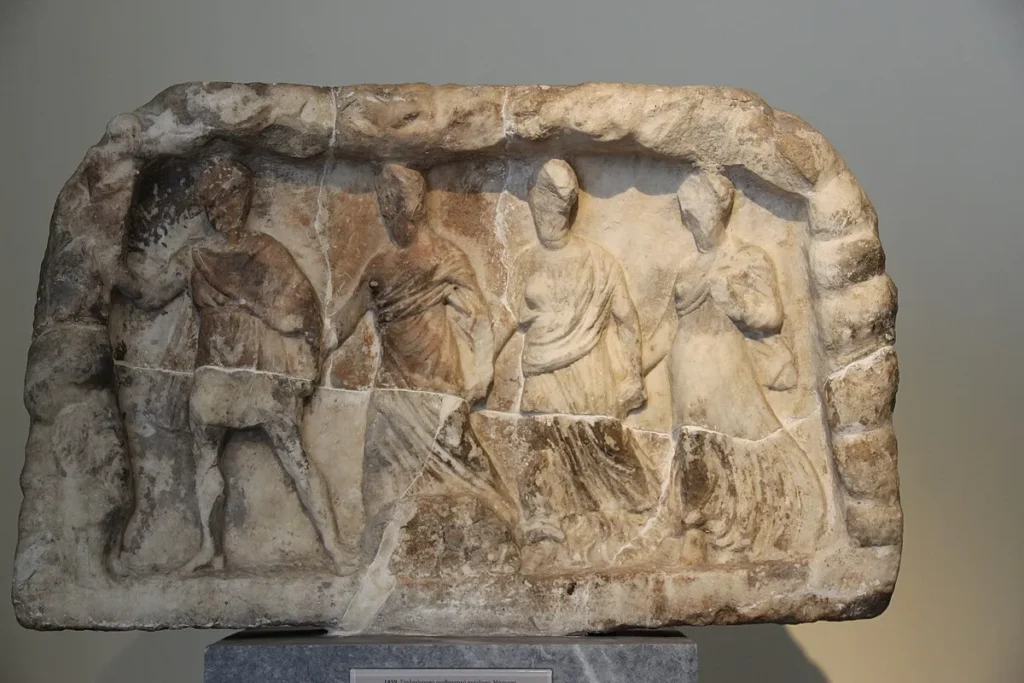
When Athenians credited Pan with help in war, they put his voice in the wind. A rumor cuts through ranks, men think they are flanked, officers misread the field, and a solid line loosens as if a pin were pulled. Panic turns a line of soldiers into a herd in minutes. Later, the city thanked the god in stone: reliefs of Pan with Nymphs and with Hermes, rural imagery used to explain a civic escape. Both truths stood together—the language of rock ledges and pipes, and the fact that a city was spared—because Pan always bridges the edge where city and country meet.
Guardian Of Hunters And Herds
Protector of flocks and goatherds
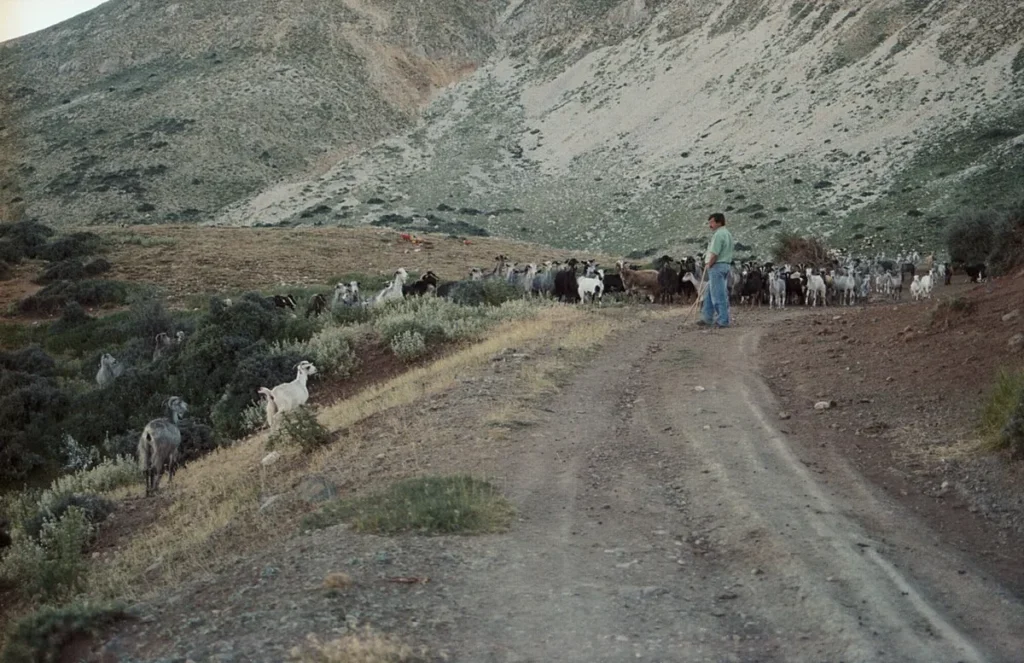
Arcadian shepherds spoke of Pan as a neighbor. He moved through folds where goats test what’s edible and sheep drift, trusting and at risk. Protection here is granular: a spring that does not fail in August, a thicket that blocks a wolf’s sightline, a warning cry that carries downhill. Pan favored people who knew such details. He was a companion to herdsmen, not their master. He didn’t tame the land; he read it—and taught his followers to read it too. Dawn milk, a tuft of the best fleece, the first share of a hunt: small gifts for a god who minds small things that decide a day’s safety.
Wolves, boundaries, and safe pasture
Trouble comes at edges: dawn and dusk, wood and grass. Those seams are Pan’s ground. Pens sit by rock scars that give a watcher sight. Paths braid in open places, not in gullies built for ambush. Shepherds travel in pairs. When a wolf is taken, its jaw goes on a gate as a warning to its kind. People didn’t claim Pan killed wolves. They said he taught them to think like wolves and still feed their flocks. Boundaries applied to humans too: footprints where none should be, a toppled cairn, a spring turned milky—signs to read, not ignore. Cross without sense and you may meet panic as your lesson.
Rules of rest and respect in the wild
Pastoral rules are plain. Don’t cut reeds where pipes already hang; those reeds now belong to Pan. Don’t stain a spring with blood. Walk around a place where a song has been left—a wreath, a cup wedged into stone. Don’t tramp past a sleeping place with clattering gear. Make no loud oath at noon. These are not city laws. They are a compact with a place, enforced by the one who owns the silence that follows.
Sanctuaries And Worship In Arcadia
Caves, shrines, and high places
To honor Pan in Arcadia is to honor heights and hollows. Caves frame him. A ledge becomes an altar; a cleft becomes a niche. On high ground, wind writes its own hymn and pines answer with their dry talk. Shrines gather where paths cross: a shepherd’s track meeting a hunter’s path, a ridge that draws thunder, a spring with a shelf for a lamp. Offerings match the terrain—milk in a shallow bowl, honey in a small cup, a pair of new pipes that still smell of wax. The sanctuary needs no roof or columns. Sound makes the walls: a chant that comes back to you, thunder that serves as a ceiling, a spring that writes its record in moss.
Tegea, Mainalos, and Neda
East Arcadia rises toward Tegea; above it, Mount Mainalos holds long forests that keep their wind even in summer. Poets often place Pan here in the hour when herds settle and hunters clean their knives. To the southwest, the Neda cuts a cool gash through rock where travelers find relief. Ritual in these places is quiet: a wreath, a strip of goat hair, a small cheese sealed with thyme—and, most of all, the habit of returning. Arcadian worship is iterative. Do the right thing again at the right time and your footsteps become a path.
Local rites for Pan
No gold. Pan receives what a field can spare without risk: a white kid from a strong herd, a libation of milk cut with water, a honey cake pressed with a thumb so sweetness pools in the dent. Music is both gift and medium. Boys make their first pipes and try them at a rock that gives a faint answer. Old men tap their staves and count the echo. Clean is acceptable. Careful is pious.
Pan In Attica And Other Regions
Caves on the slopes of Athens
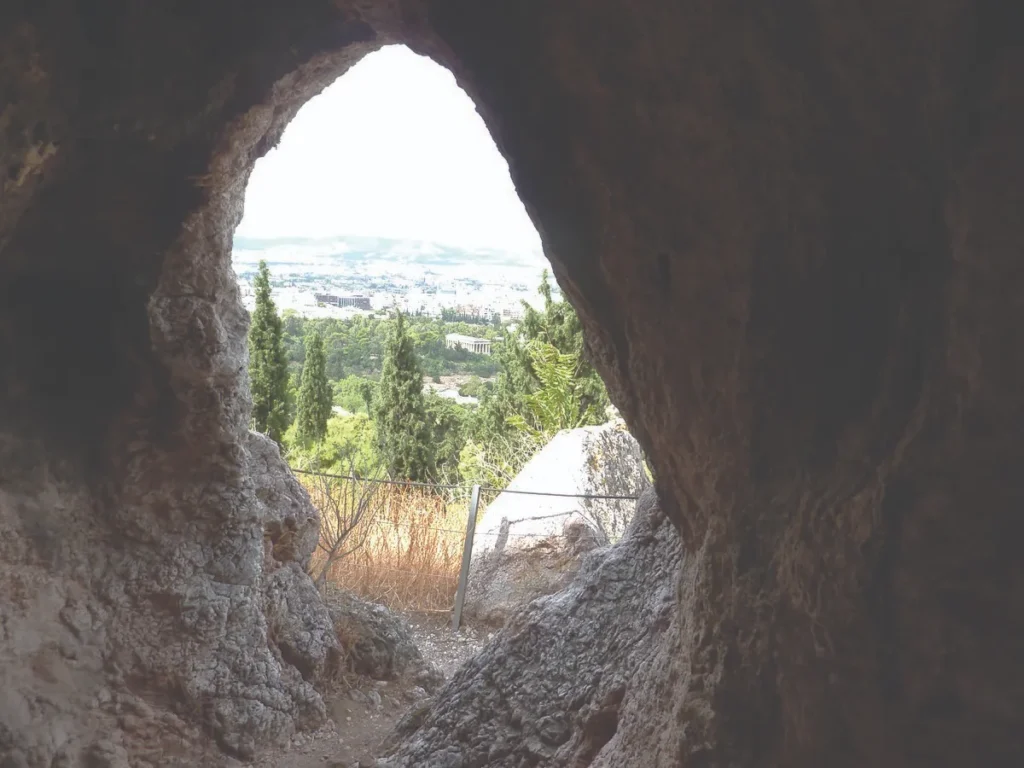
Athenians found Pan in their own stone. On the north slope of the Acropolis a run of caves once held small local shrines; one bore his name. The ledge faces city and sea—the very border Pan spans. People climbing from the Agora toward the sacred rock passed a mouth in the cliff where gifts sat in niches: little pipes, shallow bowls, a polished goat horn. Inside, the stone keeps its damp and deepens the voice. It is exactly the kind of place Pan favors: halfway between street and hillside, where the city remembers the ground it stands on.
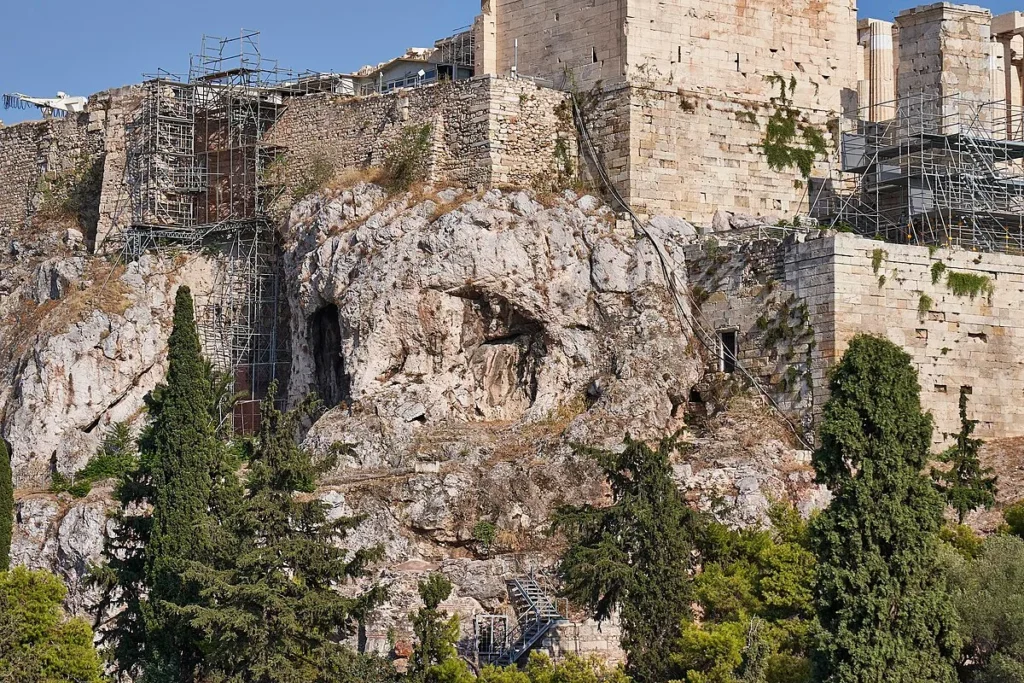
The god also had signatures around Attica. Hunters named him in the hills of Parnes; the Pentelic quarries hid niches where his image lingered; and the spine of Hymettus gave cover to caves where a traveler found a cold draft even in summer. The worship matches his character. Pan does not need civic marble to be present. A rock that throws your whisper back is enough.
Boeotian and Thessalian traces
Northwest of Attica, the ridge of Kithairon divides territories and habits. It is a natural threshold, and thresholds are Pan’s element. Shepherds in the southern Boeotian foothills left quiet marks in gullies falling toward Plataea. Farther north, the Thessalian plains demanded a different pastoral rhythm, but the same small gods watched their edges. When poets speak of night-running companies that cry out in the hills, they often set the scene on Kithairon. Pan may not be the loudest voice, but he is the one who knows what a shout does to stone walls in the dark.
Island and coastal traditions
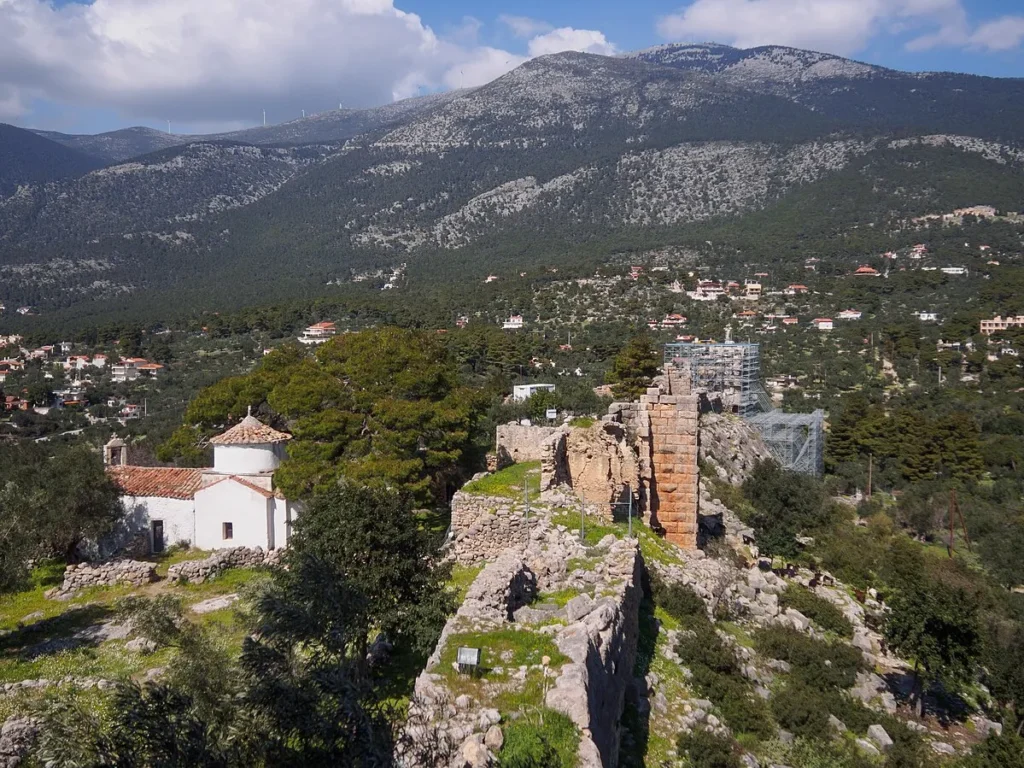
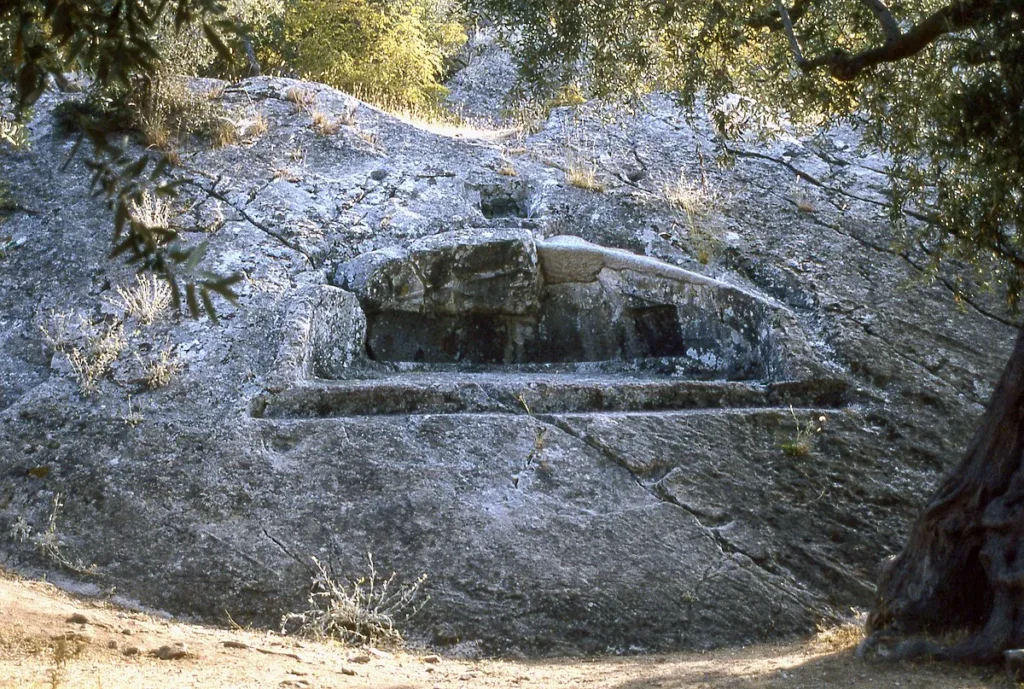
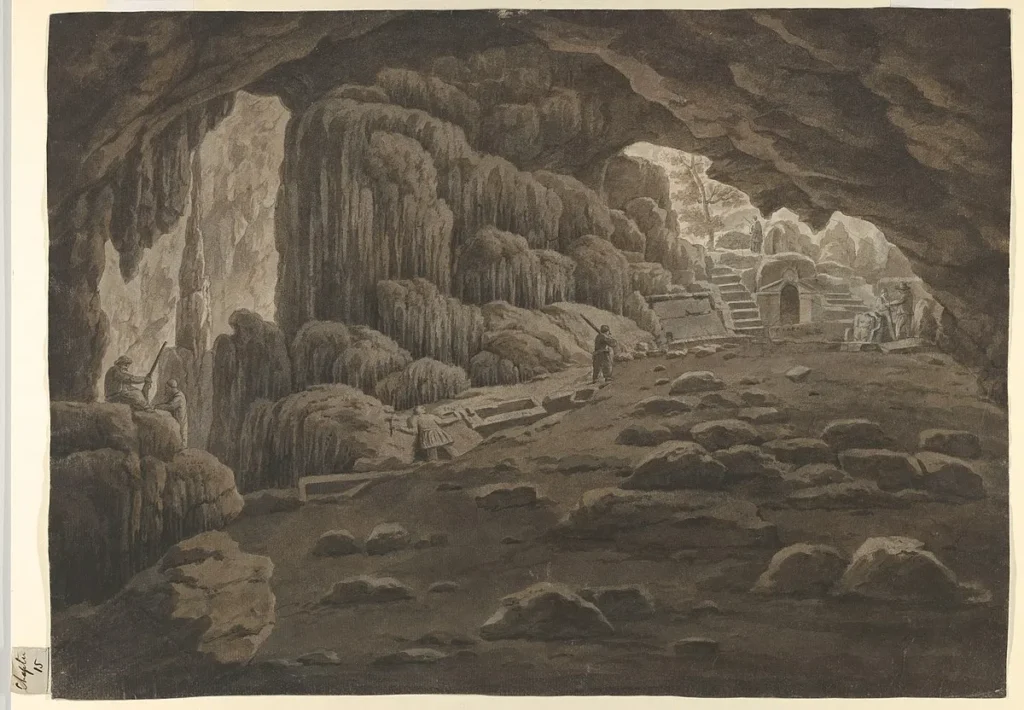
Southeast of Athens the headland of Sunium stands like a prow, and nearby coastal caves kept the memory of visits to Pan in carved names and simple drawings. Across the Aegean, islanders adapted the same cave ethic to their own cliffs. On Thasos, a sanctuary to Pan occupied a terrace tucked under rock, backed by votive niches and shaded by rough pines. The gifts there were humble and exact, and the god belonged to a way of living that paid attention to wind and aspect.
Festivals And Offerings To Pan
Milk, honey, and rustic sacrifices
Pan’s table tastes like the hillside. Milk and honey are the frequent pair: milk for the god who keeps udders full and kids fat; honey from the same countryside, its sweetness a thanks for safe passage. When sacrifice is made, it is light by city measure and careful by mountain measure. A single unblemished kid is enough. The rite does not court Pan with grandeur; it avoids offending him with clumsiness.
The promise is plain. A herdsman vows: if he brings the flock safely to winter ground, he will return to this same stone to pour milk and hang a pipe. No priest is required. The hill hears it. So does the one who swore.
Night dances with nymphs
Stories of night dances appear wherever Pan and the Nymphs share a place. These are not scheduled festivals with officials. They are felt, then remembered in the morning: a breeze shakes pine needles, a tone threads the air that cannot be the wind alone, someone swears a shape moved at the spring’s edge. Greeks told such stories without insisting on detail, and they liked the distance. It preserves dignity on both sides—listener and god.
Votive pipes and herdsmen’s gifts
Votives for Pan are often working things made sacred: a syrinx that still smells of reed and wax. When a musician hangs a pipe in a niche to fall silent, he is not discarding a tool; he is turning it into a permanent song. Hunters leave staves with tips worn smooth, goatherds leave horn points polished bright, shepherds leave a sling’s leather strap. Each gift remembers the skill that earned a living and the god who made that skill count.
Pan In Poetry And Hymn
Homeric Hymn to Pan
The Homeric Hymn presents Pan with the clarity of a mountain morning. He arrives laughing, light on goat legs, a friend to shepherds, the one who makes a thicket sound like a choir. The hymn sets him beside Hermes as kin and companion and announces his music as a new consonance in the world—neither civic nor savage, but something between. That middle place is his power. He reconciles because he is both goat and man, both rock and song.
The poet loves specifics: the syrinx answering a lyre across a valley, the god pacing in a fold between ridges, the Nymphs taking the second line of a chorus that can stop a traveler until he remembers how far he has to go. The praise is not abstract; it is almost topographic. Pan is honored by naming what the land does when he is near.
Pindar and lyric poets
Pindar places Pan in the company that attends both games and groves. When a victory ode imagines a chorus pressing words against the air, Pan stands just beyond the torchlight, keeping the rhythm that lets the human song find its meter. Other lyric poets dress the shepherd’s world in finer textures and thread Pan’s roughness through that weave. He is the correction to too much polish—keeping poetry earthy, legs scratched, fingers sticky with resin from a freshly cut reed.
Hellenistic and later Greek poets
Hellenistic poets like Theocritus treat Pan as a figure you can meet if you walk far enough at the right hour. Their idylls keep one foot in the field. One goatherd sings, another answers, and somewhere Pan is close enough that you lower your voice. Later poets keep the same conversation, sometimes turning him into an emblem of desire that belongs outdoors. Yet the basics do not change. His pipe still carries across water; a chorus of Nymphs may answer; and the warning holds—speak low at noon.
Companions And Retinue
Satyrs and Silens
If Pan reads the land, Satyrs and Silens read the mood. They are not the same, yet they travel together. Satyrs are volatile and young; Silens, older and heavier, carry the memory of roads walked and wines tested to the bottom. They gather like a cloud wherever pipes begin and they do not apologize for noise. Even so, their misrule has a grammar, and Pan is the one who turns it into music instead of racket.
Satyrs often teach by getting it wrong: rushing at noon, stamping in a cave, chasing when they should call. When sober, Silens sometimes scold them. The chorus is a family made of habits more than blood.
Maenads and rural companies
Maenads belong first to Dionysus, but they share ground with Pan. When their companies run the hills at night, he is both friend to their speed and check on their excess when the slope tips toward a cliff. By day he does not dance with them; by night he knows where the path narrows and where a group must turn or slow. Rural circles of men and women, gathered for song or harvest’s end, also place Pan at the ring’s edge—the patron of music that knows where it is being played.
Wild animals and spirits
Deer, boar, and wolf—and the smaller local spirits of rock and spring—move through Pan’s retinue without oath. They are not his servants; they are audience and counterparts. Sometimes he meets them with courtesy; sometimes with a shout that is both command and song. What matters is the relation. Pan stands where kinds meet. He keeps the conversation open.
Domains, Powers, And Signs
Liminal places and thresholds
Pan belongs to margins, and his sanctuaries underline it. Caves put you inside the land without leaving it. Rock terraces let a worshiper stand between earth and sky. Ridges like Kithairon are both boundary and bridge. City and countryside shake hands across such places, and ritual follows. People who work the edges call on Pan: goatherds, hunters, traders on the road from field to market, and those who keep watch where law thins and prudence must do the rest.
Thresholds are not only places. They are times—noon and dusk—and musical moments, when talk becomes song. Each threshold carries power in Greek thought. Pan is the switchman who knows when to open the gate and when to leave it closed.
Weather, omens, and sudden sounds
Shepherds listen to the high noise of pines because it can announce change before clouds do. One gust through needles throws a thin metallic voice across a slope, and herdsmen read what it precedes. Thunder on a hot afternoon becomes a sign if it repeats with a rhythm that seems to answer. Small sounds travel far in that world. A stone loosened by a hoof can send messages down a hillside. Pan owns such messages. He can tilt them toward warning instead of needless alarm; worshipers ask him to bend sound toward safety.
Footprints, horns, and sacred trees
Pan’s signs are literal. A goat’s hoofprint in soft ground is a page you can read. A twist of hair on a thorn marks the trail. Horns are kept and hung because they hold the memory of a herd that prospered. Trees are signs too. Pines, with sticky resin and murmuring crowns, serve as living posts for ribbons and small plaques. Leave a grove with such signs and the trees become a choir in reserve—the slightest breeze can wake them.
Regional Variants And Local Pans
Arcadian doubles and daemons
Greeks sometimes speak of Pans in the plural. It is not contradiction but a local grammar of presence. A village that knows both a cave and a spring may name the god in each place as if he were two persons. People meet him by foot, not as a distant universal. In Arcadia this feels natural. Mountains make separate worlds a mile apart, and in each the same god wears a slightly different face.
Village guardians and wayside images
Wayside herms and rustic images of Pan stood where paths forked or where a traveler might want company. They warned and reassured: Pan watches—do not cut a tree here; Pan watches—it is safe to drink here. Villages kept such markers the way a city keeps lamps. The light is not only to see by; it says someone cares for the way.
Merging and distinction across Greece
In practice Pan often overlaps with other powers without losing his outline. With Hermes, he keeps roads and luck. With Dionysus, he keeps music that moves bodies and the borders that keep it safe. With Artemis, he keeps the pact between hunter and prey that civil people call fairness. Distinctions return when needed. If the issue is a herd’s health, Pan steps forward. If it is time for a wine-lit dance, Dionysus leads. Greeks were comfortable with the overlap because they lived it. On a single night mountainside, the same person might be hunter, singer, and watchman by turns.
Meaning Of Pan Within Greek Myth
Wildness, order, and balance
Pan is not chaos in a friendly mask. He is wildness kept in conversation with order. Greek stories put him where balance is won or lost: between noon and night, between a flock’s safety and its stampede, between a hunter’s patience and a rash shot into brush. He does not abolish danger; he makes it legible—and sometimes musical. A herdsman who learns that lesson keeps his animals alive. A city that remembers it can honor a rural god without pretending to domesticate him.
City and countryside in tension
The city has its own gods, stone, and oaths. The countryside answers with rock that outlasts marble and with rites that cannot be staged indoors. Pan stands in the tension between the two. Athenians learned to climb a civic stair that passes a cave shrine to a country god. In doing so they practiced a humility that serves cities well. To keep a wall, you must know the hill behind it. To keep civic courage, you must understand panic—and the voice that can call it.
Fertility, music, and ecstatic presence
In Pan’s world, fertility and music belong together. The same god who drives goats to multiply teaches shepherds to play, and the same reeds that line a stream can become pipes that line a cave niche. Ecstasy here is calibrated. It belongs to a chorus that knows when to begin and when to cease. It respects the sign that says silence at noon. It ends with a sip-size libation—small enough to disappear, sweet enough to make the moment last. Pan’s presence is not a spectacle. It is a practice: attentive walking, careful listening, the right gift placed in the right crack of stone.
Frequently Asked Questions About Pan
Was Pan an Olympian god?
No. He was not one of the Twelve. He lived apart in mountains, caves, and forests. He could visit Olympus, and the gods welcomed him, but his power was local and rustic rather than civic.
Where was Pan worshiped most?
Arcadia in the central Peloponnese was his homeland. Almost every valley and mountain had shrines, especially Mount Lykaion and Mount Mainalos. Athens also honored him in cave sanctuaries after he was believed to aid the city in war.
What did Pan look like?
Ancient art shows him with goat legs and hooves, small horns, a beard, and a strong human torso. He often carries panpipes, a crook, or a small pouch—his look blends human and goat to embody the wild.
Why is Pan linked with panic?
Greeks explained sudden, irrational fear in open spaces as his work. A shout or noise in the hills that made soldiers scatter or animals stampede was called “panic,” after his name.
Who were Pan’s parents?
Traditions differ. Many named Hermes and the nymph Dryope. Others gave him Penelope as a mother—sometimes with Hermes as father, sometimes Odysseus, sometimes the suitors. Arcadian versions varied to suit local shrines.
Did Pan have children?
A few sources give him offspring, especially with nymphs or with the moon goddess, though these accounts are scattered and late. His legacy is less about named children and more about the spirits and moods that follow him.
What instrument did Pan play?
He invented and played the panpipes (syrinx), reeds cut to different lengths and bound together. The instrument bears his name because he shaped it after the nymph Syrinx became reeds.
How did Pan relate to other gods?
He was close to Hermes, often named as his father; he joined Dionysus in wild dances; he was friendly with Artemis in the hunt. With Apollo he sometimes entered musical contests—pipes against lyre.
What offerings did Pan receive?
Shepherds and hunters brought milk, honey, small goats, cheese, or simple votives like pipes or staves—gifts that matched the life he protected, not the grand sacrifices of city temples.
How did Greeks imagine meeting Pan?
They thought he could appear suddenly in the countryside, especially at noon or dusk. A traveler might hear unexpected music, see a flicker of movement among rocks, or feel a chill of fear for no clear reason—taken as signs that Pan was near.