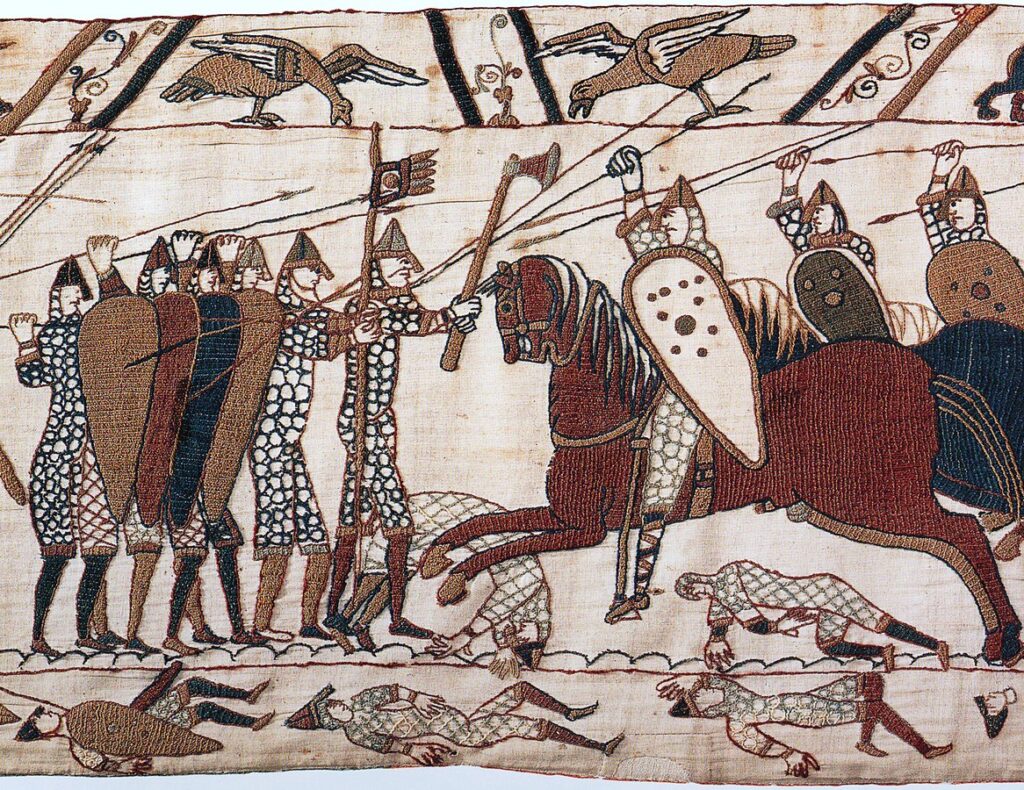
On 25 September 1066, the Norwegian army of King Harald Hardrada stood on the banks of the Stamford Bridge in Yorkshire and formed what the chroniclers describe as a wall of shields, a tight-locked line intended to hold a ford against a furious English advance. They failed. But the formation they used, the Old Norse skjaldborg, meaning literally “shield-fort” or “shield-castle,” had been the decisive infantry technology of Scandinavian and Anglo-Saxon warfare for at least three centuries before that afternoon. The Viking shield wall was not simply a defensive posture. It was a system for managing the psychological and physical dynamics of pre-gunpowder combat, and understanding how it actually worked requires looking at the physical evidence for Viking shields themselves alongside the textual record in sagas, Eddic poetry, and Old English verse. This post draws on recent archaeological scholarship on the Gokstad shield assemblage alongside Neil Price’s synthesis of Viking Age material culture to build a picture of what the formation really demanded of the men inside it.
What the sources call a Viking shield wall
The Old Norse term skjaldborg appears in sources including the kings’ sagas, particularly Snorri Sturluson’s Heimskringla, where it is used to describe the ordered infantry lines of named battles. The Old English equivalents, bordweall (shield-wall) and scyldburh (shield-fortress), appear in the Anglo-Saxon poem The Battle of Maldon, composed close in time to the 991 CE Viking raid it commemorates. Both traditions describe the same essential formation: men standing side by side with shields overlapping, creating a continuous defensive surface that was as much a social structure as a tactical one. The formation is mentioned across a wide range of battles from the late eighth century through the mid-eleventh, and it appears consistently enough across the textual record that scholars, including Neil Price, Distinguished Professor of Archaeology at Uppsala University, treat it as the standard Scandinavian and Anglo-Scandinavian infantry response for this period.
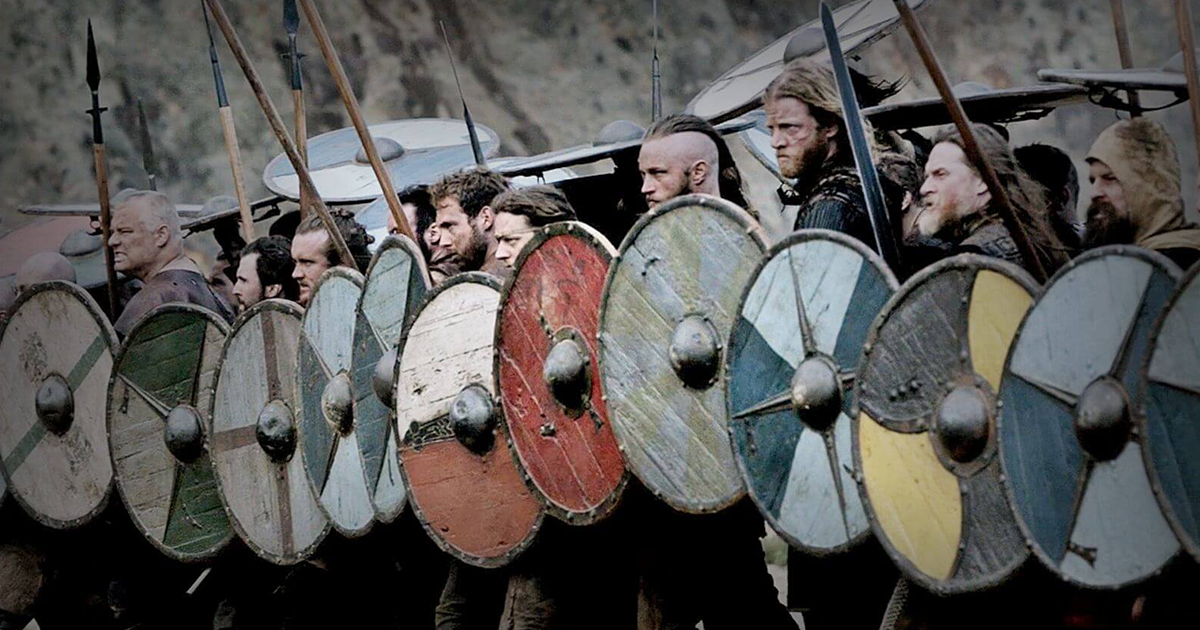
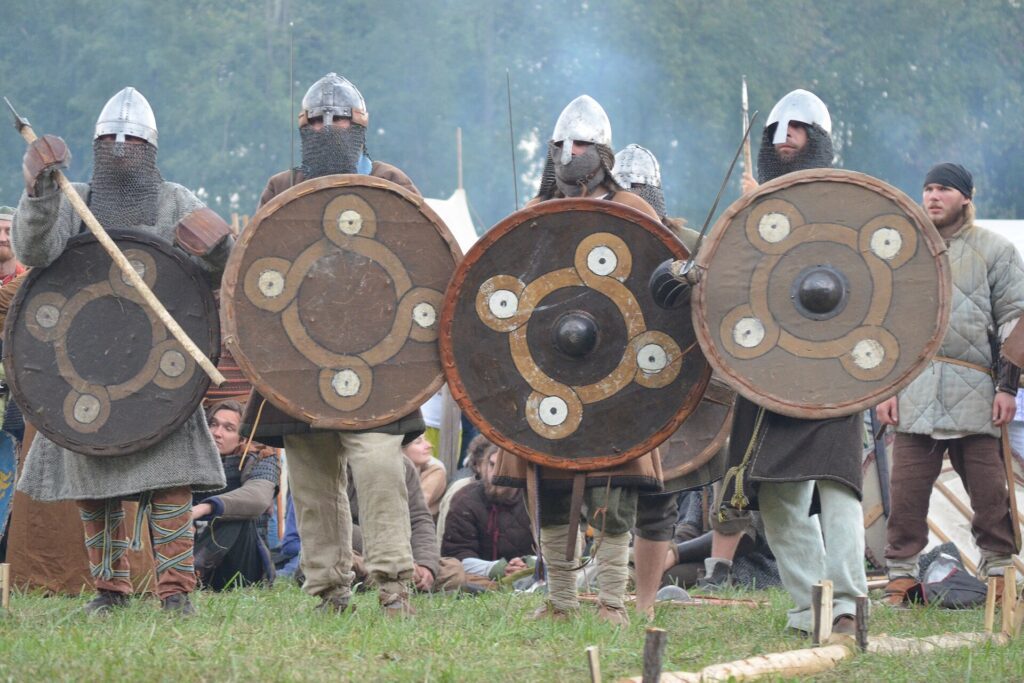
The physical vocabulary of the formation matters. “Overlapping” did not mean shields resting one against another in a passive stack. It meant the rim of each shield covering approximately the left third of the neighbour’s shield, so that blows landing near the junction would strike two shield surfaces simultaneously rather than finding a gap. This geometry meant that a man who stepped back or turned sideways created not a small gap but a structural failure in the whole section of the line he had been covering. The wall only worked because each man accepted responsibility for his neighbour’s left side as well as his own front. That mutual obligation was the technical and social core of the formation.
What Viking shields were actually made of
The primary physical evidence for Viking Age round shields comes from the excavation of the Gokstad burial mound in Vestfold, Norway, conducted by antiquarian Nicolay Nicolaysen in the spring of 1880. Nicolaysen was then President of the Society for the Preservation of Ancient Norwegian Monuments and conducted the excavation after local farmers’ sons began digging in the mound in late 1879. The burial, which dendrochronological dating has placed in the last decade of the ninth century CE, contained the remains of 64 round shields arranged along the gunwales of the longship. Ragnheiður Indriðadóttir Warming’s 2023 re-examination of the Gokstad shield fragments, published in the International Journal of Nautical Archaeology, is the most recent and detailed study of this assemblage. Warming’s analysis challenges previous assumptions of homogeneity, finding evidence for varying construction methods and wood species across the shield boards, suggesting the shields were not standardised equipment but assembled from available timber by multiple craftsmen.
What the Gokstad shields and comparative finds from other Viking Age contexts consistently show is a round shield of roughly 80 to 95 centimetres in diameter, built from radially split planks of low-density softwood, most commonly linden, poplar, or fir. The low density was deliberate. A shield built to absorb blows by deflection and deformation rather than rigid resistance needed to be light enough to manoeuvre quickly. An iron boss occupied the centre of the shield over a single hand-grip, which the fighter held with the fist rather than strapping across the forearm. This centre-grip design is the single most important technical feature distinguishing the Viking shield from the large, arm-strapped aspis of the Greek hoplite. Centre-grip allows rapid rotation of the shield face and permits the fighter to use the shield offensively, punching with the boss or hooking an opponent’s weapon rim over an edge. The shield boss of hammered iron, typically 15 to 18 centimetres across at the flanged rim, protected the hand while the planks protected the arm and body. Rawhide binding along the rim reduced the risk of splitting on impact.
How the Viking shield wall functioned in practice
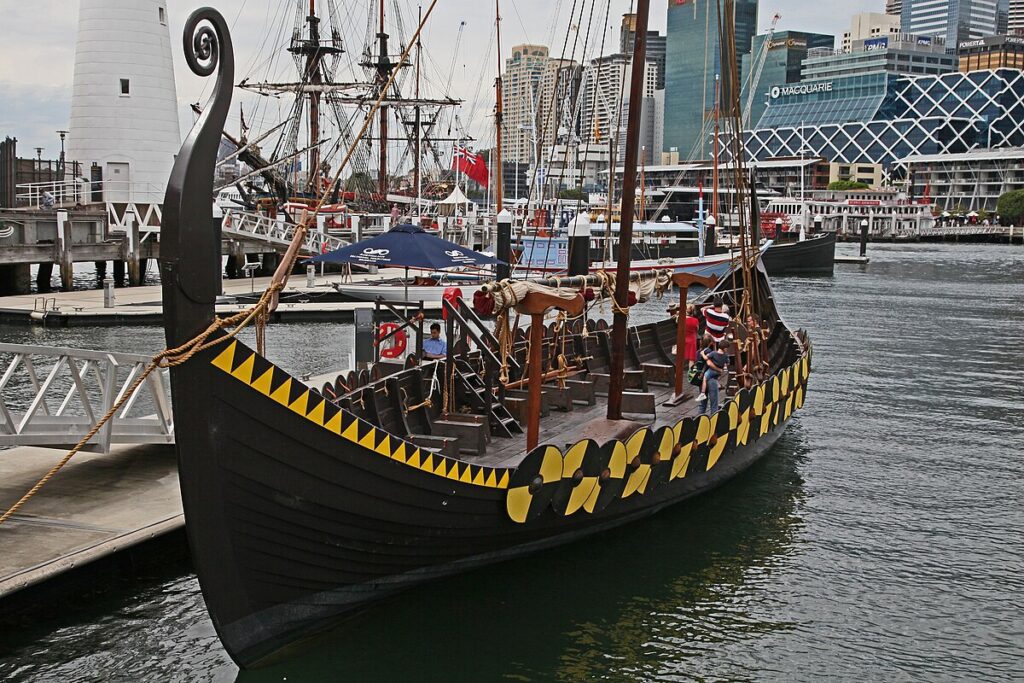
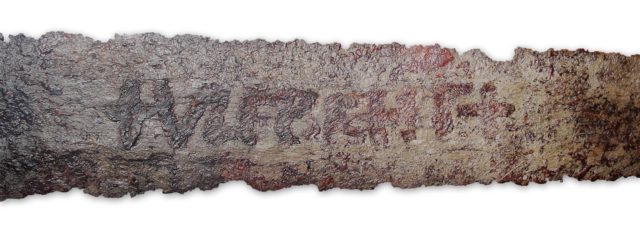
The centre-grip design meant that the Viking shield wall was considerably more dynamic than popular images suggest. The front rank did not simply stand still and absorb blows. Each fighter could angle the shield face to redirect incoming spear or axe strikes, exploit openings created by a neighbour’s attack, and punch or hook with the shield rim while delivering or receiving thrusts with a weapon held in the right hand. The standard weapons behind the shield were a spear of two to three metres, used for thrusting and hooking, a seax (a single-edged short sword or long knife of 30 to 60 centimetres), and for wealthier fighters a sword. The Ulfberht swords, high-carbon crucible steel blades whose production quality significantly exceeded contemporary European smithing standards and which are attested across Scandinavia from roughly 800 to 1000 CE, represented the premium end of the sword market. One example is displayed in the Germanisches Nationalmuseum in Nuremberg, where it entered the collection in the nineteenth century.
The second rank did not merely push. Fighters in the second rank used spears with sufficient reach to strike past the front rank, targeting legs and faces visible below or around the enemy shield line. In close-order fighting, axes were used to hook shields down or to deliver heavy blows over the top of an opponent’s guard. The tactical rhythm of a successful wall involved the front rank tying the enemy in a mutual press of shield against shield while the second rank worked the angles. Short, precise thrusts rather than dramatic overhead swings characterised the dominant attack pattern, because small controlled movements preserved balance and formation integrity in ways that wide swings did not.
Both the sagas and the physical evidence of weapons with use-wear patterns, examined by experimental archaeologists working with reconstructed equipment, support this picture of line fighting rather than individual duelling. Wear on spear points and sword edges indicates tip-and-edge contact rather than the broad flat impact one would expect from heavy swinging blows. Warming’s 2023 study of the Gokstad shields specifically cautions against reading the assemblage through the assumption that the shields were simply ceremonial, noting that construction details suggest practical defensive use alongside their funerary placement.
The psychology of the Viking shield wall
Combat psychologists working on pre-modern warfare have consistently found that the primary challenge facing ancient and medieval infantry was not physical strength or weapons skill but the suppression of the flight response under threat. Most armies of the Viking Age were not professional soldiers in any modern sense. They were farmers, fishers, craftsmen, and merchants who answered a lord’s call to arms. The shield wall addressed the flight response through two mechanisms that worked simultaneously: physical contact with neighbours and the production of collective noise.
Physical contact matters because it provides continuous proprioceptive feedback that tells the nervous system it is not alone. A man whose shoulder and shield rim are in constant contact with the men on either side of him receives information through his body that overrides some of the cortisol-driven panic that comes with approaching danger. The shield wall institutionalised this contact by making it a requirement of correct formation rather than an incidental comfort. Standing correctly in the wall meant being in contact. Breaking contact meant stepping out of the wall, which was understood by every participant as a potentially fatal action for the group.
Collective noise, the rhythmic beating of weapons on shield rims and the coordinated shouting described in multiple saga accounts of pre-battle moments, served a different function. It synchronised breathing, which has a measurable calming effect on heart rate, and it communicated to the enemy that the formation was unified and organised rather than an anxious collection of individuals. Neil Price’s analysis in Children of Ash and Elm emphasises that Viking Age warfare was deeply embedded in a culture of performance: the appearance of readiness and collective will was itself a weapon, and the shield wall was one of its primary expressions.
Built out of a love for history, kept free from distractions.
Spoken Past is an independent project shaped by curiosity, care, and long hours of research. Reader support helps keep it maintained, carefully researched, and open to everyone.
Tactical variations on the basic formation
The basic skjaldborg was a flexible instrument rather than a rigid protocol. Commanders adapted it to terrain, numbers, and the specific threat they faced. On sloped ground the wall could hold a crest and force attackers to fight uphill, which costs significantly more energy per unit of forward movement and degrades both speed and coordination before contact. At river crossings, the front rank could raise shields into an angled overhead screen, creating a rough but functional roof against missiles while the column moved across exposed ground. This technique resembles the Roman testudo formation, though it lacked the Roman legions’ drill precision, and it depended on each man trusting that his neighbours would hold the screen without peeling away to protect themselves individually.
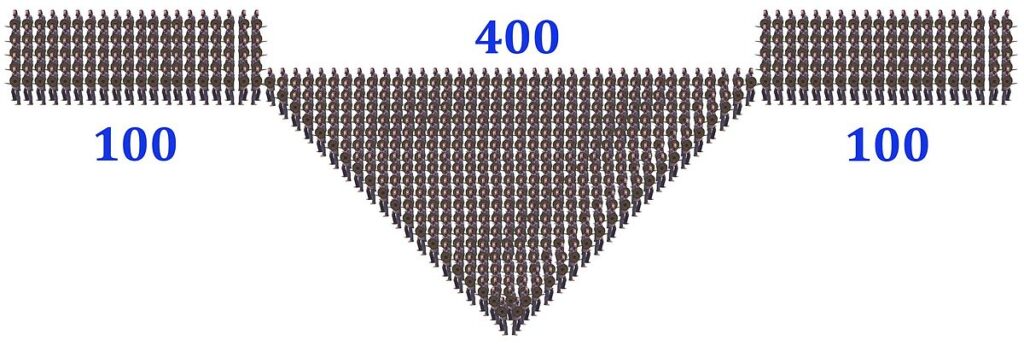
The svinfylking, or “boar’s snout,” was a wedge formation used specifically to break a wall apart. Described in several saga contexts and diagrammatically reconstructed from textual sources, the svinfylking concentrated the most heavily armoured fighters at the point of the wedge and used the geometry of the triangle to drive mass into a narrow section of the enemy line, splitting it and creating a gap that the trailing fighters could exploit. A stable, disciplined skjaldborg could absorb a svinfylking by reinforcing the threatened point, but the key word is disciplined. A nervous wall often collapsed precisely at the point of pressure because the fighters there lost the nerve to hold as the wedge’s mass hit them, and panic spread laterally from the break faster than orders could counter it.
Controlled retreat was a legitimate and sophisticated tactic within the formation’s repertoire. The front rank could step back in coordinated half-steps, drawing an enemy charge forward and disrupting its momentum, then surge forward at a signal when the enemy was off-balance from the pursuit. The difference between a controlled retrograde and a rout was entirely a function of whether the men believed the retreat was commanded or panicked, and the shield wall’s mutual contact and noise discipline were the mechanisms that kept that distinction legible in the chaos of combat.
How the Viking shield wall compared to other infantry formations
Comparisons between the skjaldborg and the Greek hoplite phalanx are common in popular accounts and consistently misleading. The phalanx relied on the arm-strapped aspis, a large, heavy shield that required the body to turn with it, and on tightly packed deep ranks whose mass pushed forward in an othismos, a collective shove. Viking and Anglo-Saxon shield walls were shallower, typically two to four ranks rather than the phalanx’s eight, and the centre-grip shield permitted individual lateral movement that the phalanx’s geometry explicitly suppressed. The phalanx was optimised for flat ground, specific deployment patterns, and the kind of drilling that citizen-soldier Greek poleis invested in heavily. The skjaldborg was optimised for variability: different ground conditions, different numbers, different durations of engagement.
The Anglo-Saxon fyrd, the militia of free men summoned to defend against Viking incursion, used the same shield-wall formation as the Vikings themselves, which is why accounts of battles like Maldon (991 CE), Assandun (1016 CE), and Stamford Bridge (1066 CE) describe both sides using recognisably similar formations. The tactical outcome of these engagements was determined less by the formation itself than by factors including ground choice, flanking opportunities, missile fire, and above all the quality of each army’s morale at the critical moment when the line first came under pressure.
What archaeological evidence contributes to the picture
Written sources for Viking Age warfare are produced almost entirely by participants, commissioners of participants, or by opponents with their own rhetorical interests, which means they need to be read critically rather than taken at face value. The archaeological record provides a different kind of check. Shield bosses and rim fragments recovered from burial contexts across Scandinavia, Iceland, the British Isles, and the Baltic consistently show construction patterns compatible with the centre-grip, round shield described in textual sources. The Gokstad Revitalised project, initiated by the Museum of Cultural History at the University of Oslo in 2009 with support from the Anders Jahre Humanitarian Foundation, subjected the 1880 assemblage to sustained modern analysis for the first time, including dendrochronological dating, osteological re-examination of the buried individual, and systematic study of the associated grave goods.
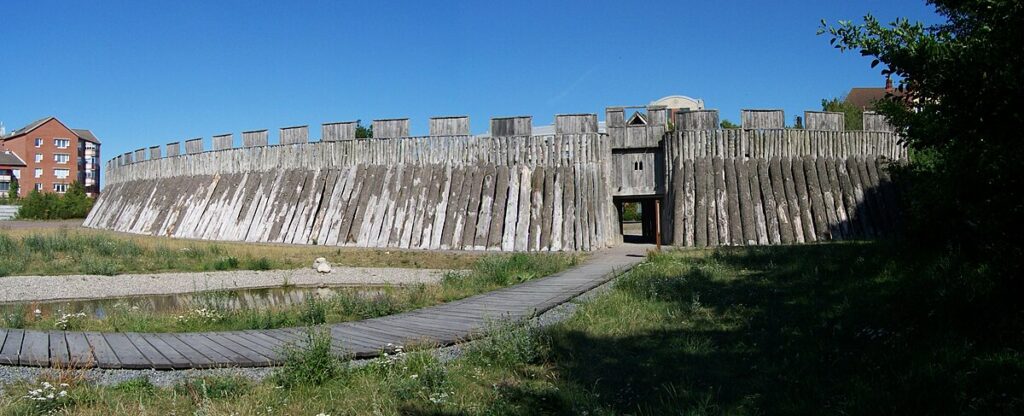
The Trelleborg ring fortresses, a series of precisely planned military encampments dated to the reign of Harald Bluetooth in the late tenth century CE and excavated at sites including Trelleborg in Sjælland, Aggersborg in Jutland, Fyrkat near Hobro, and Nonnebakken in Odense, provide a different kind of evidence. Their geometric regularity demonstrates a capacity for large-scale, disciplined military organisation that presupposes exactly the kind of training and coordination required to keep a shield wall coherent under pressure. A force capable of constructing and inhabiting a Trelleborg-pattern fortress was a force that had internalised military order as a cultural habit, not as an emergency response. The Gokstad Revitalised project is one pointer; the Trelleborg excavations, carried out by the National Museum of Denmark from the 1930s onward, are another strand of the same material argument about Viking military organisation.
How the shield wall broke and what happened when it did
Every Viking shield wall that ever formed was capable of breaking. The factors that caused collapse included sustained missile fire that reduced numbers faster than positions could be filled, flank pressure that forced end fighters to turn outward and thereby open the line’s interior, a successful svinfylking penetration that divided the wall into isolated sections, or, most decisively, the visible death or flight of a recognisable leader. Norse sagas consistently emphasise the importance of the chieftain or king as a visual anchor. When Haraldr Harfagri’s standard fell or a jarl’s banner dropped, the information spread through the formation faster than any verbal order could counteract it, and the resulting uncertainty about whether to hold often tipped into the cascading panic of a rout.
A rout from a broken shield wall was substantially more lethal than the fighting that preceded it. Once a formation dissolved into individuals running in different directions, the victorious side could pursue and kill at low risk to themselves. This is why sources describe disciplined retreats as military achievements comparable to successful attacks: a force that broke contact cleanly, rotated its rear rank into covering position, and withdrew in formation had denied the enemy the most profitable phase of the battle. The shield wall’s discipline was not only about winning. It was also about limiting the catastrophe of losing.
The Viking shield wall as a social institution
Neil Price’s analysis of Viking Age culture emphasises repeatedly that the battlefield was a performance space as much as a killing ground, and that Viking society produced its warriors through a culture of reputation, oath, and collective identity that made the shield wall not merely a tactic but an expression of social values. The man who broke formation for private glory or private survival was not merely making a tactical error. He was violating the oath-structure of the warband. The Old Norse concept of nid, the most serious form of social shame, could attach to cowardice in battle in the same way it attached to oath-breaking in peacetime. The shield wall required every man to prioritise the collective over the individual in a culture that simultaneously celebrated individual martial excellence, and managing that tension was part of what a skilled chieftain’s leadership actually meant in practice.
Experimental archaeology with reconstructed Viking shields, conducted by groups including those working with organisations affiliated to the Society for Combat Archaeology, has produced consistent findings: the physical demands of holding a centre-grip round shield in the overlapping position for extended periods are significantly greater than holding a strapped shield, because the entire weight is supported by the wrist and forearm rather than distributed across the arm. Fatigue in the shield arm became a critical variable in extended engagements. The rotation of fresh fighters from the second rank into the front, described in several saga accounts as a deliberate tactical choice, was as much a response to this physical reality as it was a strategic manoeuvre. The formation’s sustainability depended on the depth of the formation and on the willingness of each rank to take its turn at the cost.