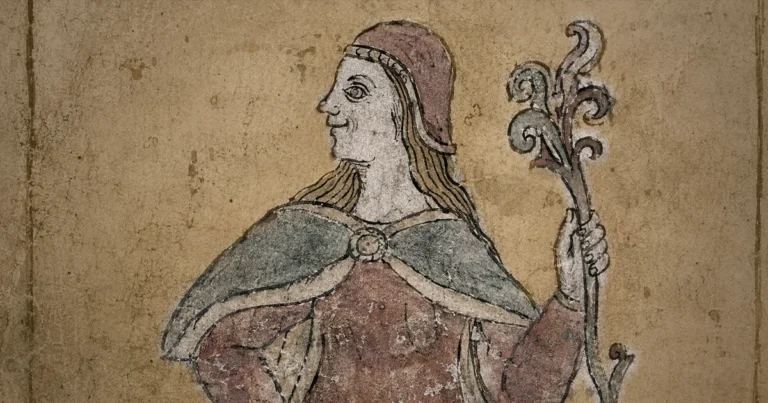

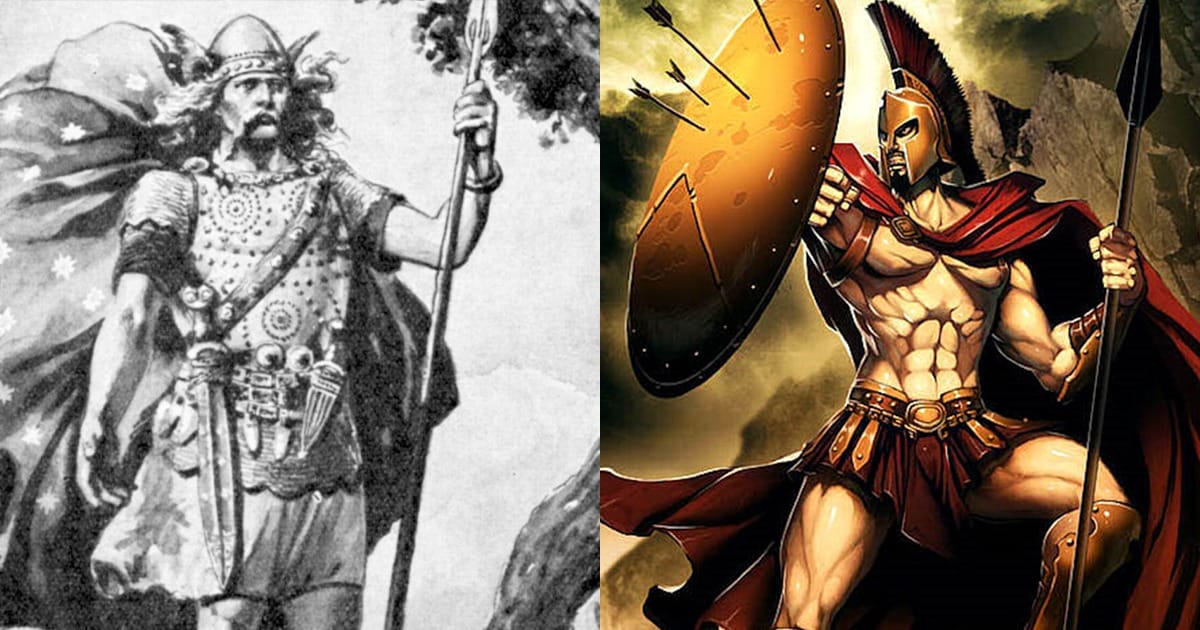
Sometime in the second or third century CE, Frisian soldiers serving in a Roman auxiliary unit at Vercovicium, the fort we now call Housesteads on Hadrian’s Wall, erected a stone altar to a god they called Mars Thincsus. They were Germanic soldiers far from home, using Roman religious vocabulary to honour a deity they knew from their own tradition: the Norse god Tyr. The altar, now housed in the Great North Museum in Newcastle, encodes something crucial in its strange hybrid title. Thingsus means the god of the Thing, the ancient Germanic legal assembly, and the name binds war and law so tightly together that no Roman equivalent could fully contain it. Tyr and Ares are both ancient war gods, and that is roughly where the similarities end. One upheld oaths at the cost of his own hand. The other was called the most hateful god on Olympus by his own father. Together, they form one of the most instructive contrasts in the history of religion: two deities of war whose myths reveal entirely different answers to the question of what war is actually for.
Tyr in the Norse Sources
Tyr’s name derives from the Proto-Germanic word *Tiwaz, meaning simply “god,” a term so ancient it shares its root with the Sanskrit Deva, the Latin deus, and the Greek Zeus. The name itself is a relic of an era when Tyr, or his proto-Germanic predecessor, may have been the supreme sky deity of the Germanic peoples, displaced over centuries first by Odin’s rising cult and then pushed further to the margins as the Prose Edda was compiled by the Icelandic scholar Snorri Sturluson in the thirteenth century. By Snorri’s time, Tyr warranted only a few passages. That brevity, though, should not mislead anyone about his original importance.
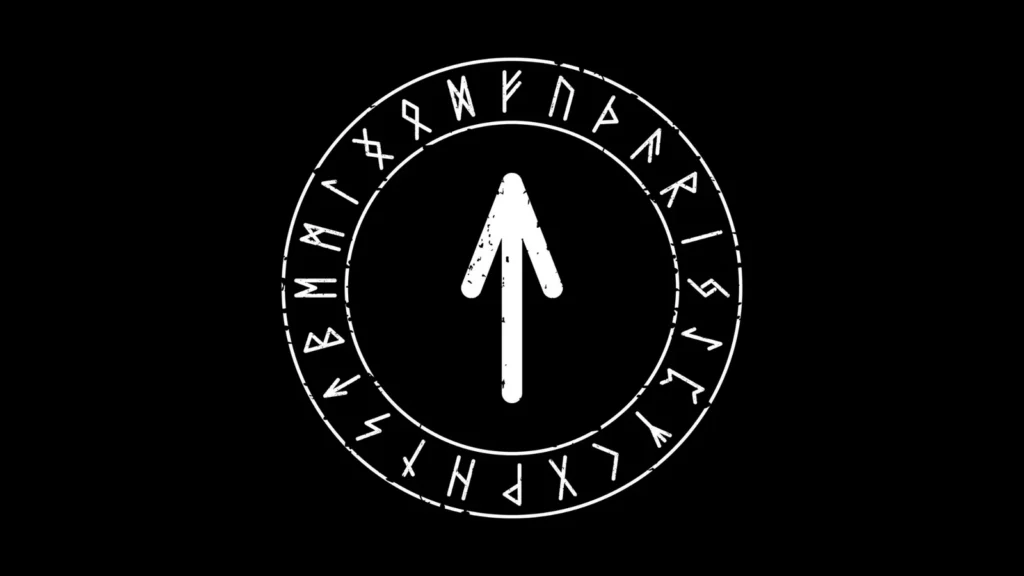
The primary sources are the Poetic Edda (a collection of older Norse verse preserved in the thirteenth-century Codex Regius manuscript) and Snorri’s Prose Edda. In the Poetic Edda poem Sigrdrífumál, the valkyrie Sigrdrifa instructs the hero Sigurd to invoke Tyr when seeking victory in battle, carving his rune twice into the blade of a sword. That rune, Tiwaz, shaped like an upward-pointing arrow, appears on archaeological objects across the Germanic world: on the Lindholm amulet found in Skåne, Sweden, on weapons, shields, and arm rings, and on the Kylver Stone from Gotland. Warriors engraved it onto their equipment not merely as decoration but as a direct appeal to the divine force Tyr embodied.
His parentage is contested even within the surviving texts. Snorri’s Prose Edda describes Tyr as a son of Odin. The Poetic Edda’s Hymiskviða, however, places him as the son of the frost giant Hymir, which would make him a figure of mixed Aesir and jötunn heritage. This contradiction is not an error so much as a reflection of how Norse mythology evolved across regions and centuries. The scholar Rudolf Simek at the University of Bonn, whose Dictionary of Northern Mythology remains a standard reference, argues that the inconsistency reflects the absorption of different local traditions into a single textual record, each with its own genealogical logic for the same deity.
What the texts do agree on is Tyr’s character. He is, in Snorri’s words, the bravest of all the gods and the one who presides over victory in battle. He is also, and just as importantly, the god of the Thing: the lawgiver, the oath-keeper, the judge whose authority made agreements binding. For the Norse and wider Germanic peoples, war was not separate from law. Battle outcomes were understood as divine judgments. Single combat resolved disputes. The phrase vápndómr, meaning judgment of arms, was not a metaphor but a legal procedure, and Tyr presided over it.
The Binding of Fenrir and Tyr’s Defining Sacrifice
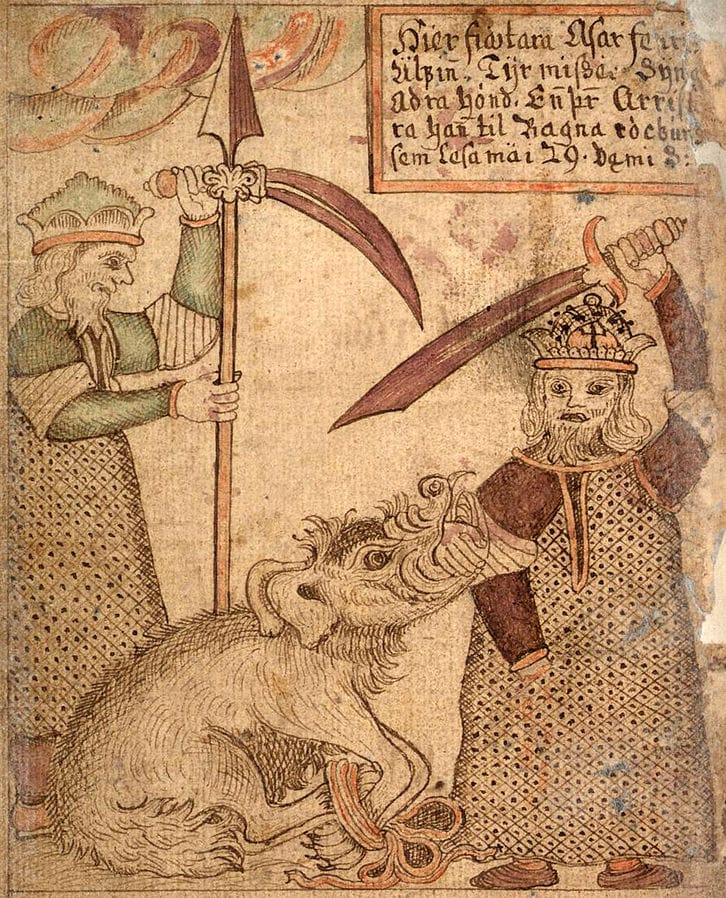
The single myth in which Tyr plays a major role tells us everything about his values. The monstrous wolf Fenrir, offspring of Loki, was raised among the Aesir gods in Asgard. He grew quickly, and the gods, aware of the prophecy that Fenrir would one day swallow Odin at Ragnarök, resolved to bind him before he became too powerful to contain. They twice attempted to chain him with iron fetters, both of which Fenrir broke with ease, seemingly enjoying the exercise.
The gods then commissioned the dwarves of Svartalfheim to forge something different: Gleipnir, a silken ribbon made from impossible materials, including the sound of a cat’s footfall, the beard of a woman, the roots of a mountain, and the breath of a fish. Precisely because the ingredients were impossible, the result was unbreakable. Fenrir, however, grew suspicious. A magical fetter that could not be tested against his strength struck him as a trap, which it was. He agreed to allow the binding only on the condition that one of the gods place a hand inside his jaws as a pledge of good faith. None of the gods would agree except Tyr, who placed his right hand in the wolf’s mouth while the others wrapped Gleipnir around the wolf’s body.
When Fenrir found he could not break free, he bit off Tyr’s hand at the wrist, at a joint the Norse text calls the wolf’s joint. Tyr lost his hand. The gods kept the wolf bound. The religious historian Georges Dumézil, who devoted decades at the Collège de France to comparative Indo-European mythology, argued that this act was not a betrayal of Tyr’s function but the supreme expression of it. By placing his hand in Fenrir’s mouth, Tyr made the binding legally valid. Without his pledge, the restraint of Fenrir would have been pure deceit, a fraud. With it, the cost was paid, the oath was honoured, and the law was preserved at the price of physical ruin. The sacrifice was not accidental but structural: order costs something, and Tyr paid it.
The myth ends, as all Tyr myths do, with Ragnarök. At the final battle, Tyr faces the hound Garmr, the guardian of Hel’s domain. They kill each other. It is an ending entirely consistent with his life: Tyr dies in the performance of duty, and the manner of his death mirrors the manner of his defining act. He suffers the consequence of facing a monstrous animal, and does so without retreating.
Ares in Homer’s Iliad and Beyond
Ares appears in Homer’s Iliad as one of the Twelve Olympians, but his standing among them is uniquely uncomfortable. When the gods take sides in the Trojan War, Ares fights for the Trojans. He is formidable, loud, and completely reckless. At one point in Book 5, the mortal hero Diomedes of Argos, emboldened by a direct grant of divine power from Athena, wounds Ares with a spear thrust to the belly. Ares lets out a cry the Iliad compares to the roar of ten thousand men and retreats to Olympus in pain. He complains to Zeus about what has happened, and the response he receives is damning.
Zeus, in the formulation of Walter Burkert of the University of Zurich, whose Greek Religion remains the standard scholarly account of ancient Greek cult, describes Ares as “overwhelming, insatiable in battle, destructive, and man-slaughtering.” That description is not praise but diagnosis. Ares is the war that cannot be controlled, the blood spilled without purpose, the assault that destroys the very city a general hoped to take intact. He is accompanied in battle by his sons Phobos and Deimos, personifications of Rout and Terror, who ride ahead of his chariot spreading panic through enemy ranks. He also travels with his sister Eris, the goddess of Strife, who prolongs wars by keeping grievances alive.
The ethnic dimension of Ares is also notable. His homeland in Greek tradition is Thrace, the wild territory to the northeast of Greece whose inhabitants the Greeks considered fierce and uncivilised. This origin story is not incidental. By locating Ares in Thrace, Greek tradition was implicitly coding his kind of war as foreign, as something that happened to less sophisticated peoples, as the opposite of the measured, strategic warfare that Athena embodied and that Greek city-states at least aspired to practise. The philosopher-statesman ideal of war as an instrument of policy, fought within rules, belonged to Athena’s domain. Ares represented what happened when that ideal collapsed.
Ares also suffered humiliation beyond his wounding by Diomedes. In one episode recounted in Iliad Book 5, Homer tells us that the twin giants Otus and Ephialtes, the Aloades, once captured Ares and sealed him inside a bronze storage jar for thirteen months. He would have died there if Hermes had not been told of his imprisonment by Eriboea, the giants’ stepmother, and arranged his release. A god of war imprisoned in a jar, slowly weakening, saved by the intervention of others: the humiliation is deliberate. It underscores the recurring Greek message that raw force without wisdom is not ultimately invincible.
Built out of a love for history, kept free from distractions.
Spoken Past is an independent project shaped by curiosity, care, and long hours of research. Reader support helps keep it maintained, carefully researched, and open to everyone.
Ares Wounded, Chained, and Humiliated
The defining relationship in Ares’ mythology is not with any mortal or monster but with Athena. The two are siblings, both children of Zeus, and both associated with war, but the contrast between them structures Greek thinking about the nature of conflict. Athena is the war god of strategy, of disciplined formations, of the general who thinks three moves ahead and wins without necessarily fighting. Ares is the war god of the charge, the frenzy, the moment when soldiers throw away their training and simply run toward the enemy screaming.
In Homer, their confrontation is brief and conclusive. When Ares charges at Athena on the battlefield, she sidesteps his spear thrust, picks up a boulder, and strikes him with it. He falls, covering several acres of ground, and Athena stands over him to make her point. The scene is almost comic in its speed. Strategy defeats rage in a single exchange, and the message is unmistakable: military intelligence, the kind Athena embodies, will always have the answer to the kind of force Ares deploys.
This pattern of defeat and humiliation is also expressed in cult practice. At Sparta, the most militaristic city-state in Greece, Ares was worshipped under the epithet Enyalius, and the cult statue was kept in fetters. The Spartan reasoning, as reported by Pausanias in his Description of Greece, was that the god of war should never be allowed to leave the city. Victory belonged to Sparta, and Ares was to be kept there by binding him. The image is striking in its ambivalence: a war god worshipped precisely by restraining him, by acknowledging that his power needed to be contained and directed rather than simply unleashed. Sparta’s soldiers were famous for their discipline, and their theology of war reflected that discipline even in how they treated the god of battle.
Ares also appears in an entirely different kind of story: the episode in the Odyssey where he is caught in bed with Aphrodite by her husband Hephaestus, who traps them both in an invisible net and summons the other gods to witness their shame. The assembled male gods laugh. Ares is mocked not just for his military failures but for his personal life. His relationship with Aphrodite, goddess of desire, is itself a telling combination: war and erotic compulsion linked together, both of them forms of appetite that override reason and cause destruction. The Greeks were aware of the connection and not particularly admiring of it.
What Tyr and Ares Reveal About Their Cultures
The most important thing Tyr and Ares reveal is not just what the Norse and Greeks thought about war, but what each culture valued in the people who fought it. In the Norse world, a warrior who kept his oath was worth more than one who simply won. An oath broken for convenience, even for a good outcome, delegitimised the result. This is why Tyr’s sacrifice was necessary: the binding of Fenrir had to be done through proper legal form, or it counted for nothing in a moral sense, however effective it might be militarily. The Norse tradition held warfare and contract law in the same conceptual space, and the god of battle was also the god who witnessed treaties.
Greek culture also valued military discipline, but it worried about something different: the complete loss of self-control in battle, the berserk state the Greeks called lyssa, the war-madness that could turn a soldier into an indiscriminate killer. Ares embodied that danger. He was not a simple villain, but a warning. The Greeks were not pacifists, and Ares received cult offerings from soldiers before campaigns across the Greek world. Yet the persistent narrative of his humiliation, his woundings, his imprisonments, and his mockery served a cultural purpose: it kept the idea of uncontrolled violence at a critical distance. You could invoke Ares for courage; you should not aspire to be Ares.
The contrast also maps onto different models of political organisation. Norse myth developed in a world of chieftains, clans, and the thing, the open-air assembly where free men settled disputes and declared war by collective vote. A deity who presided over this process, who made its outcomes legitimate by witnessing oaths, was essential to the social fabric. Greek myth developed in the context of rival city-states with standing armies, citizen soldiers, and a rich intellectual tradition of debating the ethics of war. The city-states needed a god who warned against the chaos of uncontrolled aggression precisely because they experienced that chaos so often in their own inter-city conflicts.
Tyr and Ares are also shaped by different mythological economies of suffering. Tyr suffers deliberately, as an act of moral agency. He knows what placing his hand in the wolf’s mouth will cost him, and he does it anyway, because the alternative is a legal vacuum. Ares suffers accidentally, as a consequence of his own recklessness. His wounds in the Iliad come from charging into situations he cannot manage, from fighting without the intelligence that would let him fight safely. The contrast is not between a brave god and a cowardly one; Ares is physically fearless. It is between suffering as sacrifice and suffering as the natural consequence of unrestrained aggression.
Sacred Sites, Symbols, and the Archaeology of Worship
The physical evidence for how both gods were worshipped in practice is uneven but illuminating. For Tyr, the clearest material record comes from runic inscriptions, altar dedications, and the pattern of personal names and place names across northern Europe. The Tiwaz rune was engraved on sword blades and shield fittings recovered from bog deposits across Denmark and northern Germany. These objects were not mere decorations. They were operational appeals to divine protection in a specific moment of personal danger. Tyr was present on the weapon itself.
The altar at Housesteads is part of a wider category of votive inscriptions from the Roman frontier zones of Germany and Britain in which Germanic gods were translated into Roman divine names for the benefit of the written record. Mars Thincsus appears at Housesteads alongside inscriptions to the two Alaisiagae, Germanic goddesses whose names are preserved nowhere else. These dedications were not made by Romans adopting a local custom; they were made by Germanic auxiliary soldiers maintaining their own religious practice within a Roman administrative framework. The inscriptions confirm that Tyr’s role as god of the legal assembly was active and specific enough to require its own title when transliterated into Latin.
For Ares, the archaeological record is larger but also shows a god whose cult was concentrated in specific regions and contexts. Major temples to Ares were actually rare in classical Greece. The Metropolitan Museum of Art’s survey of Greek religious practice notes that while Ares received pre-battle offerings from soldiers, he was not the focus of the elaborate civic cult that Apollo, Athena, or Zeus attracted. His worship was strongest in Thrace, in Sparta under his Enyalius epithet, and in some Boeotian cities. The Areopagus hill in Athens, whose name literally means Hill of Ares, later became the site of the city’s homicide court, a function that speaks to the god’s association with blood guilt and the legal reckoning that follows violent death.
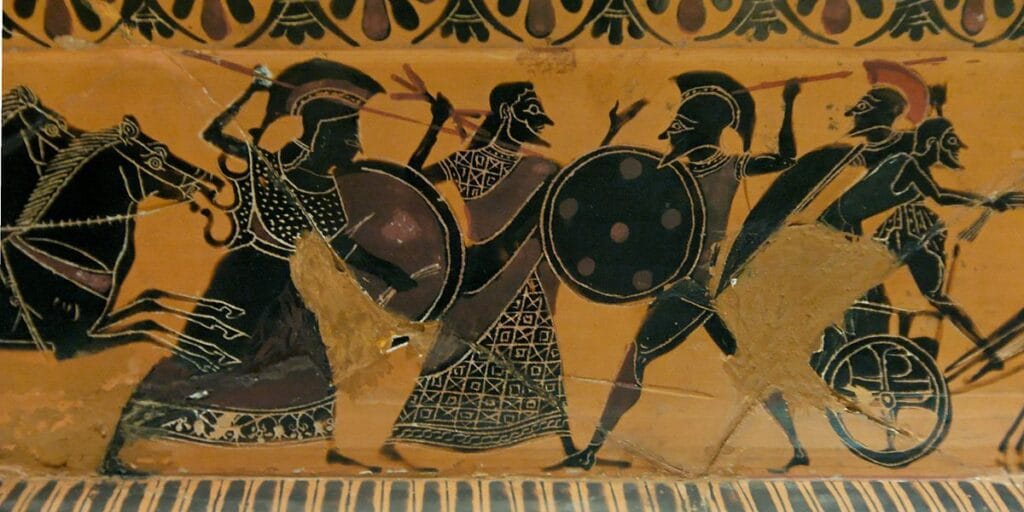
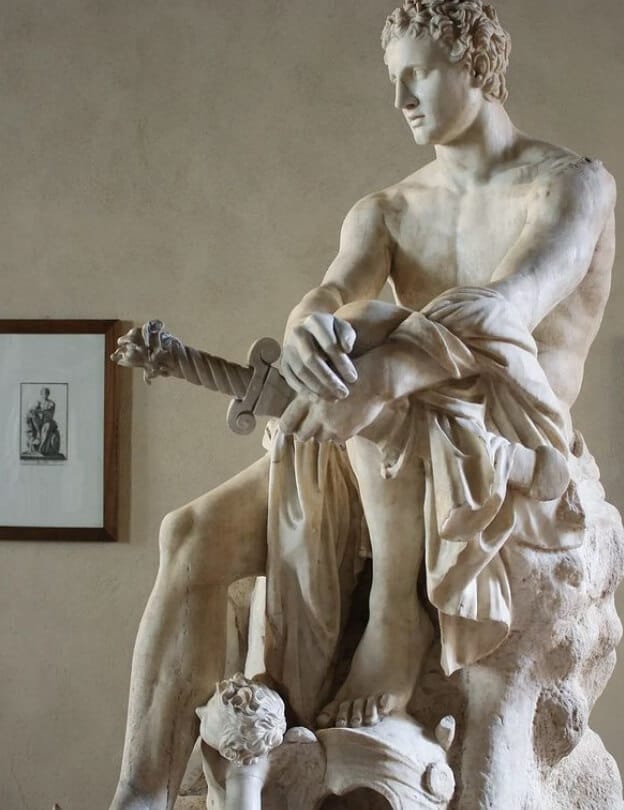
Ares’ iconography in Greek vase painting and sculpture emphasises the full panoply of war: the Corinthian helmet, the round hoplon shield, the long spear, and sometimes a war chariot drawn by fire-breathing horses. He is almost always shown in motion or alert for combat, never in the posed repose of a peacetime deity. Contrast this with the representations of Athena, who appears helmeted but often with her spear at rest, accompanied by the owl of wisdom or engaged in deliberation with other figures. The visual grammar of these two war deities captures in physical form the same distinction their myths encode in narrative: directed force and undirected force, thought and impulse, strategy and rage.
How Scholars Read These Gods Today
Modern scholarship has complicated and deepened the picture of both deities considerably. For Tyr, the key interpretive shift came from the comparative mythologist Georges Dumézil, who argued in his studies of Indo-European religion that Tyr belonged to what he called the first functional tier of the divine: sovereignty and law, not war in the purely physical sense. In Dumézil’s framework, Odin occupied one pole of divine sovereignty (wisdom, magic, the unpredictable will of the ruler) and Tyr occupied the other (contract, oath, the reliable structure of legal obligation). War, for this first tier, was a domain of jurisdiction as much as of combat.
The challenge for Tyr scholars is the thinness of the surviving record. The Prose and Poetic Eddas were compiled in Christian Iceland at a time when the active worship of the Aesir had ended. Snorri Sturluson was a sophisticated writer and politician working in the thirteenth century, not a dispassionate antiquarian, and his portrayals of the gods reflect literary and political concerns that may have reshaped older material. This is particularly relevant for Tyr, whose prominence seems to have declined sharply in the centuries before the texts were written down. Reconstructing his earlier importance requires combining the Eddic evidence with runic inscriptions, Roman votive dedications, and the linguistic evidence of the Tiwaz rune.
For Ares, Walter Burkert’s work remains foundational. His analysis in Greek Religion places Ares within the Greek tendency to personify abstract forces as divine beings with sharply defined but deliberately limited functions. Ares is war in the abstract, and war in the abstract is frightening, unproductive, and dangerous. Burkert points to a structural pattern in Greek religion where potentially dangerous divine forces were simultaneously honoured and symbolically contained, kept from becoming dominant. Ares fits this pattern: he receives cult, he receives offerings, but his stories consistently show him being managed, restrained, wounded, and corrected.
The persistence of both figures in modern popular culture is itself a form of evidence about their enduring relevance. Tyr appears in contemporary heathen and Norse-revivalist practice, where his role as the god of just war and legal honour attracts practitioners drawn to an ethics of principled force. Ares appears in film, fiction, and games, almost always coded as the dangerous temptation of unrestrained power, the villain of the war story, or the tragic figure who cannot stop fighting even when fighting destroys him. Both are still doing the cultural work they were designed to do: one insisting that conflict must be governed by principle, the other warning what happens when it is not. Scholarship on Tyr and Ares continues precisely because the contrast maps onto persistent human questions about power, restraint, and what makes a warrior worthy of admiration.
Primary sources: Snorri Sturluson, Prose Edda (c. 1220 CE); Poetic Edda, Codex Regius (c. 1270 CE), particularly the Sigrdrífumál, Lokasenna, and Hymiskviða; Homer, Iliad, Book 5 (c. 8th century BCE). Secondary sources: Walter Burkert, Greek Religion (Harvard University Press, 1985); Rudolf Simek, Dictionary of Northern Mythology (D. S. Brewer, 1993); Colette Hemingway and Séan Hemingway, “Greek Gods and Religious Practices,” Heilbrunn Timeline of Art History, Metropolitan Museum of Art (2003); Bryn Mawr Classical Review, review of Burkert’s Griechische Religion, second edition (2012); John Lindow, Norse Mythology: A Guide to the Gods, Heroes, Rituals, and Beliefs (Oxford University Press, 2001).