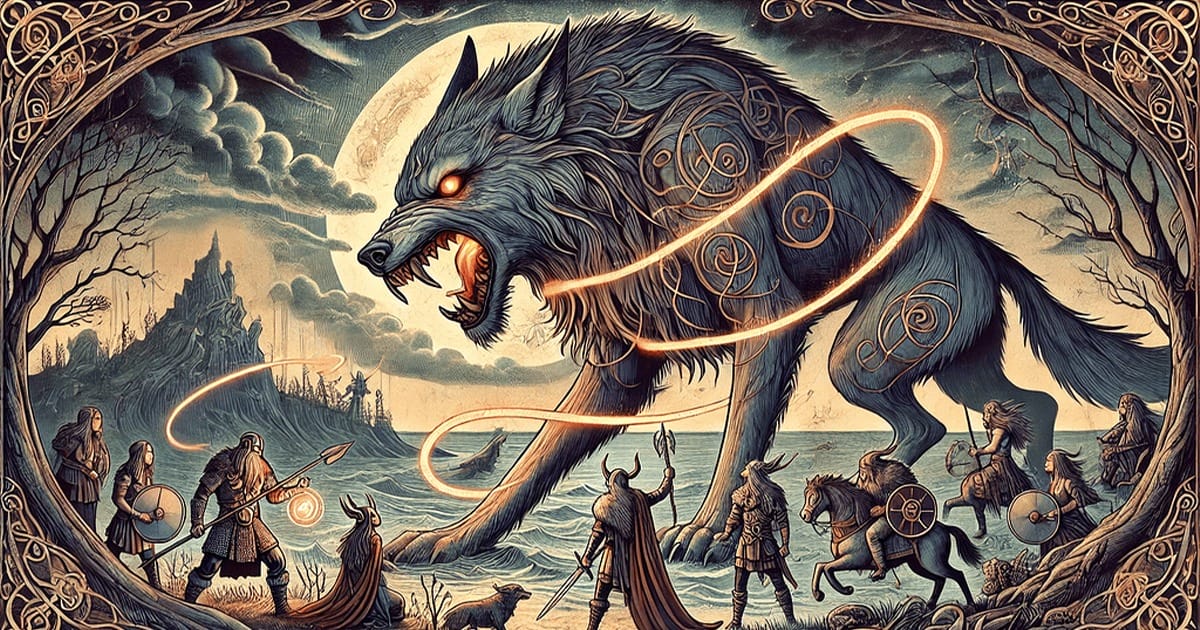
In the early fourteenth century, a scribe working in Iceland copied a set of Norse mythological poems onto vellum that had already been in circulation for centuries as oral verse. That manuscript, the Codex Regius, designated GKS 2365 4to and now housed at the Árni Magnússon Institute for Icelandic Studies in Reykjavík, is the primary source for the Poetic Edda and the closest surviving window onto the pre-Christian Norse religious imagination. Among the scenes it preserves, compressed into alliterating stanzas that assume the audience already knows the story, is the binding of Fenrir, the great wolf born of Loki and the giantess Angrboða, who is destined to kill Odin at Ragnarök. The fuller prose account appears in Snorri Sturluson’s Prose Edda, written around 1220 CE in Christian Iceland, which tells us the names of the chains, the identity of the craftsmen, the specific conversation between Fenrir and the gods, and the precise cost of the solution. Together these two sources describe one of the richest episodes in Norse mythology, one that combines cosmological inevitability, political calculation, and personal sacrifice into a single tightly engineered scene.
Who Fenrir Was and What Made Him Different from Other Wolves
Norse mythology contains a remarkable number of wolves, and distinguishing between them is important for understanding Fenrir’s specific role. Sköll and Hati chase the sun and moon across the sky, pursuing them through each day and night and destined to catch them at Ragnarök. Garmr guards the entrance to the realm of the dead and will fight Tyr at the final battle, each killing the other. These wolves are cosmic threats, but they are posted at the edges of the world, contained by their function. Fenrir is categorically different. He was raised inside Asgard itself.
His name in Old Norse is Fenrisúlfr, usually translated as “Wolf of the Fen,” the fen being the wet, marshy borderland between cultivated order and wild chaos in the Norse geographical imagination. The Prose Edda’s Gylfaginning, in chapter 34, provides the fullest account of his origins: he is the son of Loki and Angrboða, siblings with Jörmungandr the Midgard serpent and Hel, queen of the dead in Niflheim. When the Æsir received prophecies about the destruction these three children would cause, they removed Jörmungandr to the ocean encircling Midgard, cast Hel into Niflheim, and brought Fenrir to Asgard to be watched. The wolf grew with unnatural speed. Only the god Tyr, described by Snorri as the bravest of the Æsir and the guarantor of oaths and legal agreements, would approach close enough to feed him.
The decision to raise Fenrir in Asgard rather than exile him is one the sources do not fully explain. One explanation offered within the Prose Edda’s framing narrative is that the gods were constrained by their respect for the right of sanctuary: they could not shed blood on sacred ground. Another reading, which later scholars including John Lindow of the University of California, Berkeley, in his 2001 “Handbook of Norse Mythology” have noted, is that the story of Fenrir’s early life in Asgard may be a later narrative elaboration, added to make the binding scene more dramatically charged. What is certain is that by keeping the wolf nearby rather than destroying him, the gods created the specific dilemma that drives the myth: the threat is not outside the walls. It is inside them.
Læding, Drómi, and the Failure of Ordinary Chains
The Prose Edda describes two preliminary attempts to bind Fenrir before the solution of Gleipnir is reached. Both are governed by a specific ritual logic: the wolf is presented with a challenge rather than simply restrained by force. The Æsir approach him and suggest, as if it were a test of his strength and a chance for glory, that he allow himself to be bound. Fenrir, proud of his power and eager to demonstrate it, agrees. He is told the chain is called Læding. He strains, kicks once, and shatters it. The gods make a second chain, heavier, called Drómi. They present it to him again. He shakes himself and breaks it too. The pattern of the narrative is crucial: each failed attempt establishes the limit of ordinary materials while simultaneously teaching Fenrir that the gods cannot hold him by conventional means.
These two failures matter structurally because they eliminate the possibility of a simple solution. Iron and bronze, the substances of human craft, are not enough. The gods require something that operates outside the normal categories of material strength. They send Freyr’s messenger Skírnir to the world of the black elves, whom Snorri here calls dwarves, the master craftsmen of Norse cosmology, to commission something that Fenrir will not recognise as a threat precisely because it does not look like one.
What Gleipnir Was Made From and Why the Ingredients Are Paradoxical
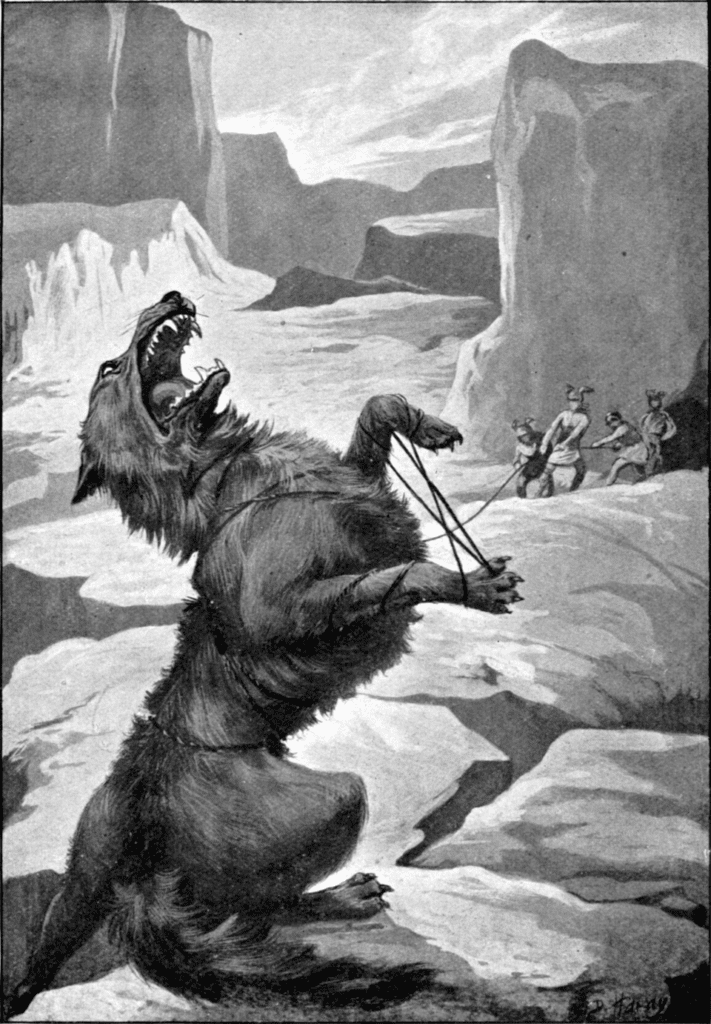
The dwarves return with a ribbon so fine it looks like silk. Snorri names it Gleipnir, a word that has been translated variously as “the entangled one,” “the deceiver,” and “the absurd lock.” Its name in Old Norse implies something that catches without appearing to grip, which is precisely its function. The ribbon is made from six ingredients, each of which is a thing that does not exist in the world, or exists in so vanishingly small a form that it cannot be detected: the sound of a cat’s footfall, the beard of a woman, the roots of a mountain, the sinews of a bear, the breath of a fish, and the spittle of a bird. Snorri adds the explanation that the reason these things cannot be found in the world today is that they were all used in the making of Gleipnir. The world is depleted of certain imperceptible substances because they were gathered and woven into an unbreakable chain.
The theological logic here is elegant and worth dwelling on. The two iron chains failed because they were made from substances that have compressive and tensile properties measurable by physical force. Fenrir could calculate how much strength he needed and apply it. Gleipnir is woven from things that have no measurable resistance because they have no physical form. You cannot calculate how much force is needed to break a sound, a breath, or a root that does not exist. The dwarves have manufactured a constraint whose strength lies entirely outside the domain of physical force, which is precisely where Fenrir’s power is greatest. Georges Dumézil, the French comparative mythologist whose work on Indo-European religious structures remains central to Norse scholarship, analysed the Fenrir myth in terms of the sovereign function in early Germanic religion. His reading, that Tyr’s sacrifice regularises what would otherwise be pure fraud and transforms an act of collective deception into a legally valid compact, gets to the heart of why the scene requires Tyr at all.
There is a second layer of meaning in the six ingredients that scholars of Norse material culture have noted. Each one represents a category of the world that is real but untouchable: sound, gender transgression, geological depth, muscular strength, breath, and saliva. Together they suggest that the binding works not by overpowering what Fenrir is but by weaving together everything he is not. The wolf is loud, male, surfacing, violent, loud-breathing, and dry with rage. Gleipnir is silent, bearded by a woman, rooted into mountains, strung with the bear’s restraint, breath of a cold fish, spit of a bird. It is his negative space made solid.
Built out of a love for history, kept free from distractions.
Spoken Past is an independent project shaped by curiosity, care, and long hours of research. Reader support helps keep it maintained, carefully researched, and open to everyone.
The Binding of Fenrir and the Wager That Cost Tyr His Hand
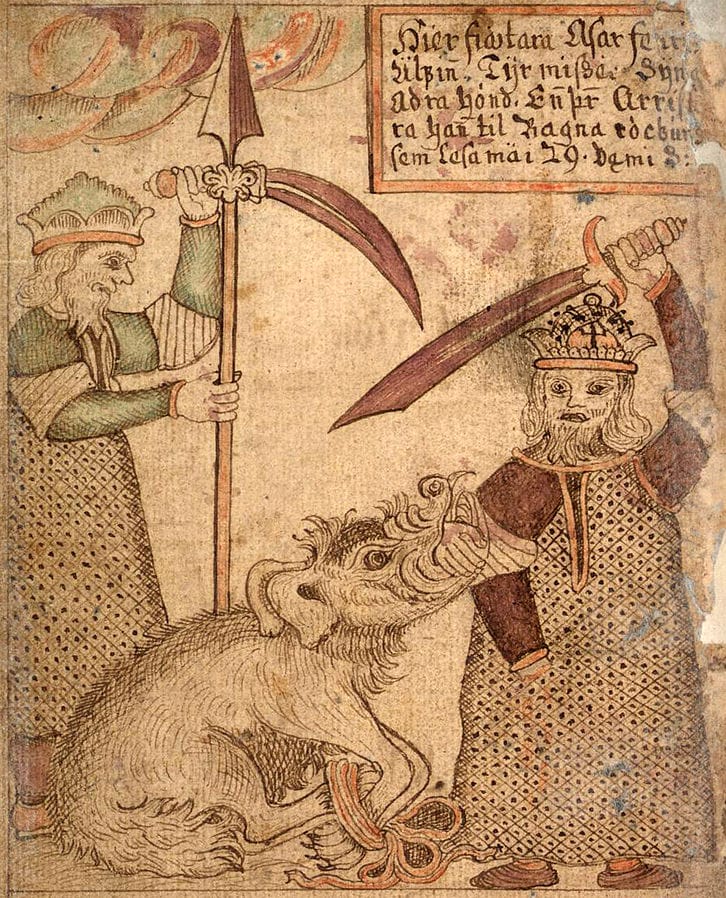
When the Æsir present Fenrir with Gleipnir, his response is immediate suspicion. The ribbon looks too slight. Something this thin cannot be a test of his strength. He agrees to submit to the binding only on one condition: a god must place a hand in his mouth as a pledge of good faith. If the gods intend to let him go when the test is over, they lose a hand. If they do not intend to let him go, they lose their honour by breaking the pledge, and Fenrir loses a hand by biting. Every god present understands what the pledge means. The gods do not intend to let him go. They know this. The wolf suspects this. The entire transaction is formally structured around a deception that both parties recognise but cannot name.
Tyr steps forward. Snorri’s prose account in Gylfaginning chapter 34 and 35 is precise: every other god refused. Tyr alone places his right hand in the wolf’s jaws. The binding proceeds. Fenrir strains with every mechanism of his strength and fails. The ribbon holds. The gods laugh. Fenrir bites down and takes Tyr’s hand at what Snorri identifies as the wolf-joint, the wrist. The Prose Edda adds with characteristic Norse dryness that Tyr “lost his hand and is not considered a promoter of settlements between people.” That last clause is the joke and the theology simultaneously: the god of legal agreements just participated in a broken oath, paid for it in flesh, and can no longer be considered a neutral mediator. The law survived. The lawgiver is maimed.
The etymology of Tyr’s name makes this sacrifice specifically resonant. As John Lindow established in his 2001 handbook and as confirmed by comparative Indo-European linguistics, Tyr derives from the Proto-Germanic *Tīwaz, which in turn derives from the Proto-Indo-European *deywos, meaning god or celestial one. The same root gives us Greek Zeus and Latin Deus. Tyr’s name literally means god, and comparative evidence from place names in Denmark, including Tislund, Tisbjerg, and Tissø, along with Roman inscriptions identifying him as Mars Thingsus, Mars of the legal assembly, suggests he held a far more central position in pre-Viking Age Germanic religion than his relatively minor role in the surviving Eddic texts implies. By the thirteenth century, when Snorri was writing, Odin had displaced him as the supreme sovereign figure. But the binding of Fenrir preserves an older theological memory: the god whose name means god alone, places his hand in the monster’s mouth so that the order of the cosmos can continue.
After the Binding and the Question of Why Fenrir Was Not Killed
Once Gleipnir holds, the gods chain Fenrir further by threading a cord through a great stone slab called Gjöll and driving that slab deep into the earth, then hammering an anchoring rock called Thviti even deeper to prevent it from moving. A sword is placed upright in Fenrir’s jaws to hold them open. The river Ván, meaning Expectation, forms from the slaver pouring from his open mouth. He will lie there, howling and drooling, until Ragnarök.
The Prose Edda itself raises the obvious question directly: why did the Æsir not simply kill Fenrir instead of binding him? The answer given within the narrative is that the gods considered the sanctuary of Asgard too sacred to defile with the wolf’s blood. That explanation strikes most scholars as a rationalization, and Snorri almost certainly invented it to paper over a theological seam. The more persuasive explanation, which Lindow and others have advanced, is that the Norse theological imagination was structured around the concept of the bound threat rather than the eliminated one. Loki is bound under a mountain until Ragnarök. The serpent Jörmungandr is contained in the ocean. Garmr is chained at the cave of Gnipahellir. Norse cosmology does not resolve its existential threats. It postpones them.
That choice to bind rather than kill has political dimensions that were audible to a Viking Age audience. A bound enemy is a known quantity. The Æsir can orient their watchfulness around a fixed point. A dead enemy might leave a vacancy filled by something worse, or might generate a blood feud with the giants and Loki’s surviving allies that could precipitate the very catastrophe the gods are trying to delay. The binding is not a victory. It is a calculated purchase of time, and everyone involved knows the time will eventually run out. The prophecy cannot be cancelled. It can only be deferred.
The Archaeological and Iconographic Evidence
Beyond the manuscript sources, the binding of Fenrir left material traces in the archaeological record, though identifying them with certainty is often difficult. The most widely cited piece of iconographic evidence is a Migration Period gold bracteate from Trollhättan, Sweden, now held in the Swedish History Museum in Stockholm, which shows a figure receiving a bite to the hand from a beast. Scholars including Hilda Ellis Davidson, whose landmark 1964 study “Gods and Myths of Northern Europe” remains foundational, proposed this as an early depiction of Tyr and Fenrir, though the identification is contested. A Viking Age hogback stone at Sockburn in County Durham, England, may also depict the binding scene, the angular shape of the carved beast suggesting a wolf in chains.
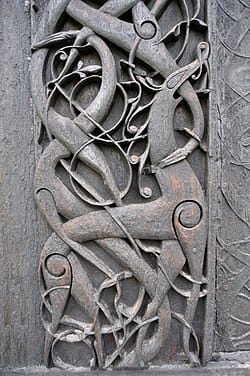
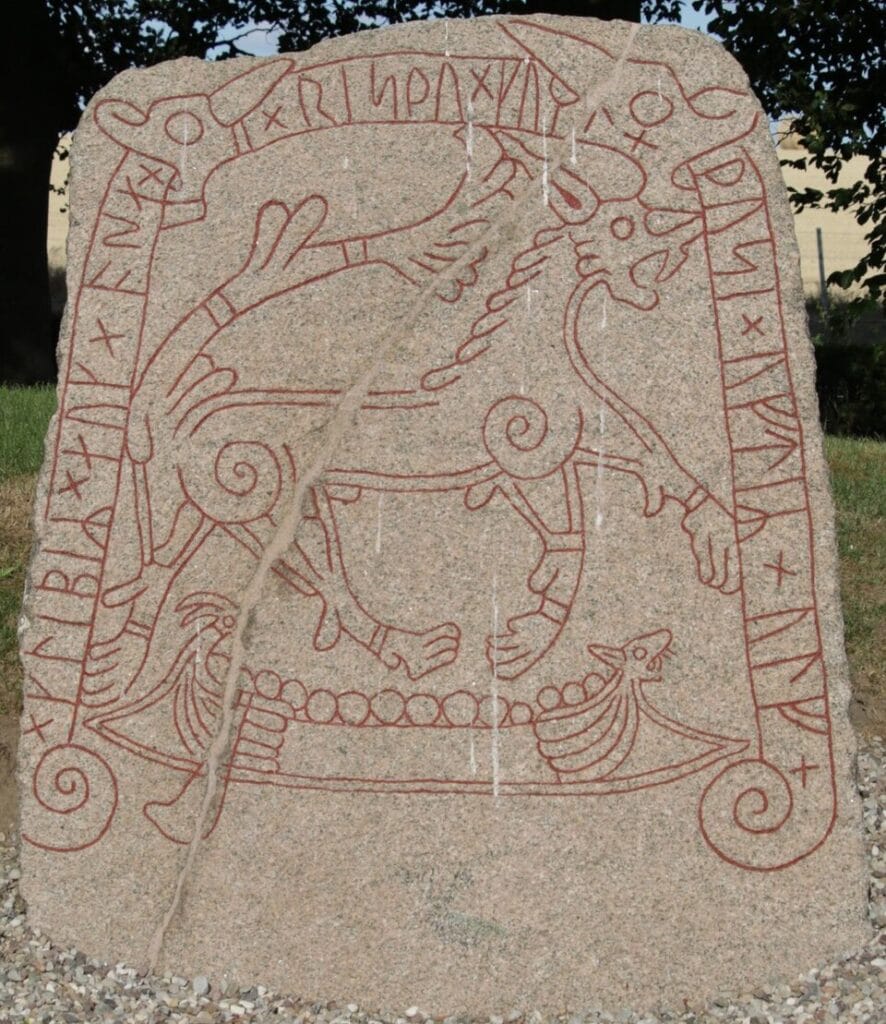
Viking Age picture stones from Gotland show bound animals with rope-like restraints, though debate continues about which scenes show Fenrir, which show the bound Loki, and which may reflect Christian influence through the imagery of the Harrowing of Hell or the bound Leviathan. The stave church portals of twelfth and thirteenth century Norway present carved beasts in interlace patterns that many art historians read as echoes of the bound-monster motif, though here the layering of pagan narrative and Christian moralizing has become so dense that certainty is rarely possible. What the physical evidence confirms, even where specific identification is uncertain, is that the image of a bound creature held by an apparently slender cord was deeply embedded in the visual vocabulary of the Norse and early medieval Scandinavian world.
Ragnarök and the Breaking of Gleipnir
The Völuspá, the first and most celebrated poem in the Codex Regius, describes the events of Ragnarök with the concentrated intensity of prophecy rather than narrative. In stanza 44, the seeress announces that Fenrir will run free. Gleipnir breaks. The wolf joins the forces of chaos in the final battle. He swallows Odin whole. Then Víðarr, Odin’s son, steps forward. The Prose Edda in chapter 51 of Gylfaginning describes what happens next with unusual precision: Víðarr places his foot on the wolf’s lower jaw. He has a specially thick shoe, made from the leather scraps that cobblers cut away at the toe and heel of every shoe they make, gathered over all the ages of the world by every craftsman who set aside the trimmings as an offering for Víðarr. He seizes the upper jaw with his hand and tears the wolf’s mouth apart.
The detail about the shoe is one of the most remarkable passages in all of Old Norse literature. The accumulated leather scraps of every cobbler in human history, saved by anonymous craftsmen who perhaps did not know what they were saving, form the weapon that kills the wolf who ate a god. Collective small acts, performed across uncounted generations, provide the means for the singular act of vengeance. The binding of Fenrir bought the time that allowed those scraps to accumulate. The delay had a purpose after all, even if no individual living through it could see the whole shape of the plan.
After Ragnarök, the surviving gods and a renewed human pair emerge into a world reborn. The bound monsters are gone, Fenrir having been destroyed, Loki and Jörmungandr having killed and been killed by Odin and Thor respectively. The cosmos that required the binding is replaced by one that no longer does. In that sense, the binding of Fenrir is not a permanent solution but a necessary phase in a cosmic process: the gods maintained order long enough for the world’s next iteration to become possible. The ribbon that looked like silk held precisely as long as it needed to hold.
Sources: Snorri Sturluson, The Prose Edda, trans. Anthony Faulkes, Everyman, 1995; trans. Jesse Byock, Penguin Classics, 2005. The Poetic Edda, Codex Regius GKS 2365 4to, Árni Magnússon Institute for Icelandic Studies, Reykjavík; trans. Carolyne Larrington, Oxford University Press, 2nd ed. 2014. John Lindow, Handbook of Norse Mythology, ABC-CLIO, 2001. Hilda R. Ellis Davidson, Gods and Myths of Northern Europe, Penguin, 1964. World History Encyclopedia, “Tyr,” April 2021. Norse Mythology for Smart People, “The Binding of Fenrir,” citing Georges Dumézil. Arnastofnun (Árni Magnússon Institute), “New Electronic Edition of the Codex Regius of the Poetic Edda.” Tacitus, Germania, trans. A.R. Birley, Penguin Classics, 1999.