In 594 BCE a poet-merchant named Solon walked into one of the most dangerous jobs in the ancient world. Athens was tearing itself apart from the inside. Smallholders across Attica had borrowed grain against their own bodies as collateral, and those who fell behind on payments lost their land first, then their freedom, sometimes sold abroad to work foreign fields. Stone markers called horoi stood in fields across the countryside as public notice that a plot or a person was pledged. The aristocratic families who dominated every magistracy and council seat were not especially interested in fixing a system that worked very well for them. Solon had been handed emergency powers by a city that had run out of better options. What he started that year, and what Cleisthenes redesigned eighty years later, and what Pericles radicalised in the generation after that, became Athenian democracy, the most imitated, most debated, most catastrophically mismanaged experiment in self-government the ancient world ever produced. This article traces exactly how that system was assembled from scratch, how its mechanical anti-corruption devices worked in practice, and how the city that invented democratic accountability nearly destroyed it twice through its own choices.
The Stone Markers That Made Revolution Inevitable
Attica’s soil was thin and punishing. A bad harvest, a sick ox, or a broken plough could push a smallholder into debt with a wealthier neighbour, and seventh-century Athenian debt contracts were catastrophic in their terms. Creditors could seize the borrower’s land as collateral, and when that ran out they could seize the borrower himself. Men who defaulted became hektemoroi, sixth-parters, bound to hand over one portion of their annual produce to the landowner and permanently tied to soil their own grandfathers had once owned outright. The physical evidence of this system is documented by the American School of Classical Studies, which has been excavating the Athenian Agora since 1931 and holds the largest collection of horoi debt-marker inscriptions in existence. The number and geographic spread of these stones across Attica make plain that debt bondage was not a fringe problem but a structural condition of rural life in the seventh century.
Solon’s first act in 594 was the seisachtheia, which translates roughly as the shaking off of burdens. He cancelled debts secured against land or persons, made it illegal in perpetuity to enslave a freeborn Athenian citizen for debt, and used public funds to buy back Athenians already sold abroad. He reorganised political participation into four wealth classes based on agricultural yield: the pentacosiomedimnoi at the top, then the hippeis, then the zeugitai, then the thetes, the landless poor who had previously possessed no formal political standing at all. High offices remained restricted to the upper tiers, but Solon created two institutions that proved decisive for everything that followed. He established a people’s court, the heliaia, where any citizen could appeal a magistrate’s ruling, and he created a new council of four hundred to prepare business for the assembly. Both moves broke the noble monopoly on legal interpretation. Both survived him.
Peisistratos, who seized power in 561 BCE and held it intermittently until 527 BCE, is an awkward figure in the democracy’s origin story, because his rule was in many respects good for Athens. He left Solon’s legal framework intact, taxed lightly, extended road networks into rural Attica, used silver revenues from the Laurion mines to fund public works, and regularised the Panathenaic festival into an event that established Athens as a cultural centre across the Greek world. He governed as a tyrant in the old Greek sense of the word, meaning one man above the law rather than a man defined by cruelty. When his son Hippias was expelled by Spartan intervention in 510 BCE, the city discovered something important: state structures built under the tyrant continued to function without a single household in charge. That fact made the next step possible.
How Cleisthenes Rewired the Entire City in a Single Reform Package
In 508 BCE, an Alcmaeonid aristocrat named Cleisthenes offered the city a structural redesign so radical that his factional rivals could not counter it before it passed. He divided Attica’s population into 139 demes, local administrative units that registered citizens by residence rather than birth or clan affiliation. He then grouped those demes into thirty trittyes, units organised by geographic zone across coast, plain, and hill country, and combined one trittys from each zone into each of ten new artificial tribes that replaced the old four kinship-based tribes entirely. The effect was that a man from the coastal deme of Phrearroi now belonged to the same tribe as a farmer from the inland uplands and a craftsman from the city itself. The old client networks that had run on geographic clustering and family loyalty were structurally disrupted at the root.
From these ten tribes came the new Boule of Five Hundred, fifty councillors per tribe, chosen annually. They prepared legislation for the full assembly, audited outgoing magistrates, and kept the machinery of city administration in motion through three hundred and sixty-five days of active service. The council’s presidency rotated through the ten tribes in sequence, with each tribe holding a period of roughly thirty-six days called a prytany. Within each prytany, a single citizen was selected by lot each day to serve as epistates, the presiding officer who held the state seal and the keys to the treasury. The rule that no man could hold the position more than once in a lifetime forced the office to circulate constantly. On any given day somewhere in Attica, a potter, a shepherd, or a carpenter was sitting at the state hearth performing the highest executive function in Athens.
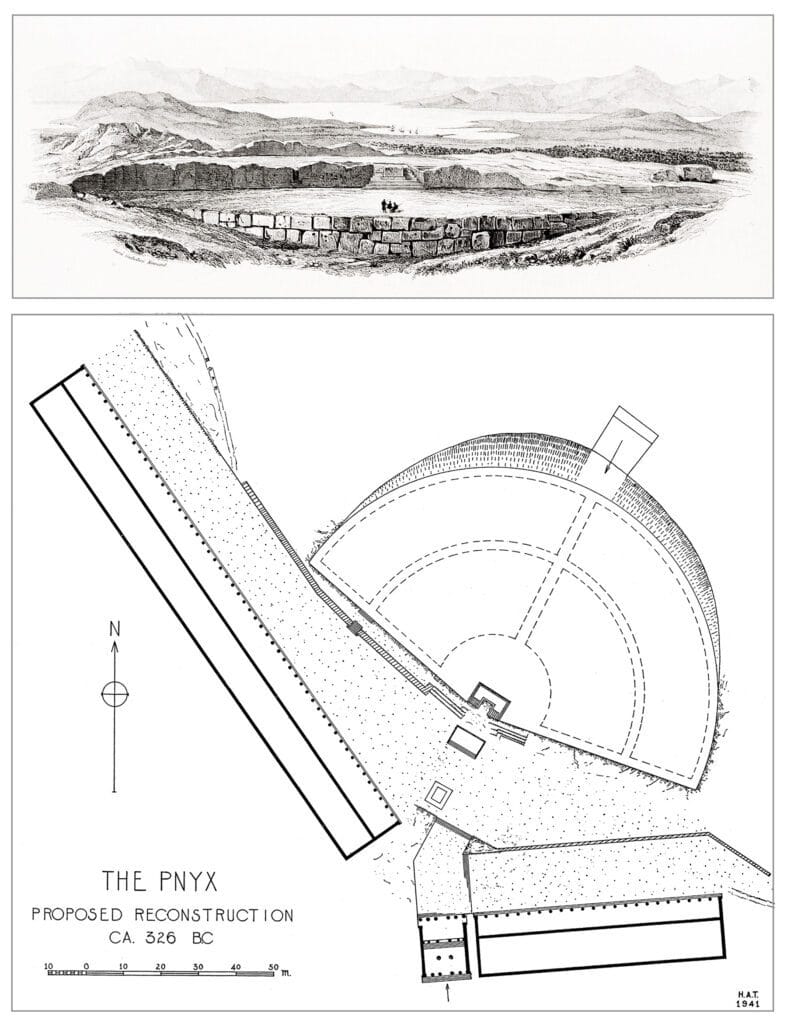
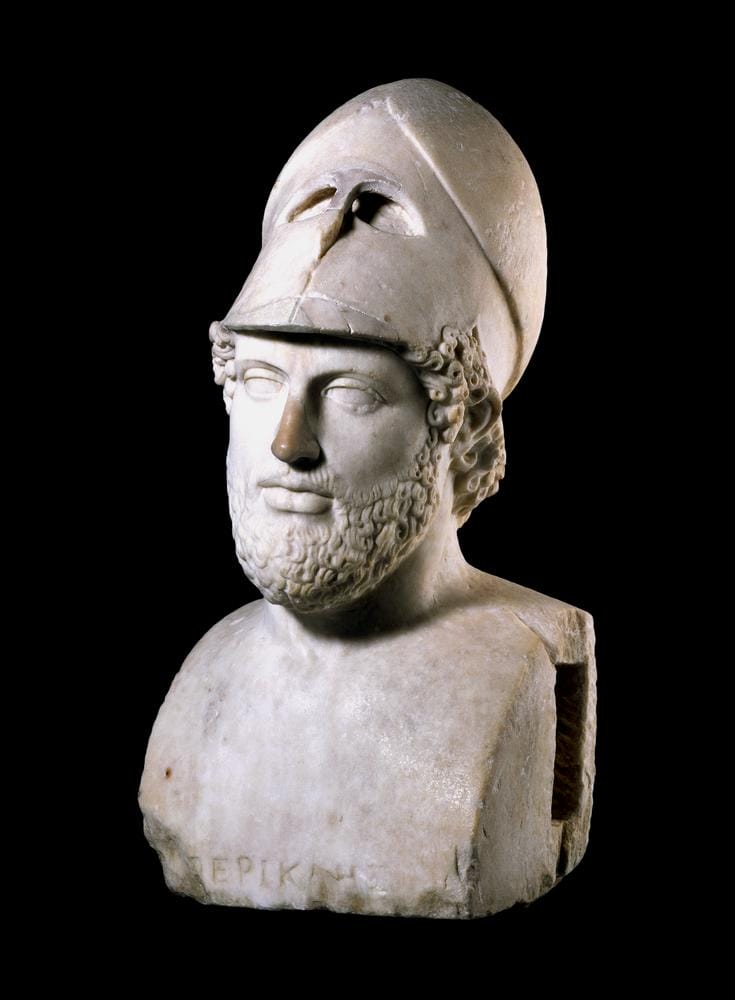
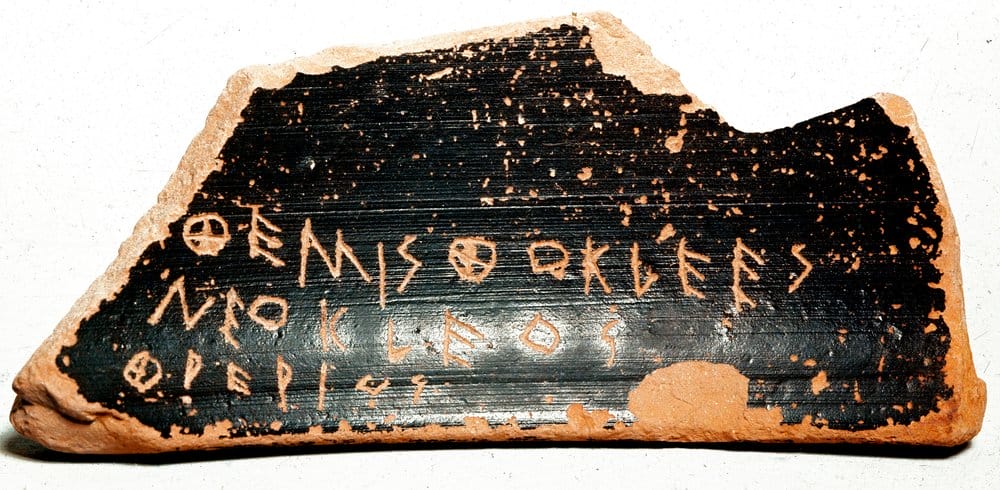
The full assembly, the ekklesia, met on the Pnyx, a rock outcrop southwest of the Acropolis that was shaped into a speaker’s platform and rising embankment capable of holding several thousand people. Major decisions required a quorum of six thousand citizens. On meeting days, Scythian public slaves stretched a rope dipped in red ochre across the agora, and any citizen found loitering in the marketplace with the ochre stain on his clothing could be fined. Attendance was not optional. The assembly decided war, peace, treaties, grain supply, the appointment of generals, and the annual budget. It voted by show of hands on ordinary matters and by pottery-shard ballot on ostracism, the annual procedure that allowed citizens to exile one person for ten years without formal charge and without confiscating his property. Thousands of these pottery ballots, called ostraka, have been recovered from Agora excavations. A famous cache of 190 ostraka all inscribed with Themistocles’ name was found in a well near the Acropolis in 1936, apparently pre-prepared by a political faction and distributed ready-written to voters who could not write.
The Kleroterion, the Machine That Made Athenian Democracy Incorruptible
Cleisthenes built the frame. Ephialtes and Pericles filled it in. In 462 BCE Ephialtes stripped the ancient Areopagus council of its supervisory powers over magistrates and transferred those functions to the popular courts and the assembly, removing the last mechanism by which aristocratic ex-magistrates could routinely veto democratic decisions. Pericles extended that logic by introducing pay for jurors, two obols per day initially and later three, roughly enough to cover a day’s food in the city. The payment mattered not because it enriched anyone but because it made sustained participation possible for men without estates who could not otherwise afford to lose a working day to public service.
The mechanism for selecting those jurors was one of the most ingenious anti-corruption devices the ancient world produced. The kleroterion was a stone slab incised with rows of narrow vertical slots, with a bronze tube attached vertically to one side. Each morning, citizens wishing to serve inserted their personal bronze identification tokens, called pinakia, into the slots in tribal groupings, one token per slot per row. Black and white balls were then poured into the funnel at the top of the tube and released one at a time from the bottom by a crank mechanism. A white ball selected an entire row of tokens, meaning all citizens in that row reported for jury duty. A black ball eliminated a row. Because the tribal arrangement ensured equal representation across each horizontal row, the resulting jury reflected the city’s population whether five hundred or two hundred jurors were needed for a given case. Sterling Dow published his catalogue of kleroterion fragments from Agora excavations in 1937, describing eleven separate machine fragments recovered from the site, and his 1939 study confirmed that Aristotle’s literary description in the Athenian Constitution matched the physical remains precisely. The fragments are now held in the Agora Museum in Athens, and the French School of Athens conducted a full-scale experimental recreation of the sortition procedure at the Agora site in October 2024.
Sortition was the default method for nearly every administrative office in classical Athens. Grain inspectors, market overseers, water commissioners, members of oversight boards, and the daily rotating presidency of the Boule were all selected by lot. Election by vote was reserved only for the ten generals and the treasurers who managed sacred funds, posts that genuinely required demonstrated expertise and could not be handed to a random citizen without obvious practical risk. The same official selected by lot then faced two rounds of public scrutiny. Before taking office he submitted to the dokimasia, a preliminary examination of his citizenship status, tax payments, and conduct. After his term he submitted to the euthynai, a public audit of his performance in which any citizen could formally accuse him of misconduct. Both procedures were run by panels of ordinary citizens. The Athenian state was designed so that a man could not acquire power, wield it, and depart without his neighbours having multiple formal opportunities to examine what he had done with it.
Built out of a love for history, kept free from distractions.
Spoken Past is an independent project shaped by curiosity, care, and long hours of research. Reader support helps keep it maintained, carefully researched, and open to everyone.
The Delian League, the Parthenon, and the Empire Athens Would Not Name
The Persian Wars of 490 to 479 BCE produced a paradox. Athens emerged from them with a reputation, an alliance network, a rebuilt navy, and a treasury it had not technically earned. The Delian League, founded in 478 BCE as a voluntary defensive alliance of Aegean Greek cities, required member states to pay annual tribute in silver or in ships toward a common fleet directed by Athens. The fund was kept on Delos under the eye of Apollo. It moved to Athens in 454 BCE, and when it did, the temptation to treat allied contributions as Athenian revenue became irresistible. The tribute records, the phoros, were inscribed on stone stelae that are still partially legible in the Epigraphical Museum in Athens. The Parthenon, begun in 447 BCE under Phidias and the architect Iktinos, was funded in significant part by those allied contributions. Member cities that objected to this arrangement and tried to leave the league found Athenian triremes arriving to discuss the matter. Athens called it a league. It was an empire.
The internal tensions this created were real and well-documented. Naval wages paid to the poorest Athenian citizens for trireme service raised the urban poor and gave them both coins and political confidence. The Athenian assembly needed those men, because a city commanding two hundred warships needed two hundred crews of roughly one hundred and seventy rowers each, and those rowers came overwhelmingly from the thetes, the lowest property class. The political logic was tight: you could not simultaneously depend on poor citizens to row the fleet that built your empire and deny those citizens a voice in how the empire was run. Jury pay, sortition for offices, and assembly participation were the institutional acknowledgements of that bargain. At the same time, metics, the resident foreigners who ran a large portion of Athenian trade and manufacturing, paid special taxes for the right to live in the city and could not vote. An estimated one hundred thousand enslaved persons laboured in households, workshops, and the silver mines at Laurion. The demokratia celebrated freedom at the assembly while resting economically on unfreedom everywhere else.
The legal checks Athens built to restrain its own worst impulses deserve attention here because they were not decorative. The graphe paranomon allowed any citizen to prosecute the proposer of a decree that contradicted existing law. A successful prosecution could result in fines, disenfranchisement, or in serious cases execution for the proposer. Aristotle describes this mechanism in detail in the Athenian Constitution, a text lost for almost two millennia until two papyrus manuscripts surfaced in 1879 and 1890. The graphe paranomon created friction between popular enthusiasm and binding law. It was never perfect. Brilliant speakers could still move crowds in directions that no legal review caught in time. But the mechanism existed, it was used regularly, and it made Athens structurally different from any other polity in the ancient world.
How the Sicilian Expedition Showed Athenian Democracy at Its Most Dangerous
The twenty-seven years of the Peloponnesian War between 431 and 404 BCE are where Athenian democracy met the conditions that exposed every structural weakness in the system. Pericles’ strategy at the war’s opening was to pull the rural population inside the Long Walls linking Athens to the port at Piraeus, refuse pitched land battles where Spartan infantry excelled, and use the fleet to raid Peloponnesian coasts at will. It was a strategy built for patience. Disease ended it. In 430 BCE a plague of uncertain identity entered the overcrowded city and killed somewhere between a quarter and a third of the population over repeated waves between 430 and 426 BCE, including Pericles himself in 429. Command fragmented. New leaders rose through the assembly by force of voice, and some of those voices were considerably more persuasive than they were wise.
The Sicilian Expedition of 415 to 413 BCE is the clearest case study in how the assembly’s genuine strengths, its speed of decision and its real collective stakes, became catastrophic liabilities when emotion ran ahead of evidence. Athens voted in 415 to send a fleet to Sicily and capture Syracuse, on the argument that control of Sicilian grain and silver would give Athens the resources to end the war. The initial force approved was sixty triremes. Nicias, one of the three appointed commanders, argued in the assembly that the force was too small and tried to bluff the assembly into withdrawing the expedition by demanding a much larger one. The assembly called his bluff and approved the larger force. The expedition that finally sailed from Piraeus in the summer of 415 comprised one hundred and thirty-four triremes, five thousand one hundred hoplites, and a large complement of support ships. Thucydides describes it as the most costly and splendid Hellenic force ever sent out by a single city up to that time.
It never had a functioning command structure. The night before departure, someone systematically mutilated the herms throughout Athens, stone boundary markers with the god’s face that stood at doorways and crossroads across the city. The religious panic was immediate. Rumour linked the desecration to Alcibiades, one of the three commanders. He demanded immediate trial to clear his name before sailing. The assembly refused the delay and sent the fleet anyway. When Alcibiades was recalled weeks later to face charges, he defected to Sparta and began advising Spartans on how to defeat the very expedition he had designed. Lamachus, the third commander, died in action early in the campaign. Nicias, opposed to the expedition from the beginning and suffering from kidney disease throughout, found himself trying to besiege a city that had been given months to prepare its defenses and had received the experienced Spartan general Gylippus to stiffen its resistance.
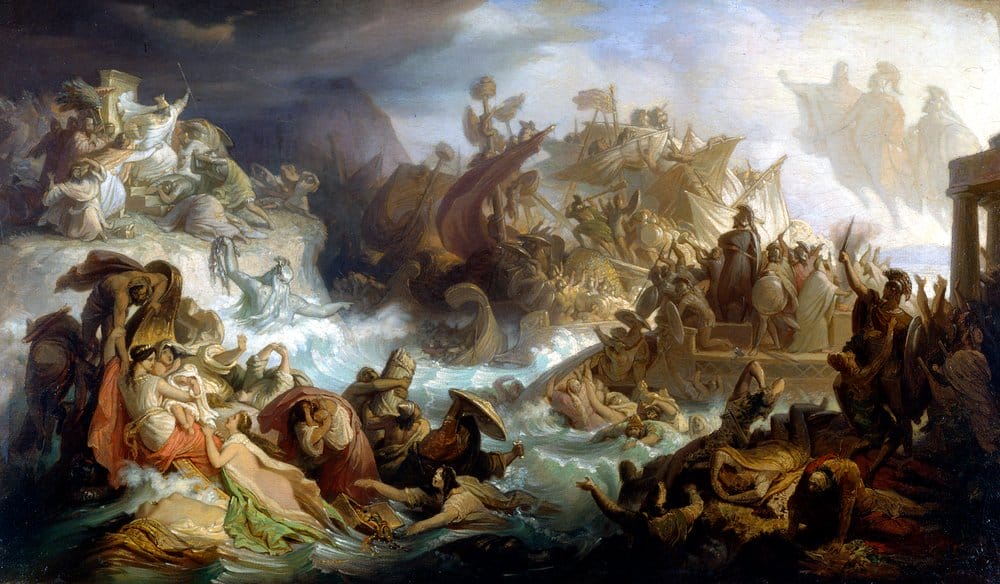
The Syracusans sealed the harbour mouth by chaining merchantmen together across the entrance and driving timber piles into the shallows to block the passage of triremes. The Athenian fleet fought repeated naval engagements in confined water where its superior open-sea speed and ramming tactics gave it no advantage over vessels that simply did not need to manoeuvre. By late 413 BCE the harbour was fully blocked and the army stranded. Survivors who attempted retreat inland were run down by Syracusan cavalry. Those captured were confined in the stone quarries known today as the Latomia dei Cappuccini outside the city, where they died of exposure, thirst, and disease in the Sicilian summer heat. The total losses were staggering: at least forty thousand men killed or captured according to most scholarly estimates, and around two hundred triremes destroyed, each requiring a trained crew of one hundred and seventy rowers that Athens could not quickly replace.
The institutional damage that followed was as serious as the military losses. In 411 BCE, with the city financially stressed and militarily weakened, a group of wealthy citizens pushed through an oligarchic coup, replacing the assembly with a council of four hundred on the promise that a broader body of five thousand would follow. The fleet crews stationed at Samos refused to accept the change and declared for democracy, creating a situation where Athens’ most powerful military instrument was operating independently of the government in Athens. The Four Hundred collapsed within months, but the precedent stuck in memory. Then in 406 BCE, after the naval battle of Arginusae where Athens won but a storm prevented recovery of crew members from sunken ships, the assembly tried and executed six of the eight victorious generals in a single mass proceeding that violated the Athenian legal guarantee of individual trial. Socrates, serving that day as epistates of the council, refused to put the illegal vote to the assembly. He was overruled. The generals died.
The Thirty Tyrants, the Amnesty of 403 BCE, and What the Second Democracy Got Right
Lysander’s Spartan fleet destroyed the Athenian squadron at Aegospotami in 405 BCE, cutting off the grain supply from the Black Sea. Athens starved and surrendered in 404. The Long Walls were pulled down to flute music by Spartan allies. A junta of thirty men installed by Sparta, known afterwards as the Thirty, executed an estimated fifteen hundred Athenians in eight months, seized the property of metics to fund their rule, disarmed the wider citizenry, and reduced political participation to a list of three thousand hand-picked loyalists. The Thirty were not a reform government. They were a purge dressed in constitutional language.
The restoration came from outside. In 403 BCE, a group of democratic exiles led by the general Thrasybulus seized the fortified position at Phyle in the hills north of the city, then captured the port of Piraeus. When a Spartan king arrived to negotiate rather than reinforce the junta, the Thirty lost their last guarantee. The agreement that ended the conflict included an amnesty for all past political acts, with specific exceptions for the Thirty themselves and their immediate enforcers. The amnesty held. Athens made a deliberate choice not to relitigate the civil war in its courts, and that choice allowed the city to function. The trial of Socrates in 399 BCE, on charges of impiety and corrupting the young, was a disturbing exception that showed how far old resentments could travel even under amnesty, but the city did not reopen general political prosecutions.
What the restored democracy then built with its second chance was, in several respects, more carefully designed than its predecessor. The city undertook a systematic revision of its entire law code, inscribed the results on stone, and established a formal separation between laws, which were permanent and required a special legislative process to change, and decrees, which were temporary and could not override standing statute. The public archive, the Metroon in the Agora, was reorganised and maintained as a reference that any citizen could consult, so no orator could claim ignorance of a law that inconvenienced his argument. The graphe paranomon, which had existed before 404, was refined and used far more consistently in the fourth century as a genuine brake on hasty legislation. The American School of Classical Studies excavations at the Agora, which have continued almost without interruption since 1931 and have produced over twenty-five volumes of primary findings, have recovered the physical infrastructure of this archival and legal machinery, including boundary markers, official weights, ballot boxes, and jury equipment that confirms the literary descriptions in extraordinary detail.
The fourth-century democracy added small attendance fees for assembly meetings, probably in the early decades after restoration, to counter the persistent problem that assemblies meeting without financial incentive skewed toward citizens with leisure time rather than citizens with working lives. The move reflected a lesson learned: that equality of nominal participation and equality of actual participation are different things, and that the gap between them requires active maintenance. Mogens Herman Hansen’s detailed reconstruction of assembly procedure in The Athenian Democracy in the Age of Demosthenes estimates that the assembly met forty times per year in the fourth century, a schedule intensive enough to require that compensation if poor citizens were to attend regularly.
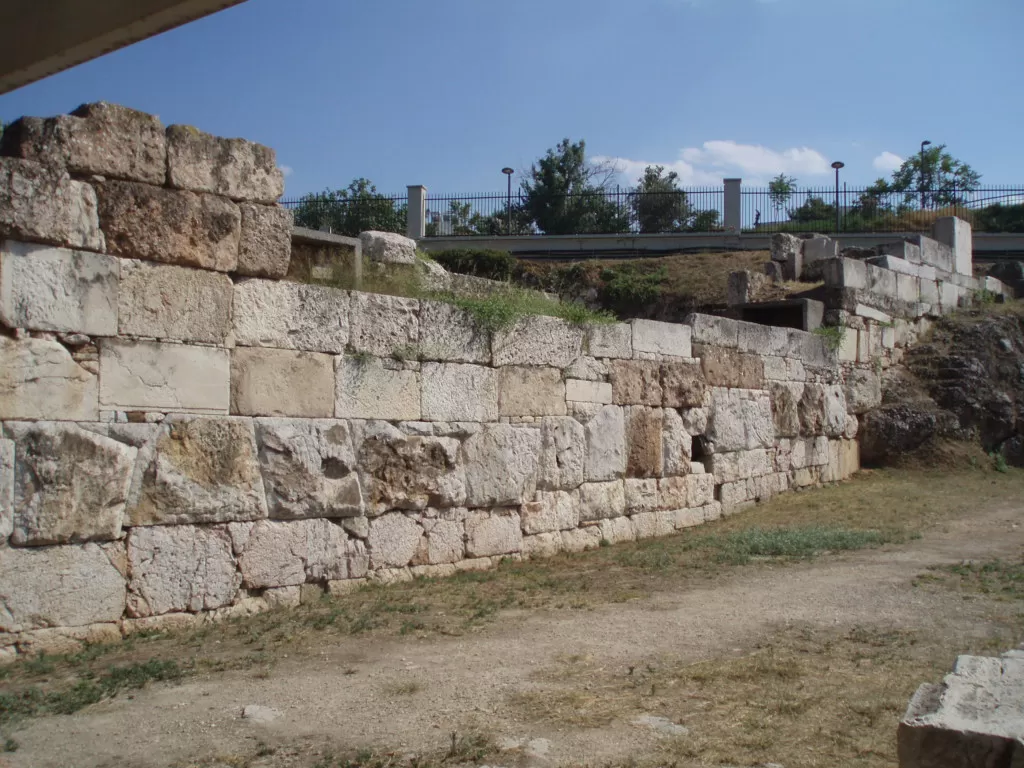
Philip II of Macedon defeated Athens and Thebes together at Chaeronea in 338 BCE. A Macedonian garrison occupied the port at Munychia. The assembly continued to meet and the courts continued to function, but the decisions they made no longer determined Greek foreign policy. The institutions survived the loss of sovereignty in a form that outlasted the walls, the fleet, and the empire. Athenian legal procedures and administrative models were absorbed by Hellenistic kingdoms across a territory stretching from Egypt to Bactria, and the Romans, who had been in commercial and intellectual contact with Greek models for centuries, built their own republican institutions in partial conversation with what Athens had assembled. The vocabulary of democratic accountability, the idea that officials answer publicly to citizens, that law stands above any individual, that power requires scrutiny after use and not just before, came from Athens in a form clear enough that Aristotle could write the Athenian Constitution in the 330s BCE precisely because the machinery was visible, documented, and shared. That legibility was itself the system’s most durable achievement.