
A quill pen scratches across stretched calfskin. The scribe’s hand moves with practiced precision, forming letters in bold insular majuscule script. Around him, perhaps three other scribes work on different sections of what will become the most lavishly decorated gospel book ever produced in medieval Europe. The year is close to 800 AD. The place is likely Iona, the tiny island monastery off the coast of Scotland where St Colum Cille had established his community two centuries earlier. However, these monks cannot know that within a decade, Viking longships will shatter their world and force them to flee to Ireland, carrying their precious, unfinished masterpiece with them.
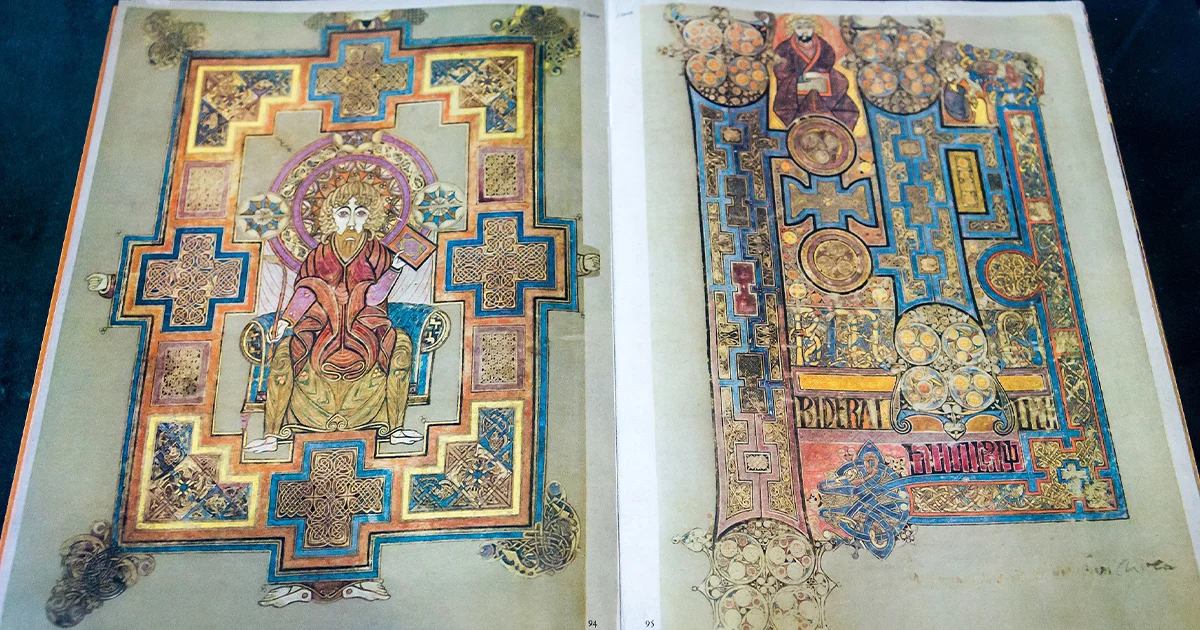
The Book of Kells stands as the supreme achievement of insular art, a term scholars use to describe the artistic style that flourished in Ireland and Britain between the seventh and ninth centuries. This manuscript contains the four Gospels in Latin, preceded by canon tables, summaries of gospel narratives, and other preliminary texts. Its 340 surviving leaves measure approximately 330 by 255 millimeters, though they were severely cropped in the nineteenth century. At least thirty leaves have been lost over the centuries, including major decorated pages.
A Monastery Between Two Worlds
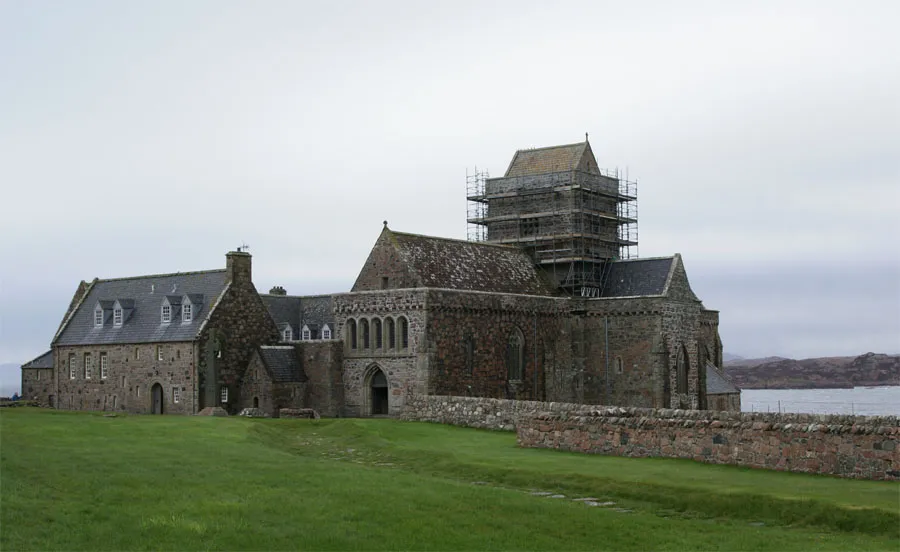
The monastery of Iona occupied a precarious position by the late eighth century. Founded around 561 by St Colum Cille, it had grown into the prosperous head of a confederation of monastic houses exercising wide influence over ecclesiastical affairs in Ireland and northern England. The island measures only about 5.5 kilometers from north to south and 2.5 kilometers at its greatest width, yet it supported a sizeable monastic community with enough arable land and grazing for their needs.
This same location that made Iona an ideal spiritual refuge and cultural crossroads also left it exposed to seaborne raiders. Vikings pillaged the monastery in 795, returning in 802 for another devastating attack. In 806, they killed sixty-eight members of the community in a third raid. The surviving monks recognized they could no longer remain safely on their island home. In 807, they began establishing a house of refuge at Kells in County Meath, Ireland, on a site granted to them in 804. For many years after, the two monasteries functioned as a single community.
The Book of Kells was almost certainly written close to this tumultuous period. Scholars have debated for generations whether it was begun at Iona and completed at Kells, created entirely at one location, or perhaps even interrupted by the Viking raids and subsequent migration. The manuscript itself provides clues through its incomplete state. Several pages remain unfinished, with decoration begun but abandoned at early stages. Folios 29v through 31v show elaborate designs traced in ink but never filled with color. A crucifixion scene was probably intended for the blank folio 123v but was never executed.
The Raw Materials of Sacred Art
Creating the Book of Kells required enormous resources. The manuscript was written on vellum, prepared calfskin from young calves. The physical examination of the vellum reveals that most gatherings were made from bifolia cut so the spine of the calf runs horizontally across the middle of the book, following standard manuscript practice. However, two gatherings contain leaves where the spine runs vertically, taken from calves killed at roughly two or three months old. These slightly thicker skins were preferred by the artists for pages of major decoration.
The calculations are revealing. The Book of Kells in its original state used the skins of around 185 calves. Since only one or two bifolia could be produced from young calves, these animals would have been culled from a herd of over 1,200 head, or more if the book was produced in a short time. Such a large herd confirms the considerable wealth of the monastery where the book was made and suggests that the skins came from more than one source, supported perhaps by other monasteries in the Columban federation.
The preparation of vellum followed established procedures. Hair was removed from the skin by immersing it in lime or excrement, then working it with a knife. The skin was tensioned on a frame, and a semicircular knife removed remaining hair and debris. Once cut to size, pages were ruled for text with a wooden or bone instrument, following guidance from prickings made on either side with a stylus or knife point. Occasionally, the monks had to make use of available skins whether perfect or not. Certain leaves bear sizeable holes created during the flaying of the pelt, and many folios show small holes from bacterial damage during skin preparation.
Pigments From Distant Lands
The Book of Kells employed a rich palette of organic and mineral pigments, some imported from the Mediterranean region at considerable cost. The most expensive pigment was lapis lazuli, used for several shades of blue. This precious stone was known in the Middle Ages from only one source, a mine in northeast Afghanistan, and must have reached Ireland in small quantities through complex trade networks. Other blues came from the oriental plant indigo or from woad, native to northern Europe.
Yellow was derived from orpiment, yellow arsenic sulphide, known in the Middle Ages as auripigmentum or gold pigment. This material shines out from the pages as a substitute for gold leaf. Organic mauves, maroons and purples may have come from the Mediterranean plant Crozophora tinctoria. Red lead provided most of the orange reds, with a kermes red produced from the pregnant body of the Mediterranean insect Kermoccocus vermilio. A copper green was also used, though this proved unstable when damp and perforated the vellum in several places.
The binding medium was normally egg white. The order of work on the unfinished folios reveals the sequence of pigment application. Yellow orpiment was followed by organic purple, then by dotting in red lead. Pigments were applied in complex combinations and techniques, including the unusual practice of adding a thin translucent wash of one color on top of another. Relief effects were achieved through layering as many as three pigments on top of a ground layer, creating a three-dimensional effect largely lost when the leaves were wetted for flattening in the nineteenth century.
The Scribes and Their Methods
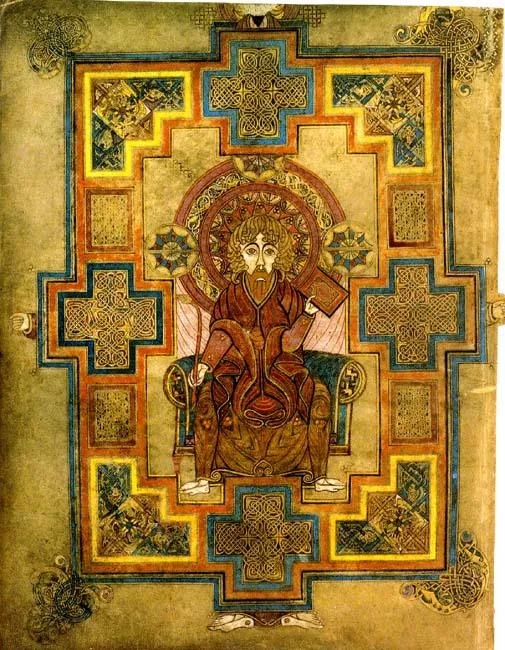
The portrait of St John on folio 291v shows the tools of the scribal trade. The evangelist holds in his right hand a stylized quill pen made from the tail feathers of a goose or swan. Scribes at this time also made some use of reeds. In his left hand, St John holds his gospel book, bound in red and purple, probably conveying an accurate impression of the manuscript’s original binding. At his right foot sits an inkpot, probably made from a cow horn stuck into the earth.
Most text pages were written with brownish iron-gall ink, made from crushed oak apples and sulphate of iron in a medium of gum and water. A black carbon ink made from lamp black or soot was used on several preliminary pages in combination with red, purple and yellow script. The scribes used knives to excise mistakes. Painting was done with brushes of varying fineness, the finest perhaps made from marten fur.
Drawings were constructed using compasses, dividers, set squares, rulers and templates or French curves, underpinned by complex mathematical formulae. The extraordinary fineness of the decoration, especially marked on pages like the eight-circle cross or the Chi Rho page, raises the question of whether the scribes could call on the assistance of magnifying instruments. Crystals may have been used, though they would probably have introduced some element of distortion.
Built out of a love for history, kept free from distractions.
Spoken Past is an independent project shaped by curiosity, care, and long hours of research. Reader support helps keep it maintained, carefully researched, and open to everyone.
Four Hands, One Vision
At least four major scribes worked on the Book of Kells, identified by scholars as Hands A, B, C and D. All four were clearly products of the same scriptorium, trained in the same way, with few obvious differences in letter forms. All shared a fondness for ending a line of text on the line above for decorative effect and to make use of space. Later Irish scribes termed this device “turn-in-the-path” or “head-under-wing.”
Scribe A can be characterized as having a conservative, sober hand with little instinct for decoration. He began the preliminary texts, began and completed St John’s gospel, and began St Mark’s gospel. Scribe B was aptly characterized by scholar Françoise Henry as an extrovert, with a fondness for using colored inks and completing his page with a flourished endline in minuscule. Scribe B completed the canon tables, the preliminaries, and St Matthew’s gospel, and supplied rubrics and other additions throughout the manuscript.
Between them, scribes C and D copied the bulk of Matthew, Mark and Luke in a manner that combined the writing of the page with its decoration. Pages executed by these scribes demonstrate that the same person was responsible for the script, the initials, and the interlinear decoration of the page. This leads naturally to the conclusion that scribe and artist did not necessarily perform separate functions in the manuscript. On some pages, script can be seen under magnification to impinge on areas of pigment, showing conclusively the scribe following decoration rather than the conventional sequence.
The Great Decorated Pages
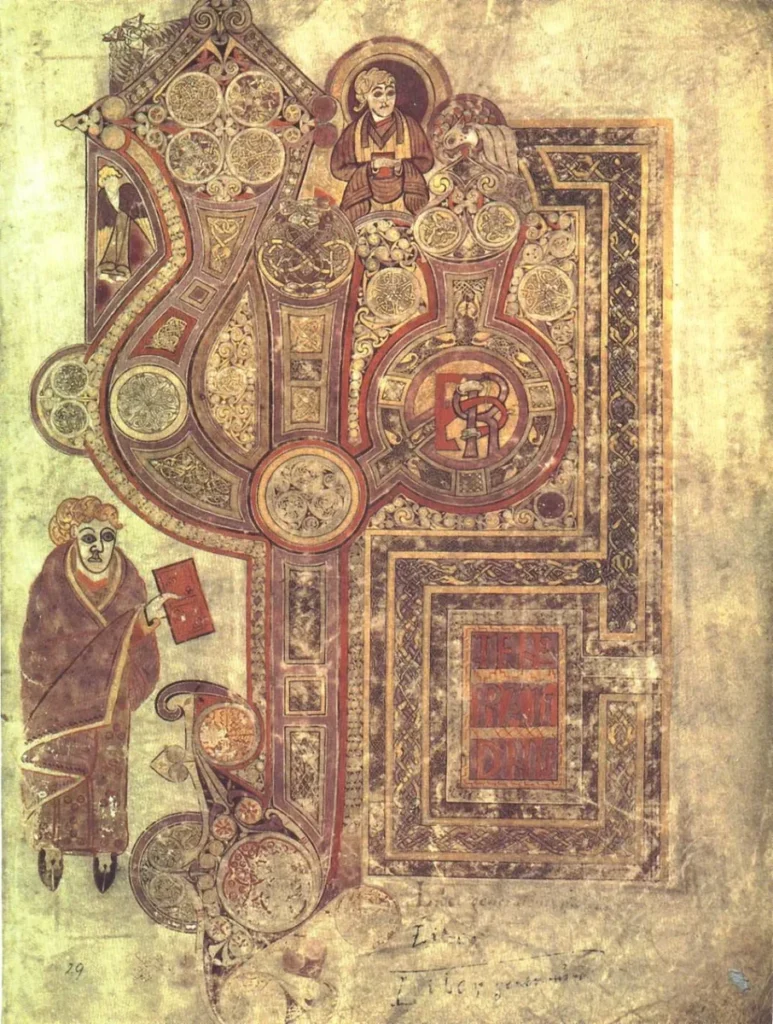
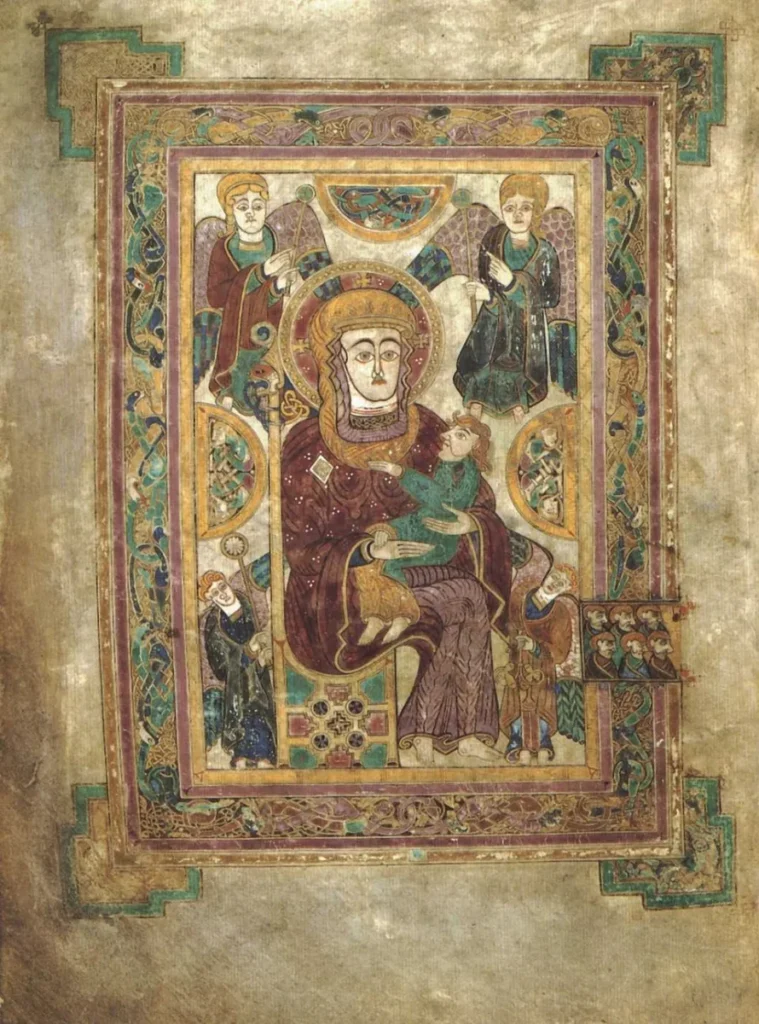
The major decorated pages are complex in composition and iconography. They comprise architectural canon tables, pages grouping symbols of the evangelists, a depiction of the Virgin and Child surrounded by angels, portraits of St Matthew and St John, narrative scenes representing the arrest and temptation of Christ, and a page wholly of decoration depicting a double-armed cross with eight roundels embedded in a frame. The famous Chi Rho page introduces St Matthew’s account of the nativity.
The opening words of each gospel are elaborated extensively. “Liber generationis” begins Matthew on folio 29r. “Initium evangelii Iesu Christi” opens Mark on folio 130r. “Quoniam” begins Luke on folio 188r. “In principio erat verbum” opens John on folio 292r. Other passages given additional decorative emphasis mark important liturgical readings, particularly those connected with the Easter season. The arrangement and elaboration of incipits show the influence of a lections system on the choice and placement of full-page illustrations and accompanying ornamented text pages.
The decorative plan appears to have been that each gospel should be introduced by a page of evangelist symbols, a portrait page, and an elaboration of the opening words or letters. It was common for pages of major decoration to be painted on single leaves so that transcription of the rest of the text might continue without interruption on conjoint leaves while the more time-consuming task of decoration was in progress. Single leaves were liable to become detached and lost or misplaced in subsequent bindings, which may explain why no portrait now accompanies St Mark’s or St Luke’s gospel.
Stolen and Recovered
In the middle ages the manuscript was revered at Kells as “the great gospel book of Colum Cille.” The Annals of Ulster record the theft of such a book in 1007 from the western sacristy of the great stone church of Kells and its recovery after two months and twenty nights “covered by a sod.” The phrase “the most precious object in the western world” occurs in the annalistic entry. It is safe to assume that the book in question is the Book of Kells. The manuscript’s gold and silver had been taken off it, though whether this refers to a treasure binding or to an ornamental shrine that protected it remains unclear.
The manuscript was inarguably at Kells from late in the eleventh century, when it was used to record property transactions. In 1090, the Annals of Tigernach reported that relics of Colum Cille were brought to Kells from Donegal, including two gospels, one of them surely the Book of Kells. The book was lost to the town in the seventeenth century during the disruption of the Cromwellian period. Around 1653, the governor of Kells sent it to Dublin for reasons of safety, and a few years later it reached Trinity College Dublin through the agency of Henry Jones, a former scout master general to Cromwell’s army in Ireland who became bishop of Meath in 1661.
The association with St Colum Cille persisted in the popular mind until the nineteenth century, and it was as “St Columba’s book” that it was introduced to Queen Victoria in 1849. By the mid-nineteenth century, the manuscript was on display in the Long Room of the College library, gradually assuming a new role as an art object. The evidence allows us to say that the book came about through the conjunction of a perceived need and the opportunity afforded by the presence of several artists and scribes of conspicuous talent, working in a wealthy and stable community during the brief period of relative calm between the arrival of Christianity in Ireland and the full fury of the Viking age.
Sources and further reading
Bernard Meehan, The Book of Kells: An Illustrated Introduction to the Manuscript in Trinity College Dublin (New York: Thames and Hudson, 1994).
Felicity O’Mahony, ed., The Book of Kells: Proceedings of a Conference at Trinity College, Dublin, 6-9 September 1992 (Aldershot: Scolar Press, 1994).
Peter Fox, ed., The Book of Kells, MS 58, Trinity College Library Dublin: Commentary (Luzern: Faksimile Verlag, 1990).
Adomnán, Life of Columba, ed. A.O. and M.O. Anderson, revised edition (Oxford, 1991).
Annals of Ulster, ed. W.M. Hennessy and B. MacCarthy, 4 vols (Dublin, 1887-1901).
J.J.G. Alexander, Insular Manuscripts, 6th to the 9th Century: A Survey of Manuscripts Illuminated in the British Isles, 1 (London, 1978).
Françoise Henry, The Book of Kells: Reproductions from the Manuscript in Trinity College Dublin, with a Study of the Manuscript (London, 1974).
George Henderson, From Durrow to Kells: The Insular Gospel-books 650-800 (London, 1987).