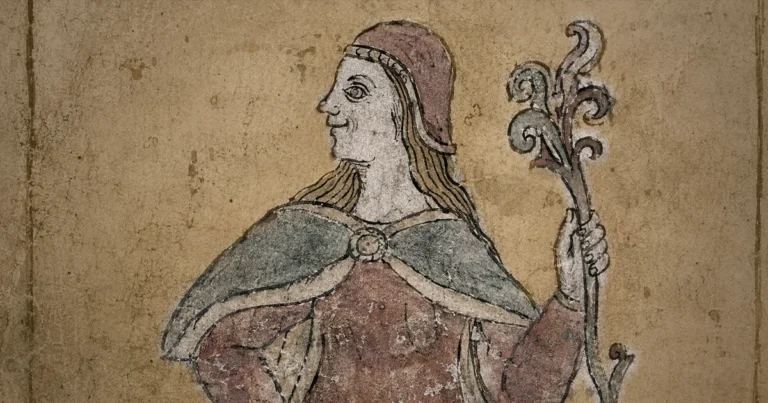

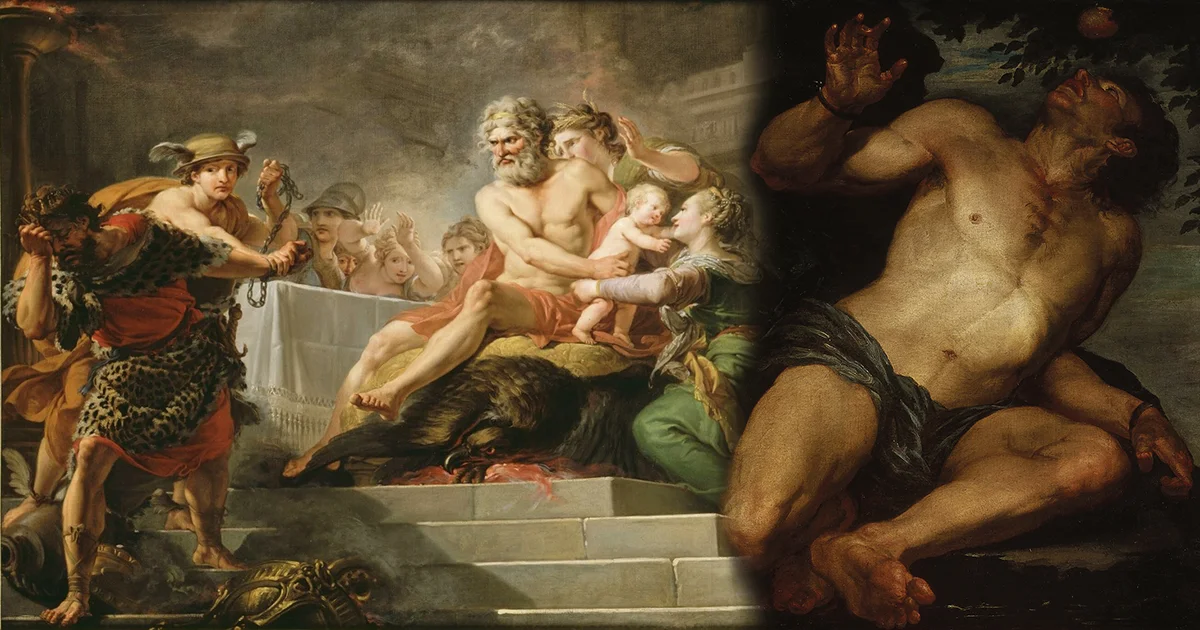
Tantalus, son of Zeus and the nymph Plouto, ruled Lydia in western Anatolia and enjoyed a privilege granted to almost no mortal: he dined with the gods on Mount Olympus, tasting ambrosia and nectar, and learned their secrets. His hubris destroyed that honor. He killed his own son Pelops, butchered him, and served the cooked flesh to the Olympians at a banquet to test their omniscience. All the gods recognized the abomination immediately except Demeter, grieving for her daughter Persephone, who bit into Pelops’s shoulder. Zeus resurrected the boy, replacing the eaten shoulder with ivory crafted by the Fate Clotho, and condemned Tantalus to an eternity of punishment in Tartarus.
The King and His Divine Heritage
Tantalus ruled a prosperous kingdom in Lydia, a region in what is now western Turkey, during the generations before the Trojan War. His father Zeus made him a demigod with access to Olympus. His mother Plouto, a nymph associated with wealth, gave him royal standing and material abundance. Ancient genealogies record that Tantalus married Dione, an early consort of Zeus in some traditions, or Euryanassa, daughter of the river god Pactolus. These unions produced several children, including Pelops, Niobe, and Broteas.
The poet Pindar, writing in the fifth century BC, places Tantalus among the few mortals granted divine intimacy. He feasted with Zeus, Hera, Apollo, and the other Olympians, learning secrets no human should possess. This privilege reflected both his parentage and his kingdom’s wealth. Lydia controlled rich gold deposits and trade routes connecting Anatolia to the Aegean, making Tantalus a figure of power and influence in the mythic age.
The Crime at the Banquet
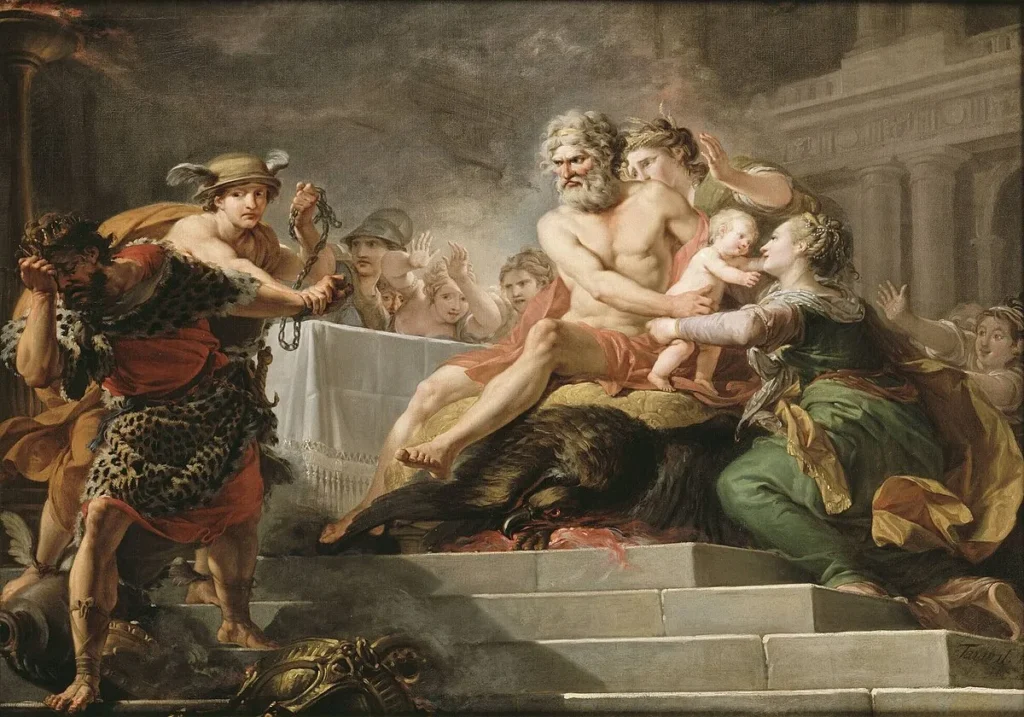
Tantalus decided to test the gods’ omniscience by committing an unspeakable act. He killed Pelops, his young son, dismembered the body, cooked the flesh in a cauldron, and served it to the Olympians at a feast he hosted. The king believed he could deceive the gods and prove they were not truly all-knowing. This was not a rash impulse but a calculated act of hubris, a direct challenge to divine authority.
All the gods recognized the human flesh instantly, except Demeter. She was consumed with grief over Hades’s abduction of Persephone and ate a piece of Pelops’s shoulder without noticing. The other Olympians recoiled in horror. Zeus ordered Clotho, one of the three Fates, to resurrect Pelops. The boy was reassembled, and Hephaestus or Demeter herself replaced the missing shoulder with a piece of polished ivory.
Ancient sources attribute additional crimes to Tantalus. Some accounts claim he stole ambrosia and nectar from Olympus and shared them with mortals, attempting to grant them immortality. Others say he revealed divine secrets and conversations to humans, violating the sacred trust the gods had placed in him. Euripides and later mythographers suggest Tantalus committed perjury by lying under oath to protect a friend who had stolen a golden dog from Zeus’s temple in Crete. Each version amplifies his arrogance and betrayal.
The Sentence in Tartarus
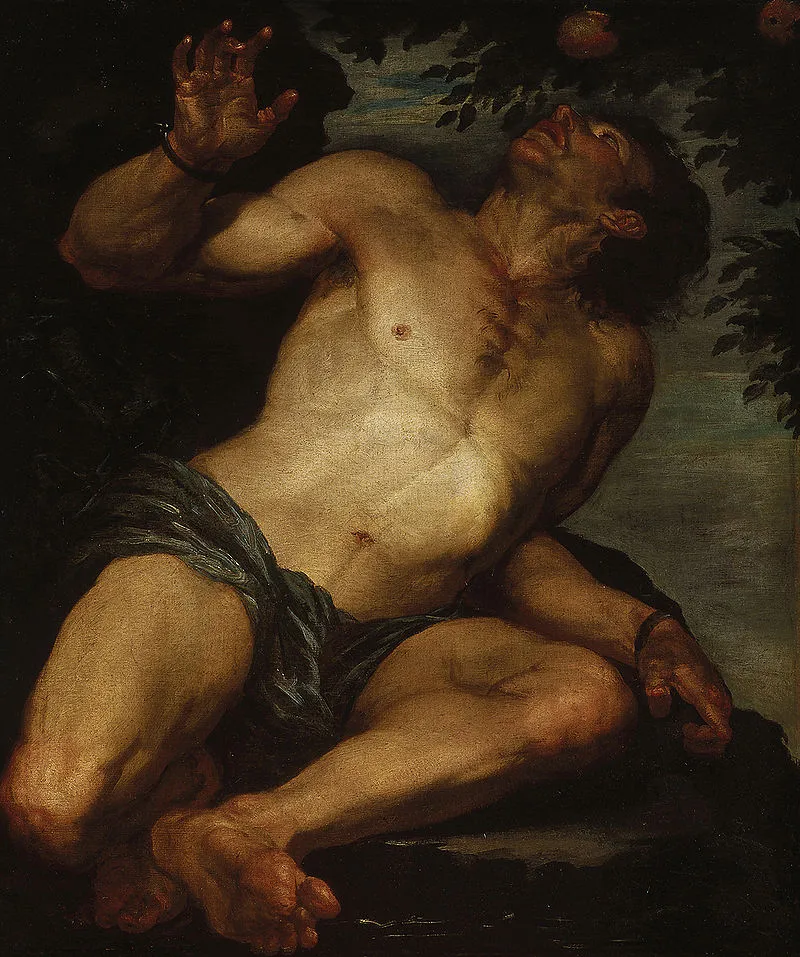
Zeus condemned Tantalus to Tartarus, the deepest pit of the underworld, reserved for those who offended the gods directly. His punishment became one of the most famous in Greek mythology. He stands forever in a pool of water that reaches his chin. Whenever he bends down to drink, the water recedes and drains away, leaving only dry earth. Above his head hang branches laden with ripe fruit: figs, pomegranates, pears, apples, olives. When he reaches up to pluck them, a gust of wind lifts the branches just out of reach.
Some sources add a third torment. A massive boulder hangs suspended over Tantalus’s head, threatening to crush him at any moment. This detail appears in accounts by Hyginus and Pausanias, emphasizing not only deprivation but also perpetual fear. The rock never falls, yet Tantalus can never relax or forget the imminent danger. The three elements of his punishment work together: physical suffering from hunger and thirst, psychological torment from the proximity of relief, and existential dread from the threat of annihilation.
Ancient Testimony and Variants
Homer describes the punishment of Tantalus in Book 11 of the Odyssey, when Odysseus visits the underworld and sees famous sinners. The passage, composed around 700 BC, provides the earliest written account. Tantalus stands in water that vanishes when he tries to drink, and fruit trees bend away from his grasp. Homer does not explain the crime in detail but implies that Tantalus violated guest-friendship or divine hospitality.
Pindar, in his first Olympian Ode (476 BC), offers a different version. He claims that Tantalus abused his privilege at divine banquets not by serving his son but by stealing ambrosia and nectar to share with his mortal companions. Pindar rejects the cannibalism story as slander invented by jealous neighbors. This sanitized version reflects Pindar’s reluctance to portray the gods as cannibals, even unwitting ones, but it did not displace the older tradition.
Euripides and later tragedians returned to the Pelops episode, using it to explore themes of parental betrayal and divine justice. The story also prefigures the cursed lineage of the House of Atreus. Pelops later became king of Pisa in the Peloponnese, and his descendants, including Atreus, Thyestes, Agamemnon, and Orestes, inherited a legacy of violence and revenge that spans multiple generations of myth.
Built out of a love for history, kept free from distractions.
Spoken Past is an independent project shaped by curiosity, care, and long hours of research. Reader support helps keep it maintained, carefully researched, and open to everyone.
Why the Gods Responded So Harshly
The severity of Tantalus’s punishment reflects the nature of his transgression. Ancient Greek religion operated on the principle of reciprocity between mortals and gods. Humans offered sacrifices, prayers, and obedience; gods provided protection, prosperity, and favor. Tantalus broke that contract in the most extreme way possible. He took the highest honor, a seat at the divine table, and used it to commit an act of contempt.
Serving human flesh to the gods violated multiple taboos simultaneously. Cannibalism was abhorrent in Greek culture, associated with barbarism and chaos. Sacrificing one’s own child inverted the natural order of family loyalty. Hosting a feast and then using it to deceive guests shattered the sacred law of hospitality, one of the foundations of Greek ethics. The gods could not ignore such an offense without undermining their authority and the moral order they upheld.
The punishment mirrors the crime. Tantalus abused the privilege of feasting with the gods, so he was condemned to eternal hunger and thirst at a feast he could see but never consume. He tried to prove the gods were not omniscient, so they demonstrated their absolute control over his fate. The sentence was designed to be both just, in the logic of reciprocal justice, and exemplary, a warning to other mortals who might consider defying the divine order.
Tantalus in Later Philosophy and Art
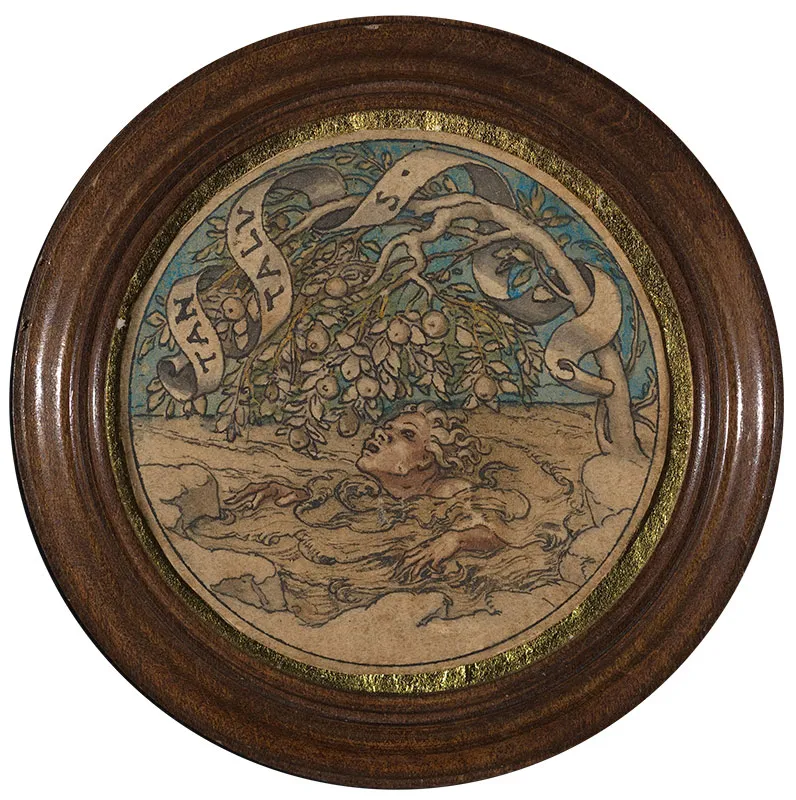
Greek philosophers used Tantalus as a symbol for various forms of existential frustration. The Stoics cited his story when discussing irrational desires and the futility of pursuing external goods. Epictetus and Marcus Aurelius both mention Tantalus in discussions of how attachment to material things leads to suffering. The story illustrated that possessing something is not the same as being able to use or enjoy it, a lesson central to Stoic ethics.
Roman poets adopted the myth and elaborated on its psychological dimensions. Ovid, in the Metamorphoses (8 AD), uses Tantalus to explore the nature of temptation and regret. Seneca, in his tragedies, depicts Tantalus as a figure of despair who infects his descendants with a hereditary curse. His torment becomes not just a personal punishment but a generational wound that spreads through the House of Atreus.
Visual artists depicted Tantalus in frescoes, vase paintings, and later Renaissance works. Attic red-figure pottery from the fifth and fourth centuries BC shows him standing in water, reaching for fruit, or cowering under the suspended rock. Roman wall paintings from Pompeii and Herculaneum include underworld scenes with Tantalus alongside other famous sinners like Sisyphus and Ixion. These images reinforced moral lessons about the consequences of hubris and the inevitability of divine justice.
The Word That Tantalus Gave Us
The English verb “tantalize” comes directly from the myth of Tantalus. It entered the language in the late sixteenth century, borrowed from French tantaliser, which was derived from the Latin Tantalus. To tantalize someone means to torment them by presenting something desirable but keeping it just out of reach, exactly as the gods tormented Tantalus with water and fruit he could never consume.
Ancient Greeks used a similar expression. The phrase “Tantalean punishments” or Tantaleioi timoriai described situations where someone possessed abundance but could not enjoy it. The idiom appears in classical texts to criticize misers, incompetent rulers, and people who hoard resources they cannot use. The myth of Tantalus provided a vivid metaphor for wasted potential and self-inflicted suffering.
The word has remained current for more than four centuries because the concept it describes is psychologically precise. Tantalizing differs from simple denial or absence; it requires the visible presence of the desired object combined with the frustration of access. Modern usage extends the term to advertising, romance, suspense narratives, and any situation where anticipation is deliberately prolonged. The punishment of Tantalus thus continues to describe a fundamental human experience of longing and frustration.
The Cursed Lineage of the House of Atreus
Tantalus’s crimes infected his descendants with a curse that persisted for three generations. Pelops, the resurrected son, won the hand of Hippodamia by bribing Myrtilus, the charioteer of King Oenomaus, to sabotage the king’s chariot. After the wedding, Pelops murdered Myrtilus to avoid paying the promised reward. Myrtilus cursed Pelops and his line as he died. Pelops’s sons, Atreus and Thyestes, fought bitterly over the throne of Mycenae. Atreus discovered that Thyestes had seduced his wife and, in revenge, killed Thyestes’s sons, cooked them, and served them to their father at a reconciliation feast. This act directly echoed Tantalus’s original crime, confirming that the family’s violent impulses were hereditary. Thyestes cursed Atreus, and the cycle continued.
Atreus’s sons, Agamemnon and Menelaus, led the Greek expedition to Troy, but Agamemnon sacrificed his daughter Iphigenia to obtain favorable winds. When he returned from the war, his wife Clytemnestra murdered him in revenge. Their son Orestes then killed Clytemnestra to avenge his father, bringing the curse to its climax. The trilogy of plays by Aeschylus, the Oresteia (458 BC), dramatizes this final chapter and shows how the curse was finally broken when Athena established a court of law to replace blood vengeance with civic justice. The punishment of Tantalus thus initiated a multi-generational narrative that became one of the central myths of Greek tragedy.
Archaeological and Geographical Context
The kingdom of Tantalus was located near Mount Sipylus in Lydia, a region rich in gold and known for its advanced civilization in the second millennium BC. Excavations at sites like Sardis, the later Lydian capital, have uncovered evidence of Bronze Age occupation, monumental architecture, and extensive trade networks. Lydia controlled access to the Hermus and Pactolus rivers, both famous in antiquity for their gold deposits. The wealth that made Tantalus a legendary king had a real geographical and economic basis.
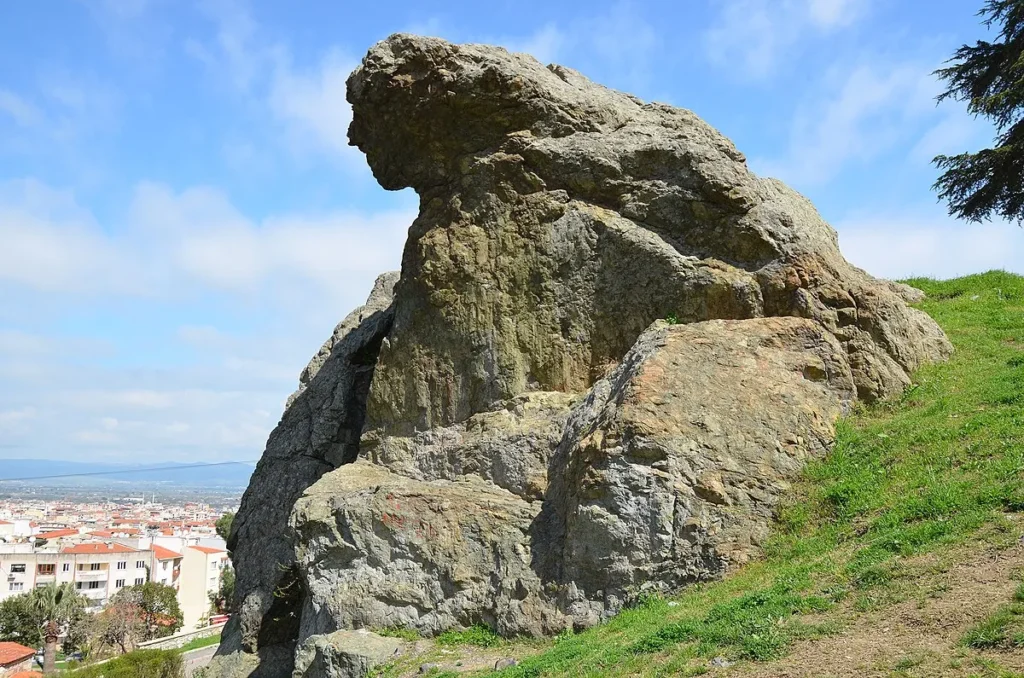
Mount Sipylus itself became associated with another of Tantalus’s children, Niobe, who boasted that her fourteen children made her superior to the goddess Leto, who had only two. Apollo and Artemis killed all of Niobe’s children in revenge, and Niobe was transformed into a weeping rock on the mountain. A natural rock formation on Sipylus, known as the “Weeping Rock” or “Niobe’s Rock,” has been identified with the myth since antiquity. Pausanias, the second-century AD geographer, describes visiting the site and noting the resemblance to a grieving woman. The concentration of myths around Sipylus suggests that the region held religious and cultural significance in the Mycenaean and early Archaic periods.