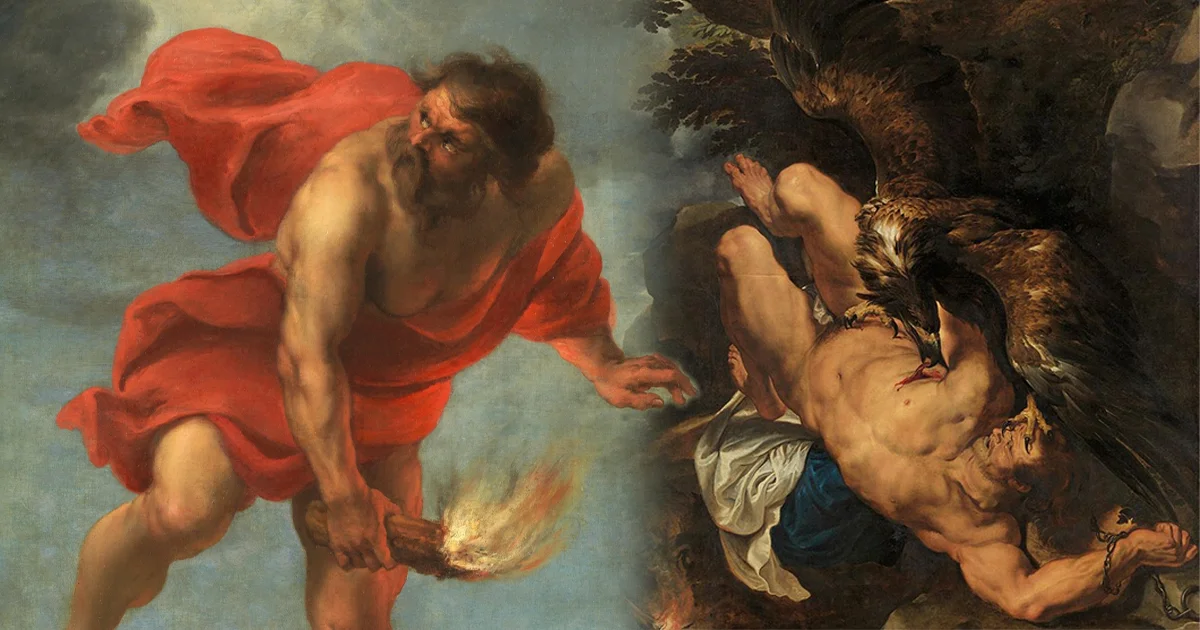
The punishment for Prometheus was being chained to a mountain in the Caucasus where an eagle ate his liver every day for 30,000 years. Zeus ordered this torture after Prometheus stole fire from the gods and gave it to humanity around 700 BCE according to Hesiod’s account in the Theogony. The liver regenerated each night because Prometheus was immortal, allowing the torture to repeat endlessly until Heracles killed the eagle and freed him.
This punishment appears in multiple Greek sources with specific details about its mechanics. Hesiod’s Theogony, composed around 700 BCE, provides the earliest account in lines 507 through 616. Aeschylus expanded the story in his tragedy Prometheus Bound, performed between 479 and 430 BCE, adding dramatic dialogue that became the standard version.
The torture answered two crimes against Zeus. Prometheus first tricked Zeus during a sacrifice at Mekone by hiding good meat under stomach lining while wrapping bones in appealing fat. After Zeus chose bones, he retaliated by hiding fire from humans. Prometheus then stole fire and concealed it in a hollow fennel stalk to deliver it to humanity.
Greek sources treat these events as progressive defiance requiring harsh response. Understanding the punishment for Prometheus requires examining who he was, what crimes he committed, and how the physical torture functioned across 30,000 years.
Prometheus the Titan Son of Iapetus
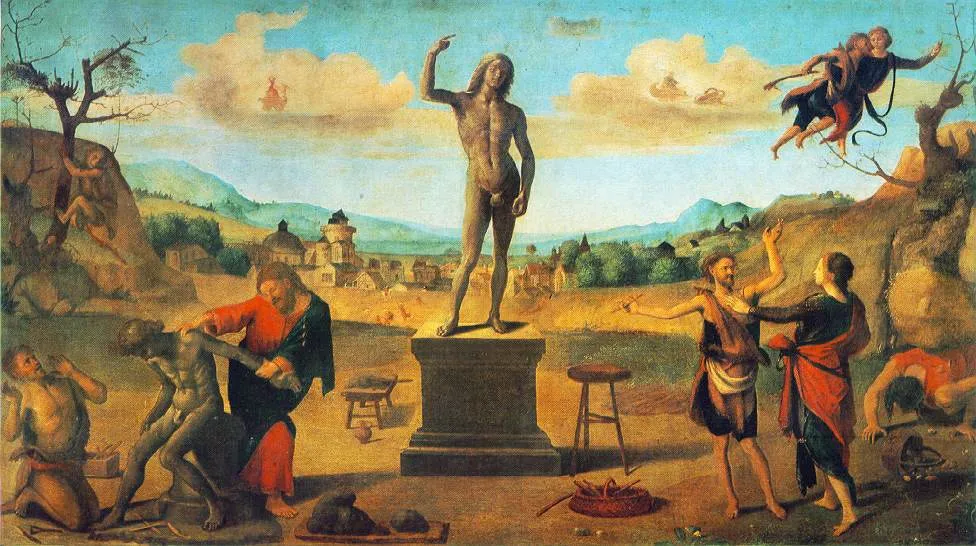
Prometheus belonged to the Titans, the generation of gods who ruled before Zeus and the Olympians took power. Hesiod identifies him in Theogony line 507 as the son of the Titan Iapetus and the Oceanid Clymene. His three brothers were Atlas, who held up the sky after the Titans lost their war, Menoetius, whom Zeus killed with lightning, and Epimetheus, whose name meant “hindsight” contrasting with Prometheus’s “forethought.”
During the Titanomachy, the ten-year war between Titans and Olympians described in Theogony lines 629 through 819, most Titans fought against Zeus. Prometheus and his mother Themis sided with the Olympians instead. This choice initially placed Prometheus in Zeus’s favor and gave him privileges other defeated Titans lost.
His name Prometheus meant “forethought” in Greek, reflecting his ability to predict future events. Ancient sources credit him with creating the first humans by molding them from clay, though this detail appears more prominently in Roman accounts than in early Greek texts. His prophetic abilities later became crucial when he possessed knowledge about Zeus’s potential downfall.
The Sacrifice Deception at Mekone
The first conflict occurred at Mekone during a sacrifice establishing permanent protocols for dividing offerings between gods and humans. Hesiod describes this event in Theogony lines 535 through 560. Prometheus slaughtered an ox and created two piles designed to trick Zeus into choosing the inferior portion.
He wrapped all edible meat and nutritious organs inside the ox’s unappealing stomach lining, making the good food look disgusting. Then he arranged worthless bones inside a thick layer of shining white fat that appeared desirable and appetizing. When Zeus arrived to select his share, the bones covered in fat looked far more attractive than the stomach-wrapped meat.
Zeus chose the pile of bones covered in fat. This choice established the permanent practice where humans burn bones and fat for gods during sacrifices while keeping nutritious meat for themselves. Hesiod states in line 551 that Zeus “knew and did not fail to see the trick,” suggesting the god understood Prometheus’s deception but chose bones deliberately to justify later revenge against both Prometheus and humanity.
Stealing Fire in a Hollow Fennel Stalk
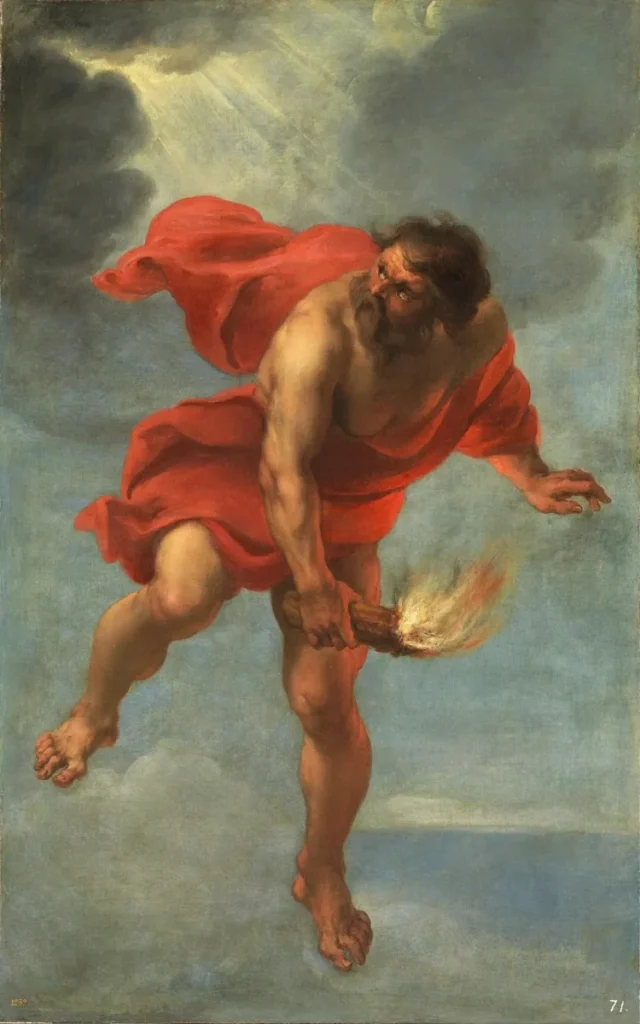
Zeus retaliated for the Mekone deception by hiding fire from humans to make their lives miserable. Hesiod writes in Theogony line 563 that Zeus “hid fire” as direct punishment for Prometheus’s trickery. Without fire, humans could not cook food, create warmth during winter, or forge metal tools necessary for civilized life.
Prometheus responded by stealing fire from either Mount Olympus or Hephaestus’s divine forge depending on which ancient source you consult. The theft method remains consistent across all accounts: Hesiod specifies in line 565 that Prometheus concealed the stolen fire inside a hollow fennel stalk called a narthex. The fennel plant’s pithy interior could hold burning coals while its moist green exterior remained cool enough to carry without burning hands.
The theft occurred in secret while Zeus remained unaware. Hesiod writes in line 568 that Zeus “did not see it” when Prometheus completed the theft and successfully delivered fire to humanity. This second act of defiance provoked far greater divine anger than the sacrifice trick because it directly undermined Zeus’s authority and his punishment of mortals.
Zeus Creates Pandora to Punish Humanity
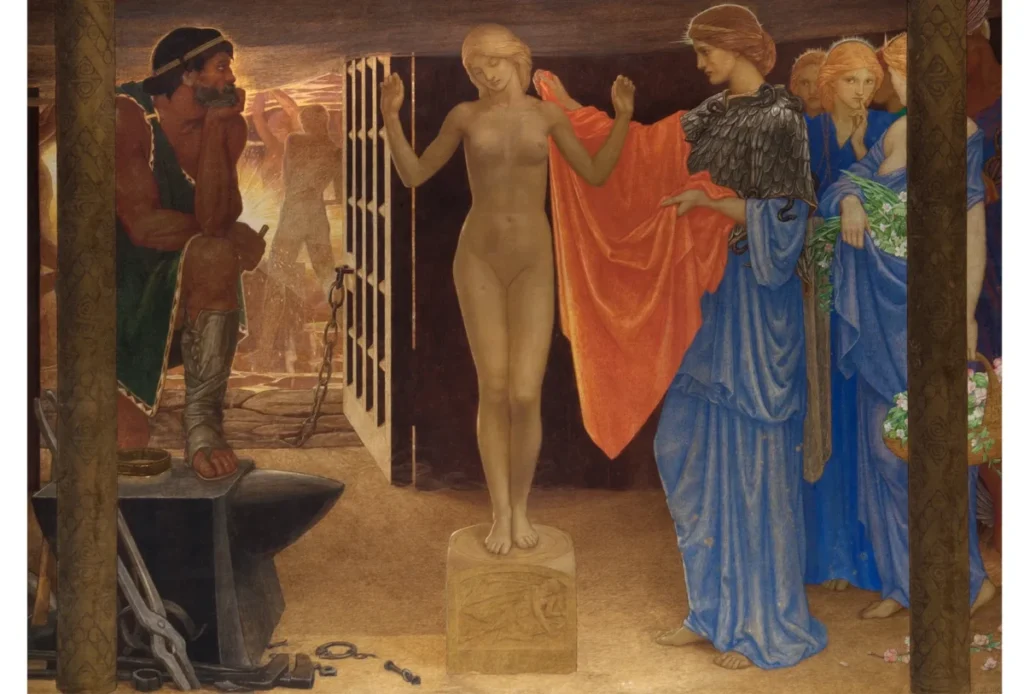
Zeus designed two separate punishments responding to the fire theft: one targeting humanity collectively and one targeting Prometheus individually. For humans, Zeus ordered Hephaestus to fashion Pandora, the first woman, from clay. Athena taught her weaving and domestic skills, Aphrodite gave her grace and desire, and Hermes gave her a deceitful mind.
Zeus sent Pandora to Prometheus’s brother Epimetheus carrying a sealed jar containing all evils. Despite Prometheus warning Epimetheus never to accept gifts from Zeus, Epimetheus married Pandora because of her beauty. She opened the forbidden jar, releasing death, disease, painful labor, and countless sufferings into the previously blessed world. Only hope remained trapped inside when Pandora slammed the lid closed.
This narrative appears in Hesiod’s Works and Days lines 47 through 105, written around the same time as Theogony. The Pandora story explained to Greeks why human life was filled with suffering despite possessing fire’s benefits. Zeus ensured that Prometheus’s gift came with permanent costs that would plague every generation of mortals forever.
Kratos and Bia Seize Prometheus
For Prometheus personally, Zeus designed eternal physical torture as punishment. According to Theogony line 521, Zeus dispatched his personal enforcers Kratos (Power) and Bia (Force) to arrest Prometheus and deliver him for binding. These divine servants represented Zeus’s absolute authority and could not be resisted even by a Titan.
Aeschylus dramatized the arrest and binding in Prometheus Bound’s opening scene spanning lines 1 through 127. The god Hephaestus reluctantly agreed to perform the actual binding because Zeus threatened him with punishment if he refused. Kratos supervised closely and repeatedly demanded that Hephaestus make the chains tighter, driving the spikes deeper, and eliminating any possibility of movement or escape.
Hephaestus expressed sympathy for Prometheus throughout the process, calling him a kinsman and regretting his role. Kratos mocked this sympathy and threatened to report Hephaestus to Zeus for insufficient cruelty. The scene establishes that even gods who disagreed with the punishment for Prometheus had no choice but to implement Zeus’s orders perfectly.
Built out of a love for history, kept free from distractions.
Spoken Past is an independent project shaped by curiosity, care, and long hours of research. Reader support helps keep it maintained, carefully researched, and open to everyone.
Adamantine Chains and Spikes Driven Through His Body
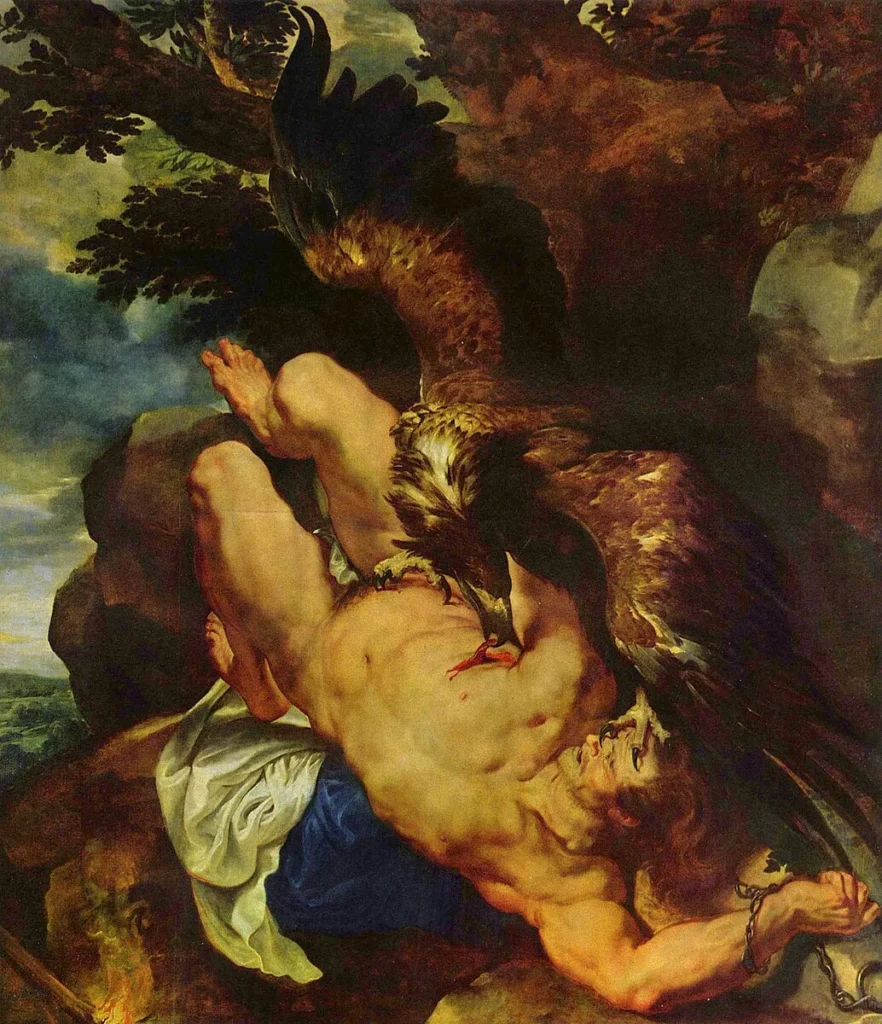
The physical restraints used adamantine, a mythical metal described as unbreakable and harder than any material found on earth. Aeschylus’s Prometheus Bound lines 6 through 81 provide detailed descriptions of the binding process. Hephaestus drove massive spikes through both of Prometheus’s arms, pinning them to the rock face at full extension so he could not move them even slightly.
Additional spikes pierced both legs, immobilizing them completely. The most brutal spike went through Prometheus’s chest directly into the rock, ensuring he could not twist his torso or shift position to relieve pressure. Kratos insisted on a “stubborn ring of adamantine steel” around Prometheus’s torso as additional restraint, though the spikes already made movement impossible.
The rock face itself rose high on Mount Caucasus. No ledge or surface existed where Prometheus could rest his weight. He hung suspended entirely by the spikes driven through his body, with his full weight pulling constantly on the pierced tissue. This position alone would cause excruciating pain even without the daily eagle visits.
Mount Caucasus at the Eastern Edge of the World
Mount Caucasus served as the punishment location, a mountain range at what Greeks considered the eastern boundary of the known world. Aeschylus’s Prometheus Bound line 2 specifically mentions “the Scythian land” and “the untrodden wilderness” where no humans lived. Greek geographical understanding placed Caucasus far beyond the Black Sea in what is now the region between the Black Sea and Caspian Sea.
Herodotus in Histories written around 440 BCE describes Caucasus as one of the world’s tallest and most remote mountain ranges. Strabo’s Geography written between 20 BCE and 23 CE places it in the distant territory of the Scythians, a nomadic people Greeks knew little about. This extreme remoteness intensified Prometheus’s isolation and suffering.
The exposed peak offered no shelter from weather. Sun burned Prometheus’s skin during day while freezing temperatures tormented him at night according to his complaints in Prometheus Bound lines 20 through 25. Rain, snow, and wind struck him directly with no possibility of protection. The combination of immobilization, isolation, and weather exposure created constant baseline suffering before the eagle even arrived.
The Eagle Sent to Devour His Liver Daily
Zeus sent an enormous eagle to tear out and consume Prometheus’s liver once every day, creating an eternal torture cycle. The eagle arrived each morning at dawn, used its beak and talons to rip open Prometheus’s torso, and spent hours consuming the liver before departing at dusk. Pseudo-Hyginus’s Astronomica 2.15, written around 1 CE but preserving earlier Greek traditions, describes the eagle as either born from the monsters Typhon and Echidna or crafted by Hephaestus and given life by Zeus.
The liver served as the specific target for important reasons in Greek medical thought. Ancient Greeks believed the liver was the seat of emotions and desires, making its destruction particularly agonizing psychologically. They also believed livers possessed natural regenerative powers. Plato’s Timaeus 71a-d written around 360 BCE discusses Greek medical understanding that damaged livers regrow, though they exaggerated this capacity far beyond reality.
Each night after the eagle departed, Prometheus’s liver regenerated completely by dawn. His immortal nature meant tissue regrew at accelerated speed, restoring him to full physical condition. This regeneration ensured the punishment for Prometheus could continue indefinitely without killing him, since immortal gods cannot die. The cycle repeated identically every single day.
Thirty Thousand Years of Eternal Torture
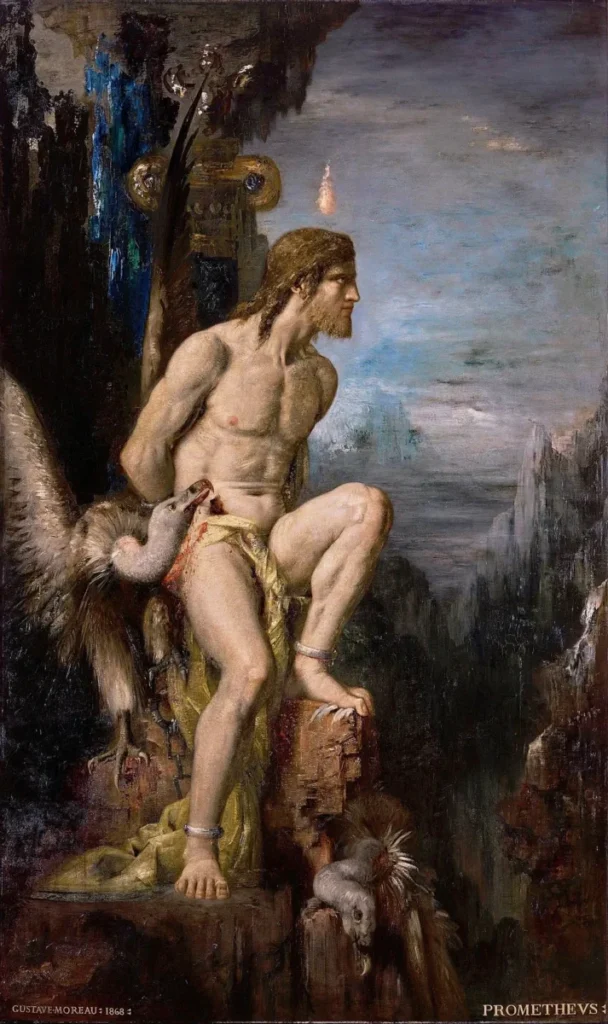
The punishment lasted 30,000 years according to Aeschylus’s Prometheus Bound. The character Ocean asks Prometheus in line 94 about his suffering’s duration, and subsequent dialogue establishes this enormous timespan. This number was not metaphorical or symbolic but represented literal years in Greek cosmological time reckoning.
During these millennia, Prometheus remained fully conscious every moment. He could not sleep, lose consciousness, or mentally escape the pain. Aeschylus emphasizes this psychological torture through Prometheus’s speeches describing his awareness of each approaching day and his helpless anticipation of the eagle’s arrival. The mental anguish of knowing the torture would repeat tomorrow and the next day and every day forever intensified the physical suffering.
The passage of time meant nothing changed for Prometheus while everything changed in the mortal world below. Roughly 1,500 human generations lived and died. Kingdoms rose and fell. Languages evolved. Cities were founded then abandoned to ruins. Prometheus experienced the same routine daily: sunrise, eagle’s arrival, hours of consumption, evening departure, nighttime regeneration, dawn beginning the cycle again.
Heracles Kills the Eagle and Breaks the Chains
The torture finally ended when the hero Heracles traveled through the Caucasus region and saw Prometheus chained to the mountain. Apollodorus’s Bibliotheca 2.5.11, written around 100 CE but compiled from earlier sources, describes Heracles stopping during his quest for the golden apples of the Hesperides. When he learned about the punishment for Prometheus, Heracles decided to intervene.
Heracles shot the eagle with one of his poisoned arrows as it arrived for its daily feeding. The arrow killed the divine bird instantly, ending the torture cycle that had continued for 30,000 years. Then Heracles used his superhuman strength to break the adamantine chains and pull the spikes from Prometheus’s body, freeing him from the rock face.
Zeus permitted this rescue because Prometheus possessed knowledge Zeus desperately wanted. The Titan knew which of Zeus’s potential marriages would produce a son strong enough to overthrow him, just as Zeus had overthrown his own father Kronos. Prometheus agreed to reveal this secret in exchange for his freedom. He warned Zeus not to marry the sea nymph Thetis, who was destined to bear a son greater than his father. Zeus married Thetis to the mortal Peleus instead, and she gave birth to Achilles.