
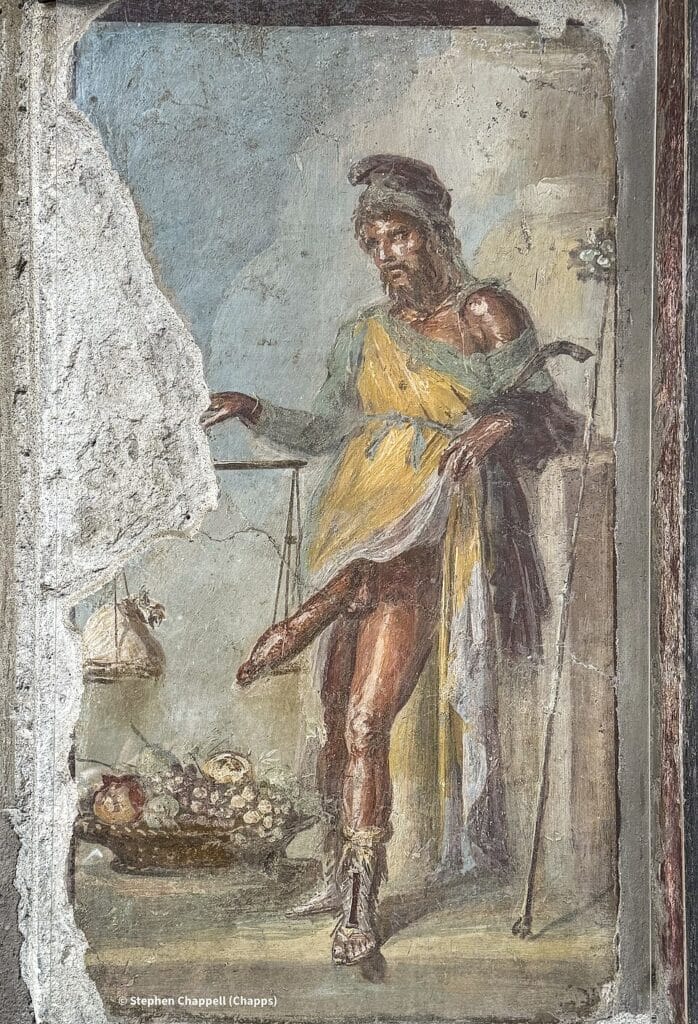
When the House of the Vettii in Pompeii reopened to visitors in January 2023 after two decades of restoration, international news coverage struggled to describe the fresco that greets every visitor at the entrance. It shows the god Priapus, dressed in a matronly garment that bunches up to serve as a basket, weighing his oversized phallus on a set of scales against a heavy bag of coins, with a bowl of fruit at his feet. Most reporters defaulted to calling it obscene, or treated it as evidence that the Vettii ran a brothel, or reported the obvious wealth symbolism and moved on. None of these readings is wrong, exactly. But erotic art in Pompeii was doing something more layered than any single explanation captures. It was operating as ritual protection, social display, commercial signal, mythological reference, and humour simultaneously, because Roman visual culture allowed one image to carry all of these meanings at once without contradiction. This article examines how those mechanisms worked, using the Pompeian evidence and current scholarship.
The Apotropaic Phallus and How It Worked
The word apotropaic comes from the Greek apotrepein, to turn away, and it describes an object or image designed to deflect harmful supernatural forces. In the Roman world, the primary such force was the evil eye, the invidia, the dangerous concentration of envy that could be directed at a person, a household, or a business by anyone whose desire or ill will was sufficiently focused. The phallus was the most widely deployed apotropaic symbol in Roman Italy. It appeared on the walls of bakeries, the lintels of workshops, the thresholds of houses, the prows of boats, the jewellery of infants, and the bodies of soldiers. Its protective power rested on a specific logic: the evil eye required an uninterrupted visual pathway from the envious looker to the envied target. An image sufficiently striking, grotesque, or funny could interrupt that pathway by seizing the looker’s attention and redirecting the dangerous gaze. The phallus, with its combination of comic exaggeration and cultural power, was ideal for this function.
Claudia Moser’s 2006 paper “Naked Power: The Phallus as an Apotropaic Symbol in the Images and Texts of Roman Italy” established the most thorough scholarly account of this mechanism, tracing it through the material record of Pompeii and Herculaneum as well as through the literary evidence of Pliny the Elder, Catullus, Martial, and the Priapea, the ancient collection of poems about Priapus himself. Moser’s core argument, that the phallus operated as a weapon turning the gaze against itself, explains why these images appear on the exterior of buildings rather than hidden inside: the protective function required the image to be publicly visible, to intercept the dangerous stare before it could penetrate the household’s interior.
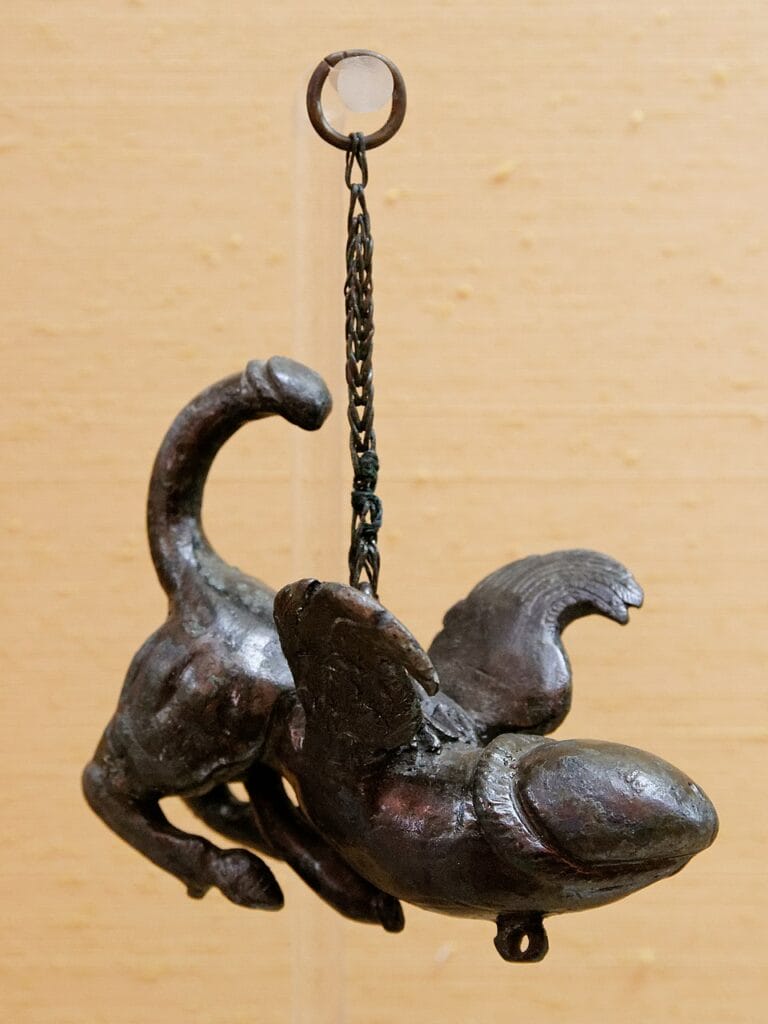
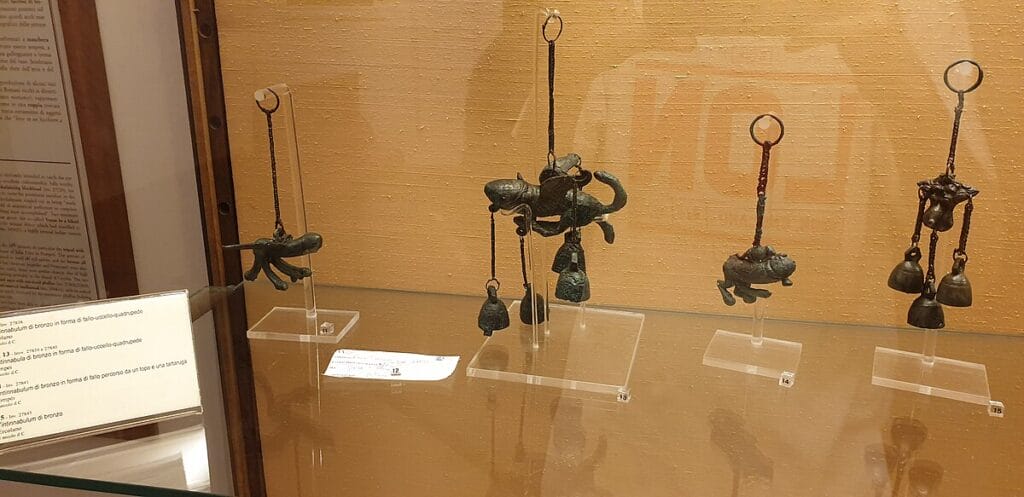
The tintinnabulum, the bronze wind chime combining phallic forms with small bells, adds a sonic dimension to this protection. Sound and sight combined to create a more powerful deflection than either could achieve alone. Several bronze tintinnabula from Pompeii now in the Naples Archaeological Museum’s Gabinetto Segreto, the Secret Cabinet, combine a phallus with wings, with additional smaller phalluses hanging as chimes, or with figures of a man wrestling a beast whose tail is another phallus. These are not surrealist jokes. They are multi-layered protective devices, and the laughter they provoked was part of their operation.
Priapus at the House of the Vettii and What the Scholarship Actually Says
The Priapus fresco at the House of the Vettii (Region VI, Insula 15, 1) is the most studied single erotic image in Pompeii, partly because of its prominent placement at the entrance vestibule and partly because it was hidden behind plaster after excavation and only rediscovered in 1998 when rainfall exposed it, making it something of a celebrity. The house’s owners, the Vettii brothers Aulus Vettius Restitutus and Aulus Vettius Conviva, were freedmen who had made their fortune in wine trading, and the exuberant decorative programme of the house, with its elaborate Fourth Style painted walls, bronze sculptures, garden fountains, and erotic imagery, has been read as a statement of social arrival by men who lacked the ancestral status of the old Roman families.
The most rigorous recent analysis of the Priapus fresco is Thomas R. Blanton IV’s 2022 article “Apotropaic Humor: The Fresco of Priapus in the House of the Vettii,” published in the journal Archimède. Blanton’s argument is that the fresco’s apotropaic effectiveness was deliberately enhanced by its comic elements, and he identifies four of them: the grotesque disproportionality of the phallus, which is rendered semiturgid rather than fully erect against convention; a partial gender reversal in which Priapus wears garments associated with matrons; the substitution of measurement for penetration as the phallus’s function in the image; and the inversion of Priapus’s usual role as a sexual threatener into a figure of commercial prosperity. Each of these incongruities is, Blanton argues, deliberate: the laughter they produced was the protective mechanism. A viewer who laughed broke their envious focus.
The classicist Craig Williams of the University of Illinois, whose book “Roman Homosexuality” (Oxford University Press, 2010) remains the standard scholarly treatment of Roman sexuality and power, frames the Priapus figure differently but complementarily. Williams reads the hyper-endowed, hyper-masculine Priapus as functioning for Roman male viewers as what he calls the patron saint or mascot of Roman machismo: an exaggerated projection of the penetrative dominance that defined acceptable masculine sexuality in Roman culture. Importantly, Williams notes that the Priapus image served simultaneously as a symbol of identification for Roman men and as a deliberate object of humor and even desire. The image was not doing one thing. It was doing several.
News coverage of the House of the Vettii’s 2023 reopening tended to report either the wealth-symbolism reading or the brothel reading, citing erotic paintings in a small room off the kitchen as evidence for sex work on the premises. Scholars have pushed back on this with some force. The room in question belonged to the domestic quarters accessible through a separate iron door, and some academics argue the paintings there were likely a gift to a favoured slave rather than a price list for clients. Gabriel Zuchtriegel, director of the Archaeological Park of Pompeii, made the point publicly at the reopening: the imagery was about saying “we’ve made it,” not about advertising paid sex.
The Lupanar and What Its Paintings Were For
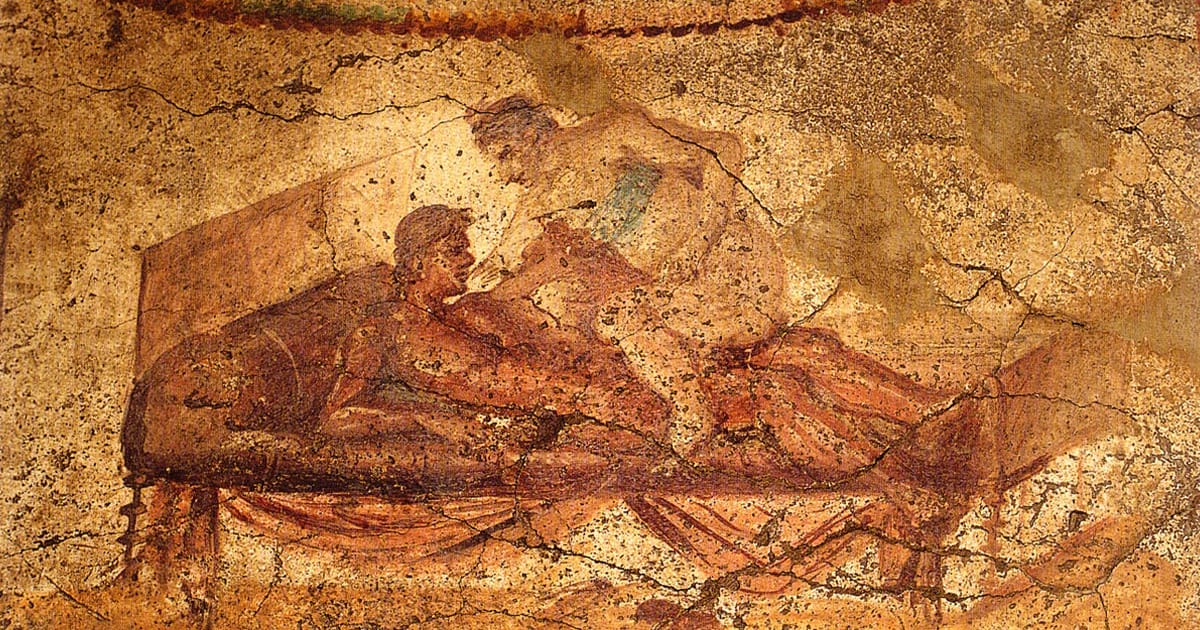
The Lupanar (Region VII, Insula 12, 18-20) is the only building in Pompeii identified with near-certainty as a purpose-built brothel, and it does contain paintings explicitly depicting sexual acts above the doors of its five ground-floor rooms. The building has two storeys, each floor with a narrow corridor giving onto rooms barely large enough for the masonry beds with stone bolsters that still occupy them. The ground-floor rooms were for clients; the upper floor, with a separate external staircase, was probably for the workers themselves. More than 120 graffiti on the walls record the names of workers and clients, prices, and preferences with a frankness that leaves little ambiguity about the function of the space.
The paintings above each room’s door, eight survive in part or whole, depict couples in various positions on beds with simple white sheets. The scholarly debate about their function has produced two main positions. The older “price-list” or “menu” interpretation, still common in popular guides, holds that the images advertised specific sexual services, allowing clients who could not read Latin or Greek to choose from a visual catalogue. The competing interpretation, articulated most carefully by Thomas McGinn of Vanderbilt University in his 2004 book “The Economy of Prostitution in the Roman World” (University of Michigan Press), argues that the images served primarily to establish the room’s purpose and create an appropriate atmosphere rather than to specify services. In practice these functions are not mutually exclusive, and the physical placement of the images, directly above doorways at head height for someone about to enter a room, is consistent with both.
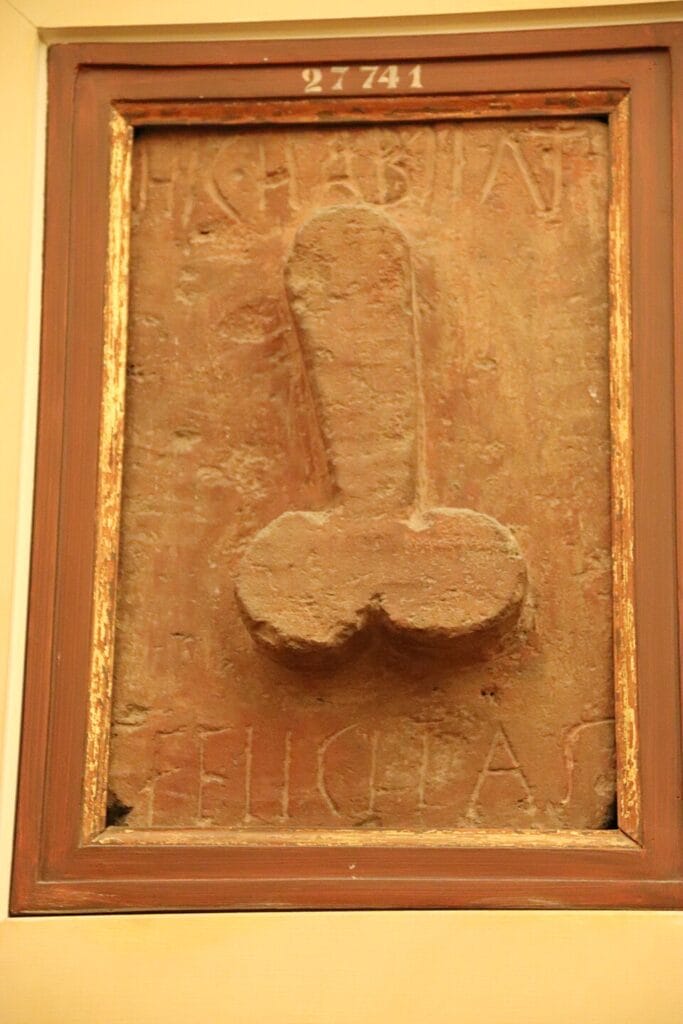
What the Lupanar paintings do not do is make the Lupanar the primary site of erotic imagery in Pompeii. Explicit paintings and phallic carvings appear across the city in contexts that have nothing to do with sex work. Accepting the Lupanar as the frame for understanding all erotic imagery in Pompeii, which much popular writing does implicitly, produces a badly distorted picture. The hic habitat felicitas relief at the Modestus Bakery (VII, 1, 36), which shows a large phallus with the inscription “happiness lives here,” was protecting an oven, not advertising services.
Built out of a love for history, kept free from distractions.
Spoken Past is an independent project shaped by curiosity, care, and long hours of research. Reader support helps keep it maintained, carefully researched, and open to everyone.
Mythological Erotic Scenes and the Fourth Style Dining Room
In wealthy Pompeian houses, the most prestigious erotic imagery was not the apotropaic phallus but the mythological panel painting. The fourth style of Roman wall painting, which dominated interior decoration from the mid-first century CE until the eruption of 79 CE, characteristically combined painted architectural frameworks, landscape vistas, and central mythological panel paintings in compositions that covered entire walls of reception rooms, dining rooms, and peristyle corridors. Among the most popular subjects for these panel paintings were erotic or sexually charged mythological episodes: Dionysus finding Ariadne asleep on Naxos, the marriage of Poseidon and Amphitrite, the union of Zeus and Hera on Mount Ida, and the myth of Leda and the swan.
These scenes served a sophisticated social function in the context of Roman dining, the triclinium. The Roman dinner party, or convivium, was a performance of cultural capital in which the host demonstrated his education, wealth, and taste simultaneously. Wall paintings that displayed mythological knowledge invited guests to discuss the stories depicted, to show off their own literary learning, and to engage in the free, witty speech that wine and good company were supposed to produce. An erotic mythological panel was not a decoration that said “look how rich I am.” It was a conversation piece that said “let’s talk about desire, power, and the nature of the gods,” with the visual sophistication of the painting standing in for the host’s cultural education. Eleanor Leach of Indiana University, in her 2004 book “The Social Life of Painting in Ancient Rome and on the Bay of Naples” (Cambridge University Press), analysed this function in detail, arguing that the decorative programme of a Pompeian dining room was designed to structure the social performance of the meal from first glance to last cup.
The distinction between mythological erotic imagery in a triclinium and explicit sexual paintings in a brothel cubiculum is therefore not simply a distinction between tasteful and tasteless, or between high art and pornography. It is a distinction between two different communicative registers that happened to share a common subject. The myth panel in the dining room said something about the host’s relationship to classical culture. The painting above the brothel door said something about the services available in the room. Roman viewers navigated these registers without apparent difficulty.
The Gabinetto Segreto and the History of Hiding the Evidence
When the first wave of excavated material from Pompeii and Herculaneum began reaching the Royal Bourbon Museum in Naples from the 1760s onward, the curators faced an immediate problem. The objects were remarkable, and the king wanted them available to educated visitors, but a substantial portion of the material was explicitly sexual. The solution, formalised under the museum director Matteo Imbriani, was the creation of a restricted room, eventually known as the Gabinetto Segreto (Secret Cabinet), where erotic objects were held separately from the main collection. Access was restricted by gender and social status: adult men of sufficient respectability could request admission; women and children could not. The room was opened briefly to the public during the revolutionary period of 1848, closed again, opened again, closed again, and finally made permanently accessible as a normal gallery in 2000, with an age advisory rather than a prohibition.
The history of the Gabinetto Segreto matters because it shaped a century and a half of scholarship on Pompeian art. Objects held in the secret room were catalogued separately, illustrated in restricted publications, and simply absent from most general accounts of Roman art. The result was a systematic distortion of the evidence. Pompeian decorative culture appeared more genteel, more like Victorian taste, than the actual record supported. Scholars who worked before the liberalisation of access in the late twentieth century sometimes described the erotic imagery as peripheral, exceptional, or the product of a specific low-status population, none of which the full distribution of the evidence supports.
Since the 1990s, and particularly following the work of Amy Richlin of the University of California, Los Angeles, whose 1992 book “The Garden of Priapus: Sexuality and Aggression in Roman Humor” (Oxford University Press) applied feminist critical theory to Roman sexual imagery and Latin erotic literature, the field has reckoned more honestly with what the Pompeian evidence actually shows. Richlin’s analysis of the power structures embedded in Roman sexuality, the centrality of penetrative dominance, the asymmetry between active and passive roles, the complete exclusion of enslaved people from agency in sexual transactions, provided a framework that allowed the imagery to be discussed as a social document rather than either a prurient curiosity or a sanitised symbol of fertility.
What Pompeii’s Erotic Art in Pompeii Actually Tells Us About Roman Society
The erotic imagery of Pompeii is valuable as historical evidence not because it shocks or titillates but because it was so thoroughly integrated into everyday life that it left an unusually complete record. Wealthy houses, modest shops, public baths, political buildings, and commercial premises all participated in the same visual system. The same protective logic that placed a phallic relief above a bakery oven placed bronze fascina on the necks of Roman children and hung tintinnabula in garden pergolas. The same mythological literacy that allowed a dining-room painter to deploy a scene of Dionysus and Ariadne as a conversation prompt was available to a Pompeian citizen passing the phallic boundary markers carved into paving stones in the city’s streets.
The distribution of erotic imagery across Pompeii’s social geography also allows us to see class distinctions at work. The Fourth Style mythological programmes of large houses like the House of the Vettii or the Villa of the Mysteries required substantial investment and assumed an audience with classical literary education. The carved stone phalluses at shop entrances required only a stonemason and a belief in protective symbolism. The painted panels in the Lupanar were produced by workshop painters working quickly at standard rates in a commercial building. These are three different points in a single cultural system, not three separate phenomena.
The hic habitat felicitas inscription at the Modestus Bakery, which translates as “happiness lives here,” sits above a phallic relief and distils the entire system into four words. The phallus protects. The protection produces prosperity. The prosperity is happiness. What looks to modern eyes like a crude joke or an obscenity is, in its original context, a precise and economical statement of Roman religious pragmatism. The walls of Pompeii did not separate the sacred from the sexual because Roman theology did not require that separation. The gods who oversaw abundance, protection, fertility, and commerce expressed themselves through the same image, because in the Roman imagination those functions were connected at their root.
Sources: Thomas R. Blanton IV, “Apotropaic Humor: The Fresco of Priapus in the House of the Vettii,” Archimède: archéologie et histoire ancienne, HS n°2, 2022. Craig Williams, Roman Homosexuality, 2nd ed., Oxford University Press, 2010. Thomas A. S. McGinn, The Economy of Prostitution in the Roman World, University of Michigan Press, 2004. Amy Richlin, The Garden of Priapus: Sexuality and Aggression in Roman Humor, Oxford University Press, 1992 (rev. ed.). Eleanor Winsor Leach, The Social Life of Painting in Ancient Rome and on the Bay of Naples, Cambridge University Press, 2004. Claudia Moser, “Naked Power: The Phallus as an Apotropaic Symbol in the Images and Texts of Roman Italy,” Memoirs of the American Academy in Rome, 2006. The Conversation, “Pompeii’s House of the Vettii Reopens,” January 2023. Archaeological Park of Pompeii, official site: pompeiisites.org.