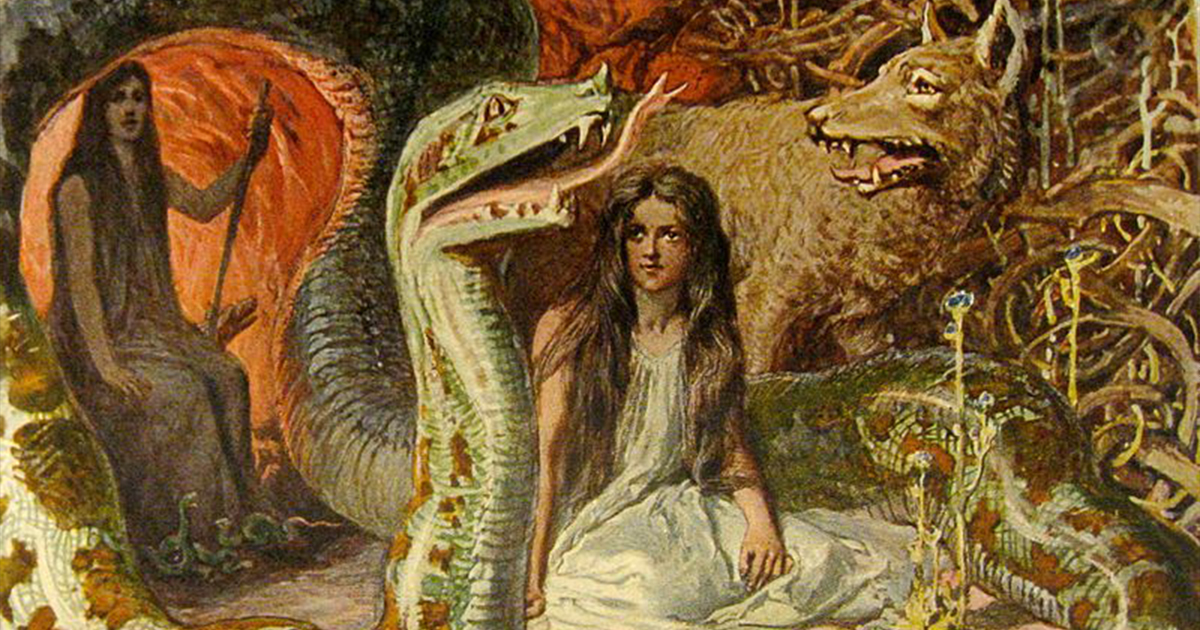
In chapter 34 of Gylfaginning, the opening book of Snorri Sturluson’s thirteenth-century Prose Edda, a single passage dispatches three offspring of Loki and the giantess Angrboda to their assigned positions in the Norse cosmos. Odin casts Jormungandr into the sea encircling Midgard, sends Hel to administer the realm of the ordinary dead beneath the roots of Yggdrasil, and retains Fenrir in Asgard under the watch of the gods. These are not arbitrary placements. Each disposition responds to a specific prophecy, to a specific kind of threat, and creates a specific kind of problem that will eventually swallow the world. Loki’s children are not background monsters. They are three load-bearing pieces of Norse mythic architecture, and understanding why each was placed where they were placed is the key to understanding what Ragnarok actually means. This post draws on Snorri’s Prose Edda and the Poetic Edda poems preserved in the Codex Regius to trace the logic behind each decision and its consequences.
The primary sources for Loki’s children
Two major textual traditions carry the mythology of Loki’s offspring. The Poetic Edda, a collection of anonymous verse preserved in the Codex Regius manuscript (designated GKS 2365 4to and now housed at the Árni Magnússon Institute for Icelandic Studies in Reykjavík), contains poems probably composed between the ninth and twelfth centuries, though written down no earlier than around 1270 CE. These include Völuspá, which sets out the prophecy of the world’s destruction, and Hymiskviða, which narrates Thor’s attempt to haul the World Serpent from the sea. The Poetic Edda is the closest surviving window onto pre-Christian Norse religion. The Prose Edda, written by the Icelandic scholar and lawspeaker Snorri Sturluson around 1220 CE, reorganises the same mythic material into narrative prose, filling in genealogies and causal chains that the verse leaves implicit.
John Lindow, Professor Emeritus of Old Norse and Folklore at the University of California, Berkeley, identifies a key methodological tension in his 2020 book Old Norse Mythology: Snorri was a Christian writing about paganism, and his rationalising tendencies pulled the myths toward logical sequence in ways that the older verse resisted. The poems assume their audience already knows the stories; Snorri explains them. Read together carefully, both layers matter. The poetry preserves the emotional and religious texture; the prose provides the organisational skeleton. Neither alone is sufficient for serious engagement with the mythology, and scholars including Carolyne Larrington, Professor Emerita of Medieval European Literature at the University of Oxford and translator of the Poetic Edda for Oxford World’s Classics, have warned against treating Snorri’s narrative as a neutral transcription rather than an active interpretation.
It is also worth noting a genuine scholarly debate about the personhood of Hel. Lindow has argued that older skaldic verse treats Hel primarily as a place rather than a person, and that the half-living, half-dead ruler described in Gylfaginning may represent Snorri’s own elaboration rather than a figure universally acknowledged in pre-Christian belief. Rudolf Simek, in his Dictionary of Northern Mythology, similarly concluded that the deity form of Hel was probably a late personification. The figure is real in the sources; the question is how old she is. Readers should hold this uncertainty alongside the mythology rather than papering over it.
Angrboda and the geography of danger
Before examining each child, it is worth pausing on their mother. The name Angrboda translates from Old Norse as “she who announces grief” or “she who brings sorrow,” and she occupies a position in Jotunheim, the realm of the giants, that stands in deliberate contrast to the fenced, oath-bound world of Asgard. Völuspá alludes to a brood of wolves bred in the Ironwood, Járnviðr, by a figure described as a watcher of giants. Snorri draws together this reference and the explicit genealogy to make Angrboda the mother of all three children. Her location matters. She is not a guest in Asgard, not a treaty hostage, not a figure integrated into Aesir society the way Njord and Freyr were after the Aesir-Vanir war. She lives beyond the boundary, and the children she bears with Loki take on something of that boundary character. Each of them will come to occupy a liminal space: the serpent lives at the edge of the world where land meets sea, Hel governs the border between the living and the dead, and Fenrir dwells inside Asgard but was never really of it.
Loki’s position is the key to this geography. He is formally of the Aesir, bound to them by oath and by his role as a fixer of their crises, yet he fathered children with an enemy’s woman on the far side of the world’s boundary. That combination, Aesir form and giant substance, is exactly what makes the three children so difficult to manage. They cannot be simply excluded as foreign enemies, because their father is an insider. They cannot be fully integrated, because their mother is not. Odin’s response to this problem involves assigning each a location that acknowledges their power while attempting to contain it. The assignments make tactical sense and mythological sense. They also, as the mythology makes plain, do not work forever.
Hel: sovereignty over the ordinary dead
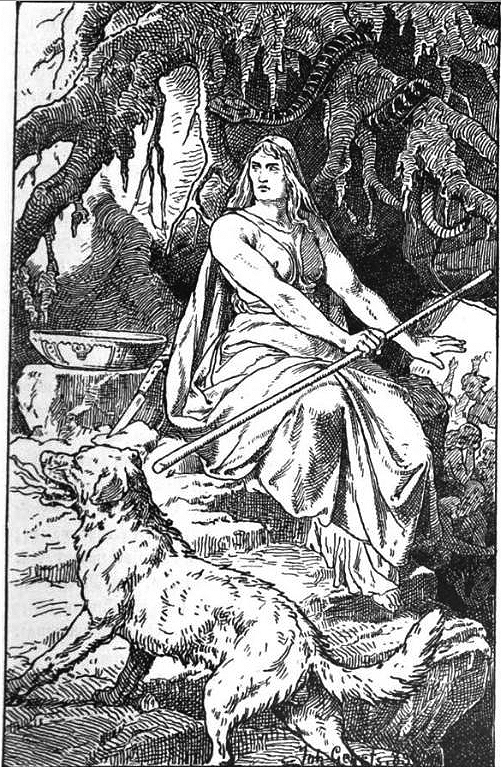
Snorri specifies in Gylfaginning chapter 34 that Odin cast Hel down into Niflheim and gave her authority over nine worlds, with the mandate to administer lodging and board to those sent to her, meaning those who die of illness or old age. The phrasing is significant. Hel does not receive the battle-dead, who go to Odin’s Valhalla or Freyja’s Fólkvangr. She receives the unremarkable majority, the people who die as most people die, without a sword in their hands on a famous field. In a world that celebrated martial death, Hel’s jurisdiction covers what is quietly universal.
Her hall in Snorri’s account is named Éljúðnir, a compound that connotes something close to “wet with sleet” or “icy dampness,” a contrast to the warm hearth of Valhalla. Her threshold is called Fallandaforað, “fall-to-peril.” Her platter is named Hunger, her knife Famine. The details are architectural and functional rather than dramatic; they describe a place that operates according to its own rules rather than the preferences of visitors. Hel herself is described as half flesh-coloured and half blue-black, an appearance that embodies the threshold she rules.
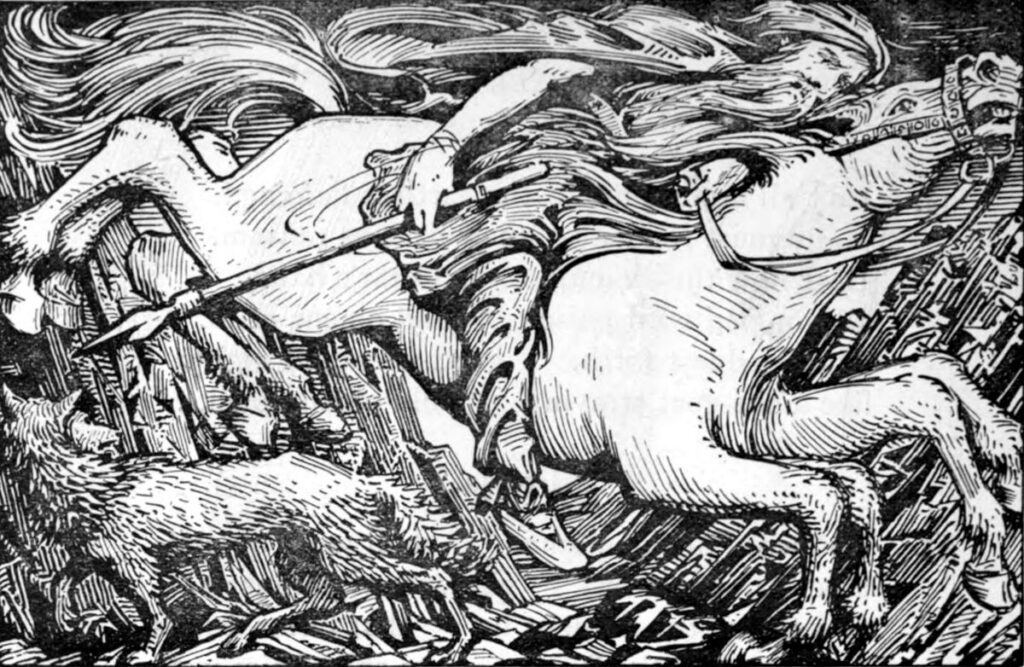
The episode that makes Hel’s authority concrete is the death of Baldr. The beloved god, son of Odin and Frigg, dies when the blind god Hodr throws a mistletoe dart guided by Loki’s hand. His death is irreversible not because of physical impossibility but because of institutional legitimacy. Hermod, another of Odin’s sons, rides Sleipnir down to Hel’s hall and begs for Baldr’s release. Hel agrees on a condition: every being and every thing in the world must weep for Baldr. Almost everything does. One figure, the giantess Thökk, refuses. The tradition identifies Thökk as Loki in disguise. The condition goes unmet. Hel keeps Baldr. The point here is not cruelty. Hel did not deny the request out of malice. She set terms, those terms were not satisfied, and she kept to her decision. Larrington, in her 2017 study The Norse Myths: A Guide to the Gods and Heroes, emphasises that Hel’s refusal is precisely what gives the mythology its tragic weight: if any ruler of the dead would simply bend to a living king’s grief, the world would feel like a place without genuine consequence.
Jormungandr: the serpent that measures and defines the world
When Odin casts the serpent into the sea, he is not simply disposing of a dangerous animal. Jormungandr grows until he encircles the entire landmass of Midgard, biting his own tail. The term for a serpent that bites its own tail in this way is ouroboros, a symbol widespread across Indo-European and Mediterranean traditions, and the mythological function in Norse cosmology is to mark the boundary between ordered land and chaotic ocean. As John Lindow observes in his OUP study of the World Serpent fishing myth, the act of holding the tail constitutes a kind of cosmic containment: the world’s boundary is held firm precisely because the serpent keeps its grip. The name Jormungandr itself is composed of two Old Norse elements: jormun, meaning something vast or superhuman, and gandr, a term covering serpentine or staff-like supernatural beings. Together they suggest something like “the vast supernatural bind” or “the world-encircler.”
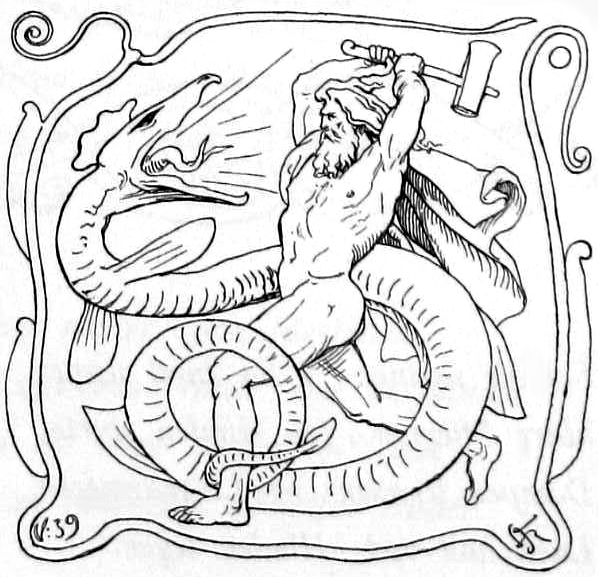
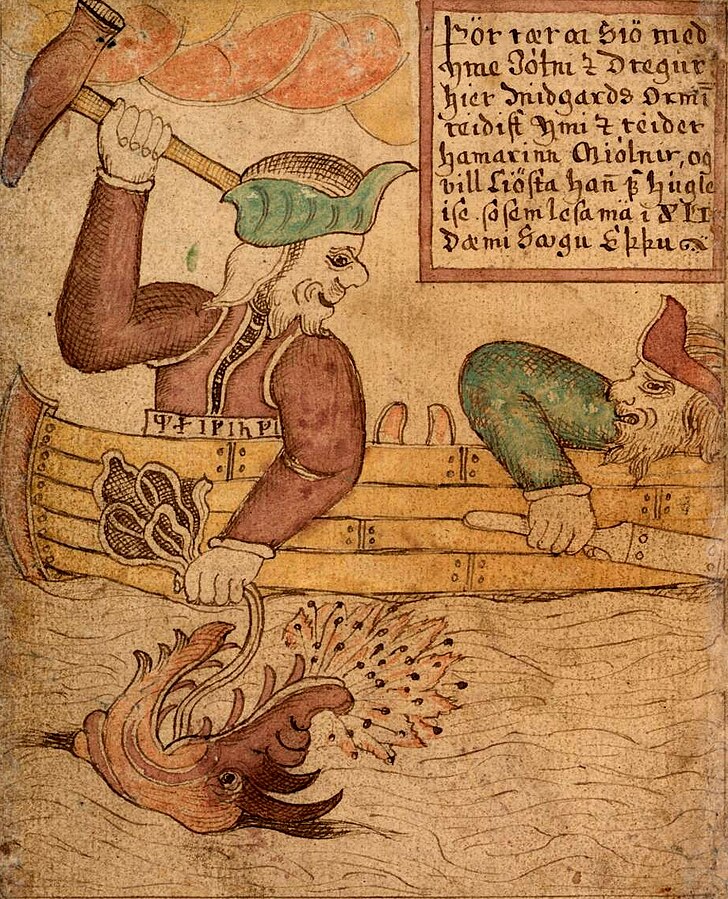
The major encounter between Thor and Jormungandr before Ragnarok appears in Hymiskviða, the Eddic poem in which Thor travels to the sea giant Hymir, borrows a cauldron, and uses an ox head as bait to fish for the Midgard Serpent. The poem is deliberately ambiguous. Thor hauls the serpent toward the surface of the sea, the boat buckles under the strain, and the moment of the killing blow is left unresolved. Snorri’s prose version preserves a tradition where Hymir cuts the fishing line before the blow lands, allowing the serpent to sink back and the world to survive a little longer. Preben Meulengracht Sørensen, the Danish scholar of Old Norse literature, argued that the fishing episode was understood in the Viking Age as a cosmic test of the boundary between order and chaos rather than a simple heroic combat. The implications are significant. Thor is not simply catching a fish. He is temporarily unseating the boundary marker of the world, and the world shakes accordingly.
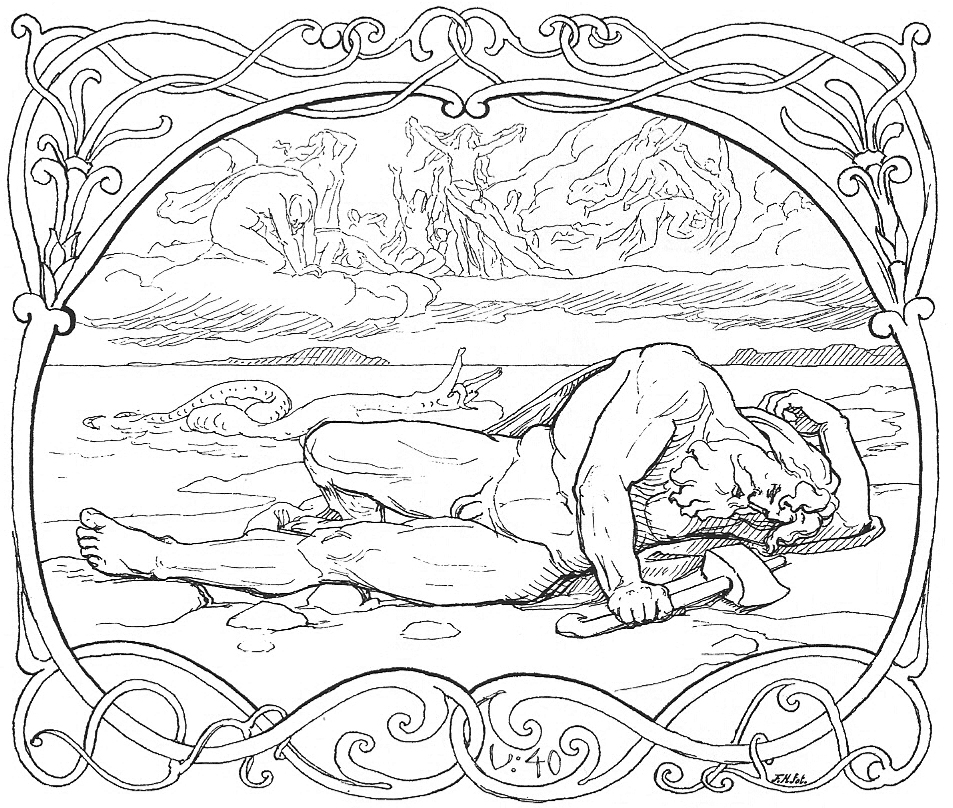
At Ragnarok, Jormungandr releases his tail. The boundary opens. He advances onto land, spraying venom into sky and sea. Thor kills the serpent with Mjolnir but staggers nine steps and falls dead from the poison. Nine, the number of worlds in Norse cosmology, carries structural resonance here that scholars have noted. The symmetry of the ending is exact: Thor kills the encircler but is killed by the encircling venom. Both die. The world’s straightener and its ring cancel each other out, and both their functions end at once.
Fenrir: the cost of keeping danger close
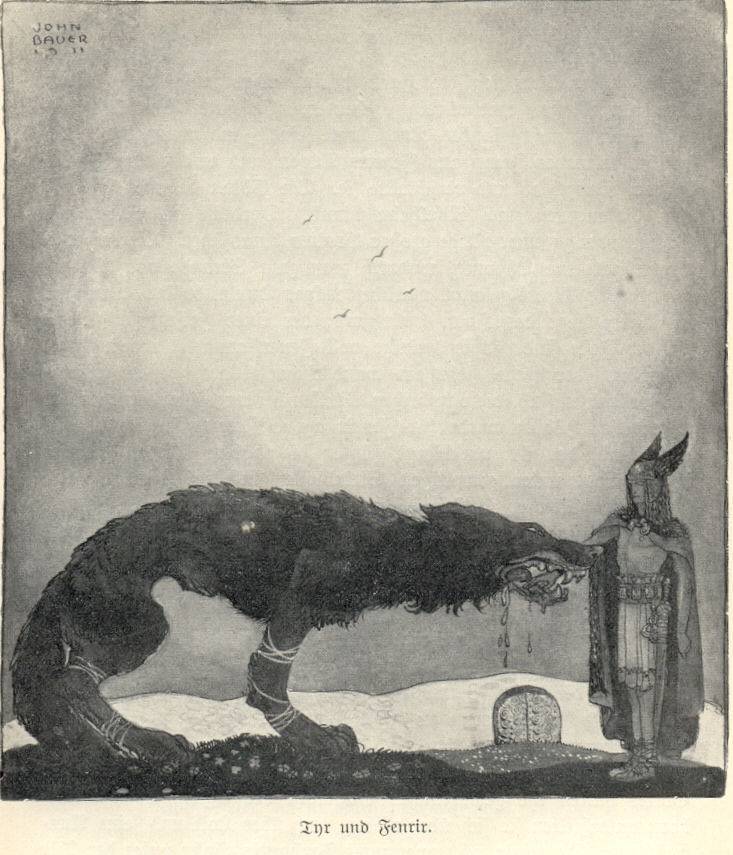
The wolf Fenrir presents Odin with the hardest problem because his threat is the most immediate and the most personal. The sea contains the serpent; Niflheim contains Hel. But Fenrir’s prophecy is that he will swallow Odin himself at the final battle. Odin’s response, bringing Fenrir to Asgard rather than casting him out, makes a kind of sense: an enemy you cannot see is more dangerous than one you can watch. The logic unravels quickly. The wolf grows faster than any god anticipated. Only one deity, Tyr, will approach Fenrir closely enough to hand-feed him, a detail that tells us something important about both the god and the wolf. Tyr, whose name derives from the Proto-Germanic *Tiwaz, connected to the Proto-Indo-European root for sky-god and divine justice, is in Snorri’s description the guarantor of oaths and the patron of law. He is precisely the god you would want at the centre of what happens next.
The gods commission Gleipnir from the dwarfs when two iron chains, Leyding and Dromi, fail to hold the wolf. Gleipnir is described as a ribbon made from six impossible things: the sound of a cat’s footfall, the beard of a woman, the roots of mountains, the sinews of a bear, the breath of a fish, and the spittle of a bird. The logic of impossibility is the logic of binding: what holds Fenrir cannot be visible or tangible in the ordinary way, because ordinary chains had already proved useless. Fenrir suspects a trick and agrees to be bound only if one of the gods will place a hand in his jaws as a pledge of good faith. No one volunteers except Tyr. The binding holds. Fenrir strains, fails to break free, and bites down on Tyr’s right hand. Tyr loses the hand. The wolf is secured with a sword propped between his jaws and a chain driven into rock. The scene, well preserved in the Codex Regius and elaborated by Snorri, is a founding document of Norse ethical thinking: one god pays in flesh for a common safety the others were unwilling to purchase themselves.
At Ragnarok, Fenrir breaks Gleipnir and kills Odin by swallowing him. Odin’s son Vidar avenges the death by standing on Fenrir’s lower jaw and tearing the upper jaw off with his hands, aided in some versions by a specially reinforced shoe. The bookkeeping is deliberate and exact. The gods deceived the wolf to bind him. The wolf kills the king. The king’s son tears the wolf apart. Norse myth does not do clean resolutions. It does earned consequences.
Built out of a love for history, kept free from distractions.
Spoken Past is an independent project shaped by curiosity, care, and long hours of research. Reader support helps keep it maintained, carefully researched, and open to everyone.
Sleipnir: the forgotten child of Loki
Fenrir, Jormungandr, and Hel are not the only offspring Loki produces. Sleipnir, Odin’s eight-legged grey horse, is also Loki’s child, born after Loki shapeshifted into a mare to distract the stallion Svadilfari and thereby saved Asgard from honouring an impossible building contract. The episode comes from the same mythological cluster as the stories of the other three. Loki enters a shape that crosses gender, species, and expected social role; the result is a horse that can travel between the nine worlds without restriction.
The functional relationship between Sleipnir and the other three children is rarely discussed but worth noting. The serpent marks the world’s outer boundary. The horse crosses all boundaries. Hel governs the boundary between life and death. Fenrir guards against the possibility of false security inside that boundary. Each of Loki’s offspring defines a different relationship to borders, edges, and thresholds. Odin rides Sleipnir down to Hel’s gate in Baldrs draumar precisely because no other creature could make that crossing. The tools and the dangers come from the same source. This is characteristic of Loki’s role in the mythology and a reason why flattening him into a simple villain misses what the tradition is doing with him.
Why Odin managed each threat the way he did
Odin’s three dispositions, sea for the serpent, underground office for Hel, internal custody for Fenrir, each reflect a specific assessment of what kind of danger each child represents. Jormungandr is a cosmological threat: his size makes him dangerous to the structure of the world itself, not merely to individuals within it. The solution is cosmological containment. The ocean is the only space large enough to hold something that encircles Midgard, and making him the boundary marker converts the danger into a function. He does not merely live in the ocean; he defines where the ocean ends and Midgard begins.
Hel is a jurisdictional threat: the unmanaged dead are not abstract. In a world where the dead could return, make demands, and disrupt the living, a ruler who received the dead and administered them was actually valuable. Giving Hel authority transforms a source of disorder into an institution. The risk is that the institution will enforce its own rules even when those rules run against what the living gods want, and Baldr’s story shows that risk fully realised. The institutionalisation of death turns out to mean exactly what it sounds like.
Fenrir is a personal and prophetic threat. He cannot be turned into a useful institution. His destiny is specific, physical, and directed at Odin himself. Keeping him close was arguably the only option other than killing him outright, and the mythology does not suggest the gods considered killing him. The binding is a compromise that delays without resolving. Neil Price, Distinguished Professor of Archaeology at Uppsala University and author of Children of Ash and Elm, has described the Norse religious imagination as one fundamentally shaped by the idea of a cosmos permanently geared for war and under existential pressure. The binding of Fenrir is one of the mythology’s clearest expressions of that pressure: peace achieved at a cost, maintained by deception, and measured out until the day the account closes.
Loki’s role in the pattern
Loki is not adequately described as a villain. He is a stress-tester. The Aesir maintain order through form, oath, and boundary. Loki consistently works at the edges of all three. With Angrboda he fathered a brood that challenges the gods from three different angles simultaneously. In Lokasenna, the flyting poem in which Loki forces his way into a divine feast and systematically accuses each god of a specific failing, he says things that are damaging, often true, and structurally incompatible with the feast’s social order. He makes the unstated visible. That function is dangerous in the short term and has a kind of usefulness in the long term, because a system that cannot tolerate its own weak places being named will discover them at the worst possible moment instead.
What makes Loki tragic rather than simply villainous is that the mythology shows both sides. He is the one who retrieves stolen goods, produces useful tools, and fixes crises he helped create. He is also the one whose children will end the world. The tradition holds both simultaneously, and scholars who flatten him into either pure trickster or pure agent of evil lose what the mythology is actually doing. His eventual binding, chained to rock with venom dripping on his face until Ragnarok, parallels the binding of Fenrir closely enough that Lindow identified them as part of a recurring pattern he called the “bound monster” theme in Norse myth. The cosmos requires these bindings to function. Their eventual release is what ends it.
What Ragnarok assigns each child to do
When Völuspá‘s prophetess recites the sequence of the world’s end, she assigns each of Loki’s children a role as precise as the roles assigned to them in the world’s maintenance. Jormungandr releases his tail, floods the land, and poisons the atmosphere. Fenrir breaks his chain and opens his jaws wide enough to span sky and earth. Hel does not ride to battle. She remains what she has always been: the administrator of the dead, receiving what the final war sends her. Her stillness at Ragnarok is as characteristic as her decisiveness in the Baldr story. She does not need to march because the battle will eventually reach her regardless. The three children are structurally necessary to the ending precisely because the ending is the reversal of the arrangements made at the beginning. Odin placed each child in a position that would maintain the world’s shape. Their release undoes those placements one by one, and without them the world’s shape cannot hold.
The seeress survives the end of that world. So does the earth, rising green from the water. New gods take the place of the old, and two humans, Lif and Lifthrasir, emerge from their hiding place in Hoddmimir’s Wood to repopulate the earth. Norse myth is not purely apocalyptic. The end is a reset as much as a destruction, a cycle rather than a terminus. But the children of Loki are specifically not part of what survives. Their roles belong to the world that was, not the one that follows. They are structural features of a specific cosmic arrangement, and when that arrangement ends, so do they.
How nineteenth-century artists fixed the images
The visual language most people bring to Loki’s children comes not from medieval manuscripts but from a cluster of nineteenth- and early twentieth-century illustrators. Johannes Gehrts, working in 1889, depicted Hel as a commanding figure standing above her realm, not a ghoul but a sovereign, which tracks closely with what Snorri actually describes. Lorenz Frølich’s 1895 illustrations for a Danish retelling of the Eddas set the standard images of both Thor’s fishing expedition and the final mutual destruction of Thor and Jormungandr at Ragnarok. John Bauer, the Swedish artist whose 1911 illustrations accompanied a popular retelling, gave Fenrir a palpable intelligence: the wolf in his binding scenes watches and waits rather than simply snarling, a choice that matches the sources’ emphasis on Fenrir’s cunning alongside his strength.
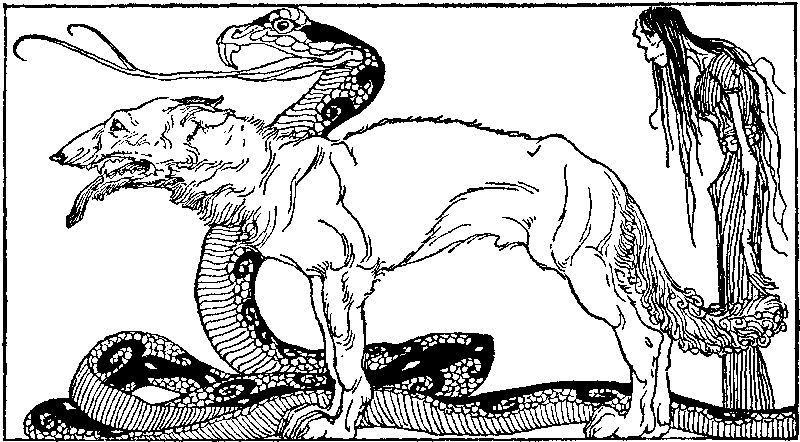
Willy Pogany’s 1920 grouping of all three children in a single illustration made the structural relationship among them visually explicit in a way that the separate textual episodes do not. Placing them together says something about how the mythology works: these are not three unrelated monsters but three aspects of a single problem that Odin distributed across the cosmos. The illustrators did not simply decorate. They made interpretive choices about what the mythology meant. Understanding those choices, and the ways they differ from what Snorri and the poems actually say, is part of how modern readers can disentangle the inheritance they have received from both traditions simultaneously.
What the three children reveal about Norse myth’s governing ideas
Read together, the stories of Loki’s children organise several ideas that run throughout Norse mythology. The first is that power is inherently jurisdictional. Hel does not simply exist; she administers a territory with rules. Her refusal to release Baldr is not a personal failing but an institutional one: she set conditions, those conditions were not met, and she acted consistently with her office. The world that Norse myth describes is one where even the queen of the dead is bound by procedural constraints. That is not incidental. It is a foundational assumption about how reality works.
The second idea is that boundaries are not decorative. Jormungandr does not merely live in the ocean. He constitutes the boundary between the ordered world and the chaos outside it. When he releases his tail, the boundary does not weaken; it disappears. The Norse cosmos is not a fixed container with things inside it. It is a dynamic arrangement of forces maintaining their positions relative to one another, and when one force stops holding its position, the whole arrangement fails. The third idea, illustrated most sharply by Fenrir’s story, is that peace achieved by cleverness rather than resolution is peace on loan. The gods did not eliminate the threat. They delayed it with a ribbon and a maimed god and a sword jammed into a jaw, and the mythology keeps Tyr’s missing hand visible throughout as a reminder of the price and the impermanence of the settlement. The bill arrives eventually. Norse myth does not argue that this is wrong or avoidable. It argues that it is the structure of reality, and that knowing it is the structure of reality is what shapes how its heroes and gods choose to act.
Primary sources: Snorri Sturluson, The Prose Edda, trans. Anthony Faulkes (Everyman, 1995); The Poetic Edda, Codex Regius GKS 2365 4to, Árni Magnússon Institute for Icelandic Studies, Reykjavík; trans. Carolyne Larrington, Oxford University Press, 2nd ed., 2014. Secondary sources: John Lindow, Old Norse Mythology, Oxford University Press, 2020; Carolyne Larrington, The Norse Myths: A Guide to the Gods and Heroes, Thames and Hudson, 2017; Rudolf Simek, Dictionary of Northern Mythology, trans. Angela Hall, D. S. Brewer, 1993; Neil Price, Children of Ash and Elm: A History of the Vikings, Basic Books, 2020, reviewed in American Antiquity, Vol. 88, Issue 3, 2023; Rolf Fabricius Warming, “The Viking Age Shields from the Ship Burial at Gokstad,” Arms & Armour, Vol. 20, Issue 1, 2023.