Table of Contents
What Jötunheim Is And Where It Fits In The Norse Cosmos
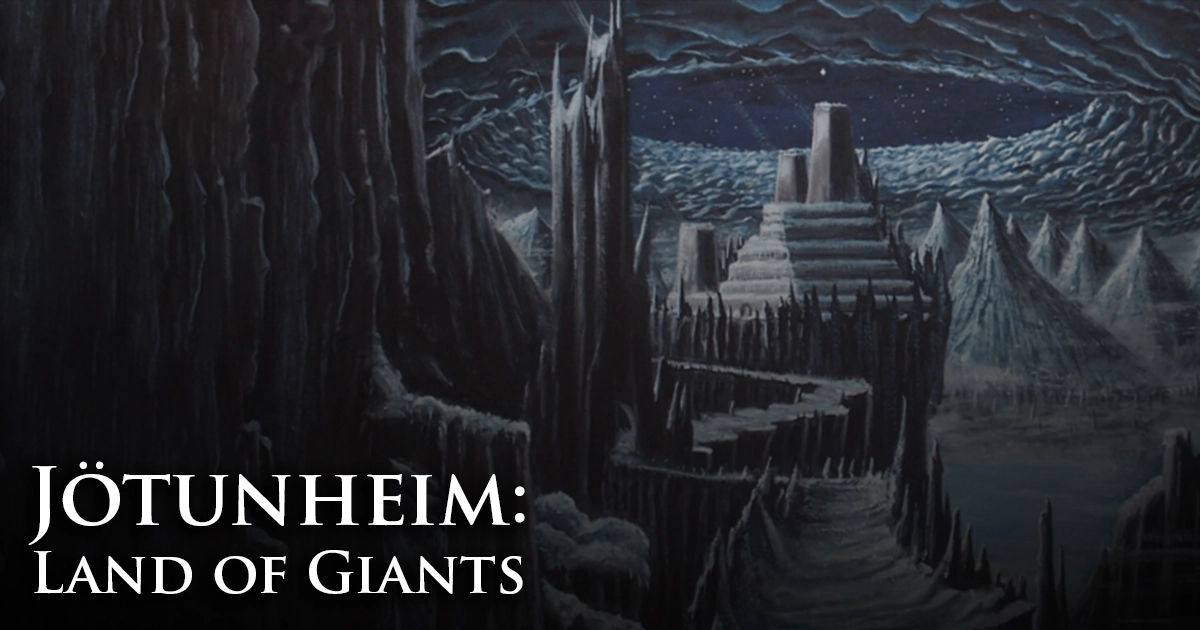
The poets of the Eddas imagine a world layered and linked by crossings, a web of places where kinship and feud determine the flow of stories. Jotunheim (Jötunheimr) lies east in that imagined geography, a wild and testing land beyond safe borders. Its very name means home of the jötnar, the beings we usually call giants. That term is imperfect. Size matters in many tales, but a jötunn is better understood as a rival force to the gods, a pressure that shapes them. To speak of Jotunheim is to speak of edges, crossings, and the bargains or battles that follow.
The nine worlds motif, known from poetic stanzas and later prose, gives us a scaffold. Midgard, the human enclosure, stands guarded at the center. Asgard, the godly stronghold, sits high and walled. Jotunheim stretches beyond rivers and mountains, reached by fords and ferries, a country of cliffs, glaciers, deep woods, and sea-skirting halls. Odin (Óðinn) rides there for knowledge. Thor (Þórr) tramps there to test his strength. Loki, God’s companion and troublemaker, slips between the borders with a comfort that reveals his mixed ties.
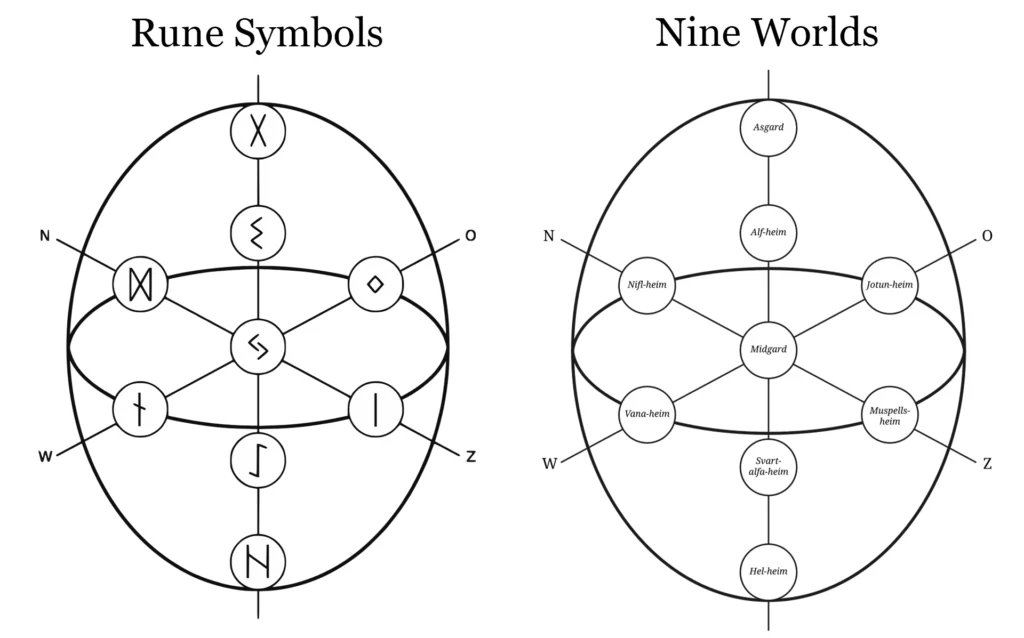
The nine worlds and Jötunheim in relation to Asgard and Midgard
The myths do not give a single map. Instead they lean on remembered routes and repeated thresholds. When a poem mentions “east of the rivers,” the audience hears a direction of danger and challenge. Jotunheim is one such east. Asgard watches that horizon. Midgard builds fences against it. The tension between enclosure and outside makes the stories move.
Boundaries that separate and connect the worlds
Rivers mark boundaries in Eddic poetry. The river Ifing (Ífingr) is the best known. It never freezes, even in winter, and flows between Asgard and Jotunheim. The detail is not just scenery. An unfrozen river in a world of long cold suggests a line of perpetual movement. Fords, ferries, and bridges recur because crossing is a ritual moment. The seer or warrior who steps into Jotunheim steps into a test.
Terms for giants and what they mean in the sources
Jötunn in the Eddas is a wide term. Old words like hrímþurs, rock-giant, and mountain-giant indicate variation in power and place. Some giants are crude strongmen, others are wise and old as the world’s first rime. Some dwell under the sea and brew ale in caverns lit by blue light. Several giant women teach or test the gods. The term holds multitudes. That nuance matters, because Jotunheim is not a single tribe behind a single wall. It is a mosaic of halls, lineages, and beings whose aims do not align.
Origins Of The Giants In Mythic Time
From primal frost and venom to the first beings
Before there were fields and fences, the myths set a gap, a yawning space. From the north came rime and frost, from the south came sparks and heat. Where they met, life stirred. That primal meeting births the first cattle and the first person-shaped beings. The stories emphasize the mixture, not a tidy creation by decree, but a slow thaw and drip that yields life.
Ymir and the early kin of the frost giants
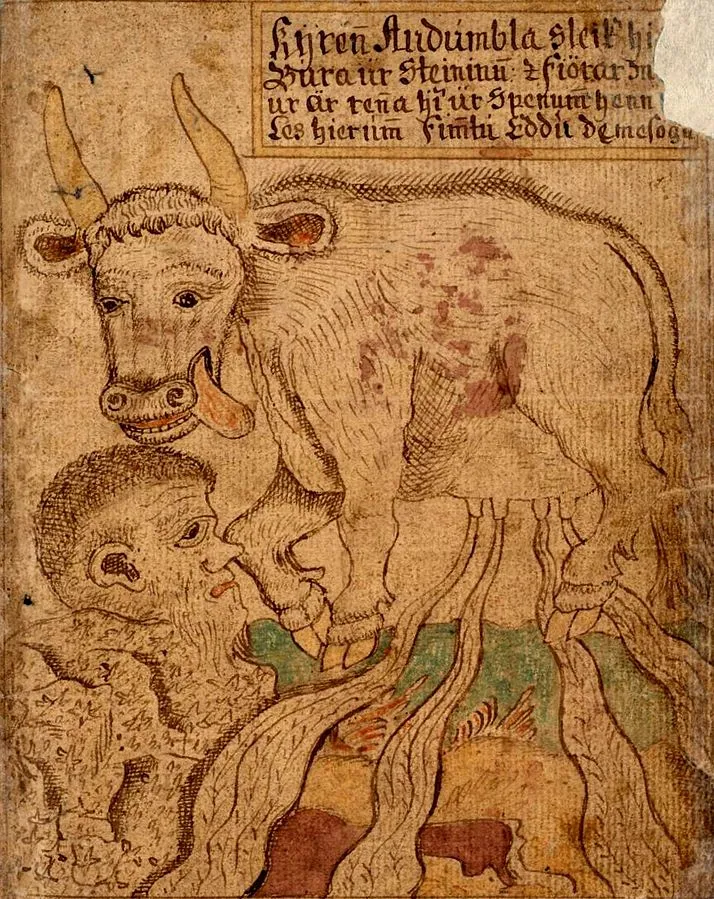
From that meeting comes Ymir. The poets treat him as ancestor of the jötnar. He sleeps, he sweats forth children, and he drinks the milk of the cosmic cow Audhumla (Auðumbla). The image is both comic and uncanny, a reminder that the first kin of giants belong to a raw world before laws are set. Audhumla licks salty rime, uncovering Buri (Búri), ancestor of the gods. From the outset, the lines of god and giant run close.
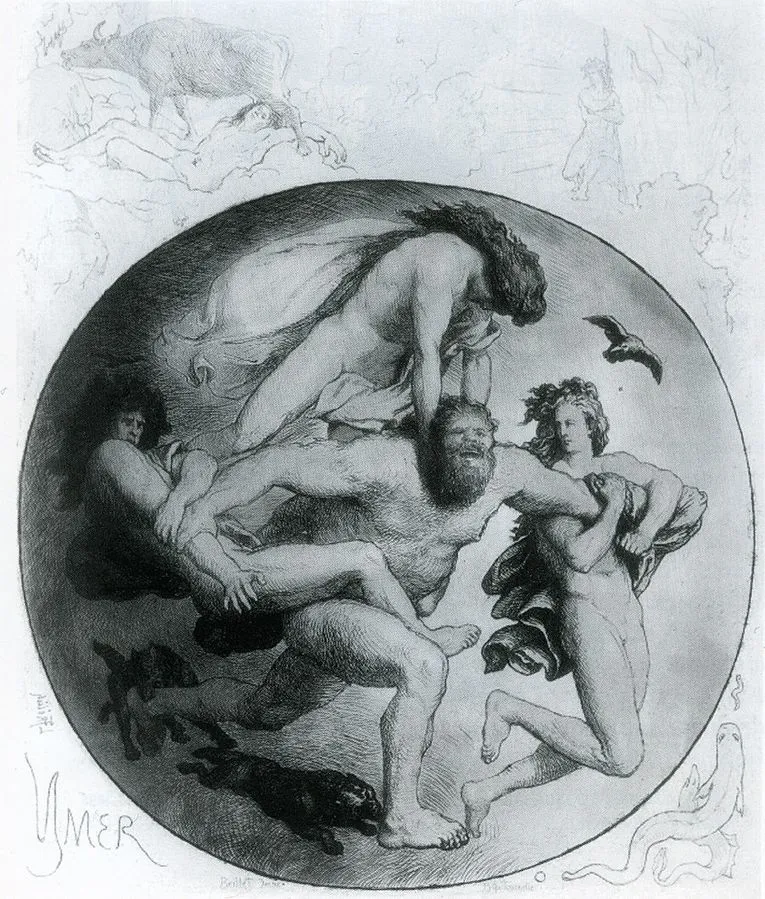
The slaying of Ymir and the surviving lineages
Odin and his brothers slay Ymir. From the blood they fashion seas, from the bones they raise mountains, from the skull they make the sky. Creation is an act of killing and repurposing. The slaughter floods the giant kin, yet some survive by rowing on a wooden box. Their descendants people Jotunheim. Creation by conflict sets a tone. The gods build by cutting, reworking, and walling. The giants endure outside those walls and remember.
The Shape Of Jötunheim As A Mythic Land
Rivers cliffs and the wild borderlands
Jotunheim is told through obstacles. Travelers hit a river that bites their thighs and chills their marrow, or a cliff face that drops “as if the world’s edge were cut with an axe.” Frost stacks in blue slabs. Winds roar off icy ridges. The land pushes back. The poetic focus falls on thresholds, not homesteads. Giant halls do exist, often cut into cliff or stone, but the path to them is the point. The traveler must wade, climb, and outlast.
Ifing as the active boundary river
Ifing remains in motion. That small claim makes it the perfect border. The living river keeps the lines between god and giant honest. No one can stroll across on winter ice. The crossing must be chosen and earned. When the gods go east, they accept hazard by entering a place that will not hold still for them.
Ironwood and the forest of monstrous offspring
The Ironwood (Járnviðr) is a forest in the giant marches where a witch-figure raises a brood that foreshadows the end. The imagery is thorn and iron, wolves and winged shadows. It is less a placed map than a theme. In the edge-wood, strange children grow. What begins there does not end there. The forest’s brood reaches into Midgard and Asgard by bite and omen.
Kinds Of Giants And How They Differ
Frost giants rock giants and mountain dwellers
The sources use different labels. Frost-giants come clothed in winter; stone-giants stand like a cliff given legs. Mountain dwellers live in high halls stacked with wealth. The poets rarely inventory a people. They sketch a figure or family, then they set them against a god who must cross out of safety to speak or fight.
Sea giants and the keepers of ale halls
Far from the cliffs, the sea’s edge holds its own lords. Aegir (Ægir) brews ale in a capacious kettle. Ran drags nets for the drowned. Their halls under the wave shelter feasts and quarrels. The seashore in Norse myth is a hinge place: what washes up cannot be kept, and what is taken in boats may not return. Sea giants are not always enemies. They can host or provision, although payment is always due.
Wise women seeresses and teachers among giants
Some of the finest teachers in the Eddas are giant women. They speak with the weight of old winters. They trade knowledge for courage or courtesy. To call all giants dull or brutal misses this thread. Jotunheim holds wit and craft as surely as brawn. When the gods want truths that hurt, they often ride east.
Law Custom And Hospitality In Giant Halls
Jotunheim is not lawless. Law lives at the border because without it, no one could cross and come back with a story. Guest rights, oaths, and table places matter. We can see this most clearly when things go wrong, because poetry loves conflict. Yet the conflicts only bite when customs are known.
Guest rights oaths and the price of breaking them
When Odin travels in disguise and asks for a seat, a host who grants it lights a fire and sets food. When Thor arrives, the custom of safe-guest holds until the first offense. To eat salt under a roof is to accept obligation. Oaths twist these ties tighter. A broken oath rings through poems like a cracked bell. It invites vengeance, not as cruelty but as the expected cost of breach.
Feasts riddles and contests as trials of worth
The halls of giants host contests that are more than sport. Riddling is a way to measure wisdom without drawing steel. Eating contests, drinking bouts, and feats of strength declare standing. To sit and drink with a host is to enter a civilized arena. The failures that follow teach the rules and mark the limits.
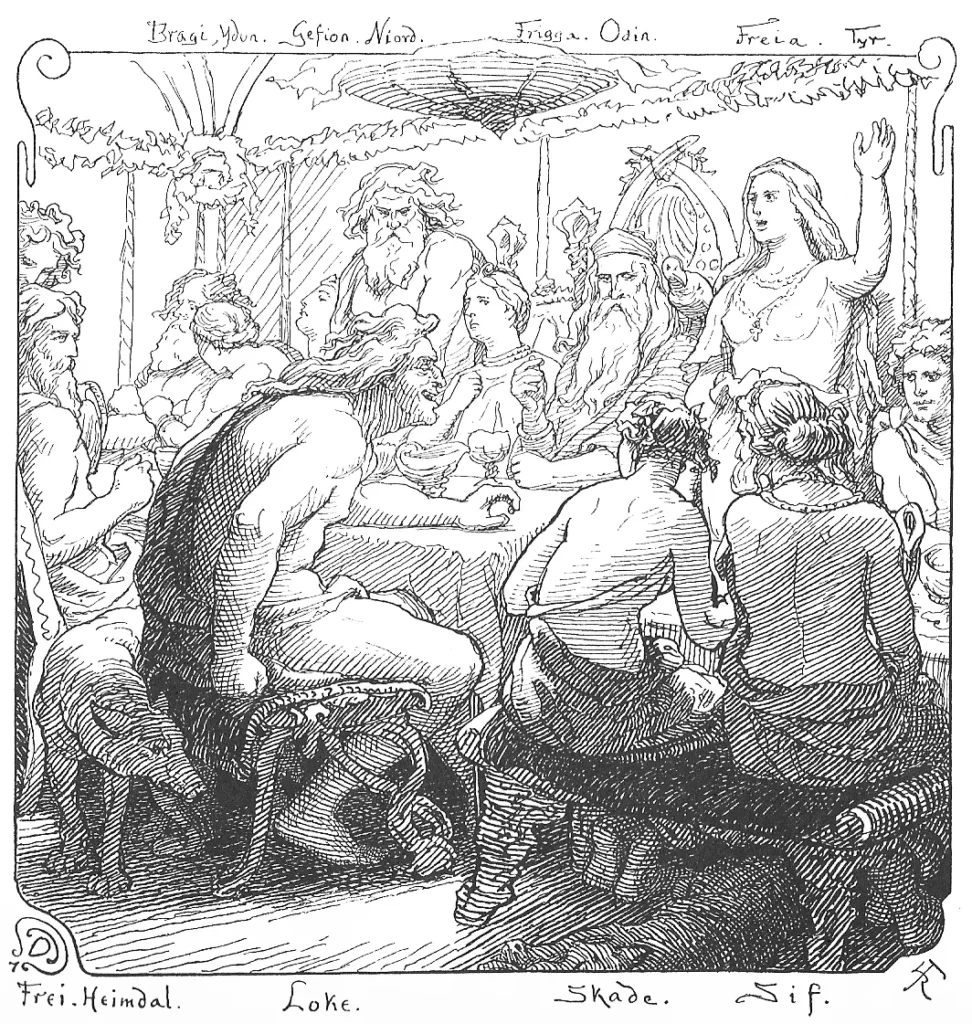
When bargains bind gods and giants
Bargains are the great bridge-builders of myth. A builder offers a wall, a god offers a bride, and the truth of the bargain tests both sides. When a host provides a bed and beer, a guest provides restraint and thanks. When the gods promise reward, they must deliver. The Eddas return to this theme because borders depend on trust. When trust fails, the river swells.
Odin Crosses Into Jötunheim For Knowledge
Odin’s journeys east show what the gods seek from their rivals: words and wisdom older than stone. The Allfather does not go to Jotunheim to win trophies. He goes to sit and speak, to risk humiliation in exchange for truths that cannot be found at home.
Quests for mead runes and hidden lore
The mead of poetry runs through giant hands. Odin steals, bargains, and wins it by guile and endurance. The runes, once cut into the world by his self-wounding, speak in a language of cost and reward. These quests cross Jotunheim not only on roads but also in thought. Odin pushes to the border of what should be known, and then he steps over it.
Encounters with Vafthrudnir and other wise giants
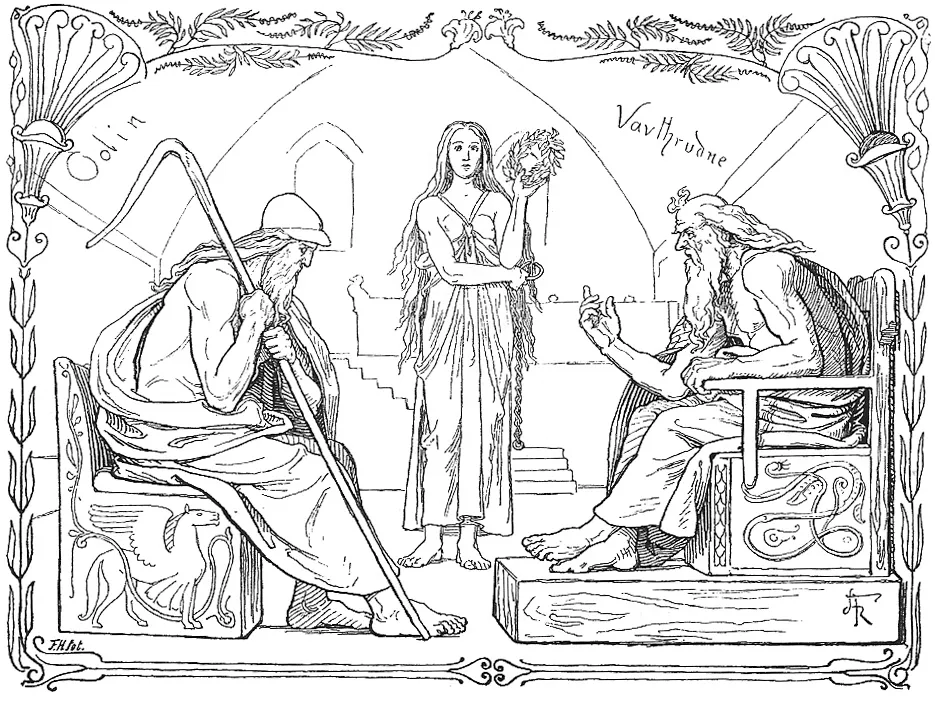
Vafthrudnir (Vafþrúðnir) is the master of one of the Edda’s great wisdom-contests. He welcomes a stranger and accepts the terms: ask and answer, and the loser loses his head. Odin speaks under a name, then throws questions that range from first ice to final fire. The old giant answers without flinching. Only when Odin asks about what he alone has whispered in a dead son’s ear does the mask drop. The contest ends, and the giant acknowledges the guest who sits before him.
The cost of wisdom for the Allfather
The poems never let us forget cost. Odin pays with an eye at a well. He hangs to win the runes. He risks his life in halls where a wrong word can end a guest. He pays because knowledge is not free, and the only knowledge worth the ride east is the kind that wounds.
Thor Travels East And Meets His Hardest Tests
If Odin seeks sayings, Thor seeks edges he can batter. He is the traveler who leaves the safe road, the walker who wades when others ride. His contests in Jotunheim define his character. The strongest god must learn what strength means when size equals illusion or when stone equals stubbornness.
Companions roads and recurring motifs of the journeys
Thor travels with Loki often. He takes the farm children Thjalfi and Roskva into his care. He meets giants on the road and sleeps under tall trees while a host lies nearby grinning. The motifs repeat: a test disguised as a chore, a race that cannot be won, a drinking horn that will not empty. The repetition works like a drum, reminding us that Jotunheim is not simply a place, it is a proving ground.
The visit to Útgarða Loki and the master of illusions
In the hall of Utgarda-Loki (Útgarða-Loki), Thor faces contests rigged by glamour. Loki eats against wildfire. Thjalfi races a thought. Thor lifts a cat that is the Midgard serpent, and he wrestles an old woman who is Time. The god does not fail because he is weak. He cannot fully win because the tests are set against the underlying fabric of the world. Even so, he lifts the cat to a paw off the floor and forces the old woman to her knee. The illusions fall when the host reveals the tricks, and Thor’s strength stands higher than before.
Duels with Hrungnir Geirröd and other stone strong foes
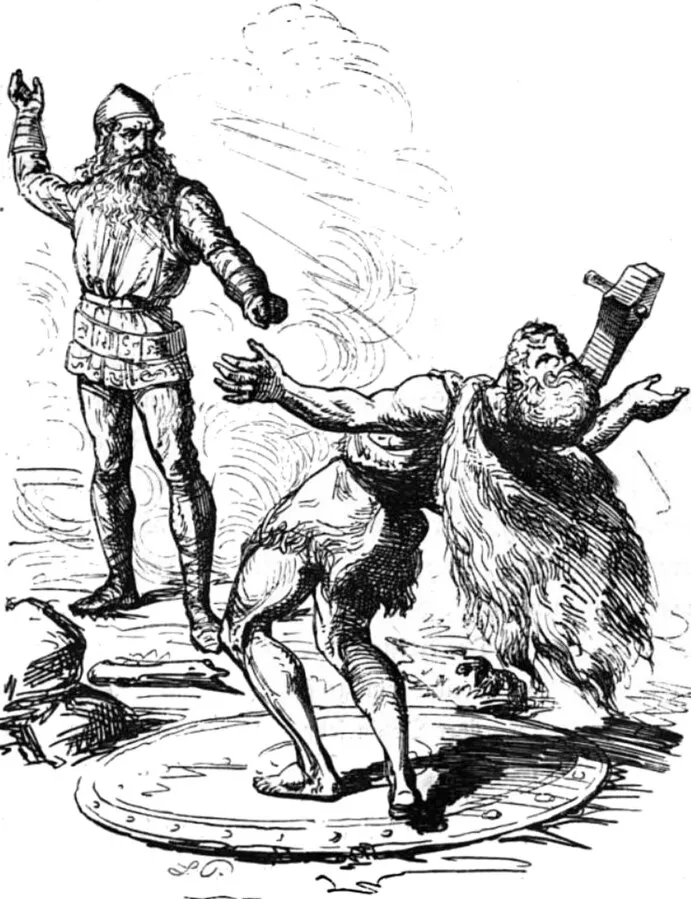
Thor’s more straightforward battles sharpen the theme. Hrungnir challenges the gods and meets Thor in a duel of stone against hammer. The jötunn’s heart is three-pointed, his head of stone, and his shield the same. Thor shatters him with Mjolnir (Mjöllnir). The hammer sinks into the giant’s skull and a shard lodges in Thor’s own head, a mark he will carry. Against Geirrod (Geirröðr), Thor must cross a river swollen to drown him and face a host who hurls iron. In some versions he borrows a staff and belt from a giantess ally to win through. The fights read like sagas set in a mythic time: travel to enemy land, accept the tricks, and prevail by wit and force together.
Loki Between The Worlds And His Ties To Giants
Loki holds friendship and blood ties in Jotunheim. His father is counted among the giants in some traditions, which gives him natural ease in their halls. He plays guest and go-between, and he stirs trouble that only Thor can unmake. The poets love his speed because he turns plots quickly. Loki is not the source of every problem, but many problems pick him as their courier.
Parentage friendships and shifting loyalties
The sagas and poems show Loki taking gifts and wives across borders. He speaks fluently both in Asgard and Jotunheim. His children with the giant woman Angrboda are not mere figures, they are forces that change the future. The wolf grows too fast. The serpent grows too long. The daughter reigns over a cold hall. Loki’s double belonging explains how he can enter giant halls without a brawl and return to Asgard without a guard. It also explains why his bridges burn so easily.
Schemes that start in Jötunheim and end in Asgard
Many thefts and rescues that define the gods’ life begin in giant country. Loki’s quick tongue wins him doors. It also paints targets on his back. He promises what he cannot pay, then races to find collateral in Asgard. That movement, east to west and back again, is the rhythm of the myths.
When trickery serves and when it breaks trust
Trickery can serve. Loki’s schemes sometimes bring home what would otherwise be lost. But trickery always carries a cost. Each lie frays a tie. The fraying accumulates across the poems until the gods and giants both reckon with breaches that cannot be mended.
Marriage And Alliance Across The Border
Kinship is a kind of bridge. The gods and giants marry across the border, not as an exception but as a pattern. These unions bring gifts and create obligations. They also import grievances. The mixed households of myth carry both welcome and risk.
Njord and Skadi and the choice between mountain and sea
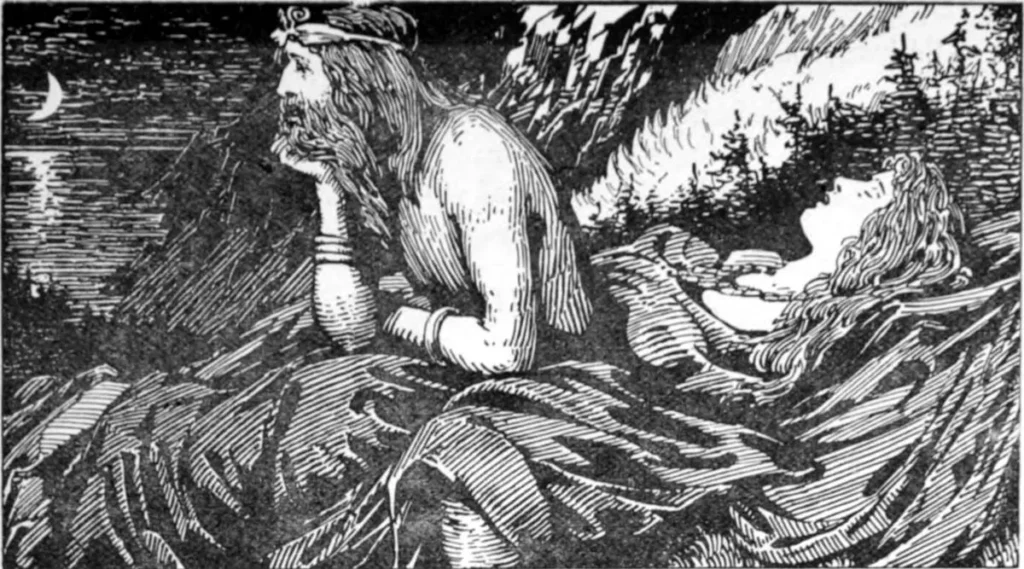
The story of Njord and Skadi (Skaði) hinges on place. Skadi seeks recompense for a father’s death and chooses a husband by his feet. She finds a sea god who longs for gull cries and salt wind. She prefers mountain snow and wolf song. They try each other’s homes in turn. The marriage falters because love cannot erase landscape. The story is not mockery. It is a sober note about difference and the cost of trying to live on the wrong side of one’s nature.
Freyr and Gerd and the price of desire
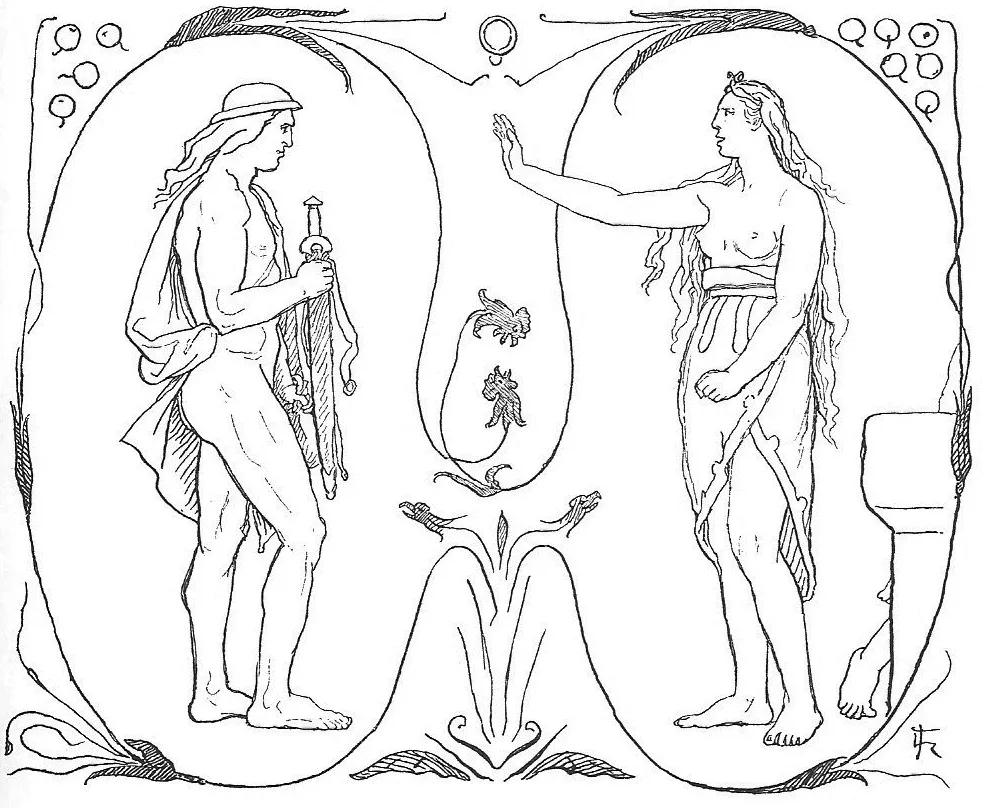
Freyr sees Gerd (Gerðr) in a distant hall and sickens with love. He sends Skirnir to woo her. The messenger rides east with gifts, then with threats. The poem that tells the tale is unsettling. It shows a god so taken by desire that he will send a servant to coerce a bride. Gerd agrees to meet at a sacred grove after nine nights, and Freyr gives up a sword that fights by itself. Desire becomes a bargain, and the price is steep.
Other unions that weave kinship between gods and giants
Other unions occur, sometimes briefly mentioned, sometimes richly told. The pattern remains. Alliances through marriage add complexity to a world otherwise divided by walls and rivers. Children of mixed households complicate every muster. In myth, bloodlines bind more tightly than borders.
Theft Loss And Recovery Of Divine Objects
Divine objects carry stories with them. They are not mere tools. Hammer, apples, spear, and cauldron: each stands for a set of rights or powers. When a giant steals one, the theft calls the gods east. When the gods steal, the theft demands clever cover. Return or replacement requires crossing boundaries and dealing with hosts who remember past wrongs.
The hammer taken and the wedding at Thrym’s hall
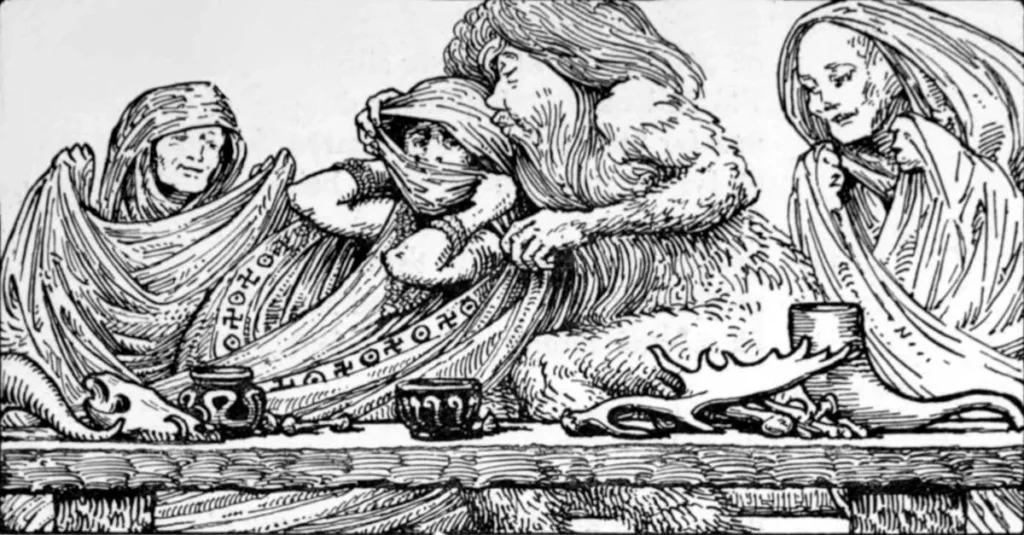
The finest comic tale in the cycle begins with absence. Thor wakes without his hammer. He seeks Loki, who borrows a feather cloak and flies east. The giant Thrym sits on a mound counting collars on his dogs and horses. He admits to taking the hammer and demands Freyja as a bride. The gods dress Thor in a bridal gown, fit him with keys and veil, and send him to Jotunheim with Loki as handmaid. The wedding feast grows noisy. Thor’s appetite nearly gives him away, and Loki lies fast to cover the slip. When the hammer is brought to hallow the bride, the veiled groom grabs it with both hands and restores his honor in a hail of shattered skulls.
Apples spears cauldrons and other contested treasures
Other objects go missing or are bargained away. Idunn’s apples vanish into a giant’s keeping, and the gods grow old. Odin’s spear Gungnir is forged by dwarfs after a betrayal forces negotiations that begin in one hall and end in another. A kettle large enough to brew ale for all the gods must be sought in a far hall. In each case the retrieval does more than fix a problem. It redraws ties across the border.
What stolen gifts reveal about power and status
When a giant steals, he does not simply enrich his hoard. He tests the gods’ claim to rule. When the gods steal, they prove that cunning can reach where force cannot. Each exchange leaves a mark. The gods return older and heavier with obligation. The giants learn the gods’ limits and habits. The stage is set for future bargains and fights.
Built out of a love for history, kept free from distractions.
Spoken Past is an independent project shaped by curiosity, care, and long hours of research. Reader support helps keep it maintained, carefully researched, and open to everyone.
Hymir And The Great Kettle For The Feast Of Ale
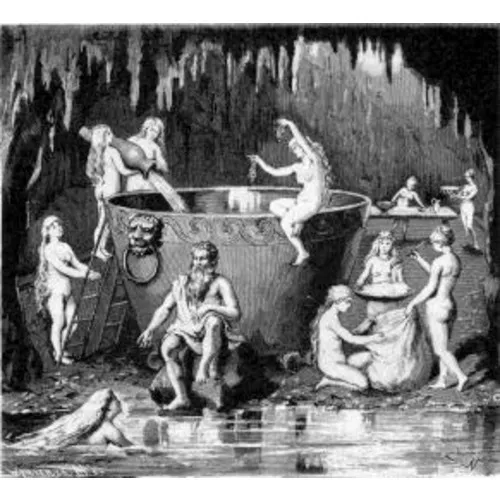
The need for a colossal kettle brings the gods to Hymir’s hall. Aegir promises to host a feast, but he lacks a cauldron vast enough to brew ale for all. Tyr knows that his giant father Hymir has such a kettle, and he offers to guide Thor east to fetch it. The story sits at the border of hall custom and brute test: hospitality depends on equipment, and the equipment belongs to a reluctant host of giant stock.
The quest for a cauldron large enough for the gods
The journey itself rehearses old motifs. The travelers meet a she-goat or ox that will later repay a kindness. They pass through cold and come to a hall where a host greets them with stony formality. Hymir’s wife or consort often appears as a voice of courtesy. She hides the guests or offers them advice. Hospitality is extended, but the cost is in the air.
Trials in the icy hall and the breaking of the cup
Hymir owns a cup that will not break unless hurled against his own head. Thor must learn or be told the trick. He throws and throws until someone whispers the rule. When the cup shatters, the act doubles as wit and insult. It proves that the guests can master the house while it also goads the host’s temper. The episode paints Jotunheim’s halls as places where rules are hidden in plain sight. To win, the guest must read the room.
What the kettle story shows about strength and wit
When Thor hoists the kettle, the tale folds strength and cleverness into one motion. The cauldron’s size is a joke tied to a serious theme. Without the kettle, no feast. Without the guest’s courage, no kettle. The journey east, the contest in the hall, and the return with a burden on the back fill out the long rhythm of exchange across the border. The ale brewed later tastes of risk, frost, and an earned seat at a shared table.
The Fishing For The World Serpent
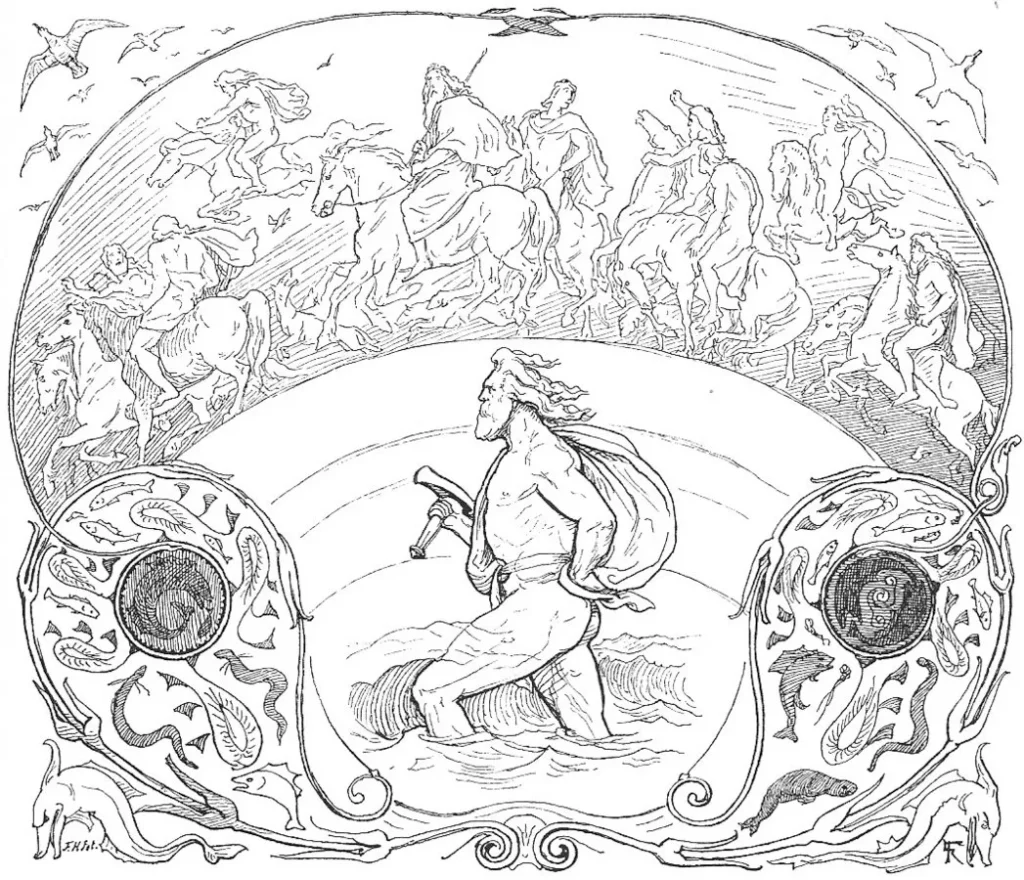
Thor sits in a low boat beside a grim host and reads the water. The sea is black with depth, cold with the northern wind, and wide enough to swallow a city. Hymir, hard as his name, watches with a scowl and gives little counsel. He has oars fit for a giant and a will to match. The shore behind them is a narrow line. Before them lies a field where ropes, hooks, and courage measure a kind of truth that halls and speeches cannot reach. Thor wants proof, not praise. The ocean has kept one proof since the early winters: the serpent that belts the world beneath the waves, a rival that is not a king or a council but a fact of the world. To pull on that fact is to measure a god.
Setting out to sea with Hymir
The patterns are old. A guest must ask permission. A host must test him. Thor receives grudging leave to fish beyond the safer grounds. His oars bite, and the keel turns toward the outer dark. Hymir mutters that the bait is poor. Thor answers by walking up the shore and hewing the head from a great ox with one clean stroke. The head swings from the hook like a red moon. The choice of bait is not a flourish. It declares scale. A god who offers a head this large expects a catch sized to match it.
The rowing is slow, then fast, then slow again as the swells climb and sink. Hymir warns that they have gone too far. That warning betrays respect. He knows what lives where the light turns iron. Thor’s face shows nothing but intent. The line coiled at his feet looks thin against the water, but the hook, the head, and the hands that hold the line join to a chain of purpose that no wave can wash apart. When the world answers, it does not answer like a fish.
The bait the pull and the near end of the world
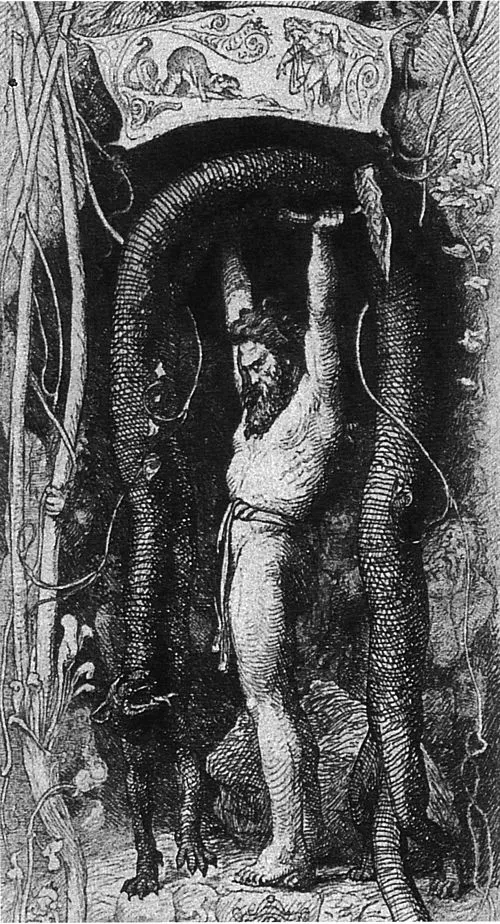
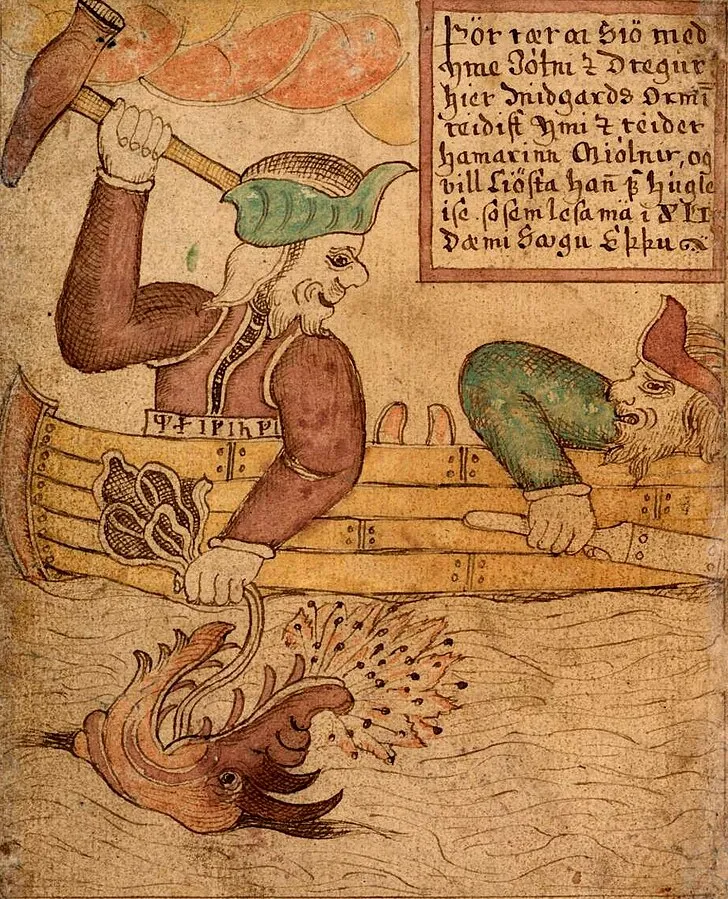
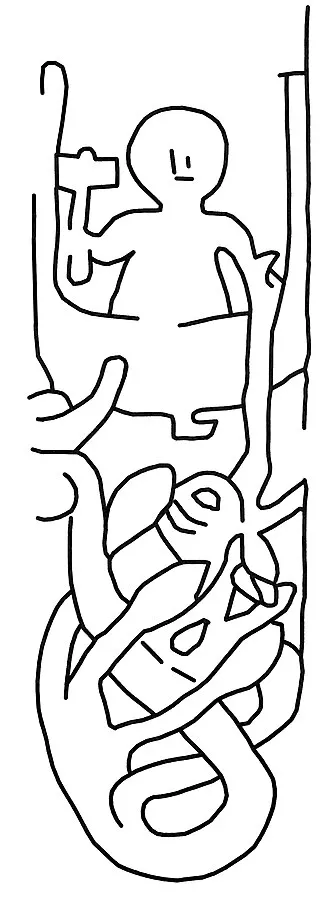
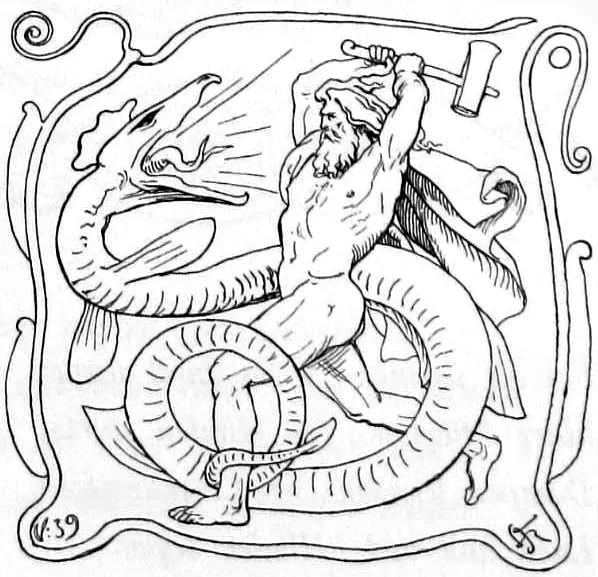
The serpent takes the bait with a force that lifts the prow. The line sings, the boat skids sideways, and waves slap the gunwales in bursts that soak the benches. Thor plants his feet and pulls. The poets say he braces so hard that both his feet go through the planks. The image is not comic, it is exact. To fight the serpent is to lean against the world so hard that the world gives way. Hymir, pale and wide-eyed, forgets to gloat. The serpent rises. Scales as broad as shields catch the gray light. The head breaks the surface, jaws open, and venom steams like breath. The world buckles between the upward twist of the line and the downward wrench of the deep. Thor readies the hammer, eager for a blow that would ring to the ends of land and sea.
In some tellings he strikes. In others he almost strikes. The failure or the stay does not weaken the story. The pull itself is the test. The sea swallows the roar and gives back only the slap of a wave and the thud of a god’s heart. The serpent writhes back into its belt beneath the rims of the world. The line hangs slack. Thor’s hands are torn and blooded, yet his face shines with a brightness that is not relief. He has learned the weight of his opposite. Hymir has learned it too.
Why the line is cut and what the tale foreshadows
Why does the blow not land? One strand of telling has Hymir slash the line in fear. Another has the serpent break free. Either way, the story holds an answer without preaching it. The world endures because some endings must wait their hour. Jormungandr (Jörmungandr) will meet Thor again on an open plain when all bonds break. To kill him early would break the clock of fate. The restraint is not mercy. It is order. The ocean keeps its secret a while longer. The god keeps the memory of the pull the way a scar keeps a lesson.
Halls Shores And Sea Kings Linked To Jötunheim
If the inland paths to giant halls run through frost and blue cliffs, the ocean has its own threshold places where laws hold and fail in turn. The sea beyond the ferries belongs to lords who are neither tame nor entirely hostile. They throw feasts in caverns lit by green light, weave nets that bite like oaths, and share kettles that can brew for armies. When travelers speak of a good harbor on a bad coast, they often mean a neighbor of Aegir, whose house is a truce within a greater danger.
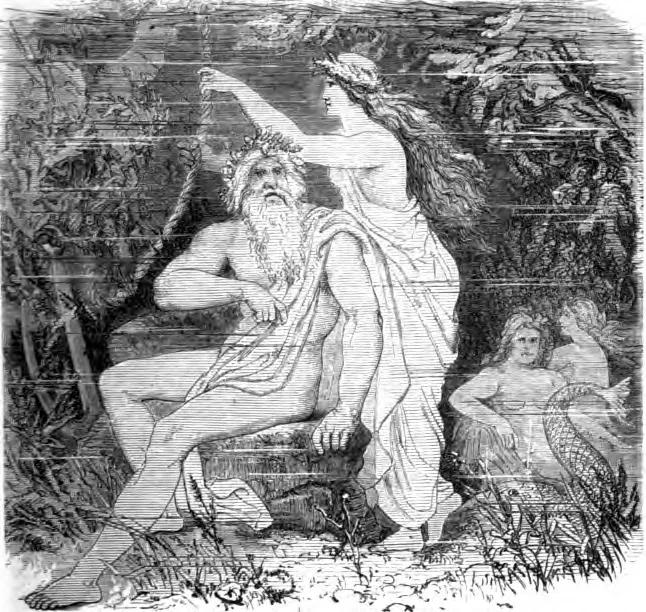
Aegir and Ran and the halls beneath the waves
Aegir is a host who knows how to fill a bench and cool a quarrel. He does not do this because he loves the guests. He does it because brewing and seating are powers that can rival iron for a day. Ran is different. She is the sea’s sudden hand and the keeper of nets for the drowned. She does not hate sailors. She simply collects a debt that the coast has always demanded. Together they make a household that teaches the rules of feast and wreck. A helm raised in Aegir’s hall hangs beside a net in Ran’s hands. One promises warmth and beer, the other the quiet sway of a rope below black water.
Feasts shipwrecks and net lore
The poems place the gods at Aegir’s table for reasons that are practical and ceremonial. Feasts are meetings where hard truths can be spoken under the softening cover of song. Kettles matter because ale is a shared language. When the kettles are too small, alliances fail for reasons as simple as thirst. On other days, Ran’s nets remind coastal farmsteads not to trust a calm surface. The old people say that if a sailor promises too much or fails to pay an offering, Ran will ask for a sleeve or a ring and then for the whole hand. To anthropologists of later centuries this reads like etiquette. To the poets it reads like fate.
Sea daughters gifts and the reach of ocean giants
Aegir and Ran have daughters whose names sound like the sea’s changing faces, billow and breaker among them. They do not simply decorate the background. They are personifications of conditions that any traveler must face. When a sailor survives a storm, he thanks not only a god in Asgard but also a temper in the sea’s own family. The ocean’s household is a mode of understanding that turns danger into neighbors. It is easier to negotiate with a person than with a force. It is easier to fear and honor a named lady than a nameless swell. The stories do not collapse the sea into pure metaphor. They elevate the sea to kin.
Giant Women As Givers Of Knowledge And Doom
On the eastern side of things, women in giant families hold seats of power that do not always resemble courtly queenship but can exceed it. They give counsel to gods who think they need none. They hand out tools that change the outcome of trials. They also bring children into the world who are not merely heirs but destinies with ribs. To enter their halls is to be measured by a gaze that is older than the walls.
Angrboda and the children who change the future
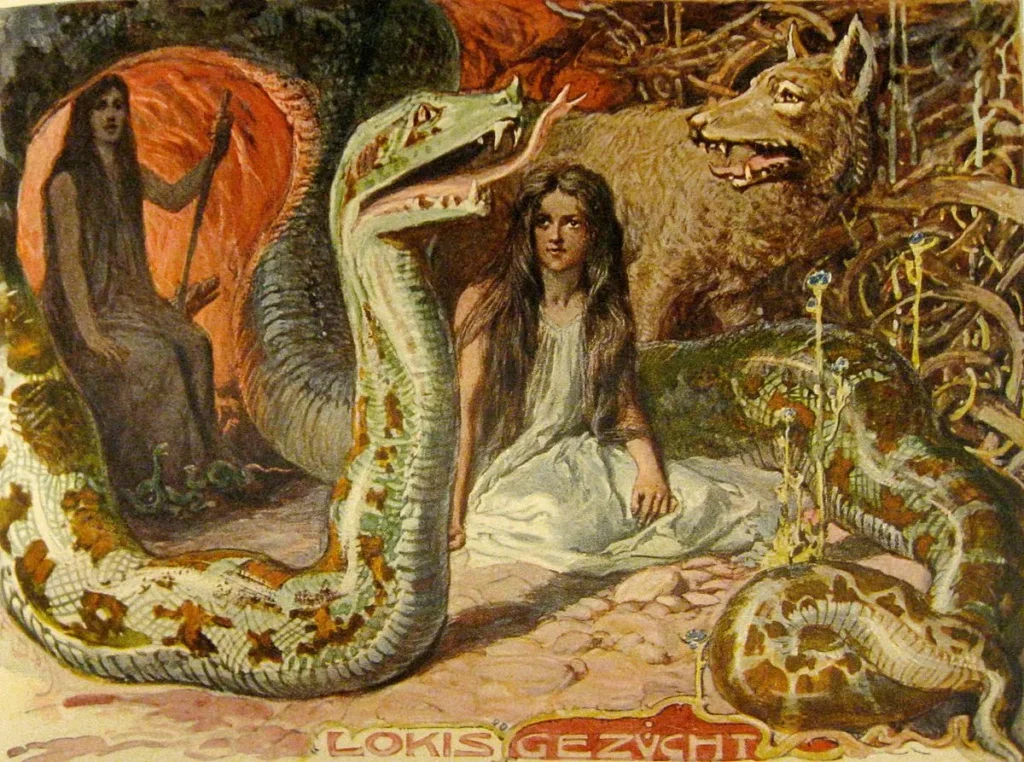
Angrboda lives in the Ironwood where frost and iron harmonize. She bears three children who do not fit into any hall. The wolf grows into the kind of hunger that must be chained. The serpent grows into a ring no fence can hold. The daughter rules a country beneath an ice-grey sky with a composure that makes even the dead careful. When the gods learn of this brood, they move quickly, and their speed betrays fear as much as prudence. They throw a binding on Fenrir that tastes like spun breath and bird’s footfall. They cast the serpent into the sea where only Thor can reach it. They send the daughter to a far realm and give her keys that admit and do not release. They think they have contained future danger. They have instead distributed it across the edges of the world.
Grid and the lending of the saving staff and belt
When Thor goes against Geirrod in a hall where iron flies and rivers rise, he succeeds because a giant woman named Grid lends him a belt, gloves, and a staff that keep him from drowning and give the throw its bite. The help is not sentimental. It affirms that even the strongest god must sometimes accept gifts from the people he is taught to call rivals. The belt is a loop, the gloves a grip, the staff a straight answer to a crooked trap. In a world where riddles can kill, a clear tool given at the right time is a form of grace.
Skadi Gerdr and the power of choice and oath
Skadi’s feet choose a husband by their beauty and discover that a coastal god is no mountain hunter. Gerd stands in a field bounded by taboo and receives a string of offers that turn into threats before the messenger wins a meeting. These tales are not romances in the modern sense. They are counsels about the cost of desire and the limits of compromise. Skadi tries the sea and wakes every night to gull cries she cannot bear. Gerd waits the appointed nights and steps into a grove that will reroute two households. In both cases, a woman’s choice is framed by men’s terms, yet her decision reshapes the border more than any duel can.
Sorcery Shape Shifting And Hidden Strength
Jotunheim is not only a land of rock and ice but also a theater of change. The line between shape and essence is thin east of the Ifing. Animals become cloaks. Old women are not entirely women. Strength hides in places where proud warriors do not think to look. The gods condemn some arts and then practice them in private. The giants master arts and then pretend they are only tricks. Stories take these matters seriously because they understand that the world’s fabric is not one kind of thread.
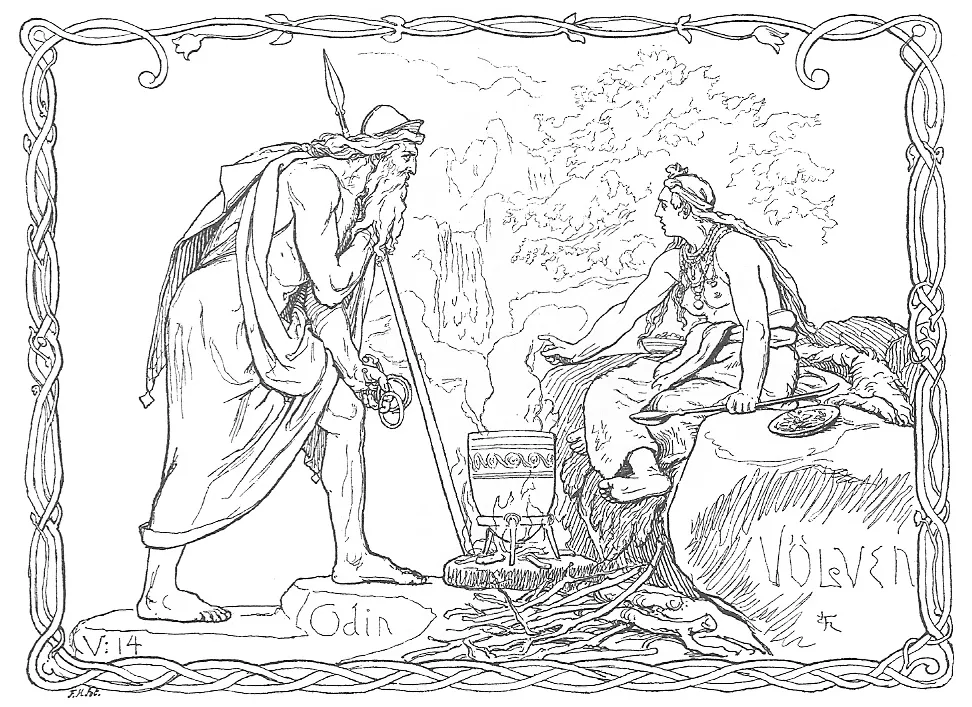
Seidr among giants and gods
Seidr is a craft of song, staff, and seat that can bend perception and lay lines across fate. The sagas say that Odin learned it and endured the shame men attach to it because wisdom has no patience for the opinions of the unwise. Giant women are often shown as masters of this craft. They sit high, hold iron wands, and sing with helpers until the walls of the hall thin and the air thickens with what will be. The art does not break the world. It rearranges attention. The seeress wakes from trance with words that are not orders but observations sharp enough to change a plan more than an army could.
Skins disguises and the limits of transformation
Shape shifting is an old skill along the border. Feathers make useful cloaks, and a salmon’s quickness can save a life for a season. But disguise does not change the debt one owes. A fox may run, yet a blood price remains. The poems are careful on this point. Transformation can delay judgment, never erase it. That is why Loki’s most brilliant turns still leave him at the wrong end of an oath. It is why the gods who chase him can both admire the art and bind the artist when the reckoning comes due.
Curses bindings and the logic of taboos
Curses in the myths do not spray indiscriminately. They follow rules that the careful can read. A broken guest right draws one kind of doom. A stolen tool draws another. Bindings, too, obey logic. The wolf’s chain is made of impossibilities because ordinary iron cannot hold a promise that men are not strong enough to keep. Taboos carve corridors through the maze. Step outside, and the air stiffens. Step within, and the walls breathe. The stories do not preach about law. They show what happens when the world remembers it.
Breaking Boundaries And The Cost Of Oathbreaking
Most disasters in this cycle begin with a small trespass. A guest insults a host at table. A messenger leaves out a clause. A promise offered lightly becomes a chain that cuts the wrist. Borderlands make such errors expensive because there is no strong king to commute the fine or a city court to file the feeling away. When a god fails at courtesy in a giant’s hall, swords do not immediately leap from sheaths, but a reckoning begins that rivers and years cannot wash out to sea.
Abductions insults and the start of blood feuds
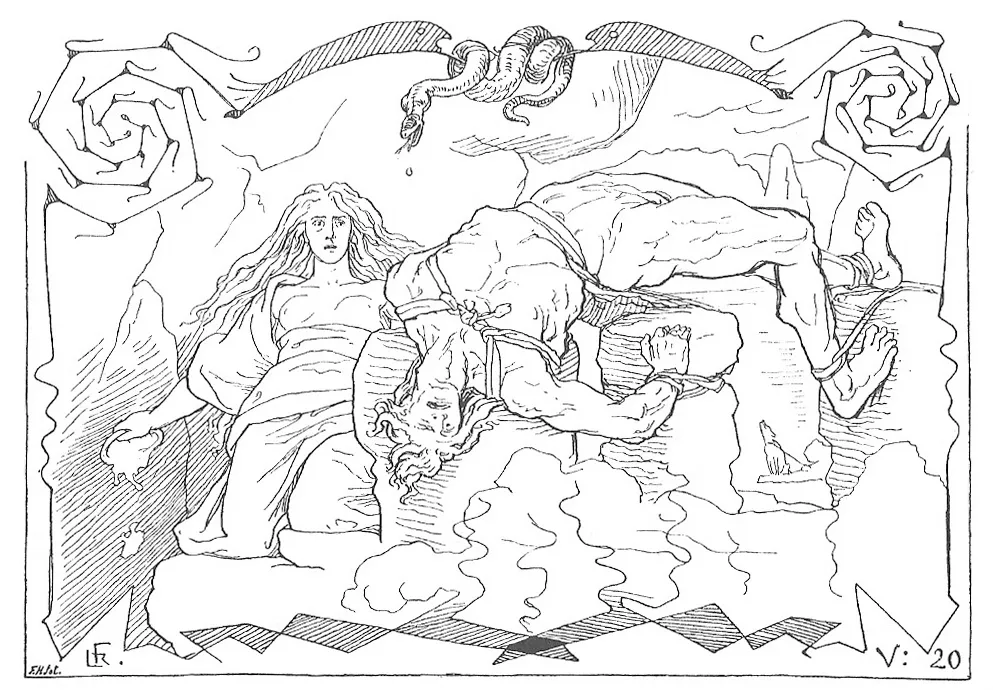
Abduction is a form of theft that tears up roots by the fistful. When a giant takes a goddess or a god takes a bride without consent, the theft must be answered. Insult at a feast does similar work. A sharp tongue can slice a bond as fast as a spear cuts a strap. Loki’s words in halls east and west make excellent poetry and terrible policy. The audience enjoys the skill, then counts the cost later. The record of these tales reads like a judge’s docket scrawled on a shield.
Blood payment guest rights and deadly outcomes
Some breaches can be settled with wergild, the price of blood. Others cannot, because the debt is not a matter of silver but of standing. If a host shelters a guest and the guest uses that shelter to break the house, the stain is not cleanable by coin. When the gods trick, the trick rebounds. When giants cheat, the cheat awakens the kind of fury that can throw a hammer through a skull and not be satisfied. The border does not favor one side. It favors the party that keeps the forms.
Lessons about border law in the myths
These stories teach without moralizing. They imply that law without mercy becomes brittle, and mercy without law becomes noise. They show that borders are not just lines on the map but disciplines of attention. A traveler who bows properly at a threshold is not obsequious, he is intelligent. A host who asks fair payment is not greedy, he is building a bridge he can stand on when the river rises. Oathbreaking in such a world is less a sin than a kind of weather that destroys crops and bends roofs, predictable in its outcome even when sudden in its arrival.
Jötunheim And The Road To Ragnarök
In the later songs the air grows taut with foreknowledge. Bonds begin to chafe. Dogs howl in halls where they once slept, and the smiths hear something strange in the ring of iron. The border that once trained heroes begins to gather an army. The giants do not finally march because they hate feasts or envy walls. They march because endings are part of beginnings, and the serpent cannot keep from growing any more than a river can keep from running.
Musters of giants and monsters for the last battle
What gathers is not a single clan but a parliament of forces that have always pressed on the enclosure of Midgard and the pride of Asgard. The wolf shakes his chain until it opens. The serpent rises and drops brine on fields. Hosts that once gave grudging shelter refuse it. Hrim’s men come in files. Fires that once lit feasts now run as raiders across the treeline. The imagery grows large because the poems are honest about fear. When everything that has been kept at the edge comes to the center at once, even gods have to count their breath.
The ship of dead and the leaders who march
Naglfar creaks at its moorings for centuries as nails fall slowly into the tally of the dead. When floodwaters lift it, the timbers make a noise like a court’s last verdict. Hrym takes the helm, and in some tellings Loki stands beside him with a face like a mirror that no longer reflects anyone else. The ship does not fly. It rows. That is important. Doom in these poems is not an explosion but a determined movement. It leaves a wake. It is as much logistics as it is miracle.
What the end reveals about the role of Jötunheim
When the end comes close enough to smell, the logic of Jotunheim becomes plain. It is the reserve army of the world’s basic resistance to order. The gods are not tyrants, but they are builders, and builders make claims. The border is the reply. In the last hour the reply is no longer a whisper over a ford but a roar across a field. Thor and the serpent complete their circuit by killing each other. The meaning is severe and clear: any enclosure draws a pressure that will one day unmake it. The worth lies in what is built and learned before that day, not in pretending the day will never come.
Everyday Life At The Edge As The Sagas Imagine It
The poems love climaxes, but they are also attentive to the tone of ordinary days along the marches. Halls must be heated, boots patched, dogs trained, and spears set in the rafters where children cannot reach them. The wind up there has a different color. The ice speaks in little cracks when the fire goes down, and the smell of iron never quite leaves the hands even when a host sits to pour beer. Such details are not folkloric filler. They are part of what makes a land a character.
Hunting herding craft and winter skill
The edges require neighbors who can read snow and stone. A hunter knows when a drift hides a stream. A herder hears the odd note in a goat’s bleat that means a wolf passed at midnight. The smith keeps a bar of good iron ready for a traveler who has paid a word-debt. If giant halls feel austere, it is because austerity is the right tool for a place where mistakes are expensive. The gods who visit take something of this back with them. Thor walks more carefully after certain trips east, not because he is afraid but because he learns that a boot worn thin is a kind of breach in armor.
Food drink and the making of strong ale
Ale is not only a drink but a way to bake peace into an evening. It must be brewed well, and that is why kettles and cauldrons carry such weight in these stories. A shared cup that has been honestly made creates a mood that even Loki takes time to ruin. Salt meat, hard cheese, and bread that keeps for journeys make the shelves look like a plan rather than a feast. In cold lands, hospitality has a mathematics. Generosity measured by what will last wins more honor than a shout of abundance that empties the bins.
Speech names and the mark of the land on its people
Talk in these halls sounds spare because people who live with weather count words like they count nails. Names are descriptive, and nicknames stick. A man called Ice-Toe has a story tied to a storm and a lost boot. A woman called Keen-Eye earned the right by sighting a raft in a fog that would have drowned a cousin. The land speaks through the mouth of those who survive it. When a traveler returns to a softer place, he carries that tone, and the people there hear Jotunheim in his voice even if he says nothing about cliffs.
Places Routes And Landmarks Used By Travelers
To reach a hall where a contest will be held or an object returned, a traveler must read the country like a long poem. The lines are rivers and passes, the rhymes are ferries and bridges. Names hang on rocks because a name can preserve a memory better than a cairn can stand a whole winter. The poems preserve the routes as much as the rooms at the end of them.
Paths rivers and mountain passes into Jötunheim
Rivers are not just obstacles, they are roadways with different rules. A ford in summer becomes a wall in spring. A pass that felt like a door yesterday feels like a wound today. Travelers carry staffs as much for measuring depth as for walking. The sagas linger on these matters because precision is respect. The land accepts it. A careless man gets behind the weather and stays there. A careful one leaves at dawn, rests where the old woman said the snow will not cave, and arrives with sense left to bargain.
Bridges ferries and keepers of crossings
Keepers of crossings matter more than petty kings. They decide who gets to live to make their case at a hearth. A ferryman’s mood can alter a poem. The price of a boat is not always coin. Sometimes it is a riddle answered, a song sung, or a promise not to hunt a certain valley next winter. These are the politics of the threshold, and a god who ignores them finds himself calling for his hammer where a word would have worked.
Waypoints halls and hazards remembered in verse
A cairn that looks like a hunched man, a pine that bends in the shape of a hook, a black fall where the foam writes a single letter: these are the signs the poems pass along. Halls are not always marked by banners. Sometimes they are recognized by the sound that snow makes in the yard or the absence of birds where birds should be. The hazards earn their own lines. A place where a guest once vanished becomes a kind of shrine to caution. The best guides recite these lists with a cadence that carries both warning and pride.
How Jötunheim Shapes The World Of Gods And Humans
The land of giants is not a villain’s country. It is a necessary neighbor. Without its pressure, Asgard would soften and forget what it is to hold a wall. Without its roads, Midgard would believe in safety as a default rather than a fragile achievement. The mythic economy depends on exchange across a fence. In one direction comes grain, knowledge, brides, and kettles. In the other come challenges, riddles, and thefts that clarify value by risking it. The flow never stops, even when winter sits like a king. If the gods sometimes speak of Jotunheim with disdain, their deeds belie their words. They ride east when they need to grow.
Pressure from the border that keeps heroes sharp
Thor’s knuckles learn different lessons on rock faces than at feasts. Odin’s tongue learns humility in riddle halls where an old man’s pride earns only a smile. Young gods who might otherwise play at heroism cut their teeth on roads where the price of ignorance is paid in ice. This pressure is not cruelty. It is calibration. A sword that is never used loses its edge. A city whose walls are never tested forgets why it built them.
Exchange of brides knowledge and loot across the line
Trade does not cease because some days end in blows. A bride changes the calculus of a feud the way a river changes its course after a small earthquake. Knowledge gathered in Jotunheim travels back to Asgard and settles into law. Loot taken in adventure is not only wealth, it is proof that risk can become ritual. A hammer wins back a roof beam, and the roof beam in turn keeps a hearth fire dry for a decade. These are the plain gains that songs are too proud to sing about and households cannot live without.
Why the world needs a land of giants
The world of the Eddas is not a dream of perpetual harmony. It is a craft in which opposing forces maintain a moving balance. Jotunheim exists so that Asgard’s claims must be argued anew each season. It exists so that Midgard’s fences make sense. The poets knew their climate and their neighbors. They knew that a story where nothing presses from outside is not a story worth keeping by a fire. In the long winter, a good tale must have a river that will not freeze and a road that is never entirely safe. Jotunheim supplies both, and in doing so it gives the gods their shape and humans their model for living with skill in a world that will never be easy.
Frequently Asked Questions
What is Jotunheim in Norse myth
Jotunheim is the mythic homeland of the jötnar, usually called giants. It lies beyond the safe centers of the cosmos, across rivers and mountain borders from Asgard and Midgard. The sources present it as a mosaic of halls, cliffs, forests, and sea coasts rather than a single unified kingdom.
Are giants always huge in the stories
Not always. Some giants are enormous, others are close to human size, and several are known more for wisdom or sorcery than for bulk. The word jötunn marks a rival power to the gods rather than a fixed body size.
How do the gods reach Jotunheim
They cross boundary rivers, most famously Ifing (Ífingr), or travel by sea, ferries, and mountain passes. Stories often linger on fords, bridges, and keepers of crossings because etiquette at thresholds decides whether a traveler reaches a hall in peace.
Why do Odin and Thor go to Jotunheim so often
Odin travels for knowledge and hidden lore. He seeks contests of wisdom with giants like Vafthrudnir (Vafþrúðnir). Thor travels to test and prove strength, to recover stolen items, and to keep threats in check. Both rely on the border to sharpen their roles.
Who is Utgarda Loki
Utgarda Loki (Útgarða Loki) is a giant ruler who stages illusion based contests to humble guests. In his hall, Thor fails tests that are rigged against the very fabric of the world, which reveals the limits of brute force and the meaning of true strength.
What is the role of Loki in Jotunheim
Loki has kin ties to giants and moves easily between Asgard and Jotunheim. He negotiates, schemes, borrows, steals, and sometimes fixes problems he helped create. His border hopping highlights how trickery can both serve and break trust.
Why does the poem about Thor’s lost hammer send him to a giant hall
Because the hammer’s theft is a challenge to divine status. Thor regains Mjolnir (Mjöllnir) by entering Thrym’s hall in disguise for a wedding. The scene shows how the gods reclaim power through a mix of deception, ritual, and force.
What is the Ironwood and why does it matter
The Ironwood (Járnviðr) is a forest on Jotunheim’s marches where a witch figure raises monstrous offspring. It is a symbol of edge places where world changing beings arise, including the brood linked to later catastrophe.
Who are the important giant women in these stories
Skadi (Skaði) chooses a husband among the gods and forces a hard lesson about place and marriage. Gerdr (Gerðr) accepts a meeting with Freyr after tense wooing by Skirnir. Grid lends Thor life saving gear. Angrboda bears children whose futures shape the world. These figures test, teach, and set terms.
Do giants have laws and hospitality
Yes. Guest rights, oaths, and feasts matter in giant halls. Many disasters begin when a guest or host breaks the forms. The myths treat courtesy, riddling, and fair bargains as real powers that can outrank weapons for a time.
What is the story of Thor fishing for the world serpent
With Hymir as his reluctant host, Thor rows into deep water and hooks Jormungandr, the serpent that girdles the world. He hauls it up to strike, but the blow does not fall. The near kill foreshadows their final meeting at Ragnarök.
Who are Ægir and Ran
Ægir is a sea host who brews ale and holds truce like feasts beneath the waves. Ran keeps the drowning net and claims shipwrecked goods and people. Their household explains why coastal stories mix hospitality with sudden loss.
What treasures pass between the gods and Jotunheim
Mjolnir is stolen and recovered. Idunn’s apples of youth are seized and retrieved. A colossal kettle from Hymir’s hall is taken so Ægir can brew for all the gods. Each object carries rights and obligations, so thefts become border negotiations.
What is seidr and why is it tied to giant women
Seidr is a trance craft of song and staff used for prophecy and influence. Giant women often practice it in the stories and teach or confront the gods with its results. Odin learns it despite the stigma because knowledge has a cost he accepts.
How do oaths and insults change the border
An oath binds parties across halls. Insults at a feast can undo years of peace. The poems show how a broken promise or a sharp tongue turns travel stories into feud stories, with wergild or vengeance as the only outcomes.
What is the place of Jotunheim in Ragnarök
Jotunheim musters forces when bonds break. The serpent rises, giants march, and ships like Naglfar carry armies. Thor and the serpent kill each other. The end clarifies Jotunheim’s role as the necessary counterforce to the gods’ order.
Do humans appear in Jotunheim stories
Indirectly. The poems are set before and beyond ordinary human realms, but Midgard’s safety depends on what happens at the border. Human practices of hospitality, oath keeping, and careful travel reflect the same logic.
Is Jotunheim a single political unit
No. The sources present many halls and lineages, sea lords like Ægir, forest dwellers in the Ironwood, and mountain clans. Alliances and feuds shift by household, not by an empire wide rule.
Why do marriages across the border matter so much
They create obligations stronger than treaties and bring gifts or losses that outlast single adventures. Skadi’s union with Njord shows the cost of living against one’s place. Freyr’s longing for Gerdr trades a self fighting sword for a meeting in a sacred grove.
What lesson do the myths draw from Jotunheim
That a world needs pressure from outside to stay honest and strong. The border tests heroes, teaches law and courtesy, and turns strength into serviceable form. Without Jotunheim the gods would forget why they carry tools, keep oaths, and travel with care.