
In the late fourth century CE, the Roman soldier-historian Ammianus Marcellinus sat down in Rome to write the final book of his history of the Roman Empire. In it he described a people who had recently shattered the Gothic confederacy and sent reverberations all the way to the walls of Constantinople. Among his observations was a single sentence about Hunnic infant boys: their cheeks, he wrote, were deeply furrowed with iron from birth so that the growth of beard hair would be checked by the resulting scars. The Huns grew old beardless. A century later Jordanes, condensing the now-lost Gothic history of Cassiodorus into a shorter text called the Getica, repeated the claim with an added interpretation: Huns cut the cheeks of their male children so that before receiving the nourishment of milk they would learn to endure wounds. These two sentences are the primary written evidence for Huns cheek scarification, and they have been cited, sensationalized, and occasionally disbelieved for sixteen centuries. What they actually tell us about Hunnic life, and what they tell us about Roman habits of describing enemies, is a different and more complicated question than the sentences themselves suggest.
Reading Ammianus Marcellinus on the Huns
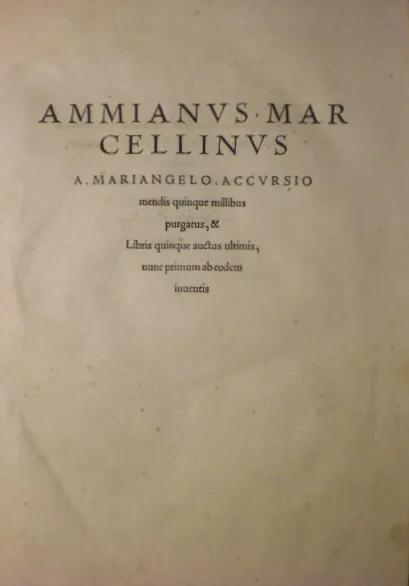
Ammianus Marcellinus was born around 330 CE in Antioch, served as a military officer in the eastern Roman armies, and spent his later life in Rome composing his Res Gestae, the continuation of Tacitus’s historical project. Book 31 of the Res Gestae, available in English translation on the University of Chicago’s LacusCurtius site at penelope.uchicago.edu, opens with an ethnographic excursus on the Huns before moving to the political and military events of the 370s. The cheek passage appears in section 31.2.2: the children’s cheeks are furrowed with steel from birth so that the growth of hair at the proper time is checked by the wrinkled scars, and they grow old beardless and without beauty, like eunuchs.
Several things are worth noting about this passage. Ammianus gives a functional explanation for the practice: it produces beardlessness. He does not mention pain training, military conditioning, or any religious or ritual purpose. His description is anatomically plausible. Deep scarring of the dermis in the areas where beard follicles develop can permanently disrupt or prevent hair growth, because the fibrous scar tissue that replaces damaged dermis does not contain functional hair follicles. Anyone who has studied burn scarring knows this. If the cuts were made in multiple parallel strokes across the future beard area of an infant boy’s cheeks, the resulting scarring pattern could produce the smooth, permanently beardless face that Ammianus describes.
The comparison to eunuchs is a Roman rhetorical reflex rather than an anthropological observation. Roman authors routinely mapped beardlessness onto emasculation because in Roman cultural logic a beard was an essential marker of adult male dignity and civic standing. Losing it, or never having it, placed a man outside the normal order of masculine life. That framing tells us everything about how Ammianus wanted his readers to receive the Huns and very little about how the Huns themselves understood their appearance.
Jordanes and the “training in wounds” interpretation
Jordanes wrote his Getica in 551 CE, roughly 170 years after Ammianus completed the Res Gestae. He was working primarily from the now-lost Gothic History written by the Roman senator Cassiodorus, which is itself lost, and his relationship to that source has been debated by historians since the nineteenth century. Section 127 of the Getica, available at penelope.uchicago.edu, contains the cheek-cutting passage with its distinctive moralising addition: the cuts teach infants to endure wounds before they receive the nourishment of milk.
The phrase “before they receive the nourishment of milk” is rhetorically crucial and historically suspect. It compresses the timing of the procedure to the absolute earliest possible moment, making the cruelty as intense as language can make it. It may record a real ritual urgency in which the cutting was performed on newborns specifically, which would be consistent with other cultures that practise neonatal body modification as a form of naming or identity inscription. It may also be rhetorical compression, a way of saying simply “very early in life.” Either interpretation is consistent with the words Jordanes chose, and neither can be ruled out from the text alone.
What can be assessed is Jordanes’s editorial purpose. He was writing a history of the Goths that was shaped in part by the political realities of the mid-sixth century, when the Gothic kingdom in Italy had recently been extinguished by Byzantine forces under Justinian. His Huns are configured as a foil for Gothic virtue and Roman civilisation. The “training in wounds” interpretation serves that configuration by making the Huns appear as a people constitutionally oriented toward suffering and inflicting it, which is exactly the kind of enemy whose defeat by civilised peoples carries a satisfying moral weight. Ammianus, writing closer to the events and without Jordanes’s retrospective moralising, did not need or use that interpretation. His functional explanation, beardlessness as a permanent body modification, stands at a different register from Jordanes’s moral one.
What Huns cheek scarification might have meant from the inside
The problem with both Ammianus and Jordanes is that they describe the practice from the outside, through the lens of what it meant to Romans and to Rome’s enemies. Neither text asks what the modification meant to the people who performed it. Comparative anthropology and the history of body modification across steppe and central Asian cultures can fill some of that gap. Permanent facial modification serving identity-marking purposes appears across a wide range of pastoral and nomadic societies and is rarely primarily about pain. It is about belonging, legibility, and the visible inscription of community membership onto a body that will move through a world of competing groups.
In the fifth-century landscape of the Carpathian Basin, where Attila’s empire was centred at its height, visual identity markers would have carried significant practical value. The region held Huns, Alans, Goths, Sarmatians, Romans, and various indigenous populations in close and often violent proximity. A face that could be read at a distance as belonging to a specific group was not a luxury. It was a navigational tool in a world where being misidentified could have lethal consequences. An elongated skull and smooth, scar-patterned cheeks would have composed a face as distinctive and unambiguous as any uniform.
The practical logic of permanent beardlessness also deserves consideration in its own right. Mounted archery places specific demands on the face and jaw. Composite bows, of the type associated with Hunnic warfare and analysed in detail by archaeologists studying the bow-lath fragments recovered from fifth-century graves across the Danube region, require the archer to draw the string to a point near the cheek or jaw. Beard hair catching in cold weather or in the string-release mechanism creates friction and potentially ruins accuracy. The smooth cheeks that Ammianus describes as a consequence of neonatal scarification would, if the practice was real and widespread, have produced a population of adult male archers with consistently smooth draw-side faces for life, without any daily maintenance required. This is not proof that practical archery was the reason for the practice. It is one functional logic among several that the evidence can support.
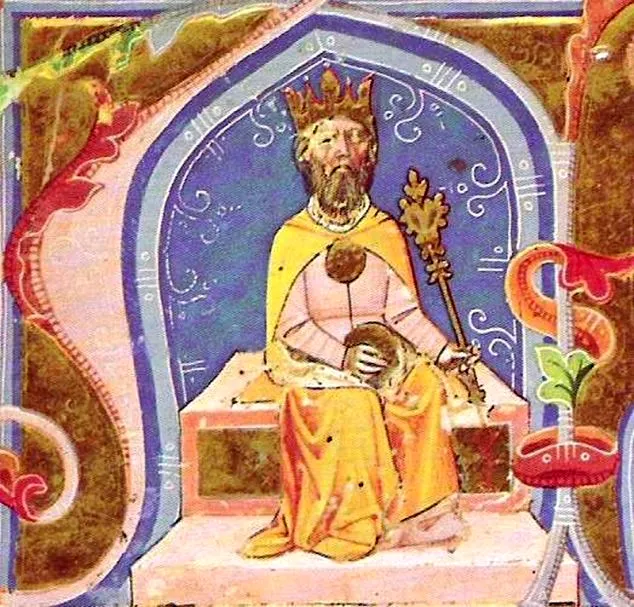
Built out of a love for history, kept free from distractions.
Spoken Past is an independent project shaped by curiosity, care, and long hours of research. Reader support helps keep it maintained, carefully researched, and open to everyone.
The osteological evidence: skulls that hold their shape
Archaeology cannot confirm Huns cheek scarification directly. Soft tissue does not survive in the burial conditions typical of fifth-century Carpathian Basin graves, and even where dried or mummified tissue has been recovered from exceptional contexts in dryer climates, a facial scar would require exceptionally clear tissue preservation and careful examination to identify with confidence. The bones of the face do not record the scarring of skin above them unless the underlying bone itself was damaged, which a blade drawn across infant cheeks would not typically produce.
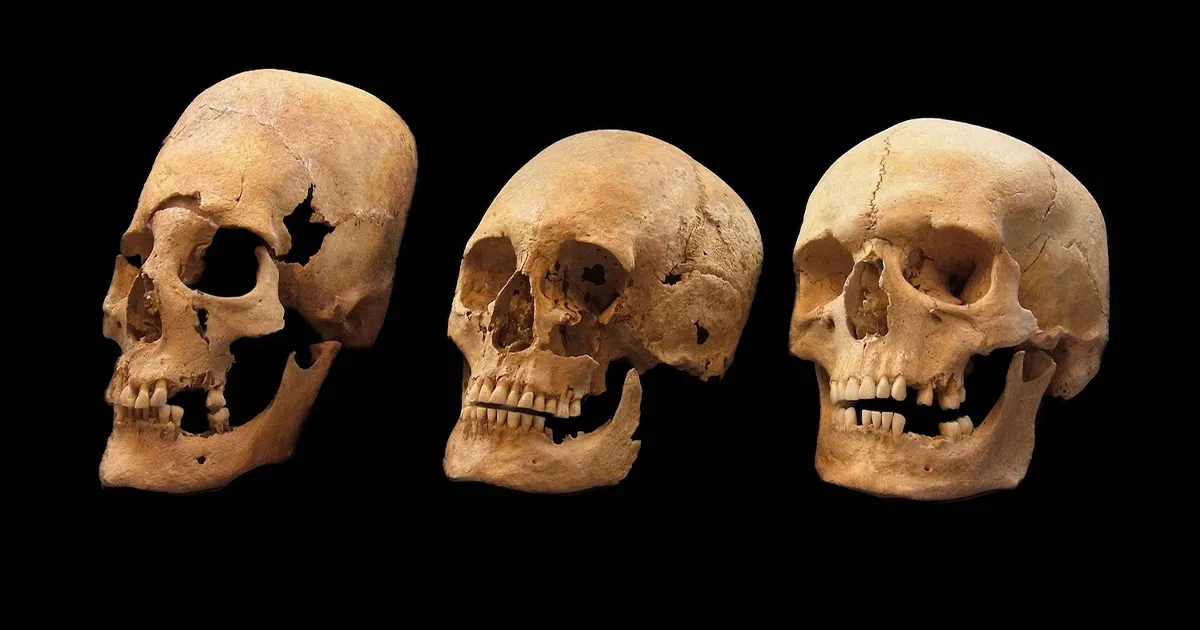
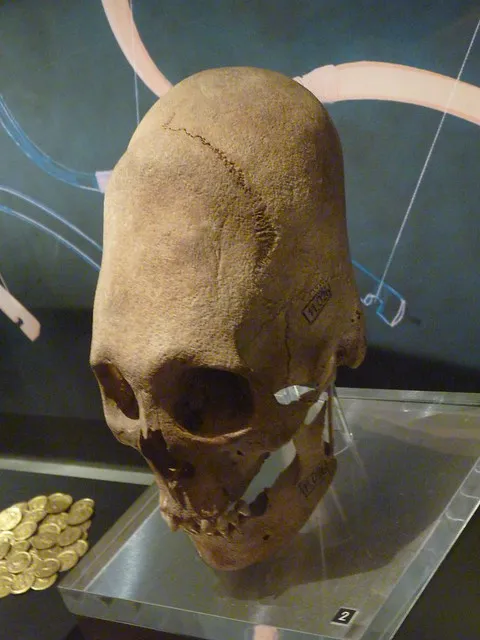
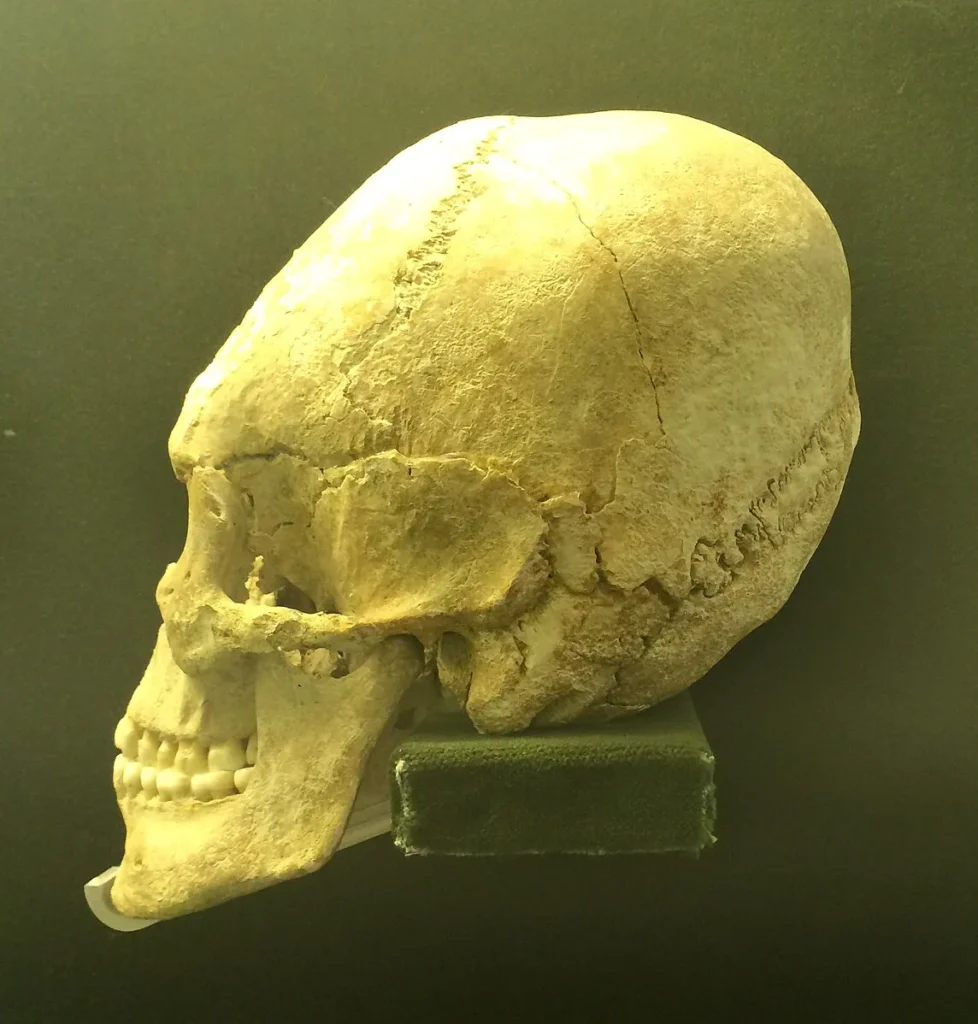
What the osteological record does confirm, beyond any reasonable doubt, is a widespread Hunnic-period practice of artificial cranial deformation. Excavations at fifth-century cemeteries across the Carpathian Basin, including sites in modern Hungary, Austria, Romania, and the former Yugoslav republics studied by osteologists including Ildiko Pap of the Hungarian Natural History Museum and international teams working at sites like Mözs in Tolna County, Hungary, have produced dozens of skulls with dramatically elongated vaults. The deformation was produced by binding the skull with tight bandages or boards during the first months of infancy, before the cranial sutures fuse and the vault loses its plasticity. The technique required sustained application over months and produced a permanent result visible throughout the individual’s life.
The significance of the cranial deformation evidence for the cheek scarification question is indirect but real. A culture that committed to months of careful infant skull-binding as a normal practice, investing considerable parental labour in producing a visible and permanent mark of group identity, had already crossed the conceptual and practical threshold that would make a brief neonatal facial cut unremarkable. The skull-binding shows that permanently modifying an infant’s body for social-visibility purposes was not foreign to Hunnic-period communities. It was, for a significant portion of those communities, standard practice.
What Priscus of Panium saw at Attila’s court
Priscus of Panium was a Greek-speaking Roman diplomat and historian who accompanied the Byzantine envoy Maximinus to Attila’s court in 448 or 449 CE. His account of that journey, preserved in fragments via Constantine VII Porphyrogenitus’s tenth-century compilation, is our most detailed and observationally grounded source on Hunnic life from inside the court rather than from the hostile frontier. The surviving fragment, Fragment 8 in the standard Müller numeration, is available in an annotated English translation at Internet History Sourcebooks Project, Fordham University. sourcebooks.web.fordham.edu.
Priscus describes the diplomatic dinner in detail. He notes wooden cups and silver plates, linen cloth and embroidered furniture, cooked meats and river fish. He records a physically compact description of Attila himself: short of stature, broad-chested, large-headed, with small eyes, a thin beard sprinkled with grey, and a flat nose. This description has the texture of direct observation. The thin beard is particularly interesting in the context of the cheek-cutting debate, because it confirms that at least some high-status Hunnic men of Attila’s generation had beards, thin ones, rather than completely smooth faces. This is not evidence against the practice of scarification. Scarring that prevents full beard growth in patterned stripes across the cheek would produce exactly the kind of thin, patchy beard that Priscus describes on Attila.
Priscus does not mention cheek-cutting. His silence is not evidence that the practice did not exist. He was an envoy attending formal occasions, not an ethnographer examining infant bodies. He records what he saw at diplomatic meals and court ceremonies, and neonatal scarification rituals are not events that a visiting diplomat would necessarily witness or think to report. The absence of the detail in Priscus tells us more about the limits of his vantage point than about the limits of the practice.
The Hunnic world as archaeological composite
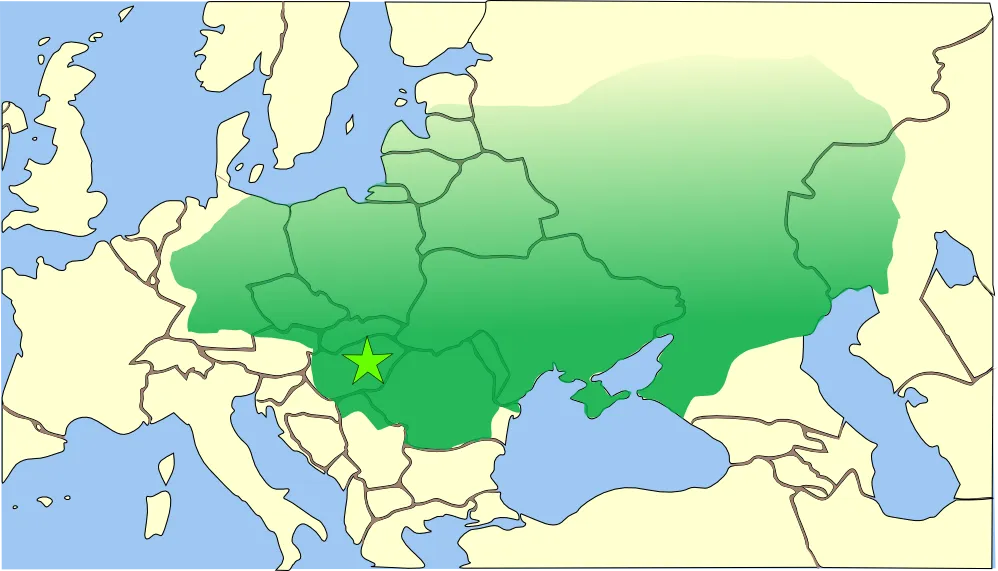
When archaeologists label a fifth-century burial “Hunnic” or “Hunnic-period,” they are rarely describing a single ethnic group. The political entity that contemporaries called Hunnic was a confederacy drawing on Alans, Goths, Sarmatians, Germanic groups, and populations indigenous to the Carpathian Basin, bound together under a mobile political centre. What makes burials identifiable as associated with the Hunnic confederacy is a cluster of artefact types and body treatments that appear with enough regularity across a wide region to constitute a recognisable assemblage.
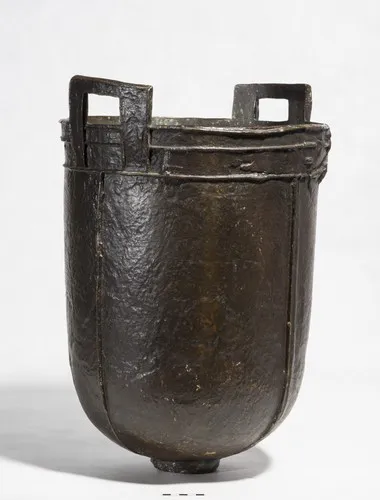
Bronze cauldrons of a distinctive cast type, recovered from riverside and marshy contexts across the Hungarian plain, mark feasting and ritual activity. The cauldrons are large, with mushroom-shaped handles, and are found singly or in small groups, typically away from settlement sites, suggesting deliberate votive deposition rather than accidental loss. Belt sets with inlaid garnets and gold foil, composite bow-lath fragments of bone and antler, and iron horse bits of characteristic design complete the assemblage. Lajos Barkoczi of the Hungarian Academy of Sciences, working at burial sites in Pannonia in the mid-twentieth century, was among the first to systematise this artefact cluster and map its distribution across the Carpathian Basin. More recent work by Kiss Attila and Istvan Bona has refined the typologies and extended the distribution map eastward.
In this assemblage, cheek scars would have contributed a visible, permanent, and entirely unarchaeological element to the identity package. An individual with an elongated skull, smooth scarred cheeks, a garnet-inlaid belt set, and a composite bow at their side would have been identified as a member of the Hunnic world immediately and without ambiguity. The archaeological elements survive. The biological modification of the face does not. This asymmetry in preservation should not be mistaken for an asymmetry in historical significance.
Pain, belonging, and why Roman writers misread the signal
Human communities that practise infant body modification do not typically frame the practice around the pain it involves. They frame it around what the modification means: this child now belongs here, carries this mark, will be recognised by our people as one of us for the rest of their life. The pain is a side effect of the method, not the purpose of the act. Jordanes, reading the practice through a Roman moral framework in which inflicting pain on an infant could only be comprehensible as deliberate cruelty or military conditioning, imposed an interpretation on the act that a participant in the practice would almost certainly not have recognised.
Roman ethnographic writing on nomadic peoples had been operating with the same toolkit of othering devices since at least the time of Herodotus. Beardlessness, unusual diet, absence of permanent housing, cruelty to children, and reversal of normal gender roles all appear regularly in classical descriptions of steppe peoples. Ammianus was a more careful and less reflexively hostile observer than many of his predecessors and contemporaries, and his functional rather than moralising account of the cheek-cutting practice reflects that relative care. Jordanes was working in a genre with different purposes and added the “training in wounds” gloss accordingly.
Peter Heather of King’s College London, whose 2006 book The Fall of the Roman Empire provides one of the most thorough recent syntheses of the Hunnic evidence for a general audience, argues that the rhetorical distortions in Roman descriptions of the Huns do not require us to discard the factual claims those descriptions contain. The cheek-cutting claim appears in two independent authors writing at different times and with different purposes. Both agree on the basic act and the basic outcome. The disagreement is about meaning, not about whether it happened. That pattern, shared factual claim combined with divergent interpretation, is characteristic of information transmitted from an outside observer whose primary goal is rhetorical but who is working from real knowledge.
Sources: Ammianus Marcellinus, Res Gestae, Book 31.2.2, trans. J.C. Rolfe, LacusCurtius, University of Chicago; Jordanes, Getica, sections 127-128, trans. Charles C. Mierow, LacusCurtius, University of Chicago; Priscus of Panium, Fragment 8, Internet History Sourcebooks Project, Fordham University; Peter Heather, The Fall of the Roman Empire: A New History of Rome and the Barbarians (London: Macmillan, 2006); E.A. Thompson, The Huns, revised edition edited by Peter Heather (Oxford: Blackwell, 1996); Istvan Bona, Das Hunnenreich (Stuttgart: Theiss, 1991); Otto Maenchen-Helfen, The World of the Huns: Studies in Their History and Culture, ed. Max Knight (Berkeley: University of California Press, 1973); Kim Hyun Jin, The Huns, Rome and the Birth of Europe (Cambridge: Cambridge University Press, 2013).